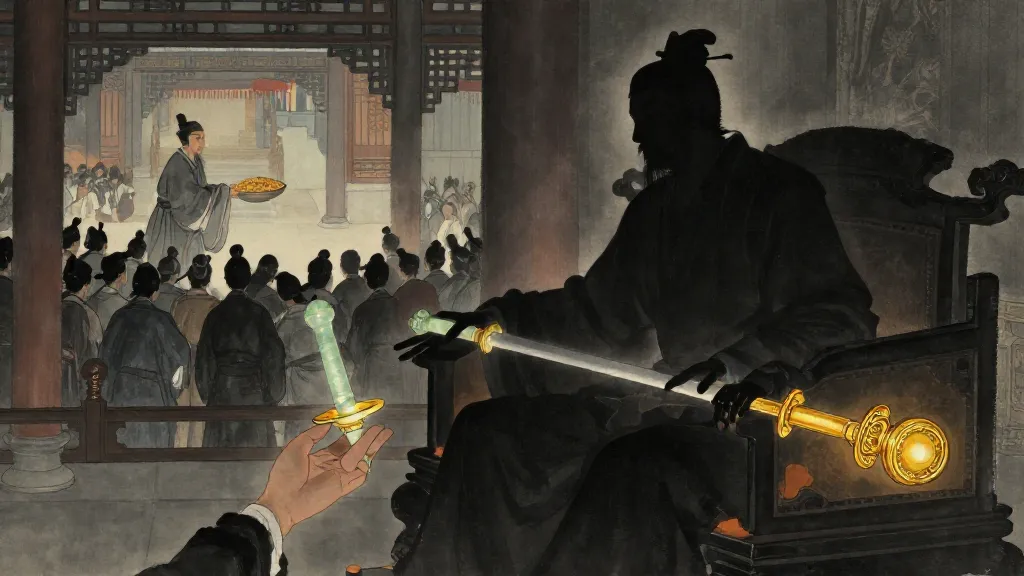
二柄之論
The Theory of the Two Handles
明主之所導制其臣者,二柄而已矣。二柄者,刑德也。何謂刑德?曰:殺戮之謂刑,慶賞之謂德。為人臣者畏誅罰而利慶賞,故人主自用其刑德,則群臣畏其威而歸其利矣。故世之奸臣則不然,所惡,則能得之其主而罪之;所愛,則能得之其主而賞之;今人主非使賞罰之威利出於已也,聽其臣而行其賞罰,則一國之人皆畏其臣而易其君,歸其臣而去其君矣。此人主失刑德之患也。夫虎之所以能服狗者,爪牙也。使虎釋其爪牙而使狗用之,則虎反服於狗矣。人主者,以刑德制臣者也。今君人者釋其刑德而使臣用之,則君反制於臣矣。故田常上請爵祿而行之群臣,下大斗斛而施於百姓,此簡公失德而田常用之也,故簡公見弒。子罕謂宋君曰:"夫慶賞賜予者,民之所喜也,君自行之;殺戮刑罰者,民之所惡也,臣請當之。"於是宋君失刑百子罕用之,故宋君見劫。田常徒用德而簡公弒,子罕徒用刑而宋君劫。故今世為人臣者兼刑德而用之,則是世主之危甚於簡公、宋君也。故劫殺擁蔽之,主非失刑德而使臣用之,而不危亡者,則未嘗有也。
The means by which an enlightened ruler controls his ministers are nothing more than the Two Handles. The Two Handles are punishment and reward. What do we mean by punishment and reward? To kill and execute is called punishment; to celebrate and bestow is called reward. Those who serve as ministers fear execution and punishment and find profit in celebration and reward. Therefore, if the ruler himself wields punishment and reward, the ministers will fear his authority and flock to his benefits.
But the treacherous ministers of this age do otherwise: whatever they hate, they can obtain condemnation for from the ruler; whatever they love, they can obtain rewards for from the ruler. Now if the ruler does not ensure that the authority and profit of reward and punishment issue from himself, but instead listens to his ministers and lets them administer rewards and punishments, then everyone in the state will fear the ministers and take the ruler lightly, will flock to the ministers and abandon the ruler. This is the calamity of a ruler who has lost the handles of punishment and reward.
The reason a tiger can overpower a dog is its claws and fangs. If the tiger were to surrender its claws and fangs and let the dog use them, the tiger would instead be overpowered by the dog. The ruler controls his ministers through punishment and reward. If the ruler now surrenders his punishment and reward and lets his ministers wield them, the ruler will instead be controlled by his ministers.
Thus Tian Chang petitioned for ranks and stipends from above and distributed them among the ministers, and enlarged the measures of grain below and bestowed them upon the common people. This was Duke Jian losing reward while Tian Chang wielded it — and so Duke Jian was assassinated. Zi Han said to the Lord of Song: "Celebrations, rewards, gifts, and grants are what the people love — let my lord administer them himself. Killing, execution, and punishment are what the people hate — allow your minister to take charge of them." Thereupon the Lord of Song lost punishment while Zi Han wielded it — and so the Lord of Song was coerced. Tian Chang merely wielded reward and Duke Jian was assassinated; Zi Han merely wielded punishment and the Lord of Song was coerced. If ministers of this present age were to wield both punishment and reward together, then the danger to today's rulers would be far greater than that of Duke Jian or the Lord of Song. Therefore, among rulers who have been coerced, assassinated, blocked, or kept in darkness, there has never been one who did not lose the handles of punishment and reward and let his ministers wield them, yet still escaped danger and destruction.
Notes
The 'Two Handles' (二柄) are Han Fei's core theory of sovereignty. 刑 (punishment) and 德 (reward) are the ruler's only instruments of power over his ministers. In Legalist usage, 德 does not mean 'virtue' but 'beneficence' or 'reward' — the positive handle complementing punitive power.
Tian Chang (田常, also known as Chen Heng 陳恆, d. 481 BC): Chief minister of the state of Qi who usurped power by distributing grain to the people using enlarged measures, winning popular support at the expense of the ducal house. He assassinated Duke Jian in 481 BC, and his descendants eventually replaced the Jiang-surnamed ruling house entirely, founding the Tian-Qi dynasty.
Duke Jian of Qi (齊簡公, r. 484–481 BC): Ruler of Qi who lost control of the state's reward system to Tian Chang. He was assassinated by Tian Chang in 481 BC.
Zi Han (子罕, 6th century BC): Chief minister of the state of Song who asked his lord to delegate all punitive authority to him while the lord retained only the pleasant task of dispensing rewards. By monopolizing punishment, Zi Han made himself feared and effectively coerced the ruler.
'易其君' — 'take the ruler lightly.' 易 here means 'to treat lightly, to hold in contempt,' contrasting with 畏 (fear) applied to the ministers.