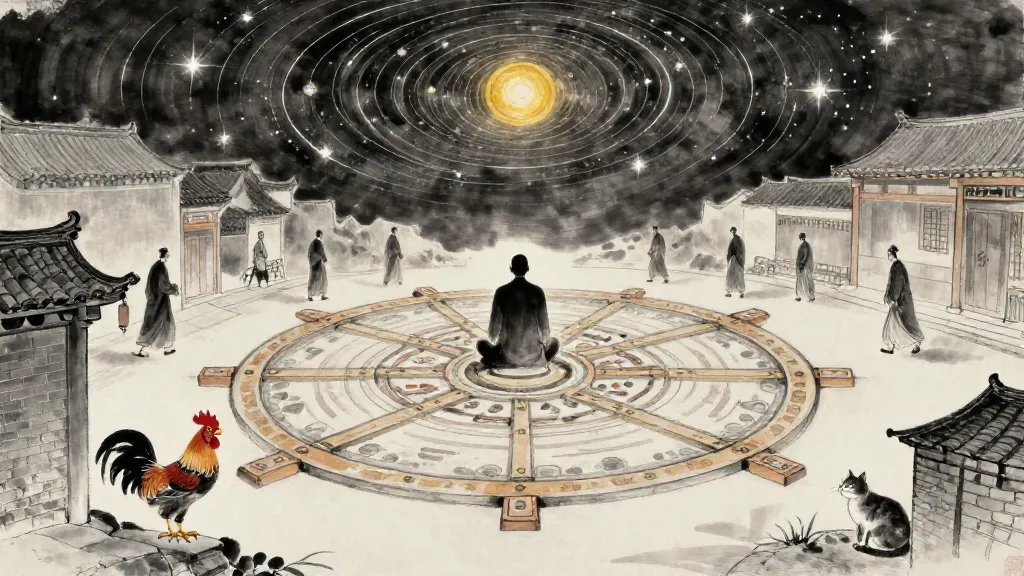
揚權 (Wielding Power) — Chinese ink painting

韓非子 Hanfeizi · Chapter 8

揚權

Wielding Power

View:

道之要旨

The Essentials of the Way

天有大命,人有大命。夫香美脆味,厚酒肥肉,甘口而疾形;曼理皓齒,說情而捐精。故去甚去泰,身乃無害。權不欲見,素無為也。事在四方,要在中央。聖人執要,四方來效。虛而待之,彼自以之。四海既藏,道陰見陽。左右既立,開門而當。勿變勿易,與二俱行。行之不已,是謂履理也。

Heaven has its great mandate, and man has his great mandate. Rich fragrances, crisp flavors, strong wine, and fatty meats — these please the mouth but damage the body. Fair skin and gleaming teeth — these delight the passions but drain the vital essence. Therefore, eliminate excess and eliminate extravagance, and the body will suffer no harm.

Power must not be made visible; its essence is non-action. Affairs are in the four quarters; the pivot is at the center. The sage grasps the pivot, and the four quarters come to serve him. He waits in emptiness, and they of themselves bring what is needed. When all within the four seas has been gathered in, the Way works in shadow yet manifests in the light. Once left and right are established, open the gate and face what comes. Do not alter, do not change — proceed with both punishment and reward together. Practice this without ceasing, and it is called treading the pattern of order.

Notes

1context

The opening of 'Wielding Power' adopts a Daoist-inflected vocabulary — emptiness (虛), non-action (無為), the Way (道) — adapted to Legalist ends. Han Fei synthesizes Laozi's metaphysics into a political technique: the ruler empties himself of visible preferences to become an unmanipulable center of power.

2translation

'與二俱行' — 'proceed with both together.' The 'two' (二) refers to punishment and reward, the Two Handles from the preceding chapter. The ruler must wield both simultaneously and consistently.

3translation

'去甚去泰' echoes Laozi ch. 29: '去甚,去奢,去泰.' Han Fei applies Laozi's counsel of moderation specifically to the ruler's self-discipline as a precondition for wielding power effectively.

各處其宜

Each in His Proper Place

夫物者有所宜,材者有所施,各處其宜,故上下無為。使雞司夜,令狸執鼠,皆用其能,上乃無事。上有所長,事乃不方。矜而好能,下之所欺:辯惠好生,下因其材。上下易用,國故不治。

Things have their proper uses, and talents have their proper applications. When each is placed in its proper role, ruler and ruled alike achieve non-action. Set the rooster to announce the night watches, and command the cat to catch mice — use each according to its ability, and the ruler will have nothing to do.

If the ruler has particular skills he displays, affairs will go awry. If he is proud and fond of showing ability, his subordinates will exploit this to deceive him. If he is eloquent, clever, and fond of advancing ideas, his subordinates will capitalize on that tendency. When ruler and ruled exchange their proper functions, the state will therefore not be well governed.

Notes

4context

The rooster-and-cat analogy illustrates the Legalist principle that the ruler must never personally perform administrative tasks. His role is solely to assign the right person to the right function and then verify results. Any display of personal competence by the ruler invites ministers to manipulate him through those very skills.

5translation

'上下易用' — 'ruler and ruled exchange their proper functions.' 易 means 'to exchange, to swap.' When the ruler does the work of ministers, ministers gain leverage over the ruler.

以名為首

Names as the Foundation

用一之道,以名為首,名正物定,名倚物徒。故聖人執一以靜,使名自命,令事自定。不見其采,下故素正。因而任之,使自事之;因而予之,彼將自舉之;正與處之,使皆自定之。上以名舉之,不知其名,復修其形。形名參同,用其所生。二者誠信,下乃貢情。

The way to wield unified authority begins with names. When names are correct, things are settled; when names are skewed, things shift. Therefore the sage grasps unity and remains still. He lets names assign themselves and lets affairs settle themselves. He does not display his judgment, and so those below are plainly upright.

Go along with them and appoint them — let them manage their own tasks. Go along with them and grant them resources — they will of themselves carry out their duties. Set them properly in their positions — let them all settle into their roles of their own accord.

The ruler raises men up on the basis of their names. If he does not know their names, he examines their actual performance. When performance and title are cross-checked and found to match, he employs what this correspondence produces. When these two are genuinely reliable, those below will offer up their true dispositions.

Notes

6context

'Names' (名) in Legalist usage means the formal titles, claims, and proposals of officials — what they say they will do. 'Performance' or 'form' (形) is the actual result. The 'cross-checking of performance and title' (形名參同) is the ruler's primary technique of control, elaborated in Chapter 7.

7translation

'執一' — 'grasps unity' or 'holds to the One.' This is a Daoist-Legalist concept: the ruler's power is unified and indivisible. He does not fragment his authority by engaging in multiple activities, but holds the single pivot from which all else follows.

聖人之道

The Way of the Sage

謹修所事,待命於天,毋失其要,乃為聖人。聖人之道,去智與巧。智巧不去,難以為常。民人用之,其身多殃;主上用之,其國危亡。因天之道,反形之理,督參鞠之,終則有始。虛以靜後,未嘗用己。凡上之患,必同其端;信而勿同,萬民一從。

Attend diligently to your duties, await the mandate of heaven, and do not lose hold of the essentials — this is what it means to be a sage. The way of the sage is to cast off cleverness and skill. If cleverness and skill are not cast off, it will be difficult to maintain constancy. When common people employ cleverness, they bring calamity upon themselves. When the ruler employs it, his state faces danger and destruction.

Follow the way of heaven, return to the principles underlying appearances, supervise and cross-check thoroughly — when one cycle ends, another begins. Through emptiness and stillness hold back, and never deploy your own person. In all matters, the ruler's danger lies in identifying himself with one side. Trust them but do not identify with them, and the ten thousand people will follow as one.

Notes

8translation

'去智與巧' — 'cast off cleverness and skill.' Echoes Laozi ch. 19: '絕聖棄智.' The Legalist application is that the ruler who displays cleverness gives ministers a handle by which to manipulate him.

9translation

'督參鞠之' — 'supervise and cross-check thoroughly.' 參 is the technique of triangulating reports from multiple sources; 鞠 means 'to investigate exhaustively.' Together they describe the Legalist ruler's method of verification.

10translation

'信而勿同' — 'trust them but do not identify with them.' The ruler must maintain trust in the system while never personally aligning with any faction or individual. Identification (同) destroys the ruler's position above all parties.

道之獨容

The Singular Capacity of the Way

夫道者,弘大而無形;德者,核理而普至。至於群生,斟酌用之,萬物皆盛,而不與其寧。道者,下周於事,因稽而命,與時生死。參名異事,通一同情。故曰:道不同於萬物,德不同於陰陽,衡不同於輕重,繩不同於出入,和不同於燥濕,君不同於群臣。--凡此六者,道之出也。道無雙,故曰一。是故明君貴獨道之容。君臣不同道,下以名禱。君操其名,臣效其形,形名參同,上下和調也。

The Way is vast and without form. Potency verifies principles and reaches everywhere. Reaching to all living things, it apportions and allocates, and the ten thousand things all flourish — yet it does not share in their tranquility. The Way below encompasses all affairs; it examines and assigns according to precedent, and lives and dies with the times. It cross-checks names against different affairs and penetrates to a unified truth underlying all.

Therefore it is said: The Way is not the same as the ten thousand things. Potency is not the same as yin and yang. The balance is not the same as light and heavy. The plumb line is not the same as straight and crooked. Harmony is not the same as dry and wet. The ruler is not the same as his ministers.

All these six are manifestations of the Way. The Way has no double — therefore it is called the One. This is why the enlightened ruler prizes the singular capacity of the Way. Ruler and ministers do not share the same Way. Those below petition through names. The ruler holds the names; the ministers present their performance. When performance and title are cross-checked and found to match, above and below are in harmony.

Notes

11context

The six analogies establish the principle that the ruler, like the Way itself, must remain categorically distinct from what he governs. A balance (衡) measures weight but is not itself heavy or light; a plumb line (繩) determines straightness but is not itself straight or crooked. Likewise, the ruler adjudicates among ministers but must never become one of them.

12translation

'道無雙,故曰一' — 'The Way has no double; therefore it is called the One.' Sovereign power, like the Way, is by nature singular and indivisible. Sharing it is not generosity but self-destruction.

聽言之道

The Art of Listening

凡聽之道,以其所出,反以為之入。故審名以定位,明分以辯類。聽言之道,溶若甚醉。脣乎齒乎,吾不為始乎;齒乎脣乎,愈惛々乎。彼自離之,吾因以知之;是非輻湊,上不與構。虛靜無為,道之情也;叄伍比物,事之形也。叄之以比物,伍之以合虛。根乾不革,則動泄不失矣。動之溶之,無為而攻之。喜之,則多事;惡之,則生怨。故去喜去惡,虛心以為道舍。上不與共之,民乃寵之;上不與義之,使獨為之。上固閉內扃,從室視庭,咫尺已具,皆之其處。以賞者賞,以刑者刑,因其所為,各以自成。善惡必及,孰敢不信?規矩既設,三隅乃列。

The general principle of listening is this: take what is put forth and turn it back as the basis for judgment. Therefore, examine names to fix positions and clarify divisions to distinguish categories.

The art of listening to proposals should be as though one were deeply drunk. Lips or teeth? — I shall not be the one to start. Teeth or lips? — ever more blurred and vague. Let them separate themselves out; I will thereby come to know them. Rights and wrongs converge like spokes on a hub; the ruler does not engage with their constructions.

Emptiness, stillness, and non-action: this is the true nature of the Way. Cross-checking threes and fives and comparing categories: this is the form of governance. Cross-check in threes to compare categories; cross-check in fives to verify against the empty standard. If the root is firm and does not shift, then actions and disclosures will not go astray.

Set them in motion, let them flow — govern through non-action. Show pleasure, and affairs will multiply. Show displeasure, and resentment will breed. Therefore eliminate pleasure and displeasure; empty the mind and make it a dwelling for the Way.

If the ruler does not participate in their affairs, the people will exalt him. If the ruler does not impose his own judgment of rightness, he will let each act on his own responsibility. The ruler firmly closes his inner gate, observes the courtyard from his chamber — everything within arm's reach is already arranged, with everyone in his proper place.

Reward those who merit reward; punish those who merit punishment. Follow what each has done, and let each bring himself to completion. When good and evil invariably meet their consequences, who will dare to be faithless? Once the compass and square are established, the remaining three corners fall into place.

Notes

13translation

'溶若甚醉' — 'as though deeply drunk.' The ruler should appear unfocused and uncommitted when listening to proposals, giving no signal of approval or disapproval. This prevents ministers from tailoring their reports to his preferences.

14context

'叄伍比物' (cross-checking threes and fives): A Legalist verification technique. Reports are cross-checked from three or five independent sources to detect inconsistencies. The method allows the ruler to discover the truth without personally investigating — he merely compares what different ministers say about the same matter.

15translation

'規矩既設,三隅乃列' — 'Once the compass and square are established, the remaining three corners fall into place.' This alludes to Analerta 7.8 where Confucius says 'I raise one corner and expect the student to return with the other three.' Han Fei repurposes the idea: once the ruler establishes the system of rewards and punishments, the rest of governance arranges itself.

主上之神

The Ruler's Divine Inscrutability

主上不神,下將有因;其事不當,下考其常。若天若地,是謂累解;若地若天,孰疏孰親?能象天地,是謂聖人。欲治其內,置而勿親;欲治其外,宮置一人;不使自恣,安得移並?大臣之門,唯恐多人。凡治之極,下不能得。周合刑名,民乃守職;去此更求,是謂大惑。猾民愈眾,奸邪滿側。故曰:毋富人而貸焉,毋貴人而逼焉;毋專信一人而失其都國焉;腓大於股,難以趣走。主失其神,虎隨其後。主上不知,虎將為狗。主不蚤止,狗益無已。虎成其群,以弒其母。為主而無臣,奚國之有?主施其法,大虎將怯;主施其刑,大虎自寧。法制苟信,虎化為人,復反其真。

If the ruler above is not inscrutable, those below will find an opening. If his conduct of affairs is not fitting, those below will probe his routines. Be like heaven, be like earth — this is called dissolving all entanglements. Like earth, like heaven — who then is distant, who close? One who can take heaven and earth as his model is called a sage.

To govern the inner court, appoint people and do not involve yourself personally. To govern external affairs, place one man in each office. If they are not allowed to act at will, how could they encroach and consolidate power? At the gates of great ministers, one should worry only that too many people gather.

The ultimate in governance is when those below cannot fathom the ruler. Match performance and title comprehensively, and the people will keep to their duties. Abandon this and seek other methods — this is called great delusion. Cunning subjects will multiply and treacherous people will fill every side.

Therefore it is said: Do not enrich a man and then borrow from him. Do not ennoble a man and then let him press close. Do not place exclusive trust in one man and thereby lose your capital and state. When the calf is larger than the thigh, it is hard to walk.

If the ruler loses his inscrutability, tigers will follow at his heels. If the ruler above does not perceive this, the tigers will come to be treated as dogs. If the ruler does not stop this early, the dogs will grow without limit. The tigers will form their packs and assassinate their sovereign. To be a ruler without loyal ministers — what state can one have?

But when the ruler applies his laws, the great tigers will grow timid. When the ruler applies his punishments, the great tigers will settle into submission. If legal institutions are made truly reliable, the tigers will transform back into men and return to their true nature.

Notes

16translation

'主上不神' — 'If the ruler is not inscrutable.' 神 here means 'divine, mysterious, unfathomable' — the quality of being impossible to read or predict. In the Legalist framework this is not supernatural but strategic: the ruler who cannot be fathomed cannot be manipulated.

17translation

'腓大於股,難以趣走' — 'When the calf is larger than the thigh, it is hard to walk.' A metaphor for the danger of subordinates growing more powerful than the ruler. When ministers accumulate too much wealth or influence, the body politic becomes dysfunctional.

18translation

'虎成其群,以弒其母' — 'The tigers will form their packs and assassinate their sovereign.' 母 (mother) is used here as a metaphor for the ruler as the source and sustainer of the state, not a gendered reference. Some commentators read 母 as a loan character for 主 (lord).

19context

The tiger-to-dog-to-tiger metaphor is one of Han Fei's most vivid political parables. Overmighty ministers begin as 'tigers' (threats), are domesticated into 'dogs' (the ruler's false sense of security), but if unchecked, revert to tigers that form packs and devour the ruler. Only the consistent application of law reverses the process.

伐聚適賜

Breaking Up Factions and Controlling Grants

欲為其國,必伐其聚;不伐其聚,彼將聚眾。欲為其地,必適其賜;不適其賜,亂人求益。彼求我予,假仇人斧;假之不可,彼將用之以伐我。黃帝有言曰:"上下一日百戰。"下匿其私,用試其上;上操度量,以割其下。故度量之立,主之寶也;黨與之具,臣之寶也。臣之所不弒其君者,黨與不具也。故上失扶寸,下得尋常。有國君,不大其都;有道之臣,不貴其家。有道之君,不貴其臣;貴之富之,彼將代之。備危恐殆,急置太子,禍乃無從起。內索出圉,必身自執其度量。厚者虧之,薄者靡之。虧靡有量,毋使民比周,同欺其上。虧之若月,靡之若熱。簡令謹誅,必盡其罰。

If you wish to secure your state, you must break up factions. If you do not break up factions, they will gather a multitude. If you wish to secure your territory, you must regulate your grants. If you do not regulate your grants, troublemakers will seek further gain. If they ask and I give, it is like lending an axe to my enemy. Yet if I refuse to lend it, they will use it to strike at me.

The Yellow Emperor had a saying: "Between ruler and ruled, there are a hundred battles each day." Those below conceal their private interests and use them to test their superiors. Those above hold fast to standards and measures and use them to cut their subordinates down to size. Therefore the establishment of standards and measures is the ruler's treasure; the formation of factions and alliances is the minister's treasure. The only reason ministers do not assassinate their lord is that their factions are not yet fully organized.

Therefore, if the ruler loses an inch, those below gain a fathom. A ruler who has a state does not enlarge the capitals of his ministers. A minister who understands the Way does not enrich his own house. A ruler who understands the Way does not ennoble his ministers excessively — for if he ennobles them and enriches them, they will replace him.

Prepare against danger and fear for peril. Establish the heir apparent promptly, and calamity will have no place from which to arise. Whether searching within or guarding without, the ruler must personally hold the standards and measures. Those who have grown too great, diminish. Those who have grown too thin, wear down further. Diminish and wear down according to measure — do not let the people band together in cliques to deceive their superiors as one. Diminish them as the moon wanes; wear them down as heat dissipates. Keep commands simple and punishments strict — be sure to carry out every penalty to the full.

Notes

20person黃帝Huáng Dì

The Yellow Emperor (黃帝): Legendary sage-emperor of Chinese antiquity, conventionally dated to c. 2697–2597 BC. Han Fei attributes the maxim about the 'hundred daily battles' between ruler and ruled to him, though this is likely a Warring States fabrication lending ancient authority to a Legalist principle.

21context

'上下一日百戰' (a hundred battles a day between ruler and ruled): This strikingly cynical maxim encapsulates the Legalist view that the ruler-minister relationship is fundamentally adversarial. Both sides are constantly probing and maneuvering. The ruler's only advantage is his monopoly on institutional standards (度量).

22translation

'上失扶寸,下得尋常' — 'if the ruler loses an inch, those below gain a fathom.' 扶 and 寸 are small units of measurement; 尋 and 常 are much larger units (eight and sixteen chi respectively). The disproportion emphasizes that every small concession by the ruler is magnified enormously by his ministers.

23translation

'假仇人斧' — 'lending an axe to one's enemy.' A proverbial expression: giving resources to those who may turn against you is self-destructive, yet withholding them also carries risk. Han Fei's solution is not to avoid granting altogether but to regulate grants through institutional measures (度量).

披木去黨

Pruning the Tree and Dispersing Factions

毋弛而弓,一棲兩雄,其斗顏(?左加口字旁)顏,豺狼在牢,其羊不繁。一家二貴,事乃無功。夫妻持政,子無適從。為人君者,數披其木,毋使木技扶疏;木枝扶疏,將塞公閭,私門將實,公庭將虛,主將壅圍。數披其木,無使木枝外拒;木枝外拒,將逼主處。數披其木,毋使枝大本小;枝大本小,將不勝春風;不勝春風,枝將害心。公子既眾,宗室憂唫。止之之道,數披其木,毋使枝茂。木數披,黨與乃離。掘其根本,木乃不神。填其洶淵,毋使水清。探其懷,奪之威。主上用之,若電若雷。

Do not slacken your bow. When two males roost in one nest, they will fight savagely. When wolves are in the pen, the sheep will not multiply. When two powers share one household, nothing will be accomplished. When husband and wife both hold the reins of government, the children will not know whom to follow.

The ruler must frequently prune his tree. Do not let the branches spread thick and luxuriant. If the branches spread thick and luxuriant, they will block the public lanes; private gates will be filled while the public court stands empty; the ruler will be surrounded and sealed off.

Frequently prune the tree. Do not let the branches extend outward in resistance. If the branches extend outward in resistance, they will press upon the ruler's dwelling.

Frequently prune the tree. Do not let the branches grow larger than the trunk. If the branches are larger than the trunk, the tree will not withstand the spring wind. If it cannot withstand the spring wind, the branches will destroy the heart of the tree.

When the princes have grown numerous, the royal house moans with anxiety. The way to stop this: frequently prune the tree, and do not let the branches flourish. If the tree is frequently pruned, factions and alliances will disintegrate.

Dig up the very roots, and the tree will lose its power. Fill in the deep pools, and do not let the water run clear. Probe their hidden thoughts and strip them of their authority. When the ruler applies these methods, let him be like lightning and thunder.

Notes

24context

The extended tree-pruning metaphor is Han Fei's most sustained political allegory. The trunk (本) represents the ruler and the central state; the branches (枝) represent ministers, nobles, and princes who accumulate power. The three pruning instructions correspond to three dangers: branches blocking public access (ministers controlling information), branches extending outward (ministers building independent power bases), and branches outgrowing the trunk (subordinates becoming more powerful than the ruler).

25textual

'顏(?左加口字旁)顏' — The source text marks an uncertain character. The intended reading is likely 嚴嚴 or a variant meaning 'fiercely, savagely.' Some editions read 吅吅 (reduplicative onomatopoeia for fighting sounds).

26translation

'填其洶淵,毋使水清' — 'Fill in the deep pools; do not let the water run clear.' Deep, clear pools are places where hidden things can be seen — metaphorically, sites of independent power that have achieved transparency and self-organization. The ruler must fill them in, preventing any center of clarity and order from forming outside his own authority.

27translation

'若電若雷' — 'like lightning and thunder.' The ruler's exercise of power should be sudden, overwhelming, and impossible to anticipate or resist — the political equivalent of a natural force.

Edition & Source

Text
《韓非子》 Hanfeizi
Edition
中華古詩文古書籍網 transcription, 《四部叢刊》本
Commentary
Han Fei (韓非), Warring States period