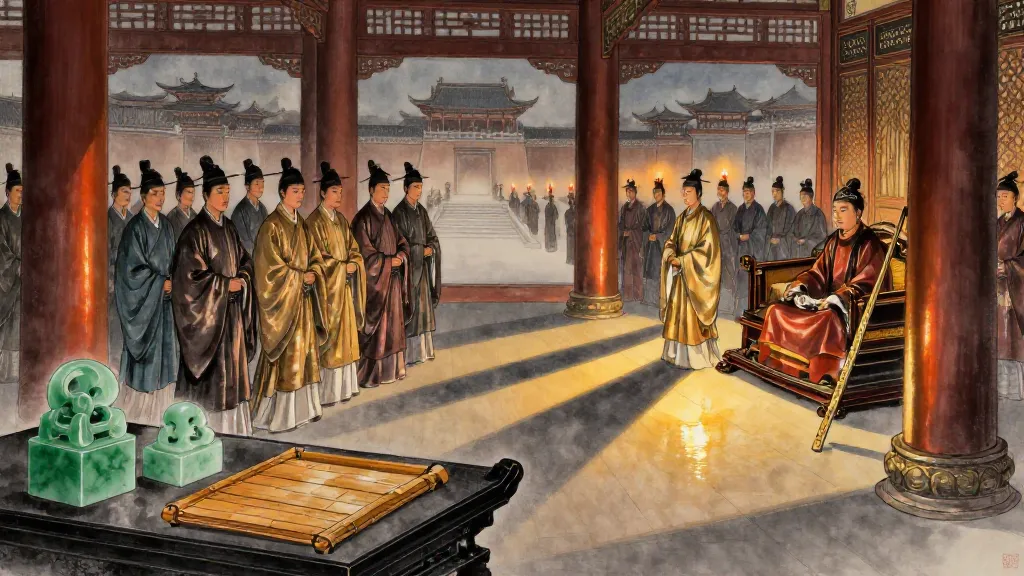
八奸 (The Eight Treacheries) — Chinese ink painting

韓非子 Hanfeizi · Chapter 9

八奸

The Eight Treacheries

View:

八奸總論

The Eight Treacheries Enumerated

凡人臣之所道成奸者有八術:一曰同床,二曰在旁,三曰父兄,四曰養殃,五曰民萌,六曰流行,七曰威強,八曰四方。

There are eight techniques by which ministers achieve treachery: the first is called 'sharing the bed'; the second, 'those at the ruler's side'; the third, 'fathers and brothers'; the fourth, 'nurturing disaster'; the fifth, 'the common people'; the sixth, 'popular eloquence'; the seventh, 'coercive force'; the eighth, 'the four directions.'

Notes

1context

This chapter is a systematic taxonomy of the channels through which ministers subvert sovereign power. Each 'treachery' is a distinct vector of influence that bypasses the ruler's direct control. The analysis proceeds from the most intimate (bedchamber) to the most remote (foreign powers).

同床與在旁

Sharing the Bed and Those at the Ruler's Side

何謂同床?曰:貴夫人,愛孺子,便僻好色,此人主之所惑也。托於燕處之虞,乘醉飽之時,而求其所欲,此必聽之術也。為人臣者內事之以金玉,使惑其主,此之謂「同床」。二曰在旁。何謂在謗?曰:優笑侏儒,左右近習,此人主未命而唯唯,未使而諾諾,先意承旨,觀貌察色以先主心者也。此皆俱進俱退,皆應皆對,一辭同軌以移主心者也。為人臣者內事之以金玉玩好,外為之行不法,使之化其主,此之謂「在旁」。

What is meant by 'sharing the bed'? It refers to the honored consort, the beloved child, the attractive attendants and favored beauties -- these are what beguile the ruler. They exploit moments of leisure and intimacy, take advantage of times when the ruler is drunk and sated, to obtain what they desire. This is an infallible technique of manipulation. When a minister bribes them with gold and jade to beguile the ruler, this is called 'sharing the bed.'

The second is 'those at the ruler's side.' What is meant by this? Jesters, dwarfs, and intimate attendants of the left and right -- these are the ones who say 'yes, yes' before the ruler has given a command, and 'of course, of course' before the ruler has issued an order. They anticipate the ruler's intentions, read his expressions and observe his moods to stay ahead of his wishes. They all advance and retreat in unison, respond and reply in concert, speaking with one voice and moving in one track to shift the ruler's mind. When a minister bribes them with gold, jade, and curios, and covers for their lawless conduct so that they transform the ruler's thinking, this is called 'those at the ruler's side.'

Notes

1translation

便僻好色 -- 'attractive attendants and favored beauties.' 便僻 refers to minions or favorites who ingratiate themselves through personal charm, not necessarily sexual in nature, though the context implies it.

2translation

優笑侏儒 -- court jesters (優), comedians (笑), and dwarfs (侏儒) were common fixtures at Warring States courts. Their proximity to the ruler gave them informal but potent influence.

父兄與養殃

Fathers and Brothers, and Nurturing Disaster

三曰父兄。何謂父兄?曰:側室公子,人主之所親愛也;大臣廷吏,人主之所與度計也。此皆盡力畢議,人主之所必聽也。為人臣者事公子側室以音聲子女,收大臣延吏以辭言,處約言事,事成則進爵益祿,以勸其心,犯其主,此之謂「父兄」。四曰養殃。何謂養殃?曰:人主樂美宮室台池,好飾子女狗馬以娛其心,此人主之殃也。為人臣者盡民力以美宮室台池,重賦斂以飾子女狗馬,以娛其主而亂其心,從其所欲,而樹私利其間,此謂「養殃」。

The third is 'fathers and brothers.' What is meant by this? Secondary consorts and princes are those the ruler loves and is close to; great ministers and court officials are those with whom the ruler deliberates and plans. These people exert their full effort in counsel, and the ruler invariably heeds them. When a minister cultivates princes and consorts with music, entertainers, and women, and wins over great ministers and court officials with flattering words -- making arrangements in private, and when the affair succeeds, advancing their ranks and increasing their stipends to encourage their compliance, thereby overriding the ruler -- this is called 'fathers and brothers.'

The fourth is 'nurturing disaster.' What is meant by this? The ruler takes pleasure in fine palaces, terraces, and pools, and delights in adorning women, dogs, and horses to gratify his desires -- these are the ruler's disasters. When a minister exhausts the people's labor to beautify palaces, terraces, and pools, levies heavy taxes to adorn women, dogs, and horses, thereby entertaining the ruler while disordering his mind, indulging his desires while planting private interests in their midst -- this is called 'nurturing disaster.'

Notes

1translation

側室公子 -- 'secondary consorts and princes.' 側室 literally means 'side chamber,' referring to concubines and their offspring who, while not in the direct line of succession, are personally close to the ruler.

2context

The 'nurturing disaster' strategy is insidious precisely because it appears loyal: the minister gives the ruler exactly what he wants. The treachery lies in using the ruler's own appetites as a mechanism of control.

民萌、流行、威強、四方

The People, Popular Eloquence, Coercive Force, and the Four Directions

五曰民萌。何謂民萌?曰:為人臣者散公財以說民人,行小惠以取百姓,使朝廷市井皆勸權譽己,以塞其主而成其所欲,此之謂「民萌」。六曰流行。何謂流行?曰:人主者,固壅其言談,希於聽論議,易移以辯說。為人臣者求諸候之辯士,養國中之能說者,使之以語其私。為巧文之言,流行之辭,示之以利勢,懼之以患害,施屬虛辭以壞其主,此之謂「流行」。七曰威強。何謂威強?曰:君人者,以群臣百姓為威強者也。群臣百姓之所善,則君善之;非群臣百姓之所善,則君不善之。為人臣者,聚帶劍之客,養必死之士,以彰其威,明焉己者必利,不為己者必死,以恐其群臣百姓而行其私,此之謂「威強」。八曰四方。何謂四方?曰:君人者,國小,則事大國;兵弱,則畏強兵。大國之所索,小國必聽;強兵之所加,弱兵必服。為人臣者,重賦斂,盡府庫,虛其國以事大國,而用其威求誘其君;甚者舉兵以聚邊境而制斂於內,薄者數內大使以震其君,使之恐懼,此之謂「四方」。凡此八者,人臣之所以道成奸,世主所以壅劫,失其所有也,不可不察焉。

The fifth is 'the people.' What is meant by this? When a minister distributes public funds to please the populace, dispenses petty favors to win over the commoners, and makes the court and marketplace all eager to speak well of him, thereby obstructing the ruler and achieving his own aims -- this is called 'the people.'

The sixth is 'popular eloquence.' What is meant by this? A ruler by nature has restricted access to discussion and debate, rarely hears deliberative argument, and is easily swayed by persuasive speech. When a minister recruits eloquent rhetoricians from the feudal states and patronizes skilled debaters within the realm, deploying them to argue his private interests -- crafting clever formulations and flowing rhetoric, dangling prospects of advantage and power, threatening with dangers and harms, stringing together empty phrases to undermine the ruler -- this is called 'popular eloquence.'

The seventh is 'coercive force.' What is meant by this? A ruler of men derives his power and strength from his ministers and people. What the ministers and people approve, the ruler approves; what they do not approve, the ruler does not approve. When a minister assembles sword-bearing retainers and maintains men sworn to die for him, thereby making his power conspicuous -- making it clear that those who serve him will profit and those who do not will die, thereby intimidating ministers and commoners alike to carry out his private ends -- this is called 'coercive force.'

The eighth is 'the four directions.' What is meant by this? When a state is small, it must serve great states; when its army is weak, it must fear strong armies. What a great state demands, a small state must obey; what a strong army imposes, a weak army must submit to. When a minister levies heavy taxes, empties the treasury, and drains the state to serve a great power, then exploits that power's leverage to coerce and manipulate his own ruler -- at worst, massing troops on the borders while extorting compliance at home; at best, repeatedly introducing foreign ambassadors to intimidate the ruler into fear -- this is called 'the four directions.'

All these eight are the means by which ministers achieve treachery, and the means by which rulers of the age are obstructed, coerced, and stripped of what they possess. They must not go unexamined.
Notes

1context

The 'popular eloquence' treachery reflects a distinctly Legalist anxiety about rhetoric. Unlike Confucian thinkers who valued persuasive speech as a tool of moral education, Han Fei sees it as a weapon wielded against institutional order.

2context

The 'coercive force' treachery describes what would later be called the phenomenon of powerful ministerial households -- such as the Tian clan in Qi or the Six Ministers of Jin -- whose private military retainers rivaled the ruler's own forces.

3translation

帶劍之客 ('sword-bearing retainers') and 必死之士 ('men sworn to die') are terms for the private military followers that powerful ministers maintained, a practice widespread in the Warring States period.

明君之防

The Enlightened Ruler's Countermeasures

明君之於內也,娛其色而不行其謁,不使私請。其於左右也,使其身必責其言,不使益辭。其於父兄大臣也,聽其言也必使以罰任於後,不令妄舉。其於觀東玩好也,必令之有所出,不使擅進擅退,不使群臣虞其意。其於德施也,縱禁財,發墳倉,利於民者,必出於君,不使人臣私其德。其於說議也,稱譽者所善,毀疵者所惡,必實其能,察其過,不使群臣相為語。其於勇力之士也,軍旅之功無逾賞,邑斗之勇無赦罪,不使群臣行私財。其於諸候之求索也,法則聽之,不法則距之。則謂亡君者,非莫有其國也,而有之者,皆非己有也。令臣以外為制於內,則是君人者亡也。聽大國為救亡也,而亡亟於不聽,故不聽。群臣知不聽,則不外諸候,諸候知不聽,則不受臣之誣其君矣。

The enlightened ruler's approach to the inner chambers: he enjoys their beauty but does not grant their petitions, and does not allow private requests. His approach to those at his side: he holds them personally accountable for their words and does not allow them to embellish. His approach to fathers, brothers, and great ministers: when he heeds their advice, he requires them to accept punishment as surety for the outcome, and does not allow reckless recommendations. His approach to spectacles and curios: he requires that all such things come through designated channels, does not allow unsanctioned presentations or withdrawals, and does not let ministers guess his preferences. His approach to benevolence and largesse: the release of restricted funds, the opening of granaries, and all benefits to the people must originate from the ruler -- he does not let ministers privatize the credit for such virtue. His approach to argument and debate: for those who praise and those who criticize, he verifies their actual abilities and investigates their faults, and does not let ministers collude in their assessments. His approach to brave and strong men: military merit receives no excess reward, and private brawling receives no pardoned offense -- he does not let ministers distribute private wealth. His approach to the demands of feudal lords: if the demand accords with the law, he grants it; if it does not, he refuses.

What is called a 'ruined ruler' does not mean one who has no state, but one who possesses a state that is no longer truly his own. When ministers use external powers to control the ruler from within, then the ruler of men is ruined. Heeding a great power in order to avoid ruin leads to ruin faster than not heeding it -- therefore he does not heed it. When ministers know the ruler will not heed foreign powers, they cease cultivating feudal lords abroad; when feudal lords know the ruler will not heed, they cease accepting ministers' slanders against their own ruler.

Notes

1context

This section provides the eight countermeasures corresponding to the eight treacheries, forming a symmetrical structure. Each countermeasure is institutional rather than personal -- the ruler does not need to be personally virtuous, only procedurally disciplined.

2translation

The key principle expressed in 亡君者非莫有其國也 is that political death precedes physical death: a ruler can 'perish' while still nominally holding the throne, if real power has migrated to his ministers. This is institutional analysis, not moral exhortation.

官職爵祿之道

The Proper Allocation of Office and Rank

明主之為官職爵祿也,所以進賢材勸有功也。故曰:賢材者處厚祿任大官;功大者有尊爵受重賞。官賢者量其能,賦祿者稱其功。是以賢者不誣能以事其主,有功者樂進其業,故事成功立,今則不然。不課賢不肖,不論有功勞,用諸候之重,聽左右之謁,父兄大臣上請爵祿於上,而下賣之以收財利及以樹私黨。故財利多者買官以為貴,有左右之交者請謁以成重。功勞之臣不論,官職之遷失謬。是以吏偷官而外交,棄事而親財。是以賢者懈怠而不勸,有功者隳而簡其業,此亡國之風也。

When an enlightened ruler establishes official positions and ranks with their stipends, it is in order to advance the worthy and talented and to encourage those with merit. Therefore it is said: the worthy and talented should hold generous stipends and fill important offices; those with great merit should hold honored ranks and receive substantial rewards. In appointing the worthy, one measures their ability; in assigning stipends, one calibrates to their achievements. Thus the worthy do not falsely claim abilities to serve their ruler, and the meritorious gladly advance in their work -- affairs are accomplished and achievements established.

But today it is not so. No distinction is made between the worthy and the unworthy; no account is taken of merit and service. Appointments follow the influence of feudal lords and the petitions of those at the ruler's side. Fathers, brothers, and great ministers request ranks and stipends from the ruler above, then sell them below to collect wealth and build private factions. Thus those with the most wealth buy offices to become eminent, and those with connections at the ruler's side secure appointments through solicitation. Ministers of genuine merit go unrecognized, and official promotions are misassigned.

As a result, officials neglect their posts and cultivate external connections, abandon their duties and pursue wealth. The worthy grow slack and lose motivation; the meritorious falter and neglect their work. This is the climate of a doomed state.

Notes

1context

This section attacks the sale of offices and the patronage system that pervaded late Warring States courts. Han Fei's proposed remedy -- strict meritocratic assignment based on verifiable performance -- was the cornerstone of Legalist administrative reform.

2translation

課 ('to assess/examine') is a key Legalist administrative term. 不課賢不肖 means the court fails to conduct performance evaluations distinguishing the competent from the incompetent -- a systemic failure, not merely an oversight.

Edition & Source

Text
《韓非子》 Hanfeizi
Edition
中華古詩文古書籍網 transcription, 《四部叢刊》本
Commentary
Han Fei (韓非), Warring States period