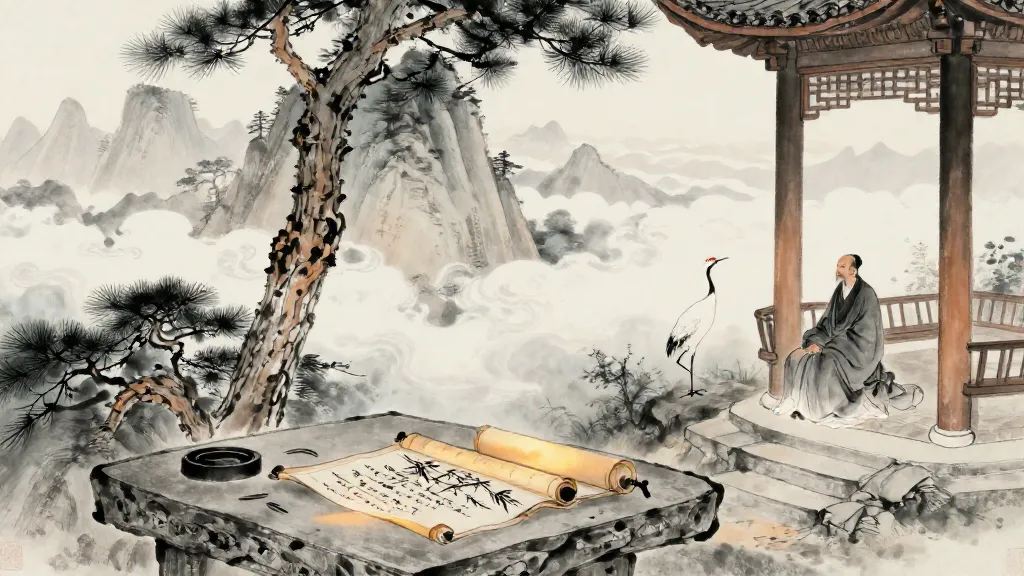
孤憤 (The Solitary Indignation) — Chinese ink painting

韓非子 Hanfeizi · Chapter 11

孤憤

The Solitary Indignation

View:

法術之士與重人之仇

The Irreconcilable Enmity Between Legalist Scholars and Powerful Men

智術之士,必遠見而明察,不明察,不能燭私;能法之士,必強毅而勁直,不勁直,不能矯奸。人臣循令而從事,案法而治官,非謂重人也。重人也者,無令而擅為,虧法以利私,耗國以便家,力能得其君,此所為重人也。智術能法之士明察,聽用,且燭重人之陰情;能法之直到勁直,聽用,矯重人之奸行。故智術能法之士用,則貴重之臣必在繩之外矣。是智法之士與當塗之人,不可兩存之仇也。

Scholars of wisdom and technique must be far-sighted and keenly perceptive -- without keen perception, they cannot illuminate private interests. Scholars capable of applying the law must be resolute and unflinchingly upright -- without unflinching uprightness, they cannot correct treachery.

A minister who follows orders and attends to affairs, who administers his office according to the law -- this is not what is meant by a 'powerful man.' A powerful man is one who acts without authorization, who undermines the law to benefit his private interests, who drains the state to enrich his household, whose power is sufficient to manipulate his ruler. This is what is meant by a powerful man.

When scholars of wisdom and legal technique are perceptive, and when their counsel is heeded and employed, they will illuminate the hidden schemes of powerful men. When scholars capable of applying the law are unflinchingly upright, and when their counsel is heeded and employed, they will correct the treacherous conduct of powerful men. Therefore, when scholars of wisdom and law are employed, the exalted and powerful ministers will inevitably fall outside the standard.

This is why scholars of law and technique and those who hold power are irreconcilable enemies who cannot coexist.

Notes

1context

This chapter is considered one of the most autobiographical in the Hanfeizi. Sima Qian records that when the First Emperor of Qin read this chapter and Chapter 3 (Nan Yan), he exclaimed: 'If I could meet this man, I would die without regret.' The 'solitary indignation' of the title refers to the isolated fury of the Legalist reformer who sees clearly but cannot act.

2translation

重人 ('powerful men' or 'men of weight') is a technical term in the Hanfeizi for entrenched ministers whose personal power rivals or exceeds the ruler's institutional authority. 當塗之人 ('those who hold the road') is a synonym -- they control the routes of access to the ruler.

當塗者之四助

The Four Supports of Those Who Hold Power

當塗之人擅事要,則外內為之用矣。是以諸候不因,則事不應,故敵國為之訟;百官不因,則業不進,故群臣為之用;郎中不因,則不得近主,故左右為之匿;學士不因,則養祿薄禮卑,故學士為之談也。此四助者,邪臣之所以自飾也。重人不能忠主而進其仇,人主不能越四助而燭察其臣,故人主愈弊而大臣愈重。

When those who hold power monopolize control of essential affairs, then both external and internal actors serve their purposes. If feudal lords do not work through them, their business goes unanswered -- therefore rival states litigate on their behalf. If officials do not work through them, their careers do not advance -- therefore ministers serve their purposes. If palace attendants do not work through them, they cannot get close to the ruler -- therefore those at the ruler's left and right conceal things for them. If scholars do not work through them, their stipends are meager and their status low -- therefore scholars speak on their behalf.

These four supports are the means by which treacherous ministers ornament themselves. Powerful men cannot be loyal to the ruler yet advance their own enemies; the ruler cannot pierce through the four supports to clearly examine his ministers. Therefore the ruler grows ever more obstructed while the great ministers grow ever more powerful.

Notes

1translation

四助 ('four supports') describes a self-reinforcing system of patronage: foreign states, officials, palace attendants, and scholars all depend on the powerful minister as gatekeeper, and in return they validate and shield him. This is a structural analysis of how corruption becomes systemically entrenched.

法術之士之五不勝

The Five Disadvantages of the Legalist Scholar

凡當塗者之於人主也,希不信愛也,又且習故。若夫即主心,同乎好惡,因其所自進也。官爵貴重,朋黨又眾,而一國為之訟。則法術之士欲幹上者,非有所信愛之親,習故之澤也,又將以法術之言矯人主阿辟之心,是與人主相反也。處勢卑賤,無黨孤特。夫以疏遠與近愛信爭,其數不勝也;以新旅與習故爭,其數不勝也;以反主意與同好惡爭,其數不勝也;以輕賤與貴重爭,其數不勝也;以一口與一國爭,其數不勝也。法術之士操五不勝之勢,以發數而又不得見;當塗之人乘五勝之資,而旦暮獨說於前。故法術之士奚道得進,而人主奚時得悟乎?故資必不勝而勢不兩存,法術之士焉得不危?其可以罪過誣者,以公法而誅之;其不可被以罪過者,以私劍而窮之。是明法術而逆主上者,不戮於吏誅,必死於私劍矣。朋黨比周以弊主,言曲以使私者,必信於重人矣。故其可以攻伐借者,以官爵貴之;其不可藉以美名者,以外權重之之。是以弊主上而趨於私門者,不顯於官爵,必重於外權矣。今人主不合參驗而行誅,不待見功而爵祿,故法術之士安能蒙死亡而進其說?奸邪之臣安肯乘利而退其身?故主上愈卑,私門益尊。

Those who hold power are almost always trusted and loved by the ruler, and moreover have the advantage of long familiarity. They conform to the ruler's heart, share his likes and dislikes, and advance through channels he is accustomed to. Their offices and ranks are exalted, their partisans numerous, and the entire state speaks on their behalf.

By contrast, the scholar of law and technique who wishes to gain the ruler's ear has no relationship of trust and affection, no advantage of long acquaintance. Moreover, he intends to use arguments of law and technique to correct the ruler's biased inclinations -- which means opposing the ruler's own preferences. His position is lowly and base; he has no faction and stands alone.

To compete from a position of distance and estrangement against one of intimacy and trust -- the odds are against him. To compete as a newcomer against one of long acquaintance -- the odds are against him. To compete by opposing the ruler's preferences against one who shares them -- the odds are against him. To compete from a position of lowliness against one of eminence -- the odds are against him. To compete with a single voice against an entire state -- the odds are against him.

The scholar of law and technique holds these five disadvantages, works at impossible odds, and moreover cannot even gain an audience. The man who holds power rides five corresponding advantages and speaks privately before the ruler morning and evening. How, then, can the scholar of law and technique ever advance? And when can the ruler ever be enlightened?

Thus when resources guarantee defeat and the two cannot coexist, how can scholars of law and technique avoid danger? Those who can be framed with charges are destroyed through public law. Those who cannot be smeared with accusations are finished off by private assassination. Thus those who advocate law and technique and thereby oppose the ruler's favorites will, if not executed by official punishment, certainly die by the private blade.

Meanwhile, those who form factions and cliques to obstruct the ruler, who twist their words to serve private ends, are certain to be trusted by the powerful. Those whose services can be borrowed for campaigns of attack are ennobled with offices and ranks. Those who cannot be credited with fine names are given weight through external connections. Thus those who obstruct the ruler and flock to private gates, if not made prominent through official rank, are certain to gain weight through external power.

Today rulers do not cross-reference and verify before executing punishments, and do not wait for demonstrated merit before granting rank and stipend. How then can the scholar of law and technique risk death to advance his counsel? And why would the treacherous minister willingly step back from his advantages? Therefore the ruler grows ever more diminished, while the private gates grow ever more exalted.

Notes

1translation

私劍 ('private blade') refers to assassination carried out by the retainers of powerful ministers -- an extralegal killing disguised as something else, or simply an open murder that goes unpunished. Han Fei is describing a world where Legalist reformers are systematically eliminated.

2translation

參驗 ('cross-reference and verify') is a core Legalist administrative method: checking claims against multiple independent sources of information. Its absence enables the powerful to control the narrative reaching the ruler.

3context

The five disadvantages (五不勝) form a devastating structural analysis of why reform consistently fails in corrupt systems. The reformer is not merely outnumbered but systematically excluded at every level: personal access, institutional standing, rhetorical framing, social networks, and political leverage.

齊晉之鑑與法術之難

The Warnings of Qi and Jin, and the Difficulty of Reform

夫越雖國富兵強,中國之主皆知無益於己也,曰:「非吾所得制也。「今有國者雖地廣人眾,然而人主壅蔽,大臣專權,是國為越也。智不類越,而不智不類其國,不察其類者也。人之所以謂齊亡者,非地與城亡也,呂氏弗制而田氏用之;所以謂晉亡者,亦非地與城亡也,姬氏不制而六卿專之也。今大臣執柄獨斷,而上弗知收,是人主不明也。與死人同病者,不可生也;與亡國同事者,不可存也。今襲跡於齊、晉,欲國安存,不可得也。

Although Yue is wealthy in territory and strong in arms, the rulers of the Central States all know it is of no use to them, saying: 'It is beyond our control.' Now if a ruler possesses a state with vast territory and a large population, yet the ruler is obstructed and the great ministers monopolize power -- that state has become Yue. To fail to recognize the similarity to Yue while failing to recognize the dissimilarity to one's own state -- this is failure of perception.

When people say Qi 'perished,' they do not mean its territory and cities vanished -- they mean the Lu clan lost control and the Tian clan usurped it. When people say Jin 'perished,' they do not mean its territory and cities vanished -- they mean the Ji clan lost control and the Six Ministers monopolized it.

Today, when great ministers grasp the handle of power and make decisions alone while the ruler above fails to reclaim authority -- this is a ruler who lacks discernment. One who shares the same symptoms as a dead man cannot be kept alive. One who follows the same course as a ruined state cannot be preserved. To follow in the footsteps of Qi and Jin while hoping for national security -- this cannot be achieved.

Notes

1context

The Tian clan's usurpation of Qi (田氏代齊) was completed in 386 BC when the Zhou court officially recognized the Tian family as the rulers of Qi, replacing the original Jiang/Lu clan. The Six Ministers (六卿) of Jin gradually partitioned the state among themselves, completing the process in 403 BC.

2translation

The Yue analogy is striking: a state where the ruler is obstructed is as useless to its ruler as a distant foreign state. The ruler nominally 'has' a state but cannot actually use it -- it might as well belong to someone else entirely.

千乘之患與臣主之利異

The Afflictions of Middle States, and the Divergent Interests of Ruler and Minister

凡法術之難行也,不獨萬乘,千乘亦然。人主之左右不必智也,人主於人有所智而聽之,因與左右論其言,是與愚人論智也;人主之左右不必賢也,人主於人有所賢而禮之,因與左右論其行,是與不肖論賢也。智者決策於愚人,賢士程行於不肖,則賢智之士羞而人主之論悖矣。人臣之欲得官者,其修士且以精潔固身,其智士且以治辯進業。其修士不能以貨賂事人,恃其精潔而更不能以枉法為治,則修智之士不事左右、不聽請謁矣。人主之左右,行非伯夷也,求索不得,貨賂不至,則精辯之功息,而毀誣之言起矣。治辯之功制於近習,精潔之行決於毀譽,則修智之吏廢,則人主之明塞矣。不以功伐決智行,不以叄伍審罪過,而聽左右近習之言,則無能之士在廷,而愚污之吏處官矣。

The difficulty of implementing law and technique is not limited to states of ten thousand chariots -- states of a thousand chariots face the same problem. The ruler's intimate attendants are not necessarily wise, yet when the ruler finds someone wise and listens to him, he then discusses that person's words with his attendants -- this is deliberating wisdom with fools. The ruler's intimate attendants are not necessarily worthy, yet when the ruler finds someone worthy and honors him, he then discusses that person's conduct with his attendants -- this is evaluating worthiness with the unworthy. When the wise must have their strategies decided by fools, and the worthy must have their conduct assessed by the unworthy, then scholars of wisdom and worth are humiliated, and the ruler's judgment goes awry.

Among ministers who seek office, the cultivated ones rely on integrity and purity to secure their standing, and the intelligent ones use competent administration to advance their careers. Cultivated ministers cannot bribe people with gifts -- they rely on their integrity and moreover cannot bend the law to gain results. Thus cultivated and intelligent ministers do not serve the ruler's intimates and do not seek audiences through solicitation.

But the ruler's intimates are no Bo Yi in their conduct. When their demands go unmet and bribes do not arrive, the accomplishments of competent administration are suppressed while words of slander and false accusation arise. When administrative competence is controlled by intimate favorites, and integrity is determined by slander and praise, then cultivated and intelligent officials are marginalized, and the ruler's discernment is blocked.

When merit and achievement are not used to judge wisdom and conduct, when cross-referencing and verification are not used to investigate crimes and errors, and instead the ruler listens to the words of intimate favorites, then incompetent men fill the court and corrupt fools occupy official positions.

Notes

1person伯夷Bo Yi

Bo Yi (伯夷) was a prince of the Shang dynasty who, with his brother Shu Qi, refused to serve the Zhou conquerors and starved to death on Mount Shouyang. He became the archetype of incorruptible integrity.

2translation

叄伍 (also written 參伍, 'threes and fives') is a Legalist method of cross-checking information through multiple independent channels, preventing any single source from controlling the ruler's understanding of reality.

萬乘千乘之公患

The Common Affliction of Great and Middle States

萬乘之患,大臣太重;千乘之患,左右太信;此人主之所公患也。且人臣有大罪,人主有大失,臣主之利與相異者也。何以明之哉?曰:主利在有能而任官,臣利在無能而得事;主利在有勞而爵祿,臣利在無功而富貴;主利在豪傑使能,臣利在朋黨用私。是以國地削而私家富,主上卑而大臣重。故主失勢而臣得國,主更稱蕃臣,而相室剖符。此人臣之所以譎主便私也。故當也之重臣,主變勢而得固寵者,十無二三。是其故何也?人臣之罪大也。臣有大罪者,其行欺主也,其罪當死亡也。智士者遠見而畏於死亡,必不從重人矣;賢士者修廉而羞與奸臣欺其主,必不從重臣矣,是當塗者徒屬,非愚而不知患者,必污而不避奸者也。大臣挾愚污之人,上與之欺主,下與之收利侵漁,朋黨比周,相與一口,惑主敗法,以亂士民,使國家危削,主上勞辱,此大罪也。臣有大罪而主弗禁,此大失也。使其主有大失於上,臣有大罪於下,索國之不亡者,不可得也。

The affliction of a ten-thousand-chariot state is that great ministers become too powerful. The affliction of a thousand-chariot state is that intimate favorites are too trusted. This is the common affliction of all rulers.

Moreover, when ministers commit great crimes and rulers make great errors, the interests of minister and ruler are fundamentally opposed. How can this be demonstrated? The ruler's interest lies in appointing the capable to office; the minister's interest lies in gaining office without capability. The ruler's interest lies in granting rank and stipend to those with merit; the minister's interest lies in gaining wealth and eminence without achievement. The ruler's interest lies in employing outstanding talent; the minister's interest lies in using factions to serve private ends.

As a result, the state's territory is diminished while private households grow wealthy; the ruler is debased while the great ministers grow powerful. The ruler loses his positional advantage while ministers gain control of the state; the ruler ends up called a 'subordinate vassal' while the chief minister splits the tallies of command.

This is how ministers deceive rulers and serve their private interests. Among today's powerful ministers, those who retain their favor when the ruler shifts his position number not two or three in ten. Why? Because the crimes of ministers are great. Ministers with great crimes are those whose conduct deceives the ruler -- their offenses merit death.

The wise, being far-sighted and fearing death, will certainly not follow the powerful. The worthy, being upright and ashamed to deceive their ruler alongside treacherous ministers, will certainly not follow the powerful either. Therefore the followers of those who hold power are invariably either fools who do not recognize danger, or the corrupt who do not avoid treachery.

Great ministers gather these foolish and corrupt men around them, deceiving the ruler above and plundering the people below, forming factions and cliques, speaking with one mouth, confusing the ruler and undermining the law, disordering the people, causing the state to be endangered and diminished, and the ruler to be exhausted and humiliated. This is a great crime.

When ministers commit great crimes and the ruler does not prohibit them -- this is a great error. When the ruler makes great errors above and ministers commit great crimes below, to seek a state that does not perish is impossible.

Notes

1translation

臣主之利與相異 -- 'the interests of minister and ruler are fundamentally opposed.' This is the axiomatic premise of Legalist political theory: unlike Confucianism, which assumes potential harmony between ruler and minister through virtue, Legalism treats their interests as structurally antagonistic.

2translation

剖符 ('splitting the tallies') refers to the division of command tokens. When the chief minister holds the tallies of command, he effectively controls the state's military and administrative apparatus, leaving the ruler a figurehead.

Edition & Source

Text
《韓非子》 Hanfeizi
Edition
中華古詩文古書籍網 transcription, 《四部叢刊》本
Commentary
Han Fei (韓非), Warring States period