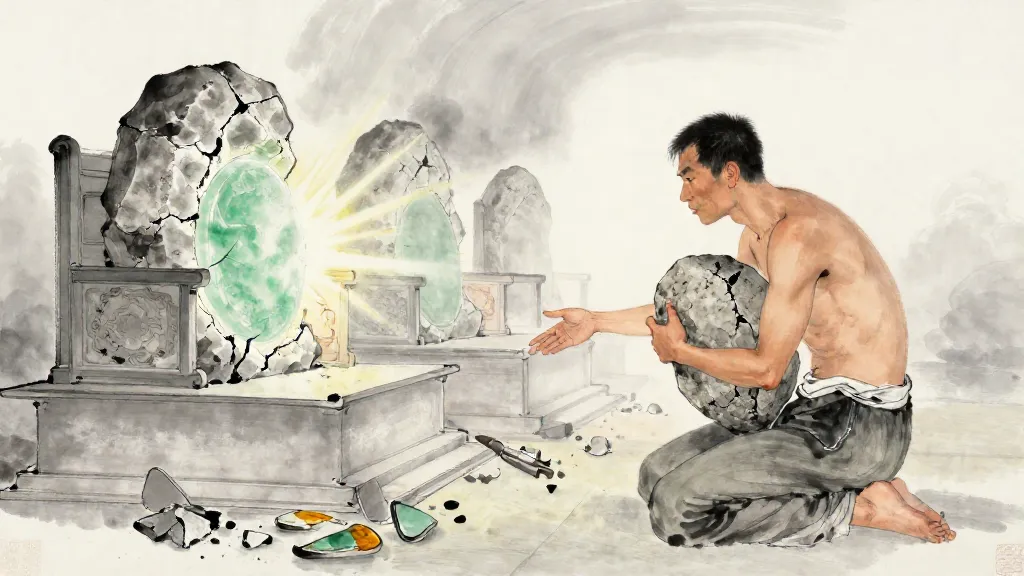
和氏之璧
The Jade of Master He
楚人和氏得玉璞楚山中,奉而獻之厲王。厲王使玉人相之。玉人曰:"石也。"王以和為誑,而刖其左足。及厲王薨,武王即位。和又奉其璞而獻之武王。武王使玉人相之。又曰:"石也。"王又以和為誑,而刖其右足。武王薨,文王即位。和乃抱其璞而哭於楚山之下,三日三夜,淚盡而繼之以血。王聞之,使人問其故,曰:"天下之刖者多矣,子奚哭之悲也?"和曰:"吾非悲刖也,悲夫寶玉而題之以石,貞士而名之以誑,此吾所以悲也。"王乃使玉人理其璞而得寶焉,遂命曰:"和氏之璧。"
A man of Chu named He discovered an uncut jade stone in the mountains of Chu. He presented it reverently to King Li. King Li ordered a jade craftsman to examine it. The craftsman said: "It is a stone." The king, considering He a fraud, had his left foot amputated.
When King Li died and King Wu ascended the throne, He once again presented his uncut jade reverently to King Wu. King Wu ordered a jade craftsman to examine it. Again the craftsman said: "It is a stone." The king again considered He a fraud, and had his right foot amputated.
When King Wu died and King Wen ascended the throne, He embraced his uncut jade and wept at the foot of the mountains of Chu for three days and three nights. When his tears were exhausted, he continued weeping blood.
The king heard of this and sent someone to inquire the reason, saying: "There are many men in the world who have suffered amputation. Why do you weep so bitterly?"
He replied: "I do not weep because of the amputation. I weep because a precious jade has been labeled a stone, and a man of integrity has been branded a fraud. This is why I weep."
The king then ordered a jade craftsman to cut and polish the uncut stone, and a treasure was found within. It was thereupon named "The Jade Disc of Master He."
Notes
Bian He (卞和), also called He Shi (和氏, 'Master He') — a man of Chu whose story became one of the most famous parables in Chinese literature. The 'Jade Disc of Master He' (和氏之璧) later became the most celebrated jade in Chinese history, eventually passing to the state of Zhao, where it figures in the famous 'returning the jade intact to Zhao' (完璧歸趙) episode of the Shiji.
King Li of Chu (楚厲王, r. 757–741 BC) — ruler of the state of Chu during the Spring and Autumn period. The name 厲 ('severe') is a posthumous epithet.
King Wu of Chu (楚武王, r. 740–690 BC) — son and successor of King Li. He was the first ruler of Chu to adopt the title of 'king' (王), asserting independence from the Zhou royal house.
King Wen of Chu (楚文王, r. 689–677 BC) — son and successor of King Wu. Under his rule, the jade was finally recognized. The three kings span roughly 80 years, underscoring the extreme patience required of He.
玉璞 (yù pú) — an uncut, unpolished jade stone still encased in its outer rock matrix. The point of the parable hinges on the fact that a 璞 looks like an ordinary stone from the outside; only cutting and polishing reveals the jade within. This is Han Fei's metaphor for the relationship between appearance and true worth.
刖 (yuè) — amputation of one or both feet, a standard punishment in the penal codes of ancient Chinese states. It was one of the 'five punishments' (五刑).