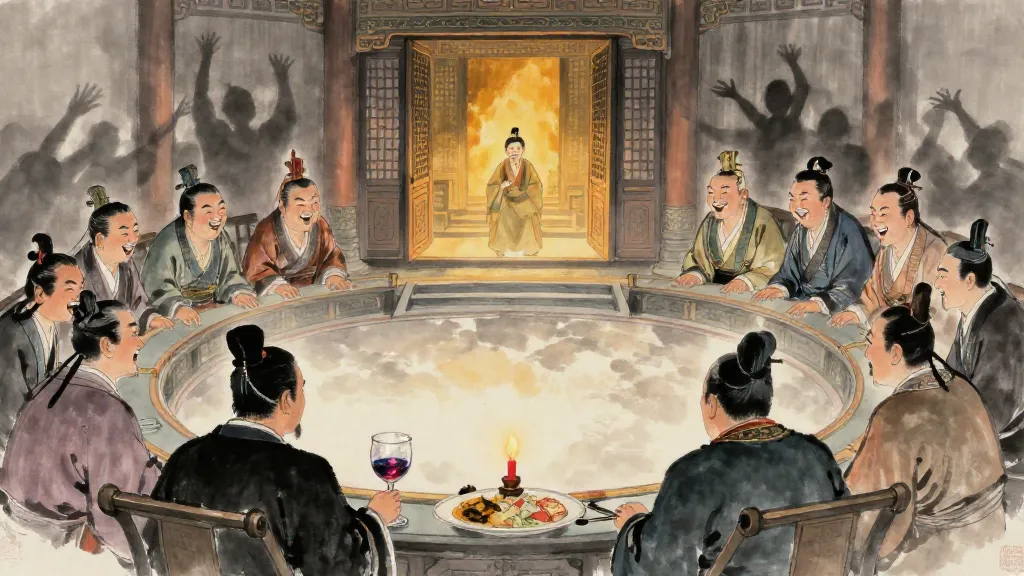
備內 (Guarding Against the Interior) — Chinese ink painting

韓非子 Hanfeizi · Chapter 17

備內

Guarding Against the Interior

View:

信人之患

The Peril of Trusting Others

人主之患在於信人,信人,則制於人。人臣之於其君,非有骨肉之親也,縛於勢而不得不事也。故為人臣者,窺覘其君心也,無須臾之休,而人主怠傲處上,此世所以有劫君殺主也。為人主而大信其子,則奸臣得乘於子以成其私,故李兌傳趙王而餓主父。為人主而大信其妻,則奸臣得乘於妻以成其私,故優施傳麗姬殺申生而立奚齊。夫以妻之近與子之親而猶不可信,則其餘無可信者矣。

The peril of a ruler lies in trusting others. If he trusts others, he is controlled by them. The relationship between a minister and his lord is not one of blood kinship -- it is the constraint of political circumstance that compels service. Therefore ministers ceaselessly scrutinize their lord's mind, never resting for an instant, while the ruler sits above in idle arrogance. This is how rulers come to be coerced and sovereigns murdered.

If a ruler places great trust in his sons, treacherous ministers exploit the sons to advance their private interests. Thus Li Dui manipulated the King of Zhao and starved King Wuling to death. If a ruler places great trust in his wife, treacherous ministers exploit the wife to advance their private interests. Thus the actor Shi aided Lady Li Ji in murdering Crown Prince Shensheng and enthroning Xi Qi. If even a wife, who is closest, and a son, who is dearest, cannot be trusted, then nothing else can be trusted at all.

Notes

person李兌Li Dui

person趙主父Zhao Zhufu

person優施You Shi

person驪姬Li Ji

person申生Shensheng

person奚齊Xi Qi

后妃夫人之利害

The Self-Interest of Queens and Consorts

且萬乘之主,千乘之君,后妃夫人、適子為太子者,或有欲其君之蚤死者。何以知其然,夫妻者,非有骨肉之恩也,愛則親,不愛則疏。語曰:「其母好者其子抱。」然則其為之反也,其母惡者其子釋。丈夫年五十而好色未解也,婦人年三十而美色衰矣。以衰美之婦人事好色之丈夫,則身見疏賤,而子疑不為後,此后妃夫人之所以冀其君之死者也。唯母為後而子為主,則令無不行,禁無不止,男女之樂不減於先君,而擅萬乘不疑,此鴆毒扼昧之所以用也。故《桃左春秋》曰:「人主之疾死者不能處半。」,人主弗知,則亂多資。故曰:利君死者眾,則人主危。

Moreover, among the lords of ten thousand chariots and the princes of a thousand chariots, there are queens, consorts, and crown princes who wish for the ruler's early death. How do we know this? The bond between husband and wife is not one of blood. When there is love, they are close; when love fades, they grow distant. The saying goes: 'If the mother is favored, her child is embraced.' The reverse follows: if the mother falls out of favor, her child is cast aside.

A man of fifty has not lost his appetite for beauty. A woman of thirty has already seen her beauty fade. When a woman of fading beauty serves a man who still craves it, she finds herself neglected and degraded, and she fears her son will not be named heir. This is why queens and consorts come to hope for the ruler's death. For only when the mother becomes dowager and the son becomes sovereign are all commands obeyed and all prohibitions enforced; the pleasures of men and women are no less than those of the former lord, and she wields the power of ten thousand chariots without question. This is why poisoned wine and smothering in the dark are employed.

Thus the Taozuo Annals states: 'Of rulers who die of illness, fewer than half truly die of illness.' If the ruler does not understand this, the resources of disorder multiply. Therefore it is said: when many people stand to profit from the ruler's death, the ruler is in danger.

Notes

translation

translation

textual

context

利害驅人

Incentives Drive All Men

故王良愛馬,越王勾踐愛人,為戰與馳。醫善吮人之傷,含人之血,非骨肉之親也,利所加也。故與人成輿,則欲人之富貴;匠人成棺,則欲人之夭死也。非輿人仁而匠人賊也,人不貴,則輿不售;人不死,則棺不買。情非憎人也,利在人之死也,故后妃、夫人太子之黨成而欲君之死也,君不死,則勢不重。情非憎君也,利在君之死也。故人主不可以不加心於利己死者。

Thus Wang Liang cherished his horses, and King Goujian of Yue cherished his men -- the one for racing, the other for war. A physician who is skilled at sucking wounds and holding blood in his mouth does so not from kinship but because profit drives him.

Thus the carriage-maker wishes people to be rich and noble; the coffin-maker wishes people to die young. It is not that the carriage-maker is benevolent and the coffin-maker is cruel -- if people are not noble, carriages do not sell; if people do not die, coffins find no buyers. The coffin-maker's feelings are not hatred of people; his profit lies in people's deaths.

So too, once the factions of the queen, the consorts, and the crown prince have formed, they wish for the ruler's death. If the ruler does not die, their power cannot grow. Their feelings are not hatred of the ruler; their profit lies in his death. Therefore the ruler must never fail to scrutinize those who stand to gain from his demise.

Notes

person王良Wang Liang

person越王勾踐Yue Wang Goujian

context

明王之防

The Vigilance of an Enlightened Ruler

故日月暈圍於外,其賊在內,備其所憎,禍在所愛。是故明王不舉不參之事,不食非常之食;遠聽而近視,以審內外之失,省同異之言以知朋黨之分,偶參伍之驗以責陳言之實;執後以應前,按法以治眾,眾端以參觀。士無幸賞,無逾行,殺必當,罪不赦,則奸邪無所容其私。

Thus when halos encircle the sun and moon, the danger lies outside; but when a man guards against those he hates, disaster comes from those he loves. Therefore the enlightened ruler undertakes no venture without cross-checking, and eats no unusual food. He listens far and examines near, auditing both internal and external failings. He compares consistent and conflicting reports to discern factional alignments. He collates multiple sources of verification to test the substance of what is claimed. He holds later results against earlier promises, governs the multitude according to law, and examines numerous threads to gain a comprehensive view.

When officers receive no unearned rewards and commit no unpunished transgressions, when executions are always warranted and crimes never pardoned, then treachery and corruption have no room to pursue private ends.

Notes

translation

translation

徭役與權勢

Corvee Labor and the Rise of Rival Power

徭役多則民苦,民苦則權勢起,權勢起則復除重,復除重則貴人富。苦民以富貴人,起勢以藉人臣,非天下長利也。故曰:徭役少則民安,民安則下無重權,下無重權則權勢滅,權勢滅則德在上矣。今夫水之勝火亦明矣,然而釜鬵間之,水煎沸竭盡其上,而火得熾盛焚其下,水失其所以勝者矣。今夫治之禁奸又明於此,然法守之臣為釜鬵之行,則法獨明於胸中,而已失其所以禁奸者矣。

When corvee labor is heavy, the people suffer. When the people suffer, rival power centers arise. When rival power centers arise, tax exemptions and privileges proliferate. When exemptions proliferate, the nobility grows rich. To impoverish the people in order to enrich the great men, and to build up rival power bases that serve the ministers -- this is not in the long-term interest of the realm.

Therefore it is said: when corvee labor is light, the people are at ease. When the people are at ease, no excessive power accumulates below. When no excessive power accumulates below, rival power centers are eliminated. When rival power centers are eliminated, authority rests with the sovereign.

Now, that water conquers fire is perfectly clear. Yet place a pot between them: the water boils away above while the fire blazes undiminished below. The water has lost the very means by which it conquers. The principle that good governance prohibits corruption is even clearer than this. Yet when law-enforcing ministers act as the pot -- interposing themselves between ruler and reality -- the law remains bright only in the ruler's mind, while the means of prohibiting corruption have already been lost.

Notes

translation

translation

大臣蔽上

Great Ministers Who Obscure the Sovereign

上古之傳言,《春秋》所記,犯法為逆以成大奸者,未嘗不從尊貴之臣也。然而法令之所以備,刑罰之所以誅,常於卑賦,是以其民絕望,無所告訴。大臣比周,蔽上為一,陰相善而陽相惡,以示無私,相為耳目,以候主隙,人主掩蔽,無道得聞,有主名而無實,臣專法而行之,周天子是也。偏借其權勢,則上下易位矣,此言人臣之不可借權勢。

In the traditions handed down from high antiquity and in the records of the Spring and Autumn Annals, those who broke the law, committed treason, and perpetrated great villainy were invariably men of high rank and noble station. Yet the laws and penalties that are prepared and enforced always fall upon the lowly and humble. Thus the common people despair, with nowhere to appeal.

When great ministers collude and conspire, forming a united front to obscure the sovereign, feigning enmity in public while allying in private -- to create an appearance of impartiality -- and serving as each other's eyes and ears to watch for the ruler's vulnerabilities, the ruler is screened off with no way to learn the truth. He holds the title of sovereign but not the reality; the ministers monopolize the law and exercise it themselves. The Son of Heaven of Zhou was just such a case.

When a ruler lends his power and authority to others, superior and subordinate trade places. This is why a ruler must never lend his power to his ministers.

Notes

translation

context

context

Edition & Source

Text
《韓非子》 Hanfeizi
Edition
中華古詩文古書籍網 transcription, 《四部叢刊》本
Commentary
Han Fei (韓非), Warring States period