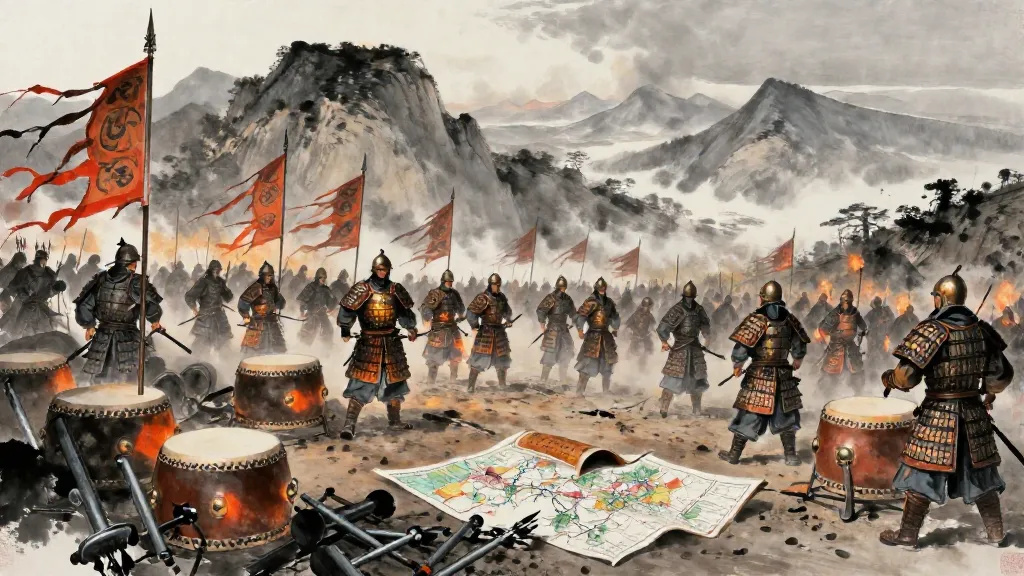
喻老 (Illustrating Laozi) — Chinese ink painting

韓非子 Hanfeizi · Chapter 21

喻老

Illustrating Laozi

View:

卻走馬以糞・戎馬生於郊

War Horses Turned to Manure; War Horses Born in the Suburbs

天下有道,無急患,則曰靜,遽傳不用。故曰:“卻走馬以糞。“天下無道,攻擊不休,相守數年不已,甲冑生蟣虱,燕雀處帷幄,而兵不歸。故曰:“戎馬生於郊。“

When All-Under-Heaven possesses the Way and there is no urgent crisis, all is calm, and the relay couriers are not employed. Therefore Laozi says: 'War horses are turned back to fertilize the fields.'

When All-Under-Heaven lacks the Way, attacks never cease, and armies hold their positions for years on end without relenting. Lice breed in armor and helmets, sparrows and swallows nest in the command tents, yet the troops do not return home. Therefore Laozi says: 'War horses are born in the suburbs.'

Notes

1context

This chapter (喻老, 'Illustrating Laozi') differs from Ch. 20 (解老, 'Interpreting Laozi') in method: rather than abstract commentary, Han Fei uses historical anecdotes to illustrate passages from the Daodejing. Each section pairs a Laozi quotation with a concrete example.

罪莫大於可欲

No Crime Greater Than Desirable Things

翟人有獻豐狐、玄豹之皮於晉文公。文公受客皮而嘆曰:“此以皮之美自為罪。“夫治國者以名號為罪,徐偃王是也;以城與地為罪,虞、虢是也。故曰:“罪莫大於可欲。“

A man of the Di people presented the skins of a rich fox and a dark leopard to Duke Wen of Jin. Duke Wen accepted the skins but sighed: 'These creatures brought ruin upon themselves through the beauty of their pelts.'

Among those who govern states, some bring ruin through their titles and fame -- Xu Yan Wang was such a case. Others bring ruin through their cities and land -- Yu and Guo were such cases. Therefore Laozi says: 'No crime is greater than desirable things.'

Notes

1person晉文公Jin Wen Gong

Duke Wen of Jin (晉文公, r. 636-628 BC) was one of the Five Hegemons of the Spring and Autumn period. His remark about the fox and leopard is a meditation on how possessing desirable qualities can itself be dangerous.

2person徐偃王Xu Yan Wang

Xu Yan Wang (徐偃王) was a legendary king of Xu who cultivated a reputation for benevolence but was destroyed by Chu precisely because his fame made him a target.

禍莫大於不知足

No Disaster Greater Than Not Knowing Sufficiency

智伯兼范、中行而攻趙不已,韓、魏反之,軍敗晉陽,身死高梁之東,遂卒被分,漆其首以為溲器。故曰:“禍莫大於不知足。“

Zhibo absorbed the Fan and Zhonghang clans and then attacked Zhao without relent. Han and Wei turned against him; his army was defeated at Jinyang, he himself was killed east of Gaoliang, and in the end his territory was divided. His skull was lacquered and made into a drinking vessel. Therefore Laozi says: 'No disaster is greater than not knowing sufficiency.'

Notes

1person智伯Zhi Bo

Zhibo (智伯, also written 知伯, d. 453 BC) was the head of the Zhi clan, the most powerful of the noble houses of Jin. His insatiable demand for territory from the other houses led to the coalition that destroyed him and partitioned Jin into Han, Zhao, and Wei.

咎莫慘於欲得・知足之為足

No Misery Worse Than the Desire to Obtain; The Sufficiency of Sufficiency

虞君欲屈產之乘與垂棘之璧,不聽宮之奇,故邦亡身死。故曰:“咎莫慘於欲得。“邦以存為常,霸王其可也;身以生為常,富貴其可也。不以欲自害,則邦不亡,身不死。故曰:“知足之為足矣。“

The lord of Yu coveted the horses of Quechan and the jade disc of Chuiji. He did not heed Gong Zhiqi, and so his state perished and he himself died. Therefore Laozi says: 'No misery is worse than the desire to obtain.'

For a state, survival is the norm -- and from survival, hegemony is possible. For a person, life is the norm -- and from life, wealth and honor are possible. If one does not harm oneself through desire, the state will not perish and the person will not die. Therefore Laozi says: 'Knowing that sufficiency is sufficient -- this is true sufficiency.'

Notes

1person宮之奇Gong Zhiqi

Gong Zhiqi (宮之奇) was a minister of the state of Yu who warned that lending passage to Jin's army to attack Guo would lead to Yu's own destruction. The lord of Yu ignored the warning, accepting Jin's bribes of fine horses and jade.

2context

The story of Yu and Guo illustrates the proverb '脣亡齒寒' ('when the lips are gone, the teeth grow cold'): Yu allowed Jin to destroy its buffer state Guo, and was itself destroyed immediately after.

善建不拔:孫叔敖之謂

Well-Established and Not Uprooted: The Case of Sun Shuao

楚莊王既勝,狩於河雍,歸而賞孫叔敖。孫叔敖請漢間之地,沙石之處。楚邦之法,祿臣再世而收地,唯孫叔敖獨在。此不以其邦為收者,瘠也,故九世而祀不絕。故曰:“善建不拔,善抱不脫,子孫以其祭祀,世世不輟。“孫叔敖之謂也。

After King Zhuang of Chu achieved victory, he hunted at Heyong and upon returning rewarded Sun Shuao. Sun Shuao requested the land between the Han Rivers -- a sandy, stony place. By the law of the Chu state, the fiefs of salaried ministers were reclaimed after two generations, yet Sun Shuao's alone remained. The reason his fief was not reclaimed by the state was that it was barren. Thus for nine generations his sacrifices never ceased.

Therefore Laozi says: 'What is well-established cannot be uprooted; what is well-embraced cannot be detached. Sons and grandsons will honor it with sacrifices that never cease, generation after generation.' This describes Sun Shuao.

Notes

1person孫叔敖Sun Shuao

Sun Shuao (孫叔敖, d. c. 593 BC) was the chief minister (令尹) of Chu under King Zhuang. He is celebrated for his wisdom in requesting poor land as his fief -- precisely because its worthlessness ensured it would never be coveted or confiscated.

2person楚莊王Chu Zhuang Wang

King Zhuang of Chu (楚莊王, r. 613-591 BC) was one of the Five Hegemons. His victory at the Battle of Bi (597 BC) against Jin established Chu's dominance.

重為輕根:主父之謂

The Heavy Is the Root of the Light: The Case of King Wuling

制在己曰重,不離位曰靜。重則能使輕,靜則能使躁。故曰:“重為輕根,靜為躁君。“故曰:“君子終日行,不離輜重也“。邦者,人君之輜重也。主父生傳其邦,此離其輜重者也,故雖有代、雲中之樂,超然已無趙矣。主父,萬乘之主,而以身輕於天下。無勢之謂輕,離位之謂躁,是以生幽而死。故曰:“輕則失臣,躁則失君。“主父之謂也。

When control rests with oneself, this is called 'heavy.' When one does not leave one's position, this is called 'still.' Being heavy, one can command the light; being still, one can command the restless. Therefore Laozi says: 'The heavy is the root of the light; the still is the master of the restless.' Therefore: 'The gentleman travels all day without leaving his baggage train.'

The state is the ruler's baggage train. The Lord Father, while still alive, transferred his state to another -- this was abandoning his baggage train. Therefore, though he had the pleasures of Dai and Yunzhong, in an instant Zhao was no longer his.

The Lord Father was the ruler of a state of ten thousand chariots, yet he treated himself lightly before All-Under-Heaven. To be without positional advantage is called 'light'; to leave one's position is called 'restless.' Therefore he was imprisoned while alive and died in captivity.

Therefore Laozi says: 'The light loses its ministers; the restless loses its ruler.' This describes the Lord Father.

Notes

1person趙武靈王 (主父)Zhao Wuling Wang (Zhufu)

The Lord Father (主父) is King Wuling of Zhao (趙武靈王, r. 325-299 BC). After abdicating in favor of his younger son, he was besieged in the Shaqiu Palace and starved to death in 295 BC. His tragic end is the classic cautionary tale about rulers who relinquish power prematurely.

2translation

勢 ('positional advantage') is a key Legalist concept. Han Fei argues that the ruler's power derives not from personal qualities but from his institutional position. Abandoning the throne is abandoning the very source of authority.

魚不可脫於深淵

The Fish Must Not Leave the Deep

勢重者,人君之淵也。君人者,勢重於人臣之間,失則不可復得矣。簡公失之于田成,晉公失之於六卿,而上亡身死。故曰:“魚不可脫於深淵。“賞罰者,邦之利器也,在君則制臣,在臣則勝君。君見賞,臣則損之以為德;君見罰,臣則益之以為威。人君見賞,則人臣用其勢;人君見罰,而人臣乘其威。故曰:“邦之利器,不可以示人。“

Positional advantage and authority are the ruler's deep waters. When a ruler holds authority over his ministers, once lost it cannot be recovered. Duke Jian lost it to Tian Cheng, and the Duke of Jin lost it to the six ministerial houses -- and both perished.

Therefore Laozi says: 'The fish must not leave the deep.'

Rewards and punishments are the state's sharp instruments. When the ruler wields them, they control the ministers; when the ministers wield them, they overpower the ruler. When the ruler is seen to reward, the minister diminishes the reward to claim the beneficence as his own. When the ruler is seen to punish, the minister augments the punishment to claim the authority as his own. When the ruler's rewards are visible, the ministers exploit his positional advantage. When the ruler's punishments are visible, the ministers ride upon his authority.

Therefore Laozi says: 'The state's sharp instruments must not be shown to others.'

Notes

1person齊簡公Qi Jian Gong

Duke Jian of Qi (齊簡公, r. 484-481 BC) was murdered by Tian Cheng (田成子, also called Tian Chang), who subsequently controlled Qi. The Tian family eventually usurped the throne entirely in 386 BC.

2context

Han Fei reinterprets Daodejing Ch. 36 ('魚不可脫於淵,邦之利器不可以示人'). For Laozi, these were observations about the subtle Way; for Han Fei, they are practical warnings about power: the ruler must never let ministers usurp the monopoly on rewards and punishments.

將欲翕之必固張之

To Contract, One Must First Expand

越王入宦於吳,而觀之伐齊以弊吳。吳兵既勝齊人於艾陵,張之於江、濟,強之於黃池,故可制於五湖。故曰:“將欲翕之,必固張之;將欲弱之,必固強之。“晉獻公將欲襲虞,遺之以璧馬;知伯將襲仇由,遺之以廣車。故曰:“將欲取之,必固與之。“起事於無形,而要大功於天下,“是謂微明“。處小弱而重自卑,謂“損弱勝強也。“

The King of Yue entered service as a menial in Wu, then maneuvered Wu into attacking Qi to exhaust itself. Once Wu's troops had defeated Qi at Ailing, Wu was overextended along the Yangtze and Ji Rivers and its strength was spent at Huangchi. Thus Yue was able to overcome Wu at the Five Lakes.

Therefore Laozi says: 'That which is about to contract must first be expanded; that which is about to be weakened must first be strengthened.'

Duke Xian of Jin wished to attack Yu, so he first presented it with jade and horses. Zhibo wished to attack Chouyou, so he first presented it with a great chariot. Therefore Laozi says: 'That which is about to be taken must first be given.'

To initiate affairs from the formless and seize great achievement in All-Under-Heaven -- 'this is called the subtle light.' To abide in smallness and weakness, prizing self-abasement -- this means 'the yielding and weak overcome the hard and strong.'

Notes

1context

This comments on Daodejing Ch. 36. Han Fei's examples show 'strategic yielding': Goujian humbled himself before Wu to lull Fuchai into complacency; Duke Xian gave gifts to Yu to gain passage for his army. In each case, the appearance of giving preceded the reality of taking.

2place艾陵Ailing

Ailing (艾陵) was the site of Wu's victory over Qi in 484 BC. Huangchi (黃池) was where Wu held a congress of lords in 482 BC -- precisely when Yue attacked Wu's undefended capital.

扁鵲見蔡桓公

Bian Que Visits Lord Huan of Cai

有形之類,大必起於小;行久之物,族必起於少。故曰:“天下之難事必作於易,天下之大事必作於細。“是以欲制物者於其細也。故曰:“圖難於其易也,為大於其細也。“千丈之堤,以螻蟻之穴潰;百步之室,以突隙之煙焚。故曰:白圭之行堤也塞其穴,丈人之慎火也塗其隙,是以白圭無水難,丈人無火患。此皆慎易以避難,敬細以遠大者也。扁鵲見蔡桓公,立有間。扁鵲曰:“君有疾在腠理,不治將恐深。“桓侯曰:“寡人無疾。“扁鵲出。桓侯曰:“醫之好治不病以為功。“居十日,扁鵲復見曰:“君之病在肌膚,不治將益深。“桓侯不應。扁鵲出。桓侯又不悅。居十日,扁鵲復見曰:“君之病在腸胃,不治將益深。“桓侯又不應。扁鵲出。桓侯又不悅。居十日,扁鵲望桓侯而還走,桓侯故使人問之。扁鵲曰:“病在腠理,湯熨之所及也;在肌膚,針石之所及也;在腸胃,火齊之所及也;在骨髓,司命之所屬,無奈何也。今在骨髓,臣是以無請也。“居五日,桓侯體痛,使人索扁鵲,已逃秦矣。桓侯遂死。故良醫之治病也,攻之於腠理。此皆爭之於小者也。夫事之禍福亦有腠理之地,故聖人蚤從事焉。

Among things that have form, the great must originate from the small; among things that endure long, the multitude must originate from the few. Therefore Laozi says: 'The difficult affairs of All-Under-Heaven must begin from the easy; the great affairs of All-Under-Heaven must begin from the minute.' Thus one who wishes to control things must attend to the minute. Therefore: 'Plan for the difficult while it is still easy; accomplish the great while it is still small.'

A dike of a thousand spans can be breached by a mole-cricket's hole. A house of a hundred paces can be burned by a spark from a chimney crack. Thus Bai Gui, when inspecting dikes, sealed every hole; the old man, when guarding against fire, plastered every crack. Therefore Bai Gui suffered no floods and the old man suffered no fires. These all attended to the easy in order to avoid the difficult, and respected the small in order to forestall the great.

Bian Que visited Lord Huan of Cai and stood before him for a moment. Bian Que said: 'My lord, you have an illness in the pores. If not treated, I fear it will go deeper.' Lord Huan said: 'I have no illness.' Bian Que departed. Lord Huan said: 'Physicians love to treat the healthy and claim credit for it.'

After ten days, Bian Que visited again and said: 'My lord's illness is in the flesh. If not treated, it will go deeper still.' Lord Huan did not respond. Bian Que departed. Lord Huan was again displeased.

After ten days, Bian Que visited again and said: 'My lord's illness is in the stomach and intestines. If not treated, it will go deeper still.' Lord Huan did not respond. Bian Que departed. Lord Huan was again displeased.

After ten days, Bian Que gazed at Lord Huan from a distance and turned to flee. Lord Huan sent someone to ask why. Bian Que said: 'When the illness is in the pores, hot compresses can reach it. When in the flesh, acupuncture needles can reach it. When in the stomach and intestines, herbal decoctions can reach it. When in the bone marrow, it belongs to the Arbiter of Fate -- nothing can be done. Now it is in the bone marrow; therefore I make no further requests.'

After five days, Lord Huan's body was wracked with pain. He sent men to find Bian Que, but he had already fled to Qin. Lord Huan thereupon died.

Thus a good physician attacks illness at the pores. These are all cases of contending over what is small. The fortune and misfortune of affairs likewise have their 'pore stage.' Therefore the sage attends to matters early.
Notes

1person扁鵲Bian Que

Bian Que (扁鵲) was the most famous physician of ancient China, traditionally dated to the 5th century BC. His name became synonymous with supreme medical skill.

2context

This is one of the most famous anecdotes in Chinese literature. It illustrates Daodejing Ch. 63's principle of addressing problems early. The progression from pores to bone marrow parallels how political problems escalate when rulers refuse counsel. The story is widely used in Chinese education to this day.

3person白圭Bai Gui

Bai Gui (白圭) was a famous hydraulic engineer and merchant of the Warring States period, known for his meticulous approach to flood prevention.

其安易持:叔瞻與宮之奇

The Stable Is Easy to Hold: Shuzhan and Gong Zhiqi

昔晉公子重耳出亡,過鄭,鄭君不禮。叔瞻諫曰:“此賢公子也,君厚待之,可以積德。“鄭君不聽。叔瞻又諫曰:“不厚待之,不若殺之,無令有後患。“鄭君又不聽。及公子返晉邦,舉兵伐鄭,大破之,取八城焉。晉獻公以垂棘之璧假道於虞而伐虢,大夫宮之奇諫曰:“不可。脣亡而齒寒,虞、虢相救,非相德也。今日晉滅虢,明日虞必隨之亡。“虞君不聽,受其璧而假之道。晉已取虢,還,反滅虞。此二臣者皆爭於腠理者也,而二君不用也。然則叔瞻、宮之奇亦虞、虢之扁鵲也,而二君不聽,故鄭以破,虞以亡。故曰:“其安易持也,其未兆易謀也。“

In the past, Prince Chong'er of Jin went into exile and passed through Zheng. The lord of Zheng did not receive him with proper courtesy. Shuzhan remonstrated: 'This is a worthy prince. If my lord treats him generously, you can accumulate a store of goodwill.' The lord of Zheng did not listen. Shuzhan remonstrated again: 'If you will not treat him generously, it would be better to kill him, lest he become a future threat.' The lord of Zheng again did not listen. When the prince returned to Jin, he raised an army and attacked Zheng, crushing it and taking eight cities.

Duke Xian of Jin used the jade disc of Chuiji to borrow passage through Yu in order to attack Guo. The minister Gong Zhiqi remonstrated: 'This must not be done. When the lips are gone, the teeth grow cold. Yu and Guo rescue each other not out of mutual affection but out of necessity. If Jin destroys Guo today, Yu will surely follow tomorrow.' The lord of Yu did not listen; he accepted the jade and granted passage. After Jin had taken Guo, it turned and destroyed Yu on the return.

These two ministers were both contending at the stage of the pores, yet both rulers refused to heed them. Thus Shuzhan and Gong Zhiqi were the Bian Que of Yu and Guo. Because the two rulers did not listen, Zheng was broken and Yu was destroyed.

Therefore Laozi says: 'When things are stable, they are easy to hold; when things have not yet shown signs, they are easy to plan for.'

Notes

1person重耳 (晉文公)Chong'er (Jin Wen Gong)

Prince Chong'er (重耳) later became Duke Wen of Jin (晉文公, r. 636-628 BC), one of the Five Hegemons. His nineteen years of exile and eventual triumphant return is one of the great narratives of the Spring and Autumn period.

2person叔瞻Shuzhan

Shuzhan (叔瞻) was a minister of Zheng who twice offered sound counsel -- first to welcome Chong'er, then to eliminate him -- but was ignored both times.

見小曰明:箕子見象箸

Perceiving the Small Is Called Insight: Jizi Sees the Ivory Chopsticks

昔者紂為象箸而箕子怖,以為象箸必不加於土鉶,必將犀玉之杯;象箸玉杯必不羹菽藿,必旄、象、豹胎;旄、象、豹胎必不衣短褐而食於茅屋之下,則錦衣九重,廣室高台。吾畏其卒,故怖其始。居五年,紂為肉圃,設砲烙,登糟丘,臨酒池,紂遂以亡。故箕子見象箸以知天下之禍。故曰:“見小曰明。“

In former times, Zhou of Shang had ivory chopsticks made, and Jizi was filled with dread. He reasoned: ivory chopsticks would surely not be paired with earthen bowls -- they would require cups of rhinoceros horn and jade. Ivory chopsticks and jade cups would surely not be used for bean and vegetable soup -- they would require yak tail, elephant, and leopard embryo. Yak tail, elephant, and leopard embryo would surely not be eaten in coarse cloth beneath a thatched roof -- they would require brocade robes in nine layers, grand halls and lofty terraces. 'I dread where this will end, and so I am terrified at where it begins.'

Five years later, Zhou created gardens of meat, installed the roasting pillar, ascended the mound of wine dregs, and looked down upon the pool of wine. Zhou thereupon perished.

Thus Jizi saw the ivory chopsticks and knew the disaster that would engulf All-Under-Heaven. Therefore Laozi says: 'To perceive the small is called insight.'

Notes

1person箕子Jizi

Jizi (箕子) was an uncle of King Zhou of Shang and one of the 'three worthies' (三仁) of the late Shang. When his remonstrances were ignored, he feigned madness to survive.

2context

This is one of the most famous logical chains in Chinese literature: ivory chopsticks -> jade cups -> exotic foods -> fine robes -> grand palaces -> total decadence -> ruin. The principle is that small signs of excess, if unchecked, lead inexorably to catastrophe.

守柔曰強

Maintaining Yielding Is Called Strength

勾踐入宦於吳,身執干戈為吳王洗馬,故能殺夫差於姑蘇。文王見詈於王門,顏色不變,而武王擒紂於牧野。故曰:“守柔曰強。“越王之霸也不病宦,武王之王也不病詈。故曰:“聖人之不病也,以其不病,是以無病也。“

Goujian entered service as a menial in Wu, personally bearing shield and halberd as Fuchai's groom. Because of this, he was able to kill Fuchai at Gusu.

King Wen endured insults at the gate of the Shang court without changing his expression, and King Wu subsequently captured Zhou at Muye.

Therefore Laozi says: 'Maintaining yielding is called strength.' The King of Yue's achievement of hegemony was not impaired by his menial service. King Wu's kingship was not impaired by the insults suffered. Therefore Laozi says: 'The sage is not afflicted, because he does not regard these things as afflictions -- therefore he has no affliction.'

Notes

1person周文王Zhou Wen Wang

King Wen of Zhou (周文王) was imprisoned by King Zhou of Shang at Youli but endured without complaint. His son King Wu (周武王) later overthrew the Shang at the Battle of Muye (c. 1046 BC).

2context

Han Fei illustrates Daodejing Ch. 52 ('守柔曰強') and Ch. 71 with examples of strategic humiliation. Goujian's servitude and King Wen's endurance of insult are not weakness but the highest form of strength -- the willingness to yield temporarily for ultimate victory.

欲不欲・學不學

Desiring Not to Desire; Learning Not to Learn

宋之鄙人得璞玉而獻之子罕,子罕不受。鄙人曰:“此寶也,宜為君子器,不宜為細人用。“子罕曰:“爾以玉為寶,我以不受子玉為寶。“是以鄙人慾玉,而子罕不欲玉。故曰:“欲不欲,而不貴難得之貨。“王壽負書而行,見徐馮於周塗。馮曰:“事者,為也;為生於時,知者無常事。書者,言也;言生於知,知者不藏書。今子何獨負之而行?“於是王壽因焚其書而舞之。故知者不以言談教,而慧者不以藏書篋。此世之所過也,而王壽復之,是學不學也。故曰:“學不學,復歸眾人之所過也。“

A rustic man of Song obtained an uncut jade and presented it to Zihan. Zihan would not accept it. The rustic said: 'This is a treasure -- it is fit to be a gentleman's possession, not for common men to use.' Zihan said: 'You consider jade your treasure; I consider not accepting your jade my treasure.' Thus the rustic desired jade, while Zihan did not desire jade.

Therefore Laozi says: 'Desire not to desire, and do not prize goods that are hard to obtain.'

Wang Shou was traveling carrying books on his back when he met Xu Feng on the road to Zhou. Feng said: 'Affairs are a matter of action; action arises from the times, and the wise man has no fixed affairs. Books are a matter of words; words arise from understanding, and the wise man does not store books. Why do you alone carry them on your back?' At this, Wang Shou burned his books and danced.

Thus the wise do not teach through spoken words, and the perceptive do not store books in boxes. This is what the world passes by, and Wang Shou returned to it. This is learning not to learn.

Therefore Laozi says: 'Learn not to learn, and return to what the multitude passes by.'

Notes

1person子罕Zihan

Zihan (子罕) was a minister of Song, celebrated for his incorruptibility. His statement '以不貪為寶' ('I take not being greedy as my treasure') became proverbial.

恃萬物之自然・不出於戶

Relying on the Natural Course of Things; Not Going Outside the Door

夫物有常容,因乘以導之。因隨物之容,故靜則建乎德,動則順乎道。宋人有為其君以象為楮葉者,三年而成。豐殺莖柯,毫芒繁澤,亂之楮葉之中而不可別也。此人遂以功食祿於宋邦。列子聞之曰:“使天地三年而成一葉,則物之有葉者寡矣。“故不乘天地之資而載一人之身,不隨道理之數而學一人之智,此皆一葉之行也。故冬耕之稼,后稷不能羨也;豐年大禾,臧獲不能惡也。以一人之力,則后稷不足;隨自然,則臧獲有餘。故曰:“恃萬物之自然而不敢為也。“空竅者,神明之戶牖也。耳目竭於聲色,精神竭於外貌,故中無主。中無主,則禍福雖如丘山,無從識之。故曰:“不出於戶,可以知天下;不窺於牖,可以知天道。“此言神明之不離其實也。

Things have their natural form; one should follow and ride upon it to guide them. By following the natural form of things, when still one establishes virtue, and when moving one accords with the Way.

A man of Song carved a mulberry leaf from ivory for his lord. It took three years to complete. The fullness and thinness, the stems and branches, the fine hairs and lustrous surface -- when mixed among real mulberry leaves, it could not be distinguished. This man was thereupon awarded a salary from the state of Song for his achievement.

Liezi heard of this and said: 'If Heaven and Earth took three years to produce a single leaf, how few things would have leaves!' Thus to ignore the resources of Heaven and Earth and rely on one person's body, to disregard the calculations of the Way and principle and study one person's cleverness -- these are all 'single-leaf' undertakings.

When one plows in winter, even Houji cannot make the crop abundant. But in a year of plenty, even a slave cannot make the harvest fail. By one person's strength alone, even Houji falls short; following nature, even a slave has surplus. Therefore Laozi says: 'Rely on the natural course of all things and do not dare to act.'

The openings of the body are the windows and doors of spiritual intelligence. When the ears and eyes are exhausted by sounds and sights, and the vital spirit is exhausted by external appearances, the center has no master. When the center has no master, then even if fortune and misfortune loom as large as hills and mountains, there is no way to perceive them.

Therefore Laozi says: 'Without going out the door, one can know All-Under-Heaven; without peering through the window, one can know the Way of Heaven.' This speaks of the spiritual intelligence not departing from its substance.

Notes

1person列子Liezi

Liezi (列子) was a Daoist philosopher, traditionally dated to the 5th century BC. His works emphasize naturalness and effortless action.

2person后稷Houji

Houji (后稷, 'Lord Millet') was the legendary ancestor of the Zhou people and the patron deity of agriculture.

趙襄主學御・白公勝

Lord Xiang of Zhao Learns Chariot-Driving; Bai Gong Sheng

趙襄主學御於王子於期,俄而與於期逐,三易馬而三後。襄主曰:“子之教我御,術未盡也?“對曰:“術已盡,用之則過也。凡御之所貴:馬體安於車,人心調於馬,而後可以進速致遠。今君後則欲逮臣,先則恐逮於臣。夫誘道爭遠,非先則後也,而先後心皆在於臣,上何以調於馬?此君之所以後也。“白公勝慮亂,罷朝,倒杖而策銳貫頤,血流至於地而不知。鄭人聞之曰:“頤之忘,將何不忘哉!“故曰:“其出彌遠者,其智彌少。“此言智周乎遠,則所遺在近也。是以聖人無常行也。能並智,故曰:“不行而知。“能並視,故曰:“不見而明。“隨時以舉事,因資而立功,用萬物之能而獲利其上,故曰:“不為而成。“

Lord Xiang of Zhao studied chariot-driving from Prince Yuqi. Shortly after, he raced against Yuqi, changed horses three times, and fell behind each time. Lord Xiang said: 'Your teaching of driving -- have you not taught me everything?' Yuqi replied: 'The technique has been fully taught, but you are misapplying it. What is valued in driving is this: the horse's body must be at ease with the chariot, and the driver's mind must be attuned to the horse -- only then can one advance quickly and reach far. Now when you fall behind, you want to catch me; when you are ahead, you fear I will catch you. In a race along the road, one is either ahead or behind, yet whether ahead or behind, your mind is fixed on me. How then can your mind be attuned to the horse? This is why you fall behind.'

Bai Gong Sheng was plotting rebellion. After leaving court, he held his walking stick upside down and drove the pointed tip through his own chin, with blood flowing to the ground -- yet he did not notice. The people of Zheng heard of this and said: 'If he can forget his own chin, what will he not forget?'

Therefore Laozi says: 'The farther one goes out, the less one knows.' This means that when one's mind reaches far afield, what is neglected lies close at hand.

For this reason, the sage has no fixed course of action. He can see all at once: therefore, 'Without traveling, one knows.' He can perceive all at once: therefore, 'Without seeing, one discerns.' He follows the times in undertaking affairs, builds achievement upon available resources, and uses the abilities of all things to secure benefit above. Therefore: 'Without acting, one achieves.'

Notes

1person白公勝Bai Gong Sheng

Bai Gong Sheng (白公勝) was a prince of Chu who led a failed rebellion around 479 BC. His distraction while plotting -- driving a stick through his own chin without noticing -- became proverbial for the dangers of fixation on distant schemes.

2context

The chariot-driving anecdote illustrates a profound Legalist and Daoist principle: fixation on competition prevents mastery. Lord Xiang's mind is on his rival rather than on his horse -- just as a ruler fixated on specific ministers loses the ability to govern through impersonal institutions.

大器晚成

The Great Vessel Takes Long to Complete

楚莊王蒞政三年,無令發,無政為也。右司馬御座而與王隱曰:“有鳥止南方之阜,三年不翅,不飛不鳴,嘿然無聲,此為何名?“王曰:“三年不翅,將以長羽翼;不飛不鳴,將以觀民則。雖無飛,飛必沖天;雖無鳴,鳴必驚人。子釋之,不穀知之矣。“處半年,乃自聽政。所廢者十,所起者九,誅大臣五,舉處士六,而邦大治。舉兵誅齊,敗之徐州,勝晉於河雍,合諸侯於宋,遂霸天下。莊王不為小害善,故有大名;不蚤見示,故有大功。故曰:“大器晚成,大音希聲。“

King Zhuang of Chu assumed governance for three years without issuing a single decree or undertaking a single act of government. The Right Marshal attended the throne and addressed the king with a riddle: 'There is a bird perched on a mound in the south. For three years it has not spread its wings, neither flying nor calling, silent without a sound. What is this bird called?'

The king said: 'Three years without spreading its wings -- it is growing its feathers. Not flying and not calling -- it is observing the ways of the people. Though it has not yet flown, when it flies it will soar to the heavens. Though it has not yet called, when it calls it will startle all people. You may set your mind at ease -- I understand.'

After half a year, he personally took charge of governance. He abolished ten measures and initiated nine; he executed five great ministers and elevated six recluses. The state was brought to excellent order. He raised an army to punish Qi and defeated it at Xuzhou; he vanquished Jin at Heyong; he convened the lords at Song and thereupon achieved hegemony over All-Under-Heaven.

King Zhuang did not let small matters obstruct the good; therefore he won a great name. He did not reveal himself early; therefore he achieved great things. Therefore Laozi says: 'The great vessel takes long to complete; the great sound is rarely heard.'

Notes

1context

The riddle of the bird that neither flies nor sings for three years is one of the most celebrated anecdotes in Chinese political literature. It became the proverb '不鳴則已,一鳴驚人' ('once it sings, it startles all'). King Zhuang's three years of apparent inaction were spent observing his court to identify who was loyal and who was corrupt.

2context

Han Fei illustrates Daodejing Ch. 41 ('大器晚成,大音希聲'). The Legalist reading: premature action reveals one's hand; patient observation allows decisive action when the time is right.

自見之謂明・自勝之謂強

To See Oneself Is Called Insight; To Conquer Oneself Is Called Strength

楚莊王欲伐越,杜子諫曰:“王之伐越,何也?“曰:“政亂兵弱。“莊子曰:“臣患智之如目也,能見百步之外而不能自見其睫。王之兵自敗於秦、晉,喪地數百里,此兵之弱也。莊蹺為盜於境內而吏不能禁,此政之亂也。王之弱亂,非越之下也,而欲伐越,此智之如目也。“王乃止。故知之難,不在見人,在自見。故曰:“自見之謂明。“子夏見曾子。曾子曰:“何肥也?“對曰:“戰勝,故肥也。“曾子曰:“何謂也?“子夏曰:“吾入見先王之義則榮之,出見富貴之樂又榮之,兩者戰於胸中,未知勝負,故癯。今先王之義勝,故肥。“是以志之難也,不在勝人,在自勝也。故曰:“自勝之謂強。“

King Zhuang of Chu wished to attack Yue. Du Zi remonstrated: 'Why does Your Majesty wish to attack Yue?' The king said: 'Its governance is disordered and its army is weak.' Du Zi said: 'I fear that wisdom is like the eye -- it can see a hundred paces away but cannot see its own lashes. Your Majesty's army has been defeated by Qin and Jin and has lost several hundred li of territory -- this is military weakness. Zhuang Qiao acts as a brigand within your borders and your officials cannot stop him -- this is disordered governance. Your Majesty's weakness and disorder are no less than Yue's, yet you wish to attack Yue. This is wisdom being like the eye.' The king desisted.

Therefore the difficulty of knowledge lies not in perceiving others but in perceiving oneself. Therefore Laozi says: 'To perceive oneself is called insight.'

Zixia visited Zengzi. Zengzi said: 'How plump you have become!' Zixia replied: 'I have won a battle, and therefore I am plump.' Zengzi said: 'What do you mean?' Zixia said: 'When I entered and beheld the righteousness of the former kings, I honored it. When I went out and saw the pleasures of wealth and honor, I was also drawn to them. The two warred in my breast, and I did not know which would prevail -- so I grew thin. Now the righteousness of the former kings has won, and so I have grown plump.'

Thus the difficulty of resolve lies not in conquering others but in conquering oneself. Therefore Laozi says: 'To conquer oneself is called strength.'

Notes

1person子夏Zixia

Zixia (子夏, b. 507 BC) and Zengzi (曾子, 505-435 BC) were both disciples of Confucius. Han Fei uses this Confucian anecdote to illustrate a Daoist principle -- a characteristic fusion of traditions.

2person莊蹺Zhuang Qiao

Zhuang Qiao (莊蹺) was a famous brigand or rebel leader active in Chu during the late Warring States period.

不貴其師不愛其資

Not Prizing One's Teacher, Not Loving One's Resources

周有玉版,紂令膠鬲索之,文王不予;費仲來求,因予之。是膠鬲賢而費仲無道也。周惡賢者之得志也,故予費仲。文王舉太公於渭濱者,貴之也;而資費仲玉版者,是愛之也。故曰:“不貴其師,不愛其資,雖知大迷,是謂要妙。“

The house of Zhou possessed jade tablets. Zhou of Shang sent Jiao Ge to demand them, but King Wen would not give them. When Fei Zhong came to demand them, King Wen gave them over.

This was because Jiao Ge was worthy while Fei Zhong was unprincipled. Zhou feared what would happen if a worthy man obtained his objectives, and therefore gave to Fei Zhong instead.

King Wen's elevation of the Grand Duke at the Wei River bank -- this showed that he prized him. His giving the jade tablets to Fei Zhong as a resource -- this showed that he loved strategically.

Therefore Laozi says: 'Not prizing one's teacher, not loving one's resources -- though one be wise, this is a great confusion. This is called the essential mystery.'

Notes

1person膠鬲Jiao Ge

Jiao Ge (膠鬲) was a worthy minister of the Shang court. Fei Zhong (費仲) was one of Zhou's notorious sycophants. King Wen's strategic calculation: give the jade to the incompetent minister (who will waste it) rather than the competent one (who might use it effectively against Zhou).

2person太公 (姜子牙)Taigong (Jiang Ziya)

The Grand Duke (太公), also known as Jiang Ziya (姜子牙) or Taigong Wang (太公望), was the legendary strategist whom King Wen discovered fishing at the Wei River and appointed as his chief advisor.

3context

This comments on Daodejing Ch. 27. Han Fei's reading is strikingly Legalist: Laozi's 'not prizing the teacher' becomes a strategic principle of deceiving the enemy -- giving resources to the incompetent rival while keeping the truly valuable advisor hidden.

Edition & Source

Text
《韓非子》 Hanfeizi
Edition
中華古詩文古書籍網 transcription, 《四部叢刊》本
Commentary
Han Fei (韓非), Warring States period