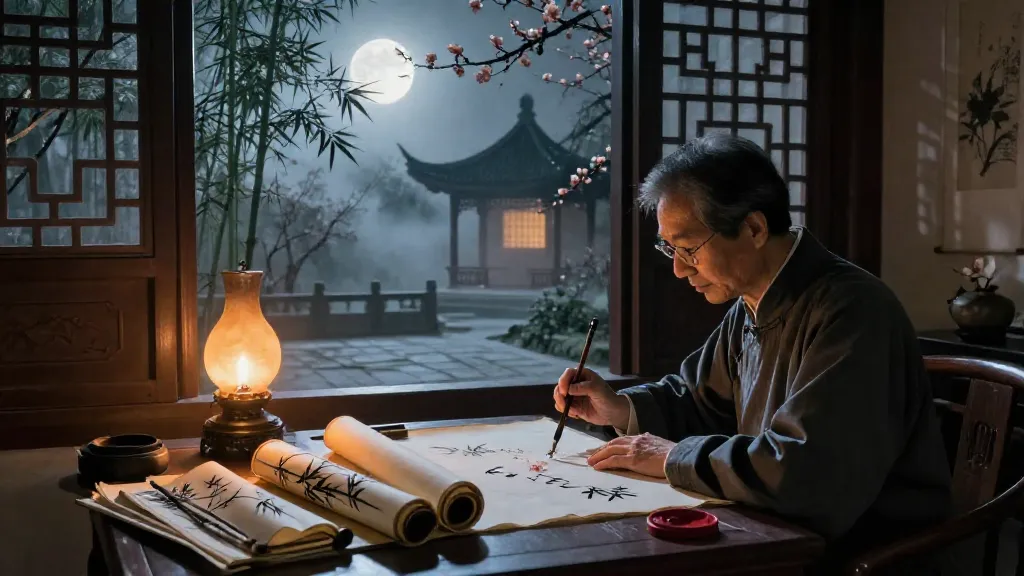
說林下 (A Forest of Persuasions, Part II) — Chinese ink painting

韓非子 Hanfeizi · Chapter 23

說林下

A Forest of Persuasions, Part II

View:

踶馬與置猿於柙

The Kicking Horse and the Monkey in a Cage

伯樂教二人相踶馬,相與之簡子廄觀馬。一人舉踶馬。其一人從後而循之,三撫其尻而馬不踢。此自以為失相。其一人曰:“子非失相也,此其為馬也,踒肩而腫膝。夫踢馬也者,舉後而任前,腫膝不可任也,故後不舉。子巧於相踢馬拙於任腫膝。“夫事有所必歸,而以有所腫膝而不任,智者之所獨知也。惠子曰:“置猿於柙中,則與豚同。“故勢不便,非所以逞能也。

Bo Le taught two men to identify kicking horses. They went together to Lord Jianzi's stables to examine horses. One identified a kicking horse. The other approached from behind, stroked its hindquarters three times, and the horse did not kick. The first man thought he had misjudged.

The other said: 'You did not misjudge. This horse has a dislocated shoulder and swollen knees. A kicking horse kicks by raising its hind legs and bearing down on its front legs, but with swollen knees it cannot bear the weight, so its hind legs do not rise. You were skilled at identifying kicking horses but unskilled at noticing swollen knees.'

In affairs there is always an underlying cause. To recognize something that is not manifest because of a hidden impediment -- this is what only the wise perceive.

Huizi said: 'Put a monkey in a cage, and it is no different from a pig.' When circumstances are unfavorable, abilities cannot be displayed.

Notes

1person伯樂Bo Le

Bo Le (伯樂) was the legendary horse expert of antiquity, whose name became synonymous with the ability to recognize talent. His teaching of horse-identification is an allegory for political judgment.

2context

Huizi's aphorism about the caged monkey illustrates the Legalist concept of 勢 (positional advantage): talent is meaningless without the right conditions. A brilliant minister in the wrong institutional position is as useless as a monkey in a cage.

刻削之道・崇侯與比干

The Art of Carving; Chong Hou and Bi Gan

桓赫曰:“刻削之道,鼻莫如大,目莫如小。鼻大可小,小不可大也;目小可大,大不可小也。“舉事亦然:為其後可復者也,則事寡敗矣。崇候、惡來知不適紂之誅也,而不見武王之滅之也。比干、子胥知其君之必亡也,而不知身之死也。故曰:“崇候、惡來知心而不知事,比干、子胥知事而不知心。“聖人其備矣。

Huan He said: 'In the art of carving, the nose should start large and the eyes should start small. A large nose can be made smaller, but a small nose cannot be enlarged. Small eyes can be widened, but large eyes cannot be reduced.' Undertaking affairs is the same: if one acts so that mistakes can still be corrected, then failures will be few.

Chong Hou and E Lai understood that they should not displease Zhou of Shang's tyranny, but did not foresee that King Wu would destroy them. Bi Gan and Wu Zixu knew that their lords would inevitably perish, but did not foresee their own deaths.

Therefore it is said: 'Chong Hou and E Lai knew the heart but not the course of events. Bi Gan and Wu Zixu knew the course of events but not the heart.' The sage is complete in both.

Notes

1person比干Bi Gan

Bi Gan (比干) was a loyal minister of Shang who remonstrated against King Zhou's tyranny and was executed -- his heart cut out. Wu Zixu (伍子胥) was the loyal minister of Wu whose warnings about Yue were ignored by King Fuchai, leading to Wu Zixu's forced suicide.

2context

The carving metaphor -- start with more material than needed, so you can always reduce -- is a principle of strategic reversibility. Han Fei's political reading: leave yourself room to correct course; do not commit irrevocably.

弱子之弓・遠水不救近火

The Weak Child's Bow; Distant Water Cannot Save a Nearby Fire

惠子曰:羿執鞅持扞,操弓關機,越人爭為持的。弱子扞弓,慈母入室閉戶。“故曰:“可必,則越人不疑羿;不可必,則慈母逃弱子。“魯穆公使眾公子或宦於晉,或宦於荊。犁鉏曰:“假人于越而救溺子,越人雖善游,子必不生矣。失火而取水于海,海水雖多,火必不滅矣,遠水不救近火也。今晉與荊雖強,而齊近,魯患其不救乎!“

Huizi said: 'When Yi the Archer takes up his arm-guard, grasps his bow, and draws the mechanism, the people of Yue compete to hold the target. But when a weak child draws a bow, even a loving mother enters the room and shuts the door.'

Therefore it is said: 'When success is certain, the people of Yue do not doubt Yi. When success is uncertain, even a loving mother flees her own child.'

Duke Mu of Lu sent his many sons to serve at the courts of Jin and Chu. Li Chu said: 'If you borrow a man from Yue to rescue a drowning child -- though the people of Yue are skilled swimmers, the child will surely die. If a fire breaks out and you fetch water from the sea -- though the sea has abundant water, the fire will surely not be quenched. Distant water cannot save a nearby fire. Though Jin and Chu are strong, Qi is near. Does Lu not worry that help will fail to arrive?'

Notes

1person羿Yi

Yi (羿), also known as Hou Yi, was the legendary divine archer. His presence at the bow guaranteed safety, making even strangers willing to hold the target.

2context

The proverb '遠水不救近火' ('distant water cannot quench a nearby fire') became one of the most enduring maxims in Chinese political and military thought, warning against reliance on distant allies when facing immediate threats.

三虱爭肥・海大魚

Three Lice Fight over Fat; The Great Fish of the Sea

三虱食彘相與訟,一虱過之,曰:“訟者奚說?“三虱曰:“爭肥饒之地。“一虱曰:“若亦不患臘之至而茅之燥耳,其又奚患?“於是乃相與聚嘬其身而食之。彘臞,人乃弗殺。靖郭君將城薛,客多以諫者。靖郭君謂謁者曰:“毋為客通。“齊人有請見者曰:“臣請三言而已。過三言,臣請烹。“靖郭君因見之。客趨進曰:“海,大,魚。“因反走。靖郭君曰:請聞其說。客曰:“臣不敢以死為戲。“靖郭君曰:“原為寡人言之。“答曰:“君聞大魚乎?網不能止,繳不能絓也,盪而失水,螻蟻得意焉。今夫齊亦君之海也。君長有齊,奚以薛為?君失齊,雖隆薛城至於天,猶無益也。“靖郭君曰:“善。“乃輟,不城薛。

Three lice were feeding on a pig and quarreling among themselves. Another louse passed by and asked: 'What are you arguing about?' The three lice said: 'We are fighting over the fattiest spot.' The other louse said: 'Are you not worried that the winter sacrifice is approaching and the pig will be singed with dry straw? What else is there to worry about?' At this, the lice all gathered together and fed on the pig in concert. The pig grew thin, and its owner therefore did not slaughter it.

Lord Jingguo was about to fortify the city of Xue. Many guests remonstrated against it. Lord Jingguo told the gatekeeper: 'Admit no more guests.' A man of Qi requested an audience, saying: 'I ask for three words only. If I exceed three words, I request to be boiled alive.' Lord Jingguo agreed to see him. The guest hurried forward and said: 'Sea. Big. Fish.' Then he turned to leave.

Lord Jingguo said: 'Please let me hear your explanation.' The guest said: 'I dare not treat my death as a joke.' Lord Jingguo said: 'I beg you to explain.' The guest replied: 'Has my lord heard of the great fish? Nets cannot hold it; lines cannot snare it. But should it be cast up and lose the water, even mole-crickets and ants will have their way with it. Now Qi is my lord's sea. As long as you possess Qi, what need have you of Xue? If you lose Qi, though you raise the walls of Xue to the heavens, it will avail nothing.' Lord Jingguo said: 'Excellent.' And he ceased fortifying Xue.

Notes

1person靖郭君 (田嬰)Jingguo Jun (Tian Ying)

Lord Jingguo (靖郭君), also known as Tian Ying (田嬰), was a prince of Qi and father of Lord Mengchang (孟嘗君). Xue (薛) was his personal fief in modern Shandong.

2context

The lice parable warns against infighting when a common existential threat looms. The great fish parable warns against investing in a personal stronghold at the expense of one's position in the larger political structure. Both illustrate the Legalist concern with strategic priorities.

管鮑相收・沮衛蹶鬲犒師

Guan Zhong and Bao Shu's Pact; The Wu Envoys Bold Reply

管仲、鮑叔相謂曰:“不壽君亂甚矣,必失國。齊國之諸公子其可輔者,非公子糾,則小白也。與子人事一人焉,先達者相收。“管仲乃從公子糾,鮑叔從小白。國人果弒君。小白先人為君,魯人拘管仲而效之,鮑叔言而相之。故諺曰:“巫鹹雖善祝,不能自祓也;秦醫雖善除,不能自彈也。“以管仲之聖而待鮑叔之助,此鄙諺所謂“虜自賣裘而不售,士自譽辯而不信“者也。荊王伐吳,吳使沮衛、蹶鬲犒於荊師,而將軍曰:“縛之,殺以釁鼓。“問之曰:“汝來,卜乎?“答曰:“卜。“”卜吉乎?“曰:“吉。“荊人曰:“今荊將以汝釁鼓,其何也?“答曰:“是故其所以吉也。吳使臣來也,固視將軍怒,將軍怒,將深溝高壘;將軍不怒,將懈怠。今也將軍殺臣,則吳必警守矣。且國之卜,非為一臣卜。夫殺一臣而存一國,其不言吉何也?且死者無知,則以臣釁鼓無益也;死者有知也,臣將當戰之時,臣使鼓不鳴。“荊人因不殺也。

Guan Zhong and Bao Shu said to each other: 'The lord Wuzhi's reign is extremely disordered; he will surely lose the state. Among the princes of Qi who could be supported, it is either Prince Jiu or Xiao Bai. Let each of us attach ourselves to one -- and whichever reaches the throne first shall rescue the other.' Guan Zhong thereupon followed Prince Jiu; Bao Shu followed Xiao Bai. The people of Qi indeed assassinated their lord. Xiao Bai arrived first and became duke. The people of Lu arrested Guan Zhong and handed him over. Bao Shu spoke on his behalf and had him made prime minister.

Therefore the proverb says: 'Though the shaman Wu Xian excels at blessings, he cannot purify himself. Though the physician of Qin excels at curing illness, he cannot treat himself.' Even with Guan Zhong's sagacity, he required Bao Shu's assistance. This is what the common proverb means: 'A captive selling his own fur coat finds no buyer; a scholar praising his own eloquence finds no believer.'

The King of Chu attacked Wu. Wu sent Ju Wei and Jue Ge to present gifts to the Chu army. The Chu general said: 'Bind them and kill them to consecrate the war drums.' He asked them: 'Before you came, did you divine?' They answered: 'We divined.' 'Was the omen auspicious?' 'Auspicious.'

The Chu man said: 'Now Chu is about to use your blood to consecrate its drums -- how is that auspicious?' They answered: 'This is precisely why it is auspicious. Wu sent us precisely to observe whether your general would be angry. If the general is angry, he will deepen his moats and raise his ramparts. If the general is not angry, he will grow lax and negligent. Now if the general kills us, Wu will certainly heighten its guard. Moreover, the state's divination was not for one minister alone. If killing one minister preserves one state, how could the omen not be called auspicious? Furthermore, if the dead have no consciousness, then consecrating the drums with our blood is useless. If the dead have consciousness, we shall ensure that the drums will not sound when battle comes.' The Chu men therefore did not kill them.

Notes

1context

The Guan Zhong and Bao Shu pact is one of the most famous friendships in Chinese history. Their strategy of hedging bets by each supporting a different prince is a masterclass in political insurance. The proverb '管鮑之交' (the friendship of Guan and Bao) remains current.

2context

The Wu envoys' argument is a brilliant piece of rhetorical judo: they transform their impending execution into proof that their divination was correct, since their death would alert Wu's defenses. This illustrates the Legalist appreciation for rhetoric that reframes unfavorable situations.

韓魏兄弟・鄭人之子

Han and Wei as Brothers; The Son of the Zheng Man

韓、趙相與為難。韓子索兵於魏,曰:“願借師以伐趙。“魏文候曰:“寡人與趙兄弟,不可以從。“趙又索兵以攻韓。文候曰:“寡人與韓兄弟,不敢從。“二國不得兵,怒而反。已乃知文候以構於已,乃皆朝魏。鄭人有一子,將宦,謂其家曰:“必築壞牆,是不善人將竊。“其巷人亦云。不時築,而人果竊之。以其子為智,以巷人告者為盜。

Han and Zhao were in conflict. Han requested troops from Wei, saying: 'We wish to borrow an army to attack Zhao.' Marquis Wen of Wei said: 'I am brothers with Zhao -- I cannot comply.' Zhao then requested troops to attack Han. Marquis Wen said: 'I am brothers with Han -- I dare not comply.' Both states failed to obtain troops and returned in anger. Only later did they realize that Marquis Wen had manipulated them into a stalemate. Both then came to pay court to Wei.

A man of Zheng had a son who was about to take up a post. The son said to his household: 'You must repair the broken wall -- otherwise dishonest people will steal from us.' A neighbor said the same thing. The wall was not repaired in time, and indeed someone stole from them. The family considered the son wise but suspected the neighbor of being the thief.

Notes

1person魏文侯Wei Wen Hou

Marquis Wen of Wei (魏文侯, r. 445-396 BC) was the founder of Wei as an independent state and the first of the great Warring States rulers. His refusal to take sides between Han and Zhao forced both to recognize Wei's mediating authority.

2context

The parable of the Zheng man's son illustrates a fundamental problem in political counsel: identical advice is received differently depending on the relationship between advisor and advisee. The son is praised for wisdom; the neighbor is suspected of complicity. This speaks directly to the dangers faced by outside advisors -- a theme Han Fei explored in Ch. 12 (說難, 'The Difficulty of Persuasion').

Edition & Source

Text
《韓非子》 Hanfeizi
Edition
中華古詩文古書籍網 transcription, 《四部叢刊》本
Commentary
Han Fei (韓非), Warring States period