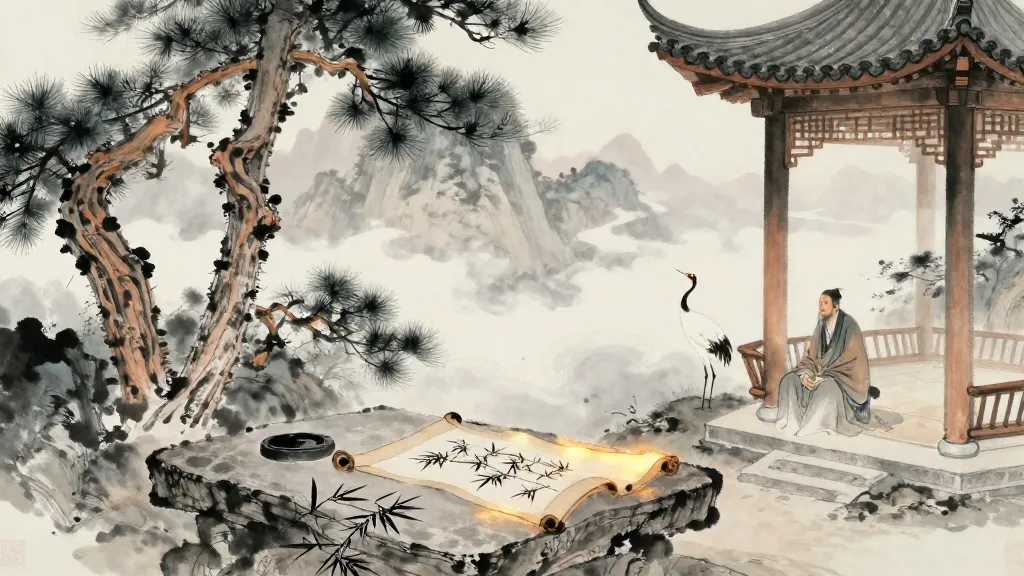
功名 (Achievement and Reputation) — Chinese ink painting

韓非子 Hanfeizi · Chapter 28

功名

Achievement and Reputation

View:

功名四要

The Four Conditions for Achievement

明君之所以立功成名者四:一曰天時,二曰人心,三曰技能,四曰勢位。非天時,雖十堯不能冬生一穗;逆人心,雖賁、育不能盡人力。故得天時則不務而自生,得人心,則不趣而自勸;因技能則不急而自疾;得勢位則不推進而名成。若水之流,若船之浮。守自然之道,行毋窮之令,故曰明主。

An enlightened ruler achieves merit and establishes his name through four conditions: first, the timeliness of Heaven; second, the hearts of the people; third, technical ability; fourth, positional advantage. Without Heaven's timing, even ten Yaos could not make a single ear of grain grow in winter. Against the hearts of the people, even Meng Ben and Xia Yu could not exhaust the people's strength. Therefore, when one obtains Heaven's timing, things grow of themselves without effort; when one wins the people's hearts, they exert themselves without being urged; when one relies on technical ability, things proceed swiftly without haste; when one holds positional advantage, one's name is established without pushing forward. Like the flow of water, like a boat floating on the current -- this is to preserve the way of nature and issue inexhaustible commands. Hence we speak of an enlightened ruler.

Notes

1person孟賁Meng Ben

Meng Ben (孟賁) and Xia Yu (夏育) were legendary strongmen of ancient China, conventionally invoked as paragons of physical strength.

2context

The four conditions (天時, 人心, 技能, 勢位) form a systematic framework. Notably, 勢位 (positional advantage) is the distinctively Legalist element -- the ruler's institutional power, independent of personal virtue.

勢位之重

The Weight of Positional Advantage

夫有材而無勢,雖賢不能制不肖。故立尺材於高山之上,下則臨千仞之谷,材非長也,位高也。桀為天子,能制天下,非賢也,勢重也;堯為匹夫,不能正三家,非不肖也,位卑也。千鈞得船則浮,錙銖失船則沉,非千鈞輕錙銖重也,有勢之與無勢也。故短之臨高也以位,不肖之制賢也以勢。

One may have talent but lack positional advantage; though worthy, one cannot control the unworthy. Place a one-foot timber atop a high mountain and it looks down upon a valley a thousand ren deep -- not because the timber is tall, but because its position is high. Jie was Son of Heaven and could control All-Under-Heaven -- not because he was worthy, but because his positional advantage was great. Were Yao a commoner, he could not have corrected even three households -- not because he was unworthy, but because his position was lowly. A weight of a thousand jun floats if it has a boat; a weight of a few zhu sinks without one -- not because the thousand jun is light and the few zhu heavy, but because one has positional advantage and the other does not. Thus the short overlooks the tall through position, and the unworthy controls the worthy through positional advantage.

Notes

1context

This passage is one of the clearest statements of the Legalist concept of 勢 (shi, positional advantage). The argument -- that institutional power matters more than personal virtue -- directly challenges the Confucian premise that the ruler's moral character determines political outcomes.

2personJie

Jie (桀) was the last ruler of the Xia dynasty, the archetypal tyrant paired with Zhou of Shang. Han Fei's point is that even a tyrant can rule effectively if the institutional position is powerful enough.

君臣相持

The Mutual Dependence of Ruler and Minister

人主者,天下一力以共載之,故安;眾同心以共立之,故尊。人臣守所長,盡所能,故忠。以尊主御忠臣,則長樂生而功名成。名實相持而成,形影相應而立,故臣主同欲而異使。人主之患在莫之應,故曰,一手獨拍,雖疾無聲。人臣之憂在不得一,故曰,右手畫圓,左手畫方,不能兩成。故曰,至治之國,君若桴,臣若鼓,技若車,事若馬。故人有餘力易於應,而技有餘巧便於事。立功者不足於力,親近者不足於信,成名者不足於勢。近者不親,而遠者不結,則名不稱實者也。

The ruler is borne up by the unified strength of All-Under-Heaven, and so he is secure; he is established by the united hearts of the multitude, and so he is exalted. The minister guards his strengths and exhausts his abilities, and so he is loyal. When an exalted ruler commands loyal ministers, lasting joy arises and achievement and reputation are established. Name and substance sustain each other to completion; form and shadow correspond to each other in standing. Thus ruler and minister share the same desires but differ in their functions.

The ruler's worry is that none will respond to him; hence the saying: 'One hand clapping alone, however fast, makes no sound.' The minister's worry is that he cannot focus on one thing; hence the saying: 'Drawing a circle with the right hand and a square with the left, one cannot complete both.' Therefore it is said: in a perfectly governed state, the ruler is like the drumstick, the minister like the drum, skill is like the carriage, and affairs are like the horse.

When people have surplus strength, it is easy to respond; when skill has surplus craft, it is convenient for affairs. Those who would establish merit lack strength; those who would be close lack trust; those who would establish a name lack positional advantage. When those nearby are not close and those far away do not attach themselves, then name does not match reality.

Notes

1translation

桴 (fu) is a drumstick. The metaphor of ruler as drumstick and minister as drum captures the Legalist ideal: the ruler initiates and sets the rhythm, but the actual sound (governance) comes from the ministers responding to the beat.

2context

The 'one hand clapping' (一手獨拍) metaphor appears here in a political context -- the ruler needs responsive ministers to translate will into action. This differs from the later Zen Buddhist usage of the same image.

功名之成

The Completion of Achievement and Reputation

聖人德若堯、舜,行若伯夷,而位不載於世,則功不立,名不遂。故古之能致功名者,眾人助之以力,近者結之以成,遠者譽之以名,尊者載之以勢。如此,故太山之功長立於國家,而日月之名久著於天地。此堯之所以南面而守名,舜之所以北面而效功也。

A sage may possess the virtue of Yao and Shun and the conduct of Bo Yi, yet if his position does not carry weight in the world, his merit will not be established and his name will not endure. Therefore those in antiquity who were able to achieve merit and reputation had the multitude assist them with strength, those nearby bind themselves in loyalty, those far away celebrate them with praise, and those in high position sustain them with positional advantage.

Thus the achievement of Mount Tai stands long over the state, and the name of the sun and moon endures forever in heaven and earth. This is how Yao, facing south, preserved his name, and how Shun, facing north, rendered his merit.

Notes

1person伯夷Bo Yi

Bo Yi (伯夷) was a prince of the Guzhu state who refused to serve the Zhou dynasty after it overthrew the Shang. He starved to death on Mount Shouyang rather than eat Zhou grain, becoming a paragon of principled conduct.

2translation

南面 (facing south) is the position of the ruler, who traditionally sat facing south. 北面 (facing north) is the position of the minister. Yao 'preserved his name' as ruler; Shun 'rendered his merit' as minister before succeeding Yao.

Edition & Source

Text
《韓非子》 Hanfeizi
Edition
中華古詩文古書籍網 transcription, 《四部叢刊》本
Commentary
Han Fei (韓非), Warring States period