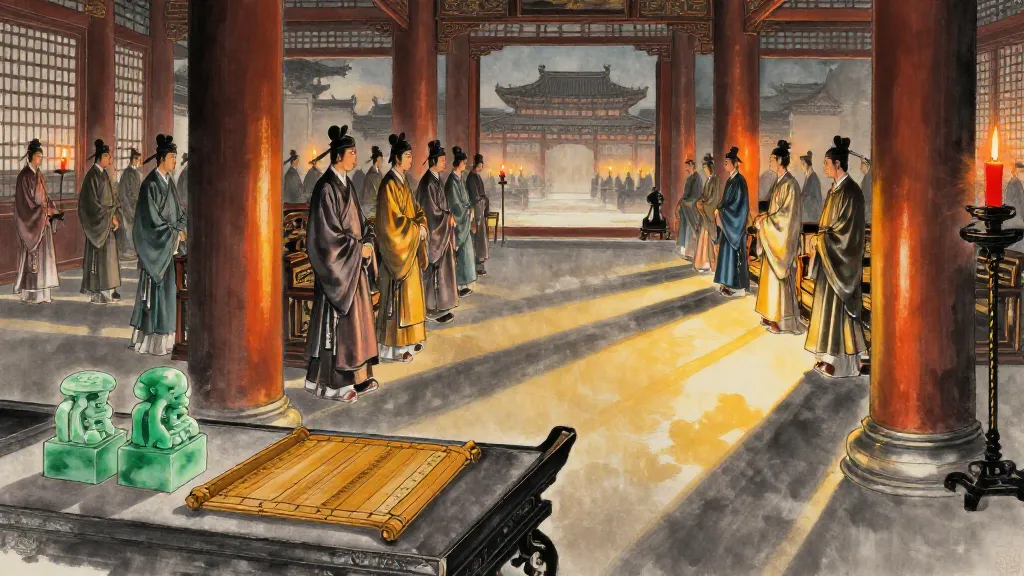
The answer: "In the state of an enlightened ruler, edicts are the most valued of all speech, and the law is the most fitting standard for all affairs. Speech has no second authority, and the law admits no competing standard. Therefore speech and conduct that do not conform to laws and edicts are invariably prohibited. If someone has something to say that is not covered by existing laws and edicts but can be used to counter deception, respond to contingencies, generate profit, or assess situations, the ruler will certainly adopt his words and hold him accountable for results. If his words prove correct, he receives great reward; if not, he receives severe punishment. Thus the foolish fear punishment and dare not speak, while the intelligent have nothing to dispute about. This is why there is no disputation.
In a chaotic age it is otherwise. The ruler issues edicts, and the people use literary learning to criticize them. The government has laws, and the people use private conduct to circumvent them. The ruler gradually abandons his laws and edicts and honors the wisdom and conduct of scholars -- this is why the age abounds in literary learning.
Speech and conduct require practical results as their target. If one sharpens arrows to a lethal edge and fires them randomly, the tips may well hit something as fine as an autumn hair -- yet this cannot be called good marksmanship, for there was no fixed target. Set up a five-inch target at a distance of ten paces, and none but Yi or Feng Meng can hit it with certainty -- because there is a fixed target. With a fixed standard, even Yi and Feng Meng find the five-inch target challenging. Without a fixed standard, hitting an autumn hair by random shooting is considered clumsy.
Now if we listen to speech and observe conduct without making practical results the target, then no matter how penetrating the speech or how resolute the conduct, it is the random-shooting school. Thus in a chaotic age, when listening to speech, they take what is difficult to understand as 'penetrating' and what is broadly learned as 'eloquent.' When observing conduct, they take separation from the crowd as 'worthy' and defiance of superiors as 'resolute.' The ruler is pleased by penetrating and eloquent speech and honors worthy and resolute conduct. Therefore those who construct systems of law and techniques, those who establish standards of acceptance and rejection, those who distinguish disputation and argument -- none of them can set the standard. As a result, those who wear Confucian robes and carry swords multiply, while farmers and soldiers dwindle. Treatises on 'hard and white' and 'having no thickness' flourish, while constitutional law withers. Therefore it is said: when the ruler lacks discernment, disputation arises."