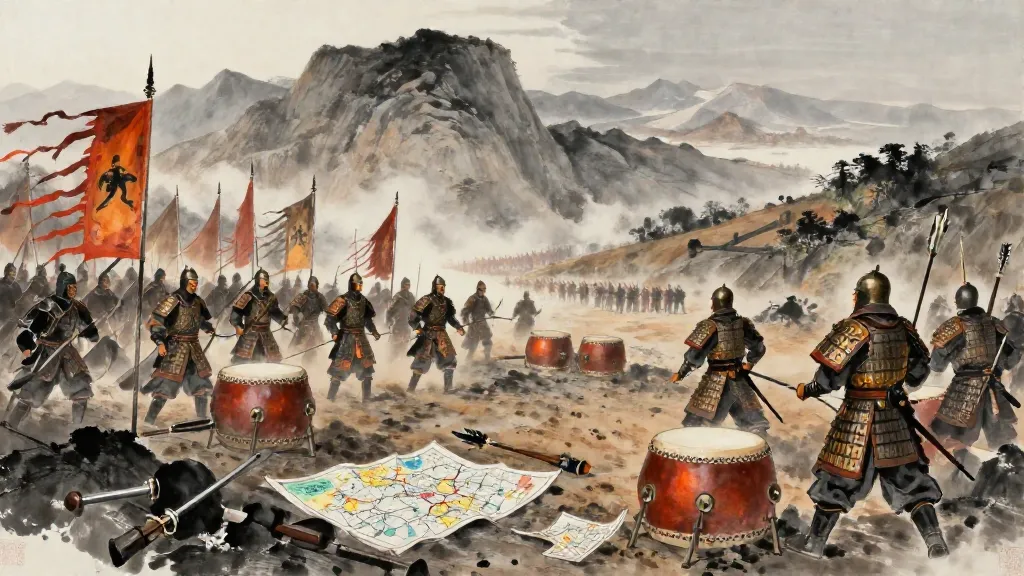
問田 (Questioning Tian Jiu) — Chinese ink painting

韓非子 Hanfeizi · Chapter 42

問田

Questioning Tian Jiu

View:

徐渠問田鳩

Xu Qu Questions Tian Jiu

徐渠問田鳩曰:"臣聞智士不襲下而遇君,聖人不見功而接上。令陽城義渠,明將也,而措於毛伯;公孫亶回,聖相也,而關於州部,何哉?"田鳩曰:"此無他故異物,主有度、上有術之故也。且足下獨不聞楚將宋觚而失其政,魏相馮離而亡其國?二君者驅於聲詞,眩乎辯說,不試於毛伯,不關乎州部,故有失政亡國之患。由是觀之,夫無毛伯之試,州部之關,豈明主之備哉!"

Xu Qu asked Tian Jiu: "I have heard that the wise officer does not bypass lower ranks to meet the ruler, and the sage does not present himself to superiors without proven merit. Now Yangcheng Yiqu is a brilliant general, yet he is stationed at the Maobo post; Gongsun Dan Hui is a sage minister, yet he is checked at the prefecture level. Why is this?" Tian Jiu said: "There is no other reason or strange circumstance -- it is because the ruler has standards and the sovereign has techniques. Has Your Excellency alone not heard how Chu appointed Song Gu as general and lost its governance, or how Wei appointed Feng Li as minister and lost its state? Those two rulers were driven by rhetoric and dazzled by eloquent persuasion. They did not test at the Maobo post, they did not check at the prefecture level -- and so they suffered the calamity of lost governance and a ruined state. Seen from this perspective, without the testing at Maobo and the checking at the prefectures, how would the enlightened ruler have his safeguards?"

Notes

1person田鳩Tian Jiu

Tian Jiu (田鳩) was a Legalist-inclined thinker, possibly a colleague or associate of Han Fei. He appears in this chapter as a spokesperson for the view that institutional gatekeeping is essential.

2context

The 'Maobo post' (毛伯) and 'prefecture level' (州部) represent the lower and middle ranks of the bureaucratic hierarchy. The argument is that even brilliant men must prove themselves through the system rather than being promoted based on reputation alone.

堂谿公與韓子論危身

Lord Tangxi and Han Fei on the Danger of Reform

堂谿公謂韓子曰:"臣聞服禮辭讓,全之術也;修行退智,遂之道也。今先生立法術,設度數,臣竊以為危於身而殆於軀。何以效之?所聞先生術曰:'楚不用吳起而削亂,秦行商君而富強。二子之言已當矣,然而吳起支解而商君車裂者,不遇世遇主之患也。'逢遇不可必也,患禍不可斥也。夫舍乎全遂之道而肆乎危殆之行,竊為先生無取焉。"韓子曰:"明先生之言矣。夫治天下之柄,齊民萌之度,甚未易處也。然所以廢先王之教,而行賤臣之所取者,竅以為立法術,設度數,所以利民萌便眾庶之道也。故不憚亂主暗上之患禍,而必思以齊民萌之資利者,仁智之行也。憚亂主暗上之患禍,而避乎死亡之害,知明而不見民萌之資夫科身者,貪鄙之為也。臣不忍向貪鄙之為,不敢傷仁智之行。先王有幸臣之意,然有大傷臣之實。"

Lord Tangxi said to Master Han: "I have heard that observing ritual propriety and yielding to others is the art of self-preservation, and cultivating virtue while retiring from cleverness is the way of self-completion. Now you, sir, establish systems of law and techniques, and set up measures and standards. I privately think this endangers your person and imperils your life. How do I demonstrate this? From what I have heard of your doctrines, you say: 'Chu did not employ Wu Qi and was diminished and disordered; Qin implemented Shang Yang's reforms and became rich and powerful. The words of these two men were proven correct, yet Wu Qi was dismembered and Shang Yang was torn apart by chariots -- the calamity of not encountering the right age and the right ruler.' Favorable encounters cannot be guaranteed, and calamity cannot be warded off. To abandon the way of self-preservation and self-completion and to indulge in dangerous conduct -- I privately think there is nothing in this for you, sir."

Master Han said: "I understand your words clearly. The handle for governing All-Under-Heaven and the standards for ordering the common people are indeed not easy matters. Yet the reason I set aside the teachings of the former kings and practice what this humble minister has chosen is that I believe establishing systems of law and techniques and setting up measures and standards is the way to benefit the common people and bring convenience to the masses. Therefore, not fearing the calamity that comes from chaotic rulers and benighted sovereigns, but resolutely striving to provide the people with resources and benefits -- this is the conduct of benevolence and wisdom. To fear the calamity from chaotic rulers and benighted sovereigns, to avoid the harm of death and destruction, to have clear understanding yet fail to see the people's need because one is calculating for oneself -- this is the conduct of greed and baseness. I cannot bring myself to turn toward greed and baseness, and I dare not impair the conduct of benevolence and wisdom. Your words, sir, carry the intention of caring for me, yet in substance they would do me great harm."

Notes

1person吳起Wu Qi

Wu Qi (吳起, c. 440-381 BC) was a brilliant military commander and reformer who served several states. As chancellor of Chu, his reforms weakened the nobility, and after his patron King Dao died, the nobles had him dismembered.

2person商鞅Shang Yang

Shang Yang (商鞅, c. 390-338 BC), also known as Lord Shang, was the great Legalist reformer of Qin whose laws transformed Qin into the dominant military power. After his patron Duke Xiao died, he was executed by being torn apart by chariots.

3context

This is one of the most personal passages in the Hanfeizi, where Han Fei directly addresses the mortal danger of being a Legalist reformer. Lord Tangxi offers the Daoist-Confucian counsel of prudent withdrawal; Han Fei's response is essentially a declaration of political martyrdom -- he would rather die pursuing reform than live in 'greed and baseness.' Historically, Han Fei was indeed forced to commit suicide while imprisoned in Qin, making this passage tragically prophetic.

Edition & Source

Text
《韓非子》 Hanfeizi
Edition
中華古詩文古書籍網 transcription, 《四部叢刊》本
Commentary
Han Fei (韓非), Warring States period