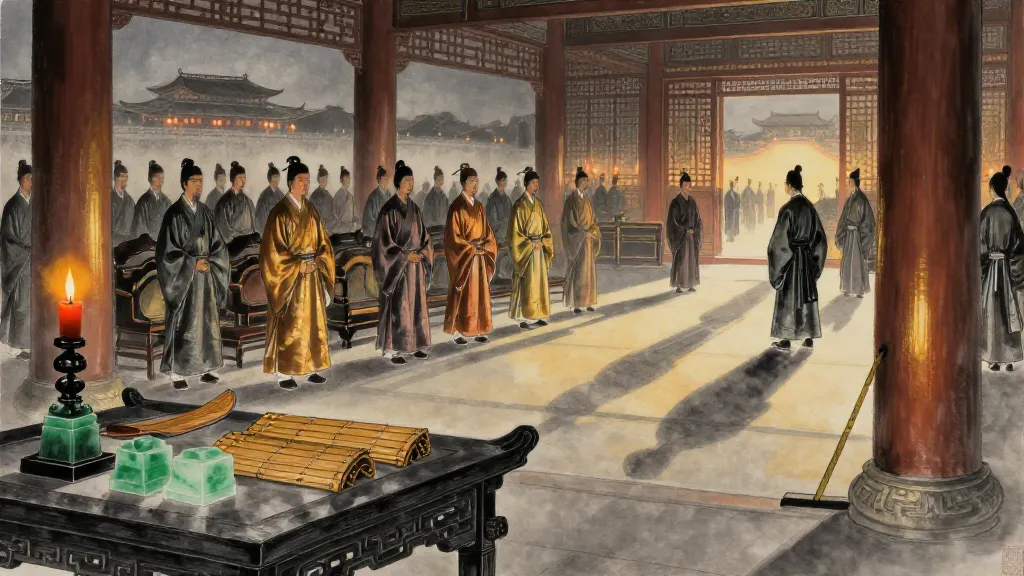
定法 (Fixing the Standard of Law) — Chinese ink painting

韓非子 Hanfeizi · Chapter 43

定法

Fixing the Standard of Law

View:

申不害與商鞅孰急

Which Is More Urgent: Shen Buhai or Shang Yang?

問者曰:"申不害、公孫鞅,此二家之言孰急於國?"

應之曰:"是不可程也。人不食,十日則死;大寒之隆,不衣亦死。謂之衣食孰急於人,則是不可一無也,皆養生之具也。今申不害言術而公孫鞅為法。術者,因任而授官,循名而責實,操殺生之柄,課群臣之能者也。此人主之所執也。法者,憲令著於官府,刑罰必於民心,賞存乎慎法,而罰加乎奸令者也。此臣之所師也。君無術則弊於上,臣無法則亂於下,此不可一無,皆帝王之具也。"

A questioner asked: "Between Shen Buhai and Gongsun Yang, whose teachings are more urgent for the state?"

The answer: "This cannot be measured comparatively. If a man does not eat, he dies in ten days. In the depth of great cold, without clothing he also dies. To ask whether clothing or food is more urgent for a person -- neither can be dispensed with, for both are necessities of life. Now Shen Buhai advocated techniques while Gongsun Yang established the law. Techniques involve appointing officials according to their responsibilities, demanding results that match their titles, holding the power of life and death, and evaluating the abilities of all ministers. This is what the ruler must personally wield. The law involves constitutional edicts published in government offices, punishments firmly impressed upon the people's minds, rewards reserved for those who carefully follow the law, and penalties imposed on those who violate edicts. This is what ministers must take as their guide. When the ruler lacks techniques, he is undermined at the top. When ministers lack law, there is chaos below. Neither can be dispensed with -- both are the instruments of emperors and kings."

Notes

1person申不害Shen Buhai

Shen Buhai (申不害, c. 400-337 BC) served as chancellor of Han for fifteen years. He is the principal theorist of 'techniques' (術) -- methods for the ruler to manage his bureaucracy.

2person公孫鞅Gongsun Yang

Gongsun Yang (公孫鞅) is another name for Shang Yang (商鞅), the great Legalist reformer of Qin who emphasized codified law (法) as the foundation of state power.

3context

This chapter is Han Fei's definitive synthesis of the two major strands of Legalist thought: Shen Buhai's techniques (術) for managing ministers and Shang Yang's codified law (法) for governing the people. Han Fei argues both are indispensable, like food and clothing.

徒術無法,徒法無術之患

The Problems of Techniques Without Law, and Law Without Techniques

問者曰:"徒術而無法,徒法而無術,其不可何哉?"

對曰:"申不害,韓昭侯之佐也。韓者,晉之別國也。晉之故法未息,而韓之新法又生;先君之令未收,而後君之令又下。申不害不擅其法,不一其憲令,則奸多。故利在故法前令則道之,利在新法後令則道之,利在故新相反,前後相勃,則申不害雖十使昭侯用術,而奸臣猶有所譎其辭矣。故托萬乘之勁韓,七十年而不至於霸王者,雖用術於上,法不勤飾於官之患也。公孫鞅之治秦也,設告相坐而責其實,連什伍而同其罪,賞厚而信,刑重而必。是以其民用力勞而不休,逐敵危而不卻,故其國富而兵強;然而無術以知奸,則以其富強也資人臣而已矣。及孝公、商君死,惠王即位,秦法未敗也,而張儀以秦殉韓、魏。惠王死,武王即位,甘茂以秦殉周。武王死,昭襄王即位,穰侯越韓、魏而東攻齊,五年而秦不益尺土之地,乃城其陶邑之封。應侯攻韓八年,成其汝南之封。自是以來,諸用秦者,皆應、穰之類也。故戰勝,則大臣尊;益地,則私封立:主無術以知奸也。商君雖十飾其法,人臣反用其資。故乘強秦之資數十年而不至於帝王者,法不勤飾於官,主無術於上之患也。"

The questioner asked: "Why is it unworkable to have techniques alone without law, or law alone without techniques?"

The answer: "Shen Buhai was the assistant of Marquis Zhao of Han. Han was a successor state of Jin. The old laws of Jin had not yet expired while Han's new laws were also being issued; the former ruler's edicts had not yet been withdrawn while the current ruler's edicts were being promulgated. Shen Buhai did not unify the law or standardize constitutional edicts, so treachery multiplied. When profit lay in the old laws and earlier edicts, people cited them; when profit lay in the new laws and later edicts, people cited those. When profit lay in the contradiction between old and new, between earlier and later, then even if Shen Buhai employed techniques with Marquis Zhao ten times over, treacherous ministers still found ways to twist their words. Therefore, despite possessing a state of ten thousand chariots as formidable as Han, for seventy years it did not achieve hegemony -- the problem was that though techniques were used at the top, the law was not diligently maintained in the offices.

Gongsun Yang's governance of Qin established mutual denunciation and collective responsibility, demanding accountability for results. He linked the groups of five and ten households to share in guilt. Rewards were generous and credible; punishments were severe and certain. Thus the people labored with all their strength without rest, and pursued the enemy into danger without retreating. The state grew rich and its army strong. Yet without techniques to detect treachery, that very wealth and strength merely provided resources for the ministers. After Duke Xiao and Shang Yang died and King Hui ascended the throne, Qin's laws had not deteriorated, yet Zhang Yi used Qin's resources to serve Han and Wei's interests. After King Hui died and King Wu ascended, Gan Mao used Qin's resources to serve Zhou's interests. After King Wu died and King Zhaoxiang ascended, the Marquis of Rang bypassed Han and Wei to attack Qi in the east for five years, gaining not a foot of territory for Qin but building up the walls of his own fief at Tao. The Marquis of Ying attacked Han for eight years, establishing his own fief at Runan. From that time on, all those who used Qin's power were of the same type as the Marquis of Ying and the Marquis of Rang. Thus when battles were won, great ministers gained prestige; when territory was added, private fiefs were established -- all because the ruler had no techniques for detecting treachery. Even if Shang Yang had perfected his laws ten times over, the ministers simply used those resources for themselves. That Qin rode its strength for decades without achieving imperial status was the problem of the law not being diligently maintained in the offices and the ruler lacking techniques at the top."

Notes

1person張儀Zhang Yi

Zhang Yi (張儀, d. 309 BC) was the famous Horizontal Alliance strategist who served as chancellor of Qin. Han Fei accuses him of pursuing campaigns that benefited his personal diplomacy rather than Qin's interests.

2person甘茂Gan Mao

Gan Mao (甘茂) was a chancellor of Qin under King Wu, accused here of using Qin's army for campaigns that served Zhou's interests rather than Qin's.

3person應侯 (范雎)Ying Hou (Fan Sui)

The Marquis of Ying (應侯) was Fan Sui (范雎, d. c. 255 BC), chancellor of Qin who displaced the Marquis of Rang. Despite his 'close attack, distant friendship' strategy, Han Fei accuses him of building his personal fief at Runan.

申商之法術皆未盡善

Neither Shen's Techniques nor Shang's Law Is Fully Perfected

問者曰:"主用申子之術,而官行商君之法,可乎?"

對曰:"申子未盡於法也。申子言:'治不逾官,雖知弗言'。治不逾官,謂之守職也可;知而弗言,是不謂過也。人主以一國目視,故視莫明焉;以一國耳聽,故聽莫聰焉。今知而弗言,則人主尚安假借矣?商君之法曰:'斬一首者爵一級,欲為官者為五十石之官;斬二首者爵二級,欲為官者為百石之官。'官爵之遷與斬首之功相稱也。今有法曰:'斬首者令為醫、匠。'則屋不成而病不已。夫匠者手巧也,而醫者齊藥也,而以斬首之功為之,則不當其能。今治官者,智慧型也;今斬首者,勇力之所加也。以勇力之所加而治者智慧型之官,是以斬首之功為醫、匠也。故曰:二子之於法術,皆未盡善也。"

The questioner asked: "Can the ruler employ Shen Buhai's techniques while the officials follow Shang Yang's laws?"

The answer: "Shen Buhai did not fully develop the law. Shen Buhai said: 'In governance, do not overstep your office; even if you know, do not speak.' Not overstepping one's office may be called maintaining one's duties -- that is acceptable. But knowing and not speaking is wrong. The ruler views through the eyes of the entire state, so no one sees more clearly; he listens through the ears of the entire state, so no one hears more keenly. If those who know do not speak, from whom can the ruler borrow insight?

Shang Yang's law says: 'One who takes one head receives one rank of nobility, and if he wishes to serve as an official, is appointed to a post of fifty shi. One who takes two heads receives two ranks, and if he wishes to serve as an official, is appointed to a post of one hundred shi.' The promotion in official rank corresponds to the merit of taking heads. Now suppose a law said: 'One who takes heads shall be made a physician or a carpenter.' Then houses would not be built and diseases would not be cured. Carpentry requires manual skill, and medicine requires knowledge of drugs -- to assign these based on the merit of taking heads does not match the required abilities. Now, governing offices requires wisdom and knowledge, while taking heads requires courage and strength. To govern offices requiring wisdom and knowledge based on the merit of courage and strength is exactly like making head-takers into physicians and carpenters.

Therefore I say: neither of the two masters fully perfected the law and techniques."

Notes

1context

This chapter reveals Han Fei as more than a mere synthesizer -- he is a critic of his predecessors. Shen Buhai's principle of 'not speaking beyond one's office' reduces the flow of information to the ruler. Shang Yang's promotion system equates military merit with administrative competence, a category error. Han Fei argues that true governance requires both a properly designed legal code AND techniques for the ruler to manage information flow -- each correcting the other's deficiencies.

2translation

循名而責實 ('follow names and demand realities') is one of the most important Legalist administrative principles: officials are assigned titles and responsibilities (名), and then held strictly accountable for matching results (實). This is the essence of Shen Buhai's 'techniques.'

Edition & Source

Text
《韓非子》 Hanfeizi
Edition
中華古詩文古書籍網 transcription, 《四部叢刊》本
Commentary
Han Fei (韓非), Warring States period