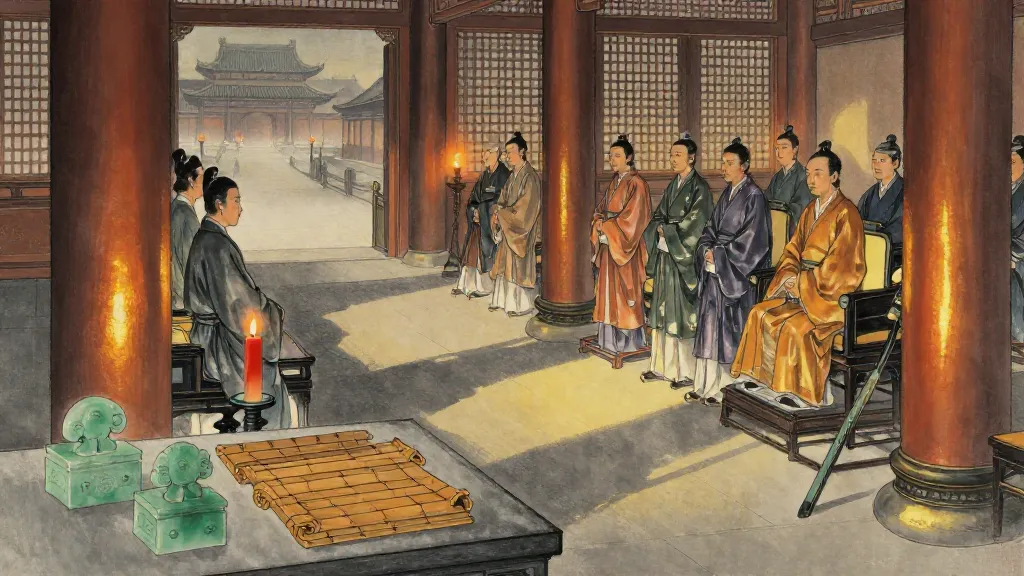
八說 (Eight Persuasions) — Chinese ink painting

韓非子 Hanfeizi · Chapter 47

八說

Eight Persuasions

View:

八私譽與八公利

Eight Private Praises versus Eight Public Benefits

為故人行私謂之"不棄",以公財分施謂之"仁人",輕祿重身謂之"君子",枉法曲親謂之"有行",棄官寵交謂之"有俠",離世遁上謂之"高傲",交爭逆令謂之"剛材",行惠取眾謂之"得民"。不棄者,吏有奸也;仁人者,公財損也;君子者,民難使也;有行者,法制毀也;有俠者,官職曠也;高傲者,民不事也;剛材者,令不行也;得民者,君上孤也。此八者,匹夫之私譽,人主之大敗也。反此八者,匹夫之私毀,人主之公利也。人主不察社稷之利害,而用匹夫之私毀,索國之無危亂,不可得矣。

To act on private interests for old acquaintances is called 'not abandoning friends.' To distribute public wealth is called 'being benevolent.' To value one's person above one's salary is called 'being a gentleman.' To bend the law to favor relatives is called 'having integrity.' To abandon one's office to indulge one's associates is called 'being chivalrous.' To withdraw from the world and defy superiors is called 'being lofty.' To quarrel and disobey orders is called 'being firm.' To bestow favors to win over the masses is called 'winning the people.'

But 'not abandoning friends' means officials harbor corruption. 'Being benevolent' means public wealth is depleted. 'Being a gentleman' means the people become difficult to employ. 'Having integrity' means the legal system is destroyed. 'Being chivalrous' means official posts go unfilled. 'Being lofty' means the people refuse to serve. 'Being firm' means orders are not carried out. 'Winning the people' means the ruler is left isolated.

These eight are the private praises of common men, but the great defeats of the ruler. The opposite of these eight are the private slanders of common men, but the public benefits of the ruler. If the ruler does not examine what benefits and harms the altars of state, and instead follows the private judgments of common men, it is impossible to keep the state free from danger and disorder.

Notes

1context

This opening passage exemplifies Han Fei's systematic method of argument: listing parallel cases to demonstrate that popular moral categories are inversions of political reality. Each 'virtue' praised by commoners is reframed as a threat to state power.

2translation

匹夫 (common man) is used pejoratively here, contrasted with 人主 (the ruler). Han Fei argues that the moral framework of ordinary people is fundamentally opposed to the interests of the state.

用人之術

The Technique of Employing Men

任人以事,存亡治亂之機也,無術以任人,無所任而不敗。人君之所任,非辯智則修潔也。任人者,使有勢也。智士者未必信也,為多其智,因惑其信也。以智士之計,處乘勢之資而為其私急,則君必欺焉。為智者之不可信也,故任修士者,使斷事也。修士者未必智,為潔其身、因惑其智。以愚人之所惽,處治事之官而為所然,則事必亂矣。故無術以用人,任智則君欺,任修則君事亂,此無術之患也。明君之道,賤德義貴,下必坐上,決誠以參,聽無門戶,故智者不得詐欺。計功而行賞,程能而授事,察端而觀失,有過者罪,有能者得,故愚者不任事。智者不敢欺,愚者不得斷,則事無失矣。

Appointing men to tasks is the pivot between survival and ruin, order and chaos. Without techniques for appointing men, there is no appointment that does not end in failure. Those whom a ruler appoints are either the eloquently clever or the morally upright.

To appoint a man is to give him power. A clever man is not necessarily trustworthy -- precisely because he has much cunning, his trustworthiness becomes doubtful. If the schemes of a clever man are combined with the resources of an empowered position and directed toward his private interests, the ruler will certainly be deceived. Because the clever cannot be trusted, one might instead appoint the morally upright to make decisions. But the upright are not necessarily clever -- precisely because they are pure in conduct, their judgment becomes doubtful. If a man of muddled understanding occupies an office that governs affairs and acts according to his limited comprehension, affairs will certainly fall into disorder.

Thus without techniques for employing men, appointing the clever leads to the ruler being deceived, and appointing the upright leads to the ruler's affairs falling into disorder. This is the disaster of having no techniques. The way of the enlightened ruler is to minimize the value placed on moral reputation: subordinates must answer to superiors, decisions must be verified through cross-checking, and channels of information must have no gatekeepers. Thus the clever cannot practice deception. He calculates merit and bestows rewards accordingly, measures ability and assigns tasks accordingly, examines the beginnings and observes the outcomes -- those with faults are punished, those with ability are advanced. Thus the foolish are not entrusted with affairs. When the clever dare not deceive and the foolish are not empowered to decide, then no affair will miscarry.

Notes

1translation

術 (techniques) is a core Legalist concept referring to the ruler's methods of bureaucratic control -- cross-checking reports, verifying performance against claims, and maintaining information asymmetry.

2translation

參 (cross-checking / verification) refers to the Legalist administrative method of comparing multiple independent sources of information to detect deception.

察與賢不可為法令

Discernment and Worthiness Cannot Serve as Law

察士然後能知之,不可以為令,夫民不盡察。賢者然後行之,不可以為法,夫民不盡賢。楊朱、墨崔,天下之所察也,乾世亂而卒不決,雖察而不可以為官職之令。鮑焦、華角,天下之所賢也,鮑焦木枯,華角赴河,雖賢不可以為耕戰之士。故人主之察,智士盡其辯焉;人主之所尊,能士能盡其行焉。今世主察無用之辯,尊遠功之行,索國之富強,不可得也。博習辯智如孔、墨,孔、墨不耕耨,則國何得焉?修孝寡慾如曾、史,曾、史不戰攻,則國何利焉?匹夫有私便,人主有公利。不作而養足,不仕而名顯,此私便也;息文學而明法度,塞私便而一功勞,此公利也。錯法以道民也,而又貴文學,則民之所師法也疑;賞功以勸民也,而又尊行修,則民之產利也惰。夫貴文學以疑法,尊行修以貳功,索國之富強,不可得也。

What only the discerning can understand cannot be made into ordinances, for the people are not all discerning. What only the worthy can practice cannot be made into the law, for the people are not all worthy. Yang Zhu and Mo Di were the most discerning minds All-Under-Heaven has known, yet they dried up the age with confusion and ultimately settled nothing -- however discerning, they cannot serve as models for official ordinances. Bao Jiao and Hua Jiao were the worthiest men All-Under-Heaven has known, yet Bao Jiao withered like a dead tree and Hua Jiao threw himself into the river -- however worthy, they cannot serve as soldiers for plowing and fighting.

When the ruler values discernment, clever men exhaust their sophistries before him. When the ruler honors ability, capable men exhaust their conduct before him. But when a ruler of today values useless eloquence and honors conduct far removed from practical achievement, it is impossible to make the state rich and strong. However broadly learned and eloquently clever a man may be, like Confucius and Mozi -- if Confucius and Mozi do not plow and weed, what does the state gain? However filial and ascetic a man may be, like Zeng Shen and Shi Qiu -- if Zeng Shen and Shi Qiu do not fight battles, what profit does the state receive?

The common man has his private conveniences; the ruler has the public benefit. To be fed without working and to be famous without serving -- these are private conveniences. To suppress literary learning and clarify legal standards, to block private conveniences and unify all effort toward merit -- these are the public benefit. If you establish the law to guide the people but also prize literary learning, then the people become confused about what standard to follow. If you reward merit to encourage the people but also honor cultivated conduct, then the people become lazy in their productive work. To prize literary learning so as to cast doubt on the law, and to honor cultivated conduct so as to divide the people's effort from merit -- seeking the state's wealth and strength under these conditions is impossible.

Notes

1person楊朱Yang Zhu

Yang Zhu (楊朱) was a philosopher known for extreme individualism, often paired with Mozi as representing opposite extremes. Mo Di is Mozi (墨翟/墨子), founder of the Mohist school.

2person鮑焦Bao Jiao

Bao Jiao (鮑焦) was a recluse who, according to legend, starved himself to death rather than eat the grain of a corrupt age. Hua Jiao (華角) drowned himself in the river as a protest against the world.

3person孔子Kongzi

Confucius (孔子) and Mozi (墨子) are cited as exemplars of learning and eloquence who nonetheless do not contribute to the material strength of the state -- a characteristic Legalist critique.

4person曾參Zeng Shen

Zeng Shen (曾參/曾子) was Confucius's disciple renowned for filial piety. Shi Qiu (史鰌/史魚) was a minister of Wei famous for his upright conduct.

古今異時

Ancient and Modern Times Differ

搢 笏乾戚,不適有方鐵銛;登降周鏇,不逮日中奏百;《狸首》射侯,不當強弩趨發;干城距衡沖,不若堙穴伏橐。古人亟於德,中世逐於智,當今爭於力。古者寡事而備簡,樸陋而不盡,故有珧銚而推車者。古者人寡而相親,物多而輕利易讓,故有揖讓而傳天下者。然則行揖讓,高慈惠,而道仁厚,皆推政也。處多事之時,用寡事之器,非智者之備也;當大爭之世,而循揖讓之軌,非聖人之治也。故智者不乘推車,聖人不行推政也。

Holding jade tablets and ceremonial axes cannot match the utility of iron-tipped weapons. Ascending and descending with ritual decorum cannot match the output of a hundred tasks completed by midday. Shooting at archery targets with the 'Fox Head' ode cannot match the rapid fire of powerful crossbows. Shield walls blocking battering rams cannot match the effectiveness of tunneling and bellows attacks.

The ancients were devoted to moral virtue; the middle age pursued cunning; the present age competes through strength. In ancient times, affairs were few and preparations simple -- things were crude and incomplete, so there were men who used shell-decorated hoes and pushed carts. In ancient times, people were few and treated each other with affection, goods were plentiful and profit was lightly regarded and easily yielded -- so there were those who passed All-Under-Heaven to another with a bow and a gesture.

But to practice polite yielding, to exalt kindness and generosity, and to preach benevolence and magnanimity -- all these belong to the politics of the pushcart age. To live in a time of many affairs yet use the tools of a time of few affairs is not the preparation of the wise. To face an age of great contention yet follow the track of polite yielding is not the governance of the sage. Therefore the wise do not ride pushcarts, and the sage does not practice pushcart politics.

Notes

1context

This passage contains one of Han Fei's most famous arguments: that political institutions must evolve with the times. The metaphor of the pushcart (推車) -- adequate for a primitive age but absurd in an age of chariots -- is used to ridicule Confucian nostalgia for the ways of the ancient sage-kings.

2translation

《狸首》(Fox Head) was a ritual ode sung during the archery ceremony described in the Zhou rites. Han Fei contrasts this ceremonial archery with the practical military technology of crossbows.

法之立難與權衡

The Difficulty of Establishing Law and the Calculus of Trade-offs

法所以制事,事所以名功也。法有立而有難,權其難而事成,則立之;事成而有害,權其害而功多,則為之。無難之法,無害之功,天下無有也。是以拔千丈之都,敗十萬之眾,死傷者軍之乘,甲兵折挫,士卒死傷,而賀戰勝得地者,出其小害計其大利也。夫沐者有棄發,除者傷血肉。為人見其難,因釋其業,是無術之事也。先聖有言曰:"規有摩而水有波,我欲更之,無奈之何!"此通權之言也。是以說有必立而曠於實者,言有辭拙而急於用者。故聖人不求無害之言,而務無易之事。人之不事衡石者,非貞廉而遠利也,石不能為人多少,衡不能為人輕重,求索不能得,故人不事也。明主之國,官不敢枉法,吏不敢為私利,貨賂不行,是境內之事盡如衡石也。此其臣有奸者必知,知者必誅。是以有道之主,不求清潔之吏,而務必知之術也。

The law is the means to regulate affairs; affairs are the means to establish merit. Establishing a law brings difficulties; if one weighs those difficulties and the affair can still be accomplished, then establish it. Accomplishing an affair brings harms; if one weighs those harms and the merit exceeds them, then carry it out. A law without difficulty and an achievement without harm -- these do not exist under Heaven.

Thus, to storm a city of a thousand zhang, to defeat an army of a hundred thousand, incurring casualties among one's own chariots, with armor and weapons broken and soldiers killed and wounded -- yet to celebrate the victory and territorial gains: this is because one weighs the small harm against the great benefit. When one washes one's hair, some hair falls out; when one lances a wound, blood and flesh are injured. If upon seeing the difficulty one abandons the task entirely, that is the conduct of one without technique.

An ancient sage once said: 'The compass has friction and water has waves -- I would change this, but what can be done!' This is the language of one who understands trade-offs. Thus there are arguments that sound compelling but are impractical, and there are words that are clumsily phrased but urgently useful. The sage does not seek words free of all harm; he devotes himself to affairs that cannot be altered.

The reason people do not tamper with the balance and weights is not that they are so upright and incorruptible that they scorn profit -- it is that the stone weight cannot be made heavier or lighter for any man, and the balance cannot be tipped for any man. Since one cannot gain advantage from them, people do not tamper with them. In the state of an enlightened ruler, officials dare not bend the law, clerks dare not pursue private profit, and bribery does not circulate -- because all affairs within the borders are as precise as the balance and weights. Under such conditions, any minister who harbors treachery will certainly be detected, and once detected will certainly be punished. Thus the ruler who possesses the Way does not seek incorruptible officials; he devotes himself to the techniques that make detection certain.

Notes

1context

The balance and weights (衡石) metaphor is central to Legalist thought: a well-designed institutional system, like a physical measuring instrument, eliminates the possibility of corruption not through moral appeals but through structural impossibility. This is the Legalist alternative to Confucian reliance on virtuous officials.

2translation

千丈之都: 丈 is a unit of measurement (approximately 3.3 meters). A 'city of a thousand zhang' is hyperbolic, emphasizing the scale of a besieged fortification.

慈母與明主

The Loving Mother and the Enlightened Ruler

慈母之於弱子也,愛不可為前。然而弱子有僻行,使之隨師;有惡病,使之事醫。不隨師則陷於刑,不事醫則疑於死。慈母雖愛,無益於振刑救死,則存子者非愛也。子母之性,愛也;臣主之權,策也。母不能以愛存家,君安能以愛持國?明主者通於富強,則可以得欲矣。故謹於聽治,富強之法也。明其法禁,察其謀計。法明則內無變亂之患,計得於外無死虜之禍。故存國者,非仁義也。仁者,慈惠而輕財者也;暴者,心毅而易誅者也。慈惠,則不忍;輕財,則好與。心毅,則憎心見於下;易誅,則妄殺加於人。不忍,則罰多宥赦;好與,則賞多無功。憎心見,則下怨其上;妄誅,則民將背叛。故仁人在位,下肆而輕犯禁法,偷幸而望於上;暴人在位,則法令妄而臣主乖,民怨而亂心生。故曰:仁暴者,皆亡國者也。

A loving mother's affection for her young child knows no bounds. Yet when the child misbehaves, she sends him to a teacher; when the child falls gravely ill, she sends him to a physician. If he does not follow the teacher, he will end in punishment; if he does not see the physician, his life is in doubt. However much the loving mother cares, her love alone cannot save the child from punishment or death -- therefore what preserves the child is not love.

Between mother and child, the natural bond is love. Between minister and ruler, the relationship is one of strategic calculation. If a mother cannot preserve her household through love alone, how can a ruler maintain his state through love? The enlightened ruler understands that the path to wealth and power is what enables him to achieve his aims. Therefore careful attention to governance is the method of wealth and power. Clarify the laws and prohibitions; scrutinize the plans and calculations. When the law is clear, there is no danger of internal upheaval. When calculations are sound, there is no disaster of death and capture abroad.

Thus what preserves the state is not benevolence and righteousness. The benevolent man is kind, generous, and free with wealth. The violent man is hard-hearted and quick to execute. Kindness leads to an inability to bear harshness; generosity leads to bestowing unearned gifts. Hard-heartedness makes hatred visible to those below; quickness to execute means arbitrary killing falls upon the people. An inability to bear harshness means punishments are frequently pardoned; bestowing unearned gifts means rewards are given without merit. When hatred is visible, the people below resent those above; when killing is arbitrary, the people will rebel.

Thus when a benevolent man holds power, those below grow reckless and lightly violate prohibitions and laws, seeking unearned advantage from their ruler. When a violent man holds power, ordinances become arbitrary and ruler and minister diverge, the people grow resentful and thoughts of rebellion arise. Therefore it is said: both the benevolent and the violent bring ruin to the state.

Notes

1context

The mother-child analogy is one of Han Fei's most powerful rhetorical devices. He concedes that love is natural (the Confucian position) but argues that love is simply insufficient as a governing principle -- just as a loving mother must defer to the physician's painful remedies, a ruler must defer to the harsh necessities of law.

2translation

仁暴者,皆亡國者也 -- this devastating conclusion rejects both Confucian benevolence AND arbitrary tyranny as paths to ruin. Han Fei's Legalism is a third way: neither kindness nor cruelty, but systematic, impersonal law.

務本作而去虛說

Devote Effort to Fundamental Work and Reject Empty Persuasion

不能具美食而勸餓人飯,不為能活餓者也;不能辟草生粟而勸貸施賞賜,不能為富民者也。今學者之言也,不務本作而好末事,知道虛聖以說民,此勸飯之說。勸飯之說,明主不受也。

If you cannot provide a fine meal but merely urge a starving man to eat, you cannot be said to have saved the starving man. If you cannot clear wasteland and grow grain but merely urge loans, gifts, and bestowals, you cannot be said to have enriched the people.

The words of today's scholars do not attend to fundamental production but delight in trivial affairs. They invoke hollow sagehood to persuade the people. This is the 'urging to eat' school of persuasion. The enlightened ruler does not accept the 'urging to eat' school.

Notes

1translation

本作 (fundamental work) refers to agriculture and military service -- the two occupations that Han Fei and the Legalist school considered genuinely productive. 末事 (trivial affairs / branch occupations) refers to commerce, scholarship, and other activities considered parasitic on agricultural production.

書約法省

Brief Texts and Simple Laws

書約而弟子辯,法省而民訟簡,是以聖人之書必著論,明主之法必詳盡事。盡思慮,揣得失,智者之所難也;無思無慮,挈前言而責後功,愚者之所易也。明主慮愚者之所易,以責智者之所難,故智慮力勞不用而國治也。

When texts are brief, the disciples dispute their meaning. When laws are sparse, the people's litigation is simple. Therefore the sage's writings must be composed as clear expositions, and the enlightened ruler's laws must cover all affairs in detail.

To exhaust one's deliberation and calculate gains and losses -- this is what the clever find difficult. To proceed without deliberation, simply holding men to their prior words and demanding subsequent results -- this is what the foolish find easy. The enlightened ruler takes what the foolish find easy and uses it to hold the clever accountable for what they find difficult. Thus without expending clever deliberation or laborious effort, the state is well governed.

Notes

1context

This passage advocates what we might call 'management by contract': instead of the ruler trying to outsmart his ministers (which is difficult), he simply records their promises and measures their results. This makes governance a mechanical process that even a mediocre ruler can execute.

人主不親觀聽則託食於國

A Ruler Who Does Not Personally Observe Becomes a Dependent in His Own State

酸甘鹹淡,不以口斷而決於宰尹,則廚人輕君而重於宰尹矣。上下清濁,不以耳斷而決于樂正,則瞽工輕君而重於樂正矣。治國是非,不以術斷而決於寵人,則臣下輕君而重於寵人矣。人主不親觀聽,而制斷在下,托食於國者也。

If sour, sweet, salty, and bland are not judged by one's own palate but decided by the chief steward, then the cooks will treat the ruler lightly and defer to the steward. If high, low, pure, and muddled tones are not judged by one's own ears but decided by the Master of Music, then the blind musicians will treat the ruler lightly and defer to the Master of Music. If the rights and wrongs of governing the state are not decided by techniques but left to favorites, then the ministers will treat the ruler lightly and defer to the favorites.

A ruler who does not personally observe and listen, but allows the power of decision to rest with those below, is merely a dependent feeding off his own state.

Notes

1translation

托食於國 (a dependent feeding off the state) -- a devastating characterization of a ruler who has ceded real power to subordinates. He retains the title of ruler but is in substance a guest in his own kingdom.

生殺之柄

The Handle of Life and Death

使人不衣不食而不飢不寒,又不惡死,則無事上之意。意欲不宰於君,則不可使也。今生殺之柄在大臣,而主令得行者,未嘗有也。虎豹必不用其爪牙而與鼷鼠同威,萬金之家必不用其富厚而與監門同資。有土之君,說人不能利,惡人不能害,索人慾畏重己,不可得也。

If men could go without clothing and food yet never hunger or freeze, and moreover did not fear death, they would have no reason to serve a superior. If their desires are not governed by the ruler, they cannot be employed. When the handle of life and death rests in the hands of great ministers, there has never been a case where the ruler's orders were carried out.

A tiger or leopard that does not use its claws and teeth will have no more authority than a field mouse. A family of ten thousand in gold that does not deploy its wealth will have no more resources than a gatekeeper. A ruler who possesses territory, yet who cannot benefit those he favors and cannot harm those he detests -- to expect people to fear and respect him is impossible.

Notes

1translation

生殺之柄 (the handle of life and death) is the same concept as the 'two handles' (二柄) discussed in Chapter 7 -- reward (德) and punishment (刑). Han Fei insists that these must never leave the ruler's personal control.

臣之肆意與主之肆意

When Ministers Act Freely versus When the Ruler Acts Freely

人臣肆意陳欲曰"俠",人主肆意陳欲曰"亂";人臣輕上曰"驕",人主輕下曰"暴"。行理同實,下以受譽,上以得非。人臣大得,人主大亡。

When a minister acts freely and indulges his desires, it is called 'chivalry.' When the ruler acts freely and indulges his desires, it is called 'disorder.' When a minister treats his superiors lightly, it is called 'pride.' When the ruler treats those below him lightly, it is called 'tyranny.' The conduct is the same in substance, yet the one below receives praise while the one above receives blame. The minister's great gain is the ruler's great loss.

Notes

1context

This passage exposes a double standard in popular moral judgment: identical behavior is praised in ministers but condemned in rulers. Han Fei sees this as evidence that moral discourse serves the interests of the ministerial class against the ruler.

貴臣與重臣

Honored Ministers versus Powerful Ministers

明主之國,有貴臣,無重臣。貴臣者,爵尊而官大也;重臣者,言聽而力多者也。明主之國,遷官襲級,官爵受功,故有貴臣。言不度行而有偽,必誅,故無重臣也。

In the state of an enlightened ruler, there are honored ministers but no powerful ministers. Honored ministers are those whose rank is high and whose office is great. Powerful ministers are those whose words are heeded and whose influence is extensive.

In the state of an enlightened ruler, promotions follow a sequence of grades, and official rank is awarded for merit -- therefore there are honored ministers. Words that do not accord with performance and contain falsity are punished without exception -- therefore there are no powerful ministers.

Notes

1translation

The distinction between 貴臣 (honored ministers) and 重臣 (powerful ministers) is crucial: the former have formal rank earned through merit, while the latter have informal influence that circumvents institutional channels. Han Fei wants the former and fears the latter.

Edition & Source

Text
《韓非子》 Hanfeizi
Edition
中華古詩文古書籍網 transcription, 《四部叢刊》本
Commentary
Han Fei (韓非), Warring States period