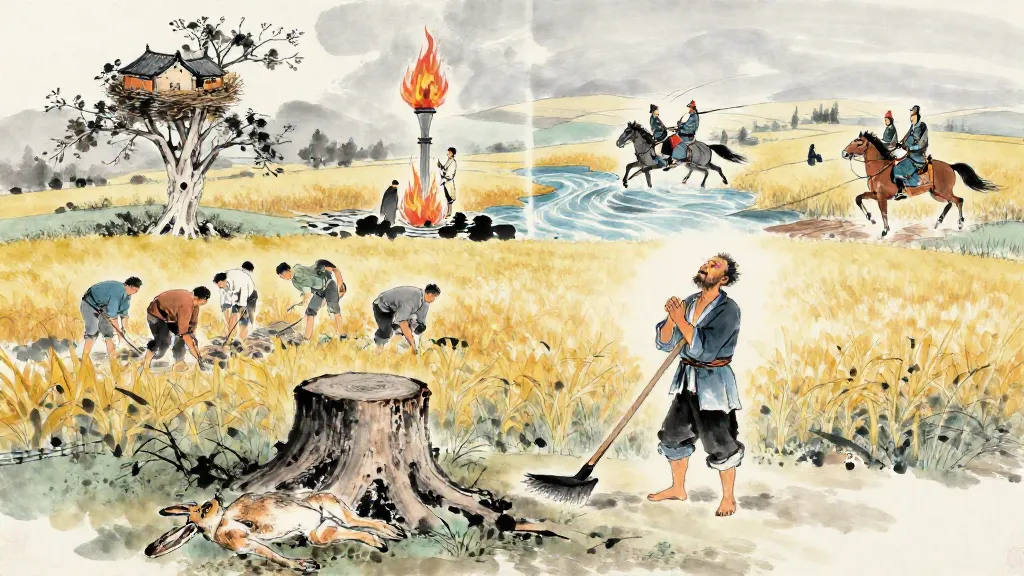
五蠹 (Five Vermin) — Chinese ink painting

韓非子 Hanfeizi · Chapter 49

五蠹

Five Vermin

View:

時移世易

Times Change and the World Changes With Them

上古之世,人民少而禽獸眾,人民不勝禽獸蟲蛇。有聖人作,構木為巢以避群害,而民悅之,使王天下,號曰有巢氏。民食果蓏蚌蛤,腥臊惡臭而傷害腹胃,民多疾病。有聖人作,鑽燧取火以化腥臊,而民說之,使王天下,號之曰燧人氏。中古之世,天下大水,而鯀、禹決瀆。近古之世,桀、紂暴亂,而湯、武征伐。今有構木鑽燧於夏後氏之世者,必為鯀、禹笑矣;有決瀆於殷、周之世者,必為湯、武笑矣。然則今有美堯、舜、湯、武、禹之道於當今之世者,必為新聖笑矣。是以聖人不期修古,不法常可,論世之事,因為之備。宋有人耕田者,田中有株,兔走觸株,折頸而死,因釋其耒而守株,冀復得兔,兔不可復得,而身為宋國笑。今欲以先王之政,治當世之民,皆守株之類也。

In the age of high antiquity, people were few and wild beasts were many. Humans could not prevail against beasts, insects, and serpents. A sage arose who wove wood into nests to shelter the people from these dangers. The people were pleased and made him king over all under Heaven; he was called the Nest Builder.

The people ate fruits, berries, mussels, and clams -- rank, foul-smelling food that injured their stomachs, and many fell ill. A sage arose who drilled wood to make fire, transforming rank flesh into cooked food. The people were delighted and made him king over all under Heaven; he was called the Fire Maker.

In the age of middle antiquity, the world was engulfed by a great flood, and Gun and Yu opened channels to drain the waters. In the age of recent antiquity, Jie and Zhou ruled with violent disorder, and Tang and Wu launched punitive campaigns.

Now, if someone were to build nests and drill for fire in the age of the Xia dynasty, Gun and Yu would surely laugh at him. If someone were to open drainage channels in the age of Yin and Zhou, Tang and Wu would surely laugh at him. It follows that if someone today glorifies the ways of Yao, Shun, Tang, Wu, and Yu in the present age, the new sages would surely laugh at him.

This is why the sage does not seek to restore antiquity, does not take established custom as his standard, but examines the affairs of his own age and prepares accordingly.

There was a man of Song who was plowing his field. In the field stood a tree stump. A hare ran into the stump, broke its neck, and died. The farmer thereupon set aside his plow and kept watch by the stump, hoping to catch another hare. No second hare was ever caught, and the man became the laughingstock of the state of Song.

Those who wish to govern the people of today with the policies of the former kings are all of the stump-guarding sort.

Notes

person有巢氏Youchao-shi

person燧人氏Suiren-shi

personGun

personYu

context

context

人口增長與資源之爭

Population Growth and the Struggle for Resources

古者丈夫不耕,草木之實足食也;婦人不織,禽獸之皮足衣也。不事力而養足,人民少而財有餘,故民不爭。是以厚賞不行,重罰不用,而民自治。今人有五子不為多,子又有五子,大父未死而有二十五孫。是以人民眾而貨財寡,事力勞而供養薄,故民爭,雖倍賞累罰而不免於亂。

In ancient times, men did not plow -- the fruits of plants and trees sufficed for food. Women did not weave -- the hides of beasts sufficed for clothing. Without laboring, sustenance was sufficient. The population was small and resources abundant, so the people did not contend. Therefore lavish rewards were not instituted, harsh punishments were not employed, and the people governed themselves.

Today a man has five sons and this is not considered many. Each son in turn has five sons, so that before the grandfather dies he has twenty-five grandsons. Thus the population grows large while goods and wealth grow scarce. People toil hard while provisions grow thin. Therefore the people contend. Even if rewards are doubled and punishments heaped upon punishments, disorder cannot be avoided.

Notes

context

translation

古今之異:讓天下之薄厚

The Difference Between Past and Present: Why Abdication Was Easy

堯之王天下也,茅茨不翦,采椽不斫;糲粢之食,藿之羹;冬日麂裘,夏日葛衣;雖監門之服養,不虧於此矣。禹之王天下也,身執耒歃以為民先,股無肢,脛不生毛,雖臣虜之勞,不苦於此矣。以是言之,夫古之讓天子者,是去監門之養,而離臣虜之勞也,古傳天下而不足多也。今之縣令,一日身死,子孫累世絜駕,故人重之。是以人之於讓也,輕辭古之天子,難去今之縣令者,薄厚之實異也。夫山居而谷汲者,臘而相遺以水;澤居苦水者,買庸而決竇。故飢歲之春,幼弟不餉;穰歲之秋,疏客必食。非疏骨肉愛過客也,多少之實異也。是以古之易財,非仁也,財多也;今之爭奪,非鄙也,財寡也。輕辭天子,非高也,勢薄也;爭士橐,非下也,權重也。故聖人議多少、論薄厚為之政。故罰薄不為慈,誅嚴不為戾,稱俗而行也。故事因於世,而備適於事。

When Yao ruled all under Heaven, his thatched roof was untrimmed and his rafters were unhewn. He ate coarse millet and drank bean-leaf broth. In winter he wore deerskin; in summer, hemp cloth. Even a gatekeeper's provisions and dress were no worse than this. When Yu ruled all under Heaven, he himself took up the plow and the hoe, leading the people by example. His thighs had no flesh on them and his shins grew no hair. Even a slave's toil was no more bitter than this.

Seen in this light, those who abdicated the throne in antiquity were merely giving up a gatekeeper's rations and leaving behind a slave's labor. That they passed on the throne is nothing to praise. But when a modern county magistrate dies, his sons and grandsons ride in carriages for generations. This is why people prize the office. Thus when it comes to abdication: men readily gave up the ancient throne yet find it hard to relinquish a modern magistracy. The difference lies in how meager or how rich the position is.

Those who live in the mountains and draw water from the valleys give each other gifts of water at the year-end festival. Those who live in the marshes and suffer from too much water hire laborers to dig drainage ditches. In a famine spring, a man will not feed his own younger brother. In a bumper autumn, even a casual stranger is given a meal. This is not because a man is cold to his own kin and loves passing guests -- it is because abundance and scarcity are different.

Therefore the ease with which the ancients gave away wealth was not benevolence -- it was because wealth was plentiful. The contention of the present is not baseness -- it is because wealth is scarce. The ease of abdicating the throne was not nobility of character -- it was because the position was meager. The fierceness of competition for office is not moral failing -- it is because the stakes are high.

Therefore the sage deliberates on scarcity and abundance, weighs meagerness and richness, and fashions his governance accordingly. Light punishments are not mercy; severe executions are not cruelty -- they are calibrated to the customs of the time. Affairs follow from the conditions of the age, and institutions must be suited to the affairs they address.

Notes

personYao

translation

translation

context

仁義不適於今

Benevolence and Righteousness Are Unsuited to the Present Age

古者大王處豐、鎬之間,地方百里,行仁義而懷西戎,遂王天下。徐偃王處漢東,地方五百里,行仁義,割地而朝者三十有六國。荊文王恐其害己也,舉兵伐徐,遂滅之。故文王行仁義而王天下,偃王行仁義而喪其國,是仁義用於古不用於今也。故曰:世異則事異。當舜之時,有苗不服,禹將伐之。舜曰:「不可。上德不厚而行武,非道也。」乃修教三年,執乾戚舞,有苗乃服。共工之戰,鐵銛矩者及乎敵,鎧甲不堅者傷乎體。是乾戚用於古不用於今也。故曰:事異則備變。上古競於道德,中世逐於智謀,當今爭於氣力。齊將攻魯,魯使子貢說之。齊人曰:「子言非不辯也,吾所欲者土地也,非斯言所謂也。」遂舉兵伐魯,去門十里以為界。故偃王仁義而徐亡,子貢辯智而魯削。以是言之,夫仁義辯智,非所以持國也。去偃王之仁,息子貢之智,循徐、魯之力使敵萬乘,則齊、荊之欲不得行於二國矣。

In ancient times, King Tai dwelt between Feng and Hao, with a territory of only a hundred li square. He practiced benevolence and righteousness, won over the Western Rong tribes, and ultimately became king of all under Heaven. King Yan of Xu dwelt east of the Han River, with a territory of five hundred li square. He practiced benevolence and righteousness, and thirty-six states ceded territory and paid court to him. King Wen of Chu, fearing that Xu would threaten him, raised an army, attacked Xu, and destroyed it.

Thus King Wen practiced benevolence and righteousness and became king of all under Heaven; King Yan practiced benevolence and righteousness and lost his state. This shows that benevolence and righteousness worked in the past but do not work in the present. Therefore it is said: when the age changes, affairs change.

In the time of Shun, the Miao tribes would not submit. Yu wished to attack them. Shun said: 'It cannot be done. To resort to force when one's virtue is not yet ample is not the Way.' So he cultivated moral instruction for three years and performed the shield-and-axe dance, and the Miao submitted. But in the battle against Gonggong, those with sharp iron weapons reached the enemy, while those with flimsy armor were wounded. The shield dance worked in antiquity; it does not work in the present. Therefore it is said: when affairs change, methods must change.

In high antiquity, men competed through moral virtue. In the middle age, they contended through wit and strategy. In the present age, they struggle through brute force.

When Qi was about to attack Lu, Lu sent Zi Gong to dissuade them. The men of Qi said: 'Your words are not unpersuasive, but what we want is territory, not the sort of thing you are talking about.' They thereupon raised an army, attacked Lu, and set their border ten li from the city gate.

Thus King Yan's benevolence led to the destruction of Xu, and Zi Gong's eloquence led to the diminishment of Lu. Seen in this light, benevolence, righteousness, eloquence, and wisdom are not the means by which to preserve a state. Had Xu abandoned King Yan's benevolence and Lu dispensed with Zi Gong's cleverness, and instead marshaled their military strength to confront ten-thousand-chariot states, then the ambitions of Qi and Chu could never have been carried out against them.

Notes

person大王Tai Wang

person徐偃王Xu Yan Wang

person荊文王Jing Wen Wang

person子貢Zi Gong

person有苗You Miao

person共工Gonggong

place豐鎬Feng-Hao

translation

儒墨之非:仁愛非治國之道

The Errors of Confucians and Mohists: Love Is Not the Way to Order a State

夫古今異俗,新故異備。如欲以寬緩之政,治急世之民,猶無轡策而御馬,此不知之患也。今儒、墨皆稱先王兼愛天下,則視民如父母。何以明其然也?曰:「司寇行刑,君為之不舉樂;聞死刑之報,君為流涕。」此所舉先王也。夫以君臣為如父子則必治,推是言之,是無亂父子也。人之情性莫先於父母,皆見愛而未必治也,雖厚愛矣,奚遽不亂?今先王之愛民,不過父母之愛子,子未必不亂也,則民奚遽治哉?且夫以法行刑,而君為之流涕,此以效仁,非以為治也。夫垂泣不欲刑者,仁也;然而不可不刑者,法也。先王勝其法,不聽其泣,則仁之不可以為治亦明矣。

Ancient and modern customs differ; old and new conditions require different measures. To try to govern the people of a turbulent age with lenient and indulgent policies is like trying to drive a horse without bit or whip -- this is the affliction of ignorance.

Now the Confucians and the Mohists both claim that the former kings loved all under Heaven impartially and regarded the people as parents regard their children. How do they demonstrate this? They say: 'When the Minister of Justice carried out punishments, the ruler refrained from music; when he heard the report of an execution, the ruler wept.' This is the former king they hold up.

If the relationship between ruler and minister could truly be made like that of father and son, then order would be assured. But to push this argument to its conclusion is to claim that there are no disorderly father-son relationships. In human nature, no bond is prior to that of parent and child. All children receive love, yet families are not necessarily well-ordered. However deep the love, how can one guarantee there will be no disorder? Now, the former kings' love for their people did not exceed a parent's love for a child. Since children are not necessarily well-ordered, how can the people be expected to be well-governed?

Moreover, when the ruler wept as the law carried out its punishments, this was a display of benevolence, not a method of governance. To weep and wish not to punish -- that is benevolence. But to punish nonetheless because one must -- that is law. The former kings let their law prevail and did not heed their own tears. That benevolence alone cannot produce order is thus perfectly clear.

Notes

context

translation

context

民服於勢,不服於義

The People Submit to Power, Not to Righteousness

且民者固服於勢,寡能懷於義。仲尼,天下聖人也,修行明道以游海內,海內說其仁、美其義而為服役者七十人。蓋貴仁者寡,能義者難也。故以天下之大,而為服役者七十人,而仁義者一人。魯哀公,下主也,南面君國,境內之民莫敢不臣。民者固服於勢,誠易以服人,故仲尼反為臣而哀公顧為君。仲尼非懷其義,服其勢也。故以義則仲尼不服於哀公,乘勢則哀公臣仲尼。今學者之說人主也,不乘必勝之勢,而務行仁義則可以王,是求人主之必及仲尼,而以世之凡民皆如列徒,此必不得之數也。

Moreover, the people are by nature submissive to power and rarely capable of being won over by righteousness. Confucius was a sage recognized throughout all under Heaven. He cultivated virtue and illuminated the Way as he traveled the realm. All under Heaven admired his benevolence and praised his righteousness -- yet those who entered his service numbered only seventy. For those who value benevolence are few, and those capable of righteousness are rare. Thus in all the vastness of the world, his followers numbered seventy, and the man of benevolence and righteousness was but one.

Duke Ai of Lu was an inferior ruler. Yet he faced south and governed a state, and not a single person within his borders dared refuse to serve as his subject. The people are by nature submissive to power, and power is truly effective at securing obedience. Thus Confucius was the subject, and Duke Ai was the sovereign. Confucius did not submit to Duke Ai's righteousness -- he submitted to his power.

Therefore, by the standard of righteousness, Confucius would never have submitted to Duke Ai. But through the leverage of political power, Duke Ai made Confucius his minister. Now the scholars who counsel rulers tell them to ignore the leverage of assured victory and instead devote themselves to benevolence and righteousness in order to become kings. This is to demand that every ruler match Confucius, and to assume that every commoner in the world is like Confucius's own disciples. This is a calculation that is certain to fail.

Notes

person仲尼Zhongni

person魯哀公Lu Ai Gong

translation

context

嚴法勝於慈愛

Strict Law Prevails Over Kind Indulgence

今有不才之子,父母怒之弗為改,鄉人譙之弗為動,師長教之弗為變。夫以父母之愛、鄉人之行、師長之智,三美加焉,而終不動,其脛毛不改。州部之吏,操官兵,推公法,而求索奸人,然後恐懼,變其節,易其行矣。故父母之愛不足以教子,必待州部之嚴刑者,民固驕於愛、聽於威矣。故十仞之城,樓季弗能逾者,峭也;千仞之山,跛牂易牧者,夷也。故明王峭其法而嚴其刑也。布帛尋常,庸人不釋;鑠金百溢,盜跖不掇。不必害,則不釋尋常;必害手,則不掇百溢。故明主必其誅也。是以賞莫如厚而信,使民利之;罰莫如重而必,使民畏之;法莫如一而固,使民知之。故主施賞不遷,行誅無赦,譽輔其賞,毀隨其罰,則賢、不肖俱盡其力矣。

Suppose there is a worthless son. His parents scold him, but he does not reform. His neighbors rebuke him, but he is not moved. His teachers instruct him, but he does not change. With the love of his parents, the pressure of his neighbors, and the wisdom of his teachers -- three admirable influences applied to him -- he remains unmoved, not changing a hair on his shin. But when the magistrate of the district dispatches officers armed with official weapons to enforce the public law and hunt down offenders, only then does he feel fear, alter his principles, and change his conduct.

Thus the love of parents is insufficient to teach a child. The harsh penalties of the district magistrate are needed, because the people are by nature insolent under indulgence and obedient under authority.

A wall of ten ren: even Lou Ji cannot scale it, because it is sheer. A mountain of a thousand ren: even a lame ewe can graze on it, because the slope is gradual. Therefore the enlightened ruler makes his laws sheer and his punishments severe.

A bolt of ordinary cloth: a common man will not let go of it. A hundred yi of molten gold: even Robber Zhi will not snatch it. When there is no certain harm, a man will not release a piece of cloth. When harm to the hand is certain, he will not grab a hundred measures of gold. Therefore the enlightened ruler makes his punishments certain.

Thus: no reward is better than one that is generous and reliable, so that the people are drawn to it. No penalty is better than one that is heavy and certain, so that the people fear it. No law is better than one that is uniform and stable, so that the people understand it. Therefore when the ruler bestows rewards without caprice and carries out punishments without pardons, when praise reinforces his rewards and censure accompanies his punishments, then both the worthy and the unworthy will exert themselves to the utmost.

Notes

person樓季Lou Ji

person盜跖Dao Zhi

translation

translation

context

賞罰悖繆

Contradictions Between Reward and Punishment

今則不然。其有功也爵之,而卑其士官也;以其耕作也賞之,而少其家業也;以其不收也外之,而高其輕世也;以其犯禁罪之,而多其有勇也。毀譽、賞罰之所加者,相與悖繆也,故法禁壞而民愈亂。今兄弟被侵,必攻者,廉也;知友辱,隨仇者,貞也。廉貞之行成,而君上之法犯矣。人主尊貞廉之行,而忘犯禁之罪,故民程於勇,而吏不能勝也。不事力而衣食,謂之能;不戰功而尊,則謂之賢。賢能之行成,而兵弱而地荒矣。人主說賢能之行,而忘兵弱地荒之禍,則私行立而公利滅矣。

Today the situation is otherwise. The state ennobles men for their meritorious service, yet looks down on those who hold military office. It rewards men for their farming, yet diminishes their household enterprises. It ostracizes men for not amassing wealth, yet extols those who disdain the world. It punishes men for violating prohibitions, yet praises those who show daring.

When censure and praise, reward and punishment, point in contradictory directions, law and prohibitions collapse and the people grow ever more disordered.

Today, when a man's brothers are attacked and he strikes back, this is called integrity. When a man's friends are insulted and he pursues the offender, this is called loyalty. But when the conduct of integrity and loyalty is established, the laws of the sovereign are violated. The ruler honors such integrity and loyalty while forgetting the crime of breaking his prohibitions. Thus the people set their sights on personal valor, and the officials cannot control them.

When a man who does not labor can eat and dress well, this is called talent. When a man who has no military merit is honored, this is called worthiness. But when the conduct of worthiness and talent is established, the army weakens and the fields go fallow. The ruler delights in worthiness and talent while forgetting the disasters of a weak army and barren land. Thus private reputations are built up while the public interest is destroyed.

Notes

context

translation

儒以文亂法,俠以武犯禁

Scholars Subvert the Law with Literature; Knights-Errant Violate Prohibitions with Force

儒以文亂法,俠以武犯禁,而人主兼禮之,此所以亂也。夫離法者罪,而諸先王以文學取;犯禁者誅,而群俠以私劍養。故法之所非,君之所取;吏之所誅,上之所養也。法、趣、上、下,四相反也,而無所定,雖有十黃帝不能治也。故行仁義者非所譽,譽之則害功;文學者非所用,用之則亂法。楚之有直躬,其父竊羊,而謁之吏。令尹曰:「殺之!」以為直於君而曲於父,報而罪之。以是觀之,夫君之直臣,父之暴子也。魯人從君戰,三戰三北。仲尼問其故,對曰:「吾有老父,身死莫之養也。」仲尼以為孝,舉而上之。以是觀之,夫父之孝子,君之背臣也。故令尹誅而楚奸不上聞,仲尼賞而魯民易降北。上下之利,若是其異也,而人主兼舉匹夫之行,而求致社稷之福,必不幾矣。

Scholars subvert the law with their writings; knights-errant violate prohibitions with their swords. Yet the ruler honors both -- this is the root of disorder.

Those who depart from the law should be punished, yet scholars are advanced through their literary arts. Those who break prohibitions should be executed, yet knights-errant are maintained by their private swords. Thus what the law condemns, the ruler selects; what the officials punish, the sovereign sustains. Law and inclination, sovereign and subordinate -- all four point in opposite directions, with nothing settled. Even ten Yellow Emperors could not govern under such conditions.

Therefore those who practice benevolence and righteousness should not be praised -- to praise them is to undermine merit. Literary scholars should not be employed -- to employ them is to subvert the law.

In Chu there was a man called Straight Body. His father stole a sheep, and the son reported him to the authorities. The Chief Minister said: 'Execute him!' -- considering the son upright toward his ruler but crooked toward his father, and so the informer was convicted and punished. Seen in this light, a ruler's upright subject is a father's cruel son.

A man of Lu followed his lord into battle and fled three times in three engagements. Confucius asked the reason. The man replied: 'I have an aged father. If I die, there is no one to care for him.' Confucius deemed this filial piety and promoted him. Seen in this light, a father's filial son is a ruler's treasonous subject.

Thus when the Chief Minister punished the informer, offenses in Chu went unreported. When Confucius rewarded the deserter, the people of Lu readily surrendered and fled. The interests of superior and inferior diverge to this extent. Yet the ruler tries to adopt the standards of private individuals while seeking blessings for the altars of state -- this is certain to fail.

Notes

person直躬Zhi Gong

person令尹Ling Yin

context

translation

公私之辨

The Distinction Between Public and Private

古者蒼頡之作書也,自環者謂之私,背私謂之公,公私之相背也,乃蒼頡固以知之矣。今以為同利者,不察之患也,然則為匹夫計者,莫如修行義而習文學。行義修則見信,見信則受事;文學習則為明師,為明師則顯榮:此匹夫之美也。然則無功而受事,無爵而顯榮,為有政如此,則國必亂,主必危矣。故不相容之事,不兩立也。斬敵者受賞,而高慈惠之行;拔城者受爵祿,而信廉愛之說;堅甲厲兵以備難,而美薦紳之飾;富國以農,距敵恃卒,而貴文學之士;廢敬上畏法之民,而養遊俠私劍之屬。舉行如此,治強不可得也。國平養儒俠,難至用介士,所利非所用,所用非所利。是故服事者簡其業,而於遊學者日眾,是世之所以亂也。

In ancient times, when Cangjie invented writing, the character for 'private' (私) depicted a person encircling himself; the character for 'public' (公) was the reversal of 'private.' That public and private stand in opposition to each other -- Cangjie already understood this.

To think that they can share the same interest is the affliction of those who do not examine closely. For the private individual, the best course is to cultivate righteousness and master literary learning. Cultivate righteousness and you will be trusted; be trusted and you will receive office. Master literary learning and you will become an esteemed teacher; become an esteemed teacher and you will enjoy honor and glory. This is the beauty of being a private individual. But when men receive office without merit and enjoy honor without rank, if this is how governance operates, then the state will surely fall into disorder and the ruler will surely be endangered.

Therefore things that are incompatible cannot coexist. You cannot reward those who slay the enemy while exalting charitable and merciful conduct. You cannot grant rank and salary to those who storm fortifications while crediting doctrines of restraint and benevolence. You cannot harden armor and sharpen weapons to prepare for crisis while admiring the ornamental robes of scholars. You cannot enrich the state through agriculture and rely on soldiers to resist the enemy while honoring literary scholars. You cannot abandon the people who respect superiors and fear the law while maintaining wandering knights and private swordsmen.

If this is how governance operates, strength and order cannot be attained. In peacetime the state nurtures Confucians and knights-errant; in crisis it must rely on armored soldiers. Those it benefits are not those it uses; those it uses are not those it benefits. Thus those who serve the state neglect their duties, while those who pursue wandering scholarship grow daily more numerous. This is why the world falls into disorder.

Notes

person蒼頡Cangjie

context

translation

微妙之言非民務

Subtle Doctrines Are Not the People's Business

且世之所謂賢者,貞信之行也;所謂智者,微妙之言也。微妙之言,上智之所難知也。今為眾人法,而以上智之所難知,則民無從識之矣。故糟糠不飽者不務粱肉,短褐不完者不待文繡。夫治世之事,急者不得,則緩者非所務也。今所治之政,民間之事,夫婦所明知者不用,而慕上知之論,則其於治反矣。故微妙之言,非民務也。若夫賢良貞信之行者,必將貴不欺之士;不欺之士者,亦無不欺之術也。布衣相與交,無富厚以相利,無威勢以相懼也,故求不欺之士。今人主處制人之勢,有一國之厚,重賞嚴誅,得操其柄,以修明術之所燭,雖有田常、子罕之臣,不敢欺也,奚待於不欺之士?今貞信之士不盈於十,而境內之官以百數,必任貞信之士,則人不足官。人不足官,則治者寡而亂者眾矣。故明主之道,一法而不求智,固術而不慕信,故法不敗,而群官無奸詐矣。

What the world calls a worthy man is one who practices constancy and good faith. What the world calls a wise man is one who speaks in subtle and profound terms. But subtle and profound speech is difficult even for the most brilliant minds to understand. If you make laws for the common people based on what even the most brilliant find difficult, the people will have no way to comprehend them.

A man who cannot fill his belly with chaff and husks does not occupy himself with fine millet and meat. A man whose coarse shirt is in tatters does not wait for embroidered silk. When the urgent affairs of governing the world cannot be accomplished, lesser matters are not worth attending to. If the governance of states and the affairs of the people -- things that any husband and wife can plainly understand -- are set aside in favor of the most esoteric doctrines, then governance is turned on its head. Therefore subtle doctrines are not the people's business.

As for the conduct of the worthy and trustworthy: it means one must prize men who do not deceive. But men who do not deceive possess no technique for ensuring that others will not deceive. Commoners deal with one another without wealth to exchange as benefits, without authority to wield as threats. Therefore they seek out trustworthy men. But the ruler occupies a position of command over others, possesses the wealth of an entire state, and holds the handles of lavish reward and severe punishment. If he employs the illumination of administrative technique, then even ministers of the caliber of Tian Chang and Zi Han would not dare deceive him. Why then would he need to wait for inherently trustworthy men?

Today, men of constancy and good faith number fewer than ten, while the offices within the realm are counted in the hundreds. If you insist on appointing only men of constancy and good faith, there will not be enough men for the offices. When offices go unfilled, those who govern are few and those who create disorder are many.

Therefore the way of the enlightened ruler is: unify the law and do not seek cleverness; secure the administrative techniques and do not yearn for trustworthiness. Then the law will not be defeated, and the officials as a whole will be free from treachery and fraud.

Notes

person田常Tian Chang

person子罕Zi Han

context

務力不務言

Value Effort, Not Words

今人主之於言也,說其辯而不求其當焉;其用於行也,美其聲而不責其功。是以天下之眾,其談言者務為辨而不周於用,故舉先王言仁義者盈廷,而政不免於亂;行身者競於為高而不合於功,故智士退處岩穴,歸祿不受,而兵不免於弱,政不免於亂,此其故何也?民之所譽,上之所禮,亂國之術也。今境內之民皆言治,藏商、管之法者家有之,而國貧,言耕者眾,執耒者寡也;境內皆言兵,藏孫、吳之書者家有之,而兵愈弱,言戰者多,被甲者少也。故明主用其力,不聽其言;賞其功,伐禁無用。故民盡死力以從其上。夫耕之用力也勞,而民為之者,曰:可得以富也。戰之事也危,而民為之者,曰:可得以貴也。今修文學,習言談,則無耕之勞而有富之實,無戰之危而有貴之尊,則人孰不為也?是以百人事智而一人用力。事智者眾,則法敗;用力者寡,則國貧:此世之所以亂也。故明主之國,無書簡之文,以法為教;無先王之語,以吏為師;無私劍之捍,以斬首為勇。是境內之民,其言談者必軌於法,動作者歸之於功,為勇者盡之于軍。是故無事則國富,有事則兵強,此之謂王資。既畜王資而承敵國之儥超五帝侔三王者,必此法也。

Today the ruler, when it comes to words, delights in eloquence without demanding substance. When it comes to conduct, he admires reputation without holding men accountable for results. Thus among the masses of the realm, those who talk strive for eloquence without concern for practical use. The court is filled with men who invoke the former kings and preach benevolence and righteousness, yet governance is not spared from disorder. Those who cultivate their conduct compete to appear lofty without contributing to practical achievement. Wise men retire to caves and cliffs, returning their salaries and refusing office, yet the army is not spared from weakness and governance is not spared from disorder.

Why is this? What the people praise and the sovereign honors is the very art of bringing a state to ruin.

Today, everyone within the borders talks about governance. Every household possesses the writings of Shang Yang and Guan Zhong, yet the state grows poor -- those who talk about farming are many, but those who hold the plow are few. Everyone within the borders talks about warfare. Every household possesses the writings of Sunzi and Wu Qi, yet the army grows ever weaker -- those who talk about war are many, but those who don armor are few.

Therefore the enlightened ruler employs men's strength and does not listen to their words. He rewards their achievements and prohibits what is useless. Thus the people exhaust their strength in service to their sovereign.

Farming is toilsome labor, yet the people do it because they say: 'Through this we can grow rich.' Warfare is dangerous, yet the people undertake it because they say: 'Through this we can win honor.' Now, if one pursues literary learning and practices the art of speech, one gains the wealth of farming without its toil and the honor of warfare without its danger. Then who would not choose that path? Thus for every hundred men who pursue cleverness, only one exerts himself in labor. When those who pursue cleverness are many, the law collapses. When those who labor are few, the state grows poor. This is why the world falls into disorder.

Therefore in the state of an enlightened ruler: there are no texts written on bamboo strips -- the law serves as instruction. There are no words of the former kings -- officials serve as teachers. There are no private swords for personal valor -- slaying the enemy in battle serves as courage.

Thus the people within the borders, when they speak, must conform to the law. When they act, their actions are directed toward merit. When they display bravery, it is devoted entirely to the army. Therefore in peace the state grows rich; in war the army grows strong. This is called the capital of kingship.

Once the capital of kingship has been accumulated and then deployed against rival states -- to surpass the Five Emperors and equal the Three Kings -- this is necessarily the method.

Notes

person商管Shang, Guan

person孫吳Sun, Wu

context

translation

縱橫之害

The Damage of Alliance Diplomacy

今則不然,士民縱恣於內,言談者為勢於外,外內稱惡,以待強敵,不亦殆乎!故群臣之言外事者,非有分於從衡之黨,則有仇讎之忠,而借力於國也。從者,合眾強以攻一弱也;而衡者,事一強以攻眾弱也:皆非所以持國也。今人臣之言衡者,皆曰:「不事大,則遇敵受禍矣。」事大未必有實,則舉圖而委,效璽而請兵矣。獻圖則地削,效璽則名卑,地削則國削,名卑則政亂矣。事大為衡,未見其利也,而亡地亂政矣。人臣之言從者,皆曰:「不救小而伐大,則失天下,失天下則國危,國危而主卑。」救小未必有實,則起兵而敵大矣。救小未必能存,而交大未必不有疏,有疏則為強國制矣。出兵則軍敗,退守則城拔。救小為從,未見其利,而亡地敗軍矣。是故事強,則以外權士官於內;求小,則以內重求利於外。國利未立,封土厚祿至矣;主上雖卑,人臣尊矣;國地雖削,私家富矣。事成,則以權長重;事敗,則以富退處。人主之於其聽說也於其臣,事未成則爵祿已尊矣;事敗而弗誅,則遊說之士孰不為用繳之說而僥倖其後?故破國亡主以聽言談者之浮說。此其故何也?是人君不明乎公私之利,不察當否之言,而誅罰不必其後也。皆曰:「外事,大可以王,小可以安。」夫王者,能攻人者也;而安,則不可攻也。強,則能攻人者也;治,則不可攻也。治強不可責於外,內政之有也。今不行法術於內,而事智於外,則不至於治強矣。

Today the situation is otherwise. Officers and commoners act without restraint at home, while persuaders build their influence abroad. Internal and external alike accumulate evils -- and then they await a powerful enemy. Is this not perilous?

When ministers speak on foreign affairs, they either have stakes in the vertical or horizontal alliance factions, or they harbor private enmities and borrow the state's power to pursue them. The vertical alliance joins many states to attack one; the horizontal alliance serves one great power to attack many. Neither is the way to preserve a state.

Today those ministers who advocate the horizontal alliance all say: 'If we do not serve the great power, we will face the enemy and suffer disaster.' But serving the great power may yield no real benefit. Instead, the state presents its maps and submits, offers up its seal and begs for troops. To present maps is to lose territory; to offer the seal is to diminish sovereignty. Lost territory means a shrunken state; diminished sovereignty means disordered governance. Serving the great power through the horizontal alliance -- its benefits are nowhere to be seen, yet territory is lost and governance disordered.

Those ministers who advocate the vertical alliance all say: 'If we do not rescue the small states and oppose the great power, we will lose the world. If we lose the world, the state is endangered and the ruler is diminished.' But rescuing small states may yield no real benefit -- instead, it means raising armies to oppose a great power. The small state may not be saved after all, and relations with the great power may well be damaged. Once relations sour, the state is at the mercy of the stronger. Sending armies leads to military defeat; falling back leads to sieges. Rescuing the small through the vertical alliance -- its benefits are nowhere to be seen, yet territory is lost and armies are broken.

Thus: serving the strong means using foreign influence to secure domestic offices. Seeking the small means using domestic weight to pursue foreign advantage. The state's benefit has not yet been established, yet enfeoffments and lavish salaries have already arrived. Though the sovereign is diminished, the ministers are exalted. Though the state's territory is reduced, their private households are enriched. If the venture succeeds, they use their influence to increase their power. If it fails, they retire in wealth. When the ruler listens to his ministers' advice, rank and salary are already elevated before the venture has succeeded. When the venture fails and no one is punished, what itinerant persuader would not concoct entangling arguments and gamble on the outcome?

Thus states are ruined and sovereigns destroyed by heeding the empty rhetoric of talkers. Why is this? Because the ruler does not understand the difference between public and private interests, does not scrutinize whether arguments are sound, and does not ensure that punishment follows failure.

All say: 'In foreign affairs, the great outcome is to become king, the small outcome is to be secure.' But to become king means to be capable of attacking others; to be secure means to be unassailable. To be strong is to be capable of attacking others; to be well-governed is to be unassailable. Good governance and strength cannot be obtained from abroad -- they come from domestic policy. If one does not practice law and technique at home but pursues cleverness abroad, good governance and strength will never be attained.

Notes

context

person蘇秦Su Qin

person張儀Zhang Yi

translation

治強在內

Strength and Order Come From Within

鄙諺曰:「長袖善舞,多錢善賈。」此言多資之易為工也。故治強易為謀,弱亂難為計。故用於秦者,十變而謀希失;用於燕者,一變而計希得。非用於秦者必智,用於燕者必愚也,蓋治亂之資異也。故周去秦為從,期年而舉;衛離魏為衡,半歲而亡。是周滅於從,衛亡于衡也。使周、衛緩其從衡之計,而嚴其境內之治,明其法禁,必其賞罰,盡其地力以多其積,致其民死以堅其城守,天下得其地則其利少,攻其國則其傷大,萬乘之國莫敢自頓于堅城之下,而使強敵裁其弊也,此必不亡之術也。舍必不亡之術而道必滅之事,治國者之過也。智困於內而政亂於外,則亡不可振也。

A rustic proverb says: 'Long sleeves make for graceful dancing; much capital makes for good trading.' This is to say that abundant resources make work easy.

A well-governed, strong state is easy to plan for; a weak, disordered state is hard to devise strategies for. Thus those who served Qin could change course ten times and rarely fail; those who served Yan could change course once and rarely succeed. This is not because those who served Qin were necessarily wise and those who served Yan were necessarily foolish -- it is because the resources of order and disorder differ.

Thus Zhou joined the vertical alliance against Qin and was destroyed within a year. Wei left Wey and joined the horizontal alliance and perished within half a year. Zhou was destroyed by the vertical alliance; Wey was destroyed by the horizontal. Had Zhou and Wey set aside their alliance schemes and instead enforced strict governance within their borders -- making their laws and prohibitions clear, ensuring their rewards and punishments, exhausting the productive capacity of their land to build up reserves, and inspiring their people to fight to the death to strengthen their defenses -- then any state that seized their territory would gain little, and any state that attacked them would suffer greatly. Not even a state of ten thousand chariots would batter itself against fortified walls and expose itself to a powerful enemy's counterattack. This is the art of certain survival.

To abandon the art of certain survival and pursue the path of certain destruction -- this is the error of those who govern states. When wisdom is exhausted domestically and governance disintegrates abroad, then ruin cannot be reversed.

Notes

context

placeZhou

placeWei (Wey)

context

民趨私門

The People Flock to Private Patrons

民之政計,皆就安利如辟危窮。今為之攻戰,進則死於敵,退則死於誅,則危矣。棄私家之事而必汗馬之勞,家困而上弗論,則窮矣。窮危之所在也,民安得勿避?故事私門而完解舍,解舍完則遠戰,遠戰則安。行貨賂而襲當塗者則求得,求得則私安,私安則利之所在,安得勿就?是以公民少而私人眾矣。

When the people calculate their interests, they invariably seek safety and profit while avoiding danger and poverty. Now consider: if they are sent to war, advancing means death at the hands of the enemy and retreating means death by execution -- this is danger. If they abandon their private affairs for the inevitable hardship of military campaigning and their families fall into poverty with no consideration from above -- this is destitution. When danger and destitution lie in that direction, how can the people not flee from it?

Therefore they attach themselves to powerful private patrons and keep their quarters secure. When their quarters are secure, they are far from war. When they are far from war, they are safe. They offer bribes and gifts to ingratiate themselves with those in power, and their petitions are granted. When petitions are granted, they are privately secure. Since private security lies in that direction, how can they not flock to it?

Thus the state's public citizens grow few while private dependents grow numerous.

Notes

translation

translation

context

商工游食之害

The Harm of Merchants, Artisans, and Idle Consumers

夫明王治國之政,使其商工游食之民少而名卑,以寡趣本務而趨末作。今世近習之請行,則官爵可買;官爵可買,則商工不卑也矣。奸財貨賈得用於市,則商人不少矣。聚斂倍農而致尊過耕戰之士,則耿介之士寡而高價之民多矣。

The governance of an enlightened king reduces the number of merchants, artisans, and idle consumers while keeping their status low, so that few are drawn to these peripheral occupations and many pursue the fundamental work of farming. But in the present age, when the requests of court favorites are carried out, offices and ranks can be purchased. When offices and ranks can be purchased, merchants and artisans are no longer of low status. When illicit fortunes and commercial profits can be freely employed in the marketplace, merchants do not diminish. When the wealth amassed through commerce yields more honor than that of soldiers and farmers, upright men grow scarce while profiteers multiply.

Notes

translation

translation

五蠹之總結

The Five Vermin Enumerated

是故亂國之俗:其學者,則稱先王之道以籍仁義,盛容服而飾辯說,以疑當世之法,而貳人主之心。其言古者,為設詐稱,借於外力,以成其私,而遺社稷之利。其帶劍者,聚徒屬,立節操,以顯其名,而犯五官之禁。其患御者,積於私門,盡貨賂,而用重人之謁,退汗馬之勞。其商工之民,修治苦之器,聚弗靡之財,蓄積待時,而侔農夫之利。此五者,邦之蠹也。人主不除此五蠹之民,不養耿介之士,則海內雖有破亡之國,削滅之朝,亦勿怪矣。

These, then, are the customs of a disordered state:

Its scholars invoke the way of the former kings, trade on benevolence and righteousness, adorn themselves in fine robes, embellish their speech with eloquence, cast doubt on the laws of the present age, and divide the ruler's mind.

Its itinerant persuaders fabricate fraudulent claims, borrow foreign power to advance their private interests, and abandon the interests of the altars of state.

Its swordsmen gather bands of followers, establish codes of honor to make their names renowned, and violate the prohibitions of the five ministries.

Its draft-evaders attach themselves to the households of the powerful, exhaust their wealth in bribes, exploit the patronage of influential men, and thereby escape the toil of military service.

Its merchants and artisans produce implements of dubious necessity, accumulate wealth that is never consumed, hoard their stores to exploit market timing, and thereby encroach upon the profits of the farmer.

These five are the vermin of the state. If the ruler does not eliminate these five classes of vermin and does not nurture upright men of straightforward character, then if within the four seas there are states that crumble and fall, dynasties that are reduced to ruin -- one should not be surprised.

Notes

translation

translation

context

context

Edition & Source

Text
《韓非子》 Hanfeizi
Edition
中華古詩文古書籍網 transcription, 《四部叢刊》本
Commentary
Han Fei (韓非), Warring States period