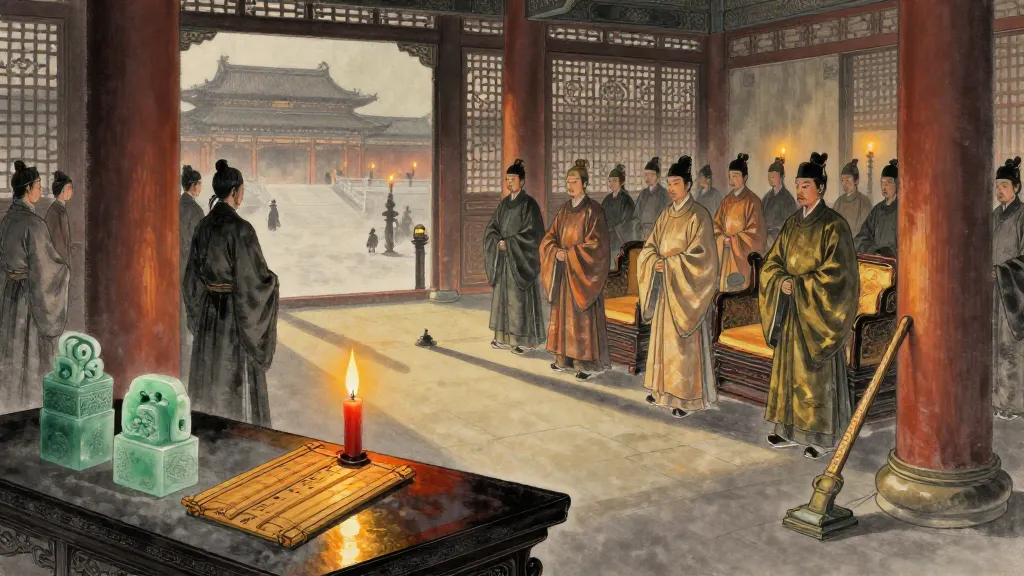
人主 (The Ruler) — Chinese ink painting

韓非子 Hanfeizi · Chapter 52

人主

The Ruler

View:

大臣太貴,左右太威

When Great Ministers Are Too Exalted and the Inner Circle Too Powerful

人主之所以身危國亡者,大臣太貴,左右太威也。所謂貴者,無法而擅行,操國柄而便私者也。所謂威者,擅權勢而輕重者也。此二者,不可不察也。夫馬之所以能任重引車致遠道者,以筋力也。萬乘之主、千乘之君所以制天下而征諸侯者,以其威勢也。威勢者,人主之筋力也。今大臣得威,左右擅勢,是人主失力;人主失力而能有國者,千無一人。虎豹之所以能勝人執百獸者,以其爪牙也,當使虎豹失其爪牙,則人必制之矣。今勢重者,人主之爪牙也,君人而失其爪牙,虎豹之類也。宋君失其爪牙於子罕,簡公失其爪牙于田常,而不蚤奪之,故身死國亡。今無術之主皆明知宋、簡之過也,而不悟其失,不察其事類者也。

The reason rulers find themselves in personal danger and their states destroyed is that great ministers are too exalted and the inner circle too powerful. Those called 'exalted' are those who act arbitrarily without law, who grasp the handles of state power to serve their private interests. Those called 'powerful' are those who monopolize authority and positional advantage to control the balance of influence. These two dangers must not go unexamined.

The reason horses can bear heavy loads, pull carts, and cover long distances is their sinew and strength. The reason the lord of ten thousand chariots or the lord of a thousand chariots can command All-Under-Heaven and subjugate the feudal lords is his authoritative power and positional advantage. Authoritative power and positional advantage are the ruler's sinew and strength. When great ministers seize authority and the inner circle monopolizes positional advantage, the ruler has lost his strength. Among rulers who have lost their strength yet managed to keep their states, not one in a thousand can be found.

The reason tigers and leopards can overpower men and seize a hundred beasts is their claws and teeth. If tigers and leopards were made to lose their claws and teeth, men would certainly overpower them. Now, the weight of positional advantage -- that is the ruler's claws and teeth. To rule men and lose one's claws and teeth: this is the same as the tiger and leopard.

The Duke of Song lost his claws and teeth to Zihan. Duke Jian lost his claws and teeth to Tian Chang. Because they did not seize them back early, they died and their states were destroyed. Today, rulers without techniques all clearly know the errors of Song and Jian, yet do not perceive their own identical failures -- they do not examine the parallels in their own situations.

Notes

1person子罕Zihan

Zihan (子罕) was a minister of Song who gained control by monopolizing the power of punishment while leaving the Duke only the power of reward -- making the Duke appear generous while Zihan appeared fearsome.

2person田常Tian Chang

Tian Chang (田常, also Tian Chengzi 田成子) was the minister who effectively seized power in Qi, assassinating Duke Jian (齊簡公) in 481 BC. His descendants eventually replaced the Jiang ruling house entirely.

3translation

The 'claws and teeth' (爪牙) metaphor for the ruler's institutional power -- reward and punishment, positional advantage -- is one of the Hanfeizi's most vivid images. A ruler who delegates these powers to ministers is a declawed tiger.

法術之士與當塗之臣不相容

Men of Law and Technique Are Incompatible with Entrenched Ministers

且法術之士與當塗之臣,不相容也。何以明之?主有術士,則大臣不得制斷,近習不敢賣重;大臣、左右權勢息,則人主之道明矣。今則不然,其當塗之臣得勢擅事以環其私,左右近習朋黨比周以制疏遠,則法述之士奚時得進用,人主奚時得論裁?故有術不必用,而勢不兩立。法述之士焉得無危?故君人者非能退大臣之議,而背左右之訟,獨合乎道言也,則法術之士安能蒙死亡之危而進說乎?此世之所以不治也。明主者,推功而爵祿,稱能而官事,所舉者必有賢,所用者必有能,賢能之士進,則私門之請止矣。夫有功者受重祿,有能者處大官,則私劍之士安得無離於私勇而疾距敵,遊宦之士焉得無撓於私門而務於清潔矣?此所以聚賢能之士,而散私門之屬也。今近習者不必智,人主之於人也或有所知而聽之,入因與近習論其言,聽近習而不計其智,是與愚論智也。其當塗者不必賢,人主之於人或有所賢而禮之,入因與當途者論其行,聽其言而不用賢,是與不肖論賢也。故智者決策於愚人,賢士程行於不肖,則賢智之士奚時得用,而人主之明塞矣。昔關龍逄說桀而傷其四肢,王子比干諫紂而剖其心,子胥忠直夫差而誅於屬鏤。此三子者,為人臣非不忠,而說非不當也,然不免於死亡之患者,主不察賢智之言,而蔽於愚不肖之患也。今人主非肯用法術之士,聽愚不肖之臣,則賢智之士孰敢當三子之危而進其智慧型者乎?此世之所以亂也。

Moreover, men of law and technique are incompatible with entrenched ministers. How can this be demonstrated? When the ruler has men skilled in techniques, great ministers cannot monopolize decisions, and inner favorites dare not sell influence. When the authority and positional advantage of great ministers and the inner circle cease, the Way of the ruler becomes clear.

But today this is not the case. The entrenched ministers gain power and monopolize affairs to encircle their private interests. The inner circle and close attendants form factions and cliques to control those who are distant. Under these conditions, when will men of law and technique ever be promoted and employed? When will the ruler ever deliberate and decide?

Thus one may possess techniques but never be able to employ them, because the two positions cannot coexist. How can men of law and technique avoid danger? Unless the ruler is able to overrule the proposals of great ministers, reject the arguments of the inner circle, and independently align himself with the Way, how can men of law and technique brave the danger of death to advance their counsel? This is why the world is not well governed.

The enlightened ruler promotes men to rank and salary based on merit, assigns offices based on ability. Those he advances are certain to be worthy; those he employs are certain to be capable. When worthy and capable men advance, petitioning through private gates ceases. When those with merit receive generous salaries and those with ability hold great offices, then men of private swords cannot help but abandon their private bravery and hasten to face the enemy, and men who wander seeking patronage cannot help but abandon private gates and devote themselves to integrity. This is how to gather worthy and capable men and scatter the followers of private gates.

But today's inner favorites are not necessarily intelligent. When the ruler comes to know a man and listens to him, he then goes inside and discusses the man's words with his inner favorites. To listen to the inner favorites without considering their intelligence is to debate wisdom with fools. Today's entrenched ministers are not necessarily worthy. When the ruler comes to consider a man worthy and shows him respect, he then discusses the man's conduct with the entrenched ministers. To heed their words without employing the worthy man is to debate worthiness with the unworthy.

Thus the wise man's strategies are decided by fools, and the worthy man's conduct is evaluated by the unworthy. Under such conditions, when will the worthy and wise ever be employed? The ruler's discernment is utterly blocked.

In former times, Guan Longfeng remonstrated with Jie and had his limbs mutilated. Prince Bigan remonstrated with Zhou and had his heart cut out. Wu Zixu was loyal and upright with Fuchai yet was executed with the Zhulou sword. These three men, as ministers, were not disloyal, and their counsel was not inappropriate. Yet they could not escape the disaster of death because their rulers did not examine the words of the worthy and wise, but were blinded by the obstruction of the foolish and unworthy.

If today's rulers refuse to employ men of law and technique and instead listen to foolish and unworthy ministers, what worthy and wise man would dare face the danger these three men faced in order to advance his intelligence? This is why the world is in disorder.

Notes

1person關龍逄Guan Longfeng

Guan Longfeng (關龍逄) was a loyal minister of Jie, the last ruler of the Xia dynasty, who was executed for his remonstrances. Prince Bigan (比干) was the uncle of Zhou of Shang, who had Bigan's heart cut out to see if a sage's heart had seven openings. Wu Zixu (伍子胥) was the great minister of Wu who was forced to commit suicide by King Fuchai with the Zhulou (屬鏤) sword.

2person比干Bi Gan

Prince Bigan (王子比干) was the uncle of the last Shang ruler Zhou. He is the archetype of the loyal minister whose sincere advice is met with death.

3person伍子胥Wu Zixu

Wu Zixu (伍子胥, d. 484 BC) was the chief minister of Wu who helped King Helu achieve hegemony but was later forced to commit suicide by King Fuchai, who favored the sycophantic minister Bo Pi instead.

4context

This chapter may reflect Han Fei's personal situation. As a Legalist intellectual from the royal house of Han, he faced precisely the dynamic he describes: entrenched ministers (like Li Si in Qin) who blocked the advancement of 'men of law and technique.' Han Fei was himself eventually executed through the machinations of Li Si.

Edition & Source

Text
《韓非子》 Hanfeizi
Edition
中華古詩文古書籍網 transcription, 《四部叢刊》本
Commentary
Han Fei (韓非), Warring States period