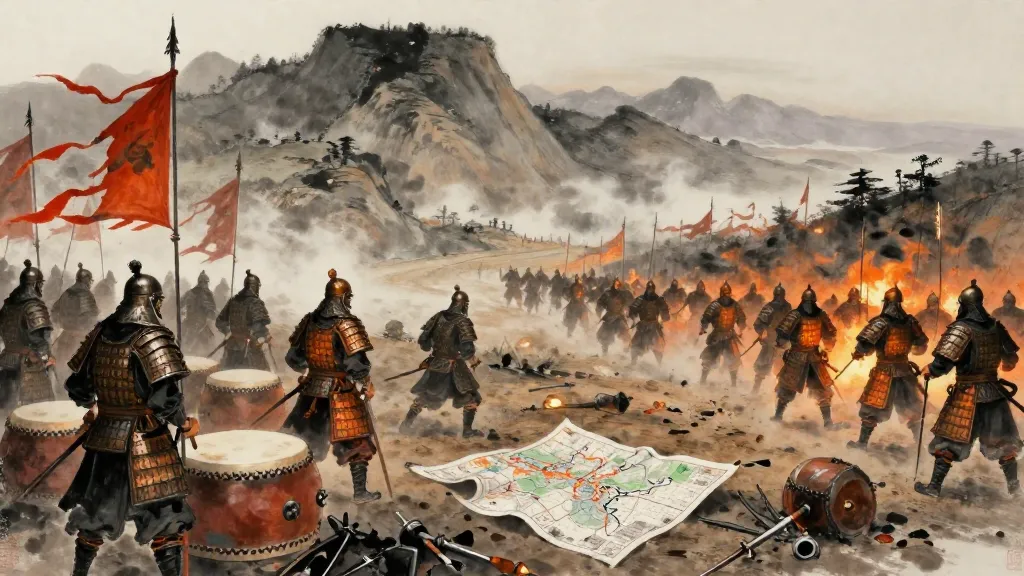
兵征 (Signs of War) — Chinese ink painting

六韜 Liutao · Chapter 29

兵征

Signs of War

View:

強征弱征

Signs of Strength and Signs of Weakness

武王問太公曰:「吾欲未戰先知敵人之強弱,預見勝負之徵,為之奈何?」太公曰:「勝負之徵,精神先見,明將察之,其效在人。謹候敵人出入進退,察其動靜,言語妖祥,士卒所告。凡三軍說懌,士卒畏法,敬其將命,相喜以破敵,相陳以勇猛,相賢以威武,此強征也。三軍數驚,士卒不齊,相恐以敵強,相語以不利,耳目相屬,妖言不止,眾口相惑,不畏法令,不重其將,此弱征也。

King Wu asked Taigong: 'I wish to know the enemy's strength or weakness before battle and foresee the signs of victory or defeat. How should this be done?' Taigong said: 'The signs of victory or defeat manifest first in the spirit — the perceptive general observes them, and their proof lies in the people. Carefully observe the enemy's comings and goings, advances and retreats. Examine their movements and stillness, their speech and omens, and what the soldiers report. When the three armies are content and cheerful, when the soldiers respect the law and honor their general's commands, when they encourage each other about defeating the enemy, when they boast to one another of courage and ferocity, when they compete in displays of martial prowess — these are the signs of strength. When the three armies are frequently startled, when the soldiers are disorderly, when they frighten each other with talk of the enemy's strength, when they tell each other of unfavorable conditions, when they watch each other nervously, when ominous rumors will not cease, when the crowd is confused by conflicting talk, when they do not fear the laws and do not respect their general — these are the signs of weakness.'

大勝大敗之徵

Signs of Great Victory and Great Defeat

「三軍齊整,陣勢已固,深溝高壘,又有大風甚雨之利,三軍無故,旌旗前指,金鐸之聲揚以清,鼙鼓之聲宛以鳴,此得神明之助,大勝之徵也。行陣不固,旌旗亂而相繞,逆大風甚雨之利,士卒恐懼,氣絕而不屬,戎馬驚奔,兵車折軸,金鐸之聲下以濁,鼙鼓之聲濕以沐,此大敗之徵也。

When the three armies are well organized, the battle formations are solid, moats are deep and ramparts high, and you have the advantage of strong wind and heavy rain; when for no apparent reason the banners point forward, when the sound of the golden bells is bright and clear, when the sound of the war drums is resonant and full — these are signs of receiving the aid of divine spirits, omens of great victory. When the formations are not solid, when banners are tangled and wrapped around each other, when the wind and rain work against you, when the soldiers are frightened, when their spirit is broken and disconnected, when the war horses bolt in panic, when chariot axles break, when the sound of the golden bells is low and murky, when the sound of the war drums is dull and muffled — these are signs of great defeat.'

城之氣色

The Aura of a Besieged City

「凡攻城圍邑:城之氣色如死灰,城可屠;城之氣出而北,城可克;城之氣出而西,城必降;城之氣出而南,城不可拔;城之氣出而東,城不可攻;城之氣出而復入,城主逃北;城之氣出而覆我軍上,軍必病;城之氣出高而無所止,用兵長久。凡攻城圍邑,過旬不雷不雨,必亟去之,城必有大輔,此所以知可攻而攻,不可攻而止。」武王曰:「善哉!」

When besieging a city or surrounding a town: if the city's vapor appears like dead ash, the city can be slaughtered. If the city's vapor rises and drifts north, the city can be overcome. If the city's vapor rises and drifts west, the city will surely surrender. If the city's vapor rises and drifts south, the city cannot be taken. If the city's vapor rises and drifts east, the city cannot be attacked. If the city's vapor rises then flows back in, the city's lord will flee northward. If the city's vapor rises and settles over our army, the army will surely suffer illness. If the city's vapor rises high with no limit, the campaign will be protracted. Whenever besieging a city or surrounding a town, if more than ten days pass without thunder or rain, you must withdraw quickly — the city surely has a powerful protector. This is how to know when to attack and attack, and when not to attack and stop.' King Wu said: 'Excellent!'

Notes

1context

The observation of 'city vapor' (城氣) was a form of military divination common in ancient Chinese warfare. Commanders interpreted atmospheric phenomena around besieged cities — mists, clouds, and vapors — as indicators of the city's fate and the defender's morale.

Edition & Source

Text
《六韜》 Liutao
Edition
中華古詩文古書籍網 transcription
Commentary
Traditional military commentaries