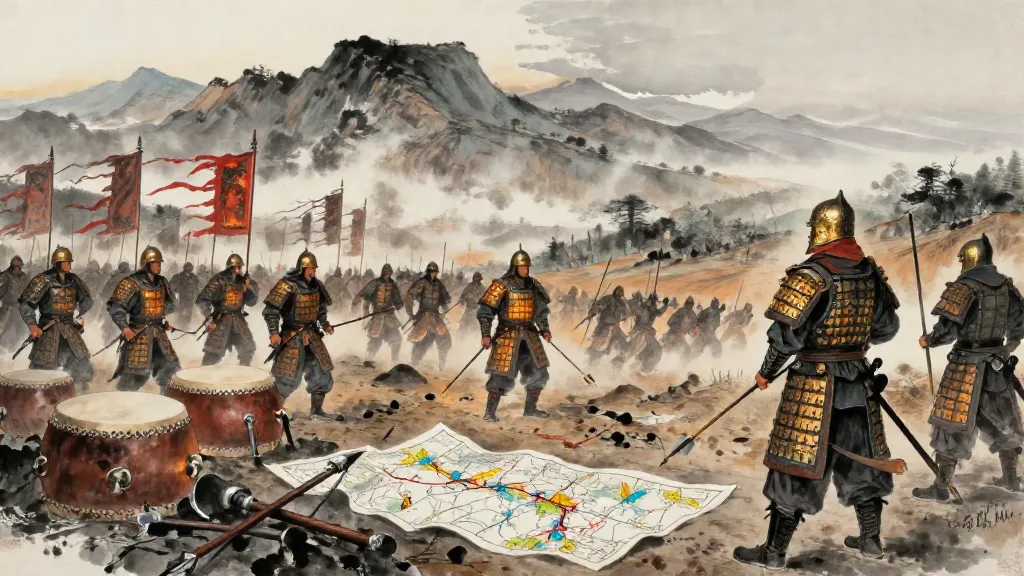
軍用 (Army Equipment) — Chinese ink painting

六韜 Liutao · Chapter 31

軍用

Army Equipment

View:

攻守之具

Equipment for Attack and Defense

武王問太公曰:「王者舉兵,三軍器用,攻守之具,科品眾寡,豈有法乎?」太公曰:「大哉,王之問也!夫攻守之具,各有科品,此兵之大威也。」武王曰:「願聞之。」

King Wu asked Taigong: "When a king raises an army, are there regulations for the equipment of the three armies, the implements of attack and defense, and their categories and quantities?" Taigong said: "How great is my king's question! The implements of attack and defense each have their proper categories — this is the great power of the military." King Wu said: "I wish to hear about it."

Notes

1person武王Wǔ Wáng

King Wu of Zhou (周武王, r. c. 1046–1043 BC) was the founder of the Zhou dynasty who overthrew the Shang. In the Liutao, he appears as the student receiving military instruction from Taigong.

2person太公Tài Gōng

Taigong (太公), also known as Jiang Ziya (姜子牙) or Lu Shang (呂尚), was the chief strategist of King Wen and King Wu of Zhou. He is the attributed author of the Liutao and is regarded as the patriarch of Chinese strategic thought.

軍用大數

The Grand Inventory of Military Equipment

太公曰:「凡用兵之大數,將甲士萬人,法用:武沖大扶胥三十六乘。材士強弩矛戟為翼,一車二十四人推之,以八尺車輪,車上立旗鼓,兵法謂之震駭,陷堅陣,敗強敵。武翼大櫓矛戟扶胥七十二具。材士強弩矛戟為翼,以五尺車輪,絞車連弩自副,陷堅陣,敗強敵。提翼小櫓扶胥一百四十具。絞車連弩自副,以鹿車輪,陷堅陣,敗強敵。大黃參連弩大扶胥三十六乘。材士強弩矛戟為翼,飛鳧、電影自副。飛鳧,赤莖白羽,以銅為首;電影,青莖赤羽,以鐵為首。晝則以絳縞,長六尺,廣六寸,為光耀;夜則以白縞,長六尺,廣六寸,為流星。陷堅陣,敗步騎。大扶胥衝車三十六乘。螳螂武士共載,可以縱擊,可以橫擊,可以敗敵。輜車騎寇,一名電車,兵法謂之電擊。陷堅陣,敗步騎。寇夜來前,矛戟扶胥輕車一百六十乘,螳螂武士三人共載,兵法謂之霆擊。陷堅陣,敗步騎。

Taigong said: "The grand inventory for deploying an army of ten thousand armored soldiers requires the following by regulation: Thirty-six Martial Assault Great Fushi war wagons. Elite soldiers with powerful crossbows, halberds, and spears form its wings; twenty-four men push each wagon, which has eight-foot wheels with banners and drums mounted on top. Military doctrine calls these 'shock and awe' — they breach solid formations and defeat strong enemies. Seventy-two Martial Wing Great Shield Fushi with halberds and spears. Elite crossbowmen with halberds and spears form its wings, using five-foot wheels, with winch-drawn linked crossbows as secondary armament — they breach solid formations and defeat strong enemies. One hundred forty Light Wing Small Shield Fushi. Winch-drawn linked crossbows as secondary armament, using deer-cart wheels — they breach solid formations and defeat strong enemies. Thirty-six Great Yellow Triple-linked Crossbow Great Fushi. Elite crossbowmen with halberds and spears form its wings, with Flying Mallard and Lightning Shadow bolts as secondary armament. Flying Mallards have red shafts and white fletching with bronze tips; Lightning Shadows have blue-green shafts and red fletching with iron tips. By day, crimson silk streamers six feet long and six inches wide serve as bright markers; by night, white silk streamers of the same dimensions serve as shooting stars — they breach solid formations and defeat infantry and cavalry. Thirty-six Great Fushi Ramming Chariots. Mantis Warriors ride together, able to strike vertically and horizontally, able to defeat the enemy. Supply wagons for cavalry raids, also called Lightning Chariots — military doctrine calls them 'lightning strikes,' breaching solid formations and defeating infantry and cavalry. When raiders come by night, one hundred sixty light chariots with halberds, spears, and Fushi carry three Mantis Warriors each — military doctrine calls them 'thunderclap strikes,' breaching solid formations and defeating infantry and cavalry."

Notes

1context

The Fushi (扶胥) was a type of mobile defensive barricade or war wagon used in ancient Chinese warfare. The various models described here — Great Fushi, Small Shield Fushi, etc. — represent different sizes and configurations for different tactical roles.

器械之備

The Arsenal of Implements

「方首鐵錘,重十二斤,柄長五尺以上,千二百枚,一名天錘。大柯斧,刃長八寸,重八斤,柄長五尺以上,千二百枚,一名天鉞。方首鐵錘,重八斤,柄長五尺以上,千二百枚,一名天錘。敗步騎群寇。飛鉤長八寸,鉤芒長四寸,柄長六尺以上,千二百枚,以投其眾。三軍拒守,木螳螂劍刃扶胥,廣二丈,百二十具,一名行馬,平易地,以步兵敗車騎。木蒺藜,去地二尺五寸,百二十具。敗步騎,要穹寇,遮走北。軸鏇短沖矛戟扶胥,百二十具。黃帝所以敗蚩尤氏。敗步騎,要窮寇,遮走北。狹路微徑,張鐵蒺藜,芒高四寸,廣八寸,長六尺以上,千二百具。敗步騎。突瞑來前促戰,白刃接,張地羅,鋪兩鏃蒺藜,參連織女,芒間相去二尺,萬二千具。曠野草中,方胸鋌矛,千二百具。張鋌矛法,高一尺五寸。敗步騎,要窮寇,遮走北。狹路微徑,地陷,鐵械鎖參連,百二十具。敗步騎,要窮寇,遮走北。

"Square-headed iron hammers weighing twelve jin with handles five feet or longer — twelve hundred of them, also called Heaven's Hammers. Great-handled axes with eight-inch blades weighing eight jin with handles five feet or longer — twelve hundred of them, also called Heaven's Battle-axes. Square-headed iron hammers weighing eight jin with handles five feet or longer — twelve hundred of them, also called Heaven's Hammers. These defeat infantry, cavalry, and raiding bands. Flying hooks eight inches long with four-inch barbed points and handles six feet or longer — twelve hundred of them, to be hurled into enemy masses. For the three armies' defensive positions: wooden Mantis sword-blade Fushi, two zhang wide — one hundred twenty of them, also called mobile barriers, for level ground where infantry defeats chariots and cavalry. Wooden caltrops standing two feet five inches off the ground — one hundred twenty sets. These defeat infantry and cavalry, intercept cornered raiders, and block retreating enemies. Axle-turning short assault Fushi with halberds and spears — one hundred twenty sets. These are what the Yellow Emperor used to defeat Chiyou. They defeat infantry and cavalry, intercept cornered enemies, and block retreating forces. For narrow roads and small paths: iron caltrops with four-inch spikes, eight inches wide and six feet or longer — twelve hundred sets. These defeat infantry and cavalry. When enemies rush forward in darkness for close combat with bare blades: spread ground nets, lay double-pointed caltrops, and link them in triple-connected Weaving Maid formations with two-foot spacing between spikes — twelve thousand sets. In open wilderness and tall grass: square-chested barbed spears — twelve hundred sets. The method for deploying barbed spears: set them one foot five inches high. These defeat infantry and cavalry, intercept cornered enemies, and block retreating forces. For narrow roads and small paths with ground traps: iron shackle-chains linked in series — one hundred twenty sets. These defeat infantry and cavalry, intercept cornered enemies, and block retreating forces."

Notes

1person黃帝Huáng Dì

The Yellow Emperor (黃帝, Huangdi) is the legendary progenitor of Chinese civilization. His defeat of Chiyou (蚩尤) at the Battle of Zhuolu is one of the foundational myths of Chinese military history.

營壘渡河之備

Equipment for Camps and River Crossings

「壘門拒守,矛戟小櫓,十二具,絞車連弩自副。三軍拒守,天羅虎落鎖連,一部廣一丈五尺,高八尺,百二十具。虎落劍刃扶胥,廣一丈五尺,高八尺,五百二十具。渡溝塹,飛橋一間,廣一丈五尺,長二丈以上,著轉關轆轤八具,以環利通索張之。渡大水,飛江,廣一丈五尺,長二丈以上,八具,以環利通索張之。天浮鐵螳螂,矩內圓外,徑四尺以上,環絡自副,三十二具。以天浮張飛江,濟大海,謂之天潢,一名天舡。山林野居,結虎落柴營,環利鐵索,長二丈以上,千二百枚。環利大通索,大四寸,長四丈以上,六百枚。環利中通索,大二寸,長四丈以上,二百枚。環利小微縲,長二丈以上,萬二千枚。

"For defending camp gates: small shields with halberds and spears — twelve sets, with winch-drawn linked crossbows as secondary armament. For the three armies' defensive positions: Heaven's Net tiger-barrier chain links, each section one zhang five chi wide and eight chi tall — one hundred twenty sets. Sword-blade tiger-barrier Fushi, one zhang five chi wide and eight chi tall — five hundred twenty sets. For crossing ditches and moats: flying bridges, one span each, one zhang five chi wide and two zhang or longer, fitted with eight winch pulleys, stretched with ring-fitted connecting ropes. For crossing major rivers: Flying River pontoons, one zhang five chi wide and two zhang or longer — eight sets, stretched with ring-fitted connecting ropes. Heaven's Float iron mantis pontoons, square on the inside and round on the outside, four chi or more in diameter, with ring nets as secondary fittings — thirty-two sets. Using Heaven's Floats to extend Flying River pontoons can cross great seas — this is called the Heaven's Pool, also named the Heaven's Ship. For encamping in mountains and wilderness: build tiger-barrier brushwood camps using ring-fitted iron chains two zhang or longer — twelve hundred of them. Large ring-fitted connecting ropes, four inches thick and four zhang or longer — six hundred of them. Medium ring-fitted connecting ropes, two inches thick and four zhang or longer — two hundred of them. Small ring-fitted fine cords, two zhang or longer — twelve thousand of them."

工具與兵員總數

Tools and Total Troop Allocation

「伐木大斧,重八斤,柄長三尺以上,三百枚;鑿刃廣六寸,柄長五尺以上,三百枚;銅築固為垂,長五尺以上,三百枚;鷹爪方胸鐵耙,柄長七尺以上,三百枚;方胸鐵叉,柄長七尺以上,三百枚。芟草木大鐮,柄長七尺以上,三百枚;大櫓,刃重八斤,柄長六尺,三百枚;委環鐵杙,長三尺以上,三百枚;鑿大槌,重五斤,柄長二尺以上,百二十具。甲士萬人,強弩六千,戟盾二千,矛盾二千,修治攻具,砥礪兵器巧手三百人,此舉兵軍用之大數也。」武王曰:「允哉!」

"Timber-felling great axes weighing eight jin with handles three feet or longer — three hundred. Chisels with six-inch blades and handles five feet or longer — three hundred. Bronze-capped mallets five feet or longer — three hundred. Eagle-claw square-chested iron rakes with handles seven feet or longer — three hundred. Square-chested iron forks with handles seven feet or longer — three hundred. Vegetation-clearing great sickles with handles seven feet or longer — three hundred. Great shields with blades weighing eight jin and handles six feet long — three hundred. Looped iron stakes three feet or longer — three hundred. Chisel-mallets weighing five jin with handles two feet or longer — one hundred twenty. For ten thousand armored soldiers: six thousand with powerful crossbows, two thousand with halberds and shields, two thousand with spears and shields, and three hundred skilled craftsmen for repairing siege equipment and sharpening weapons. This is the grand inventory for raising an army." King Wu said: "Excellent indeed!"

Edition & Source

Text
《六韜》 Liutao
Edition
中華古詩文古書籍網 transcription
Commentary
Traditional military commentaries