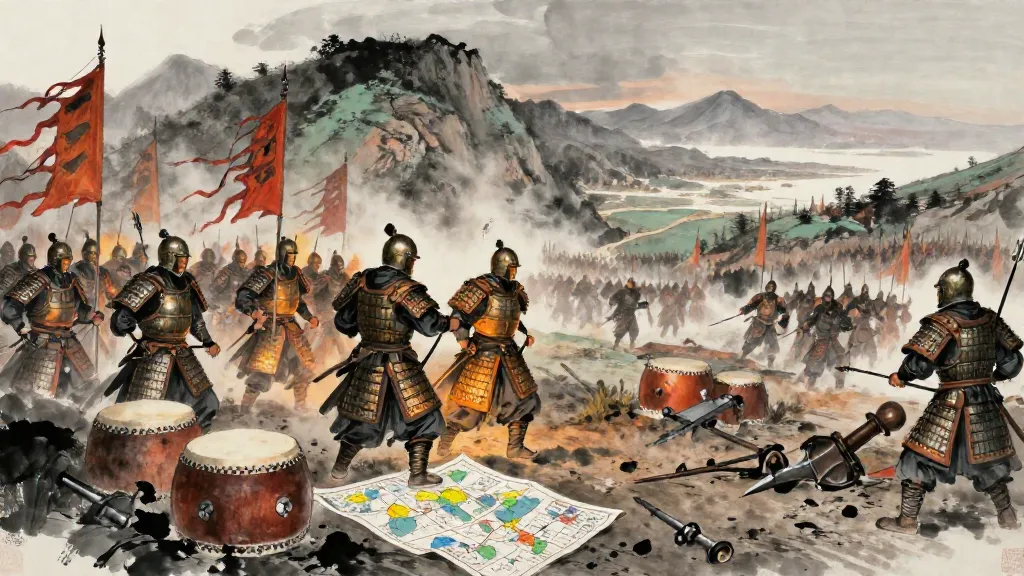
略地 (Seizing Territory) — Chinese ink painting

六韜 Liutao · Chapter 40

略地

Seizing Territory

View:

攻城圍邑

Besieging Cities and Surrounding Towns

武王問太公曰:「戰勝深入,略其地,有大城不可下。其別軍守險,與我相拒。我欲攻城圍邑,恐其別軍卒至而擊我,中外相合,擊我表裡,三軍大亂,上下恐駭,為之奈何?」太公曰:「凡攻城圍邑,車騎必遠,屯衛警戒,阻其外內,中人絕糧,外不得輸,城人恐怖,其將必降。」

King Wu asked Taigong: "After winning a battle and advancing deep to seize territory, if there is a great city that cannot be taken, and the enemy's detached forces hold strong positions and resist us — if I wish to besiege the city but fear their detached forces will suddenly arrive and strike us, combining with the defenders inside to attack us from within and without so that the three armies fall into chaos with everyone terrified — what should be done?" Taigong said: "Whenever besieging a city or surrounding a town, chariots and cavalry must be stationed far out as screen guards on alert, blocking all communication between inside and outside. Cut off the city's provisions so no supplies can be delivered from outside. The people in the city will be terrified, and their general will certainly surrender."

城中突圍

When the Besieged Attempt to Break Out

武王曰:「中人絕糧,外不得輸,陰為約誓,相與密謀,夜出窮寇死戰,其車騎銳士,或沖我內,或擊我外,士卒迷惑,三軍敗亂,為之奈何?」太公曰:「如此者,當分軍三軍,謹視地形而處。審知敵人別軍所在,及其大城別堡,為之置遺缺之道,以利其心,謹備勿失。敵人恐懼,不入山林,即歸大邑。走其別軍,車騎遠要其前,勿令遺脫。中人以為先出者得其徑道,其練卒材士必出,其老弱獨在。車騎深入長驅,敵人之軍,必莫敢至。慎勿與戰,絕其糧道,圍而守之,必久其日。

King Wu said: "If the city's provisions are exhausted and no supplies can enter, and the defenders secretly conspire and make covert plans, then sally out at night as desperate soldiers fighting to the death — their chariots and elite soldiers striking our interior while others attack our exterior, our soldiers confused, the three armies in disarray — what should be done?" Taigong said: "In such a case, divide the army into three forces and position them carefully according to the terrain. Ascertain precisely where the enemy's detached forces and auxiliary strongholds are located. Deliberately leave an apparent escape route to entice them. Prepare carefully and miss nothing. The enemy, in fear, will not flee to mountain forests but will head for major towns. Pursue their detached forces with chariots and cavalry far ahead to intercept them — let none escape. The defenders inside, believing those who left first found a clear path, will send out their trained soldiers and elite troops, leaving only the old and weak behind. Then drive chariots and cavalry deep in a long pursuit — the enemy's relief forces will certainly not dare approach. Take care not to engage in battle; cut their supply lines, surround them, and maintain the siege over many days."

仁義攻心

Conquering Hearts Through Benevolence

「無燔人積聚,無壞人宮室,冢樹社叢勿伐,降者勿殺,得而勿戮,示之以仁義,施之以厚德。令其士民曰:『罪在一人。』如此,則天下和服。」武王曰:「善哉!」

"Do not burn the people's granaries and storehouses. Do not destroy the people's homes and palaces. Do not cut down trees at graves, shrines, or sacred groves. Do not kill those who surrender. Do not execute those you capture. Show them benevolence and righteousness, bestow generous virtue upon them. Announce to their soldiers and people: 'The guilt lies with one man alone.' In this way, all under heaven will submit in peace." King Wu said: "Excellent!"

Notes

1context

The principle of 'the guilt lies with one man alone' (罪在一人) — blaming only the enemy ruler while treating the population with benevolence — was a foundational concept in classical Chinese statecraft. It allowed a conqueror to absorb the defeated population without prolonged resistance, and echoed the Zhou dynasty's own justification for overthrowing the Shang.

Edition & Source

Text
《六韜》 Liutao
Edition
中華古詩文古書籍網 transcription
Commentary
Traditional military commentaries