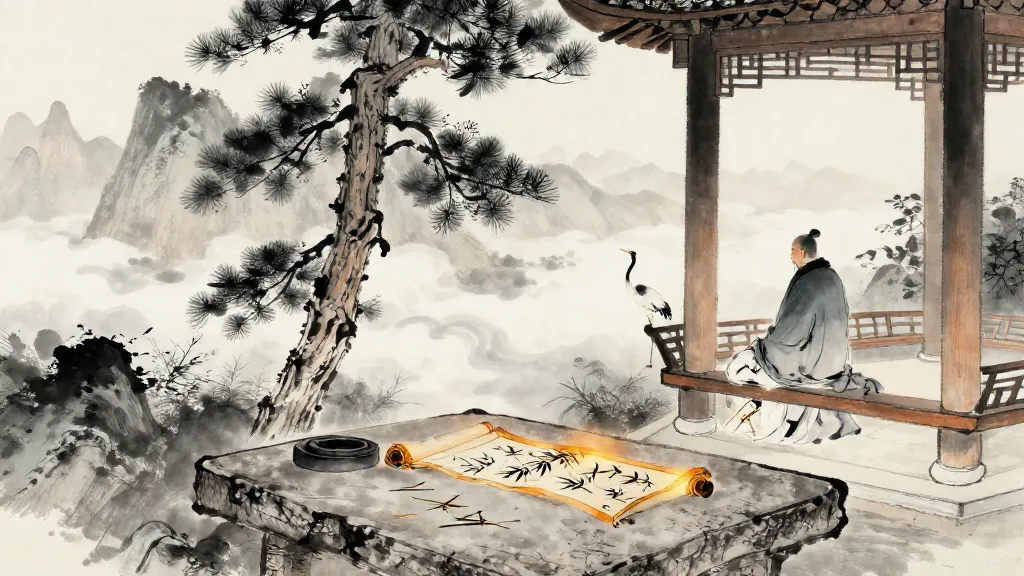
滕文公上 (Duke Wen of Teng, Part I) — Chinese ink painting

孟子 Mengzi · Chapter 5

滕文公上

Duke Wen of Teng, Part I

View:

孟子道性善

Mencius Expounds the Goodness of Human Nature

滕文公為世子,將之楚,過宋而見孟子。孟子道性善,言必稱堯舜。

世子自楚反,復見孟子。孟子曰:"世子疑吾言乎?夫道一而已矣。成覸謂齊景公曰:'彼丈夫也,我丈夫也,吾何畏彼哉?'顏淵曰:'舜何人也?予何人也?有為者亦若是。'公明儀曰:'文王我師也,周公豈欺我哉?'今滕,絕長補短,將五十里也,猶可以為善國。書曰:'若藥不瞑眩,厥疾不瘳。'"

When Duke Wen of Teng was heir apparent, he was traveling to Chu and passed through Song, where he met Mencius. Mencius spoke to him about the goodness of human nature, always citing Yao and Shun as examples.

On his return from Chu, the heir apparent again met Mencius. Mencius said: “Does the heir apparent doubt my words? The Way is one and only one. Cheng Jian told Duke Jing of Qi: ‘He is a man, and I am a man — why should I stand in awe of him?’ Yan Yuan said: ‘What kind of man was Shun? What kind of man am I? He who acts with resolve can be like him.’ Gongming Yi said: ‘King Wen is my teacher — would the Duke of Zhou deceive me?’ Now Teng, if you trim the long and pad the short, is about fifty li — it can still become a good state. The Documents say: ‘If the medicine does not make the patient dizzy, the illness will not be cured.’”

三年之喪

The Three-Year Mourning Period

滕定公薨。世子謂然友曰:"昔者孟子嘗與我言於宋,於心終不忘。今也不幸至於大故,吾欲使子問於孟子,然後行事。"然友之鄒問於孟子。

孟子曰:"不亦善乎!親喪固所自盡也。曾子曰:'生,事之以禮;死,葬之以禮,祭之以禮,可謂孝矣。'諸侯之禮,吾未之學也;雖然,吾嘗聞之矣。三年之喪,齊疏之服,飦粥之食,自天子達於庶人,三代共之。"然友反命,定為三年之喪。

父兄百官皆不欲,曰:"吾宗國魯先君莫之行,吾先君亦莫之行也,至於子之身而反之,不可。且志曰:'喪祭從先祖。'"

曰:"吾有所受之也。"謂然友曰:"吾他日未嘗學問,好馳馬試劍。今也父兄百官不我足也,恐其不能盡於大事,子為我問孟子。"然友復之鄒問孟子。

孟子曰:"然。不可以他求者也。孔子曰:'君薨,聽於冢宰。歠粥,面深墨。即位而哭,百官有司,莫敢不哀,先之也。'上有好者,下必有甚焉者矣。'君子之德,風也;小人之德,草也。草尚之風必偃。'是在世子。"然友反命。

世子曰:"然。是誠在我。"五月居廬,未有命戒。百官族人可謂曰知。及至葬,四方來觀之,顏色之戚,哭泣之哀,弔者大悅。

Duke Ding of Teng died. The heir apparent told Ran You: “Once Mencius spoke to me in Song, and I have never forgotten his words. Now I have met with this great misfortune, and I wish to send you to ask Mencius, and then arrange the rites.” Ran You went to Zou and asked Mencius.

Mencius said: “Is this not good! In mourning for parents, one should do one’s utmost. Zengzi said: ‘While they are alive, serve them according to propriety; when they die, bury them according to propriety, sacrifice to them according to propriety — this may be called filial.’ The rites of the feudal lords I have not studied; however, I have heard of them. The three-year mourning period, wearing coarse hemp garments, eating thin gruel — from the Son of Heaven down to the common people, the Three Dynasties shared these practices.”

Ran You returned with this answer, and the three-year mourning was established. But the elders and officials all objected, saying: “None of the former lords of our ancestral state Lu practiced it, and none of our own former lords practiced it. For you to reverse this in your generation is wrong.”

The heir apparent told Ran You: “I have something I received from Mencius.” He sent Ran You again to Zou to ask Mencius.

Mencius said: “So it is. This cannot be sought elsewhere. Confucius said: ‘When a lord dies, entrust affairs to the chief minister. Drink thin gruel, darken your face. Take your place and weep — and all the officials will not dare fail to grieve, for you have set the example.’ When those above have preferences, those below surely carry them to excess. ‘The virtue of the noble person is the wind; the virtue of the small person is the grass. The grass bends when the wind blows over it.’ It depends on the heir apparent.”

The heir apparent said: “So it is. It truly depends on me.” He dwelt in the mourning hut for five months, issuing no commands or prohibitions. The officials and relatives could all be said to know what was proper. When the burial came, visitors from all directions came to observe. The gravity of his expression and the sorrow of his weeping greatly pleased the mourners.
Notes

1person滕文公Téng Wén Gōng

Duke Wen of Teng was the ruler of the small state of Teng who became one of Mencius’s most sympathetic interlocutors.

民事不可緩

The People’s Livelihood Cannot Be Neglected

滕文公問為國。孟子曰:"民事不可緩也。詩云:'晝爾於茅,宵爾索綯;亟其乘屋,其始播百穀。'民之為道也,有恆產者有恆心,無恆產者無恆心。苟無恆心,放辟邪侈,無不為已。及陷乎罪,然後從而刑之,是罔民也。焉有仁人在位,罔民而可為也?是故賢君必恭儉禮下,取於民有制。陽虎曰:'為富不仁矣,為仁不富矣。'陽虎,陽貨,魯季氏家臣也。天理人慾,不容並立。虎之言此,恐為仁之害於富也;孟子引之,恐為富之害於仁也。君子小人,每相反而已矣。夏後氏五十而貢,殷人七十而助,周人百畝而徹,其實皆什一也。徹者,徹也;助者,藉也。龍子曰:'治地莫善於助,莫不善於貢。貢者校數歲之中以為常。樂歲,粒米狼戾,多取之而不為虐,則寡取之;凶年,糞其田而不足,則必取盈焉。為民父母,使民盻盻然,將終歲勤動,不得以養其父母,又稱貸而益之。使老稚轉乎溝壑,惡在其為民父母也?'夫世祿,滕固行之矣。詩云:'雨我公田,遂及我私。'惟助為有公田。由此觀之,雖周亦助也。設為庠序學校以教之:庠者,養也;校者,教也;序者,射也。夏曰校,殷曰序,周曰庠,學則三代共之,皆所以明人倫也。人倫明於上,小民親於下。有王者起,必來取法,是為王者師也。詩云'周雖舊邦,其命維新',文王之謂也。子力行之,亦以新子之國。"使畢戰問井地。

孟子曰:"子之君將行仁政,選擇而使子,子必勉之!夫仁政,必自經界始。經界不正,井地不鈞,穀祿不平。是故暴君污吏必慢其經界。經界既正,分田制祿可坐而定也。夫滕壤地褊小,將為君子焉,將為野人焉。無君子莫治野人,無野人莫養君子。請野九一而助,國中什一使自賦。卿以下必有圭田,圭田五十畝。余夫二十五畝。死徙無出鄉,鄉田同井。出入相友,守望相助,疾病相扶持,則百姓親睦。方里而井,井九百畝,其中為公田。八家皆私百畝,同養公田。公事畢,然後敢治私事,所以別野人也。此其大略也。若夫潤澤之,則在君與子矣。"

Duke Wen of Teng asked about governing the state. Mencius said: “The people’s livelihood cannot be neglected. The Odes say: ‘By day gather thatch, by night twist rope; swiftly repair the roof, then begin sowing the hundred grains.’ This is the people’s way: those with constant livelihood have constant hearts; those without constant livelihood lack constant hearts. Without constant hearts, there is no dissipation, depravity, or excess they will not commit.

The Xia took one in fifty as tribute; the Yin took one in seventy through the mutual-aid system; the Zhou took one in a hundred through the tithe — in reality all amounted to one-tenth. The tithe means ‘sharing’; the mutual-aid means ‘borrowing labor.’ Longzi said: ‘For land management, nothing is better than mutual aid, nothing worse than tribute.’

Establish schools of various kinds to educate: xiang means ‘to nourish’; xiao means ‘to teach’; xu means ‘archery practice.’ The Xia called them xiao, the Yin called them xu, the Zhou called them xiang — but learning was shared by all three dynasties, all serving to illuminate human relationships. When human relationships are clear among those above, the common people below will be bound by affection. Should a true king arise, he will surely come to learn from you — this is to be the teacher of kings. The Odes say: ‘Although Zhou is an old state, its mandate is renewed.’ This refers to King Wen. If you strive to put this into practice, you too can renew your state.”

The duke sent Bi Zhan to ask about the well-field system. Mencius said: “Your lord intends to practice benevolent governance and has chosen you for the task — you must exert yourself! Benevolent governance must begin with proper land boundaries. When boundaries are not correct, the well-fields are unequal and grain revenues are unfair. Each well is nine hundred mu: the center is the public field. Eight families each manage a hundred mu privately and together cultivate the public field. Only when public work is done may they attend to private work.”

Notes

1context

The well-field system (井田制) is Mencius’s idealized agrarian model: a square of land divided into nine equal plots like the character 井 (well), with eight families each farming one private plot and collectively cultivating the central public plot as tax.

許行之道

The Way of Xu Xing

有為神農之言者許行,自楚之滕,踵門而告文公曰:"遠方之人聞君行仁政,願受一廛而為氓。"文公與之處,其徒數十人,皆衣褐,捆屨、織席以為食。

陳良之徒陳相與其弟辛,負耒耜而自宋之滕,曰:"聞君行聖人之政,是亦聖人也,願為聖人氓。"

陳相見許行而大悅,盡棄其學而學焉。陳相見孟子,道許行之言曰:"滕君,則誠賢君也;雖然,未聞道也。賢者與民並耕而食,饔飧而治。今也滕有倉廩府庫,則是厲民而以自養也,惡得賢?"

孟子曰:"許子必種粟而後食乎?"曰:"然。""許子必織布而後衣乎?"曰:"否。許子衣褐。""許子冠乎?"曰:"冠。"曰:"奚冠?"曰:"冠素。"曰:"自織之與?"曰:"否。以粟易之。"曰:"許子奚為不自織?"曰:"害於耕。"曰:"許子以釜甑爨,以鐵耕乎?"曰:"然。""自為之與?"曰:"否。以粟易之。"

"以粟易械器者,不為厲陶冶;陶冶亦以其械器易粟者,豈為厲農夫哉?且許子何不為陶冶。舍皆取諸其宮中而用之?何為紛紛然與百工交易?何許子之不憚煩?"曰:"百工之事,固不可耕且為也。"

"然則治天下獨可耕且為與?有大人之事,有小人之事。且一人之身,而百工之所為備。如必自為而後用之,是率天下而路也。故曰:或勞心,或勞力;勞心者治人,勞力者治於人;治於人者食人,治人者食於人:天下之通義也。

當堯之時,天下猶未平,洪水橫流,泛濫於天下。草木暢茂,禽獸繁殖,五穀不登,禽獸逼人。獸蹄鳥跡之道,交於中國。堯獨憂之,舉舜而敷治焉。舜使益掌火,益烈山澤而焚之,禽獸逃匿。禹疏九河,瀹濟漯,而注諸海;決汝漢,排淮泗,而注之江,然後中國可得而食也。當是時也,禹八年於外,三過其門而不入,雖欲耕,得乎?

后稷教民稼穡。樹藝五穀,五穀熟而民人育。人之有道也,飽食、暖衣、逸居而無教,則近於禽獸。聖人有憂之,使契為司徒,教以人倫:父子有親,君臣有義,夫婦有別,長幼有序,朋友有信。放勛曰:'勞之來之,匡之直之,輔之翼之,使自得之,又從而振德之。'聖人之憂民如此,而暇耕乎?

堯以不得舜為己憂,舜以不得禹、皋陶為己憂。夫以百畝之不易為己憂者,農夫也。分人以財謂之惠,教人以善謂之忠,為天下得人者謂之仁。是故以天下與人易,為天下得人難。孔子曰:'大哉堯之為君!惟天為大,惟堯則之,蕩蕩乎民無能名焉!君哉舜也!巍巍乎有天下而不與焉!'堯舜之治天下,豈無所用其心哉?亦不用於耕耳。

吾聞用夏變夷者,未聞變於夷者也。陳良,楚產也。悅周公、仲尼之道,北學於中國。北方之學者,未能或之先也。彼所謂豪傑之士也。子之兄弟事之數十年,師死而遂倍之。昔者孔子沒,三年之外,門人治任將歸,入揖於子貢,相向而哭,皆失聲,然後歸。子貢反,築室於場,獨居三年,然後歸。他日,子夏、子張、子游以有若似聖人,欲以所事孔子事之,強曾子。曾子曰:'不可。江漢以濯之,秋陽以暴之,皜皜乎不可尚已。'今也南蠻鴃舌之人,非先王之道,子倍子之師而學之,亦異於曾子矣。吾聞出於幽谷遷於喬木者,末聞下喬木而入於幽谷者。魯頌曰:'戎狄是膺,荊舒是懲。'周公方且膺之,子是之學,亦為不善變矣。"

"從許子之道,則市賈不貳,國中無偽。雖使五尺之童適市,莫之或欺。布帛長短同,則賈相若;麻縷絲絮輕重同,則賈相若;五穀多寡同,則賈相若;屨大小同,則賈相若。"

曰:"夫物之不齊,物之情也;或相倍蓰,或相什伯,或相千萬。子比而同之,是亂天下也。巨屨小屨同賈,人豈為之哉?從許子之道,相率而為偽者也,惡能治國家?"

A man named Xu Xing, who advocated the teachings of the Divine Farmer, came from Chu to Teng and told Duke Wen: “A man from afar has heard that you practice benevolent governance. I wish to receive a dwelling and become your subject.” The duke gave him a place. His followers numbered several dozen, all wearing rough hemp, weaving sandals and mats for their living.

Chen Xiang, a follower of Chen Liang, came with his brother Xin from Song to Teng, saying they wished to be subjects of a sage’s government. Chen Xiang met Xu Xing and was greatly pleased, abandoning all his previous learning to study under him. He visited Mencius and relayed Xu Xing’s words: “The duke is truly a worthy ruler. But he has not yet heard the Way. A worthy ruler should plow alongside the people and cook his own meals while governing.”

Mencius said: “Does Master Xu grow his own grain before he eats? Does he weave his own cloth before he wears it?” Chen Xiang admitted that Xu Xing traded grain for his tools and clothing.

Mencius said: “If the craftsman who trades tools for grain does not harm the potter, does the potter who trades for grain harm the farmer? Moreover, why does Xu Xing not make his own pottery? Why this troublesome trading with the hundred craftsmen? Because the hundred crafts cannot be pursued while also farming.”

Mencius continued: “Then can governing the realm alone be pursued while also farming? There are the affairs of the great and the affairs of the small. If everyone had to make everything himself before using it, the whole realm would be on the road. Therefore it is said: some labor with their minds, some labor with their bodies. Those who labor with their minds govern others; those who labor with their bodies are governed by others. Those who are governed feed others; those who govern are fed by others — this is the universal principle.”

Mencius then argued at length that the division of labor between rulers and farmers was essential, citing the examples of Yao, Shun, Yu, and the Duke of Zhou, all of whom governed rather than farmed. He concluded by criticizing Chen Xiang for abandoning his teacher Chen Liang’s Confucian principles in favor of Xu Xing’s primitivism.

Notes

1person許行Xǔ Xíng

Xu Xing was a Warring States thinker who advocated the ‘Agriculturalist’ school (農家), arguing that rulers should farm alongside their subjects. Mencius refutes him with the argument for the necessity of the division of labor.

墨者夷之

The Mohist Yi Zhi

墨者夷之,因徐辟而求見孟子。孟子曰:"吾固願見,今吾尚病,病癒,我且往見,夷子不來!"他日又求見孟子。

孟子曰:"吾今則可以見矣。不直,則道不見;我且直之。吾聞夷子墨者。墨之治喪也,以薄為其道也。夷子思以易天下,豈以為非是而不貴也?然而夷子葬其親厚,則是以所賤事親也。"徐子以告夷子。

夷子曰:"儒者之道,古之人'若保赤子',此言何謂也?之則以為愛無差等,施由親始。"徐子以告孟子。

孟子曰:"夫夷子,信以為人之親其兄之子為若親其鄰之赤子乎?彼有取爾也。赤子匍匐將入井,非赤子之罪也。且天之生物也,使之一本,而夷子二本故也。蓋上世嘗有不葬其親者。其親死,則舉而委之於壑。他日過之,狐狸食之,蠅蚋姑嘬之。其顙有泚,睨而不視。夫泚也,非為人泚,中心達於面目。蓋歸反虆梩而掩之。掩之誠是也,則孝子仁人之掩其親,亦必有道矣。"徐子以告夷子。夷子憮然為間曰:"命之矣。"

Yi Zhi, a Mohist, sought through Xu Bi to see Mencius. Mencius said: “I certainly wish to see him, but I am currently ill. When I recover, I shall go to see him myself.”

Another day Yi Zhi again sought to see Mencius. Mencius said: “Now I can see him. If I do not speak directly, the Way will not be made clear. I have heard that Yi Zhi is a Mohist. The Mohist approach to funerals treats frugality as its principle. Yi Zhi wishes to change the customs of the realm through this — does he consider lavish funerals wrong? Yet Yi Zhi buried his own parents lavishly. In that case, he served his parents with what he himself disdains.”

Xu Bi reported this to Yi Zhi, who replied: “The Confucian way says that the ancients governed as if ‘caring for a newborn infant.’ What does this mean? I take it to mean that love has no gradations, though its application begins with those closest.”

Mencius said: “Does Yi Zhi truly believe that one loves one’s brother’s child no more than one’s neighbor’s infant? There is a specific case to be drawn upon: when an infant crawling on the ground is about to fall into a well, it is not the infant’s fault. Moreover, heaven produces things with a single root, but Yi Zhi would give them two roots.”

Mencius went on to argue that even in primitive times, when people first left the dead unburied, the sight of foxes feeding on the corpse produced a natural reaction of distress — proving that the impulse to honor the dead with proper burial is innate, not merely conventional. Yi Zhi was moved and said: “He has taught me.”

Notes

1context

This debate between Mencius and the Mohist Yi Zhi centers on whether love should be graded (Confucian position: love begins with family) or equal (Mohist ‘universal love’). Mencius argues that love naturally has gradations, beginning with one’s parents, and that the Mohist position of treating all equally actually has ‘two roots’ rather than the single natural root of family affection.

Edition & Source

Text
《孟子》 Mengzi
Edition
《四部叢刊》本
Commentary
Traditional Confucian commentaries