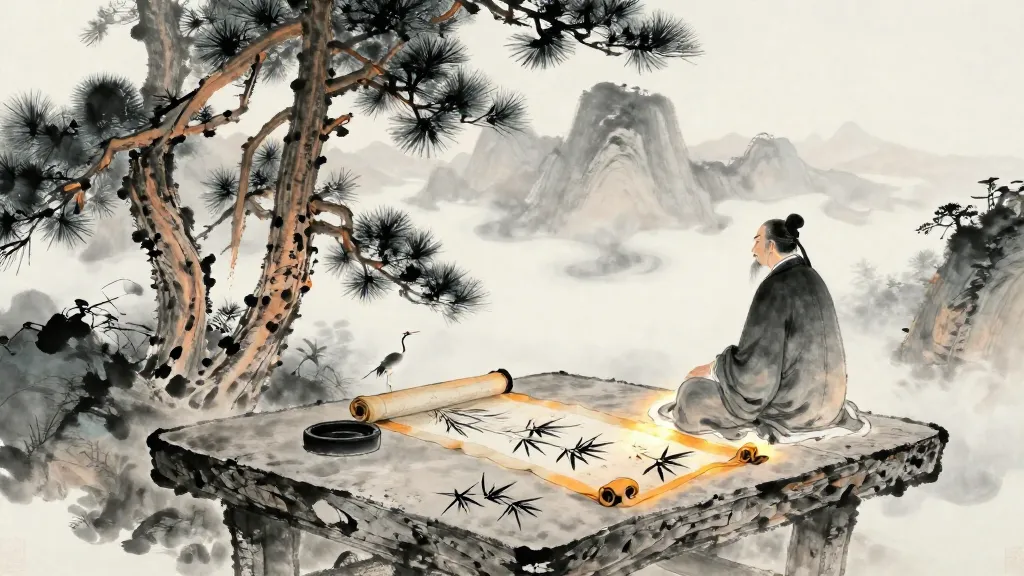
離婁上 (Li Lou, Part I) — Chinese ink painting

孟子 Mengzi · Chapter 7

離婁上

Li Lou, Part I

View:

不以規矩不能成方員

Without Compass and Square One Cannot Make Circles and Squares

孟子曰:"離婁之明,公輸子之巧,不以規矩,不能成方員:師曠之聰,不以六律,不能正五音;堯舜之道,不以仁政,不能平治天下。

今有仁心仁聞而民不被其澤,不可法於後世者,不行先王之道也。故曰,徒善不足以為政,徒法不能以自行。詩云:'不愆不忘,率由舊章。'遵先王之法而過者,未之有也。

聖人既竭目力焉,繼之以規矩準繩,以為方員平直,不可勝用也;既竭耳力焉,繼之以六律,正五音,不可勝用也;既竭心思焉,繼之以不忍人之政,而仁覆天下矣。故曰,為高必因丘陵,為下必因川澤。為政不因先王之道,可謂智乎?是以惟仁者宜在高位。不仁而在高位,是播其惡於眾也。

上無道揆也。下無法守也,朝不信道,工不信度,君子犯義,小人犯刑,國之所存者幸也。故曰:城郭不完,兵甲不多,非國之災也;田野不辟,貨財不聚,非國之害也。上無禮,下無學,賊民興,喪無日矣。

詩曰:'天之方蹶,無然泄泄。'泄泄,猶沓沓也。事君無義,進退無禮,言則非先王之道者,猶沓沓也。故曰:責難於君謂之恭,陳善閉邪謂之敬,吾君不能謂之賊。"

Mencius said: “With Li Lou’s keen sight and Gongshu Zi’s skill, without compass and square they cannot make circles and squares. With Music Master Kuang’s keen ear, without the six pitch-pipes he cannot tune the five notes. With the Way of Yao and Shun, without benevolent governance one cannot bring peace to the realm.

Now there are those with benevolent hearts and benevolent reputations, yet the people receive no benefit from them and they cannot be models for later ages — because they do not practice the Way of the ancient kings. The sage exhausts the power of his eyes, then supplements it with compass, square, level, and line to make circles, squares, planes, and straight lines in inexhaustible supply. He exhausts the power of his ears, then supplements it with the six pitch-pipes. He exhausts his thought, then supplements it with governance that cannot bear the people’s suffering, and benevolence covers the whole realm.

Therefore it is said: to build high, one must rely on the hill; to dig low, one must follow the stream. Is it wise to govern without following the Way of the ancient kings? Only the benevolent should occupy high positions. When the unbenevolent occupy high positions, they spread their wickedness to the multitude.

When those above have no guiding principles and those below have no adherence to law, when the court does not trust the Way and the craftsmen do not trust their measures, when the noble person violates righteous conduct and the common person violates the law — that the state survives at all is a matter of luck. Therefore it is said: incomplete walls and insufficient arms are not the state’s disaster; uncultivated fields and ungathered wealth are not the state’s harm. But when those above lack propriety and those below lack learning, seditious people arise, and the state’s downfall is at hand.”

規矩方員之至

Compass and Square Are the Perfection of Circles and Squares

孟子曰:"規矩,方員之至也;聖人,人倫之至也。欲為君盡君道,欲為臣盡臣道,二者皆法堯舜而已矣。不以舜之所以事堯事君,不敬其君者也;不以堯之所以治民治民,賊其民者也。孔子曰:'道二:仁與不仁而已矣。'暴其民甚,則身弒國亡;不甚,則身危國削。名之曰'幽厲',雖孝子慈孫,百世不能改也。詩云'殷鑑不遠,在夏後之世',此之謂也。"

Mencius said: “Compass and square are the perfection of circles and squares; the sage is the perfection of human relationships. To be a ruler, fulfill the ruler’s Way; to be a minister, fulfill the minister’s Way. Both need only model themselves on Yao and Shun. Not to serve your ruler as Shun served Yao is to disrespect your ruler. Not to govern your people as Yao governed his is to harm your people. Confucius said: ‘There are only two ways: benevolence and its absence.’ A ruler who oppresses his people excessively will himself be killed and his state destroyed; if not excessively, his person will be endangered and his territory diminished. Such rulers are called ‘Dark’ and ‘Cruel’ — though their filial sons and loving grandsons may try for a hundred generations, they cannot change these names. The Odes say: ‘The mirror of Yin is not far off — it is in the age of the Xia lords.’ This is what it means.”

三代之得天下也以仁

The Three Dynasties Won the Realm Through Benevolence

孟子曰:"三代之得天下也以仁,其失天下也以不仁。國之所以廢興存亡者亦然。天子不仁,不保四海;諸侯不仁,不保社稷;卿大夫不仁,不保宗廟;士庶人不仁,不保四體。惡死亡而樂不仁,是猶惡醉而強酒。"

Mencius said: “The Three Dynasties won the realm through benevolence and lost it through the lack of benevolence. The rise and fall of states follows the same pattern. Without benevolence, the Son of Heaven cannot protect the realm; without benevolence, a feudal lord cannot protect the altars of soil and grain; without benevolence, a minister cannot protect the ancestral temple; without benevolence, a commoner cannot protect his own body. To hate death yet delight in the absence of benevolence is like hating drunkenness while forcing oneself to drink.”

愛人不親反其仁

If You Love People and They Do Not Respond, Examine Your Benevolence

孟子曰:"愛人不親反其仁,治人不治反其智,禮人不答反其敬。行有不得者,皆反求諸己,其身正而天下歸之。詩云:'永言配命,自求多福。'"

Mencius said: “If you love people and they do not respond with affection, examine your benevolence. If you govern people and they are not well governed, examine your wisdom. If you treat people with propriety and they do not respond, examine your respect. Whenever your actions do not achieve their aim, always seek the cause within yourself. When your own person is correct, the whole realm will turn to you. The Odes say: ‘Forever mindful of heaven’s mandate, seek for yourself much blessing.’”

天下國家

The Realm, the State, the Family

孟子曰:"人有恆言,皆曰'天下國家'。天下之本在國,國之本在家,家之本在身。"

Mencius said: “People have a common saying: ‘The realm, the state, the family.’ The root of the realm is the state; the root of the state is the family; the root of the family is the individual.”

為政不難

Governing Is Not Difficult

孟子曰:"為政不難,不得罪於巨室。巨室之所慕,一國慕之;一國之所慕,天下慕之;故沛然德教溢乎四海。"

Mencius said: “Governing is not difficult — do not offend the great families. What the great families admire, the whole state admires; what the state admires, the whole realm admires. Thus virtue and teaching overflow to fill the four seas.”

天下有道小德役大德

When the Realm Has the Way

孟子曰:"天下有道,小德役大德,小賢役大賢;天下無道,小役大,弱役強。斯二者天也。順天者存,逆天者亡。齊景公曰:'既不能令,又不受命,是絕物也。'涕出而女於吳。今也小國師大國而恥受命焉,是猶弟子而恥受命於先師也。如恥之,莫若師文王。師文王,大國五年,小國七年,必為政於天下矣。詩云:'商之孫子,其麗不億。上帝既命,侯於周服。侯服於周,天命靡常。殷士膚敏,祼將於京。'孔子曰:'仁不可為眾也。夫國君好仁,天下無敵。'今也欲無敵於天下而不以仁,是猶執熱而不以濯也。詩云:'誰能執熱,逝不以濯?'"

Mencius said: “When the realm has the Way, the lesser virtue serves the greater virtue, the lesser worthy serves the greater worthy. When the realm lacks the Way, the small serves the great, the weak serves the strong. Both are heaven’s decree. Those who follow heaven survive; those who resist heaven perish. If you wish to be invincible yet refuse to practice benevolence, it is like grasping something hot without washing your hands. The Odes say: ‘Who can grasp what is hot without washing first?’”

不仁者可與言哉

Can You Reason with the Unbenevolent?

孟子曰:"不仁者可與言哉?安其危而利其菑,樂其所以亡者。不仁而可與言,則何亡國敗家之有?有孺子歌曰:'滄浪之水清兮,可以濯我纓;滄浪之水濁兮,可以濯我足。'孔子曰:'小子聽之!清斯濯纓,濁斯濯足矣,自取之也。'夫人必自侮,然後人侮之;家必自毀,而後人毀之;國必自伐,而後人伐之。太甲曰:'天作孽,猶可違;自作孽,不可活。'此之謂也。"

Mencius said: “Can you reason with the unbenevolent? They feel safe in danger, profit from disaster, and delight in what leads to their ruin. If you could reason with the unbenevolent, there would be no ruined states or destroyed families. A child sang: ‘When the Canglang waters are clear, I wash my cap-strings; when the Canglang waters are muddy, I wash my feet.’ Confucius said: ‘Listen, children! When they are clear, wash your cap-strings; when muddy, wash your feet — it brings it on itself.’ A person must first demean himself, and then others demean him; a family must first destroy itself, and then others destroy it; a state must first attack itself, and then others attack it. The Tai Jia says: ‘When heaven sends calamities, one may yet escape; when one brings calamity upon oneself, there is no surviving.’ This is what it means.”

桀紂之失天下

Jie and Zhou Lost the Realm

孟子曰:"桀紂之失天下也,失其民也;失其民者,失其心也。得天下有道:得其民,斯得天下矣;得其民有道:得其心,斯得民矣;得其心有道:所欲與之聚之,所惡勿施爾也。

民之歸仁也,猶水之就下、獸之走壙也。故為淵驅魚者,獺也;為叢驅爵者,鸇也;為湯武驅民者,桀與紂也。今天下之君有好仁者,則諸侯皆為之驅矣。雖欲無王,不可得已。

今之欲王者,猶七年之病求三年之艾也。苟為不畜,終身不得。苟不志於仁,終身憂辱,以陷於死亡。詩云'其何能淑,載胥及溺',此之謂也。"

Mencius said: “Jie and Zhou lost the realm because they lost the people; they lost the people because they lost their hearts. There is a way to win the realm: win the people and you win the realm. There is a way to win the people: win their hearts and you win the people. There is a way to win their hearts: give them what they desire and do not impose what they hate.

The people turn to benevolence as water flows downward and beasts run to the wilds. Just as the otter drives fish to the deep waters and the hawk drives birds to the thickets, so Jie and Zhou drove the people to Tang and Wu. If there were a ruler today who loved benevolence, all the other lords would drive the people to him. Even if he did not wish to be king, he could not avoid it.”

Notes

1context

The chain of logic — realm depends on people, people depend on hearts, hearts depend on benevolent governance — encapsulates Mencius’s political philosophy. The metaphor of the otter and hawk illustrates how tyranny paradoxically creates the conditions for dynastic revolution.

自暴者不可與有言

Self-Abandonment

孟子曰:"自暴者,不可與有言也;自棄者,不可與有為也。言非禮義,謂之自暴也;吾身不能居仁由義,謂之自棄也。仁,人之安宅也;義,人之正路也。曠安宅而弗居,舍正路而不由,哀哉!"

Mencius said: “With those who do violence to themselves, it is impossible to speak. With those who throw themselves away, it is impossible to act. To speak against propriety and righteous conduct is what I call doing violence to oneself. To say ‘I cannot dwell in benevolence or follow righteous conduct’ is what I call throwing oneself away. Benevolence is the peaceful dwelling of humankind; righteous conduct is the correct path. To leave the peaceful dwelling empty and not dwell in it, to abandon the correct path and not follow it — how pitiful!”

道在爾而求諸遠

The Way Is Near Yet You Seek It Afar

孟子曰:"道在爾而求諸遠,事在易而求之難。人人親其親、長其長而天下平。"

Mencius said: “The Way is near, yet you seek it afar. The task is easy, yet you seek it in difficulty. If everyone would simply treat their parents as parents and their elders as elders, the whole realm would be at peace.”

獲於上有道

There Is a Way to Gain the Trust of Superiors

孟子曰:"居下位而不獲於上,民不可得而治也。獲於上有道;不信於友,弗獲於上矣;信於友有道:事親弗悅,弗信於友矣;悅親有道:反身不誠,不悅於親矣;誠身有道:不明乎善,不誠其身矣。是故誠者,天之道也;思誠者,人之道也。至誠而不動者,未之有也;不誠,未有能動者也。"

Mencius said: “One in a low position who does not gain the trust of those above cannot govern the people. There is a way to gain the trust of superiors: if not trusted by friends, one cannot gain the trust of superiors. There is a way to be trusted by friends: if one does not please one’s parents, one cannot be trusted by friends. There is a way to please one’s parents: if upon self-examination one is not sincere, one cannot please one’s parents. There is a way to become sincere: if one does not understand goodness, one cannot be sincere in oneself. Therefore sincerity is the Way of heaven; thinking about sincerity is the Way of humankind. There has never been one who was perfectly sincere and did not move others; there has never been one who was not sincere and was able to move others.”

伯夷辟紂居北海之濱

Bo Yi Fled Zhou and Dwelt by the North Sea

孟子曰:"伯夷辟紂,居北海之濱,聞文王作,興曰:'盍歸乎來!吾聞西伯善養老者。'太公辟紂,居東海之濱,聞文王作,興曰:'盍歸乎來!吾聞西伯善養老者。'二老者,天下之大老也,而歸之,是天下之父歸之也。天下之父歸之,其子焉往?諸侯有行文王之政者,七年之內,必為政於天下矣。"

Mencius said: “Bo Yi fled the tyrant Zhou and dwelt by the North Sea. When he heard that King Wen had arisen, he stirred and said: ‘Let me go home! I hear the Lord of the West is good at nourishing the old.’ Taigong fled Zhou and dwelt by the East Sea. When he heard that King Wen had arisen, he stirred and said: ‘Let me go home!’ These two elders were the greatest elders in the realm, and they turned to him — meaning the realm’s fathers turned to him. When the realm’s fathers turn to you, where will their sons go? If any lord practices King Wen’s governance, within seven years he will surely govern the whole realm.”

善戰者服上刑

Those Skilled at War Deserve the Heaviest Punishment

孟子曰:"求也為季氏宰,無能改於其德,而賦粟倍他日。孔子曰:'求非我徒也,小子鳴鼓而攻之可也。'由此觀之,君不行仁政而富之,皆棄於孔子者也。況於為之強戰?爭地以戰,殺人盈野;爭城以戰,殺人盈城。此所謂率土地而食人肉,罪不容於死。故善戰者服上刑,連諸侯者次之,辟草萊、任土地者次之。"

Mencius said: “Qiu served as steward to the Ji family. He could not reform their character, yet he doubled the grain tax beyond what had been collected before. Confucius said: ‘Qiu is no disciple of mine — you young men may beat the drum and attack him.’ From this we can see: when a ruler does not practice benevolent governance, to enrich him is to be rejected by Confucius. How much worse to fight wars on his behalf! Seizing territory through war, corpses fill the wilds; seizing cities through war, corpses fill the cities. This is what is called ‘leading the land to devour human flesh’ — the crime of which death is insufficient punishment. Therefore those skilled at war deserve the heaviest punishment; those who form alliances among the lords come next; those who open wasteland and impose land taxes come next.”

存乎人者莫良於眸子

Nothing in a Person Is Better Than the Pupils of the Eyes

孟子曰:"存乎人者,莫良於眸子。眸子不能掩其惡。胸中正,則眸子了焉;胸中不正,則眸子眊焉。聽其言也,觀其眸子,人焉廋哉?"

Mencius said: “Nothing in a person reveals more than the pupils of the eyes. The pupils cannot conceal wickedness. When the heart is upright, the pupils are bright and clear. When the heart is not upright, the pupils are murky and dull. Listen to a person’s words and observe his pupils — where can he hide?”

恭者不侮人

The Respectful Do Not Insult Others

孟子曰:"恭者不侮人,儉者不奪人。侮奪人之君,惟恐不順焉,惡得為恭儉?恭儉豈可以聲音笑貌為哉?"

Mencius said: “The respectful do not insult others; the frugal do not rob others. A ruler who insults and robs his people, fearing only their disobedience — how can he be called respectful or frugal? Can respectfulness and frugality be achieved through tone of voice and facial expression alone?”

男女授受不親禮也

For Men and Women Not to Touch Hands in Giving and Receiving Is Propriety

淳于髡曰:"男女授受不親,禮與?" 孟子曰:"禮也。" 曰:"嫂溺則援之以手乎?" 曰:"嫂溺不援,是豺狼也。男女授受不親,禮也;嫂溺援之以手者,權也。" 曰:"今天下溺矣,夫子之不援,何也?" 曰:"天下溺,援之以道;嫂溺,援之以手。子欲手援天下乎?"

Chunyu Kun asked: “For men and women not to touch hands in giving and receiving — is this propriety?” Mencius said: “It is propriety.” Chunyu Kun asked: “If one’s sister-in-law is drowning, should one pull her out with his hand?” Mencius said: “Not to rescue a drowning sister-in-law would make one a wolf. The rule against touching hands is propriety; pulling her out by hand is a matter of weighing circumstances.” Chunyu Kun asked: “The whole realm is drowning now — why do you not rescue it, Master?” Mencius said: “When the whole realm is drowning, one rescues it with the Way. When a sister-in-law is drowning, one rescues her with the hand. Do you wish me to rescue the realm with my hand?”

Notes

1person淳于髡Chúnyú Kūn

Chunyu Kun was a famous debater and scholar at the Jixia Academy in Qi, known for his wit and skill in argument.

君子之不教子

Why the Noble Person Does Not Teach His Own Son

公孫丑曰:"君子之不教子,何也?"

孟子曰:"勢不行也。教者必以正;以正不行,繼之以怒;繼之以怒,則反夷矣。'夫子教我以正,夫子未出於正也。'則是父子相夷也。父子相夷,則惡矣。古者易子而教之。父子之間不責善。責善則離,離則不祥莫大焉。"

Gongsun Chou asked: “Why does the noble person not teach his own son?” Mencius said: “The circumstances do not allow it. The teacher must teach with correctness. If correctness fails to take effect, anger follows; and anger leads to estrangement. ‘My father teaches me with correctness, yet he himself has not been entirely correct’ — and father and son become estranged. When father and son are estranged, nothing is worse. Therefore the ancients exchanged sons and taught each other’s. Between father and son, one should not demand goodness. Demanding goodness leads to alienation, and nothing is more inauspicious than alienation.”

事親為大守身為大

Serving Parents Is the Greatest Duty; Guarding Oneself Is the Greatest Charge

孟子曰:"事孰為大?事親為大;守孰為大?守身為大。不失其身而能事其親者,吾聞之矣;失其身而能事其親者,吾未之聞也。孰不為事?事親,事之本也;孰不為守?守身,守之本也。曾子養曾皙,必有酒肉。將徹,必請所與。問有餘,必曰'有'。曾皙死,曾元養曾子,必有酒肉。將徹,不請所與。問有餘,曰:'亡矣'。將以復進也。此所謂養口體者也。若曾子,則可謂養志也。事親若曾子者,可也。"

Mencius said: “Of all duties, which is the greatest? Serving one’s parents is the greatest. Of all charges, which is the greatest? Guarding oneself is the greatest. I have heard of those who did not lose themselves and were able to serve their parents. I have never heard of those who lost themselves and were able to serve their parents.”

惟大人為能格君心之非

Only the Great Person Can Rectify the Ruler’s Heart

孟子曰:"人不足與適也,政不足間也。惟大人為能格君心之非。君仁莫不仁,君義莫不義,君正莫不正。一正君而國定矣。"

Mencius said: “It is not worth criticizing individuals; it is not worth finding fault with policies. Only the great person can rectify the wrongness in the ruler’s heart. When the ruler is benevolent, none will be unbenevolent; when the ruler is righteous, none will be unrighteous; when the ruler is correct, none will be incorrect. Once the ruler is set right, the state is settled.”

有不虞之譽

Unexpected Praise, Excessive Blame

孟子曰:"有不虞之譽,有求全之毀。"

Mencius said: “There is unexpected praise, and there is criticism that demands perfection.”

人之易其言也

People Speak Carelessly

孟子曰:"人之易其言也,無責耳矣。"

Mencius said: “People speak carelessly because no responsibility attaches to their words.”

人之患在好為人師

The Trouble with People Is Their Fondness for Being Teachers

孟子曰:"人之患在好為人師。"

Mencius said: “The trouble with people is their fondness for being teachers of others.”

樂正子見孟子

Yuezheng Zi Visits Mencius

樂正子從於子敖之齊。樂正子見孟子。孟子曰:"子亦來見我乎?" 曰:"先生何為出此言也?" 曰:"子來幾日矣?"曰:"昔昔。" 曰:"昔昔,則我出此言也,不亦宜乎?" 曰:"舍館未定。" 曰:"子聞之也,舍館定,然後求見長者乎?" 曰:"克有罪。"

Yuezheng Zi followed Zi Ao to Qi. Yuezheng Zi visited Mencius. Mencius said: “So you too have come to see me?” He said: “Master, why do you say this?” Mencius asked: “How many days since you arrived?” He said: “Yesterday.” Mencius said: “Yesterday! Then is it not fitting that I say this?” He said: “My lodging was not yet settled.” Mencius said: “Have you heard that one must settle one’s lodging before seeking to see an elder?” He said: “I am at fault.”

子之從於子敖來

You Came Following Zi Ao

孟子謂樂正子曰:"子之從於子敖來,徒哺啜也。我不意子學古之道,而以哺啜也。"

Mencius said to Yuezheng Zi: “You followed Zi Ao here merely to eat and drink. I did not expect that you, having studied the Way of antiquity, would use it merely for eating and drinking.”

不孝有三無後為大

Of the Three Unfilial Acts, Having No Descendants Is the Greatest

孟子曰:"不孝有三,無後為大。舜不告而娶,為無後也,君子以為猶告也。"

Mencius said: “Of the three unfilial acts, having no descendants is the greatest. Shun married without informing his parents because of this concern. The noble person considers this as good as informing them.”

仁之實事親是也

The Substance of Benevolence Is Serving One’s Parents

孟子曰:"仁之實,事親是也;義之實,從兄是也。智之實,知斯二者弗去是也;禮之實,節文斯二者是也;樂之實,樂斯二者,樂則生矣;生則惡可已也,惡可已,則不知足之蹈之、手之舞之。"

Mencius said: “The substance of benevolence is serving one’s parents. The substance of righteous conduct is obeying one’s elder brother. The substance of wisdom is knowing these two and not departing from them. The substance of propriety is the regulation and refinement of these two. The substance of music is the delight in these two. When delight arises, it cannot be stopped — and before one knows it, one’s feet are dancing and one’s hands are waving.”

天下大悅而將歸己

When the Whole Realm Rejoices and Turns to You

孟子曰:"天下大悅而將歸己。視天下悅而歸己,猶草芥也。惟舜為然。不得乎親,不可以為人;不順乎親,不可以為子。舜盡事親之道而瞽瞍厎豫,瞽瞍厎豫而天下化,瞽瞍厎豫而天下之為父子者定,此之謂大孝。"

Mencius said: “When the whole realm rejoices and is about to turn to you, yet you regard the realm’s turning to you as mere grass — only Shun was capable of this. He who cannot gain the affection of his parents cannot be called a human being; he who cannot please his parents cannot be called a son. Shun fulfilled every aspect of serving his parents, and the Blind Old Man was brought to contentment. When the Blind Old Man was content, the whole realm was transformed. When the Blind Old Man was content, the pattern for all fathers and sons in the realm was established. This is what is called great filial piety.”

Edition & Source

Text
《孟子》 Mengzi
Edition
《四部叢刊》本
Commentary
Traditional Confucian commentaries