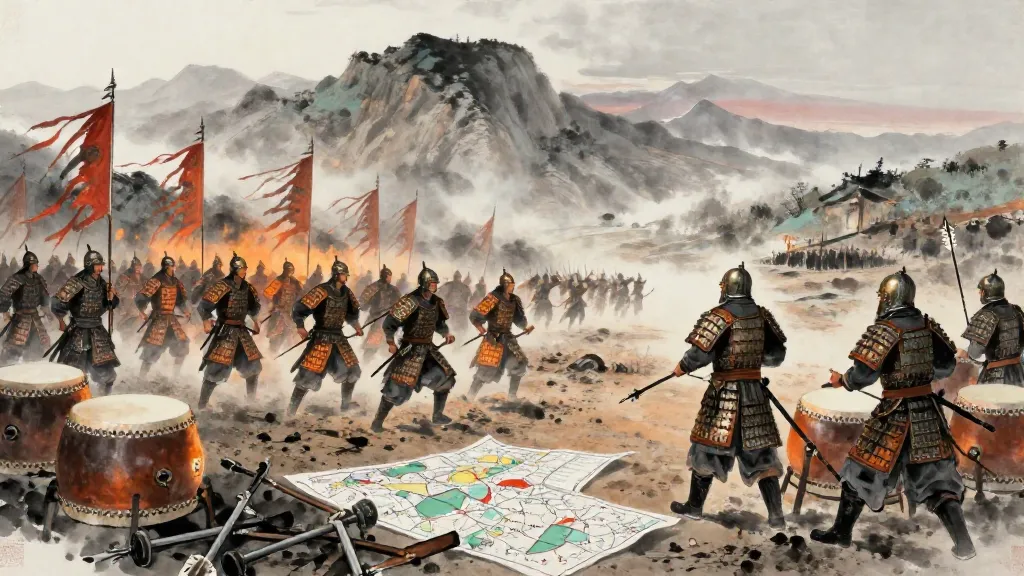
非攻(中) (Condemning Offensive Warfare, Part II) — Chinese ink painting

墨子 Mozi · Chapter 18

非攻(中)

Condemning Offensive Warfare, Part II

View:

攻戰之害

The Costs of Offensive Warfare

今師徒唯毋興起,冬行恐寒,夏行恐暑,此不可以冬夏為者也。春則廢民耕稼樹藝,秋則廢民獲斂。今唯毋廢一時,則百姓饑寒凍餒而死者,不可勝數。

Now whenever armies are mobilized, marching in winter they suffer from cold, marching in summer they suffer from heat -- campaigns cannot be conducted in either winter or summer. In spring they prevent the people from plowing and planting; in autumn they prevent the people from harvesting. If even one season is lost, the people who starve and freeze to death from hunger and cold will be beyond counting.

棄不足重有餘

Discarding What Is Scarce, Valuing What Is Surplus

今攻三里之城,七里之郭,攻此不用銳,且無殺,而徒得此然也?殺人多必數於萬,寡必數於千,然後三里之城,七里之郭且可得也。今萬乘之國,虛數於千,不勝而入;廣衍數於萬,不勝而辟。然則土地者,所有餘也;王民者,所不足也。今盡王民之死,嚴下上之患,以爭虛城,則是棄所不足,而重所有餘也。

Now to attack a city of three li with an outer wall of seven li -- even without using elite troops and without killing anyone, could one simply obtain it? To kill at most tens of thousands and at least thousands -- only then can a city of three li and an outer wall of seven li be taken. Now a state of ten thousand chariots has deserted cities numbering in the thousands that it cannot fully occupy, and uncultivated land numbering in the tens of thousands that it cannot fully develop. Thus land is what is in surplus; the ruler's people are what is in deficit. Now to exhaust the ruler's people unto death and inflict suffering upon both high and low in order to contend for empty cities -- this is discarding what is scarce and valuing what is surplus.

智伯之鑑

The Cautionary Tale of Zhibo

是故子墨子言曰:「古者有語曰:君子不鏡於水,而鏡於人。鏡於水,見面之容;鏡於人,則知吉與凶。今以攻戰為利,則蓋嘗鑒之於智伯之事乎?此其為不吉而凶,既可得而知矣。」

Therefore Master Mozi said: 'There is an old saying: The gentleman does not use water as his mirror, but uses other people. Mirrored in water, one sees only the appearance of one's face; mirrored in other people, one knows good fortune and bad. Now if one considers offensive warfare to be profitable, has one not reflected on the affair of Zhibo? That this leads not to good fortune but to calamity can already be seen and known.'

Notes

1person智伯Zhi Bo

Zhibo (智伯/知伯, d. 453 BC) was the most powerful of the six ministerial families of Jin. His aggressive campaigns to annex the territories of Han, Wei, and Zhao led to a coalition of the three against him. His defeat and death at the Battle of Jinyang (453 BC) led to the Partition of Jin, a pivotal event of the Warring States period.

Edition & Source

Text
《墨子》 Mozi
Edition
《四部叢刊》本
Commentary
Traditional commentaries