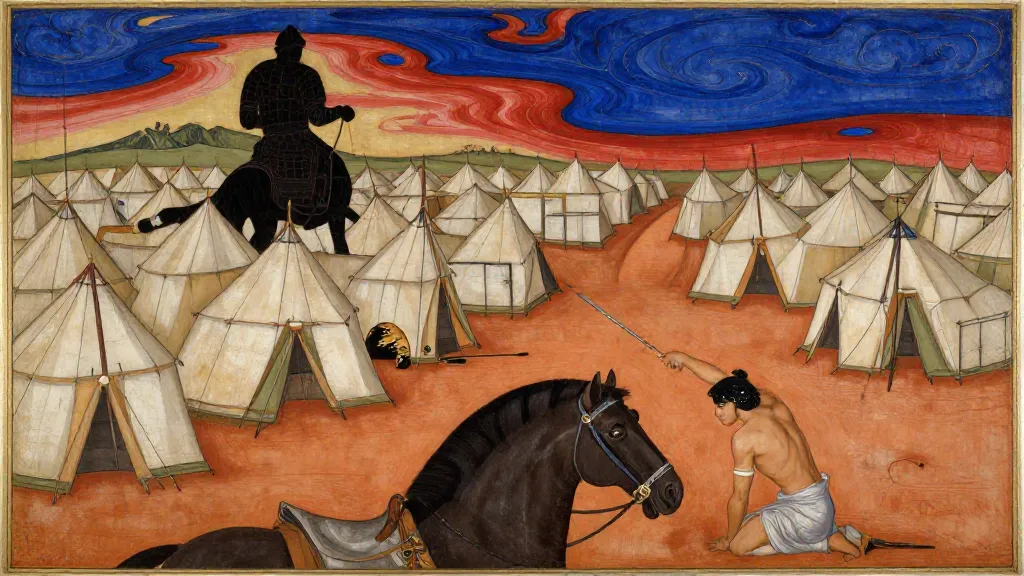
Rostam and Sohrab (Part 2) — Persian miniature painting

Shahnameh · Fall of the Sasanians

Rostam and Sohrab (Part 2)

داستان رستم و سهراب ۲

Part 2 of Father and Son

Sohrab stands on the heights above the Iranian camp and points to every pavilion in turn, asking Hejir to name its owner. When he reaches the green tent with the dragon banner, the Kaviani standard, and a warrior whose head strikes the stars — every sign his mother described — Hejir says he does not know the man's name. He lies because he believes that if this Turanian prodigy learns which tent is Rostam's, he will seek out the champion and destroy him. The calculation is rational and the loyalty is genuine. But it is this lie, more than any other single act in the story, that sends Sohrab into combat against his own father without knowing it. Hejir chooses Iran's security over one boy's right to recognize his father, and the cost of that choice is paid in full on the third day of combat.

View:

رسیدن سهراب به دژ سفید

Sohrab Reaches the White Fortress

رسیدن سهراب بدژ سفید دژی بود کس خواندندی سفید بدآن دژ بد ایرانیانرا امید نگهبان دژ رزم دیده هجیر که با زور ودل بود وبا تیغ وتیر هنوز آن زمان گژدهم خورد بود بخردی گراینده وگرد بود یکی دخترس بود گرد وسوار عنان را پیچ واسپ افگن ونامدار چو سهراب نزدیک آن دژ رسید هجیر دلاور مرورا بدید نشست از بر بادپای چو گرد ز دژ رفت پویان بدشت نبرد چو سهراب جنگاور اورا بدید برآشفت وشمشیر کین برکشید زلشکر برون تاخت برسان باد چنین گفت کای داده جانت بباد تو تنها بجنگ آمدی خیره خیر کنون پای دار و عنان سخت گیر هجیرش چنین داد پاسخ که بس بجنگت نباید مرا یار کس هجیر دلیر سپهبد منم هم اکنون سرترا زتن بر کنم بخندید سهراب چو این گفتگوی بگوش آمدش تیز بنهاد روی سبک نیزه بر نیزه انداختند چو آتش برآمد گو پیل زور یکی نیزه زد بر میانش هجیر نیآمد سنان اندرو جایگیر سنان باز پس کرد سهراب شیر بن نیزه زد بر میانش دلیر ززین برگرفتش بکردار باد بزد بر زمینش چو یک لخت کوه بجان ودلش اندر آمد ستوه از اسپ اندر آمد نشست از برش همی خواست از تن بریدن سرش بپیچید وبرگشت بر دست راست غمی شد زسهراب زنهار خواست رها کرد ازو چنگ وزنهار داد چو خشنود شد پند بسیار داد ببستش ببند آنگهی جنگجوی بنزدیک هومان فرستاد اوی

There was a fortress the people called the White Fortress — the hope of Iran stood upon its walls. Its guardian was Hejir, a battle-tested warrior of strength and courage, skilled with sword and bow. Gazhdaham was still young then, tending toward wisdom though already a warrior, and with him was his daughter, a mounted fighter famed for her rein-work and horsemanship.

When Sohrab drew near the fortress, Hejir the brave saw him coming. He mounted his swift horse and rode out to the field of battle like a dust-cloud. Sohrab the warrior saw him and blazed with fury, drawing his sword of vengeance. He charged out from his host like the wind and cried: "You whose life is forfeit! You come alone against me — reckless fool. Now stand firm and hold your reins tight!"

Hejir answered: "I need no one's help against you. I am Hejir, the bold commander. I will tear your head from your body this very hour."

Sohrab laughed when he heard this boast and set his face toward him. They clashed lance against lance. Then Hejir struck at Sohrab's midsection, but his spear-point found no purchase. Sohrab the lion reversed his spear and struck Hejir with the butt — a blow to the waist that lifted him from the saddle like the wind and hurled him to the ground like a slab of mountain rock. He dismounted and sat upon Hejir's chest, about to sever his head. But Hejir writhed and twisted and begged for quarter. Sohrab released his grip and granted him mercy, gave him much counsel, then bound him and sent him as a prisoner to Hooman.

When those in the fortress learned that their commander had been captured, a great lamentation arose from men and women alike — Hejir was lost to them.

Notes

1placeدژ سفیدDezh-e Sefid

The White Fortress (دژ سفید), Iran's key border stronghold facing Turan. Its fall would open the road into the Iranian heartland.

2context

Sohrab's mercy toward the defeated Hejir is characteristic — he grants quarter to a beaten opponent rather than killing him. This generosity will be contrasted with his father's behaviour in the climactic scene.

3translation

'Reversed his spear and struck with the butt' (سنان باز پس کرد ... بن نیزه زد) — Sohrab defeats Hejir using the blunt end of his lance, a display of contemptuous superiority. He does not even need the pointed end.

گرفتن سهراب دژ سفید را

Sohrab Captures the White Fortress

چو خورشید بر زد سر از برز گوه میانها ببستند توران گروه سپهدار سهراب نیزه بدست یکی بارهٔ تیز تک بر نشست بدآن بد که گردان دژ را همه بگیرد ببندد بسان رمه چو آهنگ دژ کرد کسرا ندید خروشی چو شیر ژیان بر کشید بیآمد در دژ کشادند باز ندیدند در دژ یکی رزم ساز بشب رفته بودند با گژدهم سواران دژدار وگردان بهم که زیر دژ اندر یکی راه بود که دشمن از آن ره نه آگاه بود چو سهراب ولشکر بدژ بر رسید بباره درون گژدهم را ندید هر آنکس که بود اندر آن جایگاه گنه کار بودند اگر بیگناه بفرمان همه پیش او آمدند بجان هر کسی چاره جوی آمدند همی جست گردآفرید وندید دلش مهر وپیوند او برگزید بدل گفت از آنپس دریغا دریغ که شد ماه تابنده در زیر میغ

When the sun raised its head above the high mountain, the Turanian host girded themselves for battle. Sohrab the commander, lance in hand, mounted a swift charger, resolved to seize every defender of the fortress and bind them like a flock of sheep.

But when he stormed the fortress, he found no one. He let out a roar like a raging lion. The gates stood open and not a single warrior remained within. In the night, Gazhdaham and his horsemen had escaped together through a hidden passage beneath the walls — a path the enemy did not know.

When Sohrab and his host entered the fortress and found no sign of Gazhdaham, all who remained in that place — guilty or innocent — came forward and submitted, each seeking to save his life. Sohrab searched for Gordafarid but could not find her. His heart had chosen her; love and longing had taken hold of him. "Alas, alas," he said to himself. "The shining moon has vanished behind clouds."

Meanwhile Gazhdaham's letter reached Kay Kavus, and the king was stricken with grief when he heard its contents. He gathered his nobles — Tus, Gudarz, Giv, Gorgin, Bahram, Farhad — and read Gazhdaham's account aloud. The old commander had described a Turanian champion barely fourteen years old, tall as a cypress, bright as the sun, with the chest of a lion and a grip unlike any Turk before him. "He resembles none so much as Rostam," Gazhdaham had written. "He is of the race of Nariman." The king asked who among them could stand against such a warrior. With one voice the nobles answered: to Rostam alone could they look in this danger.

Notes

1context

The escape through the hidden tunnel beneath the fortress is a classic motif of frontier warfare in the Shahnameh. Gazhdaham saves the garrison by sacrificing the stronghold itself.

2context

Sohrab's longing for Gordafarid — 'the shining moon has vanished behind clouds' — reveals his youth and romantic nature. He is at once a terrifying warrior and an adolescent susceptible to beauty.

3personطوسTus

Tus, son of Nuder, commander-in-chief of the Iranian army and bearer of the elephant standard. Gudarz and Giv are father and son, among Iran's greatest warrior families.

پرسیدن سهراب از نام سرداران ایران از هجیر

Sohrab Asks Hejir About the Iranian Commanders

پرسیدن سهراب نام سرداران ایران از هجیر چو خورشید برداشت زرّین سپرد زبانه برآورد از چرخ سر بپوشید سهراب خفتان جنگ نشست از بر جرمهٔ مشک رنگ برندی برافگند اندر برش یکی مغفر خسروی بر سرش کمندی بغتراک بر شست خم خم اندر خم وروی کرده دژم بیآمد یکی تند بالا گزید بجائی که ایران سپهرا بدید بفرمود تا رفت پیشش هجیر بدو گفت با من تو کژّی مگیر بهر کار در پیش کن راستی چو خواهی که نگزایدت کاستی سخن هرچه پرسم همه راست گوی بکژّی مکن رای وچاره مجوی چو خواهی که یابی رهائی زمن سرافراز باشی بهر انجمن از ایران هر آنچت بپرسم بگوی متاب از ره راستی هیچ روی سپارم بتو گنج آراسته بیابی بسی خلعت وخواسته ورایدون که کژّی بود رای تو چنین بند وزندان بود جای تو

When the sun raised its golden shield and thrust its tongue of flame above the wheel of heaven, Sohrab put on his battle-armour and mounted his dark-maned horse. He flung a warrior's surcoat over his chest, set a royal helm upon his head, and hung a coiled lasso at his saddle-strap, his face grim. He rode to a height from which he could look down upon the Iranian camp.

He summoned Hejir before him and said: "Do not deal falsely with me. In all matters put truth first, if you would not bring ruin upon yourself. Answer every question I ask with honesty — do not scheme or seek evasion. If you wish to win your freedom and hold your head high, tell me everything I ask about the Iranian host. I will give you a treasury of ornaments and wealth beyond measure. But if you choose falsehood, then chains and prison will be your portion."

Hejir agreed. Sohrab pointed to the golden pavilion in the centre of the camp, with its hundred war-elephants and turquoise throne, its violet standard bearing a sun and moon. "Whose is that?" — "That is the Shah of Iran."

He pointed to a black pavilion with an elephant standard. "That is Tus, son of Nuder." A red pavilion with a lion flag of gold — "That is Gudarz the brave; his eighty sons of valour stand around him." A camp with a wolf-head banner — "That is Giv, son of Gudarz, whom men call Giv the Valiant." A white pavilion draped in Roman brocade — "That is Fraburz, the son of the Shah." A yellow tent encircled by flags of many colours — "That is Guraz the lion-hearted."

Then Sohrab pointed to a green pavilion before which stood the royal banner of Kaveh. Upon its throne sat a warrior nobler than all his fellows, whose head struck the stars. Beside him stood a horse as tall as he, with a lasso coiled at its feet, and the steed snorted like a boiling sea. Many armoured elephants stood before it. The warrior's standard showed a dragon with a golden lion's head.

Hejir thought to himself: if I reveal the signs of Rostam to this lion-hearted Turk, he will seek him out and destroy him. Better to conceal the name. So he said: "That is some ally who has come from distant Cathay. I do not know his name."

Sohrab's heart sank. Though the signs matched everything his mother had told him, he could not credit his own eyes against Hejir's words. He asked again and again about the green tent, but Hejir denied knowledge each time. When Sohrab pressed him directly about Rostam, Hejir said the champion had gone to Zabulestan for the feast of roses.

Sohrab grew angry: "Why do you keep Rostam's name from me? No army of Kay Kavus would march without the world's champion. Show me Rostam's tent, or I will strike your head from your shoulders." But Hejir held firm. He thought: if this boy overcomes Rostam, all Iran is lost. Better that I die than betray the champion. So he said: "You will know Rostam in battle. He will strike you dumb and quell your pride of youth. But I will not show him to you."

Notes

1context

This scene is the tragedy's turning point. Had Hejir identified Rostam, Sohrab would have recognized his father and the catastrophe would have been averted. Hejir's patriotic loyalty — admirable in itself — becomes the instrument of destruction.

2translation

The 'banner of Kaveh' (اختر کاویان) is the legendary standard of Iran, originating from the blacksmith Kaveh who rose against the tyrant Zahhak. It was Iran's most sacred military emblem.

3context

Ferdowsi comments directly on fate's workings here: 'it was written that that should come to pass which had been decreed' (نبشته بر بر دگر گونه بود). The poet sees destiny as an active force preventing recognition between father and son.

4personگودرز کشوادگانGudarz-e Keshvadagan

Gudarz, son of Keshvad — patriarch of one of Iran's greatest warrior families, father of eighty sons including Giv. His clan provides many of Iran's commanders.

نامهٔ گژدهم به نزدیک کاوس

Gazhdaham's Letter to Kavus

نامهٔ گژدهم بنزدیک کاؤس چو او باز گردید گژدهم پیر بیآورد وبنشاند مرد دبیر یکی نامه بنوشت نزدیک شاه برافگند پوینده مردی براه نخست آفرین کرد بر شهریار نمود آنگهی گردش روزگار که آمد بر ما سپاهی گران همه رزم جویان وکنداوران یکی پهلوانی به پیش اندرون که سالش زدو هفت نیآید فزون ببالا زسرو سهی برترست چو خورشید تابان بدو پیکرست برش چون بر شیر وبالاش برز زترکان ندیدم چنان دست وگرز چو شمشیر هندی بچنگ آیدش زدریا واز کوه ننگ آیدش چو آواز او رعد غرّنده نیست چو بازوی او تیغ برّنده نیست بایران وتوران چنو مرد نیست زگردان کس اورا هم آورد نیست بنام است سهراب گرد دلیر نه از دیو پیچد نه از پیل وشیر تو گوئی مگر بیگیان رستمست وبا گردی از تخمهٔ نیرمست

Old Gazhdaham summoned a scribe and dictated a letter to the Shah. He dispatched a swift rider upon the road. He opened with blessings upon the king, then laid bare the turning of fortune:

"A great host has come against us — all of them battle-seekers and champions. At their head rides a warrior not yet past fourteen years of age. He is taller than any straight cypress, and his form shines like the blazing sun. His chest is that of a lion and his stature immense — I have never seen such arms and such a mace among the Turks. When an Indian sword comes to his hand, the sea and the mountains are put to shame. His voice is no less than rumbling thunder, and no blade cuts so keenly as his arm. In all Iran and Turan there is no man his equal; among the warriors none can match him. His name is Sohrab, the brave hero — he shrinks from neither demon nor elephant nor lion. You would think he is Rostam himself reborn, or that he carries the war-might of the house of Nariman."

Gazhdaham described how Hejir had been lifted from the saddle in the blink of an eye and now lay bound in the enemy camp, and he warned: "If the king does not act, if he sends no army and prepares no ambush, then consider Iran's glory already departed and the world laid waste by this warrior's sword. He is beyond the power of this fortress. The lion itself grows cautious before his fury."

The letter was sealed in the night and the messenger was told to ride so that by dawn no man of the Turanian host would see him.

Notes

1context

Gazhdaham's comparison of Sohrab to Rostam — 'you would think he is Rostam himself reborn' — is dramatic irony at its most piercing. The old commander sees the family resemblance that no one is allowed to acknowledge.

2translation

'Not yet past fourteen' (سالش زدو هفت نیآید فزون — literally 'his years do not exceed twice seven'). Sohrab's youth intensifies the horror of the tragedy. He is a child prodigy of war.

3personنیرمNariman

The 'house of Nariman' (تخمهٔ نیرمست) refers to Rostam's dynastic line: Nariman, father of Sam, father of Zal, father of Rostam. It is Iran's most celebrated warrior dynasty.

نامهٔ کاوس به رستم و خواندن او از زابلستان

Kavus's Letter Summoning Rostam from Zabulestan

نامه کاؤس برستم وخواندن او ززابلستان یکی نامه فرمود پس شهریار نبشتن بر رستم نامدار نخست آفرین کرد بر پهلوان که بیدار دل باش وروشن روان بدان کز ره ترک نام آوری یکی تاختن کرد با لشکری بدژ در نشستس خود با سپاه بر آن مردم دژ گرفتست راه یکی پهلوانست گرد ودلیر بتن ژنده پیل وبدل نرّه شیر از ایران ندارد کسی تاب اوی مگر تو که تیره کنی آب روی از آن نوشداو که در گنج تست کجا خستگانرا کند تن درست چو نامه بخوانی بروز وبشب مکن داستانرا کشاده دو لب اگر دستهٔ گل بدستست مبوی یکی تیز کن مغز وبنمای روی

Kay Kavus commanded a letter be written to Rostam the renowned. He opened with blessings upon his champion: "Be alert of heart and clear of spirit. Know that a famous Turk has made a raid with an army. He has seized the fortress and blocked the road against its defenders. He is a warrior both bold and valiant — in body an armoured elephant, in heart a male lion. No one in Iran can withstand him, save you who alone can darken his glory."

The king recalled Rostam's past deeds and implored him once more to be Iran's refuge. He wrote: "When you receive this letter, do not pause to speak the word upon your lips. If you hold roses in your hand, do not stop to smell them. Sharpen your wits and show your face. Ride with your Zabulestani horsemen and raise a battle-cry. According to Gazhdaham's account, none but you can be this warrior's match."

The letter was sealed and given to Giv, swift as the wind. The king charged him: "Neither rest nor linger in the courts of Rostam, nor tarry by the roadside." Giv obeyed and took neither food nor rest until he reached the gates of Zabulestan.

When Rostam read the letter and questioned Giv about Sohrab, he laughed in wonder. "I would not marvel if such a hero arose in Iran," he said, "but that a warrior of this renown should come from among the Turks — I cannot believe it. I myself have a son in Samangan, but he is still a child. His mother writes that he delights in the games of his age. It is not yet his time to lead an army."

Then Rostam bade his cooks prepare a banquet and feasted Giv, troubling his head with wine until he forgot both cares and time. When dawn came, Giv remembered the Shah's orders and urged Rostam to make haste. But Rostam said: "Do not trouble yourself. Death will fall upon these Turanians. Stay another day. Though this Sohrab be a hero like Sam and Nariman, he shall fall by my hands."

Three days they feasted. On the fourth Giv rose with resolve and said: "Kay Kavus is choleric and impatient. The fear of Sohrab weighs upon him, and he has lost sleep, and hunger and thirst torment him. He will be wroth if we delay."

Rostam said: "Fear not. None on earth dare be angry with me." But he did as Giv wished — he saddled Rakhsh, mustered his army, and set forth from Zabulestan with a great host, with Zvareh as his army's commander.

Notes

1translation

'If you hold roses in your hand, do not stop to smell them' (اگر دستهٔ گل بدستست مبوی) — a famous line expressing extreme urgency. Kavus tells Rostam to drop everything and come immediately.

2personگیوGiv

Giv (گیو), son of Gudarz, one of Iran's greatest warriors and Rostam's son-in-law. He serves as the messenger between Kavus and Rostam.

3context

Rostam's three-day delay feasting with Giv — ignoring the urgency — reflects both his confidence and his habitual independence from royal command. This delay will enrage Kavus and trigger a near-fatal rift between king and champion.

4personزوارهZvareh

Zvareh (زواره), Rostam's brother, who commands the Zabulestani troops in the field while Rostam fights in single combat.

رسیدن رستم به نزد کاوس

Rostam Arrives Before Kavus

رسیدن رستم بنزد کاوُس چو نزدیکی شهر ایران رسید همه جامهٔ پهلوی بر درید چو آمد بر تخت کاوُس کی سرش بود پر خاک و پر خاک پی

When the nobles came forth to meet Rostam's host and do him homage, he dismounted from Rakhsh and hastened into the presence of the king. But Kay Kavus, when he beheld him, was burning with anger. His brows were knotted with fury. When Rostam had made obeisance, the king opened his mouth and words of folly escaped his lips:

"Who is Rostam, that he defies my power and disregards my commands? If I had a sword in my hand I would split his head like an orange. Seize him and hang him upon the nearest gallows. Let his name never be spoken in my presence."

Giv trembled and said: "Do you raise your hand against Rostam?" The Shah was beside himself and cried that Giv be hanged alongside him, and commanded Tus to lead them out. But Rostam broke from Tus's grasp and stood before the king, and all the nobles were filled with dread when they saw his anger.

Rostam flung reproaches at the king. He recalled Kavus's follies — the march into Mazandaran, the disaster in Hamaveran, the flight into heaven — and reminded him that without Rostam he would not now sit upon the throne of light. "I am a free man and no slave," Rostam declared, "and am servant only to God. Without Rostam, Kay Kavus is nothing. The world is subject to me. Rakhsh is my throne, my sword my seal, my helmet my crown. Had I desired it, I could have taken this seat for myself. But now I am weary of your follies. I will turn away from Iran, and when this Turk puts his yoke upon you, I shall not hear of it."

He strode from the presence-chamber, sprang upon Rakhsh, and vanished before the nobles had recovered from their astonishment. They were filled with dread. Without Rostam's arm and counsel, they could not stand against the Turk. They blamed Kay Kavus and counted over Rostam's good deeds, and at last chose Gudarz to go before the Shah. The aged warrior spoke without fear, and the Shah knew that his words were reason and truth. He was ashamed. "That which you say is right," he admitted, and begged Gudarz to seek out Rostam and bring him back.

All the chiefs of Iran rode out and found Rostam, and Gudarz told him the Shah craved his pardon. He urged: "Though Rostam be angered, the land of Iran has done no wrong. If Rostam saves it not, it will fall to this Turk." Rostam answered: "I depart not because of Sohrab, but because scorn and insult have been my reward."

Yet when he had considered longer, he saw that he must return. He rode to the gates of the king, who stepped down from his throne, came before Rostam, and craved his forgiveness. "I was angry because you tarried," the Shah said, "and I forgot myself in my vexation. My mouth is filled with the dust of repentance." Rostam replied: "The world is yours. Until old age my loins shall be girded in fealty to you. May power and majesty be yours forever."

They feasted together far into the night, pouring gifts and holding counsel. Joy returned to the court of the king.

Notes

1context

The quarrel between Kavus and Rostam is one of the Shahnameh's recurring structural tensions: the reckless king versus the proud champion. Kavus owes his throne to Rostam yet cannot tolerate Rostam's independence. This scene nearly costs Iran its only hope against Sohrab.

2personگودرزGudarz

Gudarz serves as the mediator between king and champion — a role he plays repeatedly in the Shahnameh. His argument is pragmatic: whatever Kavus has done, Iran should not perish for it.

3context

Rostam's delay in Zabulestan, his quarrel with the king, and the reconciliation all cost precious time — time during which Sohrab grows more entrenched on Iranian soil and more eager for battle. The mechanics of the tragedy are tightening.

4translation

'Rakhsh is my throne, my sword my seal, my helmet my crown' — Rostam defines his authority in military, not courtly terms. His power derives from his personal might, not from royal appointment. This is the crux of his relationship with every king he serves.

لشکر کشیدن کاوس با رستم

Kavus Marches with Rostam

چو خورشید آن چادر قیرگون ببرّید واز پرده آمد برون بفرمود کاؤس تا گیو وطوس ببستند بر کوههٔ پیل کوس در گنج بکشاد وروزی بداد سپه بر نشاند وبنه بر نهاد سپهدار وجوشنوران صد هزار بلشکرگه آمد نبرده سوار یکی لشکر آمد زپهلو بدشت که از گرد اسپان هوا تیره گشت سراپرده وخیمه زد بر دو میل بپوشید گیتی بنعل وبپیل هوا نیلگون شد زمین آبنوس بجنبید هامون زآوای کوس

When the sun cut through its pitch-black curtain and emerged from behind the veil, Kay Kavus commanded Giv and Tus to lash the war-drums upon the backs of the elephants. He opened the treasury, paid the soldiers, mounted his host, and loaded the baggage train. A hundred thousand armoured horsemen rode out to the field. The army spread across the plain until the dust of their horses darkened the sky. Pavilions and tents stretched for two miles; the earth was blanketed with hooves and elephants. The sky turned indigo, the ground ebony, and the plain shook with the thunder of drums.

They marched stage by stage until they reached the fortress of Hejir. They pitched their camp in the customary manner. The watchman on the battlements raised a cry, and when Sohrab heard it, he climbed the ramparts and looked out upon the Iranian host — an army without end.

Hooman, seeing it from afar, was filled with dread. But Sohrab said: "Drive care from your heart. I see no warrior in all this boundless host — no man with a heavy mace who could stand against me on the field. By the fortune of King Afrasiab, I will make this battlefield a sea of blood."

He descended from the walls with a light heart, called for a cup of wine, and did not trouble himself over the coming battle. Meanwhile the royal pavilion was raised before the fortress, and tents covered every span of plain and hill.

Notes

1translation

'The sky turned indigo, the ground ebony' (هوا نیلگون شد زمین آبنوس) — Ferdowsi's description of a vast army on the march uses colour imagery drawn from Persian miniature painting: the dust-darkened sky and trampled earth merge into a single dark canvas.

2context

Sohrab's confidence — 'I see no warrior with a heavy mace' — is both his strength and his blindness. He does not know that Rostam is among the host, and Hooman, under Afrasiab's orders, will not tell him.

3context

The scene of Sohrab drinking wine on the eve of battle while an entire empire masses against him captures the boy's extraordinary self-assurance and his tragic isolation.

Edition & Source

Author
فردوسی (Ferdowsi, c. 977–1010 CE)
Edition
شاهنامه — تصحیح ژول مل (Jules Mohl critical edition)