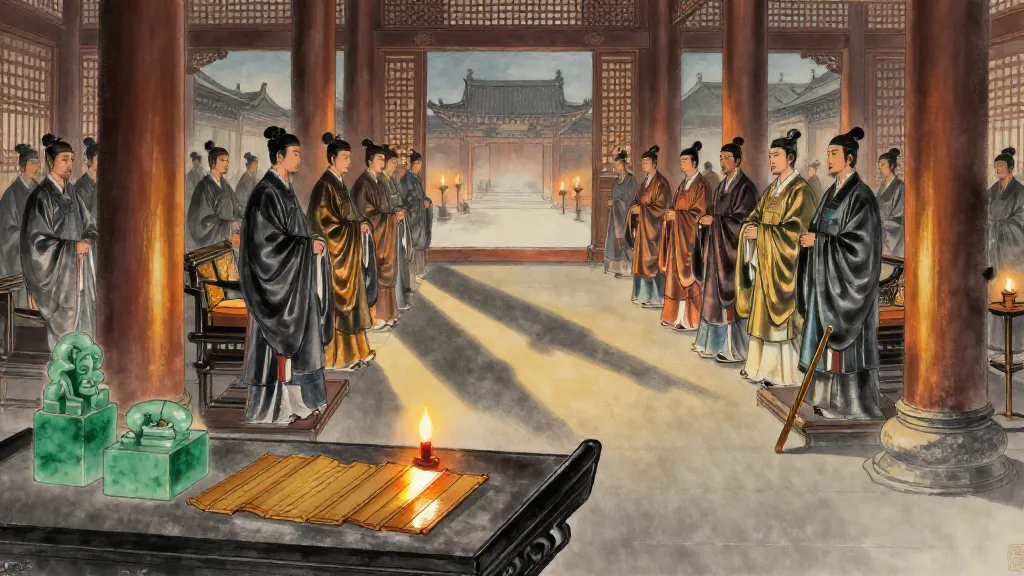
修權 (Cultivating Authority) — Chinese ink painting

商君書 Shangjunshu · Chapter 14

修權

Cultivating Authority

View:

治國三要:法信權

Three Essentials of Governance: Law, Trust, and Authority

國之所以治者三:一日法,二日信,三日權。法者,君臣之所共操也;信者,君臣之所共立也;權者,君之所獨制也,人主失守則危。君臣釋法任私必亂。故立法明分,而不以私害法,則治。權制獨斷於君則威。民信其賞,則事功成;信其刑,則奸無端。惟明主愛權重信,而不以私害法。故上多惠言而不克其賞,則下不用;數加嚴令而不致其刑,則民傲死。凡賞者,文也;刑者,武也。文武者,法之約也。故明主任法。明主不蔽之謂明,不欺之謂察。故賞厚而信,刑重而必;不失疏遠,不違親近,故臣不蔽主,而下不欺上。

There are three things through which the state is governed: first, law; second, trust; third, authority. Law is what ruler and ministers jointly maintain. Trust is what ruler and ministers jointly establish. Authority is what the ruler alone controls — if the ruler loses his grasp of it, he is in peril. If ruler and ministers abandon law and rely on private interests, there will inevitably be disorder. Therefore establish the law and clarify distinctions, and do not let private interests harm the law — then there is order. When authority and decisions rest solely with the ruler, there is awe. When the people trust in rewards, affairs and merits are accomplished; when they trust in punishments, villainy has no opening. Only the enlightened ruler cherishes authority and values trust without letting private interests harm the law. If the ruler frequently makes generous promises but does not fulfill his rewards, then those below will not serve him. If he repeatedly issues stern orders but does not carry through the punishments, the people will become contemptuous of death. Reward is the civil aspect; punishment is the martial aspect. Civil and martial together are the essence of the law. Therefore the enlightened ruler relies on the law. The enlightened ruler is called 'enlightened' because he is not deceived, and 'perceptive' because he is not cheated. Therefore rewards are generous and trustworthy, punishments are heavy and certain; he does not neglect the distant and he does not favor the close — therefore ministers do not deceive the ruler, and those below do not cheat those above.

法者國之權衡

The Law Is the State's Scales and Balance

世之為治者,多釋法而任私議,此國之所以亂也。先王縣權衡,立尺寸,而至今法之,其分明也。夫釋權衡而斷輕重,廢尺寸而意長短,雖察,商賈不用,為其不必也。故法者,國之權衡也。夫倍法度而任私議,皆不知類者也。不以法論知、能、賢、不肖者,惟堯;而世不盡為堯。是故先王知自議譽私之不可任也,故立法明分,中程者賞之,毀公者誅之。賞誅之法,不失其議,故民不爭。不以爵祿便近親,則勞臣不怨;不以刑罰隱疏遠,則下親上。故授官予爵不以其勞,則忠臣不進;行賞賦祿不稱其功,則戰士不用,凡人臣之事君也,多以主所好事君。君好法,則臣以法事君;君好言,則臣以言事君。君好法,則端直之士在前;君好言,則毀譽之臣在側。

Those who govern in the world mostly abandon law and rely on private opinion — this is why states fall into disorder. The former kings suspended the scales and balance and established the ruler and the inch — and to this day these are followed as law, because they are unambiguous. To abandon the scales and balance and judge weight by feeling, to discard the ruler and the inch and estimate length by guessing — even if one is perceptive, merchants will not accept it, because it is unreliable. Therefore the law is the state's scales and balance. Those who abandon legal standards and rely on private opinion are all people who do not understand categories. The only one who could evaluate wisdom, ability, worthiness, and unworthiness without law was Yao — but the world is not entirely made up of Yaos. Therefore the former kings knew that self-serving opinion and private praise cannot be relied upon. They established law and clarified distinctions: those who met the standard were rewarded, those who damaged the public interest were punished. When the law of reward and punishment does not miss its mark, the people do not contend. If rank and salary are not used to favor those who are close, then hardworking ministers do not harbor resentment. If punishment is not concealed from those who are distant, then those below are devoted to those above. If office and rank are not granted according to labor, loyal ministers will not advance. If rewards and salaries are not proportionate to merit, warriors will not serve. In all cases, ministers serve their ruler largely according to what the ruler favors. If the ruler favors law, ministers will serve him through law; if the ruler favors talk, ministers will serve him through talk. If the ruler favors law, upright and straightforward scholars will stand before him; if the ruler favors talk, slanderous and flattering ministers will stand at his side.

公私之分

The Division Between Public and Private

公私之分明,則小人不疾賢,而不肖者不妒功。故堯、舜之位天下也,非私天下之利也,為天下位天下也;論賢舉能而傳焉,非疏父子親越人也,明於治亂之道也。故三王以義親,五霸以法正諸侯,皆非私天下之利也,為天下治天下。是故擅其名而有其功,天下樂其政,而莫之能傷也。今亂世之君、臣,區區然皆擅一國之利而管一官之重,以便其私,此國之所以危也。

故公私之交,存亡之本也。

夫廢法度而好私議,則奸臣鬻權以約祿,秩官之吏隱下而漁民。諺曰:"蠹眾而木析,隙大而牆壞。"故大臣爭於私而不顧其民,則下離上。下離上者,國之"隙"也。秩官之吏隱下以漁百姓,此民之"蠹"也。故有"隙"、"蠹"而不亡者,天下鮮矣。是故明王任法去私,而國無"隙"、"蠹"矣。

When the division between public and private is clear, then petty men do not resent the worthy and the unworthy do not envy merit. Therefore when Yao and Shun occupied the position of ruling the world, they did not privately appropriate the world's benefits — they occupied the position of ruling the world for the world's sake. They evaluated the worthy and promoted the able and passed on the throne — not because they were distant from their own sons and close to outsiders, but because they understood the way of order and disorder. Therefore the Three Kings used righteousness to bind their people close, and the Five Hegemons used law to correct the feudal lords — none of them privately appropriated the world's benefits; they governed the world for the world's sake. Thus they monopolized the fame and possessed the merit; the world delighted in their governance and no one could harm them. Now the rulers and ministers of this disordered age all anxiously appropriate the profits of a single state and control the weight of a single office for their own private convenience — this is why the state is in peril.

Therefore the intersection of public and private is the root of survival and destruction.

When legal standards are abandoned and private opinion is favored, then treacherous ministers sell their authority to secure their salaries, and the officials of the ranked bureaucracy conceal what is below to exploit the people. The proverb says: 'When the woodworm is numerous, the timber splits; when the crack is wide, the wall collapses.' When great ministers contend for private gain without regard for their people, those below separate from those above. Those below separating from those above — this is the state's 'crack.' Ranked officials concealing what is below to exploit the common people — this is the people's 'woodworm.' A state that has 'cracks' and 'woodworms' yet does not perish — that is rare indeed in the world. Therefore the enlightened king relies on law and eliminates the private, and the state will have neither 'cracks' nor 'woodworms.'

Edition & Source

Text
《商君書》 Shangjunshu
Edition
中華古詩文古書籍網 transcription
Commentary
Traditional commentaries