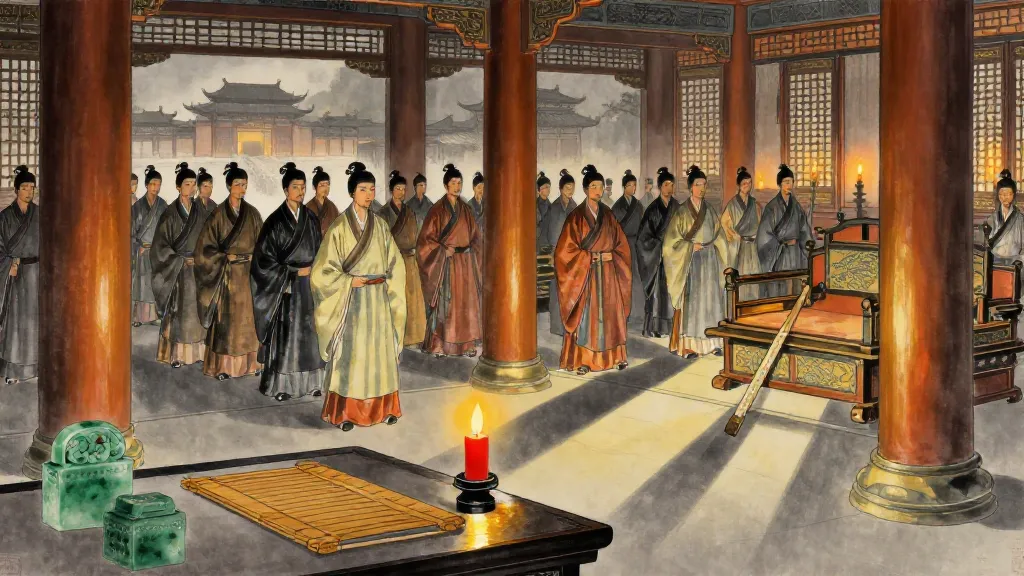
畫策 (Charting Policies) — Chinese ink painting

商君書 Shangjunshu · Chapter 18

畫策

Charting Policies

View:

時變則法變

When Times Change, Law Changes

昔者昊英之世,以代木殺獸,人民少而木獸多,黃帝之世,不麛不卵,官無供備之民,死不得用槨。事不同,皆王者,時異也。神農之世,男耕而食,婦織而衣;刑政不用而治,甲兵不起而王。神農既沒,以強勝弱,以眾暴寡,故黃帝作為君臣上下之義、義子兄弟之禮、夫婦妃匹之合,內行刀鋸,外用甲兵。故時變也。由此觀之,神農非高於黃帝也,然其名尊者,以適於時也。故以戰去戰,雖戰可也;以殺去殺,雖殺可也;以刑去刑,雖重刑可也。

In the ancient age of Hao Ying, people felled trees and killed beasts. People were few and trees and beasts were many. In the age of the Yellow Emperor, young animals were not killed nor eggs taken, officials had no conscripted laborers, and the dead were not buried in outer coffins. Their practices differed yet all achieved kingship — because the times differed. In the age of Shennong, men plowed for food and women wove for clothing; punitive governance was not employed yet there was order; armor and weapons were not raised yet there was kingship. After Shennong's passing, the strong prevailed over the weak and the many terrorized the few. Therefore the Yellow Emperor created the duties between ruler and minister, superior and inferior; the rites between father and son, elder and younger brother; the union between husband and wife. Internally he employed blades and saws; externally he deployed armor and weapons. Therefore times had changed. From this we observe: Shennong was not superior to the Yellow Emperor — yet his name is honored because he suited his times. Therefore: using warfare to eliminate warfare — though it means war, it is acceptable. Using killing to eliminate killing — though it means killing, it is acceptable. Using punishment to eliminate punishment — though it means heavy punishment, it is acceptable.

制民之本在法

The Root of Controlling the People Lies in Law

昔之能制天下者,必先制其民者也;能勝強敵者,必先勝其民者也。故勝民之本在制民,若治於金、陶於土也。本不堅,則民如飛鳥禽獸,其孰能制之?民本,法也。故善治者塞民以法,而名地作矣。

名尊地廣,以至王者,何故?名卑地削,以至於亡者,何故?戰罷者也。

不勝而王、不敗而亡者,自古及今未嘗有也,民勇者,戰勝;民不勇者,戰敗。能壹民於戰者,民勇;不能壹民於戰者,民不勇,聖王見王之致於兵也,故舉國而責之於兵。入其國,觀其治,兵用者強。奚以知民之見用者也?民之見戰也,如餓狼之見肉,則民用矣。凡戰者,民之所惡也。能使民樂戰者王。強國之民,父遺其子,史遺其弟,妻遺其夫,皆曰:"不得,無返!"

Those in antiquity who could control the world invariably first controlled their own people; those who could defeat strong enemies invariably first defeated their own people. The root of defeating the people lies in controlling them — like smelting metal or molding clay. If the root is not firm, the people are like birds and beasts in flight — who could control them? The root of the people is the law. Therefore a good governor blocks the people with law, and fame and territory are built.

What is the reason that some see their names honored and territory expanded until they achieve kingship? What is the reason that others see their names degraded and territory diminished until they perish? It is whether they prevail or fail in warfare.

There has never been a case, from antiquity to the present, of achieving kingship without victory or perishing without defeat. When the people are brave, wars are won; when the people are not brave, wars are lost. Those who can unify the people for warfare have brave people; those who cannot have cowardly people. The sage king saw that kingship comes down to military power, and therefore committed the whole state to military excellence. Enter a state and observe its governance — where the army is employed, there is strength. How do you know the people are truly employed? When the people face battle like hungry wolves facing meat — then the people are truly employed. Warfare is what the people dread. He who can make the people delight in warfare will achieve kingship. In the strong state's households, fathers send off their sons, elder brothers send off their younger brothers, wives send off their husbands, all saying: 'Do not return without victory!'

法必行之法

A Law That Ensures the Law Is Enforced

又曰:"失法離令,若死,我死。鄉治之。行間無所逃,遷徙無所入。"行間之治,連以五,辨之以章,束之以令。拙無所處,罷無所生。是以三軍之眾,從令如流,死而不鏇踵。

國之亂也,非其法亂也,非法不用也。國皆有法,而無使法必行之法。

國皆有禁奸邪、刑盜賊之法,而無使奸邪、盜賊必得之法,為奸邪、盜賊者死刑,而奸邪、盜賊不止者,不必得。必得而尚有奸邪、盜賊者,刑輕也,刑輕者,不得誅也;必得者,刑者眾也。故善治者,刑不善而不賞善,故不刑而民善。不刑而民善,刑重也。刑重者,民不敢犯,故無刑也;而民莫敢為非,是一國皆善也,故不賞善而民善。賞善之不可也,猶賞不盜。故善治者,使跖可信,而況伯夷乎?不能治者,使伯夷可疑,而況跖乎?勢不能為奸,雖跖可信也;勢得為奸,雖伯夷可疑也。

They also say: 'If you break the law and violate orders, you die, and I die too. The village will attend to it.' Within the ranks there is nowhere to flee; in migrating there is nowhere to enter. The governance of the ranks is: groups of five are mutually responsible, identified by insignia, bound together by orders. The clumsy have nowhere to hide; the weary have nowhere to survive. Thus the masses of the three armies obey orders like flowing water and die without turning their heels.

When a state is disordered, it is not that its law is disordered and not that the law is not applied. Every state has law, but no state has a law that ensures the law is invariably enforced.

Every state has laws prohibiting villainy and punishing theft, but no state has a law ensuring that villains and thieves are invariably caught. When villains and thieves face the death penalty yet villainy and theft do not cease — it is because they are not certainly caught. If they are certainly caught and there are still villains and thieves, it is because the punishment is too light. When punishment is too light, it means the condemned are not truly eliminated. When they are certainly caught, it means those punished are numerous. Therefore the good governor punishes the bad and does not reward the good — and without punishment the people are good. The people are good without punishment because punishment is heavy. When punishment is heavy, the people dare not transgress, and therefore there is no punishment. When no one among the people dares do wrong, the whole state is good — therefore without rewarding the good, the people are good. Rewarding goodness would be as absurd as rewarding people for not stealing. Therefore the good governor can make even Robber Zhi trustworthy — how much more so Bo Yi! The bad governor can make even Bo Yi suspect — how much more so Zhi! When circumstances make it impossible to commit villainy, even Zhi can be trusted. When circumstances permit villainy, even Bo Yi becomes suspect.

Notes

1person盜跖Dào Zhí

Robber Zhi (盜跖) was a legendary bandit representing the epitome of wickedness. Bo Yi (伯夷) was a paragon of virtue who starved rather than serve an unjust ruler. Their pairing illustrates the Legalist argument that institutional structure, not individual moral character, determines behavior.

聖王貴法不貴義

The Sage King Values Law, Not Righteousness

國或重治,或重亂。明主在上,所舉必賢,則法可在賢。法可在賢,則法在下,不肖不敢為非,是謂重治。不明主在上,所舉必不肖,國無明法,不肖者敢為非,是謂重亂。兵或重強。或重弱,民固欲戰,又不得不戰,是謂重強。同固不欲戰,又得無戰,是謂重弱。

明主不濫富貴其臣。所謂富者,非粟米珠玉也?所謂貴者,非爵位官職也?廢法作私爵祿之,富貴。凡人主德行非出人也,知非出人也,勇力非過人也。然民雖有聖知,弗敢我謀;勇力,弗敢我殺;雖眾,不敢勝其主;雖民至億萬之數,縣重賞而民不敢爭,行罰而民不敢怨者,法也。國亂者,民多私義;兵弱者,民多私勇。則削國之所以取爵祿者多塗;亡國之欲,賤爵輕祿。不作而食,不戰而榮,無爵而尊,無祿而富,無官而長,此之謂奸民。

所謂"治主無忠臣,慈父無孝子",欲無善言,皆以法相司也,命相正也。

不能獨為非,而莫與人為非。所謂富者,入多而出寡。衣服有制,飲食有節,則出寡矣。女事盡於內,男事盡於外,則入多矣。

所謂明者,無所不見,則群臣不敢為奸,百姓不敢為非。是以人主處匡床之上,聽絲竹之聲,而無下治。所謂明者,使眾不得不為。所謂強者,天下勝。天下勝,是故合力。是以勇強不敢為暴,聖知不敢為詐而虛用;兼天下之眾,莫敢不為其所好而辟其所惡。所謂強者,使勇力不得不為己用。其志足,天下益之;不足,天下說之。恃天下者,天下去之;自恃者,得天下。

得天下者,先自得者也;能勝強敵者,先自勝者也。

聖人知必然之理、必為之時勢,故為必治之政,戰必勇之民,行必聽之令。是以兵出而無敵,令行而天下服從。黃鵠之飛,一舉千里,有必飛之備也;麗麗、巨巨,日走千里,有必走之勢也;虎、豹、熊、羆,鷙而無敵,有必勝之理也。聖人見本然之政,知必然之理,故其制民也,如以高下制水,如以燥濕制火。故曰:仁者能仁於人,而不能使人仁;義者能愛於人,而不能使人愛。是以知仁義之不足以治天下也。聖人有必信之性,又有使天下不得不信之法。所謂義者,為人臣忠,為人子孝,少長有禮,男女有別;非其義也,餓不苟食,死不苟生。此乃有法之常也。聖王者不貴義而貴法,法必明,令必行,則已矣。

States may achieve 'doubled order' or suffer 'doubled disorder.' When an enlightened ruler is above, those he promotes are invariably worthy — then the law can rest in the worthy. When the law rests in the worthy, then the law operates below and the unworthy dare not do wrong — this is called doubled order. When an unenlightened ruler is above, those he promotes are invariably unworthy. With no clear law in the state, the unworthy dare to do wrong — this is called doubled disorder. Armies may achieve 'doubled strength' or suffer 'doubled weakness.' When the people inherently desire to fight and moreover cannot avoid fighting — this is called doubled strength. When the people inherently do not desire to fight and moreover can avoid fighting — this is called doubled weakness.

The enlightened ruler does not recklessly enrich and ennoble his ministers. What is meant by wealth if not grain, rice, pearls, and jade? What is meant by nobility if not rank, position, and office? Abandoning law to create private grants of rank and salary is false wealth and nobility. The ruler's virtue is not superior to others; his wisdom is not superior to others; his courage and strength do not surpass others. Yet the people, though they may have sage-like wisdom, dare not plot against him; though they have courage and strength, dare not kill him; though they be numerous, dare not overthrow their ruler. Though the people number in the hundreds of millions, they do not dare contest when heavy rewards are offered, and do not dare complain when punishments are applied — because of the law. When the state is disordered, it is because the people have too much private righteousness. When the army is weak, it is because the people have too much private bravery. A diminished state is one with many paths to rank and salary. A doomed state's people hold rank cheap and salary light. Eating without working, gaining glory without fighting, being honored without rank, being wealthy without salary, holding authority without office — these are the marks of the villainous people.

The saying 'a well-governed ruler has no loyal ministers; a kind father has no filial sons' means: there should be no praiseworthy words; all should supervise each other through law and correct each other through orders.

When one cannot commit wrong alone and has no one to commit wrong with — that is proper. What is called wealth means that income exceeds expenditure. If clothing has regulation and food has moderation, expenditure will be small. If women's work is fully done within and men's work is fully done without, income will be great.

What is called 'enlightened' means: nothing escapes observation — then ministers dare not commit villainy and the common people dare not do wrong. Thus the ruler sits on his canopied bed, listens to string and bamboo music, and the realm below governs itself. What is called enlightened is making it so that the multitude cannot do otherwise. What is called strong means: prevailing over all under heaven. Prevailing over the world means combining everyone's strength. Thus the brave and strong dare not commit violence; the wise and sagacious dare not practice deception or idle fraud. Unifying the world's masses, none dare not pursue what the ruler desires and avoid what the ruler detests. What is called strong is making it so that courage and strength cannot but be employed in one's service. When one's will is fulfilled, the world augments it; when not fulfilled, the world is pleased with it. He who relies on the world — the world abandons him. He who relies on himself — gains the world.

He who gains the world first gains himself; he who can defeat strong enemies first defeats himself.

The sage knows the principles of inevitability and the circumstances that must be acted upon. Therefore he creates governance that will inevitably bring order, people who will inevitably be brave in battle, and commands that will inevitably be obeyed. Thus his armies march out with no rival, and his commands are obeyed by all under heaven. The yellow swan flies a thousand li in a single flight because it has the equipment for certain flight. Swift horses run a thousand li in a day because they have the tendency for certain speed. Tigers, leopards, bears, and grizzlies are fierce and without rival because they have the principle of certain victory. The sage perceives the fundamental nature of governance and knows the principles of inevitability — therefore his control of the people is like using high and low ground to control water, or using dry and wet to control fire. Therefore it is said: the benevolent can be benevolent toward others but cannot make others benevolent; the righteous can love others but cannot make others loving. From this we know that benevolence and righteousness are insufficient to govern the world. The sage possesses the nature of certain trustworthiness, and also possesses the law that makes it so the world cannot but be trustworthy. What is called righteousness is: for a minister to be loyal, for a son to be filial, for young and old to observe propriety, for men and women to maintain distinctions. Beyond this righteousness: when hungry, not to eat carelessly; when facing death, not to live carelessly. These are the constants of having law. The sage king does not value righteousness but values law. When the law is clear and commands are enforced — that is sufficient.
Edition & Source

Text
《商君書》 Shangjunshu
Edition
中華古詩文古書籍網 transcription
Commentary
Traditional commentaries