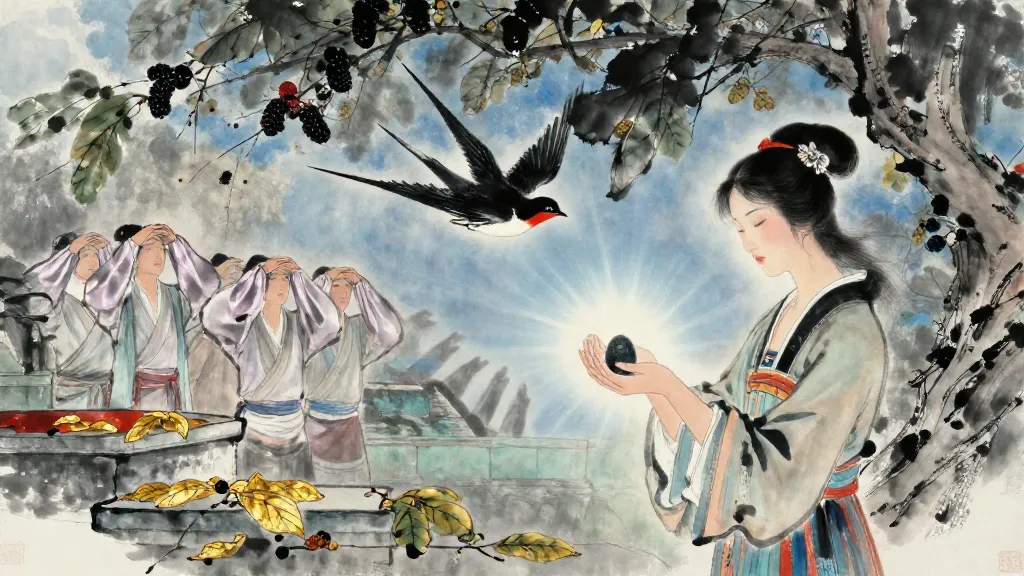
殷本紀 (Annals of the Yin/Shang) — Chinese ink painting

Chapter 3 of 130

殷本紀

Annals of the Yin/Shang

View:

殷之始祖契

Xie, the Ancestor of the Yin

殷契,母曰簡狄,有娀氏之女,為帝嚳次妃。三人行浴,見玄鳥墮其卵,簡狄取吞之,因孕生契。契長而佐禹治水有功。帝舜乃命契曰:「百姓不親,五品不訓,汝為司徒而敬敷五教,五教在寬。」封于商,賜姓子氏。契興於唐、虞、大禹之際,功業著於百姓,百姓以平。

Xie, the ancestor of the Yin, had a mother named Jiandi, a woman of the Yousong clan, who was a secondary consort of Emperor Ku. Three women went out to bathe. They saw a dark bird drop its egg. Jiandi picked it up and swallowed it, and thereby conceived and bore Xie.

When Xie grew up, he assisted Yu in controlling the flood and rendered great merit. Emperor Shun then commanded Xie: "The hundred clans are not close and the five relationships are not in order. You shall serve as Minister of Education and reverently spread the five teachings. Let the five teachings be carried out with leniency." He was enfeoffed at Shang and given the surname Zi.

Xie flourished during the time of Tang, Yu, and the Great Yu. His achievements were renowned among the people, and the people were at peace.

Notes

1personXiè

Xie (契, also read Xiè) is the legendary ancestor of the Shang/Yin dynasty. His miraculous conception from the egg of a 'dark bird' (玄鳥) connects the Shang to their totemic animal. Oracle bone inscriptions confirm that the Shang worshipped a bird ancestor.

2context

The 'dark bird' (玄鳥) is identified as a swallow. The Shang origin myth — conception through swallowing a bird's egg — is one of several Chinese dynastic origin stories involving miraculous births. The Zhou equivalent has Jiang Yuan stepping in a god's footprint to conceive Houji. These myths establish divine sanction for each dynasty's rule.

3person帝嚳Dì Kù

Emperor Ku (帝嚳) was the third of the Five Emperors (see Chapter 1). As Jiandi's husband, he is the father of Xie — making the Shang ancestors part of the unified genealogy of the Five Emperors.

契至湯世系

The Genealogy from Xie to Tang

契卒,子昭明立。昭明卒,子相土立。相土卒,子昌若立。昌若卒,子曹圉立。曹圉卒,子冥立。冥卒,子振立。振卒,子微立。微卒,子報丁立。報丁卒,子報乙立。報乙卒,子報丙立。報丙卒,子主壬立。主壬卒,子主癸立。主癸卒,子天乙立,是為成湯。

成湯,自契至湯八遷。湯始居亳,從先王居,作帝誥。

When Xie died, his son Zhaoming succeeded him. When Zhaoming died, his son Xiangtu succeeded him. When Xiangtu died, his son Changruo succeeded him. When Changruo died, his son Caoyu succeeded him. When Caoyu died, his son Ming succeeded him. When Ming died, his son Zhen succeeded him. When Zhen died, his son Wei succeeded him. When Wei died, his son Baoding succeeded him. When Baoding died, his son Baoyi succeeded him. When Baoyi died, his son Baobing succeeded him. When Baobing died, his son Zhuren succeeded him. When Zhuren died, his son Zhugui succeeded him. When Zhugui died, his son Tianyi succeeded him — this was Cheng Tang.

Cheng Tang: from Xie to Tang, the capital was moved eight times. Tang first settled at Bo, following the residence of the former kings, and composed the Emperor's Proclamation.

Notes

1person成湯Chéng Tāng

Cheng Tang (成湯), personal name Tianyi (天乙, 'Celestial First'), was the founder of the Shang dynasty. Fourteen generations separated him from the ancestor Xie. His name appears on Shang oracle bones as 大乙 (Da Yi, 'Great First'), confirming him as a historical figure.

2context

The 'eight relocations' (八遷) of the Shang capital before Tang reflect the semi-nomadic character of the pre-dynastic Shang. Archaeological evidence confirms that the Shang moved their capital repeatedly, most famously to Yin (殷, modern Anyang) under King Pangeng.

3place

Bo (亳) is the most debated of all Shang capitals. Candidates include modern Shangqiu (Henan), Yanshi (Henan near Luoyang), and Zhengzhou. The Yanshi Shang city site and the Zhengzhou Shang city are both major archaeological discoveries that may correspond to 'Bo.'

湯征伐與伊尹

Tang's Campaigns and the Rise of Yi Yin

湯征諸侯。葛伯不祀,湯始伐之。湯曰:「予有言:人視水見形,視民知治不。」伊尹曰:「明哉!言能聽,道乃進。君國子民,為善者皆在王官。勉哉,勉哉!」湯曰:「汝不能敬命,予大罰殛之,無有攸赦。」作湯征。

伊尹名阿衡。阿衡欲奸湯而無由,乃為有莘氏媵臣,負鼎俎,以滋味說湯,致于王道。或曰,伊尹處士,湯使人聘迎之,五反然後肯往從湯,言素王及九主之事。湯舉任以國政。伊尹去湯適夏。既醜有夏,復歸于亳。入自北門,遇女鳩、女房,作女鳩女房。

Tang campaigned against the feudal lords. The Earl of Ge did not perform sacrifices, so Tang first attacked him. Tang said: "I have a saying: when a man looks at water, he sees his own reflection; when he looks at the people, he knows whether there is good government or not." Yi Yin said: "Brilliant! When words can be heeded, the Way advances. To be lord of a state and father of the people — let all who do good serve in the king's government. Strive on! Strive on!" Tang said: "Those who will not respect my commands, I will punish severely, and there shall be no pardon." He composed the Campaigns of Tang.

Yi Yin's personal name was A Heng. A Heng wished to gain access to Tang but had no way in. He therefore became a retainer accompanying the bride from the Youshen clan, carrying tripod and cutting board, and used the art of cooking to persuade Tang, leading him to the kingly way.

Another account says that Yi Yin was a recluse scholar. Tang sent men to invite him, but it took five attempts before he consented to come and serve Tang. He spoke of the Uncrowned King and the Nine Types of Rulers. Tang raised him up and entrusted him with the government of the state.

Yi Yin left Tang and went to the Xia. Finding the Xia hateful, he returned to Bo. Entering by the north gate, he encountered Nü Jiu and Nü Fang, and composed the text Nü Jiu Nü Fang.

Notes

1person伊尹Yī Yǐn

Yi Yin (伊尹), also called A Heng (阿衡), is one of the most celebrated ministers in Chinese history. His rise from humble cook to chief minister through his mastery of 'flavors' — a metaphor for the art of statecraft — became the archetype of the advisor who uses culinary wisdom to teach governance. The phrase '鼎鼐調和' (harmonizing the tripod and cauldron) became a standard metaphor for the prime minister's role.

2translation

'When a man looks at water, he sees his own reflection; when he looks at the people, he knows whether there is good government' (人視水見形,視民知治不) — this aphorism became one of the most quoted political maxims in Chinese history. The people serve as the mirror of governance.

3context

The two conflicting accounts of Yi Yin's origins — cook or recluse scholar — reflect Sima Qian's characteristic honesty in preserving alternative traditions. The 'five invitations' parallel the tradition of Liu Bei's three visits to Zhuge Liang's thatched cottage.

湯之仁德與網開三面

Tang's Benevolence and the Three-Sided Net

湯出,見野張網四面,祝曰:「自天下四方皆入吾網。」湯曰:「嘻,盡之矣!」乃去其三面,祝曰:「欲左,左。欲右,右。不用命,乃入吾網。」諸侯聞之,曰:「湯德至矣,及禽獸。」

Tang went out and saw someone in the countryside who had spread nets on all four sides, praying: "Let all from the four quarters of All-Under-Heaven enter my nets." Tang said: "Alas, that would take them all!" He removed three of the four sides and prayed instead: "Those that wish to go left, go left. Those that wish to go right, go right. Only those that refuse their fate shall enter my net."

When the feudal lords heard of this, they said: "Tang's virtue reaches its utmost — it extends even to the birds and beasts."

Notes

1context

The story of 'opening three sides of the net' (網開三面) became one of the most famous anecdotes in Chinese political culture, cited for millennia as the model of magnanimous governance. The modern idiom '網開一面' (opening one side of the net, i.e. showing leniency) derives from this story, though it reverses the original — Tang opens three sides, not one.

湯伐桀與湯誓

Tang's Campaign Against Jie and the Oath of Tang

當是時,夏桀為虐政淫荒,而諸侯昆吾氏為亂。湯乃興師率諸侯,伊尹從湯,湯自把鉞以伐昆吾,遂伐桀。湯曰:「格女眾庶,來,女悉聽朕言。匪台小子敢行舉亂,有夏多罪,予維聞女眾言,夏氏有罪。予畏上帝,不敢不正。今夏多罪,天命殛之。今女有眾,女曰:『我君不恤我眾,捨我嗇事而割政』。女其曰:『有罪,其柰何』?夏王率止眾力,率奪夏國。眾有率怠不和,曰:『是日何時喪?予與女皆亡』!夏德若茲,今朕必往。爾尚及予一人致天之罰,予其大理女。女毋不信,朕不食言。女不從誓言,予則帑僇女,無有攸赦。」以告令師,作湯誓。於是湯曰:「吾甚武」,號曰武王。

At that time, Jie of the Xia ruled with cruelty, licentiousness, and excess, and the feudal lord Kunwu had caused disorder. Tang then raised his armies and led the feudal lords, with Yi Yin accompanying him. Tang personally grasped the battle-axe and attacked Kunwu, then marched against Jie.

Tang said: "Come, all you multitudes! Come and hear my every word. It is not that I, a small man, dare to raise rebellion. The Xia has committed many crimes. I have heard the words of you, the multitudes: the house of Xia is guilty. I stand in awe of the Supreme Deity and dare not fail to act justly. Now the Xia has committed many crimes, and Heaven has commanded its destruction.

"Now you, the multitudes, say: 'Our lord has no pity on us. He abandons our farming and imposes harsh government.' And you say: 'He is guilty — what can we do?' The Xia king has exhausted the people's strength and plundered the Xia state. The people are all weary and discontented, saying: 'When will this sun perish? We will die together with you!'

"Such is the virtue of the Xia. Now I must march against it. Join with me, the One Man, in carrying out Heaven's punishment, and I shall greatly reward you. Do not disbelieve me — I do not eat my words. If you do not follow this oath, I will enslave and execute you, without pardon."

With this he proclaimed the oath to his troops — this was the Oath of Tang. Thereupon Tang said: "I am greatly martial," and took the title King Wu, the Martial King.

Notes

1context

The Oath of Tang (湯誓) is preserved in the Book of Documents and is one of the founding texts of the 'Mandate of Heaven' (天命) doctrine. Tang explicitly claims that he is not rebelling but carrying out Heaven's punishment against a dynasty that has lost its mandate — the same justification King Wu of Zhou would later use against the Shang.

2translation

'When will this sun perish? We will die together with you!' (是日何時喪?予與女皆亡) — the people compare Jie to a sun that will never set, expressing their desperation. In an alternate tradition, Jie himself boasted 'I am the sun' — and the people responded with this curse. The metaphor of the ruler as the sun runs throughout Chinese political thought.

3translation

'The One Man' (予一人) is the standard royal self-designation in the Book of Documents, equivalent to the later 'I, the solitary one' (朕). It emphasizes both the ruler's unique position and his isolation.

湯克夏與建國

Tang's Victory Over the Xia and Founding of the Dynasty

桀敗於有娀之虛,桀奔於鳴條,夏師敗績。湯遂伐三嵕,俘厥寶玉,義伯、仲伯作典寶。湯既勝夏,欲遷其社,不可,作夏社。伊尹報。於是諸侯畢服,湯乃踐天子位,平定海內。

湯歸至于泰卷陶,中壘作誥。既絀夏命,還亳,作湯誥:「維三月,王自至於東郊。告諸侯群后:『毋不有功於民,勤力乃事。予乃大罰殛女,毋予怨。』曰:『古禹、皋陶久勞于外,其有功乎民,民乃有安。東為江,北為濟,西為河,南為淮,四瀆已修,萬民乃有居。后稷降播,農殖百穀。三公咸有功于民,故後有立。昔蚩尤與其大夫作亂百姓,帝乃弗予,有狀。先王言不可不勉。』曰:『不道,毋之在國,女毋我怨。』」以令諸侯。伊尹作咸有一德,咎單作明居。

湯乃改正朔,易服色,上白,朝會以晝。

Jie was defeated at the ruins of Yousong. He fled to Mingtiao and the Xia army was routed. Tang then attacked Sanzong, captured its treasures and jade. Yibo and Zhongbo composed the Record of the Treasures.

Having defeated the Xia, Tang wished to relocate the Xia altar of earth but found it could not be done. He composed the Xia Altar. Yi Yin reported the outcome. Thereupon all the feudal lords submitted, and Tang ascended the throne of the Son of Heaven and pacified all within the seas.

Tang returned as far as Taijuantao. Zhonglei composed a proclamation. Having abrogated the Xia mandate and returned to Bo, he composed the Proclamation of Tang:

"In the third month, the King came in person to the eastern suburbs. He addressed the feudal lords and assembled rulers: 'None of you shall fail to render service to the people. Be diligent in your tasks. If you do not, I will punish you severely — do not resent me for it.'

"He said: 'In ancient times, Yu and Gaoyao labored long abroad and rendered service to the people, so that the people gained security. To the east was the Yangtze, to the north the Ji, to the west the Yellow River, to the south the Huai — the four great rivers were regulated, and the myriad people had places to dwell. Houji came down and sowed, and agriculture planted the hundred grains. These three ministers all rendered service to the people, and therefore their descendants received positions of authority. In former times Chiyou and his ministers brought chaos to the people, and the Supreme Deity refused to grant them success — as the record shows. The words of the former kings cannot be neglected.'

"He said: 'Those who do not follow the Way shall have no place in the state. Do not resent me for it.'" With this he issued orders to the feudal lords.

Yi Yin composed All Possess One Virtue. Jiu Dan composed Illuminating the Dwelling.

Tang then reformed the calendar, changed the ritual colors — honoring white — and held court assemblies in the daytime.

Notes

1context

Changing the calendar and ritual colors (改正朔,易服色) was the standard procedure for founding a new dynasty. Each dynasty adopted a different color: the Xia honored black, the Shang honored white, and the Zhou honored red. This practice was rooted in Five Phases theory and continued through the imperial period.

2context

The Proclamation of Tang invokes Yu, Gaoyao, and Houji as models of meritorious service — all figures from the legendary period who earned their positions through achievement. The implicit message is that the Shang conquest is part of the same tradition: power must be earned through service to the people.

湯之繼嗣與伊尹輔政

Tang's Succession and Yi Yin's Regency

湯崩,太子太丁未立而卒,於是乃立太丁之弟外丙,是為帝外丙。帝外丙即位三年,崩,立外丙之弟中壬,是為帝中壬。帝中壬即位四年,崩,伊尹乃立太丁之子太甲。太甲,成湯適長孫也,是為帝太甲。帝太甲元年,伊尹作伊訓,作肆命,作徂后。

帝太甲既立三年,不明,暴虐,不遵湯法,亂德,於是伊尹放之於桐宮。三年,伊尹攝行政當國,以朝諸侯。

帝太甲居桐宮三年,悔過自責,反善,於是伊尹乃迎帝太甲而授之政。帝太甲修德,諸侯咸歸殷,百姓以寧。伊尹嘉之,乃作太甲訓三篇,褒帝太甲,稱太宗。

When Tang died, his crown prince Taiding had already died before ascending the throne. Taiding's younger brother Waibing was therefore enthroned — this was Emperor Waibing. Emperor Waibing reigned three years and died. His younger brother Zhongren was enthroned — this was Emperor Zhongren. Emperor Zhongren reigned four years and died.

Yi Yin then enthroned Taiding's son Taijia. Taijia was the eldest legitimate grandson of Cheng Tang — this was Emperor Taijia. In the first year of Emperor Taijia, Yi Yin composed the Instructions of Yi, the Charge of Responsibility, and the Former Rulers.

After three years on the throne, Emperor Taijia was unenlightened, cruel and tyrannical. He did not follow the laws of Tang and brought disorder to virtue. Yi Yin therefore exiled him to Tong Palace. For three years, Yi Yin served as regent, governing the state and receiving the feudal lords at court.

Emperor Taijia resided at Tong Palace for three years. He repented of his errors, reproached himself, and turned back to goodness. Yi Yin then welcomed Emperor Taijia and returned the government to him. Emperor Taijia cultivated virtue, and the feudal lords all submitted to the Yin. The people were at peace. Yi Yin commended him, and composed the three chapters of the Instructions of Taijia, praising Emperor Taijia. He was given the temple name Taizong, 'Grand Ancestor.'

Notes

1context

Yi Yin's exile of Taijia and subsequent restoration is one of the most extraordinary episodes in Chinese political history. A minister deposing his king, ruling in his stead, and then restoring him after reform was held up as the supreme example of ministerial virtue. However, a recently discovered Bamboo Annals text presents an alternative version in which Yi Yin usurps the throne and Taijia kills him to reclaim power.

2place

Tong Palace (桐宮) was reportedly near Tang's burial ground, so Taijia's exile there also served as a period of mourning and reflection at his grandfather's tomb.

殷朝中期諸帝

The Middle Period of the Yin Dynasty

太宗崩,子沃丁立。帝沃丁之時,伊尹卒。既葬伊尹於亳,咎單遂訓伊尹事,作沃丁。

沃丁崩,弟太庚立,是為帝太庚。帝太庚崩,子帝小甲立。帝小甲崩,弟雍己立,是為帝雍己。殷道衰,諸侯或不至。

帝雍己崩,弟太戊立,是為帝太戊。帝太戊立伊陟為相。亳有祥桑谷共生於朝,一暮大拱。帝太戊懼,問伊陟。伊陟曰:「臣聞妖不勝德,帝之政其有闕與?帝其修德。」太戊從之,而祥桑枯死而去。伊陟贊言于巫咸。巫咸治王家有成,作咸艾,作太戊。帝太戊贊伊陟于廟,言弗臣,伊陟讓,作原命。殷復興,諸侯歸之,故稱中宗。

中宗崩,子帝中丁立。帝中丁遷于隞。河亶甲居相。祖乙遷于邢。帝中丁崩,弟外壬立,是為帝外壬。仲丁書闕不具。帝外壬崩,弟河亶甲立,是為帝河亶甲。河亶甲時,殷復衰。

河亶甲崩,子帝祖乙立。帝祖乙立,殷復興。巫賢任職。

祖乙崩,子帝祖辛立。帝祖辛崩,弟沃甲立,是為帝沃甲。帝沃甲崩,立沃甲兄祖辛之子祖丁,是為帝祖丁。帝祖丁崩,立弟沃甲之子南庚,是為帝南庚。帝南庚崩,立帝祖丁之子陽甲,是為帝陽甲。帝陽甲之時,殷衰。

自中丁以來,廢適而更立諸弟子,弟子或爭相代立,比九世亂,於是諸侯莫朝。

When Taizong died, his son Woding succeeded him. During Emperor Woding's reign, Yi Yin died. After Yi Yin was buried at Bo, Jiu Dan composed a record of Yi Yin's deeds — this was the text Woding.

When Woding died, his brother Taigeng succeeded him — this was Emperor Taigeng. When Emperor Taigeng died, his son Emperor Xiaojia succeeded him. When Emperor Xiaojia died, his brother Yongji succeeded him — this was Emperor Yongji. The Way of the Yin declined, and some feudal lords stopped coming to court.

When Emperor Yongji died, his brother Taiwu succeeded him — this was Emperor Taiwu. Emperor Taiwu appointed Yi Zhi as chancellor. At Bo, an ominous mulberry and millet plant grew intertwined in the court, and in a single night they grew as large as a person could embrace. Emperor Taiwu was alarmed and consulted Yi Zhi. Yi Zhi said: "I have heard that portents cannot overcome virtue. Is there perhaps a deficiency in the Emperor's government? Let the Emperor cultivate his virtue." Taiwu followed this advice, and the ominous mulberry withered and died.

Yi Zhi commended Wu Xian to the court. Wu Xian managed the royal household with great success and composed the texts Xian Ai and Taiwu. Emperor Taiwu honored Yi Zhi at the ancestral temple and declared he would not treat him as a subject. Yi Zhi declined this honor, and composed the Original Mandate. The Yin revived and the feudal lords submitted. He was therefore given the temple name Zhongzong, 'Central Ancestor.'

When Zhongzong died, his son Emperor Zhongding succeeded him. Emperor Zhongding moved the capital to Ao. Hedanjia resided at Xiang. Zuyi moved to Xing. When Emperor Zhongding died, his brother Wairen succeeded him — this was Emperor Wairen. The records of Zhongding are incomplete. When Emperor Wairen died, his brother Hedanjia succeeded him — this was Emperor Hedanjia. In Hedanjia's time, the Yin declined again.

When Hedanjia died, his son Emperor Zuyi succeeded him. When Emperor Zuyi took the throne, the Yin revived. Wu Xian served in office.

When Zuyi died, his son Emperor Zuxin succeeded him. When Emperor Zuxin died, his brother Wojia succeeded him — this was Emperor Wojia. When Emperor Wojia died, the son of Wojia's elder brother Zuxin, Zuding, was enthroned — this was Emperor Zuding. When Emperor Zuding died, the son of his brother Wojia, Nangeng, was enthroned — this was Emperor Nangeng. When Emperor Nangeng died, the son of Emperor Zuding, Yangjia, was enthroned — this was Emperor Yangjia. In Emperor Yangjia's time, the Yin declined.

From Zhongding onward, the legitimate heirs were set aside and replaced by younger brothers and their sons. Brothers and nephews sometimes contested the succession, and for nine reigns there was disorder. The feudal lords ceased coming to court.

Notes

1context

The ominous mulberry and millet (祥桑谷) growing overnight in the court was interpreted as a sign of moral disorder in the government. Yi Zhi's response — 'portents cannot overcome virtue' (妖不勝德) — became a famous maxim of political rationalism, asserting that natural omens are secondary to moral governance.

2context

The 'nine reigns of disorder' (比九世亂) from Zhongding to Yangjia highlight the fundamental instability of brother-to-brother succession (兄終弟及) versus father-to-son succession (父死子繼). The Shang practiced both, leading to recurring succession crises. Oracle bone evidence confirms this complex succession pattern.

3person巫咸Wū Xián

Wu Xian (巫咸) was a famous shaman-minister of the Shang dynasty. His descendants, the Wu Xian clan, remained important ritual specialists. The word 巫 (wu, shaman) in his name reflects the Shang dynasty's deeply shamanistic religious culture.

盤庚遷殷

Pangeng Moves the Capital to Yin

帝陽甲崩,弟盤庚立,是為帝盤庚。帝盤庚之時,殷已都河北,盤庚渡河南,復居成湯之故居,乃五遷,無定處。殷民咨胥皆怨,不欲徙。盤庚乃告諭諸侯大臣曰:「昔高后成湯與爾之先祖俱定天下,法則可修。捨而弗勉,何以成德!」乃遂涉河南,治亳,行湯之政,然後百姓由寧,殷道復興。諸侯來朝,以其遵成湯之德也。

When Emperor Yangjia died, his brother Pangeng succeeded him — this was Emperor Pangeng. In Emperor Pangeng's time, the Yin had already established its capital north of the Yellow River. Pangeng crossed to the south of the river and returned to the former residence of Cheng Tang. In all, the capital had been moved five times with no fixed location. The Yin people murmured and complained among themselves, unwilling to move.

Pangeng addressed the feudal lords and great ministers: "In former times, the great ancestor Cheng Tang and your forefathers together pacified All-Under-Heaven. The laws and models they established can be maintained. To abandon them and make no effort — how can virtue be achieved!"

He then crossed to the south of the river, restored Bo, and carried out the government of Tang. Thereupon the people were at peace, and the Way of the Yin revived. The feudal lords came to court, for he followed the virtue of Cheng Tang.

Notes

1person盤庚Pángēng

Pangeng (盤庚) is one of the most important Shang kings historically. His relocation of the capital is the subject of three chapters in the Book of Documents (盤庚三篇). Archaeological evidence strongly supports identifying his new capital with the great Yin ruins (殷墟) at Anyang, Henan, though Sima Qian's account has him moving to 'Bo' rather than Yin.

2place

The Yin ruins (殷墟) at Anyang, Henan, were discovered in 1928 and are one of the most important archaeological sites in the world. Excavations revealed oracle bones, bronze vessels, royal tombs, and the remains of a massive city — providing physical confirmation of the Shang dynasty's existence.

武丁中興

The Revival Under Wu Ding

帝盤庚崩,弟小辛立,是為帝小辛。帝小辛立,殷復衰。百姓思盤庚,乃作盤庚三篇。帝小辛崩,弟小乙立,是為帝小乙。

帝小乙崩,子帝武丁立。帝武丁即位,思復興殷,而未得其佐。三年不言,政事決定於冢宰,以觀國風。武丁夜夢得聖人,名曰說。以夢所見視群臣百吏,皆非也。於是乃使百工營求之野,得說於傅險中。是時說為胥靡,筑於傅險。見於武丁,武丁曰是也。得而與之語,果聖人,舉以為相,殷國大治。故遂以傅險姓之,號曰傅說。

When Emperor Pangeng died, his brother Xiaoxin succeeded him — this was Emperor Xiaoxin. Under Emperor Xiaoxin, the Yin declined again. The people longed for Pangeng, and the three chapters of Pangeng were composed.

When Emperor Xiaoxin died, his brother Xiaoyi succeeded him — this was Emperor Xiaoyi.

When Emperor Xiaoyi died, his son Emperor Wuding succeeded him. When Emperor Wuding took the throne, he wished to revive the Yin but had not yet found his minister. For three years he did not speak, and all government decisions were left to the chief steward, so that he might observe the ways of the state.

Wuding dreamed one night of a sage whose name was Yue. He compared the face he had seen in the dream against all his ministers and officials — none matched. He then sent his hundred artisans to search for the man in the countryside. They found Yue among the laborers at Fuxian. At that time, Yue was a convict laborer building walls at Fuxian.

When he was brought before Wuding, Wuding said: "This is the one." He spoke with him and found him to be truly a sage. He raised him up as chancellor, and the state of Yin was greatly ordered. He therefore gave him the surname Fu after Fuxian, and he was known as Fu Yue.

Notes

1person武丁Wǔdīng

Wuding (武丁, r. c. 1250–1192 BC) was the greatest king of the Shang dynasty. His reign, confirmed by oracle bone inscriptions, saw the Shang at the height of its power. He conducted major military campaigns and greatly expanded the territory under Shang control.

2person傅說Fù Yuè

Fu Yue (傅說) was discovered as a convict laborer and became Wuding's chancellor — a story that parallels Yi Yin's rise from cook to minister. The tale of finding a sage through a dream underscores the Shang's deeply shamanistic worldview, where dreams were a primary medium of communication with the divine.

3place

Fuxian (傅險) is traditionally identified with a site in modern Pinglu County, Shanxi, in the mountainous area between the Yellow River gorge and the Zhongtiao Mountains.

武丁修政與祖己之訓

Wu Ding Reforms His Government and Zuji's Admonition

帝武丁祭成湯,明日,有飛雉登鼎耳而呴,武丁懼。祖己曰:「王勿憂,先修政事。」祖己乃訓王曰:「唯天監下典厥義,降年有永有不永,非天夭民,中絕其命。民有不若德,不聽罪,天既附命正厥德,乃曰其奈何。鳴呼!王嗣敬民,罔非天繼,常祀毋禮于棄道。」武丁修政行德,天下咸驩,殷道復興。

帝武丁崩,子帝祖庚立。祖己嘉武丁之以祥雉為德,立其廟為高宗,遂作高宗肜日及訓。

When Emperor Wuding was performing sacrifices to Cheng Tang, the next day a pheasant flew up and perched on the ear of a sacrificial tripod, crying out. Wuding was alarmed. Zuji said: "Let the King not worry — first attend to matters of government."

Zuji then instructed the King: "It is only that Heaven watches over those below and judges them by their righteousness. Whether it grants long life or short is not because Heaven cuts off the people or prematurely ends their mandate. When the people do not act according to virtue and do not heed punishment, Heaven has already bestowed its mandate to correct their virtue — how then can they say 'What can be done?'

"Alas! Let the King reverently succeed to the care of the people. Everything follows from Heaven's continuity. In regular sacrifices, do not treat with ceremony those who have abandoned the Way."

Wuding reformed his government and practiced virtue. All-Under-Heaven rejoiced, and the Way of the Yin revived.

When Emperor Wuding died, his son Emperor Zugeng succeeded him. Zuji commended Wuding for taking the omen of the pheasant as an occasion for cultivating virtue, established his temple as Gaozong ('Exalted Ancestor'), and composed the Gaozong Rong Ri and the Instructions.

Notes

1context

The pheasant omen continues the Shang pattern of interpreting natural phenomena as messages from Heaven. Zuji's response — to use the omen as an impetus for political reform rather than ritual anxiety — represents the rationalist interpretation that later Confucians championed.

2context

The temple name Gaozong (高宗, 'Exalted Ancestor') is one of the highest honorifics in the Shang temple name system. Oracle bone inscriptions confirm Wuding's exceptional status in the Shang ancestral cult.

殷朝晚期衰落

The Late Decline of the Yin Dynasty

帝祖庚崩,弟祖甲立,是為帝甲。帝甲淫亂,殷復衰。

帝甲崩,子帝廩辛立。帝廩辛崩,弟庚丁立,是為帝庚丁。帝庚丁崩,子帝武乙立。殷復去亳,徙河北。

帝武乙無道,為偶人,謂之天神。與之博,令人為行。天神不勝,乃僇辱之。為革囊,盛血,卬而射之,命曰「射天」。武乙獵於河渭之閒,暴雷,武乙震死。子帝太丁立。帝太丁崩,子帝乙立。帝乙立,殷益衰。

When Emperor Zugeng died, his brother Zujia succeeded him — this was Emperor Jia. Emperor Jia was licentious and dissolute, and the Yin declined again.

When Emperor Jia died, his son Emperor Linxin succeeded him. When Emperor Linxin died, his brother Gengding succeeded him — this was Emperor Gengding. When Emperor Gengding died, his son Emperor Wuyi succeeded him. The Yin again left Bo and moved north of the Yellow River.

Emperor Wuyi was without principle. He made a wooden puppet and called it the Heavenly Spirit. He gambled with it, having a man make the moves on its behalf. When the Heavenly Spirit lost, he abused and humiliated it. He made a leather bag, filled it with blood, suspended it high, and shot arrows at it — this he called 'shooting at Heaven.' Wuyi was hunting between the Yellow River and the Wei when a sudden thunderstorm struck. Wuyi was killed by lightning.

His son Emperor Taiding succeeded him. When Emperor Taiding died, his son Emperor Yi succeeded him. Under Emperor Yi, the Yin declined further.

Notes

1context

Wuyi's 'shooting at Heaven' (射天) is one of the most dramatic acts of sacrilege in Chinese history. His death by lightning was interpreted as Heaven's direct retribution — a cautionary tale cited by Confucians for centuries. Whether this represents actual behavior or a later moralistic fabrication is debated.

2context

The relocation 'north of the Yellow River' marks the Yin's return to the Anyang area. The Yin ruins archaeological site confirms continuous occupation through the late Shang period.

帝辛(紂)即位與暴政

Emperor Xin (Zhou) Ascends the Throne and His Tyranny

帝乙長子曰微子啟,啟母賤,不得嗣。少子辛,辛母正后,辛為嗣。帝乙崩,子辛立,是為帝辛,天下謂之紂。

帝紂資辨捷疾,聞見甚敏;材力過人,手格猛獸;知足以距諫,言足以飾非;矜人臣以能,高天下以聲,以為皆出己之下。好酒淫樂,嬖於婦人。愛妲己,妲己之言是從。於是使師涓作新淫聲,北里之舞,靡靡之樂。厚賦稅以實鹿臺之錢,而盈鉅橋之粟。益收狗馬奇物,充仞宮室。益廣沙丘苑臺,多取野獸蜚鳥置其中。慢於鬼神。大聚樂戲於沙丘,以酒為池,縣肉為林,使男女裸相逐其閒,為長夜之飲。

The eldest son of Emperor Yi was Weizi Qi. Because Qi's mother was of low status, he could not inherit the throne. The youngest son was Xin, whose mother was the principal consort, and so Xin became heir. When Emperor Yi died, Xin succeeded him — this was Emperor Xin. All-Under-Heaven called him Zhou.

Emperor Zhou was naturally eloquent, quick-witted, and sharp of hearing and sight. His physical strength exceeded that of other men, and he could fight wild beasts with his bare hands. His intelligence was enough to reject remonstrance; his rhetoric was enough to gloss over wrongdoing. He intimidated his ministers with his abilities and exalted himself above All-Under-Heaven by his reputation, considering everyone beneath him.

He was fond of wine and debauchery, and besotted with women. He loved Daji and followed her every word. He had the music master Shijuan compose new licentious melodies, the dances of Beili, and languorous music. He imposed heavy taxes to fill the treasury at Lutai with coins and the granary at Juqiao with grain. He amassed dogs, horses, and rare objects, filling his palaces with them. He expanded the parks and terraces at Shaqiu, stocking them with wild beasts and exotic birds. He was contemptuous of the spirits.

He held great feasts and entertainments at Shaqiu, making pools of wine and forests of hanging meat. He had men and women chase each other naked among them, drinking through the night.

Notes

1person帝紂Dì Zhòu

Emperor Zhou (紂) of Shang, personal name Xin (辛), is the archetypal tyrant of Chinese history, paired with Jie of the Xia. His posthumous name Zhou (紂) means 'Cruelly Oppressive' — it is a deliberate insult. Oracle bones refer to him by his birth-name Di Xin (帝辛).

2person妲己Dájǐ

Daji (妲己) is the most notorious femme fatale in Chinese history. Later traditions amplified her role enormously, eventually making her a fox spirit sent to destroy the Shang — but Sima Qian's account is relatively restrained, simply noting that Zhou followed her words.

3context

The 'wine pools and meat forests' (酒池肉林) became a proverbial image of imperial excess, cited throughout Chinese history whenever a ruler was criticized for extravagance. The historian Zi Gong (子貢) noted that later generations attributed many crimes to Zhou that he may not have committed — 'All the evil of All-Under-Heaven flows down to him.'

4place

Shaqiu (沙丘) was Zhou's pleasure grounds, traditionally located in modern Guangzong County, Hebei. Centuries later, both Zhao Wuling Wang and Qin Shi Huang would die at Shaqiu — making it one of the most inauspicious places in Chinese history.

5person微子啟Wēizǐ Qǐ

Weizi Qi (微子啟) was Zhou's eldest half-brother, who would later flee the Shang and eventually be enfeoffed by the Zhou as the ruler of Song. He is the subject of a separate chapter in the Shiji.

紂殘害忠良

Zhou Persecutes the Loyal and Worthy

百姓怨望而諸侯有畔者,於是紂乃重刑辟,有炮格之法。以西伯昌、九侯、鄂侯為三公。九侯有好女,入之紂。九侯女不喜淫,紂怒,殺之,而醢九侯。鄂侯爭之彊,辨之疾,并脯鄂侯。西伯昌聞之,竊嘆。崇侯虎知之,以告紂,紂囚西伯羑里。西伯之臣閎夭之徒,求美女奇物善馬以獻紂,紂乃赦西伯。西伯出而獻洛西之地,以請除炮格之刑。紂乃許之,賜弓矢斧鉞,使得征伐,為西伯。而用費中為政。費中善諛,好利,殷人弗親。紂又用惡來。惡來善毀讒,諸侯以此益疏。

The people murmured with resentment and some feudal lords rebelled. Zhou then imposed ever harsher punishments, including the roasting pillar.

He appointed the Earl of the West Chang, the Lord of Jiu, and the Lord of E as his three highest ministers. The Lord of Jiu had a beautiful daughter and presented her to Zhou. The daughter of the Lord of Jiu did not take pleasure in debauchery. Zhou was furious, killed her, and had the Lord of Jiu minced into paste. The Lord of E remonstrated fiercely and argued vehemently — Zhou had him dried into jerky. When the Earl of the West Chang heard of this, he sighed in private. Chong Houhu learned of it and reported it to Zhou. Zhou imprisoned the Earl of the West at Youli.

The Earl of the West's ministers — Hong Yao and others — sought out beautiful women, rare objects, and fine horses to present to Zhou. Zhou then pardoned the Earl of the West. After his release, the Earl of the West offered to cede the lands west of Luo, requesting in return the abolition of the roasting pillar punishment. Zhou agreed, granted him bows, arrows, axes, and battle-axes, and authorized him to conduct punitive campaigns — thus he was the Earl of the West.

Zhou then employed Fei Zhong in the government. Fei Zhong was skilled at flattery and greedy for profit; the Yin people had no affection for him. Zhou also employed E Lai. E Lai was skilled at slander; and the feudal lords grew ever more distant.

Notes

1person西伯昌(周文王)Xībó Chāng (Zhōu Wén Wáng)

The Earl of the West Chang (西伯昌) is King Wen of Zhou (周文王, c. 1112–1050 BC), one of the most celebrated figures in Chinese history. His imprisonment at Youli is traditionally the period during which he doubled the hexagrams of the Yijing from 8 trigrams to 64 hexagrams.

2context

The roasting pillar (炮格/炮烙) was a bronze pillar coated with grease and placed over a fire. Victims were made to walk across it and slipped into the flames. According to tradition, Daji delighted in watching people fall — though this detail is from later sources, not Sima Qian.

3place

Youli (羑里) is in modern Tangyin County, Henan. The site has been preserved as a memorial to King Wen. The traditional association of Youli with the creation of the Yijing hexagram system made it a site of pilgrimage for scholars.

4context

The parallel between the 'Three Ministers' (三公) episode — mincing one, making jerky of another, and imprisoning the third — and the later 'Three Excellencies' system of Han government was not lost on Chinese readers. The extreme cruelty of making human jerky (脯) and human paste (醢) became stock images of tyranny.

西伯修德與祖伊諫紂

The Earl of the West Cultivates Virtue and Zuyi Remonstrates with Zhou

西伯歸,乃陰修德行善,諸侯多叛紂而往歸西伯。西伯滋大,紂由是稍失權重。王子比干諫,弗聽。商容賢者,百姓愛之,紂廢之。及西伯伐饑國,滅之,紂之臣祖伊聞之而咎周,恐,奔告紂曰:「天既訖我殷命,假人元龜,無敢知吉,非先王不相我後人,維王淫虐用自絕,故天棄我,不有安食,不虞知天性,不迪率典。今我民罔不欲喪,曰『天曷不降威,大命胡不至』?今王其柰何?」紂曰:「我生不有命在天乎!」祖伊反,曰:「紂不可諫矣。」西伯既卒,周武王之東伐,至盟津,諸侯叛殷會周者八百。諸侯皆曰:「紂可伐矣。」武王曰:「爾未知天命。」乃復歸。

After the Earl of the West returned, he quietly cultivated virtue and practiced good government. Many feudal lords abandoned Zhou and turned to the Earl of the West. The Earl of the West grew steadily more powerful, and Zhou gradually lost his authority.

The prince Bigan remonstrated, but Zhou would not listen. Shang Rong was a worthy man beloved by the people — Zhou dismissed him. When the Earl of the West attacked the state of Ji and destroyed it, Zhou's minister Zuyi was alarmed. He blamed Zhou and rushed to report to him:

"Heaven has already ended the mandate of our Yin. When we consult the great tortoise, no divination dares show good fortune. It is not that the former kings do not aid us their descendants — it is that the King's debauchery and cruelty have brought this upon himself. Therefore Heaven has abandoned us. We have no peace even in eating. We do not know Heaven's nature or follow the established laws. Now our people all wish for our destruction, saying: 'Why does Heaven not send down its punishment? Why does the great mandate not come?' What will the King do now?"

Zhou said: "Was I not born with the mandate of Heaven!"

Zuyi withdrew and said: "Zhou cannot be remonstrated with."

After the Earl of the West died, King Wu of Zhou marched east. When he reached Mengjin, eight hundred feudal lords who had rebelled against the Yin assembled to join Zhou. The feudal lords all said: "Zhou can be attacked now." King Wu said: "You do not yet understand the Mandate of Heaven." And he returned home.

Notes

1person比干Bǐgān

Bigan (比干) was Zhou's uncle and one of the 'three virtuous men of Yin' (殷三仁), along with Weizi and Jizi. His remonstrance and gruesome death (described below) made him one of the most revered loyal ministers in Chinese history. Confucius praised the three virtuous men of Yin as models of integrity.

2context

Zhou's reply — 'Was I not born with the mandate of Heaven!' (我生不有命在天乎) — is the quintessential statement of a ruler who confuses hereditary right with divine mandate. The Confucian response is that Heaven's mandate is conditional on virtue; it is not a permanent entitlement.

3context

King Wu's retreat from Mengjin despite having eight hundred lords is one of the most debated episodes in Chinese history. The traditional interpretation is that Wu, like his father Wen, was waiting for the proper moment — allowing Zhou's wickedness to reach its fullest before striking, so that the conquest would be unambiguously righteous.

4place

Mengjin (盟津) is the ford of the Yellow River where King Wu assembled his forces, the same crossing mentioned in Chapter 2's account of Yu's waterworks.

紂殺比干與殷之覆亡

Zhou Kills Bigan and the Fall of the Yin

紂愈淫亂不止。微子數諫不聽,乃與大師、少師謀,遂去。比干曰:「為人臣者,不得不以死爭。」乃彊諫紂。紂怒曰:「吾聞聖人心有七竅。」剖比干,觀其心。箕子懼,乃詳狂為奴,紂又囚之。殷之大師、少師乃持其祭樂器奔周。周武王於是遂率諸侯伐紂。紂亦發兵距之牧野。甲子日,紂兵敗。紂走入,登鹿臺,衣其寶玉衣,赴火而死。周武王遂斬紂頭,縣之[大]白旗。殺妲己。釋箕子之囚,封比干之墓,表商容之閭。封紂子武庚、祿父,以續殷祀,令修行盤庚之政。殷民大說。於是周武王為天子。其後世貶帝號,號為王。而封殷後為諸侯,屬周。

Zhou's debauchery and disorder only intensified. Weizi remonstrated repeatedly to no avail. He consulted with the Grand Music Master and Junior Music Master, and then departed.

Bigan said: "A man who serves as minister has no choice but to remonstrate at the risk of his life." He then pressed his remonstrances forcefully upon Zhou. Zhou was furious and said: "I have heard that the heart of a sage has seven apertures." He had Bigan cut open and examined his heart.

Jizi was terrified. He feigned madness and made himself a slave. Zhou imprisoned him nonetheless. The Grand Music Master and Junior Music Master of Yin took their ritual instruments and music and fled to Zhou.

King Wu of Zhou thereupon led the feudal lords to attack Zhou of Yin. Zhou also raised his troops and opposed them at Muye. On the jiazi day, Zhou's army was defeated. Zhou fled into the city, climbed Lutai, donned his robes adorned with precious jade, and threw himself into the fire and died.

King Wu of Zhou then cut off Zhou's head and hung it on the great white banner. He killed Daji. He freed Jizi from prison, sealed Bigan's tomb with a mound, and honored the gate of Shang Rong's neighborhood. He enfeoffed Zhou's son Wugeng Lufu to continue the Yin sacrifices and ordered him to carry out the government of Pangeng. The Yin people were greatly pleased.

Thereupon King Wu of Zhou became Son of Heaven. His descendants later reduced the title of 'emperor' (帝) and called themselves 'kings' (王). They enfeoffed the Yin descendants as feudal lords under the Zhou.

Notes

1context

The cutting open of Bigan's heart to see if it had 'seven apertures' (七竅) is one of the most famous atrocities in Chinese history. It crystallized the archetype of the tyrant who destroys loyal ministers. Bigan became the patron saint of the Bi (比) family and was later deified as the God of Wealth in some traditions.

2person箕子Jīzǐ

Jizi (箕子), the third of the 'three virtuous men of Yin,' feigned madness to survive. After the Zhou conquest, he reportedly went to the Korean peninsula, where Korean tradition credits him as the founder of the Gija Joseon kingdom.

3place

Muye (牧野, 'Pastoral Wilds') is the site of the decisive battle between King Wu of Zhou and Zhou of Shang, traditionally dated to 1046 BC. It is located near modern Qi County (淇縣), Henan. According to the Book of Documents, Zhou's own soldiers turned their weapons against him — an image of total moral collapse.

4context

The jiazi (甲子) day — the first day of the sixty-day cycle — became an inauspicious day in later tradition precisely because of the Battle of Muye. The dating of the battle is one of the most debated problems in Chinese chronology, with proposed dates ranging from 1122 to 1027 BC, with 1046 BC now the most widely accepted.

5context

King Wu's actions after the conquest — freeing Jizi, honoring Bigan, enfeoffing Zhou's son to maintain the ancestral sacrifices — established the model for legitimate conquest: the victor does not exterminate the vanquished but preserves their ritual lineage. This principle was followed in nearly every subsequent dynastic transition.

6translation

The note that the Zhou 'reduced the title of emperor (帝) to king (王)' reflects a genuine historical change. The Shang rulers called themselves 帝 (di, deity/emperor); the Zhou adopted the more modest 王 (wang, king). The title 帝 was not revived until Qin Shi Huang combined it with 皇 to create 皇帝 (huangdi) in 221 BC.

武庚叛亂與宋國建立

Wugeng's Rebellion and the Establishment of Song

周武王崩,武庚與管叔、蔡叔作亂,成王命周公誅之,而立微子於宋,以續殷後焉。

When King Wu of Zhou died, Wugeng joined with the Duke of Guan and the Duke of Cai in rebellion. King Cheng commanded the Duke of Zhou to put them down, and Weizi was established at Song to continue the line of the Yin.

Notes

1context

The rebellion of Wugeng and the two dukes (管蔡之亂) was the gravest crisis of the early Zhou. The Duke of Zhou (周公) spent three years suppressing it and then restructured the entire political order, creating the feudal system that would endure for eight centuries.

2place

Song (宋) was centered on modern Shangqiu, Henan — the ancestral homeland of the Shang people. As the ritual successor of the Shang, the state of Song maintained Shang customs and sacrifices throughout the Spring and Autumn period until its destruction in 286 BC.

太史公論贊

The Grand Historian's Appraisal

太史公曰:余以頌次契之事,自成湯以來,采於書詩。契為子姓,其後分封,以國為姓,有殷氏、來氏、宋氏、空桐氏、稚氏、北殷氏、目夷氏。孔子曰,殷路車為善,而色尚白。

The Grand Historian says: I have arranged the deeds of Xie according to the Hymns, and from Cheng Tang onward I have drawn from the Documents and the Odes. Xie's surname was Zi. His descendants were enfeoffed and took their states as surnames. Thus there arose the clans of Yin, Lai, Song, Kongtong, Zhi, Beiyin, and Muyi.

Confucius said that the Yin excelled in their road chariots, and their ritual color was white.

Notes

1context

Sima Qian's appraisal is notably brief compared to the previous two chapters. His citation of the Hymns (頌) refers to the Shang Hymns (商頌) section of the Book of Odes, which preserves liturgical poems celebrating the Shang ancestors. These hymns and the Book of Documents were his primary written sources for the Shang period.

2context

Confucius's remark about the Yin 'honoring white' (色尚白) connects to the Five Phases cosmology: the Shang was associated with the Metal phase, whose color is white. Their road chariots (路車) were praised as among the finest ritual vehicles — one of several positive assessments Confucius made of the Shang despite their catastrophic end.

Edition & Source

Text
《史記》 Shiji
Edition
中華古詩文古書籍網 transcription
Commentary
裴駰《史記集解》、司馬貞《史記索隱》、張守節《史記正義》(Three Commentaries)