周本紀 (Annals of the Zhou) — Chinese ink painting

Chapter 4 of 130

周本紀

Annals of the Zhou

View:

后稷與周族起源

Lord Millet and the Origins of the Zhou People

周后稷,名棄。其母有邰氏女,曰姜原。姜原為帝嚳元妃。姜原出野,見巨人跡,心忻然說,欲踐之,踐之而身動如孕者。居期而生子,以為不祥,棄之隘巷,馬牛過者皆辟不踐;徙置之林中,適會山林多人,遷之;而棄渠中冰上,飛鳥以其翼覆薦之。姜原以為神,遂收養長之。初欲棄之,因名曰棄。

棄為兒時,屹如巨人之志。其游戲,好種樹麻、菽,麻、菽美。及為成人,遂好耕農,相地之宜,宜穀者稼穡焉,民皆法則之。帝堯聞之,舉棄為農師,天下得其利,有功。帝舜曰:「棄,黎民始饑,爾后稷播時百穀。」封棄於邰,號曰后稷,別姓姬氏。后稷之興,在陶唐、虞、夏之際,皆有令德。

The Zhou ancestor Lord Millet was named Qi — "the Abandoned One." His mother was a woman of the Youtai clan called Jiang Yuan. Jiang Yuan was the principal consort of Emperor Ku. One day Jiang Yuan went out into the countryside and saw a giant footprint. Delighted in her heart, she desired to step into it. When she stepped into it, her body stirred as though she had conceived. When her term was full she bore a son, but thinking it inauspicious, she abandoned him in a narrow lane. Yet the horses and oxen that passed all swerved aside and did not trample him. She moved him into the forest, but it happened that the woods were full of people, so she moved him again. When she left him on the ice of a drainage channel, birds came and sheltered him beneath their wings. Jiang Yuan took this for a divine sign, and so she took him back and raised him. Because she had first wished to abandon him, she named him Qi — "Abandoned."

Even as a child, Qi had the bearing and ambition of a giant. At play he loved to plant hemp and beans, and his hemp and beans grew beautifully. When he came of age, he devoted himself to farming, assessing the suitability of the land and planting grain wherever the soil was right. The people all took him as their model. Emperor Yao heard of him and appointed Qi as Master of Agriculture; All-Under-Heaven benefited from his work, and his merit was great. Emperor Shun said: "Qi, the black-haired people were first hungry, and you as Lord Millet sowed the hundred grains in their seasons." He enfeoffed Qi at Tai and titled him Lord Millet, giving him the separate surname Ji. The rise of Lord Millet came at the juncture of the Tao Tang, Yu, and Xia eras, and through all of them he possessed excellent virtue.

Notes

1person后稷Hòu Jì

Lord Millet (后稷, Hou Ji) is the mythical ancestor of the Zhou people. His name Qi (棄, 'Abandoned') reflects the exposure narrative common in ancient founding myths worldwide. He is credited with introducing systematic agriculture to China.

2person帝嚳Dì Kù

Emperor Ku (帝嚳) is one of the legendary Five Emperors, said to have reigned before Yao and Shun. His consort Jiang Yuan's miraculous conception echoes the Shang founding myth of Jian Di swallowing a bird's egg.

3place

Tai (邰) was the original fief of Lord Millet, located near modern Wugong County (武功縣), Shaanxi, in the fertile Wei River valley — appropriate for the ancestor of agriculture.

4context

The surname Ji (姬) became the royal surname of the entire Zhou dynasty. All Zhou kings and many enfeoffed lords (Lu, Wei, Jin, etc.) bore this surname. It is one of the oldest attested Chinese surnames.

不窋至古公亶父:周族遷徙

From Bu Zhu to the Ancient Duke Danfu: The Zhou Migrations

后稷卒,子不窋立。不窋末年,夏后氏政衰,去稷不務,不窋以失其官而犇戎狄之間。不窋卒,子鞠立。鞠卒,子公劉立。公劉雖在戎狄之間,復修后稷之業,務耕種,行地宜,自漆、沮度渭,取材用,行者有資,居者有畜積,民賴其慶。百姓懷之,多徙而保歸焉。周道之興自此始,故詩人歌樂思其德。公劉卒,子慶節立,國於豳。

慶節卒,子皇仆立。皇仆卒,子差弗立。差弗卒,子毀隃立。毀隃卒,子公非立。公非卒,子高圉立。高圉卒,子亞圉立。亞圉卒,子公叔祖類立。公叔祖類卒,子古公亶父立。古公亶父復修后稷、公劉之業,積德行義,國人皆戴之。薰育戎狄攻之,欲得財物,予之。已復攻,欲得地與民。民皆怒,欲戰。古公曰:「有民立君,將以利之。今戎狄所為攻戰,以吾地與民。民之在我,與其在彼,何異。民欲以我故戰,殺人父子而君之,予不忍為。」乃與私屬遂去豳,度漆、沮,踰梁山,止於岐下。豳人舉國扶老攜弱,盡復歸古公於岐下。及他旁國聞古公仁,亦多歸之。於是古公乃貶戎狄之俗,而營筑城郭室屋,而邑別居之。作五官有司。民皆歌樂之,頌其德。

When Lord Millet died, his son Bu Zhu succeeded. In Bu Zhu's later years, the Xia dynasty's government declined and abandoned the office of agriculture. Bu Zhu, having lost his official position, fled to live among the Rong and Di barbarians. When Bu Zhu died, his son Ju succeeded. When Ju died, his son Duke Liu succeeded. Though Duke Liu dwelt among the Rong and Di, he revived Lord Millet's work, devoting himself to farming, assessing the land's suitability. He crossed from the Qi and Ju rivers over the Wei, gathering timber and materials. Travelers had provisions, settlers had stores laid up, and the people relied on his bounty. The hundred surnames cherished him, and many migrated to settle under his protection. The rise of the Zhou Way began from this point, and so the poets sang joyfully in memory of his virtue. When Duke Liu died, his son Qing Jie succeeded and established his state at Bin.

When Qing Jie died, his son Huang Pu succeeded. When Huang Pu died, his son Chai Fu succeeded. When Chai Fu died, his son Hui Yu succeeded. When Hui Yu died, his son Gong Fei succeeded. When Gong Fei died, his son Gao Yu succeeded. When Gao Yu died, his son Ya Yu succeeded. When Ya Yu died, his son Gong Shu Zu Lei succeeded. When Gong Shu Zu Lei died, his son — the Ancient Duke Danfu — succeeded.

The Ancient Duke Danfu revived the work of Lord Millet and Duke Liu, accumulating virtue and practicing righteousness. All the people of his state supported him. The Xunyu Rong and Di attacked, wanting his wealth; he gave it to them. They attacked again, wanting his land and people. The people were all angry and wished to fight. The Ancient Duke said: "The purpose of setting up a ruler over the people is to benefit them. Now the Rong and Di attack for the sake of my land and people. Whether the people belong to me or to them — what difference is there? The people wish to fight on my account, but to kill men's fathers and sons in order to lord it over them — this I cannot bear to do." He thereupon departed Bin with his personal retainers, crossed the Qi and Ju rivers, climbed over Mount Liang, and settled at the foot of Mount Qi. The people of Bin, the entire state, supported the old and carried the young, and all came back to the Ancient Duke at the foot of Mount Qi. And when neighboring states heard of the Ancient Duke's benevolence, many of them too came to join him. Thereupon the Ancient Duke abandoned the customs of the Rong and Di, built city walls and houses, and settled the people in separate wards. He established the five officials and their departments. The people all sang joyfully and praised his virtue.

Notes

1person不窋Bù Zhú

Bu Zhu (不窋) marks the transition of the Zhou ancestors from Xia court officials to a semi-nomadic people living among the northwestern barbarians. His flight reflects the decline of the Xia dynasty.

2person公劉Gōng Liú

Duke Liu (公劉) is the second great culture-hero of the Zhou lineage after Lord Millet. He is celebrated in the Book of Odes (詩經·大雅·公劉) for leading the Zhou people to Bin and restoring agriculture.

3place

Bin (豳, also written 邠) was in the Bin River valley of modern Bin County (彬縣), Shaanxi. It was the Zhou homeland for many generations before the Ancient Duke's migration to Qi.

4person古公亶父Gǔ Gōng Dǎn Fù

The Ancient Duke Danfu (古公亶父), later posthumously honored as King Tai (太王), was the grandfather of King Wen. His migration from Bin to Mount Qi is one of the founding narratives of the Zhou state. His speech refusing to fight embodies the Confucian ideal of benevolent rulership.

5place

Mount Qi (岐山) in modern Qishan County, Shaanxi, gave its name to the Zhou's pre-conquest homeland. The 'foot of Mount Qi' (岐下) became the Zhou capital, also called the 'Zhou Plain' (周原). Archaeological excavations at Zhouyuan have uncovered palatial foundations, oracle bones, and bronze workshops.

季歷與文王興起

Ji Li and the Rise of King Wen

古公有長子曰太伯,次曰虞仲。太姜生少子季歷,季歷娶太任,皆賢婦人,生昌,有聖瑞。古公曰:「我世當有興者,其在昌乎?」長子太伯、虞仲知古公欲立季歷以傳昌,乃二人亡如荊蠻,文身斷髪,以讓季歷。

古公卒,季歷立,是為公季。公季修古公遺道,篤於行義,諸侯順之。

公季卒,子昌立,是為西伯。西伯曰文王,遵后稷、公劉之業,則古公、公季之法,篤仁,敬老,慈少。禮下賢者,日中不暇食以待士,士以此多歸之。伯夷、叔齊在孤竹,聞西伯善養老,盍往歸之。太顛、閎夭、散宜生、鬻子、辛甲大夫之徒皆往歸之。

崇侯虎譖西伯於殷紂曰:「西伯積善累德,諸侯皆向之,將不利於帝。」帝紂乃囚西伯於羑里。閎夭之徒患之。乃求有莘氏美女,驪戎之文馬,有熊九駟,他奇怪物,因殷嬖臣費仲而獻之紂。紂大說,曰:「此一物足以釋西伯,況其多乎!」乃赦西伯,賜之弓矢斧鉞,使西伯得征伐。曰:「譖西伯者,崇侯虎也。」西伯乃獻洛西之地,以請紂去炮格之刑。紂許之。

The Ancient Duke had an eldest son called Tai Bo and a second son called Yu Zhong. His wife Tai Jiang bore a youngest son, Ji Li. Ji Li married Tai Ren — both were worthy women. Ji Li's son Chang was born with auspicious omens. The Ancient Duke said: "In my line there shall be one who brings greatness — surely it will be Chang?" The eldest sons Tai Bo and Yu Zhong, knowing their father wished to establish Ji Li so the succession would pass to Chang, both fled to the land of the Jing barbarians. They tattooed their bodies and cut their hair, yielding to Ji Li.

When the Ancient Duke died, Ji Li succeeded, becoming Duke Ji. Duke Ji cultivated the way his father had left behind and was devoted to righteous conduct; the feudal lords deferred to him.

When Duke Ji died, his son Chang succeeded, becoming the Lord of the West. The Lord of the West — who would be called King Wen — followed the work of Lord Millet and Duke Liu, took the Ancient Duke and Duke Ji as his models, and was devoted to benevolence. He honored the old and was kind to the young. He treated worthy men with the utmost courtesy, at midday forgoing his own meal to receive scholars, and so many scholars came to join him. Bo Yi and Shu Qi in the state of Guzhu heard that the Lord of the West was generous in caring for the elderly and went to join him. Tai Dian, Hong Yao, San Yisheng, Yu Zi, and the grandee Xin Jia and others all came to join him.

The Lord of Chong, Hu, slandered the Lord of the West to Zhou of Yin, saying: "The Lord of the West accumulates goodness and piles up virtue. All the feudal lords turn toward him — this bodes ill for the sovereign." King Zhou of Yin thereupon imprisoned the Lord of the West at Youli. Hong Yao and his companions were alarmed. They sought out beautiful women of the Youxin clan, fine patterned horses of the Li Rong, nine teams of four horses from Youxiong, and other rare and wondrous objects, and through the Yin favorite Fei Zhong presented them to Zhou. Zhou was greatly pleased and said: "Any one of these would be enough to release the Lord of the West, let alone all of them!" He pardoned the Lord of the West and bestowed upon him bows, arrows, axes, and battle-axes, authorizing him to conduct punitive campaigns. He said: "The one who slandered the Lord of the West was the Lord of Chong, Hu." The Lord of the West then offered the lands west of the Luo River, requesting that Zhou abolish the punishment of roasting on the bronze pillar. Zhou agreed.

Notes

1person太伯Tài Bó

Tai Bo (太伯) and Yu Zhong (虞仲) voluntarily exiled themselves to the Yangtze delta region, where Tai Bo is said to have founded the state of Wu (吳). Their self-sacrifice is celebrated in the Analerta as the highest form of yielding (讓).

2person姬昌Jī Chāng

King Wen (文王, Ji Chang 姬昌, c. 1112–1050 BC) is one of the most revered figures in Chinese civilization. Confucius regarded him as the supreme model of virtuous rulership. Tradition credits him with composing the hexagram and line statements of the Yi Jing while imprisoned at Youli.

3place

Youli (羑里) was the prison where King Wen was held, located near modern Tangyin County (湯陰縣), Henan. Tradition holds he spent his years of captivity studying and expanding the eight trigrams into sixty-four hexagrams.

4person伯夷、叔齊Bó Yí, Shū Qí

Bo Yi (伯夷) and Shu Qi (叔齊) were princes of the small state of Guzhu (孤竹) who famously refused to eat the grain of the Zhou after King Wu's conquest of Shang, starving to death on Mount Shouyang. They represent the ideal of loyalty to the fallen dynasty.

5context

The 'roasting pillar' (炮格, also 炮烙) was a torture device attributed to King Zhou of Shang: a greased bronze pillar over a fire pit across which victims were forced to walk. It became an emblem of Shang tyranny in Zhou propaganda.

文王受命與武王繼位

King Wen Receives the Mandate and King Wu Succeeds

西伯陰行善,諸侯皆來決平。於是虞、芮之人有獄不能決,乃如周。入界,耕者皆讓畔,民俗皆讓長。虞、芮之人未見西伯,皆慚,相謂曰:「吾所爭,周人所恥,何往為,秖取辱耳。」遂還,俱讓而去。諸侯聞之,曰「西伯蓋受命之君」。

明年,伐犬戎。明年,伐密須。明年,敗耆國。殷之祖伊聞之,懼,以告帝紂。紂曰:「不有天命乎?是何能為!」明年,伐邘。明年,伐崇侯虎。而作豐邑,自岐下而徙都豐。明年,西伯崩,太子發立,是為武王。

西伯蓋即位五十年。其囚羑里,蓋益易之八卦為六十四卦。詩人道西伯,蓋受命之年稱王而斷虞芮之訟。後十年而崩,謚為文王。改法度,制正朔矣。追尊古公為太王,公季為王季:蓋王瑞自太王興。

The Lord of the West quietly practiced goodness, and all the feudal lords came to him to settle their disputes. At that time the people of Yu and Rui had a lawsuit they could not resolve, and so they went to Zhou. Upon entering Zhou territory, they saw that the farmers all yielded the borders of their fields to one another, and the common custom was to yield to one's elders. The men of Yu and Rui, before they had even met the Lord of the West, were already ashamed. They said to each other: "What we quarrel over is what the Zhou people consider shameful. Why go further and merely invite disgrace?" They returned home and both yielded to each other, letting their dispute go. When the feudal lords heard this, they said: "The Lord of the West is surely a ruler who has received the Mandate."

The following year he campaigned against the Quanrong. The year after, he campaigned against Mixu. The year after that, he defeated the state of Qi. Zu Yi of Yin heard of this and was afraid, and reported it to King Zhou. Zhou said: "Do I not possess the Mandate of Heaven? What can he do?" The next year the Lord of the West attacked Yu. The year after, he attacked the Lord of Chong, Hu. He then built the city of Feng, and moved his capital there from the foot of Mount Qi. The following year, the Lord of the West died, and Crown Prince Fa succeeded him — this was King Wu.

The Lord of the West had reigned approximately fifty years. During his imprisonment at Youli, he is said to have expanded the eight trigrams of the Yi into sixty-four hexagrams. The poets tell us that the Lord of the West, in the year he received the Mandate, took the title of king and settled the dispute of Yu and Rui. He died ten years later and was given the posthumous name King Wen — "the Cultured." He reformed the laws and regulations and established a new calendar. He posthumously honored the Ancient Duke as King Tai and Duke Ji as King Ji: for it was from King Tai that the royal auspices had arisen.

Notes

1context

The Yu-Rui dispute (虞芮之訟) became one of the most celebrated anecdotes of moral transformation in Chinese political thought. The idea that a ruler's virtue radiates outward, transforming society without coercion, became a cornerstone of Confucian governance theory.

2place

Feng (豐) was King Wen's new capital, located on the west bank of the Feng River, near modern Chang'an district of Xi'an, Shaanxi. King Wu later built a companion capital, Hao (鎬), on the east bank.

3context

The tradition that King Wen expanded the eight trigrams into sixty-four hexagrams at Youli is the foundation of the 'King Wen sequence' (文王序卦) of the Yi Jing. Modern scholarship debates whether this attribution is historical, but it became canonical in the Han dynasty.

4person姬發Jī Fā

King Wu (武王, Ji Fa 姬發, r. c. 1049–1043 BC) led the Zhou conquest of the Shang dynasty at the Battle of Muye. His posthumous name Wu (武, 'Martial') contrasts with his father's Wen (文, 'Cultured'), together representing the ideal pairing of civil and military virtue.

武王伐紂:盟津觀兵

King Wu Attacks Zhou: The Muster at Mengjin

武王即位,太公望為師,周公旦為輔,召公、畢公之徒左右王,師修文王緒業。

九年,武王上祭于畢。東觀兵,至于盟津。為文王木主,載以車,中軍。武王自稱太子發,言奉文王以伐,不敢自專。乃告司馬、司徒、司空、諸節:「齊栗,信哉!予無知,以先祖有德臣,小子受先功,畢立賞罰,以定其功。」遂興師。師尚父號曰:「總爾眾庶,與爾舟楫,後至者斬。」武王渡河,中流,白魚躍入王舟中,武王俯取以祭。既渡,有火自上復于下,至于王屋,流為烏,其色赤,其聲魄云。是時,諸侯不期而會盟津者八百諸侯。諸侯皆曰:「紂可伐矣。」武王曰:「女未知天命,未可也。」乃還師歸。

When King Wu took the throne, Grand Duke Wang served as Grand Preceptor, the Duke of Zhou Dan served as assistant, and the Duke of Shao, the Duke of Bi, and others flanked the king on left and right, all continuing King Wen's unfinished work.

In the ninth year, King Wu made an offering at Bi. He marched east to muster his forces, reaching Mengjin. He had a wooden spirit-tablet made for King Wen, loaded it on a chariot, and placed it at the center of the army. King Wu styled himself "Crown Prince Fa," declaring that he was acting on King Wen's authority and did not presume to act on his own. He addressed the Minister of War, the Minister of Works, the Minister of Education, and the various commanders: "Be solemn and reverent — this is a matter of trust! I am without wisdom, but through the virtuous ministers left by my ancestors, I, the young son, carry forward my forebears' achievement. I shall fully establish rewards and punishments to fix the merit of all." He then raised the army. The Grand Preceptor commanded: "Assemble your masses, man your boats and oars — any who arrive late will be beheaded."

When King Wu crossed the Yellow River, in midstream a white fish leapt into the king's boat. King Wu stooped down, picked it up, and offered it as a sacrifice. After the crossing, a fire appeared from above and descended, settling on the king's tent, where it transformed into a crow — its color red, its cry a sharp crack. At that time, eight hundred feudal lords assembled at Mengjin without prior arrangement. The feudal lords all said: "Zhou can be attacked now!" King Wu said: "You do not yet understand the Mandate of Heaven — the time has not come." He withdrew his forces and returned home.

Notes

1person太公望Tài Gōng Wàng

Grand Duke Wang (太公望), also known as Jiang Ziya (姜子牙) or Lü Shang (呂尚), was the chief military strategist of the Zhou conquest. He was later enfeoffed as the first lord of Qi. The military classic Six Secret Teachings (六韜) is attributed to him.

2person周公旦Zhōu Gōng Dàn

The Duke of Zhou (周公旦, Ji Dan) was King Wu's younger brother and the architect of Zhou political institutions. After King Wu's death, he served as regent for the young King Cheng and is credited with establishing the ritual and feudal system that defined the Zhou order. Confucius revered him above all other historical figures.

3place

Mengjin (盟津, also Meng Ford) was the principal crossing point of the Yellow River, near modern Mengjin County, Henan. It was the staging area for the Zhou invasion of the Shang heartland.

4context

The omens at Mengjin — the white fish and the fiery crow — are standard portents of dynastic change in Chinese historiography. The red crow may be connected to the Zhou's association with the color red and the element of fire. King Wu's refusal to attack despite the favorable signs underscores the Zhou narrative of reluctant, morally justified conquest.

牧野之戰與殷朝覆滅

The Battle of Muye and the Fall of the Yin Dynasty

居二年,聞紂昏亂暴虐滋甚,殺王子比干,囚箕子。太師疵、少師彊抱其樂器而奔周。於是武王遍告諸侯曰:「殷有重罪,不可以不畢伐。」乃遵文王,遂率戎車三百乘,虎賁三千人,甲士四萬五千人,以東伐紂。十一年十二月戊午,師畢渡盟津,諸侯咸會。曰:「孳孳無怠!」武王乃作太誓,告于眾庶:「今殷王紂乃用其婦人之言,自絕于天,毀壞其三正,離逖其王父母弟,乃斷棄其先祖之樂,乃為淫聲,用變亂正聲,怡說婦人。故今予發維共行天罰。勉哉夫子,不可再,不可三!」

二月甲子昧爽,武王朝至于商郊牧野,乃誓。武王左杖黃鉞,右秉白旄,以麾。曰:「遠矣西土之人!」武王曰:「嗟!我有國冢君,司徒、司馬、司空,亞旅、師氏,千夫長、百夫長,及庸、蜀、羌、髳、微、纑、彭、濮人,稱爾戈,比爾干,立爾矛,予其誓。」王曰:「古人有言『牝雞無晨。牝雞之晨,惟家之索』。今殷王紂維婦人言是用,自棄其先祖肆祀不答,昏棄其家國,遺其王父母弟不用,乃維四方之多罪逋逃是崇是長,是信是使,俾暴虐于百姓,以姦軌于商國。今予發維共行天之罰。今日之事,不過六步七步,乃止齊焉,夫子勉哉!不過於四伐五伐六伐七伐,乃止齊焉,勉哉夫子!尚桓桓,如虎如羆,如豺如離,于商郊,不御克奔,以役西土,勉哉夫子!爾所不勉,其于爾身有戮。」誓已,諸侯兵會者車四千乘,陳師牧野。

帝紂聞武王來,亦發兵七十萬人距武王。武王使師尚父與百夫致師,以大卒馳帝紂師。紂師雖眾,皆無戰之心,心欲武王亟入。紂師皆倒兵以戰,以開武王。武王馳之,紂兵皆崩畔紂。紂走,反入登于鹿臺之上,蒙衣其殊玉,自燔于火而死。武王持大白旗以麾諸侯,諸侯畢拜武王,武王乃揖諸侯,諸侯畢從。武王至商國,商國百姓咸待於郊。於是武王使群臣告語商百姓曰:「上天降休!」商人皆再拜稽首,武王亦答拜。遂入,至紂死所。武王自射之,三發而後下車,以輕劍擊之,以黃鉞斬紂頭,縣大白之旗。已而至紂之嬖妾二女,二女皆經自殺。武王又射三發,擊以劍,斬以玄鉞,縣其頭小白之旗。武王已乃出復軍。

Two years later, King Wu heard that Zhou's madness, chaos, and cruelty had grown ever worse. He had killed Prince Bi Gan and imprisoned Jizi. The Grand Music Master Ci and the Junior Music Master Qiang had taken their instruments and fled to Zhou. King Wu then sent word to all the feudal lords: "Yin bears grave guilt — it cannot go unpunished." Following King Wen's intent, he led three hundred war chariots, three thousand Tiger Guards, and forty-five thousand armored soldiers east to attack Zhou. On the wushen day of the twelfth month of the eleventh year, the entire army crossed Mengjin; all the feudal lords assembled. The order went out: "Be diligent and untiring!" King Wu then composed the Great Oath and proclaimed to the assembled masses: "Now the Yin king Zhou heeds only his woman's words. He has cut himself off from Heaven, destroyed the three standards of conduct, estranged himself from his own royal uncles and brothers, abandoned the ancestral music, composed licentious tunes, corrupted the proper sounds — all to please his woman. Therefore I, Fa, together with you carry out Heaven's punishment. Take heart, men! This cannot be done a second time, cannot be done a third!"

At dawn on the jiazi day of the second month, King Wu arrived at the outskirts of Shang at Muye, and there made his oath. King Wu held a yellow battle-axe in his left hand and grasped a white pennant in his right to direct his forces. He called out: "You have come far, men of the western lands!" King Wu said: "Hear me! My lords of the allied states, Ministers of Education, of War, of Works, brigade commanders and division commanders, captains of a thousand and captains of a hundred, and you men of Yong, Shu, Qiang, Mao, Wei, Lu, Peng, and Pu — raise your halberds, align your shields, stand your spears upright. I shall make the oath." The king said: "The ancients had a saying: 'The hen does not announce the dawn. When the hen announces the dawn, the household is ruined.' Now the Yin king Zhou heeds only his woman's words. He has abandoned his ancestral temple sacrifices and left them unanswered, cast off and ruined his own house and state, set aside his royal uncles and brothers and refused to employ them, and instead exalts and advances the many criminals and fugitives of the four quarters, trusts and employs them, lets them tyrannize the hundred surnames, and brings wickedness upon the Shang state. Now I, Fa, together with you carry out Heaven's punishment. In today's affair, march no more than six or seven paces, then halt and dress ranks — take heart, men! Strike no more than four, five, six, or seven blows, then halt and dress ranks — take heart, men! Be fierce and mighty, like tigers and bears, like wolves and leopards, here on the outskirts of Shang. Do not stop those who flee to surrender — they will serve our western land. Take heart, men! Those of you who do not take heart — upon your own bodies shall fall the punishment." When the oath was done, the assembled feudal lords' forces totaled four thousand chariots, and they drew up in battle formation at Muye.

King Zhou of Yin, hearing that King Wu had come, likewise sent out seven hundred thousand soldiers to resist him. King Wu sent the Grand Preceptor with a hundred warriors to challenge the enemy, then charged the main body of troops against King Zhou's army. Though Zhou's army was vast, none had the will to fight — in their hearts they wished for King Wu to enter swiftly. Zhou's soldiers reversed their weapons and fought for the other side, opening the way for King Wu. King Wu charged forward; Zhou's troops collapsed and deserted him entirely. Zhou fled, retreated into the palace, and climbed the Deer Terrace. He wrapped himself in his finest jade-studded robes, set himself on fire, and died. King Wu held up the great white banner to signal the feudal lords. All the feudal lords bowed to King Wu, and King Wu saluted them in return; all the feudal lords followed him. When King Wu reached the Shang capital, the people of Shang were all waiting in the outskirts. King Wu sent his ministers to address the Shang people: "Heaven has sent down blessings!" The Shang people all bowed twice and touched their heads to the ground; King Wu bowed in return.

He then entered the city and went to the place where Zhou had died. King Wu himself shot three arrows at the corpse, then descended from his chariot, struck it with a light sword, and with the yellow battle-axe cut off Zhou's head. He hung it from the great white banner. Then he went to Zhou's two favorite concubines — both women had already hanged themselves. King Wu again shot three arrows, struck them with his sword, cut off their heads with the dark battle-axe, and hung them from the lesser white banner. King Wu then went out and returned to his army.

Notes

1person比干Bǐ Gān

Prince Bi Gan (比干) was King Zhou's uncle who remonstrated with the king. Zhou reportedly had Bi Gan's chest cut open to see if a sage truly had a heart with seven openings, as legend claimed. Bi Gan became the archetype of the loyal minister martyred by a tyrant.

2person箕子Jī Zǐ

Jizi (箕子) was another uncle of King Zhou who feigned madness to avoid execution and was imprisoned. After the conquest, King Wu consulted him on governance. He is traditionally said to have later gone to Korea and founded the state of Joseon.

3place

Muye (牧野, 'Pastoral Wilds') was the site of the decisive battle, located just south of the Shang capital at Yin (modern Anyang), near present-day Qi County (淇縣), Henan. The traditional date is 1046 BC, though scholars have proposed dates ranging from 1122 to 1027 BC.

4context

The 'hen announcing the dawn' (牝雞司晨) became one of the most quoted metaphors in Chinese political rhetoric, used to criticize female influence in government. In this context it refers to Daji (妲己), King Zhou's concubine, blamed for leading him astray.

5context

The figure of 700,000 Shang soldiers is likely exaggerated. The Shang army's mass defection reflects a key Zhou ideological claim: that Heaven withdrew its Mandate from the Shang because of the king's tyranny, and even Shang's own people welcomed the Zhou as liberators.

武王定天下:封建與祭祀

King Wu Settles All-Under-Heaven: Enfeoffment and Ritual

其明日,除道,修社及商紂宮。及期,百夫荷罕旗以先驅。武王弟叔振鐸奉陳常車,周公旦把大鉞,畢公把小鉞,以夾武王。散宜生、太顛、閎夭皆執劍以衛武王。既入,立于社南大卒之左,左右畢從。毛叔鄭奉明水,衛康叔封布茲,召公奭贊采,師尚父牽牲。尹佚筴祝曰:「殷之末孫季紂,殄廢先王明德,侮蔑神祇不祀,昏暴商邑百姓,其章顯聞于天皇上帝。」於是武王再拜稽首,曰:「膺更大命,革殷,受天明命。」武王又再拜稽首,乃出。

封商紂子祿父殷之餘民。武王為殷初定未集,乃使其弟管叔鮮、蔡叔度相祿父治殷。已而命召公釋箕子之囚。命畢公釋百姓之囚,表商容之閭。命南宮括散鹿臺之財,發鉅橋之粟,以振貧弱萌隸。命南宮括、史佚展九鼎保玉。命閎夭封比干之墓。命宗祝享祠于軍。乃罷兵西歸。行狩,記政事,作武成。封諸侯,班賜宗彝,作分殷之器物。武王追思先聖王,乃褒封神農之後於焦,黃帝之後於祝,帝堯之後於薊,帝舜之後於陳,大禹之後於杞。於是封功臣謀士,而師尚父為首封。封尚父於營丘,曰齊。封弟周公旦於曲阜,曰魯。封召公奭於燕。封弟叔鮮於管,弟叔度於蔡。餘各以次受封。

The following day, the roads were cleared and the altars of soil and the palace of Shang Zhou were repaired. When the appointed time came, a hundred men carrying halbert-pennants led the procession. King Wu's brother Shu Zhenduo bore and arranged the ceremonial chariot. The Duke of Zhou held the great battle-axe and the Duke of Bi held the lesser battle-axe, flanking King Wu. San Yisheng, Tai Dian, and Hong Yao all bore swords to guard King Wu. Having entered, they took their positions south of the altar of soil, to the left of the main body of troops, with all attendants on either side. Mao Shu Zheng presented the lustral water, Kang Shu Feng of Wei spread the mats, the Duke of Shao Shi assisted with the ritual objects, and the Grand Preceptor led the sacrificial animal. The scribe Yin Yi read the prayer from his tablets: "The last descendant of Yin, the youngest Zhou, has destroyed and cast away the illustrious virtue of the former kings, scorned and neglected the spirits and refused to sacrifice to them, and tyrannized the people of the Shang capital. His infamy is manifest and known to the Supreme God on High." Thereupon King Wu bowed twice, touching his head to the ground, and said: "I receive and renew the great Mandate, I overthrow Yin and accept Heaven's bright command." King Wu bowed twice more, then withdrew.

He enfeoffed Lu Fu, the son of King Zhou of Shang, over the remnant people of Yin. Since Yin had only just been pacified and was not yet settled, King Wu appointed his brothers Guan Shu Xian and Cai Shu Du to assist Lu Fu in governing Yin. He then ordered the Duke of Shao to release Jizi from prison. He ordered the Duke of Bi to release the common people from prison and to mark the gate of Shang Rong's neighborhood with honor. He ordered Nangong Kuo to distribute the wealth of the Deer Terrace and open the granaries of Juqiao to relieve the poor, the weak, and the bondsmen. He ordered Nangong Kuo and the scribe Yi to display the Nine Tripods and the protective jades. He ordered Hong Yao to raise a mound over Bi Gan's grave. He ordered the ancestral priests to make offerings at the army camp. Then he disbanded his forces and returned west.

During the return march he hunted, recorded the affairs of government, and composed the "Completion of the War." He enfeoffed the feudal lords, distributed the ancestral bronze vessels, and divided the ritual objects of Yin. King Wu, reflecting on the ancient sage-kings, bestowed honors: he enfeoffed a descendant of Shennong at Jiao, a descendant of the Yellow Emperor at Zhu, a descendant of Emperor Yao at Ji, a descendant of Emperor Shun at Chen, and a descendant of the Great Yu at Qi. He then enfeoffed the meritorious ministers and strategists, with the Grand Preceptor receiving the first fief. He enfeoffed the Grand Preceptor at Yingqiu, calling it Qi. He enfeoffed his brother the Duke of Zhou Dan at Qufu, calling it Lu. He enfeoffed the Duke of Shao Shi at Yan. He enfeoffed his brother Shu Xian at Guan and his brother Shu Du at Cai. The rest each received fiefs in due order.

Notes

1context

The Nine Tripods (九鼎) were legendary bronze vessels said to have been cast by Yu the Great from metal tribute sent by the Nine Provinces. They symbolized sovereignty over All-Under-Heaven. Whoever possessed them was the legitimate ruler. They were transferred from Xia to Shang to Zhou.

2place

Yingqiu (營丘) was the first capital of the state of Qi, near modern Linzi (臨淄), Zibo, Shandong. Under the descendants of the Grand Duke, Qi became one of the most powerful states of the Spring and Autumn and Warring States periods.

3place

Qufu (曲阜) in modern Shandong was the capital of the state of Lu. It later became the birthplace and home of Confucius, who looked back to the Duke of Zhou as his supreme model.

4context

The enfeoffment of descendants of previous dynasties was a deliberate Zhou policy: by maintaining the sacrifices of the Xia, Shang, and legendary rulers, the Zhou presented themselves not as destroyers but as inheritors of a continuous civilizational tradition.

5person管叔鮮、蔡叔度Guǎn Shū Xiān, Cài Shū Dù

Guan Shu Xian (管叔鮮) and Cai Shu Du (蔡叔度) were King Wu's brothers appointed to oversee the former Shang territory. After King Wu's death, they rebelled against the Duke of Zhou's regency — the so-called 'Rebellion of the Three Supervisors' (三監之亂).

武王營洛邑與晚年

King Wu Plans Luoyi and His Final Years

武王徵九牧之君,登豳之阜,以望商邑。武王至于周,自夜不寐。周公旦即王所,曰:「曷為不寐?」王曰:「告女:維天不饗殷,自發未生於今六十年,麋鹿在牧,蜚鴻滿野。天不享殷,乃今有成。維天建殷,其登名民三百六十夫,不顯亦不賓滅,以至今。我未定天保,何暇寐!」王曰:「定天保,依天室,悉求夫惡,貶從殷王受。日夜勞來定我西土,我維顯服,及德方明。自洛汭延于伊汭,居易毋固,其有夏之居。我南望三涂,北望嶽鄙,顧詹有河,粵詹雒、伊,毋遠天室。」營周居于雒邑而後去。縱馬於華山之陽,放牛於桃林之虛;偃干戈,振兵釋旅:示天下不復用也。

武王已克殷,後二年,問箕子殷所以亡。箕子不忍言殷惡,以存亡國宜告。武王亦醜,故問以天道。

武王病。天下未集,群公懼,穆卜,周公乃祓齋,自為質,欲代武王,武王有瘳。後而崩,太子誦代立,是為成王。

King Wu summoned the lords of the nine provinces and climbed a hill at Bin to gaze upon the Shang capital. When King Wu returned to Zhou, he could not sleep at night. The Duke of Zhou went to the king and asked: "Why can you not sleep?" The king said: "I will tell you. Heaven has not accepted Yin's offerings for sixty years now, since before Fa was born. Deer roam the pasturelands and wild geese fill the fields. Heaven refused to accept Yin, and only now has the work been completed. Yet when Heaven established Yin, it raised up three hundred and sixty renowned men. Though they were not illustrious, neither were they extinguished — they have endured until today. I have not yet secured the protection of Heaven. How can I find leisure to sleep?"

The king continued: "To secure Heaven's protection, I must rely on the Center of Heaven, root out all evil, and reduce those who followed King Shou of Yin. Day and night I toil to settle our western lands; I seek to make our governance illustrious, our virtue manifest. From the bend of the Luo River to the bend of the Yi River — the land is level and not confined — there lie the former domains of the Xia. Looking south I see the Three Tu Mountains, looking north I see the borders of the sacred peak. I gaze upon the Yellow River, and survey the Luo and the Yi. It is not far from the Center of Heaven." He planned a Zhou residence at Luoyi, and then departed. He released his horses on the southern slopes of Mount Hua and set his oxen free in the Taolin wilderness. He laid down shields and spears, disbanded the troops and released the soldiers — showing All-Under-Heaven that he would use them no more.

Two years after conquering Yin, King Wu asked Jizi why Yin had perished. Jizi could not bear to speak of Yin's evils, and instead spoke of the principles governing a state's survival or ruin. King Wu too was uncomfortable, and so asked him about the Way of Heaven.

King Wu fell ill. All-Under-Heaven was not yet settled, and the assembled lords were afraid. They performed solemn divination. The Duke of Zhou then purified himself and fasted, offering himself as a substitute, willing to die in King Wu's place. King Wu recovered. But later he died, and Crown Prince Song succeeded him — this was King Cheng.

Notes

1place

Luoyi (雒邑, later 洛邑) is modern Luoyang, Henan. King Wu chose this location because it was the geographical center of the realm — equidistant for tribute from all directions. It became the Eastern Capital (成周), while Feng-Hao remained the Western Capital (宗周).

2context

King Wu's sleepless night and his vision for Luoyi reveal the Zhou's strategic anxiety: they were a small western people who had conquered a vast eastern empire. The new capital at Luoyi was needed to control the former Shang territories.

3context

The Duke of Zhou's offer to substitute himself for King Wu (recorded more fully in the 'Metal-Bound Coffer' chapter of the Book of Documents) became a paradigm of fraternal loyalty and ministerial devotion in Confucian tradition.

4person姬誦Jī Sòng

King Cheng (成王, Ji Song 姬誦, r. c. 1042–1021 BC) was still a child when he succeeded. The Duke of Zhou served as regent, provoking the Rebellion of the Three Supervisors. His reign, together with his son King Kang's, was remembered as the golden age of the Zhou — the 'Reign of Cheng and Kang' (成康之治).

周公攝政與成康之治

The Duke of Zhou's Regency and the Reign of Cheng and Kang

成王少,周初定天下,周公恐諸侯畔周,公乃攝行政當國。管叔、蔡叔群弟疑周公,與武庚作亂,畔周。周公奉成王命,伐誅武庚、管叔,放蔡叔。以微子開代殷後,國於宋。頗收殷餘民,以封武王少弟封為衛康叔。晉唐叔得嘉穀,獻之成王,成王以歸周公于兵所。周公受禾東土,魯天子之命。初,管、蔡畔周,周公討之,三年而畢定,故初作大誥,次作微子之命,次歸禾,次嘉禾,次康誥、酒誥、梓材,其事在周公之篇。周公行政七年,成王長,周公反政成王,北面就群臣之位。

成王在豐,使召公復營洛邑,如武王之意。周公復卜申視,卒營筑,居九鼎焉。曰:「此天下之中,四方入貢道里均。」作召誥、洛誥。成王既遷殷遺民,周公以王命告,作多士、無佚。召公為保,周公為師,東伐淮夷,殘奄,遷其君薄泵。成王自奄歸,在宗周,作多方。既絀殷命,襲淮夷,歸在豐,作周官。興正禮樂,度制於是改,而民和睦,頌聲興。成王既伐東夷,息慎來賀,王賜榮伯作賄息慎之命。

成王將崩,懼太子釗之不任,乃命召公、畢公率諸侯以相太子而立之。成王既崩,二公率諸侯,以太子釗見於先王廟,申告以文王、武王之所以為王業之不易,務在節儉,毋多欲,以篤信臨之,作顧命。太子釗遂立,是為康王。康王即位,遍告諸侯,宣告以文武之業以申之,作康誥。故成康之際,天下安寧,刑錯四十餘年不用。康王命作策畢公分居里,成周郊,作畢命。

King Cheng was young, and the Zhou had only just pacified All-Under-Heaven. The Duke of Zhou, fearing that the feudal lords would rebel, assumed the regency and governed the state. His brothers Guan Shu and Cai Shu and others grew suspicious of the Duke of Zhou and joined Wu Geng in revolt against Zhou. The Duke of Zhou, acting on King Cheng's command, attacked and executed Wu Geng and Guan Shu and banished Cai Shu. He installed Weizi Kai to continue the sacrifices of Yin and gave him a state at Song. He gathered up the remnant people of Yin and enfeoffed King Wu's youngest brother Feng as Kang Shu of Wei.

Tang Shu of Jin obtained auspicious grain and presented it to King Cheng. King Cheng forwarded it to the Duke of Zhou at his military camp. The Duke of Zhou received the grain in the eastern territory and carried out the Son of Heaven's command. When Guan and Cai had first rebelled, the Duke of Zhou campaigned against them for three years before the matter was fully settled. Therefore he first composed the "Great Announcement," then "The Charge to Weizi," then "The Returned Grain," then "The Auspicious Grain," then the "Announcement to Kang," the "Announcement on Wine," and "The Timber of the Catalpa" — these affairs are recorded in the chapter on the Duke of Zhou. The Duke of Zhou governed for seven years. When King Cheng came of age, the Duke of Zhou returned the government to King Cheng and took his place facing north among the ranks of ministers.

King Cheng was at Feng. He sent the Duke of Shao to resume the construction of Luoyi, in accordance with King Wu's vision. The Duke of Zhou again performed divination to confirm the site, and completed the building. The Nine Tripods were placed there. He said: "This is the center of All-Under-Heaven; the distances for tribute from the four directions are equal." The "Announcement of the Duke of Shao" and the "Announcement Concerning Luo" were composed. When King Cheng had relocated the remnant Yin people, the Duke of Zhou announced the royal command to them, composing "The Many Officers" and "Against Idleness." The Duke of Shao served as Grand Guardian, the Duke of Zhou as Grand Preceptor. They campaigned east against the Huai Yi, destroyed Yan, and relocated its ruler. When King Cheng returned from Yan to the ancestral capital, he composed "The Many Regions." Having ended the Yin mandate and subjugated the Huai Yi, he returned to Feng and composed "The Offices of Zhou." He reformed ritual and music; institutions and measures were renewed. The people lived in harmony, and songs of praise arose. After King Cheng had subdued the Eastern Yi, the Sushen people came to offer congratulations; the king bestowed gifts on the Earl of Rong, composing "The Charge Regarding the Sushen Gifts."

When King Cheng was about to die, he feared that Crown Prince Zhao was not yet capable. He ordered the Duke of Shao and the Duke of Bi to lead the feudal lords in assisting and establishing the crown prince. After King Cheng died, the two dukes led the feudal lords to present Crown Prince Zhao at the ancestral temple of the former kings, solemnly admonishing him on the difficulty of the kingly enterprise that King Wen and King Wu had built — urging him to be frugal, to curb his desires, and to govern with steadfast trust. They composed "The Testamentary Charge." Crown Prince Zhao then took the throne — this was King Kang.

When King Kang took the throne, he sent word to all the feudal lords, proclaiming anew the enterprise of King Wen and King Wu, and composed the "Announcement of Kang." Thus during the reigns of Cheng and Kang, All-Under-Heaven was at peace and the punishments were set aside for more than forty years without use. King Kang ordered the composition of a charge to the Duke of Bi concerning the distribution of residential wards in the suburbs of Chengzhou, and composed "The Charge to the Duke of Bi."

Notes

1person武庚Wǔ Gēng

Wu Geng (武庚, also called Lu Fu 祿父) was King Zhou of Shang's son, left in place to maintain Shang sacrifices. His rebellion with Guan Shu and Cai Shu — the 'Rebellion of the Three Supervisors' (三監之亂) — was the gravest crisis of the early Zhou and required three years to suppress.

2person微子開Wēi Zǐ Kāi

Weizi Kai (微子開, also Weizi Qi 微子啟) was an older half-brother of King Zhou of Shang, known for his virtue. He became the founding ruler of Song (宋), which preserved the Shang sacrificial tradition throughout the Zhou dynasty.

3context

The texts mentioned — 'Great Announcement' (大誥), 'Announcement to Kang' (康誥), 'Announcement on Wine' (酒誥), etc. — are chapters of the Book of Documents (尚書), traditionally attributed to the Duke of Zhou. They represent some of the earliest Chinese political prose.

4context

The 'Reign of Cheng and Kang' (成康之治) was remembered as the zenith of Zhou civilization — a time of such peace that punishments went unused for forty years. It became the benchmark against which all later golden ages were measured.

5person姬釗Jī Zhāo

King Kang (康王, Ji Zhao 姬釗, r. c. 1020–996 BC) continued the stable governance of his father's reign. His era marks the end of the early Zhou golden age; decline begins with his successor King Zhao.

昭王至穆王:王道衰微

From King Zhao to King Mu: The Royal Way Wanes

康王卒,子昭王瑕立。昭王之時,王道微缺。昭王南巡狩不返,卒於江上。其卒不赴告,諱之也。立昭王子滿,是為穆王。穆王即位,春秋已五十矣。王道衰微,穆王閔文武之道缺,乃命伯臩申誡太仆國之政,作臩命。復寧。

穆王將征犬戎,祭公謀父諫曰:「不可。先王燿德不觀兵。夫兵戢而時動,動則威,觀則玩,玩則無震。是故周文公之頌曰:『載戢干戈,載櫜弓矢,我求懿德,肆于時夏,允王保之。』先王之於民也,茂正其德而厚其性,阜其財求而利其器用,明利害之鄉,以文修之,使之務利而辟害,懷德而畏威,故能保世以滋大。昔我先王世后稷以服事虞、夏。及夏之衰也,棄稷不務,我先王不窋用失其官,而自竄於戎狄之閒。不敢怠業,時序其德,遵修其緒,修其訓典,朝夕恪勤,守以敦篤,奉以忠信。奕世載德,不忝前人。至于文王、武王,昭前之光明而加之以慈和,事神保民,無不欣喜。商王帝辛大惡于民,庶民不忍,訢載武王,以致戎于商牧。是故先王非務武也,勸恤民隱而除其害也。夫先王之制,邦內甸服,邦外侯服,侯衛賓服,夷蠻要服,戎翟荒服。甸服者祭,侯服者祀,賓服者享,要服者貢,荒服者王。日祭,月祀,時享,歲貢,終王。先王之順祀也,有不祭則修意,有不祀則修言,有不享則修文,有不貢則修名,有不王則修德,序成而有不至則修刑。於是有刑不祭,伐不祀,征不享,讓不貢,告不王。於是有刑罰之辟,有攻伐之兵,有征討之備,有威讓之命,有文告之辭。布令陳辭而有不至,則增修於德,無勤民於遠。是以近無不聽,遠無不服。今自大畢、伯士之終也,犬戎氏以其職來王,天子曰『予必以不享征之,且觀之兵』,無乃廢先王之訓,而王幾頓乎?吾聞犬戎樹敦,率舊德而守終純固,其有以御我矣。」王遂征之,得四白狼四白鹿以歸。自是荒服者不至。

When King Kang died, his son King Zhao Xia succeeded. In King Zhao's time, the royal way began to falter. King Zhao went south on a royal progress and did not return — he died on the Yangtze. His death was not formally announced, for it was considered shameful.

King Zhao's son Man was enthroned — this was King Mu. When King Mu took the throne, he was already fifty years of age. The royal way was in decline. King Mu grieved that the way of Wen and Wu had deteriorated, and so he ordered his minister Bo Jiong to admonish the Grand Steward on the governance of the state, composing "The Charge to Bo Jiong." Order was restored.

King Mu intended to campaign against the Quanrong. The Duke of Ji, Moufu, remonstrated: "You must not. The former kings displayed virtue, not paraded armies. Military force is to be stored away and used only when the occasion demands. When used, it awes; when paraded, it becomes a plaything; when it becomes a plaything, there is no awe. Thus the hymn of the Duke of Zhou says: 'Store away the shields and spears, sheathe the bows and arrows. I seek fine virtue, extending it throughout this great land — truly the king shall preserve it.'

"The former kings dealt with the people by cultivating their virtue, strengthening their nature, enriching their resources, and improving their tools. They clarified the direction of benefit and harm, refined these through culture, caused the people to pursue benefit and avoid harm, to cherish virtue and fear authority. Thus they were able to preserve their position and grow ever greater.

"In former times our ancestor Lord Millet served the courts of Yu and Xia through successive generations. When the Xia declined and abandoned the office of agriculture, our ancestor Bu Zhu lost his position and fled among the Rong and Di. Yet he did not dare neglect his calling. Generation after generation he ordered his virtue, maintained his heritage, cultivated his principles and traditions, was reverent and diligent from morning to evening, guarded these with steadfastness and sincerity. Generation after generation they bore virtue and did not disgrace their forebears. Down to King Wen and King Wu, they illuminated their predecessors' glory and added to it kindness and harmony, serving the spirits and protecting the people, so that all were delighted. When King Zhou of Shang committed great evil against the people, the common people could not bear it and joyfully supported King Wu, bringing war to the pastures of Shang. Thus the former kings did not pursue warfare for its own sake — they comforted and cared for the people's suffering and removed their afflictions.

"The former kings' system of the five zones of submission was: within the royal domain, the dian zone offered daily sacrifice; beyond it, the hou zone offered monthly sacrifice; beyond that, the bin zone offered seasonal tribute; beyond that, the yao zone offered annual tribute; and at the farthest reaches, the huang zone offered a visit once per reign. When the ordered sacrifices were not performed: if the daily sacrifice was lacking, the king examined his intentions; if the monthly sacrifice was lacking, he examined his words; if the seasonal tribute was lacking, he examined his institutions; if the annual tribute was lacking, he examined his commands; if the visit was lacking, he examined his virtue. When all these were in order and there was still non-compliance, then he applied punishments. Thus there were punishments for failure to sacrifice daily, campaigns for failure to sacrifice monthly, expeditions for failure to offer seasonal tribute, reprimands for failure to offer annual tribute, and proclamations for failure to visit. These corresponded to the codes of punishment, the forces of attack, the preparations for expeditions, the commands of stern reprimand, and the words of formal proclamation. If after issuing commands and delivering proclamations there was still non-compliance, he would further cultivate his virtue rather than exhaust the people in distant campaigns. Thus none nearby failed to obey, and none far away failed to submit.

"Now since the deaths of Da Bi and Bo Shi, the Quanrong have come to pay their tribute as their duty requires. Yet the Son of Heaven says: 'I must campaign against them for not offering seasonal tribute, and parade my armies before them.' Does this not abandon the instructions of the former kings, and will the royal enterprise not stumble? I have heard that the Quanrong are established in honesty, that they follow ancient virtue and maintain their purity with firmness. They will have the means to resist us."

The king campaigned against them nonetheless. He returned with four white wolves and four white deer. From this time on, those in the outermost zone of submission no longer came.

Notes

1person姬瑕Jī Xiá

King Zhao (昭王, Ji Xia 姬瑕, r. c. 995–977 BC) died under mysterious circumstances during a southern expedition, possibly drowned in the Han River. The Zhou court's refusal to announce the death formally suggests it was a humiliating defeat — possibly at the hands of the rising Chu state.

2person姬滿Jī Mǎn

King Mu (穆王, Ji Man 姬滿, r. c. 976–922 BC) is one of the most legendary Zhou kings. He is the subject of the 'Mu Tianzi Zhuan' (穆天子傳), a romanticized account of his journeys to the far west to visit the Queen Mother of the West (西王母). His long reign saw the beginning of serious institutional decline.

3person祭公謀父Jì Gōng Móu Fù

The Duke of Ji, Moufu (祭公謀父) delivered one of the great remonstrance speeches in Chinese political literature. His 'Five Zones of Submission' (五服) model became a foundational concept in Chinese theories of imperial geography and governance.

4context

The Five Zones (五服) model posits concentric rings of decreasing obligation radiating outward from the royal domain: dian (甸, royal domain), hou (侯, feudal lords), bin (賓, allied states), yao (要, submitted barbarians), huang (荒, distant barbarians). It is an idealized geography that shaped Chinese thinking about center and periphery for millennia.

穆王甫刑至西周衰落

King Mu's Penal Code and the Decline of the Western Zhou

諸侯有不睦者,甫侯言於王,作修刑辟。王曰:「吁,來!有國有土,告汝祥刑。在今爾安百姓,何擇非其人,何敬非其刑,何居非其宜與?兩造具備,師聽五辭。五辭簡信,正於五刑。五刑不簡,正於五罰。五罰不服,正於五過。五過之疵,官獄內獄,閱實其罪,惟鈞其過。五刑之疑有赦,五罰之疑有赦,其審克之。簡信有眾,惟訊有稽。無簡不疑,共嚴天威。黥辟疑赦,其罰百率,閱實其罪。劓辟疑赦,其罰倍灑,閱實其罪。臏辟疑赦,其罰倍差,閱實其罪。宮辟疑赦,其罰五百率,閱實其罪。大辟疑赦,其罰千率,閱實其罪。墨罰之屬千,劓罰之屬千,臏罰之屬五百,宮罰之屬三百,大辟之罰其屬二百:五刑之屬三千。」命曰甫刑。

穆王立五十五年,崩,子共王繄扈立。共王游於涇上,密康公從,有三女奔之。其母曰:「必致之王。夫獸三為群,人三為眾,女三為粲。王田不取群,公行不下眾,王御不參一族。夫粲,美之物也。眾以美物歸女,而何德以堪之?王猶不堪,況爾之小醜乎!小醜備物,終必亡。」康公不獻,一年,共王滅密。共王崩,子懿王艱立。懿王之時,王室遂衰,詩人作刺。

懿王崩,共王弟辟方立,是為孝王。孝王崩,諸侯復立懿王太子燮,是為夷王。

When some feudal lords were not at peace with one another, the Marquis of Fu spoke to the king and revised the penal code. The king said: "Ah, come! You who have states and lands, I inform you of the auspicious punishments. Now, in bringing peace to the hundred surnames: how can you fail to choose the right men? How can you fail to respect the proper punishments? How can you fail to consider what is fitting? When both parties in a case are present, the judges shall hear the five categories of plea. If the five pleas are clear and credible, judgment falls under the five punishments. If the five punishments do not clearly apply, judgment falls under the five fines. If the five fines do not satisfy, judgment falls under the five mitigations. The flaws of the five mitigations — whether from the officials handling the case or from private influence within — examine the facts of the crime and weigh the offense fairly.

"Where there is doubt regarding the five punishments, grant pardon. Where there is doubt regarding the five fines, grant pardon. Examine and judge carefully. Clear and credible evidence requires witnesses; interrogation requires corroboration. Without clear evidence, do not dismiss doubt — reverently maintain the awe of Heaven. Where tattooing is doubtful, pardon and fine one hundred measures, examining the facts of the crime. Where nose-cutting is doubtful, pardon and fine double, examining the facts. Where kneecap-removal is doubtful, pardon and fine double the difference, examining the facts. Where castration is doubtful, pardon and fine five hundred measures, examining the facts. Where execution is doubtful, pardon and fine one thousand measures, examining the facts. The offenses under the tattooing penalty number one thousand; under nose-cutting, one thousand; under kneecap-removal, five hundred; under castration, three hundred; under execution, two hundred: the five punishments comprise three thousand offenses in all." This was named the Penal Code of Fu.

King Mu reigned for fifty-five years and died. His son King Gong Yi Hu succeeded. King Gong was traveling along the Jing River with Duke Kang of Mi in attendance, when three women came running to the duke. His mother said: "You must present them to the king. Three beasts make a herd, three men make a crowd, three women make a splendor. When the king hunts, he does not take the entire herd. When a lord travels, he does not appropriate the whole crowd. When the king takes women, he does not take three from one clan. A splendor is a thing of great beauty. For the masses to present such beauty to you — what virtue do you possess to bear it? Even the king could scarcely bear it, let alone a minor lord such as you! A minor lord in possession of such bounty will surely perish." Duke Kang did not present them. Within a year, King Gong destroyed the state of Mi.

When King Gong died, his son King Yi Jian succeeded. In the time of King Yi, the royal house declined further, and the poets composed satires.

When King Yi died, King Gong's brother Pi Fang took the throne — this was King Xiao. When King Xiao died, the feudal lords restored King Yi's crown prince Xie to the throne — this was King Yi.

Notes

1context

The Penal Code of Fu (甫刑, also called 呂刑 Lü Xing) is one of the earliest discussions of legal philosophy in Chinese literature, preserved in the Book of Documents. Its principle that doubt should lead to pardon (疑赦) anticipates the presumption of innocence. The five punishments (五刑) — tattooing (墨), nose-cutting (劓), kneecap-removal (臏), castration (宮), and execution (大辟) — were the standard mutilating punishments of ancient China.

2person姬繄扈Jī Yī Hù

King Gong (共王, Ji Yi Hu 姬繄扈, r. c. 922–900 BC) is also written 恭王. The anecdote about the three women of Mi is an allegory about the dangers of appropriating what belongs to one's superior.

3person姬艱Jī Jiān

King Yi (懿王, Ji Jian 姬艱, r. c. 899–892 BC) marks a turning point: 'the royal house declined further, and the poets composed satires.' Many poems in the Odes (國風 and 小雅) are traditionally dated to this era of decline.

厲王暴政與共和行政

The Tyranny of King Li and the Gonghe Regency

夷王崩,子厲王胡立。厲王即位三十年,好利,近榮夷公。大夫芮良夫諫厲王曰:「王室其將卑乎?夫榮公好專利而不知大難。夫利,百物之所生也,天地之所載也,而有專之,其害多矣。天地百物皆將取焉,何可專也?所怒甚多,不備大難。以是教王,王其能久乎?夫王人者,將導利而布之上下者也。使神人百物無不得極,猶日怵惕懼怨之來也。故《頌》曰『思文后稷,克配彼天,立我蒸民,莫匪爾極』。大雅曰『陳錫載周』。是不布利而懼難乎,故能載周以至于今。今王學專利,其可乎?匹夫專利,猶謂之盜,王而行之,其歸鮮矣。榮公若用,周必敗也。」厲王不聽,卒以榮公為卿士,用事。

王行暴虐侈傲,國人謗王。召公諫曰:「民不堪命矣。」王怒,得衛巫,使監謗者,以告則殺之。其謗鮮矣,諸侯不朝。三十四年,王益嚴,國人莫敢言,道路以目。厲王喜,告召公曰:「吾能弭謗矣,乃不敢言。」召公曰:「是鄣之也。防民之口,甚於防水。水壅而潰,傷人必多,民亦如之。是故為水者決之使導,為民者宣之使言。故天子聽政,使公卿至於列士獻詩,瞽獻曲,史獻書,師箴,瞍賦,矇誦,百工諫,庶人傳語,近臣盡規,親戚補察,瞽史教誨,耆艾修之,而後王斟酌焉,是以事行而不悖。民之有口也,猶土之有山川也,財用於是乎出:猶其有原隰衍沃也,衣食於是乎生。口之宣言也,善敗於是乎興。行善而備敗,所以產財用衣食者也。夫民慮之於心而宣之於口,成而行之。若壅其口,其與能幾何?」王不聽。於是國莫敢出言,三年,乃相與畔,襲厲王。厲王出奔於彘。

厲王太子靜匿召公之家,國人聞之,乃圍之。召公曰:「昔吾驟諫王,王不從,以及此難也。今殺王太子,王其以我為讎而懟怒乎?夫事君者,險而不讎懟,怨而不怒,況事王乎!」乃以其子代王太子,太子竟得脫。

召公、周公二相行政,號曰「共和」。共和十四年,厲王死于彘。太子靜長於召公家,二相乃共立之為王,是為宣王。宣王即位,二相輔之,修政,法文、武、成、康之遺風,諸侯復宗周。十二年,魯武公來朝。

When King Yi died, his son King Li Hu succeeded. Thirty years into King Li's reign, he was greedy for profit and kept the company of Rong Yigong. The grandee Rui Liangfu remonstrated with King Li: "Is the royal house about to be brought low? The Lord of Rong loves to monopolize profit and does not understand the great disaster this invites. Profit is what all things are born from, what heaven and earth sustain — to monopolize it brings immense harm. When all things under heaven and earth would draw from it, how can one monopolize it? Those he angers are far too many; he does not guard against great disaster. If the king is taught by such a man, how long can the king endure?

"One who rules over men should channel profit and distribute it high and low. He should ensure that spirits, men, and all things achieve their fullest — and even then he would daily tremble in fear that resentment might come. Therefore the Hymns say: 'O glorious Lord Millet, able to match Heaven itself — he established our teeming people, and none fail to reach their fullest.' The Greater Odes say: 'He spread his gifts and sustained Zhou.' Was it not by distributing profit and fearing disaster that Zhou was sustained until today? Now the king learns to monopolize profit — can this work? When a common man monopolizes profit, we call him a thief. When a king does so, few will follow him. If the Lord of Rong is employed, Zhou will surely fail." King Li did not listen. He ultimately appointed the Lord of Rong as chief minister, and gave him power.

The king's conduct was violent, tyrannical, extravagant, and arrogant. The people of the capital criticized the king. The Duke of Shao remonstrated: "The people can no longer bear their burdens." The king was furious. He found a shaman from Wei and set him to monitor those who criticized. Anyone reported was killed. The criticism diminished, and the feudal lords stopped coming to court.

In the thirty-fourth year, the king grew ever harsher. No one in the capital dared speak; people on the roads communicated only with their eyes. King Li was pleased and told the Duke of Shao: "I have managed to silence the criticism — they no longer dare speak." The Duke of Shao said: "You have merely dammed it up. Blocking the mouths of the people is more dangerous than damming a river. When a river is dammed and bursts, the harm to people is immense — and so it is with the people.

"Therefore those who manage water open channels to let it flow; those who manage the people give them outlets to speak. Thus when the Son of Heaven governs, he has the ministers and grandees down to the common officers present poems, the blind musicians present tunes, the scribes present documents, the preceptors present admonitions, the sightless recite, the blind chant, the hundred artisans remonstrate, the common people pass along their sayings, the close ministers offer every counsel, relatives supplement and observe, the blind musicians and scribes instruct and guide, and the elders refine it all — only then does the king deliberate. This is why affairs proceed without error.

"The people having mouths is like the earth having mountains and rivers — wealth and resources come from them. It is like the earth having highlands and lowlands, marshes and fertile fields — food and clothing come from them. When mouths proclaim words, success and failure are made known. By pursuing what succeeds and guarding against what fails, wealth and resources, food and clothing are produced. When the people think in their hearts and proclaim with their mouths, the plans take shape and are carried out. If you block their mouths, how long can you go on?"

The king did not listen. After that, no one in the capital dared utter a word. Three years later, the people rose together in revolt and attacked King Li. King Li fled to Zhi.

King Li's crown prince Jing was hidden in the Duke of Shao's household. When the people learned of this, they surrounded the house. The Duke of Shao said: "In the past I remonstrated with the king repeatedly, and the king would not listen — hence this disaster. If the king's crown prince is killed now, the king will take me for an enemy and rage against me. Yet one who serves his lord faces danger without becoming an enemy, bears resentment without anger — how much more when serving one's king!" He substituted his own son for the crown prince, and the crown prince escaped.

The Duke of Shao and the Duke of Zhou, the two chief ministers, administered the government jointly. This was called the "Gonghe" regency. In the fourteenth year of Gonghe, King Li died at Zhi. Crown Prince Jing had grown up in the Duke of Shao's household. The two ministers together enthroned him — this was King Xuan. When King Xuan took the throne, with the two ministers assisting him, he reformed the government, modeled himself on the legacy of Kings Wen, Wu, Cheng, and Kang, and the feudal lords once again revered Zhou. In the twelfth year, Duke Wu of Lu came to court.

Notes

1person姬胡Jī Hú

King Li (厲王, Ji Hu 姬胡, r. c. 877–841 BC) is the first Zhou king for whom precise chronological dating becomes possible, thanks to the Gonghe regency that followed his exile. His reign is a case study in tyrannical government that Sima Qian clearly designed as a warning to later rulers.

2context

The Duke of Shao's speech on free expression — 'blocking the mouths of the people is more dangerous than damming a river' (防民之口,甚於防水) — became one of the most quoted passages in Chinese political thought. It was invoked by Confucians for millennia to argue that suppressing dissent is self-destructive.

3context

The 'Gonghe' regency (共和, 841–828 BC) is a landmark in Chinese chronology. The year 841 BC is the earliest date from which Chinese history can be dated year by year without interruption — all earlier dates are reconstructed and debated. The word gonghe (共和) was later borrowed as the Chinese term for 'republic.'

4place

Zhi (彘) was in modern Huozhou (霍州), Shanxi. King Li lived there in exile for fourteen years until his death — never restored to the throne.

5person姬靜Jī Jìng

King Xuan (宣王, Ji Jing 姬靜, r. 827–782 BC) presided over a temporary restoration of Zhou power — the 'Xuan Wang Restoration' (宣王中興). However, his later military defeats and refusal to follow tradition foreshadowed the catastrophe of his son's reign.

宣王晚年與幽王烽火

King Xuan's Decline and King You's Beacon Fires

宣王不修籍於千畝,虢文公諫曰不可,王弗聽。三十九年,戰于千畝,王師敗績于姜氏之戎。

宣王既亡南國之師,乃料民於太原。仲山甫諫曰:「民不可料也。」宣王不聽,卒料民。

四十六年,宣王崩,子幽王宮湦立。幽王二年,西周三川皆震。伯陽甫曰:「周將亡矣。夫天地之氣,不失其序;若過其序,民亂之也。陽伏而不能出,陰迫而不能蒸,於是有地震。今三川實震,是陽失其所而填陰也。陽失而在陰,原必塞;原塞,國必亡。夫水土演而民用也。土無所演,民乏財用,不亡何待!昔伊、洛竭而夏亡,河竭而商亡。今周德若二代之季矣,其川原又塞,塞必竭。夫國必依山川,山崩川竭,亡國之徵也。川竭必山崩。若國亡不過十年,數之紀也。天之所棄,不過其紀。」是歲也,三川竭,岐山崩。

三年,幽王嬖愛褒姒。褒姒生子伯服,幽王欲廢太子。太子母申侯女,而為后。後幽王得褒姒,愛之,欲廢申后,并去太子宜臼,以褒姒為后,以伯服為太子。周太史伯陽讀史記曰:「周亡矣。」昔自夏后氏之衰也,有二神龍止於夏帝庭而言曰:「余,褒之二君。」夏帝卜殺之與去之與止之,莫吉。卜請其漦而藏之,乃吉。於是布幣而策告之,龍亡而漦在,櫝而去之。夏亡,傳此器殷。殷亡,又傳此器周。比三代,莫敢發之,至厲王之末,發而觀之。漦流于庭,不可除。厲王使婦人裸而譟之。漦化為玄黿,以入王後宮。後宮之童妾既齔而遭之,既笄而孕,無夫而生子,懼而棄之。宣王之時童女謠曰:「厭弧箕服,實亡周國。」於是宣王聞之,有夫婦賣是器者,宣王使執而戮之。逃於道,而見鄉者後宮童妾所棄妖子出於路者,聞其夜啼,哀而收之,夫婦遂亡,奔於褒。褒人有罪,請入童妾所棄女子者於王以贖罪。棄女子出於褒,是為褒姒。當幽王三年,王之後宮見而愛之,生子伯服,竟廢申后及太子,以褒姒為后,伯服為太子。太史伯陽曰:「禍成矣,無可奈何!」

褒姒不好笑,幽王欲其笑萬方,故不笑。幽王為烽燧大鼓,有寇至則舉烽火。諸侯悉至,至而無寇,褒姒乃大笑。幽王說之,為數舉烽火。其後不信,諸侯益亦不至。

幽王以虢石父為卿,用事,國人皆怨。石父為人佞巧善諛好利,王用之。又廢申后,去太子也。申侯怒,與繒、西夷犬戎攻幽王。幽王舉烽火徵兵,兵莫至。遂殺幽王驪山下,虜褒姒,盡取周賂而去。於是諸侯乃即申侯而共立故幽王太子宜臼,是為平王,以奉周祀。

King Xuan did not perform the royal plowing ceremony at the Thousand Acres. Duke Wen of Guo remonstrated that this was wrong; the king would not listen. In the thirty-ninth year, battle was joined at the Thousand Acres, and the royal army was routed by the Jiang Rong.

After King Xuan had lost his southern armies, he ordered a census of the people at Taiyuan. Zhong Shanfu remonstrated: "The people cannot be counted." King Xuan did not listen and carried out the census.

In the forty-sixth year, King Xuan died. His son King You, Gong Sheng, succeeded. In the second year of King You, the three rivers of the western Zhou region all suffered earthquakes. Bo Yangfu said: "Zhou is about to perish. The qi of heaven and earth does not lose its proper sequence. If the sequence is disrupted, it is the people who have disordered it. When yang is suppressed and cannot emerge, and yin is pressed down and cannot rise, then earthquakes occur. Now the three rivers have truly quaked — this means yang has lost its place and is buried beneath yin. When yang is lost within yin, the springs must be blocked. When the springs are blocked, the state must perish. For water moistens the soil, and the people use it. When the soil has no moisture, the people lack resources — what else can follow but ruin? In the past, when the Yi and Luo rivers dried up, the Xia perished. When the Yellow River dried up, the Shang perished. Now Zhou's virtue resembles those two dynasties in their final age. Its rivers and springs are also blocked, and blocked they must dry up. A state depends on its mountains and rivers. When mountains collapse and rivers dry up — these are the signs of a state's destruction. When rivers dry up, mountains must collapse. If the state perishes, it will be within ten years — for ten is the completion of the cycle. What Heaven abandons, it does not carry past the cycle." That same year, the three rivers dried up and Mount Qi collapsed.

In the third year, King You became infatuated with Bao Si. Bao Si bore a son, Bo Fu, and King You wished to depose the crown prince. The crown prince's mother was the daughter of the Marquis of Shen and had been queen. Later King You obtained Bao Si, loved her, and wished to depose Queen Shen and remove Crown Prince Yijiu, making Bao Si queen and Bo Fu crown prince. The Zhou Grand Scribe Bo Yang, reading the historical records, said: "Zhou is finished."

In former times, when the Xia dynasty was declining, two divine dragons alighted in the Xia emperor's court and said: "We are the two lords of Bao." The Xia emperor divined whether to kill them, drive them away, or let them stay — none was auspicious. He divined whether to request their spittle and store it away — this was auspicious. He spread out silk, announced the divination result on bamboo tablets, and the dragons departed, leaving their spittle behind. It was boxed and put away. When the Xia fell, this vessel was transmitted to the Yin. When the Yin fell, it was transmitted to the Zhou. Through three dynasties none dared open it. In the last years of King Li, it was opened for inspection. The spittle flowed across the courtyard and could not be removed. King Li had women strip naked and shout at it. The spittle transformed into a dark turtle and entered the royal harem. A young servant girl of the harem, who had just lost her milk teeth, encountered it. When she came of age and put up her hair, she became pregnant. Having no husband, she bore a child, and in fear abandoned it.

In King Xuan's time, little girls sang a ditty: "The quiver of mulberry-wood, the arrow-bag of wicker — these will truly destroy the Zhou state." King Xuan heard this. A husband and wife were selling these wares; King Xuan had them seized for execution. They fled along the road, where they found the abandoned uncanny child that the harem servant had cast out. Hearing it crying in the night, they pitied it and took it in. The husband and wife then fled to the state of Bao. The people of Bao had committed an offense and sought to present the abandoned girl to the king to redeem their guilt. The abandoned girl came from Bao — she was Bao Si.

In King You's third year, the king saw her in his harem and loved her. She bore Bo Fu. In the end he deposed Queen Shen and Crown Prince Yijiu, making Bao Si queen and Bo Fu crown prince. The Grand Scribe Bo Yang said: "The disaster is complete. There is nothing to be done."

Bao Si did not like to smile. King You tried ten thousand ways to make her smile, but she would not smile. King You had established beacon towers with great drums: when enemies came, the beacons were lit. When the feudal lords all arrived and found there were no enemies, Bao Si burst into great laughter. King You was delighted, and lit the beacons several more times. After that, the feudal lords no longer trusted the signals and increasingly did not come.

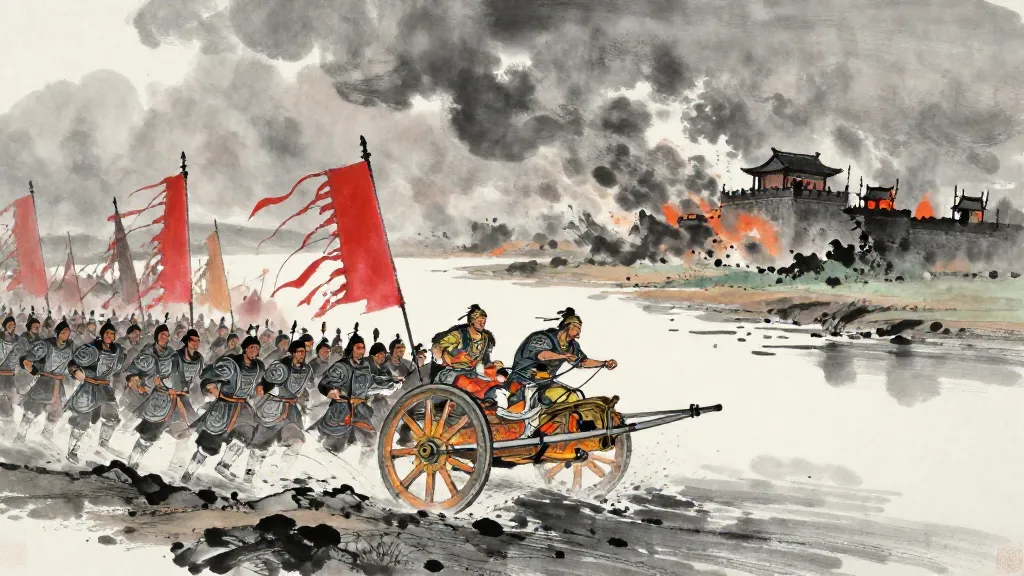
King You appointed Guo Shifu as chief minister and gave him authority. The people of the capital all resented this. Shifu was crafty, flattering, and greedy — and the king employed him. He had also deposed Queen Shen and removed the crown prince. The Marquis of Shen was furious. Together with the state of Zeng and the western Yi Quanrong, he attacked King You. King You lit the beacons to summon troops, but none came. They killed King You at the foot of Mount Li, captured Bao Si, seized all of Zhou's treasures, and departed. The feudal lords then gathered at the Marquis of Shen's court and together enthroned the former crown prince Yijiu — this was King Ping — to maintain the Zhou sacrifices.
Notes

1person姬宮湦Jī Gōng Shēng

King You (幽王, Ji Gong Sheng 姬宮湦, r. 781–771 BC) is the last Western Zhou king. His posthumous name You (幽, 'Dark/Hidden') is a condemnation. The fall of the Western Zhou in 771 BC is one of the great turning points in Chinese history.

2person褒姒Bāo Sì

Bao Si (褒姒) is the archetypal femme fatale of Chinese historiography, blamed for the fall of the Western Zhou. Her supernatural origin story — the dragon spittle transmitted across three dynasties — links her to the cosmological forces of dynastic decline. Modern scholars note the misogynistic pattern of blaming women for dynastic collapse (Moxi for Xia, Daji for Shang, Bao Si for Zhou).

3context

The beacon fire story (烽火戲諸侯, 'playing with the feudal lords through beacon fires') is one of the most famous anecdotes in Chinese history, comparable to 'the boy who cried wolf' in Western tradition. Some historians consider it a later legend rather than historical fact, but it effectively dramatizes the collapse of trust between the Zhou court and its vassals.

4place

Mount Li (驪山) is near modern Lintong (臨潼), Xi'an, Shaanxi. It later became famous as the site of the First Emperor of Qin's tomb and the Terracotta Army.

5person伯陽甫Bó Yáng Fǔ

Bo Yangfu (伯陽甫) was the Zhou court's expert in cosmological interpretation. His analysis of the earthquake as a disruption of yin-yang balance is one of the earliest recorded instances of Chinese natural philosophy applied to political prognostication.

平王東遷與東周初期

King Ping's Eastward Move and the Early Eastern Zhou

平王立,東遷于雒邑,辟戎寇。平王之時,周室衰微,諸侯彊并弱,齊、楚、秦、晉始大,政由方伯。

四十九年,魯隱公即位。

五十一年,平王崩,太子洩父蚤死,立其子林,是為桓王。桓王,平王孫也。

桓王三年,鄭莊公朝,桓王不禮。五年,鄭怨,與魯易許田。許田,天子之用事太山田也。八年,魯殺隱公,立桓公。十三年,伐鄭,鄭射傷桓王,桓王去歸。

二十三年,桓王崩,子莊王佗立。莊王四年,周公黑肩欲殺莊王而立王子克。辛伯告王,王殺周公。王子克奔燕。

十五年,莊王崩,子釐王胡齊立。釐王三年,齊桓公始霸。

五年,釐王崩,子惠王閬立。惠王二年。初,莊王嬖姬姚,生子穨,穨有寵。及惠王即位,奪其大臣以為囿,故大夫邊伯等五人作亂,謀召燕、衛師,伐惠王。惠王犇溫,已居鄭之櫟。立釐王弟穨為王。樂及徧舞,鄭、虢君怒。四年,鄭與虢君伐殺王穨,復入惠王。惠王十年,賜齊桓公為伯。

King Ping took the throne and moved east to Luoyi, fleeing the Rong raiders. In King Ping's time the Zhou royal house was weak and diminished. The strong feudal lords annexed the weak. Qi, Chu, Qin, and Jin began to grow powerful, and real authority lay with the regional hegemons.

In the forty-ninth year, Duke Yin of Lu took the throne.

In the fifty-first year, King Ping died. His crown prince Xie Fu had died young, so his grandson Lin was enthroned — this was King Huan. King Huan was King Ping's grandson.

In King Huan's third year, Duke Zhuang of Zheng came to court, and King Huan treated him discourteously. In the fifth year, Zheng was resentful and exchanged the fields of Xu with Lu. The Xu fields were lands the Son of Heaven used for sacrifices at Mount Tai. In the eighth year, Lu killed Duke Yin and installed Duke Huan. In the thirteenth year, the king attacked Zheng. Zheng archers wounded King Huan, and the king withdrew.

In the twenty-third year, King Huan died. His son King Zhuang Tuo succeeded. In King Zhuang's fourth year, the Duke of Zhou Heijian plotted to kill King Zhuang and install Prince Ke. Xin Bo informed the king; the king killed the Duke of Zhou. Prince Ke fled to Yan.

In the fifteenth year, King Zhuang died. His son King Xi Huqi succeeded. In King Xi's third year, Duke Huan of Qi first became hegemon.

In the fifth year, King Xi died. His son King Hui Lang succeeded. In King Hui's second year — earlier, King Zhuang had favored his concubine Yao, who bore a son Tui; Tui had been in favor. When King Hui took the throne, he seized the estates of certain grandees for his own parks, so the grandees Bian Bo and four others launched a rebellion, plotting to summon the armies of Yan and Wei to attack King Hui. King Hui fled to Wen, then took refuge in Li in the state of Zheng. They installed King Xi's brother Tui as king. Tui indulged in licentious music and wild dancing, and the lords of Zheng and Guo were outraged. In the fourth year, the lords of Zheng and Guo attacked and killed King Tui and restored King Hui. In King Hui's tenth year, he bestowed the title of hegemon upon Duke Huan of Qi.

Notes

1context

The eastward move (東遷, 770 BC) marks the division between Western Zhou (c. 1046–771 BC) and Eastern Zhou (770–256 BC). From this point, the Zhou kings retain ritual prestige but lose real power. The Eastern Zhou is subdivided into the Spring and Autumn period (770–476 BC) and the Warring States period (475–221 BC).

2person姬宜臼Jī Yí Jiù

King Ping (平王, Ji Yijiu 姬宜臼, r. 770–720 BC) reigned for fifty-one years but presided over the permanent diminishment of royal power. His long reign coincides with the rise of the great feudal states.

3context

The wounding of King Huan by Zheng archers at the Battle of Xuge (繻葛之戰, 707 BC) was a watershed moment: for the first time, a feudal lord openly defeated and injured the Son of Heaven in battle. It exposed the irreversible decline of royal authority.

4person齊桓公Qí Huán Gōng

Duke Huan of Qi (齊桓公, r. 685–643 BC) was the first of the Five Hegemons (五霸) of the Spring and Autumn period. With his chancellor Guan Zhong, he built Qi into the dominant power and upheld a system of interstate order under nominal Zhou suzerainty.

襄王流亡與晉文公稱霸

King Xiang's Exile and the Hegemony of Duke Wen of Jin

二十五年,惠王崩,子襄王鄭立。襄王母蚤死,後母曰惠后。惠后生叔帶,有寵於惠王,襄王畏之。三年,叔帶與戎、翟謀伐襄王,襄王欲誅叔帶,叔帶奔齊。齊桓公使管仲平戎于周,使隰朋平戎于晉。王以上卿禮管仲。管仲辭曰:「臣賤有司也,有天子之二守國、高在。若節春秋來承王命,何以禮焉。陪臣敢辭。」王曰:「舅氏,余嘉乃勳,毋逆朕命。」管仲卒受下卿之禮而還。九年,齊桓公卒。十二年,叔帶復歸于周。

十三年,鄭伐滑,王使游孫、伯服請滑,鄭人囚之。鄭文公怨惠王之入不與厲公爵,又怨襄王之與衛滑,故囚伯服。王怒,將以翟伐鄭。富辰諫曰:「凡我周之東徙,晉、鄭焉依。子穨之亂,又鄭之由定,今以小怨棄之!」王不聽。十五年,王降翟師以伐鄭。王德翟人,將以其女為后。富辰諫曰:「平、桓、莊、惠皆受鄭勞,王棄親親翟,不可從。」王不聽。十六年,王絀翟后,翟人來誅,殺譚伯。富辰曰:「吾數諫不從。如是不出,王以我為懟乎?」乃以其屬死之。

初,惠后欲立王子帶,故以黨開翟人,翟人遂入周。襄王出奔鄭,鄭居王于汜。子帶立為王,取襄王所絀翟后與居溫。十七年,襄王告急于晉,晉文公納王而誅叔帶。襄王乃賜晉文公珪鬯弓矢,為伯,以河內地與晉。二十年,晉文公召襄王,襄王會之河陽、踐土,諸侯畢朝,書諱曰「天王狩于河陽」。

二十四年,晉文公卒。

三十一年,秦穆公卒。

三十二年,襄王崩,子頃王壬臣立。頃王六年,崩,子匡王班立。匡王六年,崩,弟瑜立,是為定王。

In the twenty-fifth year, King Hui died. His son King Xiang Zheng succeeded. King Xiang's mother had died young; his stepmother was called Queen Hui. Queen Hui bore Shu Dai, who had been favored by King Hui, and King Xiang feared him. In the third year, Shu Dai conspired with the Rong and Di to attack King Xiang. King Xiang wished to execute Shu Dai, who fled to Qi. Duke Huan of Qi sent Guan Zhong to pacify the Rong at Zhou and sent Xi Peng to pacify the Rong at Jin. The king wished to receive Guan Zhong with the rites of a senior minister. Guan Zhong declined: "I am but a lowly functionary. The Son of Heaven has his own two great officers, Guo and Gao. If they come as scheduled in spring and autumn to receive the royal command, how should they be treated? Your vassal's vassal dares to decline." The king said: "Uncle, I commend your merit — do not refuse my command." Guan Zhong in the end accepted the rites of a junior minister and departed. In the ninth year, Duke Huan of Qi died. In the twelfth year, Shu Dai returned to Zhou.

In the thirteenth year, Zheng attacked Hua. The king sent You Sun and Bo Fu to intercede for Hua; the Zheng people imprisoned them. Duke Wen of Zheng resented that when King Hui was restored, he had not given Duke Li his proper rank, and also resented that King Xiang had taken the side of Wei and Hua — hence the imprisonment of Bo Fu. The king was furious and planned to use the Di to attack Zheng. Fu Chen remonstrated: "When we Zhou moved east, it was on Jin and Zheng that we relied. When Tui's rebellion was settled, it was again through Zheng. Now you would discard them over a petty grudge!" The king did not listen. In the fifteenth year, the king brought down a Di army to attack Zheng. The king was grateful to the Di and planned to make a Di woman his queen. Fu Chen remonstrated: "Kings Ping, Huan, Zhuang, and Hui all benefited from Zheng's service. For the king to abandon a kinsman state and befriend the Di — this cannot be followed." The king did not listen. In the sixteenth year, the king demoted the Di queen. The Di came to punish him and killed the Earl of Tan. Fu Chen said: "I have remonstrated repeatedly and been ignored. If I do not go out to fight now, the king will think me resentful." He led his followers out and died fighting.

Originally, Queen Hui had wished to establish Prince Dai, and so she had used her faction to open the way for the Di. The Di then entered Zhou. King Xiang fled to Zheng; Zheng housed the king at Fan. Prince Dai set himself up as king and took the Di queen whom King Xiang had demoted, living with her at Wen. In the seventeenth year, King Xiang sent an urgent appeal to Jin. Duke Wen of Jin restored the king and executed Shu Dai. King Xiang thereupon bestowed upon Duke Wen of Jin jade tablets, sacrificial wine, bows and arrows, and the title of hegemon, and gave him the lands within the Yellow River.

In the twentieth year, Duke Wen of Jin summoned King Xiang. King Xiang met him at Heyang and Jiantu. All the feudal lords came to court. The records euphemistically state: "The Son of Heaven went hunting at Heyang."

In the twenty-fourth year, Duke Wen of Jin died.

In the thirty-first year, Duke Mu of Qin died.

In the thirty-second year, King Xiang died. His son King Qing Renchen succeeded. In the sixth year of King Qing, he died. His son King Kuang Ban succeeded. In the sixth year of King Kuang, he died. His brother Yu succeeded — this was King Ding.

Notes

1person晉文公Jìn Wén Gōng

Duke Wen of Jin (晉文公, Chong Er 重耳, r. 636–628 BC) was the second great hegemon of the Spring and Autumn period. After nineteen years of exile wandering among the states, he returned to Jin and built it into the dominant military power. His restoration of King Xiang gave him the moral authority to claim hegemony.

2person管仲Guǎn Zhòng

Guan Zhong (管仲, d. 645 BC) was Duke Huan of Qi's great chancellor, credited with transforming Qi into the first hegemonic power. His modesty in refusing senior ministerial rites demonstrates the delicate balance of power between the hegemon's minister and the Zhou king.

3context

The euphemism 'the Son of Heaven went hunting at Heyang' (天王狩于河陽) is one of the most famous examples of the 'Spring and Autumn Annals' diplomatic language. In reality, it was Duke Wen who summoned the king — an act of lese-majeste that the chroniclers concealed behind polite fiction. Confucius is said to have praised this phrasing.

4person姬鄭Jī Zhèng

King Xiang (襄王, Ji Zheng 姬鄭, r. 651–619 BC) exemplifies the humiliation of the Eastern Zhou monarchy: driven from his capital by his own brother, dependent on a feudal lord to restore him, and then summoned by that same lord as if he were a subordinate.

定王至敬王:東周中期

From King Ding to King Jing: The Middle Eastern Zhou

定王元年,楚莊王伐陸渾之戎,次洛,使人問九鼎。王使王孫滿應設以辭,楚兵乃去。十年,楚莊王圍鄭,鄭伯降,已而復之。十六年,楚莊王卒。

二十一年,定王崩,子簡王夷立。簡王十三年,晉殺其君厲公,迎子周於周,立為悼公。

十四年,簡王崩,子靈王泄心立。靈王二十四年,齊崔杼弒其君莊公。

二十七年,靈王崩,子景王貴立。景王十八年,后太子聖而蚤卒。二十年,景王愛子朝,欲立之,會崩,子丐之黨與爭立,國人立長子猛為王,子朝攻殺猛。猛為悼王。晉人攻子朝而立丐,是為敬王。

敬王元年,晉人入敬王,子朝自立,敬王不得入,居澤。四年,晉率諸侯入敬王于周,子朝為臣,諸侯城周。十六年,子朝之徒復作亂,敬王奔于晉。十七年,晉定公遂入敬王于周。

三十九年,齊田常殺其君簡公。

四十一年,楚滅陳。孔子卒。

四十二年,敬王崩,子元王仁立。元王八年,崩,子定王介立。

In the first year of King Ding, King Zhuang of Chu attacked the Rong of Luhun and encamped at the Luo River, where he sent a man to inquire about the Nine Tripods. The king sent Wang Sun Man to deflect him with words, and the Chu army departed. In the tenth year, King Zhuang of Chu besieged Zheng. The Earl of Zheng surrendered, but was afterward restored. In the sixteenth year, King Zhuang of Chu died.

In the twenty-first year, King Ding died. His son King Jian Yi succeeded. In King Jian's thirteenth year, Jin killed its lord Duke Li and welcomed Prince Zhou from the Zhou capital, installing him as Duke Dao.

In the fourteenth year, King Jian died. His son King Ling Xiexin succeeded. In the twenty-fourth year of King Ling, Cui Zhu of Qi assassinated his lord Duke Zhuang.

In the twenty-seventh year, King Ling died. His son King Jing Gui succeeded. In King Jing's eighteenth year, the heir apparent Sheng died young. In the twentieth year, King Jing favored his son Chao and wished to install him, but died before he could. The faction of Prince Gai fought for the succession. The people of the capital enthroned the eldest son Meng as king. Prince Chao attacked and killed Meng — Meng became known as King Dao. The Jin then attacked Prince Chao and installed Gai — this was King Jing.

In the first year of King Jing, the Jin installed King Jing. Prince Chao had declared himself king; King Jing could not enter the capital and resided at Ze. In the fourth year, Jin led the feudal lords to install King Jing in Zhou. Prince Chao submitted as a minister, and the feudal lords fortified the Zhou capital. In the sixteenth year, followers of Prince Chao launched another rebellion. King Jing fled to Jin. In the seventeenth year, Duke Ding of Jin restored King Jing to Zhou.

In the thirty-ninth year, Tian Chang of Qi killed his lord Duke Jian.

In the forty-first year, Chu destroyed the state of Chen. Confucius died.

In the forty-second year, King Jing died. His son King Yuan Ren succeeded. In the eighth year of King Yuan, he died. His son King Ding Jie succeeded.

Notes

1person楚莊王Chǔ Zhuāng Wáng

King Zhuang of Chu (楚莊王, r. 613–591 BC) was the third great hegemon of the Spring and Autumn period. His inquiry about the Nine Tripods (問鼎) — the symbols of Zhou sovereignty — was a transparent challenge to Zhou legitimacy. The phrase 'inquiring about the tripods' (問鼎) became an idiom for coveting the throne.

2person王孫滿Wáng Sūn Mǎn

Wang Sun Man (王孫滿) famously replied to Chu's inquiry: 'The virtue of the Zhou may have declined, but the Mandate of Heaven has not yet changed. The weight of the tripods is not something one may ask about.' This became the classic response to usurpers.

3context

Tian Chang's (田常) murder of Duke Jian of Qi in 481 BC was a step in the Tian clan's gradual usurpation of the state of Qi, completed when the Tian family formally replaced the Jiang ruling house in 386 BC.

4context

The death of Confucius (孔子, 551–479 BC) is noted here at 479 BC. Its inclusion in a royal annals is remarkable — Sima Qian considered Confucius important enough to receive his own 'Hereditary House' chapter (世家), a rank normally reserved for feudal lords.

戰國時期與周的滅亡

The Warring States and the Extinction of Zhou

定王十六年,三晉滅智伯,分有其地。

二十八年,定王崩,長子去疾立,是為哀王。哀王立三月,弟叔襲殺哀王而自立,是為思王。思王立五月,少弟嵬攻殺思王而自立,是為考王。此三王皆定王之子。

考王十五年,崩,子威烈王午立。

考王封其弟于河南,是為桓公,以續周公之官職。桓公卒,子威公代立。威公卒,子惠公代立,乃封其少子於鞏以奉王,號東周惠公。

威烈王二十三年,九鼎震。命韓、魏、趙為諸侯。

二十四年,崩,子安王驕立。是歲盜殺楚聲王。

安王立二十六年,崩,子烈王喜立。烈王二年,周太史儋見秦獻公曰:「始周與秦國合而別,別五百載復合,合十七歲而霸王者出焉。」

十年,烈王崩,弟扁立,是為顯王。顯王五年,賀秦獻公,獻公稱伯。九年,致文武胙於秦孝公。二十五年,秦會諸侯於周。二十六年,周致伯於秦孝公。三十三年,賀秦惠王。三十五年,致文武胙於秦惠王。四十四年,秦惠王稱王。其後諸侯皆為王。

四十八年,顯王崩,子慎靚王定立。慎靚王立六年,崩,子赧王延立。王赧時東西周分治。王赧徙都西周。

In the sixteenth year of King Ding, the Three Jin destroyed Zhi Bo and divided his territory among themselves.

In the twenty-eighth year, King Ding died. His eldest son Quji succeeded — this was King Ai. King Ai had been on the throne three months when his brother Shu attacked and killed him, taking the throne himself — this was King Si. King Si had been on the throne five months when the youngest brother Wei attacked and killed King Si, taking the throne himself — this was King Kao. All three kings were sons of King Ding.

In the fifteenth year of King Kao, he died. His son King Weilie Wu succeeded.

King Kao had enfeoffed his brother south of the Yellow River — this was Duke Huan — to continue the official duties of the Duke of Zhou. When Duke Huan died, his son Duke Wei succeeded. When Duke Wei died, his son Duke Hui succeeded. Duke Hui then enfeoffed his youngest son at Gong to attend the king — this was Duke Hui of Eastern Zhou.

In the twenty-third year of King Weilie, the Nine Tripods trembled. He commanded that Han, Wei, and Zhao be recognized as feudal lords.

In the twenty-fourth year, the king died. His son King An Jiao succeeded. That year bandits killed King Sheng of Chu.

King An reigned for twenty-six years and died. His son King Lie Xi succeeded. In the second year of King Lie, the Zhou Grand Scribe Dan had an audience with Duke Xian of Qin and said: "Originally Zhou and Qin were united, then separated. Five hundred years after the separation they will unite again. Seventeen years after reuniting, a hegemon-king will arise."

In the tenth year, King Lie died. His brother Bian succeeded — this was King Xian. In King Xian's fifth year, he sent congratulations to Duke Xian of Qin; Duke Xian took the title of hegemon. In the ninth year, he sent the sacrificial meat of Kings Wen and Wu to Duke Xiao of Qin. In the twenty-fifth year, Qin assembled the feudal lords at Zhou. In the twenty-sixth year, Zhou conferred the title of hegemon on Duke Xiao of Qin. In the thirty-third year, he sent congratulations to King Hui of Qin. In the thirty-fifth year, he sent the sacrificial meat of Kings Wen and Wu to King Hui of Qin. In the forty-fourth year, King Hui of Qin took the title of king. After this, all the feudal lords titled themselves king.

In the forty-eighth year, King Xian died. His son King Shen Jing Ding succeeded. After six years on the throne King Shen Jing died. His son King Nan Yan succeeded. In King Nan's time, the Eastern and Western Zhou were governed separately. King Nan moved his capital to Western Zhou.

Notes

1context

The Three Jin's (三晉) destruction of Zhi Bo in 453 BC and their subsequent partition of the state of Jin is traditionally taken as the beginning of the Warring States period, though the formal recognition by the Zhou king came in 403 BC (King Weilie's 23rd year).

2context

The rapid succession of three kings murdered by their own brothers (哀王, 思王, 考王) within a single year vividly illustrates the degradation of the Zhou royal house. By this point the Zhou kings controlled little more than the capital region.

3context

The splitting of Zhou into Eastern Zhou (東周) and Western Zhou (西周) — not to be confused with the earlier historical periods of the same names — refers to the division of the small remaining Zhou royal domain into two even smaller territories, each with its own lord. The king resided with one of them.

4context

The Grand Scribe Dan's prophecy about Qin reuniting with Zhou after 500 years, with a hegemon-king arising 17 years later, is one of several passages in the Shiji that seem to foreshadow Qin's unification. Such prophecies may be later interpolations or retrospective constructions.

5context

The Zhou king's sending of sacrificial meat (胙) from the temples of Kings Wen and Wu to Qin was a formal acknowledgment of Qin's supremacy — an act of ritual subordination disguised as a gift of honor.

王赧時代:縱橫家與周的掙扎

The Era of King Nan: Strategists and Zhou's Final Struggles

西周武公之共太子死,有五庶子,毋適立。司馬翦謂楚王曰:「不如以地資公子咎,為請太子。」左成曰:「不可。周不聽,是公之知困而交疏於周也。不如請周君孰欲立,以微告翦,翦請令楚資之以地。」果立公子咎為太子。

八年,秦攻宜陽,楚救之。而楚以周為秦故,將伐之。蘇代為周說楚王曰:「何以周為秦之禍也?言周之為秦甚於楚者,欲令周入秦也,故謂『周秦』也。周知其不可解,必入於秦,此為秦取周之精者也。為王計者,周於秦因善之,不於秦亦言善之,以疏之於秦。周絕於秦,必入於郢矣。」

秦借道兩周之閒,將以伐韓,周恐借之畏於韓,不借畏於秦。史厭謂周君曰:「何不令人謂韓公叔曰『秦之敢絕周而伐韓者,信東周也。公何不與周地,發質使之楚』?秦必疑楚不信周,是韓不伐也。又謂秦曰『韓彊與周地,將以疑周於秦也,周不敢不受』。秦必無辭而令周不受,是受地於韓而聽於秦。」

秦召西周君,西周君惡往,故令人謂韓王曰:「秦召西周君,將以使攻王之南陽也,王何不出兵於南陽?周君將以為辭於秦。周君不入秦,秦必不敢踰河而攻南陽矣。」

東周與西周戰,韓救西周。或為東周說韓王曰:「西周故天子之國,多名器重寶。王案兵毋出,可以德東周,而西周之寶必可以盡矣。」

王赧謂成君。楚圍雍氏,韓徵甲與粟於東周,東周君恐,召蘇代而告之。代曰:「君何患於是。臣能使韓毋徵甲與粟於周,又能為君得高都。」周君曰:「子茍能,請以國聽子。」代見韓相國曰:「楚圍雍氏,期三月也,今五月不能拔,是楚病也。今相國乃徵甲與粟於周,是告楚病也。」韓相國曰:「善。使者已行矣。」代曰:「何不與周高都?」韓相國大怒曰:「吾毋徵甲與粟於周亦已多矣,何故與周高都也?」代曰:「與周高都,是周折而入於韓也,秦聞之必大怒忿周,即不通周使,是以獘高都得完周也。曷為不與?」相國曰:「善。」果與周高都。

三十四年,蘇厲謂周君曰:「秦破韓、魏,撲師武,北取趙藺、離石者,皆白起也。是善用兵,又有天命。今又將兵出塞攻梁,梁破則周危矣。君何不令人說白起乎?曰『楚有養由基者,善射者也。去柳葉百步而射之,百發而百中之。左右觀者數千人,皆曰善射。有一夫立其旁,曰「善,可教射矣」。養由基怒,釋弓搤劍,曰「客安能教我射乎」?客曰「非吾能教子支左詘右也。夫去柳葉百步而射之,百發而百中之,不以善息,少焉氣衰力倦,弓撥矢鉤,一發不中者,百發盡息」。今破韓、魏,撲師武,北取趙藺、離石者,公之功多矣。今又將兵出塞,過兩周,倍韓,攻梁,一舉不得,前功盡棄。公不如稱病而無出』。」

四十二年,秦破華陽約。馬犯謂周君曰:「請令梁城周。」乃謂梁王曰:「周王病若死,則犯必以周之九鼎寶器與王。王不如以地資周,最宜。」馬犯又謂秦王曰:「梁王欲得周之九鼎。王不如與周地,以為周利,是與秦親也。」秦乃予周。

四十五年,周君之秦客謂周曰:「不如譽秦王之孝也,因以應為太后養地,秦王必喜,是周有秦交也。交善,周乃可無憂矣。」

五十八年,三晉距秦。周令其相國之秦,以秦之輕也,還其行。客謂相國曰:「秦之輕重未可知也。秦之輕周,是不重相國。相國不若逢秦之聘,而重相國。秦交既完,則善周,周以取秦也。齊重,則固善周矣。是周常不失大國之交也。」周乃令相國之秦,秦果善之。

When the Heir Apparent of Duke Wu of Western Zhou died, there were five sons by concubines and no legitimate successor. Sima Jian said to the King of Chu: "Why not grant land to Prince Jiu and request that he be made heir?" Zuo Cheng said: "That will not work. If Zhou refuses, it will show that your wisdom was limited and your relations with Zhou will sour. Better to ask the Lord of Zhou which son he wishes to install, have someone discreetly inform Jian, and then Jian can ask Chu to grant land to support that choice." In the end, Prince Jiu was made heir apparent.

In the eighth year, Qin attacked Yiyang. Chu came to its rescue. But Chu blamed Zhou for siding with Qin and was about to attack it. Su Dai, speaking on Zhou's behalf, said to the King of Chu: "Why consider Zhou a tool of Qin? Those who say Zhou serves Qin more than it serves Chu wish to force Zhou into Qin's arms — that is why they say 'Zhou and Qin.' If Zhou knows it cannot escape this accusation, it must submit to Qin — and that would hand Qin the core of Zhou. The best plan for your majesty is this: whether Zhou is friendly with Qin or not, speak well of Zhou in either case, and so drive a wedge between Zhou and Qin. If Zhou is cut off from Qin, it must turn to Ying."

Qin requested passage through the land between the two Zhous in order to attack Han. Zhou was afraid: granting passage would offend Han; refusing would offend Qin. The strategist Shi Yan said to the Lord of Zhou: "Why not send someone to tell Han's Gongshu: 'The reason Qin dares to cut through Zhou and attack Han is that it trusts Eastern Zhou. Why not give Zhou some land and send hostages to Chu?' Then Qin will suspect Chu of distrusting Zhou, and Han will not be attacked. Then tell Qin: 'Han is forcing land on Zhou in order to make Qin suspect Zhou. Zhou dares not refuse.' Qin will have no grounds to complain and will instruct Zhou to refuse. Thus Zhou receives land from Han while obeying Qin."

Qin summoned the Lord of Western Zhou. The Lord of Western Zhou did not wish to go. He had someone say to the King of Han: "Qin summons the Lord of Western Zhou in order to make him attack your Nanyang. Why not deploy troops at Nanyang? The Lord of Zhou will use this as his excuse to Qin. If the Lord of Zhou does not go to Qin, Qin will surely not dare cross the river to attack Nanyang."

When Eastern Zhou and Western Zhou went to war, Han came to Western Zhou's rescue. Someone persuaded the King of Han on Eastern Zhou's behalf: "Western Zhou was once the state of the Son of Heaven and has many famous vessels and precious treasures. If your majesty holds back his troops and does not intervene, you can win Eastern Zhou's gratitude, and you will certainly be able to obtain all of Western Zhou's treasures."

King Nan addressed Lord Cheng. Chu besieged Yongshi. Han demanded armor and grain from Eastern Zhou. The Lord of Eastern Zhou was afraid and summoned Su Dai. Su Dai said: "Why worry about this? I can stop Han from demanding armor and grain from Zhou, and I can also obtain Gaodu for you." The Lord of Zhou said: "If you can do this, I will entrust the state to you." Su Dai met with the Han chancellor and said: "Chu besieged Yongshi and expected to take it in three months. It has now been five months and they cannot take it — Chu is exhausted. Now the chancellor demands armor and grain from Zhou — this is as good as telling Chu that you are exhausted." The Han chancellor said: "Good. But the envoy has already departed." Su Dai said: "Why not give Zhou the city of Gaodu?" The Han chancellor was furious: "It is already generous enough that we stop demanding armor and grain from Zhou — why should we give them Gaodu?" Su Dai said: "If you give Zhou Gaodu, Zhou will turn and align with Han. When Qin hears of this, it will be furious at Zhou and cut off Zhou's envoys. Thus by giving away the trifle of Gaodu, you gain all of Zhou. Why not do it?" The chancellor said: "Good." He gave Zhou Gaodu.

In the thirty-fourth year, Su Li said to the Lord of Zhou: "The one who defeated Han and Wei, who routed the General Shi Wu, who took Lin and Lishi from Zhao to the north — all of this was Bai Qi. He is skilled at war and has Heaven's favor. Now he is about to lead an army through the passes to attack Liang. If Liang falls, then Zhou is in danger. Why not send someone to persuade Bai Qi? Say to him: 'In Chu there was Yang Youji, the finest archer. At a hundred paces from a willow leaf, he shot and hit it — a hundred shots, a hundred hits. Thousands watched from all sides, and all said he was a fine archer. But one man standing beside him said: "Good — now he can be taught to shoot." Yang Youji was furious. He put down his bow, gripped his sword, and said: "How can you presume to teach me to shoot?" The man said: "It is not that I can teach you to draw your left arm and bend your right. But to shoot a willow leaf at a hundred paces, hitting it a hundred times out of a hundred — if you do not stop while you are ahead, in a little while your energy will flag and your strength will fail. Your bow will wobble and your arrows will hook. One miss, and all hundred hits are erased." Now you have defeated Han and Wei, routed Shi Wu, and taken Lin and Lishi from Zhao in the north — your achievements are immense. Now to lead an army out through the passes, pass through the two Zhous, turn your back on Han, and attack Liang — if a single attempt fails, all your former achievements are wiped out. Better to plead illness and stay home.'"

In the forty-second year, Qin broke the Huayang alliance. Ma Fan said to the Lord of Zhou: "Allow me to make Liang fortify Zhou's walls." He then said to the King of Liang: "If the King of Zhou falls ill and dies, I will certainly deliver Zhou's Nine Tripods and treasures to your majesty. Your majesty would do well to invest in Zhou with some land." Ma Fan then said to the King of Qin: "The King of Liang wants to obtain Zhou's Nine Tripods. Your majesty should give Zhou some land to benefit Zhou — this will make Zhou close to Qin." Qin thereupon gave Zhou land.

In the forty-fifth year, a Qin guest at the Zhou court said to Zhou: "You should praise the King of Qin's filial piety and offer the city of Ying as a maintenance estate for the Queen Dowager. The King of Qin will be pleased, and Zhou will have Qin's friendship. With good relations, Zhou need not worry."

In the fifty-eighth year, the Three Jin resisted Qin. Zhou sent its chancellor to Qin, but because Qin treated Zhou lightly, the chancellor turned back. A guest said to the chancellor: "Whether Qin values or slights Zhou is not yet certain. If Qin slights Zhou, it also slights you, the chancellor. You would do better to accept Qin's invitation — that would increase your own importance. Once relations with Qin are secure, Qin will treat Zhou well, and Zhou will benefit from Qin. If Qi then also values Zhou, Zhou's position is strong — thus Zhou will never lose the friendship of a great power." Zhou then sent the chancellor to Qin, and Qin indeed treated him well.

Notes

1context

This entire section reads like an excerpt from the Zhanguoce (戰國策, Stratagems of the Warring States). The Zhou state has been reduced to a pawn manipulated by Warring States strategists (縱橫家). The various schemes — playing Qin against Chu, Han against Qin — represent the tiny Zhou court's desperate attempts to survive between hostile great powers.

2person蘇代、蘇厲Sū Dài, Sū Lì

Su Dai (蘇代) and Su Li (蘇厲) were brothers of the famous strategist Su Qin (蘇秦). They served as itinerant diplomats in the Warring States, frequently advocating for the weak Zhou court. Their arguments exemplify the logical gymnastics of Warring States rhetoric.

3person白起Bái Qǐ

Bai Qi (白起, d. 257 BC) was Qin's most devastating general, responsible for the deaths of hundreds of thousands across multiple campaigns. The Yang Youji archery parable used to dissuade him is a masterpiece of indirect persuasion — rather than opposing his military genius, it appeals to his self-interest in preserving his undefeated record.

4context

The Nine Tripods had by this point become more rumor than reality — Ma Fan's scheme to play Qin and Liang (Wei) against each other using the promise of the tripods shows how the ancient symbols of sovereignty had been reduced to bargaining chips in interstate manipulation.

周的滅亡與太史公論

The Extinction of Zhou and the Grand Historian's Assessment

五十九年,秦取韓陽城負黍,西周恐,倍秦,與諸侯約從,將天下銳師出伊闕攻秦,令秦無得通陽城。秦昭王怒,使將軍摎攻西周。西周君犇秦,頓首受罪,盡獻其邑三十六,口三萬。秦受其獻,歸其君於周。

周君、王赧卒,周民遂東亡。秦取九鼎寶器,而遷西周公於憚狐。後七歲,秦莊襄王滅東周。東西周皆入于秦,周既不祀。

太史公曰:學者皆稱周伐紂,居洛邑,綜其實不然。武王營之,成王使召公卜居,居九鼎焉,而周復都豐、鎬。至犬戎敗幽王,周乃東徙于洛邑。所謂「周公葬於畢」,畢在鎬東南杜中。秦滅周。漢興九十有餘載,天子將封泰山,東巡狩至河南,求周苗裔,封其後嘉三十里地,號曰周子南君,比列侯,以奉其先祭祀。

In the fifty-ninth year, Qin seized Han's cities of Yangcheng and Fushu. Western Zhou was alarmed, turned against Qin, and made a pact with the other feudal lords for a vertical alliance. They planned to send the finest troops of All-Under-Heaven out through Yique to attack Qin, and to prevent Qin from reaching Yangcheng. King Zhao of Qin was furious and sent General Jiu to attack Western Zhou. The Lord of Western Zhou fled to Qin, bowed his head to the ground in submission, and surrendered all of his territory — thirty-six towns and thirty thousand people. Qin accepted the surrender and returned the lord to Zhou.

The Lord of Zhou — King Nan — died. The people of Zhou then fled east. Qin seized the Nine Tripods and precious vessels and relocated the Duke of Western Zhou to Danhu. Seven years later, King Zhuangxiang of Qin destroyed Eastern Zhou. Both Eastern and Western Zhou were absorbed into Qin. The Zhou sacrifices ceased.

The Grand Historian comments: Scholars all say that after the Zhou attacked Zhou of Shang, they resided at Luoyi. Examining the facts, this is not so. King Wu planned Luoyi; King Cheng had the Duke of Shao divine a site there, and the Nine Tripods were placed there — yet the Zhou court continued to be based at Feng and Hao. Only when the Quanrong defeated King You did the Zhou move east to Luoyi. As for the saying that 'the Duke of Zhou was buried at Bi' — Bi is located southeast of Hao, within the area of Du. Qin destroyed Zhou. More than ninety years after the rise of the Han dynasty, the Son of Heaven planned to perform the Feng sacrifice at Mount Tai. Traveling east on a royal progress, he reached Henan and sought out descendants of the Zhou royal house. He enfeoffed the descendant Jia with thirty li of land, titled him Lord of Zhou Zinan, ranking him with the marquises, so that he might continue the ancestral sacrifices of his forebears.

Notes

1person姬延Jī Yán

King Nan (赧王, Ji Yan 姬延, r. 314–256 BC) was the last Zhou king. His posthumous name Nan (赧, 'Ashamed') says everything about the final state of the dynasty. He reigned for fifty-nine years — the longest reign of any Zhou king — but over a domain that was little more than a city-state.

2context

The fall of Zhou in 256 BC ended a dynasty that had lasted nearly eight hundred years — the longest in Chinese history. Yet by the end, the Zhou controlled so little territory that their extinction barely registered as a political event. Qin's seizure of the Nine Tripods symbolically ended the old order.

3context

Sima Qian's concluding comment corrects a common misconception: the Zhou capital was at Feng-Hao (near modern Xi'an), not Luoyi (Luoyang), until the eastward move in 770 BC. This matters because it establishes that the 'Western Zhou' designation reflects geography, not just periodization.

4context

The Han emperor mentioned is Emperor Wu (漢武帝, r. 141–87 BC), who sought Zhou descendants around 110 BC during his eastern progress. This gesture of honoring the former dynasty's sacrificial line was a standard act of dynastic legitimation — precisely what the Zhou themselves had done for the Shang descendants at Song.

5person秦莊襄王Qín Zhuāng Xiāng Wáng

King Zhuangxiang of Qin (秦莊襄王, r. 249–247 BC) was the father of Qin Shi Huang, the First Emperor. His destruction of Eastern Zhou in 249 BC extinguished the last remnant of the eight-century-old dynasty.

Edition & Source

Text
《史記》 Shiji
Edition
中華古詩文古書籍網 transcription
Commentary
裴駰《史記集解》、司馬貞《史記索隱》、張守節《史記正義》(Three Commentaries)