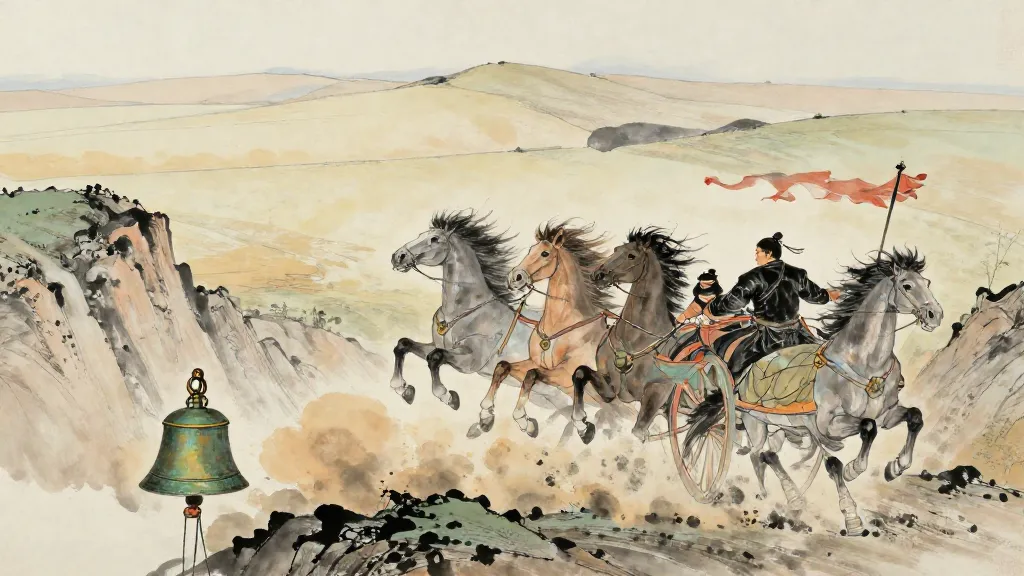
秦本紀 (Basic Annals of Qin) — Chinese ink painting

Chapter 5 of 130

秦本紀

Basic Annals of Qin

View:

嬴姓起源:顓頊至柏翳

Origins of the Ying Clan: From Zhuanxu to Bo Yi

秦之先,帝顓頊之苗裔孫曰女脩。女脩織,玄鳥隕卵,女脩吞之,生子大業。大業取少典之子,曰女華。女華生大費,與禹平水土。已成,帝錫玄圭。禹受曰:「非予能成,亦大費為輔。」帝舜曰:「咨爾費,贊禹功,其賜爾皁游。爾後嗣將大出。」乃妻之姚姓之玉女。大費拜受,佐舜調馴鳥獸,鳥獸多馴服,是為柏翳。舜賜姓嬴氏。

The ancestors of Qin descended from Emperor Zhuanxu. Among his distant descendants was a woman called Nu Xiu. While Nu Xiu was weaving, a dark bird dropped an egg; Nu Xiu swallowed it and bore a son named Da Ye. Da Ye married a daughter of the Shaodian clan called Nu Hua. Nu Hua bore Da Fei, who assisted Yu in taming the floods and controlling the land. When the work was done, the Emperor bestowed a dark jade tablet. Yu accepted it and said: "It was not I alone who accomplished this — Da Fei served as my deputy." Emperor Shun said: "Da Fei, you have aided Yu's great work. I grant you a dark banner. Your descendants shall flourish greatly." He then gave Da Fei a jade maiden of the Yao surname in marriage. Da Fei bowed and accepted, and went on to assist Shun in taming birds and beasts, bringing many wild creatures under control. He is the one known as Bo Yi. Shun bestowed upon him the surname Ying.

Notes

1person顓頊Zhuānxū

Emperor Zhuanxu (帝顓頊) is one of the legendary Five Emperors, grandson of the Yellow Emperor. He is claimed as ancestor by both the Qin and Chu royal houses, reflecting their shared eastern-barbarian heritage distinct from the Zhou.

2context

The dark bird (玄鳥) swallowing motif parallels the Shang founding myth of Jian Di, who also swallowed a bird's egg and bore the Shang ancestor Xie. This shared motif connects the Ying clan's origins to the eastern Yi peoples associated with bird totems.

3person大費/柏翳Dà Fèi / Bó Yì

Da Fei (大費), also known as Bo Yi (柏翳/伯益), is the legendary progenitor of the Ying surname clan. His role assisting Yu with flood control establishes the Ying lineage's ancient claim to merit and royal favour. He is distinct from the Bo Yi (伯夷) who yielded the throne to Yu.

4context

The surname Ying (嬴) would become the royal surname of the state of Qin and ultimately of the First Emperor. The Zhao (趙) branch of the same clan is introduced below.

嬴姓分支:大廉至造父

Branches of the Ying Clan: From Da Lian to Zao Fu

大費生子二人:一曰大廉,實鳥俗氏;二曰若木,實費氏。其玄孫曰費昌,子孫或在中國,或在夷狄。費昌當夏桀之時,去夏歸商,為湯御,以敗桀於鳴條。大廉玄孫曰孟戲、中衍,鳥身人言。帝太戊聞而卜之使御,吉,遂致使御而妻之。自太戊以下,中衍之後,遂世有功,以佐殷國,故嬴姓多顯,遂為諸侯。

其玄孫曰中潏,在西戎,保西垂。生蜚廉。蜚廉生惡來。惡來有力,蜚廉善走,父子俱以材力事殷紂。周武王之伐紂,並殺惡來。是時蜚廉為紂石北方,還,無所報,為壇霍太山而報,得石棺,銘曰「帝令處父不與殷亂,賜爾石棺以華氏」。死,遂葬於霍太山。蜚廉復有子曰季勝。季勝生孟增。孟增幸於周成王,是為宅皋狼。皋狼生衡父,衡父生造父。造父以善御幸於周繆王,得驥、溫驪、驊緌、騄耳之駟,西巡狩,樂而忘歸。徐偃王作亂,造父為繆王御,長驅歸周,一日千里以救亂。繆王以趙城封造父,造父族由此為趙氏。自蜚廉生季勝已下五世至造父,別居趙。趙衰其後也。

Da Fei had two sons. The first was Da Lian, who founded the Niaoshu clan; the second was Ruo Mu, who founded the Fei clan. A great-grandson named Fei Chang had descendants scattered both within the Central States and among the barbarian peoples. In the time of Jie, last king of the Xia, Fei Chang abandoned Xia and went over to Shang. He served as charioteer to Tang and helped defeat Jie at Mingtiao.

Da Lian's great-grandsons Meng Xi and Zhong Yan had bird-like bodies but spoke with human voices. Emperor Taiwu of Shang heard of them, divined on appointing them as charioteers, and received an auspicious result. He made them charioteers and gave them wives. From Taiwu onward, the descendants of Zhong Yan rendered meritorious service generation after generation, assisting the Yin state. Thus the Ying surname became prominent, and members of the clan were enfeoffed as lords.

A later descendant named Zhong Jue settled among the Western Rong and defended the western frontier. He fathered Fei Lian. Fei Lian fathered E Lai. E Lai was a man of great strength; Fei Lian was a swift runner. Father and son both served the Shang king Zhou by virtue of their physical prowess. When King Wu of Zhou attacked King Zhou, he killed E Lai as well. At that time Fei Lian had been sent north by King Zhou to collect stone. He returned to find no one to report to, so he built an altar on Mount Huo to make his report. There he discovered a stone coffin inscribed: "The Lord on High commands that Chu Fu shall not share in the Yin calamity. He is granted this stone coffin to glorify his line." Fei Lian died and was buried on Mount Huo.

Fei Lian had another son called Ji Sheng. Ji Sheng fathered Meng Zeng. Meng Zeng was favoured by King Cheng of Zhou and was known as "the one who dwelt at Gaolang." Gaolang fathered Heng Fu, and Heng Fu fathered Zao Fu. Zao Fu won the favour of King Mu of Zhou through his skill as a charioteer. With his team of four fine horses — Ji, Wenli, Huarui, and Luer — King Mu toured the west and was so delighted he forgot to return. When the Xu Yanwang raised a rebellion, Zao Fu drove for King Mu, racing back to Zhou a thousand li in a single day to suppress the revolt. King Mu enfeoffed Zao Fu with the city of Zhao, and from then on Zao Fu's branch of the clan took the surname Zhao. From Fei Lian's son Ji Sheng, five generations down to Zao Fu, this branch settled separately at Zhao. Zhao Cui of the Spring and Autumn period was their descendant.

Notes

1context

The Battle of Mingtiao (鳴條之戰) was the legendary battle in which Tang, founder of the Shang dynasty, overthrew Jie, last ruler of the Xia. The Ying clan's role as charioteers for the winning side established a pattern of military service that would characterise the family for centuries.

2person惡來È Lái

E Lai (惡來) was the direct ancestor of the Qin ruling house. His death fighting for the Shang against the Zhou meant that his descendants began the Zhou era in disfavour — a critical factor in the Qin clan's long climb back to power.

3place

Mount Huo (霍太山) is modern Mount Huo (霍山) in Shanxi province, one of the sacred mountains of ancient China.

4person造父Zào Fù

Zao Fu (造父) was the legendary charioteer whose reward of the city of Zhao gave rise to the Zhao surname. This establishes the common ancestry of the Qin and Zhao ruling houses — both descended from Fei Lian through different sons. The Zhao state would become one of Qin's most formidable rivals during the Warring States period.

5person趙衰Zhào Shuāi

Zhao Cui (趙衰, d. 622 BC) was a famous minister of Jin during the Spring and Autumn period, one of the 'Five Worthies' who followed Duke Wen of Jin in exile. His descendants became the lords of Zhao.

非子牧馬:秦嬴始封

Feizi the Horse-Breeder: The Founding of the Qin Fief

惡來革者,蜚廉子也,蚤死。有非子居犬丘,好馬及畜,善養息之。犬丘人言之周孝王,孝王召使主馬於汧渭之間,馬大蕃息。孝王欲以為大駱適嗣。申侯之女為大駱妻,生子成為適。申侯乃言孝王曰:「昔我先酈山之女,為戎胥軒妻,生中潏,以親故歸周,保西垂,西垂以其故和睦。今我復與大駱妻,生適子成。申駱重婚,西戎皆服,所以為王。王其圖之。」於是孝王曰:「昔伯翳為舜主畜,畜多息,故有土,賜姓嬴。今其後世亦為朕息馬,朕其分土為附庸。」邑之秦,使復續嬴氏祀,號曰秦嬴。亦不廢申侯之女子為駱適者,以和西戎。

E Lai Ge, a son of Fei Lian, died young. His descendant Feizi lived at Quanqiu, where he loved horses and livestock and excelled at breeding them. The people of Quanqiu commended him to King Xiao of Zhou. The king summoned him and put him in charge of the royal horses in the pastures between the Qian and Wei rivers. The horses multiplied greatly.

King Xiao wished to make Feizi the designated heir of Daluo. But the daughter of the Lord of Shen was Daluo's wife and had already borne a son, Cheng, who was the designated heir. The Lord of Shen therefore addressed King Xiao: "In former times, my ancestress, a woman of Mount Li, married the Rong chieftain Xu Xuan and bore Zhong Jue. Because of this kinship, Zhong Jue's line returned to serve Zhou and defended the western frontier; the western borderlands were peaceful on that account. Now I have again given a daughter to Daluo, and she has borne the heir Cheng. The double marriage alliance between the Shen and Luo clans keeps all the Western Rong in submission — this is what secures Your Majesty's position. Your Majesty should consider this carefully."

King Xiao then said: "In ancient times Bo Yi served Shun as Master of Livestock; his herds multiplied, and for that he was granted land and the surname Ying. Now his descendant likewise breeds my horses. I shall grant him a parcel of land as an appanage." He gave Feizi the town of Qin and had him continue the sacrifices of the Ying clan, with the title "Qin Ying." At the same time, the king did not depose the Lord of Shen's daughter's son as Daluo's heir, so as to maintain peace with the Western Rong.

Notes

1person非子Fēizǐ

Feizi (非子) is the founding ancestor of the Qin state, active during the reign of King Xiao of Zhou (周孝王, r. c. 897–888 BC). His appointment as royal horse-breeder marks the beginning of Qin's rise. The town of Qin (秦) that gave the state its name was located near modern Qingshui County (清水縣) in southeastern Gansu.

2place

Quanqiu (犬丘, 'Dog Hill') was the original seat of the Daluo branch of the Ying clan, located near modern Xingping (興平) or Liquan (禮泉) in Shaanxi. It later became an important Qin administrative centre.

3context

The Lord of Shen (申侯) wielded significant influence because his clan's marriage alliances with both the Zhou court and the Western Rong barbarians formed a critical diplomatic buffer on the western frontier. This triangle of Zhou–Shen–Rong relations would shape western politics for over a century. The same Shen clan would later play a role in the fall of the Western Zhou.

4context

The title 'appanage' (附庸) denoted a sub-fief too small to rank as a full feudal state. Qin began as the humblest rank of Zhou territory — far below the ranks of duke, marquis, earl, viscount, or baron. Its later rise to imperial power was thus all the more remarkable.

秦仲至莊公:西戎征伐

Duke Qinzhong to Duke Zhuang: Wars Against the Western Rong

秦嬴生秦侯。秦侯立十年,卒。生公伯。公伯立三年,卒。生秦仲。

秦仲立三年,周厲王無道,諸侯或叛之。西戎反王室,滅犬丘大駱之族。周宣王即位,乃以秦仲為大夫,誅西戎。西戎殺秦仲。秦仲立二十三年,死於戎。有子五人,其長者曰莊公。周宣王乃召莊公昆弟五人,與兵七千人,使伐西戎,破之。於是復予秦仲後,及其先大駱地犬丘並有之,為西垂大夫。

Qin Ying fathered Qin Hou. Qin Hou reigned for ten years and died. He fathered Gong Bo. Gong Bo reigned for three years and died. He fathered Qin Zhong.

In the third year of Qin Zhong's rule, King Li of Zhou was governing tyrannically, and some of the feudal lords revolted. The Western Rong turned against the royal house and wiped out the Daluo clan at Quanqiu. When King Xuan of Zhou came to the throne, he appointed Qin Zhong as a Grand Master and ordered him to punish the Western Rong. But the Western Rong killed Qin Zhong. He had ruled for twenty-three years when he died fighting the Rong.

He had five sons, the eldest of whom was Duke Zhuang. King Xuan of Zhou summoned Duke Zhuang and his four brothers, gave them seven thousand troops, and sent them to attack the Western Rong. They defeated them. The king then restored to Qin Zhong's heirs all the former Daluo territory at Quanqiu, and appointed them Grand Masters of the Western Frontier.

Notes

1person周厲王Zhōu Lì Wáng

King Li of Zhou (周厲王, r. c. 877–841 BC) was one of the most reviled Zhou kings, whose oppressive rule provoked the Gonghe Regency (841 BC) — the earliest securely dated event in Chinese history.

2person周宣王Zhōu Xuān Wáng

King Xuan of Zhou (周宣王, r. 827–782 BC) presided over a brief revival of Zhou power. His appointment of the Qin clan to fight the Western Rong was a pivotal moment — it established the military role on the frontier that would define Qin's identity for centuries.

3context

The title Grand Master of the Western Frontier (西垂大夫) was not a full feudal rank but a military-administrative appointment. Qin's promotion to feudal lord (諸侯) would not come until the next generation under Duke Xiang.

襄公立國:秦升為諸侯

Duke Xiang Founds the State: Qin Elevated to Feudal Lord

莊公居其故西犬丘,生子三人,其長男世父。世父曰:「戎殺我大父仲,我非殺戎王則不敢入邑。」遂將擊戎,讓其弟襄公。襄公為太子。莊公立四十四年,卒,太子襄公代立。襄公元年,以女弟繆嬴為豐王妻。襄公二年,戎圍犬丘,世父擊之,為戎人所虜。歲餘,復歸世父。七年春,周幽王用襃姒廢太子,立襃姒子為適,數欺諸侯,諸侯叛之。西戎犬戎與申侯伐周,殺幽王酈山下。而秦襄公將兵救周,戰甚力,有功。周避犬戎難,東徙洛邑,襄公以兵送周平王。平王封襄公為諸侯,賜之岐以西之地。曰:「戎無道,侵奪我岐、豐之地,秦能攻逐戎,即有其地。」與誓,封爵之。襄公於是始國,與諸侯通使聘享之禮,乃用緌駒、黃牛、羝羊各三,祠上帝西畤。十二年,伐戎而至岐,卒。生文公。

Duke Zhuang settled at the old Western Quanqiu and had three sons. The eldest was Shi Fu. Shi Fu declared: "The Rong killed my grandfather Qin Zhong. I will not dare enter the city until I have slain the Rong king." He set out to fight the Rong, yielding his position as heir to his younger brother, Duke Xiang. Duke Xiang became the designated successor.

Duke Zhuang reigned forty-four years and died. His heir Duke Xiang succeeded him. In the first year of his reign, Duke Xiang gave his younger sister Mu Ying in marriage to the King of Feng. In the second year, the Rong besieged Quanqiu. Shi Fu attacked them but was captured. After more than a year, the Rong returned him.

In the seventh year, in spring, King You of Zhou deposed his crown prince in favour of Baosi's son, and repeatedly deceived the feudal lords. The lords turned against him. The Western Rong and Quanrong, together with the Lord of Shen, attacked Zhou and killed King You below Mount Li. Duke Xiang of Qin led troops to rescue Zhou and fought with great valor, earning merit. The Zhou court fled the Quanrong threat and moved east to Luoyi. Duke Xiang escorted King Ping with his army.

King Ping enfeoffed Duke Xiang as a feudal lord and granted him all the land west of Qi. He said: "The Rong are lawless and have seized my lands of Qi and Feng. If Qin can attack and drive them out, the land shall be yours." He swore an oath and bestowed the title. Duke Xiang thus established Qin as a state for the first time, exchanging envoys and gifts with the other feudal lords on equal terms. He sacrificed three colts with feathered manes, three yellow oxen, and three rams at the Western Altar to the Supreme God. In the twelfth year, he campaigned against the Rong and advanced as far as Qi, where he died. His son was Duke Wen.

Notes

1person秦襄公Qín Xiāng Gōng

Duke Xiang of Qin (秦襄公, r. 777–766 BC) was the first ruler of Qin to hold the rank of feudal lord. His escort of King Ping to the new eastern capital in 770 BC marks the boundary between the Western and Eastern Zhou periods.

2person周幽王Zhōu Yōu Wáng

King You of Zhou (周幽王, r. 781–771 BC) was the last effective Western Zhou king. His infatuation with his concubine Baosi (褒姒) and the 'crying wolf' episode of the beacon fires are among the most famous stories in Chinese history.

3place

Mount Li (酈山/驪山) is located east of modern Xi'an in Shaanxi. It later became the site of the First Emperor of Qin's tomb and the Terracotta Warriors.

4context

King Ping's grant was extraordinary: he effectively ceded the entire Zhou homeland in the Wei River valley to Qin, on condition that Qin could win it back from the Rong. This 'blank check' set Qin on its centuries-long path of eastward expansion. The other Zhou states regarded Qin as semi-barbarous precisely because it had absorbed the former Rong territories and peoples.

5context

The Western Altar (西畤) was the first of several ritual sites established by early Qin rulers for the worship of the Supreme God (上帝). Qin's independent ritual system, separate from the Zhou ancestral rites, reflected its peripheral position and its aspiration to autonomous sovereignty.

文公東進:收周遺民

Duke Wen Advances East: Gathering the Remnant Zhou People

文公元年,居西垂宮。三年,文公以兵七百人東獵。四年,至汧渭之會。曰:「昔周邑我先秦嬴於此,後卒獲為諸侯。」乃卜居之,占曰吉,即營邑之。十年,初為鄜畤,用三牢。十三年,初有史以紀事,民多化者。十六年,文公以兵伐戎,戎敗走。於是文公遂收周餘民有之,地至岐,岐以東獻之周。十九年,得陳寶。二十年,法初有三族之罪。二十七年,伐南山大梓,豐大特。四十八年,文公太子卒,賜謚為竫公。竫為太子,是文公孫也。五十年,文公卒,葬西山。竫公子立,是為寧公。

In the first year of Duke Wen's reign, he resided at the Palace of the Western Frontier. In the third year, Duke Wen led seven hundred men on a hunting expedition to the east. In the fourth year, he reached the confluence of the Qian and Wei rivers. He said: "Long ago, the Zhou granted my ancestor Qin Ying a town here, and ultimately he won the rank of feudal lord." He divined on whether to settle there; the oracle was auspicious, and he built a city on the spot.

In the tenth year, he established the Fu Altar and used three sets of sacrificial animals. In the thirteenth year, Qin for the first time appointed scribes to record events, and many of the people adopted civilised customs. In the sixteenth year, Duke Wen attacked the Rong with his army; the Rong were defeated and fled. Thereupon Duke Wen gathered the remnant Zhou people and took them under his rule. His territory extended as far as Qi; the land east of Qi he presented to Zhou.

In the nineteenth year, the Chen Treasure was discovered. In the twentieth year, the law of collective punishment covering three degrees of kinship was first enacted. In the twenty-seventh year, he attacked the great catalpas of the Southern Mountains and sacrificed a great bull. In the forty-eighth year, Duke Wen's crown prince died and was posthumously titled Duke Jing. Duke Jing's son became the heir — this was Duke Wen's grandson. In the fiftieth year, Duke Wen died and was buried at the Western Mountains. Duke Jing's son took the throne; he was Duke Ning.

Notes

1person秦文公Qín Wén Gōng

Duke Wen of Qin (秦文公, r. 765–716 BC) consolidated Qin's control over the former Zhou heartland in the Wei River valley. His fifty-year reign was the longest of any early Qin ruler and transformed the state from a frontier outpost into a territorial power.

2context

The appointment of scribes (史) in Duke Wen's thirteenth year (753 BC) marks the beginning of Qin's written historical records. Events before this date in the Qin annals rely on oral tradition and genealogical memory.

3context

The 'three degrees of kinship' punishment (三族之罪) was an early form of collective punishment in which the criminal's father's, mother's, and wife's families could all be punished. This harsh legal tradition would later become a hallmark of the Qin state under the Legalist reforms.

4context

The Chen Treasure (陳寶) was a mysterious object — according to later commentaries, a divine stone or thunderstone found at Chen Cang (陳倉, modern Baoji, Shaanxi). It became an important object of state worship for Qin.

寧公至出子:內亂時期

Duke Ning to Duke Chu: A Period of Internal Turmoil

寧公二年,公徙居平陽。遣兵伐盪社。三年,與亳戰,亳王奔戎,遂滅盪社。四年,魯公子翬弒其君隱公。十二年,伐盪氏,取之。寧公生十歲立,立十二年卒,葬西山。生子三人,長男武公為太子。武公弟德公,同母魯姬子。生出子。寧公卒,大庶長弗忌、威壘、三父廢太子而立出子為君。出子六年,三父等復共令人賊殺出子。出子生五歲立,立六年卒。三父等乃復立故太子武公。

In the second year of Duke Ning's reign, the duke moved his residence to Pingyang. He sent troops to attack the Dangshe. In the third year, he fought against Bo; the King of Bo fled to the Rong, and Dangshe was destroyed. In the fourth year, the Lu prince Hui assassinated his lord, Duke Yin of Lu.

In the twelfth year, he attacked the Dang clan and conquered them. Duke Ning had come to the throne at the age of ten and reigned for twelve years before his death. He was buried at the Western Mountains. He had three sons: the eldest, Duke Wu, was crown prince. Duke Wu's younger brother was Duke De, born of the same mother, a Ji woman from Lu. He also fathered Chu Zi.

When Duke Ning died, the Great Shuchang officials — Fu Ji, Wei Lei, and San Fu — deposed the crown prince and installed Chu Zi as ruler. In the sixth year of Chu Zi's reign, San Fu and the others had assassins murder Chu Zi. Chu Zi had come to the throne at the age of five and reigned for six years. San Fu and the others then reinstated the former crown prince, Duke Wu.

Notes

1person秦寧公Qín Níng Gōng

Duke Ning of Qin (秦寧公, r. 715–704 BC) came to the throne as a child and spent his reign fighting the remnant Rong and barbarian polities on Qin's borders. His early death triggered a succession crisis.

2context

The Great Shuchang (大庶長) was one of the highest offices in early Qin. The coup by Fu Ji, Wei Lei, and San Fu — deposing the rightful heir, installing a child puppet, then murdering him — reflects the instability of early Qin politics, where powerful ministers could override the succession.

3place

Pingyang (平陽) was Duke Ning's capital, located near modern Baoji (寶雞) in Shaanxi.

武公至德公:縣制初創

Duke Wu to Duke De: The First Counties

武公元年,伐彭戲氏,至於華山下,居平陽封宮。三年,誅三父等而夷三族,以其殺出子也。鄭高渠眯殺其君昭公。十年,伐邽、冀戎,初縣之。十一年,初縣杜、鄭。滅小虢。

十三年,齊人管至父、連稱等殺其君襄公而立公孫無知。晉滅霍、魏、耿。齊雍廩殺無知、管至父等而立齊桓公。齊、晉為彊國。

十九年,晉曲沃始為晉侯。齊桓公伯於鄄。

二十年,武公卒,葬雍平陽。初以人從死,從死者六十六人。有子一人,名曰白,白不立,封平陽。立其弟德公。

德公元年,初居雍城大鄭宮。以犧三百牢祠鄜畤。卜居雍。後子孫飲馬於河。梁伯、芮伯來朝。二年,初伏,以狗御蠱。德公生三十三歲而立,立二年卒。生子三人:長子宣公,中子成公,少子穆公。長子宣公立。

In the first year of Duke Wu's reign, he attacked the Pengxi clan, advancing as far as the foot of Mount Hua, and resided at the Feng Palace in Pingyang. In the third year, he executed San Fu and the other conspirators, exterminating their clans to the third degree, in retribution for the murder of Chu Zi. In Zheng, Gao Qumei assassinated his lord, Duke Zhao of Zheng.

In the tenth year, Duke Wu attacked the Gui and Ji Rong and for the first time organised their territory into counties. In the eleventh year, he made Du and Zheng into counties for the first time, and destroyed Lesser Guo.

In the thirteenth year, the Qi men Guan Zhifu and Lian Cheng and others killed their lord, Duke Xiang of Qi, and installed Gongsun Wuzhi. Jin destroyed Huo, Wei, and Geng. The Qi man Yong Lin killed Wuzhi and Guan Zhifu and installed Duke Huan of Qi. Qi and Jin became powerful states.

In the nineteenth year, the Jin branch at Quwo at last became the legitimate lords of Jin. Duke Huan of Qi held a conference of lords at Juan and assumed hegemony.

In the twentieth year, Duke Wu died and was buried at Yong in Pingyang. For the first time, human attendants were made to follow their lord in death: sixty-six people accompanied him. He had one son named Bai, but Bai was not installed as ruler — he was enfeoffed at Pingyang. Instead, Duke Wu's younger brother Duke De succeeded.

In the first year of Duke De's reign, he took up residence at the Great Zheng Palace in the city of Yong. He sacrificed three hundred sets of animals at the Fu Altar. He divined on settling at Yong, and the oracle said that his descendants would one day water their horses at the Yellow River. The Lord of Liang and the Lord of Rui came to pay court. In the second year, the Fu Day ritual was first established, using dogs to ward off pestilence. Duke De was thirty-three when he took the throne and reigned for only two years before his death. He had three sons: the eldest, Duke Xuan; the middle son, Duke Cheng; and the youngest, Duke Mu. The eldest, Duke Xuan, succeeded.

Notes

1context

The creation of counties (縣) in Duke Wu's tenth year (688 BC) is one of the most significant institutional developments in Chinese history. The county system replaced feudal sub-enfeoffment with direct bureaucratic administration — conquered territories were governed by appointed officials rather than hereditary lords. Qin was among the first states to adopt this system, and it would eventually become the administrative foundation of the imperial state.

2place

Mount Hua (華山) is one of the Five Sacred Mountains of China, located in modern Huayin (華陰), Shaanxi. It marked Qin's eastern frontier in this period.

3context

Human sacrifice upon a ruler's death (人殉) was practiced in Qin well into the Spring and Autumn period. The sixty-six people who followed Duke Wu in death, and the later one hundred and seventy-seven who followed Duke Mu, shocked contemporaries in the Central States and contributed to Qin's reputation for barbarism.

4place

Yong (雍) became the capital of Qin from Duke De onward and remained so until 350 BC when Shang Yang moved the capital to Xianyang. Modern Fengxiang (鳳翔), Shaanxi, occupies the site.

5context

The prophecy that Qin's descendants would 'water their horses at the Yellow River' (飲馬於河) foretold Qin's expansion eastward to the great river — a goal not achieved until Duke Mu's reign.

6person齊桓公Qí Huán Gōng

Duke Huan of Qi (齊桓公, r. 685–643 BC) was the first of the Five Hegemons of the Spring and Autumn period. His hegemony, supported by his minister Guan Zhong, represents the era of interstate politics into which Qin was just beginning to enter.

宣公至成公:兄終弟及

Duke Xuan to Duke Cheng: Succession from Brother to Brother

宣公元年,衛、燕伐周,出惠王,立王子穨。三年,鄭伯、虢叔殺子穨而入惠王。四年,作密畤。與晉戰河陽,勝之。十二年,宣公卒。生子九人,莫立,立其弟成公。

成公元年,梁伯、芮伯來朝。齊桓公伐山戎,次於孤竹。

成公立四年卒。子七人,莫立,立其弟繆公。

In the first year of Duke Xuan's reign, Wei and Yan attacked Zhou, drove out King Hui, and installed Prince Tui. In the third year, the Lord of Zheng and the Lord of Guo killed Prince Tui and restored King Hui. In the fourth year, Duke Xuan built the Mi Altar. He fought Jin at Heyang and won. In the twelfth year, Duke Xuan died. He had nine sons, but none of them was installed as his successor; instead his younger brother Duke Cheng took the throne.

In the first year of Duke Cheng's reign, the Lord of Liang and the Lord of Rui came to pay court. Duke Huan of Qi attacked the Shanrong and camped at Guzhu.

Duke Cheng reigned for four years and died. He had seven sons, but none succeeded him; instead, his younger brother Duke Mu took the throne.

Notes

1context

The succession pattern of the three brothers — Duke Xuan, Duke Cheng, and Duke Mu — passing the throne laterally rather than to their own sons was unusual. Between them, the three brothers had nineteen sons, yet the throne passed from brother to brother. This may reflect the power of court factions or a deliberate arrangement by Duke De.

2person秦繆公Qín Mù Gōng

Duke Mu of Qin (秦繆公/秦穆公, r. 659–621 BC) is one of the most celebrated rulers in early Chinese history and is traditionally counted among the Five Hegemons of the Spring and Autumn period. His personal name was Ren Hao (任好).

繆公初政:得百里傒

Duke Mu's Early Reign: Obtaining Baili Xi

繆公任好元年,自將伐茅津,勝之。四年,迎婦於晉,晉太子申生姊也。其歲,齊桓公伐楚,至邵陵。

五年,晉獻公滅虞、虢,虜虞君與其大夫百里傒,以璧馬賂於虞故也。既虜百里傒,以為秦繆公夫人媵於秦。百里傒亡秦走宛,楚鄙人執之。繆公聞百里傒賢,欲重贖之,恐楚人不與,乃使人謂楚曰:「吾媵臣百里傒在焉,請以五羖羊皮贖之。」。楚人遂許與之。當是時,百里傒年已七十餘。繆公釋其囚,與語國事。謝曰:「臣亡國之臣,何足問!」繆公曰:「虞君不用子,故亡,非子罪也。」固問,語三日,繆公大說,授之國政,號曰五羖大夫。百里傒讓曰:「臣不及臣友蹇叔,蹇叔賢而世莫知。臣常游困於齊而乞食綍人,蹇叔收臣。臣因而欲事齊君無知,蹇叔止臣,臣得脫齊難,遂之周。周王子穨好牛,臣以養牛乾之。及穨欲用臣,蹇叔止臣,臣去,得不誅。事虞君,蹇叔止臣。臣知虞君不用臣,臣誠私利祿爵,且留。再用其言,得脫,一不用,及虞君難:是以知其賢。」於是繆公使人厚幣迎蹇叔,以為上大夫。

In the first year of Duke Mu Ren Hao's reign, he personally led an attack on Maojin and won. In the fourth year, he received a bride from Jin — the elder sister of Jin Crown Prince Shensheng. That same year, Duke Huan of Qi attacked Chu and advanced as far as Shaoling.

In the fifth year, Duke Xian of Jin destroyed the states of Yu and Guo, capturing the Lord of Yu and his Grand Master Baili Xi. This had come about because Yu had accepted bribes of jade and horses to grant Jin passage through its territory. After capturing Baili Xi, Jin sent him to Qin as part of the bridal retinue of Duke Mu's new wife. But Baili Xi escaped from Qin and fled to Wan, where a man of the Chu borderlands seized him.

Duke Mu heard that Baili Xi was a man of ability and wished to ransom him at a high price, but feared the people of Chu would refuse. So he sent a messenger to Chu saying: "My wife's attendant slave Baili Xi is in your lands. I request to ransom him for five ram skins." The Chu people agreed to hand him over.

At that time, Baili Xi was already over seventy years old. Duke Mu released him from his bonds and discussed affairs of state with him. Baili Xi demurred: "I am a minister of a fallen state — what is there worth asking me?" Duke Mu said: "The Lord of Yu did not heed your counsel, and that is why he perished. The fault was not yours." He pressed him, and they talked for three days. Duke Mu was greatly pleased and entrusted him with the government of the state, giving him the title "Grand Master of the Five Ram Skins."

Baili Xi declined, saying: "I am not the equal of my friend Jian Shu. Jian Shu is a man of true worth, yet the world does not know him. I once wandered in Qi, destitute and begging food from a rope-maker; Jian Shu took me in. I then wished to serve the Qi ruler Wuzhi, but Jian Shu stopped me — and so I escaped the troubles in Qi. I went on to Zhou. Prince Tui of Zhou was fond of cattle, so I tried to gain his favour by raising oxen. When Tui was about to employ me, Jian Shu stopped me again — I departed and thus avoided being executed. When I served the Lord of Yu, Jian Shu warned me against it. I knew the Lord of Yu would not heed me, but I was privately drawn by the salary and rank, so I stayed. Twice I followed Jian Shu's advice and escaped danger; the one time I did not, I was caught up in Yu's downfall. This is how I know his worth."

Duke Mu thereupon sent envoys with rich gifts to invite Jian Shu, and appointed him Senior Grand Master.

Notes

1person百里傒Bǎilǐ Xī

Baili Xi (百里傒) is one of the most famous ministers in Chinese history. Originally a Grand Master of the state of Yu, he was captured when Jin destroyed Yu in 655 BC. His recruitment by Duke Mu for the price of five ram skins became a paradigmatic story of recognising talent regardless of circumstances. He was over seventy when he entered Qin's service.

2person蹇叔Jiǎn Shū

Jian Shu (蹇叔) was Baili Xi's close friend and one of Duke Mu's most trusted advisors. His three warnings to Baili Xi — against serving Wuzhi of Qi, Prince Tui of Zhou, and the Lord of Yu — were all vindicated when each patron met a violent end.

3context

The destruction of Yu (虞) by Jin is one of the most famous episodes of Spring and Autumn diplomacy. Jin bribed the Lord of Yu with jade and horses to gain passage through Yu's territory to attack Guo. After destroying Guo, Jin turned on Yu. The saying 'the lips gone, the teeth cold' (唇亡齒寒) — Baili Xi's warning to the Lord of Yu about the folly of letting Jin destroy a buffer state — became a proverb for interdependence.

4context

Duke Mu's stratagem of offering only five ram skins to ransom Baili Xi was deliberate: a high ransom would have alerted Chu to Baili Xi's value and made them refuse. The paltry price disguised the transaction as the return of a mere runaway slave.

繆公與晉:扶立夷吾

Duke Mu and Jin: Installing Duke Hui

秋,繆公自將伐晉,戰於河曲。晉驪姬作亂,太子申生死新城,重耳、夷吾出餎。

九年,齊桓公會諸侯於葵丘。

晉獻公卒。立驪姬子奚齊,其臣里克殺奚齊。荀息立卓子,克又殺卓子及荀息。夷吾使人請秦,求入晉。於是繆公許之,使百里傒將兵送夷吾。夷吾謂曰:「誠得立,請割晉之河西八城與秦。」及至,已立,而使丕鄭謝秦,背約不與河西城,而殺里克。丕鄭聞之,恐,因與繆公謀曰:「晉人不欲夷吾,實欲重耳。今背秦約而殺里克,皆呂甥、郤芮之計也。原君以利急召呂、郤,呂、郤至,則更入重耳便。」繆公許之,使人與丕鄭歸,召呂、郤。呂、郤等疑丕鄭有間,乃言夷吾殺丕鄭。丕鄭子丕豹奔秦,說繆公曰:「晉君無道,百姓不親,可伐也。」繆公曰:「百姓苟不便,何故能誅其大臣?能誅其大臣,此其調也。」不聽,而陰用豹。

In the autumn, Duke Mu personally led an attack on Jin and fought at Hequ. In Jin, Lady Li had caused turmoil: Crown Prince Shensheng died at Xincheng, while Chonger and Yiwu fled into exile.

In the ninth year, Duke Huan of Qi convened the feudal lords at Kuiqiu.

Duke Xian of Jin died. Lady Li's son Xi Qi was installed, but the Jin minister Li Ke assassinated him. Xun Xi then installed Zhuo Zi, but Li Ke killed Zhuo Zi and Xun Xi as well. Yiwu sent a messenger to Qin requesting help to enter Jin. Duke Mu agreed and ordered Baili Xi to lead troops escorting Yiwu back. Yiwu had promised: "If I am truly installed as ruler, I will cede Jin's eight cities west of the Yellow River to Qin."

But once he was established on the throne, Yiwu sent Pi Zheng to Qin to offer apologies and reneged on the agreement, refusing to hand over the cities west of the river. He also executed Li Ke. Pi Zheng, hearing of this and fearing for his own safety, conspired with Duke Mu, saying: "The Jin people do not want Yiwu — they truly want Chonger. The breach of the treaty with Qin and the killing of Li Ke were all the doing of Lu Sheng and Xi Rui. If Your Lordship uses incentives to urgently summon Lu and Xi, once they arrive, it will be easier to replace Yiwu with Chonger." Duke Mu agreed and sent people to accompany Pi Zheng back to Jin to summon Lu and Xi. But Lu, Xi, and the others suspected Pi Zheng of treachery and persuaded Yiwu to execute him.

Pi Zheng's son Pi Bao fled to Qin and urged Duke Mu: "The lord of Jin is without principle and the people do not support him. You can attack." Duke Mu replied: "If the people truly did not support him, how could he execute his own Grand Masters? The fact that he can execute his ministers shows he has the state well in hand." He declined to listen, but secretly kept Pi Bao in his service.

Notes

1person晉獻公Jìn Xiàn Gōng

Duke Xian of Jin (晉獻公, r. 676–651 BC) was a powerful but ultimately destructive ruler. His infatuation with Lady Li (驪姬) led to the death of Crown Prince Shensheng and the exile of the princes Chonger and Yiwu, plunging Jin into a succession crisis that drew in Qin, Qi, and Chu.

2person晉惠公夷吾Jìn Huì Gōng Yíwú

Yiwu, who became Duke Hui of Jin (晉惠公, r. 650–637 BC), was installed with Qin's military support but immediately broke his promise to cede territory. His faithlessness would lead to war between Qin and Jin.

3person重耳Chóng'ěr

Chonger (重耳) would eventually become Duke Wen of Jin (晉文公, r. 636–628 BC), one of the greatest hegemons of the Spring and Autumn period. At this point he was still wandering in exile, and would not return to Jin for another fifteen years.

4context

The conference at Kuiqiu (葵丘之會, 651 BC) was the apex of Duke Huan of Qi's hegemony. The Zhou king sent Duke Huan sacrificial meat, effectively recognising him as first among the feudal lords. This was the high-water mark of the Qi-led interstate order that Duke Mu of Qin was seeking to join or supplant.

繆公與晉:泛舟之役與韓原之戰

Duke Mu and Jin: The Grain Fleet and the Battle of Han

十二年,齊管仲、隰朋死。

晉旱,來請粟。丕豹說繆公勿與,因其飢而伐之。繆公問公孫支,支曰:「飢穰更事耳,不可不與。」問百里傒,傒曰:「夷吾得罪於君,其百姓何罪?」於是用百里傒、公孫支言,卒與之粟。以船漕車轉,自雍相望至絳。

十四年,秦飢,請粟於晉。晉君謀之群臣。虢射曰:「因其飢伐之,可有大功。」晉君從之。十五年,興兵將攻秦。繆公發兵,使丕豹將,自往擊之。九月壬戌,與晉惠公夷吾合戰於韓地。晉君棄其軍,與秦爭利,還而馬䧟。繆公與麾下馳追之,不能得晉君,反為晉軍所圍。晉擊繆公,繆公傷。於是岐下食善馬者三百人馳冒晉軍,晉軍解圍,遂脫繆公而反生得晉君。初,繆公亡善馬,岐下野人共得而食之者三百餘人,吏逐得,欲法之。繆公曰:「君子不以畜產害人。吾聞食善馬肉不飲酒,傷人。」乃皆賜酒而赦之。三百人者聞秦擊晉,皆求從,從而見繆公窘,亦皆推鋒爭死,以報食馬之德。於是繆公虜晉君以歸,令於國,齊宿,吾將以晉君祠上帝。周天子聞之,曰「晉我同姓」,為請晉君。夷吾姊亦為繆公夫人,夫人聞之,乃衰絰跣,曰:「妾兄弟不能相救,以辱君命。」繆公曰:「我得晉君以為功,今天子為請,夫人是憂。」乃與晉君盟,許歸之,更舍上舍,而饋之七牢。十一月,歸晉君夷吾,夷吾獻其河西地,使太子圉為質於秦。秦妻子圉以宗女。是時秦地東至河。

In the twelfth year, Guan Zhong and Xi Peng of Qi died.

Jin suffered a drought and sent to Qin requesting grain. Pi Bao urged Duke Mu to refuse and to exploit the famine by attacking. Duke Mu consulted Gongsun Zhi, who said: "Famine and plenty come in turns — you must not refuse." He asked Baili Xi, who said: "Yiwu has given offence to Your Lordship, but what crime have his people committed?" Duke Mu followed the counsel of Baili Xi and Gongsun Zhi and in the end sent the grain. Boats on the river and carts on the roads formed an unbroken line from Yong all the way to Jiang.

In the fourteenth year, Qin in turn suffered a famine and requested grain from Jin. Duke Hui of Jin consulted his ministers. Guo She said: "Exploit their famine and attack — this is a chance for great achievement." The Duke of Jin followed this advice. In the fifteenth year, he raised an army to attack Qin.

Duke Mu mobilised his forces, appointed Pi Bao as general, and went himself to meet the attack. On the renxu day of the ninth month, he fought Duke Hui Yiwu at Han. The Duke of Jin abandoned his own army to race ahead for plunder; on the way back his horses became mired. Duke Mu and his bodyguard charged in pursuit but could not capture the Duke of Jin, and were instead surrounded by the Jin army. The Jin troops struck Duke Mu, wounding him.

At that moment, three hundred men from below Mount Qi — the ones who had eaten his fine horse — charged through the Jin lines. The Jin encirclement broke, Duke Mu was rescued, and the Duke of Jin was captured alive.

The story behind this was as follows: Duke Mu had once lost a fine horse, and over three hundred common folk below Mount Qi had caught and eaten it. Officials tracked them down and intended to punish them. Duke Mu said: "A gentleman does not harm people over livestock. I have heard that eating fine horse-meat without drinking wine causes injury." He gave them all wine and pardoned them. When these three hundred men heard that Qin was fighting Jin, they all volunteered to join. When they saw Duke Mu in peril, they threw themselves forward, competing to die, in repayment for his kindness over the horse.

Duke Mu brought the captive Duke of Jin home and issued a decree throughout the state: purify yourselves and fast — I shall sacrifice the Duke of Jin to the Supreme God. The Son of Heaven heard of this and said: "Jin shares my surname," and interceded for the Duke of Jin. Yiwu's elder sister was also Duke Mu's wife. When the duchess heard the decree, she put on mourning garments and went barefoot, saying: "My brother and I cannot save each other, and I have brought shame upon Your Lordship's command." Duke Mu said: "I captured the Duke of Jin as a great achievement. But now the Son of Heaven pleads for him, and my wife grieves." So he made a covenant with the Duke of Jin, agreed to release him, moved him to the finest quarters, and feasted him with seven sets of sacrificial animals.

In the eleventh month, he sent Duke Hui Yiwu home. Yiwu ceded his lands west of the Yellow River and sent his crown prince Yu as a hostage to Qin. Qin married Prince Yu to a woman of the royal clan. At this time, Qin's territory reached east to the Yellow River.

Notes

1context

The grain shipment from Qin to Jin (known as the 'Fleet of Fan', 泛舟之役, 647 BC) and Jin's subsequent refusal to reciprocate is one of the great moral contrasts in Spring and Autumn history. The convoy stretched from Yong (modern Fengxiang, Shaanxi) to Jiang (modern Quwo, Shanxi), a distance of over 500 li.

2context

The Battle of Han (韓原之戰, 645 BC) was a pivotal engagement. Duke Mu's rescue by the horse-meat eaters became one of the most celebrated stories of reciprocal loyalty in Chinese literature. It illustrated the principle that magnanimity to commoners could yield extraordinary dividends.

3person公孫支Gōngsūn Zhī

Gongsun Zhi (公孫支), also known as Zi Sang (子桑), was another of Duke Mu's key advisors alongside Baili Xi and Jian Shu.

4context

The cession of land west of the Yellow River (河西) gave Qin control of a strategic corridor and fulfilled the prophecy that Qin's descendants would 'water their horses at the Yellow River.' This territory — roughly modern eastern Shaanxi between the Luo River and the Yellow River — would be fiercely contested between Qin and the Wei/Jin states for the next three centuries.

繆公與晉:扶立重耳

Duke Mu and Jin: Installing Duke Wen

十八年,齊桓公卒。二十年,秦滅梁、芮。

二十二年,晉公子圉聞晉君病,曰:「梁,我母家也,而秦滅之。我兄弟多,即君百歲後,秦必留我,而晉輕,亦更立他子。」子圉乃亡歸晉。二十三年,晉惠公卒,子圉立為君。秦怨圉亡去,乃迎晉公子重耳於楚,而妻以故子圉妻。重耳初謝,後乃受。繆公益禮厚遇之。二十四年春,秦使人告晉大臣,欲入重耳。晉許之,於是使人送重耳。二月,重耳立為晉君,是為文公。文公使人殺子圉。子圉是為懷公。

In the eighteenth year, Duke Huan of Qi died. In the twentieth year, Qin destroyed the states of Liang and Rui.

In the twenty-second year, the Jin prince Yu, held hostage in Qin, heard that the Duke of Jin was ill. He said: "Liang was my mother's home, and Qin has destroyed it. I have many brothers. Once the duke dies, Qin will certainly detain me, and since Jin will think little of me, they will install another prince." So Prince Yu fled back to Jin. In the twenty-third year, Duke Hui of Jin died and Prince Yu succeeded as ruler.

Qin resented Yu's escape and therefore invited the Jin prince Chonger from Chu, giving him the wife who had formerly been Prince Yu's. Chonger at first declined, but eventually accepted. Duke Mu treated him with ever-greater ceremony. In the spring of the twenty-fourth year, Qin sent word to the Jin ministers that he wished to install Chonger. Jin assented, and Qin escorted Chonger home. In the second month, Chonger was installed as lord of Jin — this was Duke Wen. Duke Wen had Prince Yu killed. Prince Yu is known posthumously as Duke Huai.

Notes

1person晉文公重耳Jìn Wén Gōng Chóng'ěr

Duke Wen of Jin (晉文公 Chonger, r. 636–628 BC) is one of the greatest figures of the Spring and Autumn period. He spent nineteen years in exile before Qin helped him to the Jin throne at the age of sixty-two. He would go on to defeat Chu at the Battle of Chengpu (632 BC) and become the pre-eminent hegemon of the age.

2context

Qin's destruction of Liang (梁) eliminated Prince Yu's maternal family — a move that may have been calculated to cut his diplomatic ties. Liang was a small state near modern Hancheng (韓城), Shaanxi.

3context

Duke Mu giving Chonger the wife formerly married to Prince Yu was both a political gesture and a deliberate humiliation of Yu. The woman was a Qin princess of the royal Ying clan, and the remarriage signified the transfer of Qin's political support from one Jin prince to another.

繆公與晉文公:爭霸中原

Duke Mu and Duke Wen of Jin: Contending for Central Plains Hegemony

其秋,周襄王弟帶以翟伐王,王出居鄭。二十五年,周王使人告難於晉、秦。秦繆公將兵助晉文公入襄王,殺王弟帶。二十八年,晉文公敗楚於城濮。三十年,繆公助晉文公圍鄭。鄭使人言繆公曰:「亡鄭厚晉,於晉而得矣,而秦未有利。晉之彊,秦之憂也。」繆公乃罷兵歸。晉亦罷。三十二年冬,晉文公卒。

That autumn, Prince Dai, brother of King Xiang of Zhou, used the Di barbarians to attack the king, who fled to Zheng. In the twenty-fifth year, the Zhou king sent word of his distress to both Jin and Qin. Duke Mu of Qin led troops to assist Duke Wen of Jin in restoring King Xiang and killing Prince Dai.

In the twenty-eighth year, Duke Wen of Jin defeated Chu at the Battle of Chengpu. In the thirtieth year, Duke Mu joined Duke Wen of Jin in besieging Zheng. Zheng sent an envoy to Duke Mu, who said: "Destroying Zheng will only strengthen Jin. Jin gains everything, while Qin gains nothing. A stronger Jin is a worry for Qin." Duke Mu thereupon withdrew his forces and returned home. Jin likewise withdrew.

In the winter of the thirty-second year, Duke Wen of Jin died.

Notes

1context

The Battle of Chengpu (城濮之戰, 632 BC) was the decisive engagement in which Duke Wen of Jin defeated the great Chu army and established Jin's hegemony over the Central States. Duke Mu played no role in this battle — Qin was a supporting actor in Jin's rise.

2context

The Zheng envoy's argument — that destroying Zheng would only benefit Jin at Qin's expense — is one of the most famous diplomatic speeches in Chinese history. It was delivered by Zhu Zhiwu (燭之武), though Sima Qian does not name him here. The Zuozhuan account of this episode is more detailed and is the basis of the story as commonly taught today.

3context

Duke Mu's withdrawal from the siege of Zheng marked a turning point in Qin-Jin relations. Up to this point Qin had been Jin's ally and supporter; from here on, the two states became rivals. Duke Wen's death shortly afterward removed the one Jin ruler whom Duke Mu respected.

殽之戰:繆公遠襲鄭國

The Battle of Xiao: Duke Mu's Ill-Fated Raid on Zheng

鄭人有賣鄭於秦曰:「我主其城門,鄭可襲也。」繆公問蹇叔、百里傒,對曰:「徑數國千里而襲人,希有得利者。且人賣鄭,庸知我國人不有以我情告鄭者乎?不可。」繆公曰:「子不知也,吾已決矣。」遂發兵,使百里傒子孟明視,蹇叔子西乞術及白乙丙將兵。行日,百里傒、蹇叔二人哭之。繆公聞,怒曰:「孤發兵而子沮哭吾軍,何也?」二老曰:「臣非敢沮君軍。軍行,臣子與往;臣老,遲還恐不相見,故哭耳。」二老退,謂其子曰:「汝軍即敗,必於殽厄矣。」三十三年春,秦兵遂東,更晉地,過周北門。周王孫滿曰:「秦師無禮,不敗何待!」兵至滑,鄭販賣賈人弦高,持十二牛將賣之周,見秦兵,恐死虜,因獻其牛,曰:「聞大國將誅鄭,鄭君謹修守御備,使臣以牛十二勞軍士。」秦三將軍相謂曰:「將襲鄭,鄭今已覺之,往無及已。」滅滑。滑,晉之邊邑也。

當是時,晉文公喪尚未葬。太子襄公怒曰:「秦侮我孤,因喪破我滑。」遂墨衰絰,發兵遮秦兵於殽,擊之,大破秦軍,無一人得脫者。虜秦三將以歸。文公夫人,秦女也,為秦三囚將請曰:「繆公之怨此三人入於骨髓,原令此三人歸,令我君得自快烹之。」晉君許之,歸秦三將。三將至,繆公素服郊迎,鄉三人哭曰:「孤以不用百里傒、蹇叔言以辱三子,三子何罪乎?子其悉心雪恥,毋怠。」遂復三人官秩如故,愈益厚之。

A man of Zheng offered to betray Zheng to Qin, saying: "I am in charge of the city gate. Zheng can be taken by surprise." Duke Mu consulted Jian Shu and Baili Xi. They replied: "To cross through several states over a thousand li to mount a surprise attack — rarely does anyone profit from that. Moreover, if a man of Zheng is willing to sell out his own state, how do we know that someone in our state is not informing Zheng of our plans? It cannot be done."

Duke Mu said: "You do not understand. I have already decided." He mobilised the army and appointed Baili Xi's son Meng Mingshi, Jian Shu's son Xi Qishu, and Bai Yibing as commanders. On the day the army marched, Baili Xi and Jian Shu wept at the gate. Duke Mu heard and was furious: "I am sending forth my army and you weep to demoralise it — why?" The two old men said: "We would not dare demoralise Your Lordship's army. The army marches, and our sons go with it. We are old, and if they are late returning we fear we shall not see them again. That is why we weep." The two withdrew and said to their sons: "If your army meets defeat, it will surely be at the narrows of Xiao."

In the spring of the thirty-third year, the Qin army marched east, passing through Jin territory and past the northern gate of the Zhou capital. The Zhou prince Wang Sun Man remarked: "The Qin army is without propriety — how can it not meet defeat?"

When the army reached Hua, a Zheng merchant named Xian Gao, who was taking twelve oxen to sell in Zhou, saw the Qin force. Fearing capture or death, he presented his oxen, saying: "I have heard that your great state intends to chastise Zheng. Our lord has prepared his defences, and he sends your servant with twelve oxen to feast the troops." The three Qin generals conferred: "We meant to surprise Zheng, but Zheng is already aware. There is no point in going further." They destroyed Hua instead. Hua was a border town of Jin.

At that time, Duke Wen of Jin had not yet been buried. His heir, Duke Xiang, was furious: "Qin insults us in our mourning and destroys our border town of Hua during our funeral." He dyed his mourning garments black, led out his army, and intercepted the Qin forces at the pass of Xiao. He struck and utterly destroyed the Qin army — not a single man escaped. The three Qin generals were captured and brought back.

Duke Wen's widow, who was a daughter of Qin, pleaded for the three captive generals: "Duke Mu's hatred for these three men has sunk into his very marrow. Let these three return so that my lord can have the satisfaction of boiling them himself." The Duke of Jin agreed and released the three generals.

When the three arrived home, Duke Mu came out to the suburbs in plain white garments to meet them. Facing them, he wept and said: "Because I failed to heed the words of Baili Xi and Jian Shu, I brought shame upon you three. What fault was yours? Devote your hearts to wiping out this disgrace, and do not falter." He restored all three to their former ranks and treated them with even greater honour.

Notes

1context

The Battle of Xiao (殽之戰, 627 BC) was one of the most devastating defeats in Qin history. The pass of Xiao (modern Mianchi area, Henan) was a narrow mountain defile where Jin ambushed the returning Qin army. The complete annihilation of the Qin force — and the capture of all three commanders — was an unprecedented humiliation.

2person弦高Xián Gāo

Xian Gao (弦高) was a cattle merchant from Zheng who single-handedly thwarted Qin's surprise attack through quick-witted improvisation. By pretending to be an official emissary, he convinced the Qin generals that Zheng was forewarned. He became a symbol of patriotic initiative by private citizens.

3person孟明視Mèng Míngshì

Meng Mingshi (孟明視), son of Baili Xi, was the lead commander. Despite the catastrophic defeat, Duke Mu's decision to reinstate him rather than punish him proved wise — Meng Mingshi would eventually avenge the defeat at Xiao.

4person王孫滿Wáng Sūn Mǎn

Wang Sun Man (王孫滿) was a young Zhou prince whose observation about the Qin army's lack of propriety (passing the royal capital without dismounting from their chariots) became a famous prognostication. He would later rebuff King Zhuang of Chu's inquiry about the weight of the Nine Cauldrons.

5context

Duke Mu's response to the defeat — accepting full responsibility, publicly admitting his error in overriding his advisors, and reinstating the defeated generals — is presented by Sima Qian as a model of wise rulership. The ability to acknowledge mistakes and retain talented subordinates despite failure is a recurring theme in the Shiji.

殽後餘波

Aftermath of Xiao

三十四年,楚太子商臣弒其父成王代立。

繆公於是復使孟明視等將兵伐晉,戰於彭衙。秦不利,引兵歸。

In the thirty-fourth year, the Chu crown prince Shang Chen murdered his father, King Cheng of Chu, and took the throne in his place.

Duke Mu thereupon sent Meng Mingshi and the others to lead another campaign against Jin. They fought at Pengya, but Qin fared badly and withdrew.

Notes

1place

Pengya (彭衙) was located near modern Baishui County (白水縣) in Shaanxi. This second defeat, following so closely after Xiao, demonstrated how badly the balance of power had shifted against Qin on its eastern front.

2person楚成王Chǔ Chéng Wáng

King Cheng of Chu (楚成王, r. 671–626 BC) was murdered by his own crown prince in a palace coup. The parricide shocked the feudal world and is noted here as part of the general disorder of the age.

繆公晚年:由余與西戎霸業

Duke Mu's Later Years: You Yu and Hegemony over the Western Rong

三十四年,楚太子商臣弒其父成王代立。

繆公於是復使孟明視等將兵伐晉,戰於彭衙。秦不利,引兵歸。

戎王使由余於秦。由余,其先晉人也,亡入戎,能晉言。聞繆公賢,故使由余觀秦。秦繆公示以宮室、積聚。由余曰:「使鬼為之,則勞神矣。使人為之,亦苦民矣。」繆公怪之,問曰:「中國以詩書禮樂法度為政,然尚時亂,今戎夷無此,何以為治,不亦難乎?」由余笑曰:「此乃中國所以亂也。夫自上聖黃帝作為禮樂法度,身以先之,僅以小治。及其後世,日以驕淫。阻法度之威,以責督於下,下罷極則以仁義怨望於上,上下交爭怨而相篡弒,至於滅宗,皆以此類也。夫戎夷不然。上含淳德以遇其下,下懷忠信以事其上,一國之政猶一身之治,不知所以治,此真聖人之治也。」於是繆公退而問內史廖曰:「孤聞鄰國有聖人,敵國之憂也。今由余賢,寡人之害,將奈之何?」內史廖曰:「戎王處辟匿,未聞中國之聲。君試遺其女樂,以奪其志;為由余請,以疏其間;留而莫遣,以失其期。戎王怪之,必疑由余。君臣有間,乃可虜也。且戎王好樂,必怠於政。」繆公曰:「善。」因與由余曲席而坐,傳器而食,問其地形與其兵勢盡虓,而後令內史廖以女樂二八遺戎王。戎王受而說之,終年不還。於是秦乃歸由余。由余數諫不聽,繆公又數使人間要由余,由余遂去降秦。繆公以客禮禮之,問伐戎之形。

三十六年,繆公復益厚孟明等,使將兵伐晉,渡河焚船,大敗晉人,取王官及鄗,以報殽之役。晉人皆城守不敢出。於是繆公乃自茅津渡河,封殽中屍,為發喪,哭之三日。乃誓於軍曰:「嗟士卒!聽無譁,余誓告汝。古之人謀黃髮番番,則無所過。」以申思不用蹇叔、百里傒之謀,故作此誓,令後世以記余過。君子聞之,皆為垂涕,曰:「嗟乎!秦繆公之與人周也,卒得孟明之慶。」

三十七年,秦用由余謀伐戎王,益國十二,開地千里,遂霸西戎。天子使召公過賀繆公以金鼓。三十九年,繆公卒,葬雍。從死者百七十七人,秦之良臣子輿氏三人名曰奄息、仲行、針虎,亦在從死之中。秦人哀之,為作歌黃鳥之詩。君子曰:「秦繆公廣地益國,東服彊晉,西霸戎夷,然不為諸侯盟主,亦宜哉。死而棄民,收其良臣而從死。且先王崩,尚猶遺德垂法,況奪之善人良臣百姓所哀者乎?是以知秦不能復東征也。」繆公子四十人,其太子代立,是為康公。

In Duke Mu's thirty-fourth year (626 BC), Crown Prince Shang Chen of Chu murdered his father King Cheng and took the throne.

Duke Mu again dispatched Meng Mingshi and the other generals to attack Jin. They fought at Pengya, but Qin fared poorly and withdrew.

The king of the Rong barbarians sent You Yu on an embassy to Qin. You Yu was of Jin descent: his ancestors had fled into Rong territory, and he could speak the Jin language. Having heard of Duke Mu's virtue, the Rong king sent You Yu to observe Qin. Duke Mu showed him the palaces and storehouses. You Yu remarked: "If spirits built all this, they must have exhausted themselves. If men built it, the people must have suffered greatly."

Duke Mu was surprised and asked: "The Central States govern through the Odes, Documents, rites, music, and legal codes, yet they still fall into disorder. The Rong have none of these — how can they possibly maintain order? Surely it must be difficult."

You Yu laughed and said: "That is precisely why the Central States fall into disorder. When the sage-emperor the Yellow Emperor first created rites, music, and legal codes, he practiced them himself and barely achieved a modest order. In later generations, rulers grew ever more arrogant and dissolute. They relied on the intimidating power of laws and regulations to press demands on those below; the exhausted people below then cited benevolence and righteousness to express resentment toward those above. Upper and lower levels clashed in mutual resentment, usurping and assassinating one another until entire lineages were destroyed — all from this same pattern. The Rong are different. Those above embrace pure virtue in dealing with those below; those below cherish loyalty and good faith in serving those above. Governing an entire state is like governing a single body — they do not even realize how order is maintained. This is truly the government of the sage."

Duke Mu withdrew and consulted his Interior Scribe Liao: "I have heard that when a neighboring state has a sage, it becomes a rival state's peril. Now You Yu is a man of talent — he is a threat to me. What should I do?"

Interior Scribe Liao said: "The Rong king dwells in a remote backwater and has never heard the music of the Central States. Try sending him a troupe of female musicians to bewitch his mind. Then request that You Yu be detained, to sow suspicion between them. Keep You Yu here and delay his return, so he misses his appointed time. The Rong king will grow suspicious and will surely doubt You Yu. Once there is a rift between ruler and minister, the Rong can be conquered. Moreover, if the Rong king develops a taste for music, he will certainly neglect his government."

Duke Mu said: "Excellent." He proceeded to sit with You Yu at a private banquet, share dishes, and question him thoroughly about the Rong's terrain and military dispositions. Then he had Interior Scribe Liao send a troupe of sixteen female musicians to the Rong king. The Rong king accepted them with delight and for an entire year did not return You Yu. Qin then sent You Yu home. You Yu remonstrated repeatedly, but the Rong king would not listen. Duke Mu meanwhile sent agents to secretly approach You Yu, and You Yu eventually defected to Qin. Duke Mu received him with the courtesy due a guest and consulted him on strategy for attacking the Rong.

In Duke Mu's thirty-sixth year (624 BC), he again honored Meng Mingshi and the others, and sent them to attack Jin. They crossed the Yellow River and burned their boats, inflicting a crushing defeat on Jin and capturing Wangguan and Hao, avenging the disaster at Xiao. The people of Jin all retreated behind their city walls and dared not come out. Duke Mu then crossed the river at Maojin, gathered up the corpses from Xiao, held funeral rites, and wept for three days. He made a solemn oath before the army: "Hear me, soldiers! Listen without clamor — I make this oath to you. The ancients sought counsel from the white-haired elders, and so committed no errors." He made this oath to express his deep regret at not having heeded the advice of Jian Shu and Baili Xi, so that later generations might remember his fault. When gentlemen heard of it, all shed tears and said: "Ah! Duke Mu of Qin was so generous in his dealings with others that he ultimately reaped the reward of Meng Mingshi's success."

In the thirty-seventh year (623 BC), Qin used You Yu's strategies to attack the Rong king, annexing twelve states and expanding its territory by a thousand li, thereby achieving hegemony over the Western Rong. The Son of Heaven dispatched the Duke of Shao to congratulate Duke Mu with gifts of bronze drums.

In the thirty-ninth year (621 BC), Duke Mu died and was buried at Yong. One hundred and seventy-seven people followed him in death. Among them were three excellent ministers of the Ziyu clan — Yan Xi, Zhong Hang, and Zhen Hu. The people of Qin mourned them and composed the poem "Yellow Birds" in their memory.

Gentlemen commented: "Duke Mu of Qin expanded his territory and annexed states, subjugated mighty Jin in the east and achieved hegemony over the Rong in the west. Yet he never became leader of the feudal lords' covenants, and rightly so. In death he abandoned his people, seizing his finest ministers to follow him to the grave. When former kings died, they still bequeathed virtue and transmitted laws to posterity — how much worse, then, to rob the people of the good men and worthy ministers they loved? From this we can know that Qin would never again be able to campaign eastward."

Duke Mu had forty sons. His crown prince succeeded him; this was Duke Kang.

Notes

1person由余Yóu Yú

You Yu (由余) was a man of Jin ancestry living among the Western Rong. His philosophical critique of Chinese governance — arguing that elaborate institutions breed disorder while the Rong's natural simplicity achieves true order — echoes Daoist themes and may reflect debates current in Sima Qian's own era.

2context

The burning of boats at the river crossing (渡河焚船) is one of the earliest recorded instances of this tactic in Chinese military history, symbolizing total commitment. The phrase later became proverbial (破釜沈舟, 'smash the cauldrons and sink the boats').

3place

Xiao (殽, also written 崤) is the mountain pass in modern Mianchi County (澠池縣), Henan, where Qin's army was annihilated by Jin in 627 BC. Duke Mu's return to mourn the dead and take personal blame is presented as a model of princely accountability.

4context

The poem 'Yellow Birds' (黃鳥) is preserved in the Book of Odes (詩經·秦風·黃鳥). It laments the three Ziyu brothers forced to follow Duke Mu in death, calling them 'the pick of a hundred men.' It is the earliest Chinese literary protest against the practice of human sacrifice at royal burials.

5context

Duke Mu's practice of human sacrifice (殉葬) is the pivot of Sima Qian's moral judgment. Despite all his achievements — hegemony, generosity, willingness to accept blame — the final act of burying 177 people alive with him undoes his legacy. The 'gentleman's commentary' at the end functions as an editorial verdict.

康公至桓公:秦晉爭霸的衰落

Duke Kang through Duke Huan: Qin's Decline in the Struggle with Jin

康公元年。往歲繆公之卒,晉襄公亦卒;襄公之弟名雍,秦出也,在秦。晉趙盾欲立之,使隨會來迎雍,秦以兵送至令狐。晉立襄公子而反擊秦師,秦師敗,隨會來奔。二年,秦伐晉,取武城,報令狐之役。四年,晉伐秦,取少梁。六年,秦伐晉,取羈馬。戰於河曲,大敗晉軍。晉人患隨會在秦為亂,乃使魏讎餘詳反,合謀會,詐而得會,會遂歸晉。康公立十二年卒,子共公立。

共公二年,晉趙穿弒其君靈公。三年,楚莊王彊,北兵至洛,問周鼎。共公立五年卒,子桓公立。

桓公三年,晉敗我一將。十年,楚莊王服鄭,北敗晉兵於河上。當是之時,楚霸,為會盟合諸侯。二十四年,晉厲公初立,與秦桓公夾河而盟。歸而秦倍盟,與翟合謀擊晉。二十六年,晉率諸侯伐秦,秦軍敗走,追至涇而還。桓公立二十七年卒,子景公立。

In the first year of Duke Kang's reign (620 BC), Duke Mu had died the previous year, and Duke Xiang of Jin had also died. Duke Xiang's brother Yong — born of a Qin mother — was living in Qin. Zhao Dun of Jin wished to enthrone him and sent Sui Hui to escort him. Qin dispatched troops to accompany Yong as far as Linghu. But Jin enthroned Duke Xiang's own son instead and turned to attack the Qin escort force. Qin's army was defeated, and Sui Hui fled to Qin.

In Duke Kang's second year, Qin attacked Jin and took Wucheng in retaliation for the Linghu affair. In the fourth year, Jin attacked Qin and took Shaoliang. In the sixth year, Qin attacked Jin and took Jima, then fought at Hequ and inflicted a major defeat on the Jin army. The Jin, concerned that Sui Hui's presence in Qin was causing trouble, sent Wei Chouxu to feign defection. Through a joint ruse they recovered Sui Hui, who returned to Jin.

Duke Kang reigned twelve years and died. His son Duke Gong succeeded.

In Duke Gong's second year (607 BC), Zhao Chuan of Jin assassinated his lord Duke Ling. In the third year, King Zhuang of Chu grew powerful, marched his armies north to the Luo River, and inquired about the Zhou cauldrons. Duke Gong reigned five years and died. His son Duke Huan succeeded.

In Duke Huan's third year (601 BC), Jin defeated one of Qin's generals. In the tenth year, King Zhuang of Chu subjugated Zheng and defeated Jin's army north of the Yellow River. At that time Chu was hegemon and convened the feudal lords in covenant-conferences. In the twenty-fourth year, Duke Li of Jin, newly enthroned, met Duke Huan of Qin in a covenant on opposite banks of the Yellow River. But upon returning home, Qin broke the covenant and conspired with the Di barbarians to attack Jin. In the twenty-sixth year, Jin led the feudal lords in an expedition against Qin. Qin's army was routed and fled; the allies pursued them as far as the Jing River before turning back.

Duke Huan reigned twenty-seven years and died. His son Duke Jing succeeded.

Notes

1person趙盾Zhào Dùn

Zhao Dun (趙盾, d. 601 BC) was the most powerful minister in Jin, effectively controlling the state. His attempt to install a Qin-born prince on Jin's throne and its failure marked the beginning of decades of Qin-Jin hostility.

2person隨會Suí Huì

Sui Hui (隨會, also known as Fan Hui 范會 or Shi Hui 士會) was a Jin minister who fled to Qin after the Linghu debacle and served there until Jin recovered him by ruse. He later became one of Jin's most distinguished statesmen.

3context

King Zhuang of Chu 'inquiring about the cauldrons' (問鼎) at the Zhou capital in 606 BC is one of the most famous episodes in Spring and Autumn history. The Nine Cauldrons symbolized the Mandate of Heaven; asking about their weight was tantamount to questioning Zhou's right to rule. The phrase 問鼎 became a permanent idiom meaning 'to covet supreme power.'

4place

Shaoliang (少梁) was a strategic fortress on the western bank of the Yellow River, in modern Hancheng (韓城), Shaanxi. It changed hands repeatedly between Qin and Jin/Wei.

景公:秦楚交際與後子出奔

Duke Jing: Relations with Chu and the Flight of Hou Zi

景公四年,晉欒書弒其君厲公。十五年,救鄭,敗晉兵於櫟。是時晉悼公為盟主。十八年,晉悼公彊,數會諸侯,率以伐秦,敗秦軍。秦軍走,晉兵追之,遂渡涇,至棫林而還。二十七年,景公如晉,與平公盟,已而背之。三十六年,楚公子圍弒其君而自立,是為靈王。景公母弟後子針有寵,景公母弟富,或譖之,恐誅,乃奔晉,車重千乘。晉平公曰:「後子富如此,何以自亡?」對曰:「秦公無道,畏誅,欲待其後世乃歸。」三十九年,楚靈王彊,會諸侯於申,為盟主,殺齊慶封。景公立四十年卒,子哀公立。後子復來歸秦。

In Duke Jing's fourth year (573 BC), Luan Shu of Jin assassinated his lord Duke Li. In the fifteenth year, Qin rescued Zheng and defeated Jin's forces at Li. At that time Duke Dao of Jin was hegemon over the feudal lords.

In the eighteenth year, Duke Dao of Jin was powerful and repeatedly convened the feudal lords, leading them in campaigns against Qin. They defeated the Qin army. Qin's forces fled, and Jin pursued them across the Jing River as far as Yulin before turning back.

In the twenty-seventh year, Duke Jing visited Jin and made a covenant with Duke Ping, but subsequently broke it.

In the thirty-sixth year, Prince Wei of Chu assassinated his lord and took the throne himself; this was King Ling of Chu.

Duke Jing's half-brother Hou Zi Zhen was favored and wealthy. Someone slandered him, and fearing execution, he fled to Jin with a baggage train of a thousand chariots. Duke Ping of Jin said: "If Hou Zi is this wealthy, why did he flee?" Hou Zi replied: "The Duke of Qin is without principle. I feared execution and wished to wait for his successor before returning."

In the thirty-ninth year, King Ling of Chu, now powerful, convened the feudal lords at Shen, served as covenant-leader, and had Qing Feng of Qi executed.

Duke Jing reigned forty years and died. His son Duke Ai succeeded. Hou Zi then returned to Qin.

Notes

1person晉悼公Jìn Dào Gōng

Duke Dao of Jin (晉悼公, r. 573–558 BC) is generally considered the last effective hegemon of the Spring and Autumn period. His repeated campaigns against Qin pushed Qin back to a purely western position.

2person後子針Hòu Zǐ Zhēn

Hou Zi Zhen (後子針) was Duke Jing's half-brother. His flight with a thousand chariots' worth of baggage illustrates the immense personal wealth that Qin's royal kinsmen had accumulated — and the political instability that made such wealth dangerous.

3context

This period (577–537 BC) marks Qin's nadir in Spring and Autumn interstate politics. Repeatedly defeated by Jin, reduced to breaking covenants, and losing its royal kinsmen to exile, Qin was effectively marginalized from Central States affairs.

哀公:伍子胥入吳與秦救楚

Duke Ai: Wu Zixu's Rise in Wu and Qin's Rescue of Chu

哀公八年,楚公子棄疾弒靈王而自立,是為平王。十一年,楚平王來求秦女為太子建妻。至國,女好而自娶之。十五年,楚平王欲誅建,建亡;伍子胥奔吳。晉公室卑而六卿彊,欲內相攻,是以久秦晉不相攻。三十一年,吳王闔閭與伍子胥伐楚,楚王亡奔隨,吳遂入郢。楚大夫申包胥來告急,七日不食,日夜哭泣。於是秦乃發五百乘救楚,敗吳師。吳師歸,楚昭王乃得復入郢。哀公立三十六年卒。太子夷公,夷公蚤死,不得立,立夷公子,是為惠公。

In Duke Ai's eighth year (529 BC), Prince Qi Ji of Chu assassinated King Ling and took the throne himself; this was King Ping.

In the eleventh year, King Ping of Chu sent a request to Qin for a woman to be the bride of Crown Prince Jian. When the woman arrived in Chu, the king found her beautiful and took her for himself.

In the fifteenth year, King Ping wished to execute Crown Prince Jian. Jian fled, and Wu Zixu escaped to Wu.

Jin's ducal house had grown weak while the six great ministerial families had grown powerful, and they intended to fight among themselves. For this reason, Qin and Jin did not attack each other for a long time.

In the thirty-first year (505 BC), King Helü of Wu and Wu Zixu attacked Chu. The King of Chu fled to Sui, and Wu occupied Ying, the Chu capital. The Chu minister Shen Baoxu came to Qin to beg for aid. For seven days he refused food and wept day and night. Qin thereupon dispatched five hundred war chariots to rescue Chu and defeated the Wu forces. When Wu withdrew, King Zhao of Chu was able to return to Ying.

Duke Ai reigned thirty-six years and died. His crown prince Yi Gong had died early and never took the throne. Yi Gong's son was enthroned instead; this was Duke Hui.

Notes

1person伍子胥Wǔ Zǐxū

Wu Zixu (伍子胥, d. 484 BC) was a Chu nobleman whose father and brother were executed by King Ping. He fled to Wu and helped transform it into a major power, ultimately leading the campaign that sacked the Chu capital. His story is one of the most dramatic revenge narratives in Chinese history.

2person申包胥Shēn Bāoxū

Shen Baoxu (申包胥) was a Chu loyalist who went to Qin to beg for military aid. His seven days of weeping at the Qin court until the duke relented became proverbial for steadfast loyalty.

3place

Ying (郢) was the Chu capital, located near modern Jiangling (江陵), Hubei. Its fall to Wu in 506 BC was the most dramatic military event of the late Spring and Autumn period.

4context

The note about Jin's internal divisions explains the long Qin-Jin peace: both states were consumed by domestic politics. In Jin, the six ministerial families (Han, Zhao, Wei, Zhi, Fan, Zhonghang) were drifting toward the civil wars that would eventually split Jin into three states.

惠公與悼公:孔子時代的秦國

Duke Hui and Duke Dao: Qin in the Age of Confucius

惠公元年,孔子行魯相事。五年,晉卿中行、范氏反晉,晉使智氏、趙簡子攻之,范、中行氏亡奔齊。惠公立十年卒,子悼公立。

悼公二年,齊臣田乞弒其君孺子,立其兄陽生,是為悼公。六年,吳敗齊師。齊人弒悼公,立其子簡公。九年,晉定公與吳王夫差盟,爭長於黃池,卒先吳。吳彊,陵中國。十二年,齊田常弒簡公,立其弟平公,常相之。十三年,楚滅陳。秦悼公立十四年卒,子厲共公立。孔子以悼公十二年卒。

In the first year of Duke Hui's reign (500 BC), Confucius was serving as acting chancellor of Lu.

In the fifth year, the Zhonghang and Fan clans of Jin rebelled. Jin dispatched the Zhi clan and Zhao Jianzi to attack them. The Fan and Zhonghang clans were defeated and fled to Qi.

Duke Hui reigned ten years and died. His son Duke Dao succeeded.

In Duke Dao's second year (489 BC), the Qi minister Tian Qi assassinated his lord, the Young Ruler, and enthroned the latter's elder brother Yangsheng; this was Duke Dao of Qi.

In the sixth year, Wu defeated Qi's army. The people of Qi assassinated Duke Dao and enthroned his son Duke Jian.

In the ninth year (482 BC), Duke Ding of Jin and King Fuchai of Wu made a covenant and contended for precedence at Huangchi. Jin ultimately took precedence over Wu. Wu was powerful and domineered over the Central States.

In the twelfth year, Tian Chang of Qi assassinated Duke Jian and enthroned his brother Duke Ping, with Tian Chang serving as chancellor.

In the thirteenth year, Chu destroyed Chen.

Duke Dao reigned fourteen years and died. His son Duke Li Gong succeeded. Confucius died in Duke Dao's twelfth year (479 BC).

Notes

1person孔子Kǒngzǐ

Confucius (孔子, 551–479 BC) is mentioned here as a chronological marker. His brief service as acting chancellor of Lu in 500 BC and his death in 479 BC anchor Qin's timeline in the broader intellectual history of the period.

2person田常Tián Cháng

Tian Chang (田常, also called Chen Heng 陳恆) orchestrated the usurpation of Qi by the Tian clan. His assassination of Duke Jian in 481 BC is traditionally taken as the event that ends the Spring and Autumn period, since it is the last event recorded in Confucius's Spring and Autumn Annerta.

3context

The conference at Huangchi (黃池, modern Fengqiu, Henan) in 482 BC saw Wu at the peak of its power. King Fuchai left his homeland undefended to contest hegemony in the north, allowing Yue to attack Wu's capital — the beginning of Wu's rapid decline.

厲共公至懷公:戰國初期的秦國

Duke Li Gong through Duke Huai: Qin in the Early Warring States

厲共公二年,蜀人來賂。十六年,巉河旁。以兵二萬伐大荔,取其王城。二十一年,初縣頻陽。晉取武成。二十四年,晉亂,殺智伯,分其國與趙、韓、魏。二十五年,智開與邑人來奔。三十三年,伐義渠,虜其王。三十四年,日食。厲共公卒,子躁公立。躁公二年,南鄭反。十三年,義渠來伐,至渭南。十四年,躁公卒,立其弟懷公。

懷公四年,庶長晁與大臣圍懷公,懷公自殺。懷公太子曰昭子,蚤死,大臣乃立太子昭子之子,是為靈公。靈公,懷公孫也。

In the second year of Duke Li Gong's reign (475 BC), envoys from Shu came bearing gifts.

In the sixteenth year, Qin fortified the banks of the Yellow River. With twenty thousand troops, Qin attacked the Dali Rong and captured their royal city.

In the twenty-first year, Qin established Pinyang as a county for the first time. Jin took Wucheng.

In the twenty-fourth year (453 BC), Jin fell into disorder. Zhi Bo was killed, and his territory was divided among Zhao, Han, and Wei.

In the twenty-fifth year, Zhi Kai and people from his fief fled to Qin.

In the thirty-third year, Qin attacked the Yiqu Rong and captured their king.

In the thirty-fourth year, there was a solar eclipse. Duke Li Gong died, and his son Duke Zao succeeded.

In Duke Zao's second year (441 BC), Nanzheng rebelled. In the thirteenth year, the Yiqu Rong invaded and reached the south bank of the Wei River. In the fourteenth year, Duke Zao died, and his younger brother Duke Huai was enthroned.

In Duke Huai's fourth year (425 BC), the Senior Chamberlain Chao and other grandees besieged Duke Huai. Duke Huai killed himself. Duke Huai's crown prince, known as Zhao Zi, had died young. The grandees therefore enthroned Zhao Zi's son; this was Duke Ling. Duke Ling was Duke Huai's grandson.

Notes

1context

The killing of Zhi Bo (智伯) in 453 BC and the tripartite division of Jin among Zhao, Han, and Wei is conventionally taken as the beginning of the Warring States period. It replaced Qin's single great rival with three separate states, fundamentally reshaping the strategic landscape.

2place

Dali (大荔) was a Rong polity in modern Dali County (大荔縣), Shaanxi, in the Wei River valley east of Qin's heartland. Its conquest gave Qin control of fertile agricultural land.

3context

The Yiqu (義渠) were a powerful Rong group occupying the Ordos loop region northwest of Qin. They remained a persistent threat for over a century, raiding as far as the Wei River, until Qin finally annexed them in the mid-third century BC.

4context

Duke Huai's forced suicide illustrates Qin's chronic political instability in this period. The 'Senior Chamberlain' (庶長) was a uniquely Qin official title; holders of this rank staged multiple coups during the fifth and fourth centuries BC.

靈公至出子:秦國的內亂時期

Duke Ling through Chu Zi: An Era of Internal Turmoil

靈公六年,晉城少梁,秦擊之。十三年,城籍姑。靈公卒,子獻公不得立,立靈公季父悼子,是為簡公。簡公,昭子之弟而懷公子也。

簡公六年,令吏初帶劍。巉洛。城重泉。十六年卒,子惠公立。

惠公十二年,子出子生。十三年,伐蜀,取南鄭。惠公卒,出子立。

出子二年,庶長改迎靈公之子獻公於河西而立之。殺出子及其母,沈之淵旁。秦以往者數易君,君臣乖亂,故晉復彊,奪秦河西地。

In Duke Ling's sixth year (419 BC), Jin fortified Shaoliang, and Qin attacked it. In the thirteenth year, Qin fortified Jigu. Duke Ling died. His son, the future Duke Xian, was not enthroned; instead, Duke Ling's uncle Dao Zi was installed. This was Duke Jian. Duke Jian was Zhao Zi's brother and a son of Duke Huai.

In Duke Jian's sixth year (409 BC), officials were for the first time ordered to wear swords. Qin fortified the Luo River banks and built the walls of Chongquan. In the sixteenth year, Duke Jian died, and his son Duke Hui succeeded.

In Duke Hui's twelfth year (388 BC), his son Chu Zi was born. In the thirteenth year, Qin attacked Shu and took Nanzheng. Duke Hui died, and Chu Zi was enthroned.

In Chu Zi's second year (385 BC), the Senior Chamberlain Gai welcomed Duke Ling's son, Duke Xian, from the west bank of the Yellow River and enthroned him. Chu Zi and his mother were killed and their bodies sunk beside a deep pool.

Because Qin had repeatedly changed its ruler in this period, with ruler and ministers in mutual discord, Jin recovered its strength and seized Qin's territory west of the Yellow River.

Notes

1context

The order for officials to wear swords (令吏初帶劍, 409 BC) is a notable administrative reform, suggesting Qin was moving toward a more militarized bureaucracy even before the Shang Yang reforms.

2context

This section covers roughly 415–385 BC, a period when Qin endured four rulers in three decades, with two of them murdered by court factions. The editorial comment that these coups allowed 'Jin' (by now effectively Wei) to seize the strategically vital Hexi region frames the domestic chaos as a geopolitical disaster.

3place

The Hexi (河西, 'West of the River') region was the land between the Yellow River and the Luo River in modern eastern Shaanxi. Its loss to Wei was Qin's greatest strategic humiliation, and its recovery became a central goal of Qin policy under Duke Xian and Duke Xiao.

獻公:秦國復興的開端

Duke Xian: The Beginning of Qin's Revival

獻公元年,止從死。二年,城櫟陽。四年正月庚寅,孝公生。十一年,周太史儋見獻公曰:「周故與秦國合而別,別五百歲複合,合十七歲而霸王出。」十六年,桃冬花。十八年,雨金櫟陽。二十一年,與晉戰於石門,斬首六萬,天子賀以襜霢。二十三年,與魏晉戰少梁,虜其將公孫痤。二十四年,獻公卒,子孝公立,年已二十一歲矣。

In the first year of Duke Xian's reign (384 BC), the practice of followers dying with the ruler was abolished.

In the second year, Qin built the fortified city of Liyang and made it the capital.

In the fourth year, on the gengyin day of the first month (381 BC), the future Duke Xiao was born.

In the eleventh year, the Grand Astrologer Dan of Zhou had an audience with Duke Xian and said: "Zhou and Qin were once united, then separated. After five hundred years of separation they will reunite, and seventeen years after reuniting, a hegemon-king will arise."

In the sixteenth year, peach trees bloomed in winter. In the eighteenth year, it rained metal at Liyang.

In the twenty-first year (364 BC), Qin fought Jin at Shimen and took sixty thousand heads. The Son of Heaven sent congratulations along with a ceremonial apron.

In the twenty-third year, Qin fought Wei at Shaoliang and captured their general Gongsun Cuo.

In the twenty-fourth year, Duke Xian died. His son Duke Xiao succeeded at the age of twenty-one.

Notes

1context

The abolition of human sacrifice at burials (止從死, 384 BC) is one of Duke Xian's most significant reforms. It reversed the practice that had been condemned at Duke Mu's funeral 237 years earlier and signaled Qin's turn toward rationalized governance.

2place

Liyang (櫟陽) was located near modern Yanliang district (閻良區) of Xi'an, Shaanxi. Moving the capital eastward from Yong to Liyang signaled Qin's strategic reorientation toward recovering the Hexi lands from Wei.

3context

The Grand Astrologer's prophecy about Zhou and Qin 'reuniting' after five hundred years is retrospective history dressed as prophecy. Sima Qian includes it to foreshadow Qin's eventual unification of the realm, lending an air of cosmic inevitability to what was in fact a contingent political outcome.

4context

The victory at Shimen (石門, 364 BC) with sixty thousand enemy heads taken was Qin's first major battlefield success in generations. The Zhou king's congratulatory gift acknowledged Qin's return to great-power status.

孝公與商鞅變法

Duke Xiao and the Shang Yang Reforms

孝公元年,河山以東彊國六,與齊威、楚宣、魏惠、燕悼、韓哀、趙成侯並。淮泗之間小國十餘。楚、魏與秦接界。魏築長城,自鄭濱洛以北,有上郡。楚自漢中,南有巴、黔中。周室微,諸侯力政,爭相併。秦僻在雍州,不與中國諸侯之會盟,夷翟遇之。孝公於是布惠,振孤寡,招戰士,明功賞。下令國中曰:「昔我繆公自岐雍之間,修德行武,東平晉亂,以河為界,西霸戎翟,廣地千里,天子致伯,諸侯畢賀,為後世開業,甚光美。會往者厲、躁、簡公、出子之不寧,國家內憂,未遑外事,三晉攻奪我先君河西地,諸侯卑秦、醜莫大焉。獻公即位,鎮撫邊境,徙治櫟陽,且欲東伐,復繆公之故地,脩繆公之政令。寡人思念先君之意,常痛於心。賓客群臣有能出奇計彊秦者,吾且尊官,與之分土。」於是乃出兵東圍陝城,西斬戎之獂王。

衛鞅聞是令下,西入秦,因景監求見孝公。

二年,天子致胙。

三年,衛鞅說孝公變法修刑,內務耕稼,外勸戰死之賞罰,孝公善之。甘龍、杜摯等弗然,相與爭之。卒用鞅法,百姓苦之;居三年,百姓便之。乃拜鞅為左庶長。其事在商君語中。

七年,與魏惠王會杜平。八年,與魏戰元里,有功。十年,衛鞅為大良造,將兵圍魏安邑,降之。十二年,作為鹹陽,築冀闕,秦徙都之。並諸小鄉聚,集為大縣,縣一令,四十一縣。為田開阡陌。東地渡洛。十四年,初為賦。十九年,天子致伯。二十年,諸侯畢賀。秦使公子少官率師會諸侯逢澤,朝天子。

二十一年,齊敗魏馬陵。

二十二年,衛鞅擊魏,虜魏公子卬。封鞅為列侯,號商君。

二十四年,與晉戰雁門,虜其將魏錯。

In the first year of Duke Xiao's reign (361 BC), east of the mountains and the Yellow River there were six powerful states: Qi under King Wei, Chu under King Xuan, Wei under King Hui, Yan under Marquis Dao, Han under Marquis Ai, and Zhao under Marquis Cheng. Between the Huai and Si rivers there were more than ten small states. Chu and Wei shared borders with Qin. Wei had built a long wall from Zheng along the Luo River northward and controlled Shangjun. Chu held Hanzhong and to the south possessed Ba and Qianzhong. The Zhou royal house was feeble; the feudal lords governed by force and competed to annex one another. Qin was isolated in the far west of Yongzhou, excluded from the covenants and conferences of the Central States lords, who treated it as a barbarian country.

Duke Xiao therefore distributed bounties, supported orphans and widows, recruited warriors, and clarified rewards for merit. He issued a decree throughout the state:

"In former times, our ancestor Duke Mu, starting from the land between Qi and Yong, cultivated virtue and exercised military power. Eastward he pacified Jin's disorders, making the Yellow River his boundary. Westward he achieved hegemony over the Rong and Di, expanding our territory by a thousand li. The Son of Heaven bestowed the title of hegemon, and all the feudal lords offered congratulations — he opened a magnificent enterprise for posterity. But then came the troubles under Dukes Li, Zao, Jian, and Chu Zi: the state was consumed by internal disorder and had no leisure for external affairs. The Three Jin states attacked and seized our forefathers' lands west of the Yellow River. No humiliation for the feudal lords to inflict on Qin could be greater than this. When Duke Xian came to the throne, he pacified the borders, moved the capital to Liyang, and intended to campaign eastward to recover Duke Mu's former territory and restore Duke Mu's policies. I think constantly of my forefathers' purpose, and the pain never leaves my heart. Any guest or minister who can devise an extraordinary plan to strengthen Qin — I shall grant him high office and share my lands with him."

He then sent armies east to besiege Shan and west to kill the Huan king of the Rong.

Wei Yang heard that this decree had been issued and traveled west into Qin. Through the eunuch Jing Jian, he obtained an audience with Duke Xiao.

In the second year, the Son of Heaven sent sacrificial meat to Qin.

In the third year (359 BC), Wei Yang persuaded Duke Xiao to reform the laws and revise punishments: domestically, the state should concentrate on agriculture; externally, it should use rewards and punishments to encourage soldiers to fight to the death. Duke Xiao approved. Gan Long, Du Zhi, and others opposed the reforms and debated against them. In the end, Yang's laws were adopted. The common people found them harsh at first, but after three years they had grown accustomed to them. Wei Yang was appointed Left Senior Chamberlain. The details are in the account of Lord Shang.

In the seventh year, Duke Xiao met with King Hui of Wei at Duping. In the eighth year, Qin fought Wei at Yuanli and won. In the tenth year (352 BC), Wei Yang was appointed Grand Master of Works and led armies to besiege Wei's capital Anyi, which surrendered.

In the twelfth year (350 BC), Qin built Xianyang, erected the Ji Gate towers, and moved the capital there. The small villages and hamlets were consolidated into large counties, each with a county magistrate — forty-one counties in all. The field boundaries were reorganized by abolishing the old footpaths between plots. Qin's eastern territory now extended beyond the Luo River.

In the fourteenth year, Qin levied its first regular tax assessment. In the nineteenth year, the Son of Heaven bestowed the title of hegemon. In the twentieth year, all the feudal lords offered congratulations. Qin sent Prince Shaoguan to lead troops in a joint feudal lords' assembly at Fengze and to pay court to the Son of Heaven.

In the twenty-first year (341 BC), Qi defeated Wei at Maling.

In the twenty-second year, Wei Yang attacked Wei and captured Prince Ang of Wei. Yang was enfeoffed as a ranked marquis with the title Lord of Shang.

In the twenty-fourth year, Qin fought Wei at Yanmen and captured their general Wei Cuo.

Notes

1person商鞅Shāng Yāng

Wei Yang (衛鞅), later known as Lord Shang (商君, Shang Yang, d. 338 BC), was a Wei nobleman who became the architect of Qin's transformation from a marginal western state into the most powerful polity in China. His Legalist reforms — abolishing hereditary privilege, rewarding military merit, reorganizing agriculture and administration — created the institutional foundations that would ultimately enable Qin's unification of China.

2context

Duke Xiao's decree is one of the most important political documents in Chinese history. It frankly admits Qin's humiliation, frames recovery in terms of ancestral duty, and offers an unprecedented bargain: meritorious outsiders will receive land and office. This open-door policy attracted talent from across China and became a hallmark of Qin's rise.

3place

Xianyang (咸陽) became Qin's capital in 350 BC and remained so until the fall of the Qin dynasty in 206 BC. It was located on the north bank of the Wei River, near modern Xianyang, Shaanxi. The move from Liyang to Xianyang placed the capital at a more central and defensible location.

4context

The abolition of field paths (開阡陌) was a revolutionary land reform that broke up the old well-field system and allowed private ownership and free sale of agricultural land. Combined with the county system, it replaced the feudal order with direct state administration of the population.

5context

The Battle of Maling (馬陵之戰, 341 BC) was a devastating defeat for Wei at the hands of Qi's strategist Sun Bin. It permanently weakened Wei and shifted the balance of power, creating an opening that Qin exploited almost immediately.

商鞅之死與惠文王即位

The Death of Shang Yang and the Accession of King Huiwen

孝公卒,子惠文君立。是歲,誅衛鞅。鞅之初為秦施法,法不行,太子犯禁。鞅曰:「法之不行,自於貴戚。君必欲行法,先於太子。太子不可黥,黥其傅師。」於是法大用,秦人治。及孝公卒,太子立,宗室多怨鞅,鞅亡,因以為反,而卒車裂以徇秦國。

Duke Xiao died (338 BC), and his son, the Lord of Huiwen, succeeded. That same year, Wei Yang was executed.

When Yang first implemented the laws in Qin, the laws were not being obeyed; the crown prince had violated the prohibitions. Yang said: "The reason the laws are not being obeyed begins with the nobility. If the ruler truly wishes to enforce the laws, he must start with the crown prince. Since the crown prince cannot be tattooed, tattoo his tutors instead." From that point on the laws were strictly enforced and the people of Qin were well governed.

But when Duke Xiao died and the crown prince took the throne, many members of the royal clan bore grudges against Yang. Yang fled, but was accused of rebellion. He was ultimately torn apart by chariots and his remains displayed throughout Qin as a warning.

Notes

1context

Shang Yang's death is deeply ironic: the very prince whose tutors he had punished became the ruler who destroyed him. Yet his reforms survived his execution. King Huiwen kept every one of Shang Yang's institutional changes while eliminating the man himself — a pattern that would recur throughout Qin history.

2context

Chariot-tearing (車裂) was the most severe form of execution in ancient China, reserved for the crime of treason. The body was tied to multiple chariots that were then driven in opposite directions. That Shang Yang suffered this fate reflects the depth of aristocratic hatred toward him.

惠文王:張儀連橫與秦國擴張

King Huiwen: Zhang Yi's Horizontal Alliance and Qin's Expansion

惠文君元年,楚、韓、趙、蜀人來朝。二年,天子賀。三年,王冠。四年,天子致文武胙。齊、魏為王。

五年,陰晉人犀首為大良造。六年,魏納陰晉,陰晉更名寧秦。七年,公子卬與魏戰,虜其將龍賈,斬首八萬。八年,魏納河西地。九年,渡河,取汾陰、皮氏。與魏王會應。圍焦,降之。十年,張儀相秦。魏納上郡十五縣。十一年,縣義渠。歸魏焦、曲沃。義渠君為臣。更名少梁曰夏陽。十二年,初臘。十三年四月戊午,魏君為王,韓亦為王。使張儀伐取陝,出其人與魏。

十四年,更為元年。二年,張儀與齊、楚大臣會齧桑。三年,韓、魏太子來朝。張儀相魏。五年,王游至北河。七年,樂池相秦。韓、趙、魏、燕、齊帥匈奴共攻秦。秦使庶長疾與戰修魚,虜其將申差,敗趙公子渴、韓太子奐,斬首八萬二千。八年,張儀復相秦。九年,司馬錯伐蜀,滅之。伐取趙中都、西陽。十年,韓太子蒼來質。伐取韓石章。伐敗趙將泥。伐取義渠二十五城。十一年,醿里疾攻魏焦,降之。敗韓岸門,斬首萬,其將犀首走。公子通封於蜀。燕君讓其臣子之。十二年,王與梁王會臨晉。庶長疾攻趙,虜趙將莊。張優相楚。十三年,庶長章擊楚於丹陽,虜其將屈匄,斬首八萬;又攻楚漢中,取地六百里,置漢中郡。楚圍雍氏,秦使庶長疾助韓而東攻齊,到滿助魏攻燕。十四年,伐楚,取召陵。丹、犁臣,蜀相壯殺蜀侯來降。

惠王卒,子武王立。韓、魏、齊、楚、越皆賓從。

In the first year of King Huiwen's reign (337 BC), envoys from Chu, Han, Zhao, and Shu came to pay court. In the second year, the Son of Heaven sent congratulations. In the third year, the king performed the capping ceremony. In the fourth year, the Son of Heaven sent sacrificial meat from the Wen and Wu temple offerings. Qi and Wei both adopted the title of king.

In the fifth year, Xihou of Yinjin was appointed Grand Master of Works. In the sixth year, Wei ceded Yinjin, which was renamed Ningqin. In the seventh year, Prince Ang fought Wei, capturing their general Long Jia and taking eighty thousand heads. In the eighth year (330 BC), Wei ceded its territory west of the Yellow River.

In the ninth year, Qin crossed the Yellow River and took Fenyin and Pishi. The king met King Hui of Wei at Ying. Qin besieged Jiao, which surrendered. In the tenth year (328 BC), Zhang Yi became chancellor of Qin. Wei ceded fifteen counties of Shangjun. In the eleventh year, Qin established the Yiqu territory as a county. Jiao and Quwo were returned to Wei. The lord of Yiqu submitted as a vassal. Shaoliang was renamed Xiayang. In the twelfth year, the La festival was held for the first time. In the thirteenth year, on the wuwu day of the fourth month, the lord of Wei adopted the title of king; Han likewise became a kingdom. Zhang Yi was sent to attack and take Shan, then its population was given to Wei.

In the fourteenth year, the era count was reset to year one (324 BC). In the second year, Zhang Yi met with senior ministers of Qi and Chu at Niesang. In the third year, the crown princes of Han and Wei came to pay court. Zhang Yi went to serve as chancellor of Wei.

In the fifth year, the king traveled north to the Yellow River bend. In the seventh year (318 BC), Yue Chi served as Qin's chancellor. Han, Zhao, Wei, Yan, and Qi led the Xiongnu in a joint attack on Qin. Qin dispatched Senior Chamberlain Ji to fight them at Xiuyu. He captured their general Shen Cha, defeated Prince Ke of Zhao and Crown Prince Huan of Han, and took eighty-two thousand heads.

In the eighth year, Zhang Yi returned as chancellor of Qin. In the ninth year (316 BC), Sima Cuo conquered Shu and destroyed it. Qin also took Zhongdu and Xiyang from Zhao.

In the tenth year, Crown Prince Cang of Han came as a hostage. Qin took Shizhang from Han, defeated the Zhao general Ni, and captured twenty-five Yiqu cities.

In the eleventh year, Zhangli Ji attacked Wei's Jiao and took it. Qin defeated Han at Anmen, taking ten thousand heads; their general Xihou fled. Prince Tong was enfeoffed in Shu. The lord of Yan abdicated in favor of his minister Zi Zhi.

In the twelfth year, the king met King Hui of Wei at Linjin. Senior Chamberlain Ji attacked Zhao and captured the Zhao general Zhuang. Zhang You served as chancellor of Chu.

In the thirteenth year (312 BC), Senior Chamberlain Zhang struck Chu at Danyang, capturing their general Qu Gai and taking eighty thousand heads. He then attacked Chu's Hanzhong, seizing six hundred li of territory and establishing Hanzhong Commandery. When Chu besieged Yongshi, Qin sent Senior Chamberlain Ji to aid Han while simultaneously attacking Qi to the east, and dispatched Dao Man to aid Wei in attacking Yan.

In the fourteenth year, Qin attacked Chu and took Zhaoling. Dan and Li submitted. The chancellor of Shu, Zhuang, killed the Marquis of Shu and surrendered.

King Huiwen died (311 BC). His son King Wu succeeded. Han, Wei, Qi, Chu, and Yue all came to pay homage.

Notes

1person張儀Zhāng Yí

Zhang Yi (張儀, d. 309 BC) was the premier diplomat of the Warring States period. A native of Wei, he devised the 'Horizontal Alliance' (連橫) strategy of bilateral Qin alliances to break up the anti-Qin 'Vertical Alliance' (合縱). He served as chancellor of both Qin and Wei, manipulating interstate relations to Qin's advantage.

2context

Wei's cession of the Hexi territory (河西地, 330 BC) reversed the greatest humiliation in Qin's recent history. The lands that Wei had seized during Qin's era of internal chaos were now returned, vindicating Duke Xiao's reform program.

3person司馬錯Sīmǎ Cuò

Sima Cuo (司馬錯) was a Qin general who argued for conquering Shu (modern Sichuan) rather than attacking Han directly. His conquest of Shu in 316 BC gave Qin the agricultural wealth of the Chengdu Plain, which proved decisive in later campaigns against Chu.

4place

Hanzhong (漢中) is the basin along the upper Han River in modern southern Shaanxi. Its capture from Chu in 312 BC gave Qin a strategic corridor between the Guanzhong heartland and the newly conquered Sichuan basin.

5context

The Five-State Attack of 318 BC was the first major 'Vertical Alliance' campaign against Qin. Its crushing failure at Xiuyu demonstrated both the weakness of anti-Qin coalitions and the military superiority that the Shang Yang reforms had created.

武王:舉鼎而死

King Wu: Death by Cauldron-Lifting

武王元年,與魏惠王會臨晉。誅蜀相壯。張儀、魏章皆東出之魏。伐義渠、丹、犁。二年,初置丞相,醿里疾、甘茂為左右丞相。張優死於魏。三年,與韓襄王會臨晉外。南公揭卒,醿里疾相韓。武王謂甘茂曰:「寡人慾容車通三川,窺周室,死不恨矣。」其秋,使甘茂、庶長封伐宜陽。四年,拔宜陽,斬首六萬。涉河,城武遂。魏太子來朝。武王有力好戲,力士任鄙、烏獲、孟說皆至大官。王與孟說舉鼎,絕臏。八月,武王死。族孟說。武王取魏女為後,無子。立異母弟,是為昭襄王。昭襄母楚人,姓琇氏,號宣太后。武王死時,昭襄王為質於燕,燕人送歸,得立。

In the first year of King Wu's reign (310 BC), he met King Hui of Wei at Linjin. The Shu chancellor Zhuang was executed. Zhang Yi and Wei Zhang were both expelled eastward to Wei. Qin attacked the Yiqu, Dan, and Li.

In the second year, the office of chancellor was established for the first time. Zhangli Ji and Gan Mao were appointed left and right chancellors. Zhang You died in Wei.

In the third year, King Wu met King Xiang of Han outside Linjin. Nan Gong Jie died, and Zhangli Ji served as chancellor of Han. King Wu said to Gan Mao: "If I could drive my chariot through Sanchuan and gaze upon the Zhou royal domain, I would die without regret." That autumn, he sent Gan Mao and Senior Chamberlain Feng to attack Yiyang.

In the fourth year (307 BC), Yiyang fell, with sixty thousand heads taken. Qin crossed the river and fortified Wusui. The crown prince of Wei came to pay court.

King Wu was physically powerful and fond of contests of strength. The strongmen Ren Bi, Wu Huo, and Meng Yue all rose to high office. The king competed with Meng Yue in lifting a bronze cauldron and snapped his kneecap. In the eighth month, King Wu died. Meng Yue's entire clan was executed.

King Wu had taken a Wei woman as his queen, but had no sons. His half-brother was enthroned; this was King Zhaoxiang. King Zhaoxiang's mother was a Chu woman surnamed Xiu, known as Queen Dowager Xuan. When King Wu died, King Zhaoxiang was serving as a hostage in Yan. The people of Yan escorted him home, and he was enthroned.

Notes

1person秦武王Qín Wǔ Wáng

King Wu of Qin (秦武王, r. 310–307 BC) was remembered for his physical prowess and his ambition to dominate the Zhou heartland. His famous remark about wanting to 'gaze upon the Zhou domain' expressed Qin's growing contempt for the nominal overlord of All-Under-Heaven.

2context

King Wu's death from a cauldron-lifting accident at age 23 is one of the most bizarre royal deaths in Chinese history. The bronze cauldrons of the Zhou court were massive ritual objects weighing hundreds of kilograms. The incident became a cautionary tale about rulers who neglect statecraft in favor of personal indulgence.

3person宣太后Xuān Tàihòu

Queen Dowager Xuan (宣太后) was one of the most powerful women in Chinese history. She effectively ruled Qin for decades during her son's minority and early reign, making alliances (including a notorious personal relationship with the Yiqu king) and placing her relatives in key positions.

4place

Sanchuan (三川, 'Three Rivers') referred to the region around the confluence of the Yellow River, the Luo River, and the Yi River — the heartland of the Zhou royal domain, in modern western Henan.

昭襄王前期:白起崛起

King Zhaoxiang, Early Reign: The Rise of Bai Qi

昭襄王元年,嚴君疾為相。甘茂出之魏。二年,彗星見。庶長壯與大臣、諸侯、公子為逆,皆誅,及惠文后皆不得良死。悼武王后出歸魏。三年,王冠。與楚王會黃棘,與楚上庸。四年,取蒲阪。彗星見。五年,魏王來朝應亭,復與魏蒲阪。六年,蜀侯煇反,司馬錯定蜀。庶長奐伐楚,斬首二萬。涇陽君質於齊。日食,晝晦。七年,拔新城。醿里子卒。八年,使將軍羋戎攻楚,取新市。齊使章子,魏使公孫喜,韓使暴鳶共攻楚方城,取唐眛。趙破中山,其君亡,竟死齊。魏公子勁、韓公子長為諸侯。九年,孟嘗君薛文來相秦。奐攻楚,取八城,殺其將景快。十年,楚懷王入朝秦,秦留之。薛文以金受免。樓緩為丞相。十一年,齊、韓、魏、趙、宋、中山五國共攻秦,至鹽氏而還。秦與韓、魏河北及封陵以和。彗星見。楚懷王走之趙,趙不受,還之秦,即死,歸葬。十二年,樓緩免,穰侯魏厓為相。予楚粟五萬石。

十三年,向壽伐韓,取武始。左更白起攻新城。五大夫禮出亡奔魏。任鄙為漢中守。十四年,左更白起攻韓、魏於伊闕,斬首二十四萬,虜公孫喜,拔五城。十五年,大良造白起攻魏,取垣,復予之。攻楚,取宛。十六年,左更錯取軹及鄧。厓免,封公子市宛,公子悝鄧,魏厓陶,為諸侯。十七年,城陽君入朝,及東周君來朝。秦以垣為蒲阪、皮氏。王之宜陽。十八年,錯攻垣、河雍,決橋取之。十九年,王為西帝,齊為東帝,皆復去之。呂禮來自歸。齊破宋,宋王在魏,死溫。任鄙卒。二十年,王之漢中,又之上郡、北河。

In the first year of King Zhaoxiang's reign (306 BC), Lord Yan Ji served as chancellor. Gan Mao was expelled to Wei.

In the second year, a comet appeared. Senior Chamberlain Zhuang, along with grandees, feudal lords' agents, and royal princes, attempted a revolt. All were executed. Queen Huiwen also died an unnatural death. The late King Wu's queen was sent back to Wei.

In the third year, the king performed the capping ceremony. He met King Huai of Chu at Huangji and ceded Shangyong to Chu.

In the fourth year, Qin took Puban. A comet appeared. In the fifth year, the King of Wei came to pay court at Yingting; Puban was returned to Wei. In the sixth year, the Marquis of Shu, Hui, rebelled; Sima Cuo pacified Shu. Senior Chamberlain Huan attacked Chu and took twenty thousand heads. The Lord of Jingyang was sent as a hostage to Qi. A solar eclipse turned day into darkness.

In the seventh year, Qin took Xincheng. Zhangli Zi died. In the eighth year, General Mi Rong attacked Chu and took Xinshi. Qi sent Zhang Zi, Wei sent Gongsun Xi, and Han sent Bao Yuan to jointly attack Chu's Fangcheng, taking Tangmei. Zhao destroyed Zhongshan; its lord fled and eventually died in Qi. Prince Jin of Wei and Prince Zhang of Han were established as minor lords.

In the ninth year, Lord Mengchang of Xue, Wen, came to serve as chancellor of Qin. Huan attacked Chu, taking eight cities and killing their general Jing Kuai.

In the tenth year (299 BC), King Huai of Chu came to Qin for an audience. Qin detained him. Lord Mengchang was dismissed after a bribery scandal. Lou Huan became chancellor.

In the eleventh year, Qi, Han, Wei, Zhao, Song, and Zhongshan — five states — jointly attacked Qin, reaching Yanshi before turning back. Qin made peace with Han and Wei, ceding territory north of the Yellow River and Fengling. A comet appeared. King Huai of Chu fled to Zhao, but Zhao refused to receive him and sent him back to Qin, where he soon died. His body was returned to Chu for burial.

In the twelfth year, Lou Huan was dismissed. The Marquis of Rang, Wei Ran, became chancellor. Qin gave Chu fifty thousand shi of grain.

In the thirteenth year (294 BC), Xiang Shou attacked Han and took Wushi. Bai Qi, holding the rank of Left Superintendent, attacked Xincheng. The Fifth-Rank Noble Li fled to Wei. Ren Bi was appointed governor of Hanzhong.

In the fourteenth year (293 BC), Bai Qi attacked Han and Wei at Yique, taking two hundred and forty thousand heads, capturing Gongsun Xi, and seizing five cities.

In the fifteenth year, Bai Qi, now Grand Master of Works, attacked Wei and took Yuan, then returned it. He attacked Chu and took Wan.

In the sixteenth year, the Left Superintendent Cuo took Zhi and Deng. Wei Ran was dismissed. Prince Shi was enfeoffed at Wan, Prince Kui at Deng, and Wei Ran at Tao, all as minor lords.

In the seventeenth year, the Lord of Chengyang came to pay court, as did the Lord of Eastern Zhou. Qin redesignated Yuan as Puban and Pishi. The king went to Yiyang.

In the eighteenth year, Cuo attacked Yuan and Heyong, breaking the bridge to take them.

In the nineteenth year (288 BC), the king assumed the title of Western Emperor; Qi became the Eastern Emperor. Both soon abandoned these titles. Lü Li came to submit to Qin. Qi destroyed Song; the King of Song was in Wei and died at Wen. Ren Bi died.

In the twentieth year, the king traveled to Hanzhong, then to Shangjun and the northern bend of the Yellow River.

Notes

1person白起Bái Qǐ

Bai Qi (白起, d. 257 BC) was the most feared general of the Warring States period. His victory at Yique (伊闕) in 293 BC, where he annihilated 240,000 Han and Wei troops, announced his arrival as Qin's supreme military commander. He would go on to win every major battle he fought.

2person楚懷王Chǔ Huái Wáng

King Huai of Chu (楚懷王, r. 329–299 BC) was lured to Qin for a diplomatic meeting and detained as a hostage — a flagrant violation of interstate norms. His flight, rejection by Zhao, and death in Qin captivity became one of the great tragedies of the era and permanently embittered Chu toward Qin.

3person魏冉Wèi Rǎn

Wei Ran (魏冉), the Marquis of Rang (穰侯), was Queen Dowager Xuan's half-brother. He dominated Qin politics for decades, installing and removing chancellors at will. His personal fief at Tao (in modern Shandong) was larger than many states.

4person孟嘗君Mèngcháng Jūn

Lord Mengchang (孟嘗君, Tian Wen) of Qi was one of the 'Four Lords' of the Warring States, famous for maintaining three thousand retainers. His brief stint as Qin chancellor ended when he fled Qin under dramatic circumstances.

5place

Yique (伊闕, 'Gate of Yi') is the gorge where the Yi River cuts through the mountains south of Luoyang, in modern Longmen (龍門), Henan — the same site later famous for its Buddhist cave sculptures.

昭襄王中期:攻楚滅郢

King Zhaoxiang, Middle Reign: The Destruction of Chu's Capital

二十一年,錯攻魏河內。魏獻安邑,秦出其人,募徙河東賜爵,赦罪人遷之。涇陽君封宛。二十二年,蒙武伐齊。河東為九縣。與楚王會宛。與趙王會中陽。二十三年,尉斯離與三晉、燕伐齊,破之濟西。王與魏王會宜陽,與韓王會新城。二十四年,與楚王會鄢,又會穰。秦取魏安城,至大梁,燕、趙救之,秦軍去。魏厓免相。二十五年,拔趙二城。與韓王會新城,與魏王會新明邑。二十六年,赦罪人遷之穰。侯厓復相。二十七年,錯攻楚。赦罪人遷之南陽。白起攻趙,取代光狼城。又使司馬錯發隴西,因蜀攻楚黔中,拔之。二十八年,大良造白起攻楚,取鄢、鄧,赦罪人遷之。二十九年,大良造白起攻楚,取郢為南郡,楚王走。周君來。王與楚王會襄陵。白起為武安君。三十年,蜀守若伐楚,取巫郡,及江南為黔中郡。三十一年,白起伐魏,取兩城。楚人反我江南。三十二年,相穰侯攻魏,至大梁,破暴鳶,斬首四萬,鳶走,魏入三縣請和。三十三年,客卿胡攻魏卷、蔡陽、長社,取之。擊芒卯華陽,破之,斬首十五萬。魏入南陽以和。三十四年,秦與魏、韓上庸地為一郡,南陽免臣遷居之。三十五年,佐韓、魏、楚伐燕。初置南陽郡。

In the twenty-first year (286 BC), Cuo attacked Wei's Henei region. Wei surrendered Anyi. Qin removed its population, recruited settlers for Hedong with grants of rank, and pardoned convicts to relocate them there. The Lord of Jingyang was enfeoffed at Wan.

In the twenty-second year, Meng Wu attacked Qi. Hedong was organized into nine counties. The king met the King of Chu at Wan and the King of Zhao at Zhongyang.

In the twenty-third year (284 BC), the commandant Si Li joined the Three Jin states and Yan in attacking Qi, defeating them west of the Ji River. The king met the King of Wei at Yiyang and the King of Han at Xincheng.

In the twenty-fourth year, the king met the King of Chu at Yan and again at Rang. Qin took Wei's Ancheng and advanced to Daliang, but Yan and Zhao came to Wei's rescue and Qin withdrew. Wei Ran was dismissed as chancellor.

In the twenty-fifth year, Qin took two cities from Zhao. The king met the King of Han at Xincheng and the King of Wei at Xinmingyi.

In the twenty-sixth year, pardoned convicts were relocated to Rang. The Marquis of Rang, Wei Ran, was reinstated as chancellor.

In the twenty-seventh year (280 BC), Cuo attacked Chu. Pardoned convicts were relocated to Nanyang. Bai Qi attacked Zhao and took Dai Guanglang city. Sima Cuo was also sent to mobilize forces from Longxi and, using Shu as a base, attacked Chu's Qianzhong and captured it.

In the twenty-eighth year, Bai Qi, Grand Master of Works, attacked Chu and took Yan and Deng. Pardoned convicts were relocated there.

In the twenty-ninth year (278 BC), Bai Qi attacked Chu and captured Ying, which became Nan Commandery. The King of Chu fled. The Lord of Zhou came to pay court. The king met the King of Chu at Xiangling. Bai Qi was granted the title Lord of Wuan.

In the thirtieth year, the governor of Shu, Ruo, attacked Chu and took Wu Commandery. The territory south of the Yangtze became Qianzhong Commandery.

In the thirty-first year, Bai Qi attacked Wei and took two cities. Chu recaptured Qin's territory south of the Yangtze.

In the thirty-second year, Chancellor Wei Ran, the Marquis of Rang, attacked Wei. He reached Daliang, defeated Bao Yuan, took forty thousand heads — Yuan fled — and Wei ceded three counties for peace.

In the thirty-third year (274 BC), the guest minister Hu attacked Wei's Juan, Caiyang, and Changshe, and took them. He struck Mang Mao at Huayang and destroyed his force, taking a hundred and fifty thousand heads. Wei ceded Nanyang for peace.

In the thirty-fourth year, Qin merged the Shangyong territory of Wei, Han, and its own holdings into a single commandery. Freed bondsmen from Nanyang were resettled there.

In the thirty-fifth year, Qin aided Han, Wei, and Chu in attacking Yan. Nanyang Commandery was formally established.

Notes

1context

The fall of Ying (郢) in 278 BC was the defining catastrophe of Chu's history. The poet Qu Yuan (屈原), in despair at the loss of the ancestral capital, drowned himself in the Miluo River — an event commemorated annually during the Dragon Boat Festival. Chu never recovered its former power.

2context

Qin's systematic relocation of pardoned convicts (赦罪人遷之) to newly conquered territories was a deliberate colonization policy. It simultaneously solved the problem of garrisoning distant conquests and removed potentially disruptive populations from the Qin heartland.

3place

Nanyang (南陽) was a strategically vital region in the Han River basin, modern Nanyang, Henan. Its acquisition gave Qin control of the corridor between the northern plains and the Chu heartland.

4context

The joint five-state attack on Qi in 284 BC, led by the Yan general Yue Yi (樂毅), nearly destroyed Qi entirely. It eliminated Qin's only serious eastern rival and left the remaining states too weak to resist Qin individually.

昭襄王晚期:長平之戰與白起之死

King Zhaoxiang, Late Reign: The Battle of Changping and the Death of Bai Qi

三十六年,客卿灶攻齊,取剛、壽,予穰侯。三十八年,中更胡攻趙閼與,不能取。四十年,悼太子死魏,歸葬芷陽。四十一年夏,攻魏,取邢丘、懷。四十二年,安國君為太子。十月,宣太后薨,葬芷陽酈山。九月,穰侯出之陶。四十三年,武安君白起攻韓,拔九城,斬首五萬。四十四年,攻韓南,取之。四十五年,五大夫賁攻韓,取十城。葉陽君悝出之國,未至而死。四十七年,秦攻韓上黨,上黨降趙,秦因攻趙,趙發兵擊秦,相距。秦使武安君白起擊,大破趙於長平,四十餘萬盡殺之。四十八年十月,韓獻垣雍。秦軍分為三軍。武安君歸。王齕將伐趙皮牢,拔之。司馬梗北定太原,盡有韓上黨。正月,兵罷,復守上黨。其十月,五大夫陵攻趙邯鄲。四十九年正月,益發卒佐陵。陵戰不善,免,王齕代將。其十月,將軍張唐攻魏,為蔡尉捐弗守,還斬之。五十年十月,武安君白起有罪,為士伍,遷陰密。張唐攻鄭,拔之。十二月,益發卒軍汾城旁。武安君白起有罪,死。齕攻邯鄲,不拔,去,還奔汾軍。二月餘攻晉軍,斬首六千,晉楚流死河二萬人。攻汾城,即從唐拔寧新中,寧新中更名安陽。初作河橋。

In the thirty-sixth year (271 BC), the guest minister Zao attacked Qi and took Gang and Shou, which were given to the Marquis of Rang.

In the thirty-eighth year, the Middle Superintendent Hu attacked Zhao's Eyu but could not take it.

In the fortieth year, Crown Prince Dao died in Wei. His body was returned for burial at Zhiyang.

In the forty-first year, in summer, Qin attacked Wei and took Xingqiu and Huai.

In the forty-second year (265 BC), Lord Anguo was made crown prince. In the tenth month, Queen Dowager Xuan died and was buried at Zhiyang on Mount Li. In the ninth month, the Marquis of Rang was expelled to his fief at Tao.

In the forty-third year, Lord Wuan Bai Qi attacked Han and took nine cities, with fifty thousand heads.

In the forty-fourth year, Qin attacked southern Han and took it.

In the forty-fifth year, the Fifth-Rank Noble Ben attacked Han and took ten cities. The Lord of Yeyang, Kui, was expelled to his fief but died before arriving.

In the forty-seventh year (260 BC), Qin attacked Han's Shangdang. Shangdang surrendered to Zhao instead. Qin therefore attacked Zhao, and Zhao sent armies to resist. The two sides faced off. Qin dispatched Lord Wuan Bai Qi to command. He inflicted a devastating defeat on Zhao at Changping and slaughtered the entire force of over four hundred thousand.

In the forty-eighth year, in the tenth month, Han surrendered Yuanyong. The Qin army was divided into three corps. Lord Wuan returned home. Wang He led an attack on Zhao's Pilao and took it. Sima Geng went north to pacify Taiyuan, securing all of Han's Shangdang. In the first month, the armies were stood down and returned to garrisoning Shangdang. In the tenth month, the Fifth-Rank Noble Ling attacked Zhao's capital Handan.

In the forty-ninth year, in the first month, additional troops were sent to reinforce Ling. Ling fought without success and was dismissed; Wang He took over command. In the tenth month, General Zhang Tang attacked Wei. Because the garrison commander Cai Wei Juan Bu refused to hold his position, he was recalled and executed.

In the fiftieth year (257 BC), in the tenth month, Lord Wuan Bai Qi was found guilty, stripped of his titles, reduced to the rank of common soldier, and exiled to Yinmi. Zhang Tang attacked Zheng and took it. In the twelfth month, additional troops were deployed beside Fen city. Lord Wuan Bai Qi was found guilty again and put to death.

Wang He attacked Handan but could not take it. He withdrew and fell back to the army at Fen. After two more months of fighting against Jin and Chu relief forces, Qin took six thousand heads, but twenty thousand Jin and Chu soldiers drowned in the river. Qin attacked Fen city, then joined with Zhang Tang to take Ningxinzhong, which was renamed Anyang. Qin built its first bridge across the Yellow River.

Notes

1context

The Battle of Changping (長平之戰, 260 BC) was the largest and most devastating battle of the Warring States period. Bai Qi's massacre of over 400,000 surrendered Zhao soldiers — buried alive according to tradition — remains one of the most controversial events in Chinese military history. It effectively destroyed Zhao as a major power.

2person白起Bái Qǐ

Bai Qi's forced suicide in 257 BC came after he refused orders to lead the siege of Handan, arguing it could not succeed. When the siege indeed failed, the king blamed him rather than acknowledging his judgment. Sima Qian presents his death as a tragic waste: the greatest general of the age destroyed by his own sovereign's spite.

3place

Changping (長平) was located near modern Gaoping (高平), Shanxi. Mass graves excavated at the site in the twentieth century confirmed the historical accounts of the massacre.

4context

The dismissal of Wei Ran and the death of Queen Dowager Xuan in 265 BC marked a turning point: King Zhaoxiang finally took personal control of Qin's government after decades of domination by his mother's faction. The expulsion of the Marquis of Rang ended one of the most powerful consort-clan regimes in pre-imperial Chinese history.

昭襄王末年:滅西周

King Zhaoxiang's Final Years: The Destruction of Western Zhou

五十一年,將軍摎攻韓,取陽城、負黍,斬首四萬。攻趙,取二十餘縣,首虜九萬。西周君背秦,與諸侯約從,將天下銳兵出伊闕攻秦,令秦毋得通陽城。於是秦使將軍摎攻西周。西周君走來自歸,頓首受罪,盡獻其邑三十六城,口三萬。秦王受獻,歸其君於周。五十二年,周民東亡,其器九鼎入秦。周初亡。

五十三年,天下來賓。魏後,秦使摎伐魏,取吳城。韓王入朝,魏委國聽令。五十四年,王郊見上帝於雍。五十六年秋,昭襄王卒,子孝文王立。尊唐八子為唐太后,而合其葬於先王。韓王衰絰入吊祠,諸侯皆使其將相來吊祠,視喪事。

In the fifty-first year (256 BC), General Jiu attacked Han, taking Yangcheng and Fushu with forty thousand heads. He attacked Zhao, taking over twenty counties with ninety thousand killed or captured.

The Lord of Western Zhou turned against Qin and joined the feudal lords in a Vertical Alliance pact. They planned to concentrate the realm's best troops, march through Yique, and attack Qin, blocking Qin's access to Yangcheng. Qin thereupon sent General Jiu to attack Western Zhou. The Lord of Western Zhou came to surrender in person, kowtowed, and accepted his guilt. He surrendered all thirty-six of his cities and thirty thousand people. The King of Qin accepted the surrender and allowed the lord to return to Zhou.

In the fifty-second year (255 BC), Zhou's people fled eastward. The Nine Cauldrons — the ritual vessels of sovereignty — entered Qin. Zhou had fallen.

In the fifty-third year, envoys from all the states came to pay homage. Wei arrived last; Qin sent Jiu to punish Wei by taking Wucheng. The King of Han came to pay court in person. Wei placed its state at Qin's disposal and obeyed its commands.

In the fifty-fourth year, the king performed the suburban sacrifice to the Supreme Deity at Yong.

In the fifty-sixth year (251 BC), in autumn, King Zhaoxiang died. His son King Xiaowen succeeded. The Lady Tang of the Eighth Rank was honored as Queen Dowager Tang, and her remains were interred alongside the former king. The King of Han came in mourning garments to offer condolences. All the feudal lords sent their generals and chancellors to attend the funeral rites.

Notes

1context

The fall of Western Zhou in 256 BC and the transfer of the Nine Cauldrons to Qin formally ended the Zhou dynasty, which had lasted since the eleventh century BC. In practice the Zhou court had been powerless for centuries, but the symbolic transfer of the cauldrons — the supreme emblems of legitimate sovereignty — was of immense ideological significance.

2context

King Zhaoxiang reigned fifty-six years (306–251 BC), the longest reign in Qin history. During his rule Qin transformed from a powerful regional state into the dominant force in China. The destruction of Zhao's army at Changping, the sack of Chu's capital, and the extinction of Zhou all occurred under his reign.

3context

The fact that the King of Han came personally in mourning garments to attend a Qin king's funeral — a gesture of subordination that would have been unthinkable a century earlier — vividly illustrates how completely the balance of power had shifted.

孝文王與莊襄王

King Xiaowen and King Zhuangxiang

孝文王元年,赦罪人,修先王功臣,襃厚親戚,弛苑囿。孝文王除喪,十月己亥即位,三日辛丑卒,子莊襄王立。

莊襄王元年,大赦罪人,修先王功臣,施德厚骨肉而布惠於民。東周君與諸侯謀秦,秦使相國呂不韋誅之,盡入其國。秦不絕其祀,以陽人地賜周君,奉其祭祀。使蒙驁伐韓,韓獻成皋、鞏。秦界至大梁,初置三川郡。二年,使蒙驁攻趙,定太原。三年,蒙驁攻魏高都、汲,拔之。攻趙榆次、新城、狼孟,取三十七城。四月日食。王齕攻上黨。初置太原郡。魏將無忌率五國兵擊秦,秦卻於河外。蒙驁敗,解而去。五月丙午,莊襄王卒,子政立,是為秦始皇帝。

In the first year of King Xiaowen's reign (250 BC), he pardoned convicts, rewarded the descendants of meritorious ministers of former reigns, treated his kinsmen generously, and opened the royal parks to the people.

King Xiaowen completed the mourning period and formally ascended the throne on the jihai day of the tenth month. Three days later, on the xinchou day, he died. His son King Zhuangxiang succeeded.

In the first year of King Zhuangxiang's reign (249 BC), he issued a general amnesty, rewarded descendants of meritorious ministers, bestowed favor on the royal kinsmen, and distributed bounties to the common people.

The Lord of Eastern Zhou conspired with the feudal lords against Qin. Qin sent its chancellor Lü Buwei to destroy him and annexed his entire territory. However, Qin did not extinguish the Zhou sacrifices: it granted the Lord of Zhou land at Yangren so that he could maintain his ancestral rites.

Qin sent Meng Ao to attack Han. Han surrendered Chenggao and Gong. Qin's border now reached Daliang. Sanchuan Commandery was established for the first time.

In the second year, Meng Ao attacked Zhao and pacified Taiyuan.

In the third year (247 BC), Meng Ao attacked Wei's Gaodu and Ji and took them. He attacked Zhao's Yuci, Xincheng, and Langmeng, taking thirty-seven cities. In the fourth month there was a solar eclipse. Wang He attacked Shangdang. Taiyuan Commandery was formally established.

The Wei general Lord Xinling led the armies of five states in attacking Qin. Qin was pushed back beyond the Yellow River. Meng Ao was defeated and withdrew.

In the fifth month, on the bingwu day, King Zhuangxiang died. His son Zheng succeeded. This was the First Emperor of Qin.

Notes

1person秦孝文王Qín Xiàowén Wáng

King Xiaowen (秦孝文王) holds the distinction of having one of the shortest reigns in Chinese history — just three days after his formal enthronement. The brevity was likely due to his advanced age; he had waited decades as crown prince during his father's fifty-six-year reign.

2person呂不韋Lǚ Bùwéi

Lü Buwei (呂不韋, d. 235 BC) was a merchant from Wei who engineered King Zhuangxiang's accession to the throne through a famous political gamble. He served as chancellor and regent, compiled the encyclopedic Lüshi Chunqiu, and was widely rumored to be the biological father of the future First Emperor.

3person信陵君Xìnlíng Jūn

Lord Xinling (信陵君, Wei Wuji 魏無忌, d. 243 BC) was the most celebrated of the 'Four Lords' of the Warring States. His coalition victory over Qin in 247 BC was the last successful multi-state resistance to Qin's expansion.

4context

Qin's decision not to extinguish the Zhou ancestral sacrifices was a calculated act of political theater. By allowing the defeated Zhou lord to maintain his rites, Qin presented itself as magnanimous rather than sacrilegious — important at a time when the legitimacy implications of Zhou's fall were still being debated.

秦始皇帝至秦亡

The First Emperor through the Fall of Qin

秦王政立二十六年,初並天下為三十六郡,號為始皇帝。始皇帝五十一年而崩,子胡亥立,是為二世皇帝。三年,諸侯並起叛秦,趙高殺二世,立子嬰。子嬰立月餘,諸侯誅之,遂滅秦。其語在始皇本紀中。

King Zheng of Qin reigned twenty-six years before unifying All-Under-Heaven, dividing it into thirty-six commanderies, and proclaiming himself First Emperor (221 BC).

The First Emperor died at the age of fifty-one (210 BC). His son Hu Hai succeeded; this was the Second Emperor. In the third year of the Second Emperor's reign (207 BC), the former feudal lords rose in rebellion against Qin on all sides. Zhao Gao murdered the Second Emperor and enthroned Zi Ying. Zi Ying reigned barely a month before the rebel lords executed him, and Qin was destroyed.

The full account is in the Annals of the First Emperor.

Notes

1context

Sima Qian deliberately compresses the entire Qin dynasty — from unification in 221 BC to its fall in 207 BC — into a single paragraph here, directing readers to the separate Annals of the First Emperor (始皇本紀, Shiji chapter 6) for the full narrative. This brevity underscores that the present chapter is focused on Qin as a feudal state, not as a universal empire.

2person趙高Zhào Gāo

Zhao Gao (趙高, d. 207 BC) was a eunuch who seized control of the Qin court after the First Emperor's death. He forged the imperial will to install the pliable Hu Hai, systematically eliminated competent officials, and eventually murdered the Second Emperor himself — only to be killed in turn by Zi Ying.

太史公曰

The Grand Historian's Commentary

太史公曰:秦之先為嬴姓。其後分封,以國為姓,有徐氏、郯氏、莒氏、終黎氏、運奄氏、菟裘氏、將梁氏、黃氏、江氏、脩魚氏、白冥氏、蜚廉氏、秦氏。然秦以其先造父封趙城,為趙氏。

柏翳佐舜,皁斿是旌。蜚廉事紂,石槨斯營。造父善馭,封之趙城。非子息馬,厥號秦嬴。禮樂射御,西垂有聲。襄公救周,始命列國。金祠白帝,龍祚水德。祥應陳寶,妖除豐特。里奚致霸,衛鞅任刻。厥後吞併,卒成凶慝。

The Grand Historian comments:

The ancestors of Qin bore the surname Ying. In later generations, as branches were enfeoffed, they took their states' names as surnames: thus there arose the Xu, Tan, Ju, Zhongli, Yunyan, Tuqiu, Jiangliang, Huang, Jiang, Xiuyu, Baiming, Feilian, and Qin clans. However, because their ancestor Zao Fu had been enfeoffed at the city of Zhao, the Qin ruling house used Zhao as their clan name.

Bo Yi aided Shun — the dark-pennanted banner was his standard. Fei Lian served Tyrant Zhou — a stone sarcophagus was built for him. Zao Fu excelled at driving — he was enfeoffed at the city of Zhao. Fei Zi bred horses — and earned the title "Qin of the Ying." Rites and music, archery and charioteering — at the Western Marches their fame resounded. Duke Xiang rescued Zhou — and first received the mandate as a feudal state. Golden shrines to the White Emperor, the dragon-destiny of Water's virtue. Auspicious omens answered with the Treasure of Chen; the monstrous creature of Feng was destroyed. Li Xi brought hegemony; Wei Yang imposed harsh rule. What followed was annexation and conquest, culminating at last in monstrous tyranny.

Notes

1context

The 'Grand Historian's commentary' (太史公曰) is Sima Qian's editorial voice, appearing at the end of each chapter. Here he provides both a genealogical summary in prose and a verse epilogue (贊) that compresses the entire arc of Qin history into rhyming couplets.

2context

The verse epilogue traces Qin's trajectory from divine origin (Bo Yi aiding Shun) through its rise (Duke Xiang, Baili Xi's statesmanship, Shang Yang's reforms) to its final 'monstrous tyranny' (凶慝). The structure moves from praise to condemnation, encapsulating Sima Qian's ambivalent verdict: Qin's rise was magnificent, but its end was an abomination.

3person百里傒Bǎilǐ Xī

Li Xi (里奚) refers to Baili Xi (百里傒), Duke Mu's great minister. 'Wei Yang' (衛鞅) is Shang Yang. Sima Qian pairs them as the two figures most responsible for Qin's rise, while noting that Shang Yang 'imposed harsh rule' (任刻) — a moral distinction between the two.

4context

The 'Water virtue' (水德) refers to the Five Phases cosmological theory, in which the Qin dynasty corresponded to the element Water (and the color black). The 'Treasure of Chen' (陳寶) was an auspicious stone said to have been found during Duke Wen's reign, interpreted as an omen of Qin's future greatness.

Edition & Source

Text
《史記》 Shiji
Edition
中華古詩文古書籍網 transcription
Commentary
裴駰《史記集解》、司馬貞《史記索隱》、張守節《史記正義》(Three Commentaries)