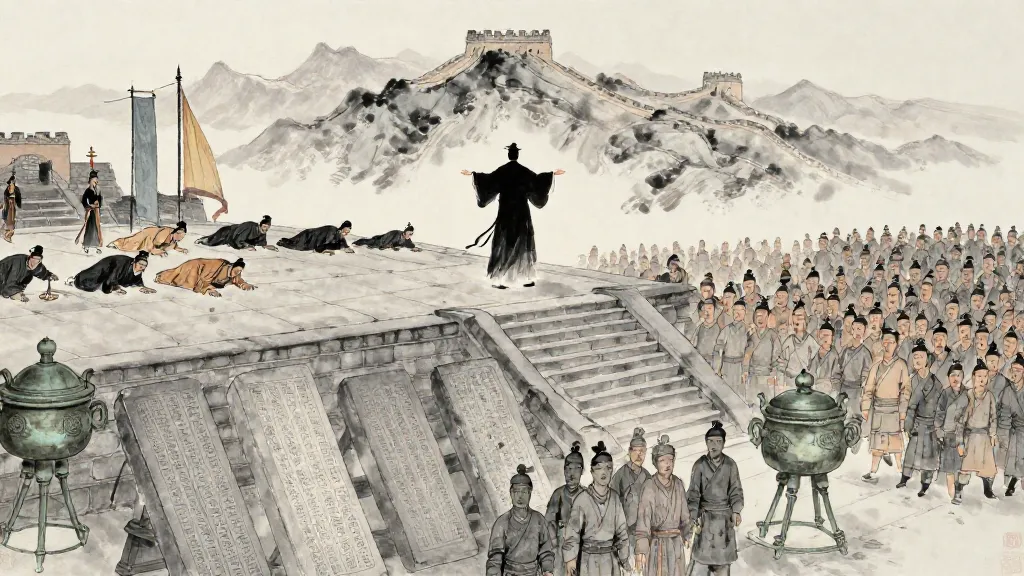
Duke Xiao of Qin commanded the strongholds of Xiao and Hangu, held the territory of Yong Province, and with his ruler and ministers firmly defending their position, looked covetously upon the Zhou royal house. He harbored the ambition to roll up All-Under-Heaven like a mat, to enfold the entire realm, to bag the four seas, and to swallow the eight wilds. At that time, Lord Shang assisted him: within, he established laws and standards, devoted the state to agriculture and weaving, and cultivated the preparations for defense and war; without, he employed the strategy of horizontal alliances to set the feudal lords against each other. And so the men of Qin took the lands west of the Yellow River with folded hands.
After Duke Xiao died, Kings Hui and Wu inherited the old enterprise, followed the bequeathed plans, annexed Hanzhong in the south, took Ba and Shu in the west, carved out the rich lands in the east, and seized the strategic commanderies. The feudal lords were terrified; they convened alliances and plotted to weaken Qin. They did not begrudge precious vessels, heavy treasures, or fertile lands in order to attract the scholars of All-Under-Heaven, forming vertical alliances, binding treaties, and acting as one. At that time, Qi had Lord Mengchang, Zhao had Lord Pingyuan, Chu had Lord Chunshen, and Wei had Lord Xinling. These four lords were all perceptive and wise, loyal and trustworthy, broad-minded and humane. They honored the worthy and esteemed the scholar. They negotiated vertical alliances and disrupted horizontal ones, uniting the multitudes of Han, Wei, Yan, Chu, Qi, Zhao, Song, Wey, and Zhongshan. The scholars of the six states included Ning Yue, Xu Shang, Su Qin, and Du He as strategists; Qi Ming, Zhou Zui, Chen Zhen, Zhao Hua, Lou Huan, Zhai Jing, Su Li, and Yue Yi to convey their intentions; and Wu Qi, Sun Bin, Dai Tuo, Er Liang, Wang Liao, Tian Ji, Lian Po, and Zhao She to command their armies. They regularly brought together territory ten times that of Qin and armies of a million men to batter the passes and attack Qin. Yet when Qin opened its passes and admitted the enemy, the armies of nine states wavered and retreated without daring to advance. Qin suffered not even the loss of a single arrow or arrowhead, and yet the feudal lords of All-Under-Heaven were already exhausted. The vertical alliances broke apart and the treaties dissolved; they competed to carve up their own territory to present to Qin. Qin had surplus strength and exploited their weakness, pursuing the fleeing and hunting down the defeated, laying a million corpses to rest, and floating shields upon rivers of blood. Seizing advantage and riding the momentum, Qin carved up All-Under-Heaven, divided mountains and rivers; the strong states sued for submission, the weak states came to pay court. This continued down to Kings Xiaowen and Zhuangxiang, who reigned only briefly, and the state faced no crises.
Then came the King of Qin, who continued the accumulated power of six generations, cracked the long whip and drove the realm, swallowed the two Zhous and destroyed the feudal lords, ascended the supreme position and controlled the six directions, wielded the rod and lash to flog All-Under-Heaven, and shook the four seas with his might. In the south, he took the lands of the Hundred Yue and made them into Guilin and Xiang commanderies. The lords of the Hundred Yue bowed their heads, tied cords around their necks, and entrusted their lives to his subordinate officials. He dispatched Meng Tian to build the Great Wall in the north as a hedge and barrier, driving back the Xiongnu over seven hundred li. The Hu people dared not come south to pasture their horses; their warriors dared not draw their bows in vengeance.
Thereupon he abolished the Way of the Former Kings, burned the writings of the Hundred Schools to stupefy the black-headed people. He demolished famous cities, killed heroes and men of talent, collected the weapons of All-Under-Heaven and brought them to Xianyang, melting down the blades and casting them into bell-stands to make twelve colossal bronze figures — thus to weaken the common people. Then he cut through Mount Hua to make his walls, used the Yellow River as his moat, relied upon ramparts a hundred million zhang high, and looked down upon unfathomable ravines for his defenses. Excellent generals with powerful crossbows guarded the strategic points; trusted ministers and crack troops deployed sharp weapons and challenged all comers. All-Under-Heaven was settled. In his heart, the King of Qin believed that the stronghold within the passes, his city of metal spanning a thousand li, was the foundation of an imperial dynasty for his descendants lasting ten thousand generations.
After the King of Qin died, his remaining authority overawed even remote peoples. Chen She was the son of a family with broken-jar windows and rope-pull doors — a common laborer, a transported convict — whose talent did not match that of an average man. He lacked the worthiness of Confucius or Mozi and the wealth of Tao Zhu or Yi Dun. Yet striding forth from the ranks, rising suddenly from among the squads, he led exhausted and scattered soldiers, commanded a force of only several hundred, and turned to attack Qin. They cut down trees for weapons and raised bamboo poles as banners. All-Under-Heaven gathered like clouds and responded like echoes. They carried their own provisions and followed him as shadows follow form. The heroes east of the mountains arose together and destroyed the house of Qin.
Now All-Under-Heaven had not become small or weak. The territory of Yong Province, the strongholds of Xiao and Hangu, remained the same as before. Chen She's rank was not more exalted than the rulers of Qi, Chu, Yan, Zhao, Han, Wei, Song, Wey, or Zhongshan. Hoe-handles and wooden staves were not sharper than hooked halberds and long lances. A rabble of transported conscripts was no match for the armies of nine states. In depth of planning, breadth of vision, and the art of marshaling and deploying troops, they were far inferior to the strategists of old. Yet the outcomes were utterly different, the achievements completely reversed. If one were to compare the states east of the mountains with Chen She, measuring their length and breadth, weighing their power and strength, they could not be spoken of in the same breath. Yet Qin, from its modest territory and its power of a thousand chariots, summoned eight provinces to pay court and brought its peers into submission — this for over a hundred years. Then it took the six directions as its household and Xiao and Hangu as its palace. One common man raised a difficulty, and the seven ancestral temples collapsed. The ruler died at the hands of others and became the laughingstock of All-Under-Heaven. Why? Because benevolence and righteousness were not practiced, and the dynamics of offense and defense had fundamentally changed.
When Qin united all within the seas, absorbed the feudal lords, faced south and called itself Emperor, and nourished the four seas, the scholars of All-Under-Heaven eagerly turned toward it like grass bending in the wind. Why was this? Because in recent ages there had been no true king for a long time. The Zhou royal house had become insignificant; the Five Hegemons were all dead; orders no longer ran throughout All-Under-Heaven. Therefore the feudal lords governed by force; the strong encroached upon the weak; the many tyrannized the few. Warfare never ceased; soldiers and people were worn out. Now that Qin faced south and ruled All-Under-Heaven — at last there was a Son of Heaven above. The common people of the multitudes hoped to secure their lives. There was none who did not open his heart and look upward to the sovereign. At that moment, to maintain authority and fix accomplishment — the foundation of security and peril lay precisely here.
The King of Qin harbored a greedy and base heart, exercised only his own self-confident cleverness, placed no trust in his meritorious ministers, did not cultivate closeness with the scholars and people, abandoned the Kingly Way, established personal authority, prohibited literature and imposed cruel punishments, placing deception and force before benevolence and righteousness, and using violent oppression as the beginning of his rule of All-Under-Heaven. Now, he who annexes and conquers values deception and force; he who stabilizes and secures values compliance with circumstance. This is to say that the methods for taking and for holding are not the same. Qin emerged from the Warring States and ruled All-Under-Heaven, but did not change its Way or reform its governance — this is why its means of taking and its means of holding differed. Holding it in isolation, without allies, its destruction could be awaited standing up. Had the King of Qin considered the affairs of past generations, incorporated the legacy of Yin and Zhou into his governance, then even if later rulers were dissolute and arrogant, there would have been no crisis of collapse. Thus the Three Kings who founded All-Under-Heaven achieved fame that was illustrious and fine, and accomplishments that endured.
Now when the Second Emperor of Qin ascended the throne, all in All-Under-Heaven craned their necks to observe his governance. Those who shiver find even a short coarse garment a blessing; those who starve find even chaff and husks sweet. The anguished cries of All-Under-Heaven were the new ruler's capital. This means that for a people worn out by hardship, benevolence is easy to practice. Had the Second Emperor possessed even the conduct of a mediocre ruler, and employed the loyal and worthy, had ruler and ministers been of one mind in worrying about the afflictions of the realm, had he donned mourning garments and corrected the late Emperor's errors, divided land and people to enfeoff the descendants of meritorious ministers, established states and set up rulers to show propriety to All-Under-Heaven, emptied the prisons and abolished punishments, removed the taint of collective guilt, let each person return to his home village, opened the granaries and disbursed treasures to relieve the orphaned, destitute, and impoverished, lightened taxes and reduced corvée to aid the people's urgent needs, simplified the laws and reduced punishments to give the people a future — if he had let every person in All-Under-Heaven renew himself, reform his conduct, and take care of his own person, if he had fulfilled the hopes of the myriad people and shared both authority and virtue with All-Under-Heaven — then All-Under-Heaven would have rallied to him. Within the four seas, all would have joyfully settled in their places, fearing only that change might come. Even had there been cunning and crafty men, none would have had the heart to leave the sovereign. Then lawless ministers would have had no way to dress up their schemes, and the treachery of violent rebels would have ceased.
But the Second Emperor did not follow this course. Instead he compounded it with lawlessness: he ruined the ancestral temples for the sake of the people's labor, resumed construction of the Epang Palace, proliferated punishments and tightened executions, made administration cruel and harsh, bestowed rewards and punishments unjustly, levied taxes without limit. The realm's affairs multiplied beyond what officials could manage; the common people were impoverished, and the ruler did not gather them in or show pity. Then deceit and treachery arose on all sides; high and low evaded one another; those charged with crimes were many; the executed were seen one after another along the roads, and All-Under-Heaven suffered. From lords and ministers on down to the common people, every person harbored a sense of personal danger, personally experienced the reality of hardship, and felt unsafe in his position. Therefore they were easily set in motion. This is why Chen She, without using the worthiness of Tang or Wu, and without relying on the dignity of lords or dukes, raised his arm at the Great Marsh, and All-Under-Heaven responded like an echo — because the people were in danger.
The Former Kings perceived the transformations from beginning to end and understood the pivots of survival and destruction. Therefore the Way of shepherding the people lies simply in securing their peace. Even should there be ministers who act contrary to order, there would certainly be no one to respond and assist them. Therefore it is said: 'A people at peace can be led to practice righteousness; a people in peril can easily be led to do wrong.' This is what is meant. To be exalted as Son of Heaven, to be rich in the possession of All-Under-Heaven, and yet not to escape execution — it was because his remedy for the state's decline was wrong. This was the fault of the Second Emperor.