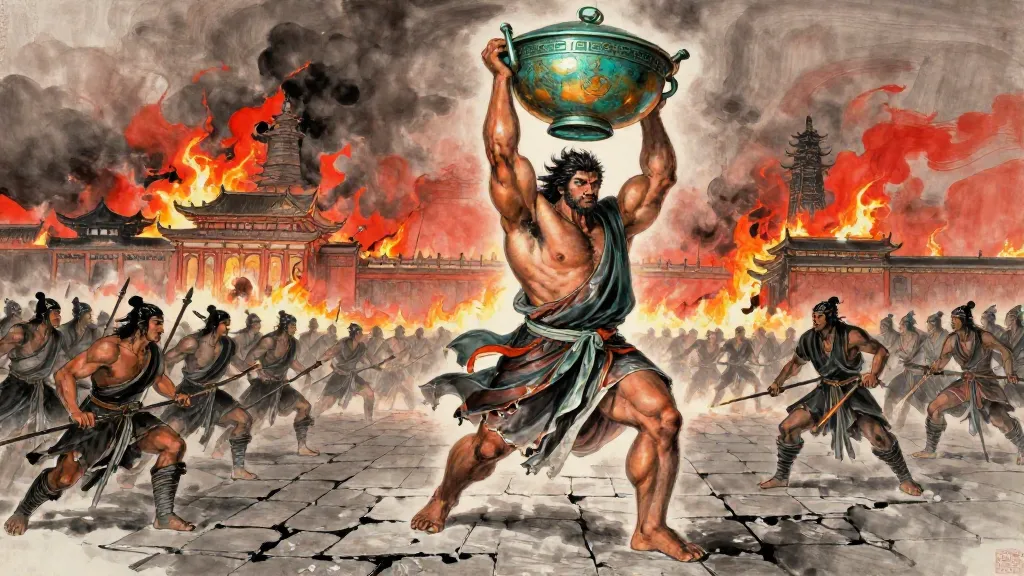
項羽本紀 (Annals of Xiang Yu) — Chinese ink painting

Chapter 7 of 130

項羽本紀

Annals of Xiang Yu

View:

項羽身世與少年志氣

Xiang Yu's Origins and Youthful Ambition

項籍者,下相人也,字羽。初起時,年二十四。其季父項梁,梁父即楚將項燕,為秦將王翦所戮者也。項氏世世為楚將,封於項,故姓項氏。

項籍少時,學書不成,去學劍,又不成。項梁怒之。籍曰:"書足以記名姓而已。劍一人敵,不足學,學萬人敵。"於是項梁乃教籍兵法,籍大喜,略知其意,又不肯竟學。項梁嘗有櫟陽逮,乃請蘄獄掾曹咎書抵櫟陽獄掾司馬欣,以故事得已。項梁殺人,與籍避仇於吳中。吳中賢士大夫皆出項梁下。每吳中有大繇役及喪,項梁常為主辦,陰以兵法部勒賓客及子弟,以是知其能。秦始皇帝游會稽,渡浙江,梁與籍俱觀。籍曰:"彼可取而代也。"梁掩其口,曰:"毋妄言,族矣!"梁以此奇籍。籍長八尺餘,力能扛鼎,才氣過人,雖吳中子弟皆已憚籍矣。

Xiang Ji was a native of Xiaxiang. His courtesy name was Yu. He was twenty-four when the uprising began. His uncle Xiang Liang was the son of Xiang Yan, the Chu general killed by the Qin general Wang Jian. The Xiang clan had served as Chu generals for generations. They held a fief at Xiang, and so took Xiang as their surname.

As a boy, Xiang Ji studied writing but gave it up. He took up swordsmanship but gave that up too. Xiang Liang was furious. Ji said: "Writing is only good for recording names. Swordsmanship is one man's skill — not worth learning. I want to learn the skill that defeats ten thousand men." At this, Xiang Liang taught him the art of war. Ji was overjoyed. He grasped the broad principles, then refused to finish the course.

Xiang Liang once faced an arrest warrant from Liyang. He asked the prison clerk Cao Jiu of Qi to write a letter to the Liyang prison clerk Sima Xin, and by this connection the matter was dropped. Later, Xiang Liang killed a man, and he and Ji fled to the Wu region to escape the blood feud. All the worthy gentlemen and officials of Wu deferred to Xiang Liang. Whenever there was a major corvée levy or funeral in Wu, Xiang Liang took charge of the arrangements, secretly using the art of war to organize the guests and young men — and so came to know each one's abilities.

When the First Emperor toured Kuaiji and crossed the Zhe River, Liang and Ji watched together. Ji said: "That man — I could take his place." Liang clapped a hand over his mouth: "Don't talk like that — it's death for the whole clan!" But from that moment, Liang recognized something extraordinary in Ji. Ji stood over eight chi tall, strong enough to lift a bronze tripod, his talent and spirit surpassing all around him. Even the young men of Wu were already in awe of him.

Notes

1person項梁Xiàng Liáng

Xiang Liang (項梁, d. 208 BC) was Xiang Yu's uncle and early mentor. Son of the great Chu general Xiang Yan, he organized the initial Xiang clan uprising in Wu and served as the rebellion's military leader until his death at the Battle of Dingtao.

2person項燕Xiàng Yān

Xiang Yan (項燕, d. 223 BC) was the last great general of Chu, killed by the Qin general Wang Jian during the final conquest. His name carried enormous symbolic weight for the Chu restoration movement.

3translation

"One man's skill vs. ten thousand men's skill" (劍一人敵...學萬人敵): This exchange defines Xiang Yu's character from childhood — impatient with incremental mastery, drawn to grand-scale power. The 'skill that defeats ten thousand' means strategic command, i.e., the art of war (兵法).

4translation

"That man — I could take his place" (彼可取而代也): One of the most famous lines in the Shiji. Compare Liu Bang's reaction on seeing the First Emperor's procession (recorded in his own annals): 'Ah, this is what a great man should be!' (嗟乎,大丈夫當如此也). Xiang Yu's line is blunt and aggressive; Liu Bang's is aspirational. Sima Qian uses the contrast to foreshadow their different fates.

5place

Xiaxiang (下相) was in modern Suqian, Jiangsu. The Wu region (吳中) where they fled corresponds to modern Suzhou and surrounding areas in the Yangtze delta.

會稽起兵

The Uprising at Kuaiji

秦二世元年七月,陳涉等起大澤中。其九月,會稽守通謂梁曰:"江西皆反,此亦天亡秦之時也。吾聞先即制人,後則為人所制。吾欲發兵,使公及桓楚將。"是時桓楚亡在澤中。梁曰:"桓楚亡,人莫知其處,獨籍知之耳。"梁乃出,誡籍持劍居外待。梁復入,與守坐,曰:"請召籍,使受命召桓楚。"守曰:"諾。"梁召籍入。須臾,梁眴籍曰:"可行矣!"於是籍遂拔劍斬守頭。項梁持守頭,佩其印綬。門下大驚,擾亂,籍所擊殺數十百人。一府中皆慴伏,莫敢起。梁乃召故所知豪吏,諭以所為起大事,遂舉吳中兵。使人收下縣,得精兵八千人。梁部署吳中豪傑為校尉、候、司馬。有一人不得用,自言於梁。梁曰:"前時某喪使公主某事,不能辦,以此不任用公。"眾乃皆伏。於是梁為會稽守,籍為裨將,徇下縣。

In the seventh month of the first year of the Second Emperor, Chen She and his followers rose up at Daze. In the ninth month, the governor of Kuaiji, Yin Tong, said to Xiang Liang: "All the lands west of the Yangtze are in revolt. This is Heaven's time to destroy Qin. I have heard that he who strikes first controls others; he who strikes second is controlled. I intend to raise troops and appoint you and Huan Chu as commanders."

At that time, Huan Chu was a fugitive hiding in the marshes. Liang said: "Huan Chu is a fugitive. No one knows where he is — only Ji knows." Liang went out and instructed Ji to wait outside with his sword ready. He went back in, sat down with the governor, and said: "Please summon Ji and have him receive orders to find Huan Chu." The governor agreed.

Liang called Ji in. After a moment, Liang signaled Ji with his eyes: "Now!" Ji drew his sword and cut off the governor's head. Xiang Liang seized the head and put on the governor's seal and sash. The household staff were thrown into panic. Ji cut down several dozen of them. The entire office fell prostrate in terror; none dared rise.

Liang then summoned the local strongmen and officials he knew and explained that they were launching a great undertaking. He raised the troops of Wu. He sent men to take the surrounding districts and assembled eight thousand elite soldiers. Liang appointed the local leaders of Wu as colonels, lieutenants, and marshals. One man who received no appointment came to complain. Liang said: "At a certain funeral, I put you in charge of a certain task, and you could not handle it. That is why I have not given you a position." After that, everyone accepted his authority. Xiang Liang became governor of Kuaiji, Ji became his deputy general, and they pacified the surrounding districts.

Notes

1person陳涉/陳勝Chén Shè / Chén Shèng

Chen She (陳涉), also known as Chen Sheng (陳勝, d. 208 BC), led the first major uprising against Qin in 209 BC at Daze (in modern Anhui). His rebellion, though short-lived, ignited the chain of revolts that destroyed the Qin dynasty. He has his own chapter in the Shiji (Ch. 48).

2context

The 'eight thousand soldiers of Jiangdong' (江東八千子弟) became legendary as the original core of Xiang Yu's army. They will appear again at the chapter's end, when Xiang Yu refuses to cross the Wu River because none of those eight thousand survived to return home.

3place

Kuaiji (會稽) was a commandery centered on modern Shaoxing, Zhejiang. The region 'west of the Yangtze' (江西) here means the interior of China relative to the river — not the modern province of Jiangxi.

渡江西進與諸軍歸附

Crossing the Yangtze and Gathering Allies

廣陵人召平於是為陳王徇廣陵,未能下。聞陳王敗走,秦兵又且至,乃渡江矯陳王命,拜梁為楚王上柱國。曰:"江東已定,急引兵西擊秦。"項梁乃以八千人渡江而西。聞陳嬰已下東陽,使使欲與連和俱西。陳嬰者,故東陽令史,居縣中,素信謹,稱為長者。東陽少年殺其令,相聚數千人,欲置長,無適用,乃請陳嬰。嬰謝不能,遂彊立嬰為長,縣中從者得二萬人。少年欲立嬰便為王,異軍蒼頭特起。陳嬰母謂嬰曰:"自我為汝家婦,未嘗聞汝先古之有貴者。今暴得大名,不祥。不如有所屬,事成猶得封侯,事敗易以亡,非世所指名也。"嬰乃不敢為王。謂其軍吏曰:"項氏世世將家,有名於楚。今欲舉大事,將非其人,不可。我倚名族,亡秦必矣。"於是眾從其言,以兵屬項梁。項梁渡淮,黥布、蒲將軍亦以兵屬焉。凡六七萬人,軍下邳。

Zhao Ping of Guangling had been campaigning on behalf of the King of Chen to take Guangling, but had not succeeded. When he heard that the King of Chen had been defeated and that Qin troops were approaching, he crossed the Yangtze and, forging an order from the King of Chen, appointed Xiang Liang as Grand Pillar of State of Chu. He said: "The east is pacified. Move your troops west at once to strike Qin."

Xiang Liang then crossed the Yangtze westward with his eight thousand men. He heard that Chen Ying had already taken Dongyang and sent envoys to propose an alliance for the westward campaign. Chen Ying had been a clerk in the Dongyang county office, known locally as a man of integrity and prudence, respected as an elder. The young men of Dongyang had killed their magistrate, gathered several thousand followers, and wanted to choose a leader. Finding no one suitable, they asked Chen Ying. Ying declined, but they forced the position on him. Twenty thousand people from the county rallied to him. The young men wanted to make Ying king outright and raised a special force with dark headbands.

Chen Ying's mother said to him: "Since I married into your family, I have never heard of any ancestor of yours who held high rank. Now you have suddenly gained a great name — this is unlucky. Better to serve under someone. If things go well, you can still be enfeoffed as a marquis. If things go badly, it will be easier to escape, because you will not be the one everyone knows by name." Ying therefore did not dare call himself king. He told his officers: "The Xiang clan have been a family of generals for generations, famous throughout Chu. To launch a great undertaking, the commander must be the right man — anything less will not do. Let us attach ourselves to this noble house, and the fall of Qin is certain."

The assembled troops accepted this reasoning and pledged their forces to Xiang Liang. Xiang Liang crossed the Huai River. Qing Bu and General Pu also brought their troops under his command. In all, they numbered sixty or seventy thousand men and encamped at Xiapi.

Notes

1person黥布/英布Qíng Bù / Yīng Bù

Qing Bu (黥布), later known as Ying Bu (英布, d. 196 BC), was a convict laborer whose face had been branded (黥 = tattooed as punishment). He became one of the most formidable generals of the era, later enfeoffed as King of Jiujiang under Xiang Yu and eventually defecting to Liu Bang.

2context

Chen Ying's mother's advice is a masterclass in political survival. Her reasoning — that a man without noble ancestry who suddenly rises to kingship will be the first targeted — proved sound. Chen Ying survived the wars and died of old age, unlike nearly every other figure who claimed a crown.

3place

Xiapi (下邳) was a strategic town in northern Jiangsu, near modern Pizhou. It controlled the crossing of the Si River and was a key staging point for north-south campaigns.

擊秦嘉、立楚懷王

Defeating Qin Jia and Enthroning King Huai of Chu

當是時,秦嘉已立景駒為楚王,軍彭城東,欲距項梁。項梁謂軍吏曰:"陳王先首事,戰不利,未聞所在。今秦嘉倍陳王而立景駒,逆無道。"乃進兵擊秦嘉。秦嘉軍敗走,追之至胡陵。嘉還戰一日,嘉死,軍降。景駒走死梁地。項梁已並秦嘉軍,軍胡陵,將引軍而西。章邯軍至栗,項梁使別將硃雞石、餘樊君與戰。餘樊君死。硃雞石軍敗,亡走胡陵。項梁乃引兵入薛,誅雞石。項梁前使項羽別攻襄城,襄城堅守不下。已拔,皆阬之。還報項梁。項梁聞陳王定死,召諸別將會薛計事。此時沛公亦起沛,往焉。

居鄛人范增,年七十,素居家,好奇計,往說項梁曰:"陳勝敗固當。夫秦滅六國,楚最無罪。自懷王入秦不反,楚人憐之至今,故楚南公曰'楚雖三戶,亡秦必楚'也。今陳勝首事,不立楚後而自立,其勢不長。今君起江東,楚蜂午之將皆爭附君者,以君世世楚將,為能復立楚之後也。"於是項梁然其言,乃求楚懷王孫心民間,為人牧羊,立以為楚懷王,從民所望也。陳嬰為楚上柱國,封五縣,與懷王都盱台。項梁自號為武信君。

At this time, Qin Jia had already set up Jing Ju as King of Chu and was camped east of Pengcheng, intending to block Xiang Liang. Xiang Liang told his officers: "The King of Chen was first to raise the standard. His campaigns met with setbacks, and no one knows where he is. Now Qin Jia has betrayed the King of Chen and set up Jing Ju — this is rebellion against the rightful order." He advanced and attacked Qin Jia. Qin Jia's army was routed and fled; Xiang Liang pursued them to Huling. Qin Jia turned and fought for one day, then was killed. His army surrendered. Jing Ju fled and died in the territory of Liang.

Having absorbed Qin Jia's forces, Xiang Liang camped at Huling and prepared to march west. Zhang Han's army reached Li. Xiang Liang sent his subordinate commanders Zhu Jishi and Lord Yu Fan to engage them. Lord Yu Fan was killed. Zhu Jishi's army was defeated, and he fled to Huling. Xiang Liang entered Xue and executed Zhu Jishi.

Earlier, Xiang Liang had sent Xiang Yu to attack Xiangcheng separately. Xiangcheng held out stubbornly. When it finally fell, Xiang Yu buried the entire garrison alive. He returned to report to Xiang Liang.

When Xiang Liang confirmed that the King of Chen was dead, he summoned all his separate commanders to a council of war at Xue. At this time, the Duke of Pei had also risen in revolt at Pei, and he came to the meeting.

Fan Zeng, a man of Juchao, seventy years old, who had lived in retirement and was known for his unconventional strategies, came to advise Xiang Liang: "Chen Sheng's failure was inevitable. When Qin destroyed the six states, Chu was the least guilty. Ever since King Huai entered Qin and never returned, the people of Chu have mourned him to this day. That is why the Chu sage Nangong said: 'Even if Chu is reduced to three households, it is Chu that will destroy Qin.' Now Chen Sheng was first to rise, but he set himself up as king instead of restoring the Chu royal line — his cause could not last. You, my lord, have risen from east of the Yangtze, and the swarming Chu commanders compete to join you because your family have been Chu generals for generations and they believe you can restore the Chu succession."

Xiang Liang agreed. He searched among the common people for a grandson of King Huai of Chu, found one named Xin — a shepherd — and enthroned him as King Huai of Chu, in accordance with the people's hopes. Chen Ying was made Grand Pillar of State and given five counties. He and King Huai established their capital at Xutai. Xiang Liang styled himself Lord Wuxin.

Notes

1person范增Fàn Zēng

Fan Zeng (范增, 277–204 BC) became Xiang Yu's chief strategist, addressed as 'Second Father' (亞父). His counsel was consistently shrewd — he urged Xiang Yu to kill Liu Bang at the Feast of Hongmen — but Xiang Yu repeatedly failed to follow his advice. He was later driven from Xiang Yu's side by Chen Ping's espionage scheme and died of a back abscess on the road.

2person劉邦/沛公Liú Bāng

Liu Bang (劉邦, 256–195 BC), referred to in the text as 'the Duke of Pei' (沛公), was Xiang Yu's great rival. A former village headman of humble origins, he would ultimately defeat Xiang Yu and found the Han dynasty as Emperor Gaozu.

3person楚懷王/義帝Chǔ Huái Wáng / Yì Dì

King Huai of Chu (楚懷王) here refers to Xiong Xin (熊心), a grandson of the historical King Huai (r. 328–299 BC) who had been tricked into captivity by Qin and died there. The new King Huai was a figurehead enthroned by Xiang Liang to legitimize the rebellion. He was later retitled 'Righteous Emperor' (義帝) and murdered on Xiang Yu's orders.

4translation

"Even if Chu is reduced to three households, it is Chu that will destroy Qin" (楚雖三戶,亡秦必楚): One of the most famous prophecies in Chinese history. The 'three households' may refer to the three great Chu clans (Qu, Jing, Zhao) or simply mean 'even the smallest remnant.' The prophecy proved true.

5person章邯Zhāng Hán

Zhang Han (章邯, d. 205 BC) was the most capable Qin general of the civil war period. Originally a court official, he armed convict laborers to crush the initial rebellions. He defeated Chen She's forces, killed Xiang Liang at Dingtao, and nearly destroyed the rebellion before his own surrender to Xiang Yu after the Battle of Julu.

6place

Pengcheng (彭城) is modern Xuzhou, Jiangsu. It would become Xiang Yu's capital as Hegemon-King of Western Chu, and the site of one of his most spectacular victories — the rout of Liu Bang's 560,000-man coalition.

項梁兵敗定陶

Xiang Liang's Defeat and Death at Dingtao

居數月,引兵攻亢父,與齊田榮、司馬龍且軍救東阿,大破秦軍於東阿。田榮即引兵歸,逐其王假。假亡走楚。假相田角亡走趙。角弟田間故齊將,居趙不敢歸。田榮立田儋子市為齊王。項梁已破東阿下軍,遂追秦軍。數使使趣齊兵,欲與俱西。田榮曰:"楚殺田假,趙殺田角、田間,乃發兵。"項梁曰:"田假為與國之王,窮來從我,不忍殺之。"趙亦不殺田角、田間以市於齊。齊遂不肯發兵助楚。項梁使沛公及項羽別攻城陽,屠之。西破秦軍濮陽東,秦兵收入濮陽。沛公、項羽乃攻定陶。定陶未下,去,西略地至雝丘,大破秦軍,斬李由。還攻外黃,外黃未下。

項梁起東阿,西,至定陶,再破秦軍,項羽等又斬李由,益輕秦,有驕色。宋義乃諫項梁曰:"戰勝而將驕卒惰者敗。今卒少惰矣,秦兵日益,臣為君畏之。"項梁弗聽。乃使宋義使於齊。道遇齊使者高陵君顯,曰:"公將見武信君乎?"曰:"然。"曰:"臣論武信君軍必敗。公徐行即免死,疾行則及禍。"秦果悉起兵益章邯,擊楚軍,大破之定陶,項梁死。沛公、項羽去外黃攻陳留,陳留堅守不能下。沛公、項羽相與謀曰:"今項梁軍破,士卒恐。"乃與呂臣軍俱引兵而東。呂臣軍彭城東,項羽軍彭城西,沛公軍碭。

After several months, Xiang Liang led his forces to attack Kangfu. Together with Qi generals Tian Rong and Sima Longju, he rescued Dong'e and crushed the Qin army there. Tian Rong immediately pulled his forces back to Qi to drive out King Jia. Jia fled to Chu. His chancellor Tian Jiao fled to Zhao. Jiao's brother Tian Jian, a former Qi general, stayed in Zhao and dared not return. Tian Rong enthroned Tian Dan's son Shi as King of Qi.

Having broken the Qin forces below Dong'e, Xiang Liang pursued them. He sent repeated messages urging Qi to send troops for a joint westward campaign. Tian Rong replied: "Kill Tian Jia for me, and have Zhao kill Tian Jiao and Tian Jian — then I will send troops." Xiang Liang said: "Tian Jia is the king of an allied state who came to me in desperation. I cannot bear to kill him." Zhao likewise refused to kill Tian Jiao and Tian Jian to buy Qi's favor. So Qi refused to send troops to aid Chu.

Xiang Liang sent the Duke of Pei and Xiang Yu separately to attack Chengyang, which they sacked. Moving west, they routed a Qin army east of Puyang. The Qin forces withdrew into Puyang. The Duke of Pei and Xiang Yu then attacked Dingtao but failed to take it. They moved west, raiding as far as Yongqiu, where they crushed a Qin army and killed Li You. They returned to attack Waihuang but failed to take it either.

Since Dong'e, Xiang Liang had marched west to Dingtao and beaten the Qin twice. Xiang Yu and the others had killed Li You. They grew contemptuous of Qin, and arrogance showed on their faces. Song Yi remonstrated with Xiang Liang: "A commander who grows arrogant after victory and whose soldiers grow slack will meet defeat. The troops are already somewhat slack. Qin's forces grow stronger by the day. I fear for you, my lord." Xiang Liang did not listen. He sent Song Yi as envoy to Qi.

On the road, Song Yi met the Qi envoy Lord Gaoling Xian, and asked: "Are you going to see Lord Wuxin?" "I am," he replied. Song Yi said: "In my judgment, Lord Wuxin's army will certainly be defeated. If you travel slowly, you will escape death. If you travel quickly, you will walk into disaster."

Qin indeed mobilized all available forces to reinforce Zhang Han. He struck the Chu army and destroyed it at Dingtao. Xiang Liang was killed. The Duke of Pei and Xiang Yu abandoned Waihuang and attacked Chenliu, but it held firm. They conferred: "Xiang Liang's army is destroyed. The soldiers are frightened." They joined forces with Lü Chen's army and withdrew east. Lü Chen camped east of Pengcheng, Xiang Yu west of Pengcheng, and the Duke of Pei at Dang.

Notes

1person宋義Sòng Yì

Song Yi (宋義, d. 207 BC) was a Chu commander who correctly predicted Xiang Liang's defeat. His foresight earned him King Huai's trust and the supreme command — which Xiang Yu would take from him by assassination.

2context

Xiang Liang's defeat at Dingtao (定陶之戰, 208 BC) was the rebellion's darkest hour. Zhang Han had destroyed the main Chu field army and killed its commander. The Qin general then turned north to crush Zhao, setting the stage for the Battle of Julu.

3person李由Lǐ Yóu

Li You (李由, d. 208 BC) was the son of Qin chancellor Li Si. His death in battle was one factor in Li Si's eventual downfall and execution by the eunuch Zhao Gao.

殺宋義奪兵權

Killing Song Yi and Seizing Command

章邯已破項梁軍,則以為楚地兵不足憂,乃渡河擊趙,大破之。當此時,趙歇為王,陳餘為將,張耳為相,皆走入鉅鹿城。章邯令王離、涉間圍鉅鹿,章邯軍其南,築甬道而輸之粟。陳餘為將,將卒數萬人而軍鉅鹿之北,此所謂河北之軍也。

楚兵已破於定陶,懷王恐,從盱台之彭城,並項羽、呂臣軍自將之。以呂臣為司徒,以其父呂青為令尹。以沛公為碭郡長,封為武安侯,將碭郡兵。

初,宋義所遇齊使者高陵君顯在楚軍,見楚王曰:"宋義論武信君之軍必敗,居數日,軍果敗。兵未戰而先見敗徵,此可謂知兵矣。"王召宋義與計事而大說之,因置以為上將軍,項羽為魯公,為次將,范增為末將,救趙。諸別將皆屬宋義,號為卿子冠軍。行至安陽,留四十六日不進。項羽曰:"吾聞秦軍圍趙王鉅鹿,疾引兵渡河,楚擊其外,趙應其內,破秦軍必矣。"宋義曰:"不然。夫搏牛之虻不可以破蟣虱。今秦攻趙,戰勝則兵罷,我承其敝;不勝,則我引兵鼓行而西,必舉秦矣。故不如先鬥秦趙。夫被堅執銳,義不如公;坐而運策,公不如義。"因下令軍中曰:"猛如虎,很如羊,貪如狼,彊不可使者,皆斬之。"乃遣其子宋襄相齊,身送之至無鹽,飲酒高會。天寒大雨,士卒凍飢。項羽曰:"將戮力而攻秦,久留不行。今歲饑民貧,士卒食芋菽,軍無見糧,乃飲酒高會,不引兵渡河因趙食,與趙併力攻秦,乃曰'承其敝'。夫以秦之彊,攻新造之趙,其勢必舉趙。趙舉而秦彊,何敝之承!且國兵新破,王坐不安席,埽境內而專屬於將軍,國家安危,在此一舉。今不恤士卒而徇其私,非社稷之臣。"項羽晨朝上將軍宋義,即其帳中斬宋義頭,出令軍中曰:"宋義與齊謀反楚,楚王陰令羽誅之。"當是時,諸將皆慴服,莫敢枝梧。皆曰:"首立楚者,將軍家也。今將軍誅亂。"乃相與共立羽為假上將軍。使人追宋義子,及之齊,殺之。使桓楚報命於懷王。懷王因使項羽為上將軍,當陽君、蒲將軍皆屬項羽。

Having destroyed Xiang Liang's army, Zhang Han concluded that the Chu forces were no longer a threat. He crossed the Yellow River and attacked Zhao, inflicting a devastating defeat. At this time, Zhao Xie was king, Chen Yu was general, and Zhang Er was chancellor. All of them fled into the city of Julu. Zhang Han ordered Wang Li and She Jian to besiege Julu. Zhang Han himself camped to the south and built a walled supply corridor to deliver grain to the besiegers. Chen Yu, commanding several tens of thousands of troops, camped north of Julu — these were the so-called "Army North of the River."

The Chu army had been shattered at Dingtao. King Huai, alarmed, moved from Xutai to Pengcheng, merged Xiang Yu's and Lü Chen's armies, and took personal command. He appointed Lü Chen as Minister of Works and Lü Chen's father Lü Qing as Chief Minister. The Duke of Pei was made administrator of Dang Commandery, enfeoffed as Lord Wu'an, and given command of the Dang garrison troops.

Now, the Qi envoy Lord Gaoling Xian, whom Song Yi had met on the road, was present in the Chu army. He had an audience with King Huai and said: "Song Yi predicted that Lord Wuxin's army would be defeated. A few days later, it was. To see the signs of defeat before battle is even joined — this man understands war." The King summoned Song Yi, discussed strategy with him, and was greatly impressed. He appointed Song Yi supreme commander, with Xiang Yu as Duke of Lu and second-in-command, and Fan Zeng as third-in-command, to rescue Zhao. All the separate detachment commanders were placed under Song Yi. He was given the title "Champion of the Nobles."

The army marched to Anyang and halted for forty-six days without advancing. Xiang Yu said: "I hear the Qin army has besieged the King of Zhao at Julu. We should cross the river at once — Chu attacks from outside, Zhao responds from inside — and the Qin army will certainly be broken." Song Yi replied: "Not so. The gadfly that bites a bull cannot crack a nit. If Qin defeats Zhao, its troops will be exhausted, and we exploit the advantage. If Qin fails, we march west with drums beating and take Qin outright. Better to let Qin and Zhao fight first. When it comes to bearing armor and wielding weapons, I am no match for you. When it comes to sitting in command and devising strategy, you are no match for me." He then issued orders to the army: "Any man who is fierce as a tiger, stubborn as a ram, greedy as a wolf, and too headstrong to take orders — execute him."

Song Yi then sent his son Song Xiang to serve as chancellor of Qi and personally escorted him as far as Wuyan, drinking wine and holding banquets. The weather was bitterly cold with heavy rain. The soldiers were freezing and starving.

Xiang Yu said: "We are supposed to be uniting our strength to attack Qin, yet we sit here and do not move. This year the harvests have failed and the people are destitute. The soldiers are eating taro and beans. There are no grain reserves in camp. Yet Song Yi drinks wine and holds feasts. He will not lead the army across the river to feed off Zhao's supplies and join Zhao in attacking Qin. Instead he talks of 'exploiting their exhaustion.' With Qin's full strength bearing down on a newly established Zhao, the outcome is certain — Qin will take Zhao. And once Zhao falls and Qin grows stronger, what exhaustion will there be to exploit? Our own national army was just destroyed. The King cannot sit still on his throne. He has scraped together every soldier within our borders and entrusted them all to the supreme commander. The survival of the state hinges on this one campaign. Yet Song Yi ignores the soldiers and pursues his private interests. This is not a man who serves the altars of state."

At dawn, Xiang Yu went to pay his respects to Supreme Commander Song Yi. Inside Song Yi's tent, he cut off his head. He came out and announced to the army: "Song Yi conspired with Qi to rebel against Chu. The King secretly ordered me to execute him." At that moment, all the commanders were cowed into submission. None dared oppose him. They said: "It was your family, General, that first established Chu. Now you have put down a traitor." Together they installed Xiang Yu as acting supreme commander.

Men were sent to pursue Song Yi's son. They caught up with him in Qi and killed him. Huan Chu was sent to report to King Huai. The King had no choice but to confirm Xiang Yu as supreme commander. Lord Dangyang and General Pu were both placed under his command.

Notes

1place

Julu (鉅鹿) was in modern Pingxiang County, Hebei. The Battle of Julu (207 BC) was the decisive engagement that broke Qin's main field army and made Xiang Yu the supreme warlord of All-Under-Heaven.

2context

Song Yi's metaphor of the gadfly and the nit (搏牛之虻不可以破蟣虱) means: a tool suited for large prey is useless against small vermin — i.e., the real target is Qin, not the Zhao siege. His strategy of letting Qin and Zhao exhaust each other was rational but politically untenable given the crisis.

3context

Song Yi's order about tigers, rams, and wolves was a veiled threat aimed directly at Xiang Yu. The description — fierce, stubborn, greedy, and insubordinate — fit Xiang Yu precisely. Xiang Yu understood this, and it accelerated his decision to kill Song Yi.

4person張耳、陳餘Zhāng Ěr, Chén Yú

Zhang Er (張耳, d. 202 BC) and Chen Yu (陳餘, d. 204 BC) were once sworn friends, famously described as having a bond 'closer than father and son.' Their relationship disintegrated during the siege of Julu when Zhang Er felt Chen Yu failed to rescue him, and they became bitter enemies.

破釜沉舟:鉅鹿之戰

Breaking the Pots and Sinking the Boats: The Battle of Julu

項羽已殺卿子冠軍,威震楚國,名聞諸侯。乃遣當陽君、蒲將軍將卒二萬渡河,救鉅鹿。戰少利,陳餘復請兵。項羽乃悉引兵渡河,皆沈船,破釜甑,燒廬舍,持三日糧,以示士卒必死,無一還心。於是至則圍王離,與秦軍遇,九戰,絕其甬道,大破之,殺蘇角,虜王離。涉間不降楚,自燒殺。當是時,楚兵冠諸侯。諸侯軍救鉅鹿下者十餘壁,莫敢縱兵。及楚擊秦,諸將皆從壁上觀。楚戰士無不一以當十,楚兵呼聲動天,諸侯軍無不人人惴恐。於是已破秦軍,項羽召見諸侯將,入轅門,無不膝行而前,莫敢仰視。項羽由是始為諸侯上將軍,諸侯皆屬焉。

Having killed the Champion of the Nobles, Xiang Yu's prestige shook the state of Chu, and his name was known to every feudal lord. He sent Lord Dangyang and General Pu across the Yellow River with twenty thousand men to relieve Julu. They won a minor engagement. Chen Yu requested more troops.

Xiang Yu then led his entire army across the river. He sank every boat. He smashed the cooking pots and steamers. He burned the shelters. Each soldier carried three days' rations — nothing more. By this he showed his men that they must fight to the death: there would be no return.

They reached Julu and surrounded Wang Li. They clashed with the Qin army nine times, severed the walled supply corridor, and shattered them. They killed Su Jiao and captured Wang Li alive. She Jian refused to surrender to Chu and burned himself to death.

At this moment, the Chu army stood above all the feudal lords. More than ten allied armies had camped around Julu to rescue Zhao, but none dared commit their troops. When Chu attacked Qin, the commanders of every allied army watched from atop their ramparts. Every Chu soldier fought as if one man against ten. The battle cries of the Chu army shook the heavens. Every man in the allied armies trembled with fear.

When the Qin army was broken, Xiang Yu summoned the feudal commanders. As they entered through the gate of his camp, every one of them advanced on their knees. None dared look up. From this moment, Xiang Yu became supreme commander of all the feudal lords, and all of them submitted to his authority.

Notes

1translation

"Sank the boats, smashed the cooking pots" (沈船,破釜甑): The origin of the famous idiom 破釜沉舟 (pò fǔ chén zhōu), meaning to cut off all retreat and commit totally to victory. This is one of the most celebrated military decisions in Chinese history. By destroying every means of retreat or even cooking a meal, Xiang Yu transformed desperation into unstoppable ferocity.

2context

The image of the allied generals 'watching from the ramparts' (從壁上觀) became a proverbial expression for standing by and watching without committing. Then 'advancing on their knees' (膝行而前) after the battle — Sima Qian contrasts their cowardice during the fight with their abasement afterward. This is the apex of Xiang Yu's military career.

3person王離Wáng Lí

Wang Li (王離) was the grandson of Wang Jian, the same Qin general who had killed Xiang Yu's grandfather Xiang Yan. His capture at Julu was a personal as well as strategic victory for Xiang Yu.

章邯投降與新安坑殺

Zhang Han's Surrender and the Massacre at Xin'an

章邯軍棘原,項羽軍漳南,相持未戰。秦軍數卻,二世使人讓章邯。章邯恐,使長史欣請事。至鹹陽,留司馬門三日,趙高不見,有不信之心。長史欣恐,還走其軍,不敢出故道,趙高果使人追之,不及。欣至軍,報曰:"趙高用事於中,下無可為者。今戰能勝,高必疾妒吾功;戰不能勝,不免於死。原將軍孰計之。"陳餘亦遺章邯書曰:"白起為秦將,南征鄢郢,北阬馬服,攻城略地,不可勝計,而竟賜死。蒙恬為秦將,北逐戎人,開榆中地數千里,竟斬陽周。何者?功多,秦不能盡封,因以法誅之。今將軍為秦將三歲矣,所亡失以十萬數,而諸侯並起滋益多。彼趙高素諛日久,今事急,亦恐二世誅之,故欲以法誅將軍以塞責,使人更代將軍以脫其禍。夫將軍居外久,多內卻,有功亦誅,無功亦誅。且天之亡秦,無愚智皆知之。今將軍內不能直諫,外為亡國將,孤特獨立而欲常存,豈不哀哉!將軍何不還兵與諸侯為從,約共攻秦,分王其地,南面稱孤;此孰與身伏鈇質,妻子為僇乎?"章邯狐疑,陰使候始成使項羽,欲約。約未成,項羽使蒲將軍日夜引兵度三戶,軍漳南,與秦戰,再破之。項羽悉引兵擊秦軍汙水上,大破之。

章邯使人見項羽,欲約。項羽召軍吏謀曰:"糧少,欲聽其約。"軍吏皆曰:"善。"項羽乃與期洹水南殷虛上。已盟,章邯見項羽而流涕,為言趙高。項羽乃立章邯為雍王,置楚軍中。使長史欣為上將軍,將秦軍為前行。到新安。諸侯吏卒異時故繇使屯戍過秦中,秦中吏卒遇之多無狀,及秦軍降諸侯,諸侯吏卒乘勝多奴虜使之,輕折辱秦吏卒。秦吏卒多竊言曰:"章將軍等詐吾屬降諸侯,今能入關破秦,大善;即不能,諸侯虜吾屬而東,秦必盡誅吾父母妻子。"諸侯微聞其計,以告項羽。項羽乃召黥布、蒲將軍計曰:"秦吏卒尚眾,其心不服,至關中不聽,事必危,不如擊殺之,而獨與章邯、長史欣、都尉翳入秦。"於是楚軍夜擊阬秦卒二十餘萬人新安城南。

Zhang Han camped at Jiyuan. Xiang Yu camped south of the Zhang River. The two armies faced off without engaging. The Qin forces suffered repeated setbacks, and the Second Emperor sent envoys to reprimand Zhang Han. Zhang Han was frightened. He sent his chief of staff Sima Xin to report to the capital. Xin arrived at Xianyang and waited at the Sima Gate for three days. Zhao Gao refused to see him, showing clear distrust. Alarmed, Sima Xin fled back to the army by a different route. Zhao Gao indeed sent men to pursue him, but they failed to catch him.

Xin reported to the army: "Zhao Gao controls everything at court. No one below him can accomplish anything. If we win the battle, Zhao Gao will certainly be consumed with jealousy of our achievement. If we lose, we die regardless. I urge the general to consider this carefully."

Chen Yu also sent Zhang Han a letter: "Bai Qi was Qin's general. He campaigned south to Yan and Ying, buried the army of Lord Mafu alive in the north, took more cities and territory than can be counted — yet in the end he was ordered to kill himself. Meng Tian was Qin's general. He drove the Rong peoples north, opened up thousands of li of territory at Yuzhong — yet in the end he was executed at Yangzhou. Why? Because their achievements were too great for Qin to fully reward, so Qin used the law to destroy them.

"Now you, General, have been Qin's commander for three years. Your losses number in the hundreds of thousands, while the feudal lords rise up and multiply. Zhao Gao has been a flatterer for years. Now that the situation is critical, he fears the Second Emperor will punish him too, so he wants to use the law to execute you and deflect blame, then replace you with someone else to save himself. You have been in the field too long and have too many enemies at court. Win or lose, you die. And Heaven's destruction of Qin — every fool and wise man alike can see it. You cannot speak freely at court, and abroad you command a doomed state's army, standing alone and isolated, hoping somehow to survive. Is this not pitiful? General, why not turn your troops, join the alliance of feudal lords, attack Qin together, divide its lands, and face south as a king? Surely this is better than bowing your neck to the executioner's block while your wife and children are slaughtered?"

Zhang Han wavered. He secretly sent his envoy Hou Shicheng to Xiang Yu to negotiate terms. Before the terms were settled, Xiang Yu ordered General Pu to march his troops across the Sanhu crossing day and night, camp south of the Zhang River, and attack the Qin forces. He defeated them twice. Xiang Yu then threw his full army against the Qin forces at the Wu River and crushed them.

Zhang Han sent a man to see Xiang Yu and request terms. Xiang Yu called his officers to council: "Our grain is running low. I am inclined to accept." The officers all agreed. Xiang Yu set a meeting with Zhang Han at Yin Ruins, south of the Huan River. After the oath was sworn, Zhang Han came before Xiang Yu and wept, telling him of Zhao Gao's tyranny. Xiang Yu enfeoffed Zhang Han as King of Yong and kept him in the Chu army. He made Sima Xin supreme commander of the surrendered Qin troops and placed them in the vanguard.

When they reached Xin'an, a problem emerged. In the past, feudal soldiers on corvée duty had passed through the Qin heartland, and Qin officials and soldiers had treated them with contempt and cruelty. Now that the Qin army had surrendered, the feudal soldiers took their revenge — abusing, enslaving, and humiliating the Qin troops. The Qin soldiers whispered among themselves: "General Zhang tricked us into surrendering to the feudal lords. If we can break into the passes and destroy Qin, good. But if we cannot, the feudal lords will drag us east as captives, and Qin will slaughter our parents, wives, and children."

The feudal commanders got wind of this unrest and reported it to Xiang Yu. Xiang Yu summoned Qing Bu and General Pu and said: "The Qin troops are still numerous and their hearts are not with us. If they refuse to obey when we reach the passes, we face disaster. Better to kill them now and enter Qin with only Zhang Han, Sima Xin, and Commander Dong Yi."

That night, the Chu army attacked and buried alive more than two hundred thousand surrendered Qin soldiers south of Xin'an.

Notes

1context

The massacre at Xin'an (新安坑殺, 206 BC) was one of the largest mass killings in ancient history. Burying alive over 200,000 surrendered soldiers horrified All-Under-Heaven and became a lasting stain on Xiang Yu's reputation. It also ensured that the people of the Qin heartland would never willingly submit to him — a strategic blunder with consequences throughout the Chu-Han War.

2person趙高Zhào Gāo

Zhao Gao (趙高, d. 207 BC) was the eunuch who effectively controlled the Qin government after the death of the First Emperor. He forged the succession to place the pliable Second Emperor on the throne, then systematically eliminated rivals. His misrule accelerated Qin's collapse.

3person司馬欣Sīmǎ Xīn

Sima Xin (司馬欣, d. 205 BC) was the former Liyang prison clerk who had once helped Xiang Liang escape arrest — the same connection mentioned at the chapter's opening. He became Zhang Han's chief of staff and later King of Sai under the Xiang Yu settlement.

4place

The Yin Ruins (殷虛) south of the Huan River (洹水) is the site of the last Shang dynasty capital — modern Anyang, Henan. The location where Zhang Han swore his oath of surrender was itself a place haunted by the fall of a dynasty.

鴻門宴前夜

The Night Before the Feast at Hongmen

行略定秦地。函谷關有兵守關,不得入。又聞沛公已破鹹陽,項羽大怒,使當陽君等擊關。項羽遂入,至於戲西。沛公軍霸上,未得與項羽相見。沛公左司馬曹無傷使人言於項羽曰:"沛公欲王關中,使子嬰為相,珍寶盡有之。"項羽大怒,曰:"旦日饗士卒,為擊破沛公軍!"當是時,項羽兵四十萬,在新豐鴻門,沛公兵十萬,在霸上。范增說項羽曰:"沛公居山東時,貪於財貨,好美姬。今入關,財物無所取,婦女無所幸,此其志不在小。吾令人望其氣,皆為龍虎,成五采,此天子氣也。急擊勿失。"

楚左尹項伯者,項羽季父也,素善留侯張良。張良是時從沛公,項伯乃夜馳之沛公軍,私見張良,具告以事,欲呼張良與俱去。曰:"毋從俱死也。"張良曰:"臣為韓王送沛公,沛公今事有急,亡去不義,不可不語。"良乃入,具告沛公。沛公大驚,曰:"為之柰何?"張良曰:"誰為大王為此計者?"曰:"鯫生說我曰'距關,毋內諸侯,秦地可盡王也'。故聽之。"良曰:"料大王士卒足以當項王乎?"沛公默然,曰:"固不如也,且為之柰何?"張良曰:"請往謂項伯,言沛公不敢背項王也。"沛公曰:"君安與項伯有故?"張良曰:"秦時與臣游,項伯殺人,臣活之。今事有急,故幸來告良。"沛公曰"孰與君少長?"良曰:"長於臣。"沛公曰"君為我呼入,吾得兄事之。"張良出,要項伯。項伯即入見沛公。沛公奉卮酒為壽,約為婚姻,曰:"吾入關,秋豪不敢有所近,籍吏民,封府庫,而待將軍。所以遣將守關者,備他盜之出入與非常也。日夜望將軍至,豈敢反乎!原伯具言臣之不敢倍德也。"項伯許諾。謂沛公曰:"旦日不可不蚤自來謝項王。"沛公曰:"諾。"於是項伯復夜去,至軍中,具以沛公言報項王。因言曰:"沛公不先破關中,公豈敢入乎?今人有大功而擊之,不義也,不如因善遇之。"項王許諾。

The army advanced, conquering the Qin territories as it went. There were troops guarding Hangu Pass, and the army could not enter. Then word came that the Duke of Pei had already taken Xianyang. Xiang Yu was furious. He sent Lord Dangyang and others to storm the pass. Xiang Yu then entered and reached the area west of Xi.

The Duke of Pei was camped at Bashang. He had not yet met with Xiang Yu. The Duke of Pei's Left Marshal Cao Wushang sent a man to tell Xiang Yu: "The Duke of Pei intends to make himself king of the lands within the passes. He has made Ziying his chancellor and taken possession of all the treasures." Xiang Yu was enraged: "Tomorrow, feast the troops — then we destroy the Duke of Pei's army!"

At this time, Xiang Yu had four hundred thousand soldiers at Hongmen near Xinfeng. The Duke of Pei had one hundred thousand at Bashang.

Fan Zeng advised Xiang Yu: "When the Duke of Pei was east of the mountains, he was greedy for wealth and fond of beautiful women. Now he has entered the passes and taken no property, favored no women. His ambition is not small. I had someone observe his emanations — they form dragons and tigers in five colors. This is the aura of a Son of Heaven. Strike now, before you lose the chance."

Xiang Bo, the Chu Left Commandant, was Xiang Yu's uncle. He had long been friends with Zhang Liang, the Marquis of Liu. Zhang Liang was at that time serving the Duke of Pei. Xiang Bo rode through the night to the Duke of Pei's camp, met Zhang Liang in private, told him everything, and urged him to flee. "Do not stay and die with him," he said.

Zhang Liang replied: "I was sent by the King of Han to escort the Duke of Pei. Now that he faces a crisis, to abandon him would be disloyal. I must tell him." Liang went in and told the Duke of Pei everything. The Duke of Pei was aghast: "What do I do?" Zhang Liang asked: "Who advised you on this plan?" "A petty scholar told me: 'Hold the passes, deny entry to the other lords, and you can rule all the Qin lands.' So I listened to him." Liang said: "Does Your Lordship honestly believe your troops are a match for Xiang Yu's?" The Duke of Pei was silent a long moment. "Of course they are not. What am I to do?" Zhang Liang said: "Let me go to Xiang Bo and tell him that the Duke of Pei would never dare betray Xiang Yu."

The Duke of Pei asked: "How do you know Xiang Bo?" Liang said: "Under Qin, we were friends. Xiang Bo killed a man, and I saved his life. Now that things are desperate, he has come to warn me." The Duke of Pei asked: "Who is older, you or he?" "He is older than I." "Bring him in — I will treat him as an elder brother."

Zhang Liang went out and brought Xiang Bo in. The Duke of Pei offered him a cup of wine in toast, proposed a marriage alliance between their families, and said: "Since I entered the passes, I have not dared touch so much as a hair's breadth of property. I have registered the officials and people, sealed the treasuries, and waited for the General. The reason I sent troops to guard the passes was only to prevent bandits and deal with emergencies. Day and night I have waited for the General's arrival — how could I dare rebel? I beg you to convey to him that I would never betray his trust."

Xiang Bo agreed. He told the Duke of Pei: "Tomorrow you must come early in person to apologize to Xiang Yu." The Duke of Pei said: "I will."

Xiang Bo rode back through the night. He reported everything the Duke of Pei had said to Xiang Yu, then added: "If the Duke of Pei had not broken through first, would you have dared enter? Now a man has rendered great service and you would attack him — that is unjust. Better to treat him well." Xiang Yu agreed.

Notes

1person張良Zhāng Liáng

Zhang Liang (張良, d. 186 BC), the Marquis of Liu (留侯), was one of the 'Three Heroes of the Early Han' and Liu Bang's chief strategist. A descendant of five generations of Han (韓) chancellors, he had once attempted to assassinate the First Emperor. His cool judgment at Hongmen saved Liu Bang's life.

2person項伯Xiàng Bó

Xiang Bo (項伯, d. after 195 BC) was Xiang Yu's youngest uncle. His warning to Zhang Liang — motivated by personal loyalty to an old friend — was arguably the single act that cost Xiang Yu the empire. After the war, Liu Bang enfeoffed him as Marquis of Sheyang and gave him the imperial surname Liu.

3place

Hongmen (鴻門) was located near modern Lintong, Shaanxi, close to the First Emperor's tomb and the later site of the terracotta warriors. Bashang (霸上) was the high ground east of the Ba River, overlooking the approach to Xianyang.

4context

King Huai had made a compact with all the rebel commanders: 'He who first enters the passes and takes Qin shall be king there' (先入關者王之). The Duke of Pei entered first, but Xiang Yu, with the overwhelmingly larger army, refused to honor the agreement. This broken promise became the legal and moral basis for Liu Bang's later war against Xiang Yu.

鴻門宴

The Feast at Hongmen

沛公旦日從百餘騎來見項王,至鴻門,謝曰:"臣與將軍戮力而攻秦,將軍戰河北,臣戰河南,然不自意能先入關破秦,得復見將軍於此。今者有小人之言,令將軍與臣有卻。"項王曰:"此沛公左司馬曹無傷言之;不然,籍何以至此。"項王即日因留沛公與飲。項王、項伯東鄉坐。亞父南鄉坐。亞父者,范增也。沛公北鄉坐,張良西鄉侍。范增數目項王,舉所佩玉玦以示之者三,項王默然不應。范增起,出召項莊,謂曰:"君王為人不忍,若入前為壽,壽畢,請以劍舞,因擊沛公於坐,殺之。不者,若屬皆且為所虜。"莊則入為壽,壽畢,曰:"君王與沛公飲,軍中無以為樂,請以劍舞。"項王曰:"諾。"項莊拔劍起舞,項伯亦拔劍起舞,常以身翼蔽沛公,莊不得擊。於是張良至軍門,見樊噲。樊噲曰:"今日之事何如?"良曰:"甚急。今者項莊拔劍舞,其意常在沛公也。"噲曰:"此迫矣,臣請入,與之同命。"噲即帶劍擁盾入軍門。交戟之衛士欲止不內,樊噲側其盾以撞,衛士仆地,噲遂入,披帷西鄉立,瞋目視項王,頭髮上指,目眥盡裂。項王按劍而跽曰:"客何為者?"張良曰:"沛公之參乘樊噲者也。"項王曰:"壯士,賜之卮酒。"則與斗卮酒。噲拜謝,起,立而飲之。項王曰:"賜之彘肩。"則與一生彘肩。樊噲覆其盾於地,加彘肩上,拔劍切而啗之。項王曰:"壯士,能復飲乎?"樊噲曰:"臣死且不避,卮酒安足辭!夫秦王有虎狼之心,殺人如不能舉,刑人如恐不勝,天下皆叛之。懷王與諸將約曰'先破秦入鹹陽者王之'。今沛公先破秦入鹹陽,豪毛不敢有所近,封閉宮室,還軍霸上,以待大王來。故遣將守關者,備他盜出入與非常也。勞苦而功高如此,未有封侯之賞,而聽細說,欲誅有功之人。此亡秦之續耳,竊為大王不取也。"項王未有以應,曰:"坐。"樊噲從良坐。坐須臾,沛公起如廁,因招樊噲出。

The next day, the Duke of Pei came to see Xiang Yu with an escort of just over a hundred horsemen. He arrived at Hongmen and said in apology: "I joined forces with the General to attack Qin. The General fought north of the river, I fought south of it. I never expected to enter the passes first and defeat Qin, nor to meet the General again here. Now petty men have spoken between us and caused a rift."

Xiang Yu said: "That was your Left Marshal Cao Wushang's doing. Otherwise, how would things have come to this?" Xiang Yu kept the Duke of Pei that day to drink with him.

Xiang Yu and Xiang Bo sat facing east. The Second Father sat facing south — the Second Father was Fan Zeng. The Duke of Pei sat facing north. Zhang Liang attended, facing west.

Fan Zeng repeatedly caught Xiang Yu's eye and raised the jade jue pendant at his waist three times to signal him. Xiang Yu sat silent and did not respond.

Fan Zeng rose, went out, and summoned Xiang Zhuang. He said: "The King is too soft-hearted. Go in and offer a toast. When the toast is done, ask to perform a sword dance — and strike the Duke of Pei where he sits. Kill him. If you do not, all of us will become his captives."

Xiang Zhuang went in and offered his toast. When it was done, he said: "The King drinks with the Duke of Pei, but there is no entertainment in camp. May I perform a sword dance?" Xiang Yu said: "Very well."

Xiang Zhuang drew his sword and began to dance. Xiang Bo also drew his sword and danced, constantly shielding the Duke of Pei with his body like a wing, so that Zhuang could not strike.

Zhang Liang went to the camp gate and found Fan Kuai. Fan Kuai asked: "How are things?" Liang said: "Critical. Xiang Zhuang is dancing with his sword, and his intent is fixed on the Duke of Pei." Fan Kuai said: "This is desperate. Let me go in and share his fate."

Fan Kuai strapped on his sword, took up his shield, and strode toward the camp gate. The guards crossed their halberds to block him. Fan Kuai rammed them with his shield. The guards fell. Fan Kuai burst through, threw aside the curtain, and stood facing west. He glared at Xiang Yu, his hair bristling upward, his eyes splitting at the corners.

Xiang Yu gripped his sword and rose to his knees: "Who is this man?" Zhang Liang said: "He is Fan Kuai, the Duke of Pei's chariot bodyguard." Xiang Yu said: "A brave man! Give him a cup of wine." They brought him a full dou of wine. Fan Kuai bowed in thanks, stood, and drank it down. Xiang Yu said: "Give him a leg of pork." They brought a raw leg of pork. Fan Kuai set his shield on the ground, placed the pork on top, drew his sword, sliced it, and ate.

Xiang Yu said: "A brave man! Can you drink more?" Fan Kuai said: "I do not flinch from death itself — why would I refuse a cup of wine? The King of Qin had the heart of a tiger and a wolf. He killed as though he could never kill enough. He punished as though he feared someone might escape punishment. All-Under-Heaven turned against him. King Huai made a compact with his commanders: 'He who first breaks Qin and enters Xianyang shall be king there.' Now the Duke of Pei entered Xianyang first. He did not dare touch so much as a hair of its wealth. He sealed the palaces, withdrew his army to Bashang, and waited for the Great King's arrival. He sent troops to guard the passes only against bandits and emergencies. After such toil and such achievement, he has received no reward of enfeoffment. Instead, you listen to slander and would kill a man of merit. This is simply continuing the way of fallen Qin. In my humble view, the Great King should not take this path."

Xiang Yu had no answer. He said: "Sit." Fan Kuai sat down beside Zhang Liang. After a short while, the Duke of Pei rose to use the latrine and beckoned Fan Kuai to follow him out.

Notes

1person樊噲Fán Kuài

Fan Kuai (樊噲, d. 189 BC) was a dog butcher from Pei who became one of Liu Bang's most loyal warriors. His eruption into the Hongmen banquet — glaring, hair on end, eating raw pork with his sword — is one of the most vivid scenes in the Shiji. He later married Lü Xu, sister of Empress Lü.

2translation

The jade jue (玉玦) pendant was a deliberate signal. The word jue (玦) is a homophone of jue (決, 'decide/execute'). Fan Zeng was wordlessly urging Xiang Yu: 'Make your decision — kill him now.' Xiang Yu's silence is the moment the empire slips from his grasp.

3translation

"Xiang Zhuang's sword dance — his intent is fixed on the Duke of Pei" (項莊舞劍,意在沛公): This became one of the most famous idioms in Chinese, meaning that someone's ostensible actions conceal their true purpose.

4context

The seating arrangement encodes the power dynamics. East-facing was the position of honor (the host). Xiang Yu sits in the place of supreme authority. The Duke of Pei faces north — the position of a subordinate or supplicant. Fan Zeng faces south — the position of an honored advisor. Zhang Liang merely 'attends' (侍), not even formally seated.

沛公脫身

The Duke of Pei's Escape

沛公已出,項王使都尉陳平召沛公。沛公曰:"今者出,未辭也,為之柰何?"樊噲曰:"大行不顧細謹,大禮不辭小讓。如今人方為刀俎,我為魚肉,何辭為。"於是遂去。乃令張良留謝。良問曰:"大王來何操?"曰:"我持白璧一雙,欲獻項王,玉斗一雙,欲與亞父,會其怒,不敢獻。公為我獻之。"張良曰:"謹諾。"當是時,項王軍在鴻門下,沛公軍在霸上,相去四十里。沛公則置車騎,脫身獨騎,與樊噲、夏侯嬰、靳彊、紀信等四人持劍盾步走,從酈山下,道芷陽間行。沛公謂張良曰:"從此道至吾軍,不過二十里耳。度我至軍中,公乃入。"沛公已去,間至軍中,張良入謝,曰:"沛公不勝桮杓,不能辭。謹使臣良奉白璧一雙,再拜獻大王足下;玉斗一雙,再拜奉大將軍足下。"項王曰:"沛公安在?"良曰:"聞大王有意督過之,脫身獨去,已至軍矣。"項王則受璧,置之坐上。亞父受玉斗,置之地,拔劍撞而破之,曰:"唉!豎子不足與謀。奪項王天下者,必沛公也,吾屬今為之虜矣。"沛公至軍,立誅殺曹無傷。

The Duke of Pei had gone out. Xiang Yu sent his commandant Chen Ping to summon the Duke of Pei back. The Duke of Pei said: "I have come out without taking my leave. What should I do?" Fan Kuai said: "When undertaking great deeds, do not fuss over small courtesies. When performing great rites, do not worry about minor proprieties. Right now, they are the knife and the cutting board; we are the fish and the meat. What is there to take leave of?"

So they left. The Duke of Pei ordered Zhang Liang to stay behind and present his excuses. Liang asked: "What gifts did Your Lordship bring?" "I brought a pair of white jade discs to present to Xiang Yu, and a pair of jade wine cups for the Second Father. But I met with such hostility that I dared not offer them. Present them for me." Zhang Liang said: "I shall."

At this time, Xiang Yu's army was at Hongmen and the Duke of Pei's army at Bashang — forty li apart. The Duke of Pei abandoned his chariot and escort, slipped away on a single horse, and with Fan Kuai, Xiahou Ying, Jin Qiang, and Ji Xin — four men carrying swords and shields on foot — took a shortcut under Mount Li through Zhiyang. The Duke of Pei told Zhang Liang: "By this route, it is no more than twenty li to my camp. Wait until I have had time to reach the army, then go in."

After the Duke of Pei had gone and reached his camp by the back route, Zhang Liang entered and said: "The Duke of Pei cannot hold his liquor and was unable to take his leave. He has respectfully sent your servant Liang to present a pair of white jade discs with two bows to the Great King, and a pair of jade wine cups with two bows to the Grand General."

Xiang Yu asked: "Where is the Duke of Pei?" Liang said: "He heard that the Great King intended to reprimand him. He slipped away alone and has already reached his camp."

Xiang Yu accepted the jade discs and placed them on his seat. The Second Father took the jade cups, set them on the ground, drew his sword, and smashed them. He said: "Bah! This boy is not worth scheming with. The man who will steal All-Under-Heaven from Xiang Yu — that is the Duke of Pei. We are all going to be his captives."

The Duke of Pei reached his camp and immediately executed Cao Wushang.

Notes

1translation

"They are the knife and cutting board; we are the fish and the meat" (人方為刀俎,我為魚肉): Another idiom born from this scene — 人為刀俎,我為魚肉 — meaning to be completely at another's mercy. Fan Kuai's earthy common sense cuts through the Duke of Pei's hesitation about etiquette.

2person陳平Chén Píng

Chen Ping (陳平, d. 178 BC) appears here briefly as Xiang Yu's commandant but would later defect to Liu Bang and become one of the Han dynasty's most important strategists. It was his espionage scheme that later drove Fan Zeng from Xiang Yu's side.

3translation

Fan Zeng's outburst — "This boy is not worth scheming with" (豎子不足與謀) — is directed at Xiang Yu, not Liu Bang. The 'boy' (豎子) is his own king, whom he calls unworthy of counsel because he let the man who will destroy him walk out alive. It is one of the most bitter lines in the Shiji.

屠鹹陽與東歸

The Sack of Xianyang and the Return East

居數日,項羽引兵西屠鹹陽,殺秦降王子嬰,燒秦宮室,火三月不滅;收其貨寶婦女而東。人或說項王曰:"關中阻山河四塞,地肥饒,可都以霸。"項王見秦宮皆以燒殘破,又心懷思欲東歸,曰:"富貴不歸故鄉,如衣繡夜行,誰知之者!"說者曰:"人言楚人沐猴而冠耳,果然。"項王聞之,烹說者。

A few days later, Xiang Yu led his army west and sacked Xianyang. He killed Ziying, the surrendered King of Qin. He burned the Qin palaces — the fire raged for three months without going out. He seized the treasures and the women, and turned east.

Someone advised Xiang Yu: "The land within the passes is shielded by mountains and rivers on four sides, the soil is rich and fertile — you could establish your capital here and rule as hegemon." But Xiang Yu saw that the Qin palaces were already burned to ruins, and his heart longed to go home to the east. He said: "To become rich and noble and not return to one's homeland — that is like wearing embroidered robes and walking in the dark. Who would see it?"

The advisor said: "People say that the men of Chu are merely monkeys in caps. So it is." Xiang Yu heard this and had the man boiled alive.

Notes

1translation

"Wearing embroidered robes and walking in the dark" (衣繡夜行): Xiang Yu's remark reveals his fatal flaw — his decisions are driven by the desire for recognition, not strategic calculation. Returning east to Pengcheng instead of holding the impregnable passes of Guanzhong was perhaps his single greatest strategic error.

2translation

"Monkeys in caps" (沐猴而冠): This insult — that the Chu people are apes dressed up in human clothing, incapable of true civilization — stung so badly that Xiang Yu killed the speaker. The phrase became a lasting idiom for someone who has the trappings of authority but not the substance.

3context

The burning of the Qin palaces destroyed not only architectural masterworks but also much of the Qin imperial archive. Sima Qian himself lamented the loss of records that this destruction caused. The fire lasting three months may be an exaggeration but conveys the scale of the conflagration across the vast Qin palace complex.

分封天下

Dividing All-Under-Heaven

項王使人致命懷王。懷王曰:"如約。"乃尊懷王為義帝。項王欲自王,先王諸將相。謂曰:"天下初發難時,假立諸侯後以伐秦。然身被堅執銳首事,暴露於野三年,滅秦定天下者,皆將相諸君與籍之力也。義帝雖無功,故當分其地而王之。"諸將皆曰:"善。"乃分天下,立諸將為侯王。項王、范增疑沛公之有天下,業已講解,又惡負約,恐諸侯叛之,乃陰謀曰:"巴、蜀道險,秦之遷人皆居蜀。"乃曰:"巴、蜀亦關中地也。"故立沛公為漢王,王巴、蜀、漢中,都南鄭。而三分關中,王秦降將以距塞漢王。項王乃立章邯為雍王,王鹹陽以西,都廢丘。長史欣者,故為櫟陽獄掾,嘗有德於項梁;都尉董翳者,本勸章邯降楚。故立司馬欣為塞王,王鹹陽以東至河,都櫟陽;立董翳為翟王,王上郡,都高奴。徙魏王豹為西魏王,王河東,都平陽。瑕丘申陽者,張耳嬖臣也,先下河南,迎楚河上,故立申陽為河南王,都雒陽。韓王成因故都,都陽翟。趙將司馬卬定河內,數有功,故立卬為殷王,王河內,都朝歌。徙趙王歇為代王。趙相張耳素賢,又從入關,故立耳為常山王,王趙地,都襄國。當陽君黥布為楚將,常冠軍,故立布為九江王,都六。鄱君吳芮率百越佐諸侯,又從入關,故立芮為衡山王,都邾。義帝柱國共敖將兵擊南郡,功多,因立敖為臨江王,都江陵。徙燕王韓廣為遼東王。燕將臧荼從楚救趙,因從入關,故立荼為燕王,都薊。徙齊王田市為膠東王。齊將田都從共救趙,因從入關,故立都為齊王,都臨菑。故秦所滅齊王建孫田安,項羽方渡河救趙,田安下濟北數城,引其兵降項羽,故立安為濟北王,都博陽。田榮者,數負項梁,又不肯將兵從楚擊秦,以故不封。成安君陳餘棄將印去,不從入關,然素聞其賢,有功於趙,聞其在南皮,故因環封三縣。番君將梅鋗功多,故封十萬戶侯。項王自立為西楚霸王,王九郡,都彭城。

Xiang Yu sent a man to report to King Huai. King Huai said: "Follow the compact." Xiang Yu then honored King Huai with the title Righteous Emperor.

Xiang Yu intended to make himself king, but first he enfeoffed the various commanders. He declared: "When the troubles first began, the descendants of the old feudal houses were set up as temporary figureheads to attack Qin. But those who bore armor, wielded weapons, led the fight, and spent three years exposed to the elements to destroy Qin and pacify All-Under-Heaven — that was the work of the commanders and of me, Ji. The Righteous Emperor contributed nothing. Still, we should divide the land and make him king of a portion."

The commanders all said: "Well spoken." And so he divided All-Under-Heaven and established the commanders as kings and marquises.

Xiang Yu and Fan Zeng suspected the Duke of Pei would contest All-Under-Heaven. They had already made peace with him and were reluctant to openly break the compact, fearing the other lords would rebel. So they plotted in private: "The roads to Ba and Shu are treacherous. All the convicts Qin exiled were sent to Shu." They then declared: "Ba and Shu are also part of the land within the passes." So they made the Duke of Pei King of Han, ruling Ba, Shu, and Hanzhong, with his capital at Nanzheng. They divided the land within the passes into three kingdoms and gave them to Qin's surrendered generals, to block the King of Han.

Xiang Yu made Zhang Han King of Yong, ruling the territory west of Xianyang, with his capital at Feiqu. Sima Xin, the former Liyang prison clerk who had once done Xiang Liang a favor, was made King of Sai, ruling from Xianyang east to the Yellow River, with his capital at Liyang. Dong Yi, who had originally persuaded Zhang Han to surrender, was made King of Di, ruling Shang Commandery, with his capital at Gaonu.

King Bao of Wei was relocated as King of Western Wei, ruling Hedong, with his capital at Pingyang. Shen Yang of Xiaqiu, a favorite minister of Zhang Er who had first taken Henan and welcomed Chu at the river, was made King of Henan, with his capital at Luoyang. King Cheng of Han kept his former capital at Yangdi. The Zhao general Sima Ang, who had pacified Henei and won several merits, was made King of Yin, ruling Henei, with his capital at Zhaoyu. King Xie of Zhao was relocated as King of Dai. Zhang Er, chancellor of Zhao, known for his virtue and having followed the army into the passes, was made King of Changshan, ruling the Zhao lands, with his capital at Xiangguo.

Lord Dangyang — Qing Bu — had served as a Chu general and was always first in battle, so he was made King of Jiujiang, with his capital at Liu. Lord Po, Wu Rui, who had led the Hundred Yue peoples to aid the feudal lords and also entered the passes, was made King of Hengshan, with his capital at Zhu. Gong Ao, Grand Pillar of State under the Righteous Emperor, who had led troops to attack Nan Commandery and won many merits, was made King of Linjiang, with his capital at Jiangling.

King Han Guang of Yan was relocated as King of Liaodong. The Yan general Zang Tu, who had followed Chu to rescue Zhao and then entered the passes, was made King of Yan, with his capital at Ji. King Tian Shi of Qi was relocated as King of Jiaodong. The Qi general Tian Du, who had joined the rescue of Zhao and entered the passes, was made King of Qi, with his capital at Linzi. Tian An, grandson of King Jian of Qi whom Qin had destroyed, had captured several cities in Jibei and surrendered his troops to Xiang Yu while Xiang Yu was crossing the river to rescue Zhao, so he was made King of Jibei, with his capital at Boyang.

Tian Rong had repeatedly failed Xiang Liang and refused to send troops to join Chu in attacking Qin, so he received no enfeoffment. Chen Yu, Lord Cheng'an, had abandoned his general's seal and left, and had not entered the passes. But Xiang Yu had heard of his virtue and his services to Zhao, and learned he was at Nanpi, so he granted him a ring of three counties. General Mei Juan under Lord Fan had many merits and was enfeoffed as a marquis with a hundred thousand households.

Xiang Yu titled himself Hegemon-King of Western Chu, ruling nine commanderies, with his capital at Pengcheng.

Notes

1context

The Eighteen Kingdoms settlement (十八路諸侯, 206 BC) was Xiang Yu's attempt to create a new political order for All-Under-Heaven. It was deliberately designed to reward his followers, neutralize potential rivals, and trap Liu Bang in the remote southwest. The system collapsed within a year as displaced kings fought to reclaim their territories.

2context

Making Liu Bang 'King of Han' (漢王) — ruling the remote Ba-Shu region (modern Sichuan) behind the Qinling Mountains — was meant to exile him permanently. The three Qin surrendered generals placed in Guanzhong were a buffer to prevent his return. Instead, Liu Bang used Sichuan as a base to rebuild, then broke back through the passes and eventually conquered All-Under-Heaven. The name 'Han' (漢), from the Han River valley, became the name of his dynasty.

3translation

Hegemon-King of Western Chu (西楚霸王): The title 霸王 combines 霸 (hegemon, the supreme leader among feudal lords) with 王 (king). It claims both royal sovereignty and hegemonic supremacy — a title without precedent. Xiang Yu ruled the rich heartland of the old Chu and central China.

4context

The deliberate exclusion of Tian Rong from any reward was a critical error. It drove Qi into immediate rebellion, which tied down Xiang Yu's forces in the north and gave Liu Bang the opening to break out of Sichuan and seize Guanzhong.

義帝被殺與諸侯反叛

The Murder of the Righteous Emperor and the Revolts

漢之元年四月,諸侯罷戲下,各就國。項王出之國,使人徙義帝,曰:"古之帝者地方千里,必居上游。"乃使使徙義帝長沙郴縣。趣義帝行,其群臣稍稍背叛之,乃陰令衡山、臨江王擊殺之江中。韓王成無軍功,項王不使之國,與俱至彭城,廢以為侯,已又殺之。臧荼之國,因逐韓廣之遼東,廣弗聽,荼擊殺廣無終,並王其地。

田榮聞項羽徙齊王市膠東,而立齊將田都為齊王,乃大怒,不肯遣齊王之膠東,因以齊反,迎擊田都。田都走楚。齊王市畏項王,乃亡之膠東就國。田榮怒,追擊殺之即墨。榮因自立為齊王,而西殺擊濟北王田安,並王三齊。榮與彭越將軍印,令反梁地。陳餘陰使張同、夏說說齊王田榮曰:"項羽為天下宰,不平。今盡王故王於醜地,而王其群臣諸將善地,逐其故主趙王,乃北居代,餘以為不可。聞大王起兵,且不聽不義,原大王資餘兵,請以擊常山,以復趙王,請以國為扞蔽。"齊王許之,因遣兵之趙。陳餘悉發三縣兵,與齊併力擊常山,大破之。張耳走歸漢。陳餘迎故趙王歇於代,反之趙。趙王因立陳餘為代王。

In the fourth month of the first year of Han, the feudal lords disbanded from Xi and departed for their kingdoms. As Xiang Yu set out for his own kingdom, he sent men to relocate the Righteous Emperor, saying: "In ancient times, an emperor's domain was a thousand li on each side, and he always dwelt at the upper reaches of the rivers." He sent envoys to move the Righteous Emperor to Chen County in Changsha. He pressed the Emperor to leave quickly. The Emperor's ministers gradually deserted him. Then Xiang Yu secretly ordered the kings of Hengshan and Linjiang to ambush and kill him on the river.

King Cheng of Han had no military merits. Xiang Yu did not allow him to go to his kingdom but brought him to Pengcheng, demoted him to marquis, and then killed him. When Zang Tu went to his kingdom, he drove Han Guang toward Liaodong. Han Guang refused to go. Zang Tu attacked and killed him at Wuzhong, annexing his territory.

When Tian Rong heard that Xiang Yu had relocated King Shi of Qi to Jiaodong and installed the Qi general Tian Du as King of Qi, he was furious. He refused to send King Shi to Jiaodong and raised Qi in revolt, attacking Tian Du. Tian Du fled to Chu. King Shi of Qi, afraid of Xiang Yu, fled to Jiaodong to take up his assigned kingdom. Tian Rong, enraged, pursued and killed him at Jimo. Tian Rong then declared himself King of Qi, marched west, and killed King Tian An of Jibei, unifying all three parts of Qi under his rule. He gave Peng Yue a general's seal and ordered him to rebel in the Liang territory.

Chen Yu secretly sent Zhang Tong and Xia Shuo to persuade King Tian Rong of Qi: "Xiang Yu rules All-Under-Heaven unjustly. He has sent the former kings to poor territories and given the good lands to his own followers and generals. He drove the former King of Zhao north to Dai — I say this cannot stand. I hear that the Great King has raised his troops and refuses to accept this injustice. I beg the Great King to provide me with soldiers. I will attack Changshan, restore the King of Zhao, and make my state a buffer for Qi." The King of Qi agreed and sent troops to Zhao. Chen Yu mobilized all the soldiers of his three counties, joined forces with Qi, and attacked Changshan, shattering it. Zhang Er fled to Han. Chen Yu brought the former King Xie of Zhao back from Dai and restored him in Zhao. The King of Zhao then made Chen Yu King of Dai.

Notes

1context

The murder of the Righteous Emperor (義帝, 206 BC) gave Liu Bang his greatest propaganda weapon. He publicly mourned the Emperor, wore white mourning garments, and declared that he was fighting to avenge the Emperor's murder — thus casting himself as the champion of legitimacy against Xiang Yu the usurper.

2person彭越Péng Yuè

Peng Yue (彭越, d. 196 BC) was a bandit-turned-guerrilla leader who operated in the Liang territory (modern eastern Henan/western Shandong). His constant raids on Xiang Yu's supply lines were crucial to Liu Bang's eventual victory. He was later made King of Liang but was executed by Liu Bang on charges of rebellion.

彭城之戰

The Battle of Pengcheng

是時,漢還定三秦。項羽聞漢王皆已並關中,且東,齊、趙叛之:大怒。乃以故吳令鄭昌為韓王,以距漢。令蕭公角等擊彭越。彭越敗蕭公角等。漢使張良徇韓,乃遺項王書曰:"漢王失職,欲得關中,如約即止,不敢東。"又以齊、梁反書遺項王曰:"齊欲與趙並滅楚。"楚以此故無西意,而北擊齊。徵兵九江王布。布稱疾不往,使將將數千人行。項王由此怨布也。漢之二年冬,項羽遂北至城陽,田榮亦將兵會戰。田榮不勝,走至平原,平原民殺之。遂北燒夷齊城郭室屋,皆阬田榮降卒,系虜其老弱婦女。徇齊至北海,多所殘滅。齊人相聚而叛之。於是田榮弟田橫收齊亡卒得數萬人,反城陽。項王因留,連戰未能下。

春,漢王部五諸侯兵,凡五十六萬人,東伐楚。項王聞之,即令諸將擊齊,而自以精兵三萬人南從魯出胡陵。四月,漢皆已入彭城,收其貨寶美人,日置酒高會。項王乃西從蕭,晨擊漢軍而東,至彭城,日中,大破漢軍。漢軍皆走,相隨入穀、泗水,殺漢卒十餘萬人。漢卒皆南走山,楚又追擊至靈壁東睢水上。漢軍卻,為楚所擠,多殺,漢卒十餘萬人皆入睢水,睢水為之不流。圍漢王三匝。於是大風從西北而起,折木髮屋,揚沙石,窈冥晝晦,逢迎楚軍。楚軍大亂,壞散,而漢王乃得與數十騎遁去,欲過沛,收家室而西;楚亦使人追之沛,取漢王家:家皆亡,不與漢王相見。漢王道逢得孝惠、魯元,乃載行。楚騎追漢王,漢王急,推墮孝惠、魯元車下,滕公常下收載之。如是者三。曰:"雖急不可以驅,柰何棄之?"於是遂得脫。求太公、呂后不相遇。審食其從太公、呂后間行,求漢王,反遇楚軍。楚軍遂與歸,報項王,項王常置軍中。

At this time, the King of Han had reconquered the Three Qins. When Xiang Yu heard that the King of Han had unified the passes and was about to march east, and that Qi and Zhao had rebelled, he was furious. He installed Zheng Chang, the former magistrate of Wu, as King of Han to block the King of Han's advance. He sent Xiao Gongjiao and others to attack Peng Yue, but Peng Yue defeated them.

The King of Han sent Zhang Liang on a campaign through Han and forwarded a letter to Xiang Yu: "The King of Han only lost his rightful position and wants the lands within the passes. As the compact stipulates, he will stop there and has no intention of moving east." He also sent Xiang Yu forged letters about the Qi and Liang rebellions: "Qi intends to join with Zhao and destroy Chu." Because of this, Chu turned its attention away from the west and marched north to strike Qi.

Xiang Yu summoned troops from King Bu of Jiujiang. Bu pleaded illness and would not come, sending only a general with a few thousand men. Xiang Yu resented him for this.

In the winter of the second year of Han, Xiang Yu marched north to Chengyang. Tian Rong brought his troops to meet him in battle but was defeated. He fled to Pingyuan, where the local people killed him. Xiang Yu marched north, burning and destroying the walls, buildings, and houses of Qi. He buried alive all of Tian Rong's surrendered soldiers and took the old, the weak, and the women as captives. He swept through Qi as far as the Northern Sea, leaving devastation everywhere. The people of Qi gathered together and revolted against him. Tian Rong's brother Tian Heng rallied the scattered Qi soldiers — tens of thousands of them — and retook Chengyang. Xiang Yu was bogged down, fighting battle after battle, unable to subdue them.

In the spring, the King of Han assembled the armies of five feudal lords — 560,000 men in all — and marched east against Chu. When Xiang Yu heard this, he ordered his generals to continue the Qi campaign while he personally took thirty thousand elite troops south through Lu and out by Huling.

In the fourth month, the Han coalition had already entered Pengcheng. They seized its treasures and women and spent their days feasting and drinking. Xiang Yu came west through Xiao and attacked the Han army at dawn, driving east toward Pengcheng. By noon, he had shattered the Han army utterly. The Han troops fled, pouring into the Gu and Si rivers. Over a hundred thousand Han soldiers were killed. The Han troops all fled south toward the mountains. Chu pursued them to the Sui River east of Lingbi. The Han army was driven back and crushed by the Chu advance; the slaughter was immense. Over a hundred thousand Han soldiers fell into the Sui River, and the river ceased to flow.

Xiang Yu surrounded the King of Han three layers deep. Then a great storm rose from the northwest, snapping trees, tearing off roofs, hurling sand and stones, turning day into darkness. It drove straight into the Chu army. The Chu forces fell into chaos and scattered. The King of Han escaped with a few dozen horsemen.

He tried to pass through Pei to collect his family and head west, but Chu had sent men to Pei as well to seize his family. The family had all fled; they did not find the King of Han. On the road, the King of Han came upon his children — the future Emperor Xiaohui and Princess Luyuan — and took them into his chariot. The Chu cavalry pressed close. In his desperation, the King of Han shoved the children off the chariot. Teng Gong kept getting down to pick them up and put them back. This happened three times. Teng Gong said: "However desperate things are, we cannot drive faster. Why abandon them?" And so they escaped.

They searched for the Grand Duke and Empress Lü but could not find them. Shen Yiji had been traveling with the Grand Duke and Empress Lü by back roads, looking for the King of Han, but ran into the Chu army instead. The Chu forces brought them back and reported to Xiang Yu. Xiang Yu kept them in his camp.

Notes

1context

The Battle of Pengcheng (彭城之戰, 205 BC) is one of history's most stunning reversal victories. Xiang Yu, with only 30,000 elite cavalry, destroyed a coalition army of 560,000 — a ratio of nearly 1:19. He caught the Han forces drunk and complacent, attacked at dawn, and drove them into the rivers. It remains a textbook study in the power of speed, surprise, and decisive leadership.

2context

Liu Bang pushing his own children off the chariot to lighten the load and escape faster is one of the most controversial episodes in his biography. Sima Qian records it without comment, letting the reader judge. The 'Teng Gong' (滕公) who saved the children was Xiahou Ying, one of Liu Bang's most loyal followers from Pei.

3person呂后/呂雉Lǚ Hòu / Lǚ Zhì

Empress Lü (呂后, 241–180 BC), née Lü Zhi, was Liu Bang's wife. She spent years as Xiang Yu's hostage. After the founding of Han, she became one of the most powerful figures in early Chinese imperial history, effectively ruling as regent after Liu Bang's death.

4place

Lingbi (靈壁) and the Sui River (睢水) are in modern Lingbi County, Anhui. The phrase 'the river ceased to flow' (睢水為之不流) means that so many corpses choked the river that the water was dammed.

滎陽對峙與范增之死

The Stalemate at Xingyang and the Death of Fan Zeng

是時呂后兄周呂侯為漢將兵居下邑,漢王間往從之,稍稍收其士卒。至滎陽,諸敗軍皆會,蕭何亦發關中老弱未傅悉詣滎陽,復大振。楚起於彭城,常乘勝逐北,與漢戰滎陽南京、索間,漢敗楚,楚以故不能過滎陽而西。

項王之救彭城,追漢王至滎陽,田橫亦得收齊,立田榮子廣為齊王。漢王之敗彭城,諸侯皆復與楚而背漢。漢軍滎陽,築甬道屬之河,以取敖倉粟。漢之三年,項王數侵奪漢甬道,漢王食乏,恐,請和,割滎陽以西為漢。

項王欲聽之。歷陽侯范增曰:"漢易與耳,今釋弗取,後必悔之。"項王乃與范增急圍滎陽。漢王患之,乃用陳平計間項王。項王使者來,為太牢具,舉欲進之。見使者,詳驚愕曰:"吾以為亞父使者,乃反項王使者。"更持去,以惡食食項王使者。使者歸報項王,項王乃疑范增與漢有私,稍奪之權。范增大怒,曰:"天下事大定矣,君王自為之。原賜骸骨歸卒伍。"項王許之。行未至彭城,疽發背而死。

At this time, Empress Lü's brother, the Marquis of Zhou Lü, was commanding Han troops at Xiayi. The King of Han slipped away to join him and gradually reassembled his soldiers. When he reached Xingyang, all the defeated forces converged there. Xiao He also mobilized the old and young men of Guanzhong who had not yet been called up and sent them all to Xingyang. The army was restored to full strength.

Chu had advanced from Pengcheng, riding its momentum and pursuing the retreating Han forces. But in the battles south of Xingyang, between Jing and Suo, Han defeated Chu. Chu was therefore unable to push past Xingyang and advance west.

When Xiang Yu turned back from pursuing the King of Han to Xingyang, Tian Heng was able to recover Qi and enthrone Tian Rong's son Guang as King of Qi. After the King of Han's defeat at Pengcheng, all the feudal lords switched sides back to Chu and abandoned Han.

The Han army fortified Xingyang and built a walled supply corridor connecting it to the Yellow River, drawing grain from the Ao Granary. In the third year of Han, Xiang Yu repeatedly raided and seized sections of the Han supply corridor. The King of Han, short of food and frightened, offered peace, proposing to cede everything east of Xingyang to Chu.

Xiang Yu was inclined to accept. The Marquis of Liyang, Fan Zeng, said: "Han is easy to take now. If you let them go today, you will regret it." Xiang Yu and Fan Zeng then pressed the siege of Xingyang.

The King of Han was desperate. He adopted Chen Ping's scheme to drive a wedge between Xiang Yu and Fan Zeng. When Xiang Yu's envoy arrived, the Han court prepared a grand sacrificial feast and made a show of presenting it. Upon seeing the envoy, they feigned shock: "We thought you were the Second Father's envoy — but you are Xiang Yu's envoy!" They took the fine food away and served the envoy coarse rations instead.

The envoy returned and reported this to Xiang Yu. Xiang Yu began to suspect that Fan Zeng was in secret communication with Han, and gradually stripped him of authority. Fan Zeng was furious. He said: "The affairs of All-Under-Heaven are largely settled. Let the King manage them himself. I beg leave to return my old bones to the ranks." Xiang Yu let him go. Before he reached Pengcheng, a carbuncle erupted on his back, and he died.

Notes

1context

Chen Ping's stratagem (陳平反間計) is a classic example of espionage warfare. By treating Xiang Yu's envoy as inferior to a supposed envoy from Fan Zeng, he planted the seed of suspicion that Fan Zeng was negotiating independently with Han. The scheme cost Chen Ping 40,000 jin of gold from Han's treasury, which he spent without keeping accounts — a fact Liu Bang never questioned.

2place

Xingyang (滎陽) was the key stronghold controlling the corridor between the passes and the eastern plains, located near modern Xingyang, Henan. The Ao Granary (敖倉) at the nearby Ao Mountain was the largest grain reserve in All-Under-Heaven, making Xingyang the single most strategically important point in the Chu-Han War.

3context

Fan Zeng's death marks the turning point of the war. He was the only strategist in Xiang Yu's camp capable of matching Zhang Liang and Chen Ping. With Fan Zeng gone, Xiang Yu fought the rest of the war on military instinct alone, against opponents who combined battlefield skill with political cunning.

紀信替死與滎陽失守

Ji Xin's Sacrifice and the Fall of Xingyang

漢將紀信說漢王曰:"事已急矣,請為王誑楚為王,王可以間出。"於是漢王夜出女子滎陽東門被甲二千人,楚兵四面擊之。紀信乘黃屋車,傅左纛,曰:"城中食盡,漢王降。"楚軍皆呼萬歲。漢王亦與數十騎從城西門出,走成皋。項王見紀信,問:"漢王安在?"曰:"漢王已出矣。"項王燒殺紀信。

漢王使御史大夫周苛、樅公、魏豹守滎陽。周苛、樅公謀曰:"反國之王,難與守城。"乃共殺魏豹。楚下滎陽城,生得周苛。項王謂周苛曰:"為我將,我以公為上將軍,封三萬戶。"周苛罵曰:"若不趣降漢,漢今虜若,若非漢敵也。"項王怒,烹周苛,井殺樅公。

The Han general Ji Xin said to the King of Han: "The situation is desperate. Let me impersonate you and deceive Chu. You can slip out through a gap."

That night, the King of Han sent two thousand women out of Xingyang's east gate, dressed in armor. The Chu forces attacked them on all sides. Ji Xin rode out in the yellow-canopied imperial chariot, flying the left-side pennant, and announced: "The city's food is exhausted. The King of Han surrenders." The Chu army shouted ten thousand cheers.

Meanwhile, the King of Han and several dozen horsemen slipped out through the west gate and fled to Chenggao. When Xiang Yu saw Ji Xin, he demanded: "Where is the King of Han?" Ji Xin said: "The King of Han has already escaped." Xiang Yu had Ji Xin burned alive.

The King of Han left the Imperial Censor Zhou Ke, Cong Gong, and King Bao of Wei to hold Xingyang. Zhou Ke and Cong Gong discussed the matter: "A king who has betrayed his own state cannot be trusted to defend a city." They killed Wei Bao.

Chu took Xingyang and captured Zhou Ke alive. Xiang Yu said to him: "Serve me as my general. I will make you supreme commander and enfeoff you with thirty thousand households." Zhou Ke cursed him: "You had better surrender to Han quickly. Han is going to capture you. You are no match for Han." Xiang Yu, furious, had Zhou Ke boiled alive and killed Cong Gong as well.

Notes

1person紀信Jì Xìn

Ji Xin (紀信, d. 204 BC) sacrificed his life by impersonating the King of Han to allow Liu Bang's escape. He is one of the most celebrated loyalists in Chinese history. Temples were later built in his honor.

2context

The scene of two thousand armored women marching out as a diversion is one of the most dramatic deceptions in the Chu-Han War. While the Chu army was occupied with them, the real escape took place from the opposite gate.

成皋拉鋸與廣武對峙

The Struggle for Chenggao and the Guangwu Standoff

漢王之出滎陽,南走宛、葉,得九江王布,行收兵,復入保成皋。漢之四年,項王進兵圍成皋。漢王逃,獨與滕公出成皋北門,渡河走脩武,從張耳、韓信軍。諸將稍稍得出成皋,從漢王。楚遂拔成皋,欲西。漢使兵距之鞏,令其不得西。

是時,彭越渡河擊楚東阿,殺楚將軍薛公。項王乃自東擊彭越。漢王得淮陰侯兵,欲渡河南。鄭忠說漢王,乃止壁河內。使劉賈將兵佐彭越,燒楚積聚。項王東擊破之,走彭越。漢王則引兵渡河,復取成皋,軍廣武,就敖倉食。項王已定東海來,西,與漢俱臨廣武而軍,相守數月。

當此時,彭越數反梁地,絕楚糧食,項王患之。為高俎,置太公其上,告漢王曰:"今不急下,吾烹太公。"漢王曰:"吾與項羽俱北面受命懷王,曰'約為兄弟',吾翁即若翁,必欲烹而翁,則幸分我一桮羹。"項王怒,欲殺之。項伯曰:"天下事未可知,且為天下者不顧家,雖殺之無益,祇益禍耳。"項王從之。

楚漢久相持未決,丁壯苦軍旅,老弱罷轉漕。項王謂漢王曰:"天下匈匈數歲者,徒以吾兩人耳,原與漢王挑戰決雌雄,毋徒苦天下之民父子為也。"漢王笑謝曰:"吾寧鬥智,不能鬥力。"項王令壯士出挑戰。漢有善騎射者樓煩,楚挑戰三合,樓煩輒射殺之。項王大怒,乃自被甲持戟挑戰。樓煩欲射之,項王瞋目叱之,樓煩目不敢視,手不敢發,遂走還入壁,不敢復出。漢王使人間問之,乃項王也。漢王大驚。於是項王乃即漢王相與臨廣武間而語。漢王數之,項王怒,欲一戰。漢王不聽,項王伏弩射中漢王。漢王傷,走入成皋。

After escaping Xingyang, the King of Han fled south to Wan and Ye, recruited King Bu of Jiujiang, gathered troops along the way, and returned to hold Chenggao. In the fourth year of Han, Xiang Yu advanced and besieged Chenggao. The King of Han fled again, escaping through Chenggao's north gate with only Teng Gong, crossing the Yellow River, and reaching Xiuwu, where he joined the forces of Zhang Er and Han Xin. His other commanders gradually escaped Chenggao and rejoined him. Chu took Chenggao and attempted to advance west. Han sent troops to block them at Gong, preventing them from going further.

At this time, Peng Yue crossed the Yellow River and attacked Chu at Dong'e, killing the Chu general Lord Xue. Xiang Yu personally marched east to strike Peng Yue. The King of Han, having taken command of the Marquis of Huaiyin's troops, wanted to cross the river southward. Zheng Zhong advised against it, so the King of Han stayed and fortified Henei instead. He sent Liu Jia to lead troops in support of Peng Yue, burning Chu's supply depots. Xiang Yu marched east and defeated them, driving Peng Yue away. The King of Han then led his army across the river, retook Chenggao, and camped at Guangwu, drawing supplies from the Ao Granary. Xiang Yu, having pacified the east, returned west. Both armies faced each other at Guangwu, locked in a standoff for months.

During this time, Peng Yue repeatedly raided the Liang territory, cutting Chu's food supply. Xiang Yu was troubled. He had a tall chopping block built, placed the Grand Duke upon it, and called out to the King of Han: "Surrender now, or I boil your father alive."

The King of Han replied: "You and I both received our commands from King Huai, facing north together. We called each other 'sworn brothers.' My father is your father. If you insist on boiling your own father, be so kind as to share me a cup of the broth."

Xiang Yu was furious and wanted to kill the old man. Xiang Bo said: "The outcome of All-Under-Heaven is not yet decided. A man who seeks to rule All-Under-Heaven does not concern himself with his family. Even if you kill him, it gains nothing — it only adds to the disaster." Xiang Yu relented.

Chu and Han remained locked in their standoff. The young men suffered under military service; the old and weak were exhausted from transporting grain. Xiang Yu called out to the King of Han: "All-Under-Heaven has been in turmoil for years, and all because of the two of us. I challenge you to single combat to decide the issue — do not make the fathers and sons of All-Under-Heaven suffer for nothing."

The King of Han laughed and declined: "I would rather match wits than match strength."

Xiang Yu sent his champions forward to challenge the Han forces. Han had a skilled mounted archer called Loufan. Three times Chu warriors came out to duel, and three times Loufan shot them dead. Xiang Yu was enraged. He put on his own armor, took up his halberd, and strode out to challenge. Loufan tried to draw his bow, but Xiang Yu glared at him and bellowed. Loufan's eyes could not look at him, his hands could not loose the arrow. He turned and fled behind the ramparts, and did not dare come out again.

The King of Han sent a man to inquire discreetly who the challenger had been. It was Xiang Yu himself. The King of Han was shaken.

Xiang Yu and the King of Han then spoke to each other across the Guangwu gorge. The King of Han enumerated Xiang Yu's crimes. Xiang Yu, enraged, wanted battle. The King of Han refused. Xiang Yu had a hidden crossbowman shoot the King of Han. The bolt struck him. Wounded, the King of Han withdrew to Chenggao.

Notes

1person韓信Hán Xìn

Han Xin (韓信, d. 196 BC), the Marquis of Huaiyin (淮陰侯), was the supreme military genius of the era. Originally a destitute young man who had once crawled between a bully's legs rather than fight, he became the architect of Han's military victories. He conquered the northern states one by one, then delivered the decisive blow at Gaixia. He was later executed by Empress Lü on charges of treason.

2translation

"My father is your father. If you insist on boiling your own father, share me a cup of the broth" (吾翁即若翁,必欲烹而翁,則幸分我一桮羹): This is Liu Bang at his most brazen. By reframing the hostage situation through their 'sworn brotherhood,' he neutralized the threat — Xiang Yu could not boil his own 'father' without looking monstrous. The callousness appalled contemporaries but was strategically brilliant.

3context

Xiang Yu's challenge to single combat (挑戰決雌雄) reveals his worldview: he saw the war as a personal contest between two warriors. Liu Bang's refusal — 'I match wits, not strength' (吾寧鬥智,不能鬥力) — encapsulates the fundamental difference between them. Xiang Yu excelled at the heroic virtues of the old aristocracy; Liu Bang operated by the pragmatic logic of the new political order.

4place

Guangwu (廣武) consisted of two fortified hills separated by a gorge (廣武澗), near modern Xingyang, Henan. The two armies faced each other across this natural divide for months. It was here that Xiang Yu and Liu Bang held their famous shouted exchange.

龍且敗亡與外黃少年

The Fall of Long Ju and the Boy of Waihuang

項王聞淮陰侯已舉河北,破齊、趙,且欲擊楚,乃使龍且往擊之。淮陰侯與戰,騎將灌嬰擊之,大破楚軍,殺龍且。韓信因自立為齊王。項王聞龍且軍破,則恐,使盱台人武濊涉往說淮陰侯。淮陰侯弗聽。是時,彭越復反,下樑地,絕楚糧。項王乃謂海春侯大司馬曹咎等曰:"謹守成皋,則漢欲挑戰,慎勿與戰,毋令得東而已。我十五日必誅彭越,定梁地,復從將軍。"乃東,行擊陳留、外黃。

外黃不下。數日,已降,項王怒,悉令男子年十五已上詣城東,欲阬之。外黃令舍人兒年十三,往說項王曰:"彭越彊劫外黃,外黃恐,故且降,待大王。大王至,又皆阬之,百姓豈有歸心?從此以東,梁地十餘城皆恐,莫肯下矣。"項王然其言,乃赦外黃當阬者。東至睢陽,聞之皆爭下項王。

Xiang Yu heard that the Marquis of Huaiyin had conquered the lands north of the Yellow River, defeated Qi and Zhao, and was preparing to attack Chu. He sent Long Ju to stop him. The Marquis of Huaiyin gave battle, and the cavalry general Guan Ying struck the Chu army, destroying it and killing Long Ju. Han Xin then declared himself King of Qi.

When Xiang Yu heard that Long Ju's army had been annihilated, he was afraid. He sent Wu Hui She of Xutai to persuade the Marquis of Huaiyin to change sides. The Marquis of Huaiyin would not listen.

At this time, Peng Yue again revolted, took the Liang territory, and cut Chu's grain supply. Xiang Yu told the Grand Marshal Cao Jiu, Marquis of Haichun, and the others: "Hold Chenggao firmly. If Han tries to provoke a battle, under no circumstances engage. Just prevent them from moving east. Within fifteen days I will have destroyed Peng Yue, pacified Liang, and returned to rejoin you." He marched east and attacked Chenliu and Waihuang.

Waihuang would not surrender. After several days it finally submitted. Xiang Yu was furious and ordered all males aged fifteen and above to assemble east of the city, intending to bury them alive.

A retainer's son in the household of the Waihuang magistrate, a boy of thirteen, went to see Xiang Yu and said: "Peng Yue coerced Waihuang by force. The people were frightened. They surrendered temporarily and waited for the Great King. Now the Great King arrives and buries them all alive — where will the people's loyalty go? From here eastward, more than ten cities of the Liang territory will be terrified. None will be willing to surrender."

Xiang Yu accepted his reasoning and pardoned all those condemned at Waihuang. He marched east to Suiyang, and every city, having heard the news, competed to surrender to him.

Notes

1context

The killing of Long Ju (龍且) at the Battle of the Wei River (濰水之戰, 203 BC) was Han Xin's masterpiece. He dammed the Wei River upstream, lured Long Ju's forces into the riverbed, then broke the dam and drowned them. With Long Ju dead, Xiang Yu lost his best remaining general and the entire north fell to Han.

2context

The thirteen-year-old boy of Waihuang is one of the Shiji's most striking minor characters. His argument — that massacre breeds resistance while clemency wins cities — is strategically obvious, yet Xiang Yu needed a child to point it out. The scene encapsulates Xiang Yu's oscillation between brilliance and self-destructive rage.

3person曹咎Cáo Jiù

Cao Jiu (曹咎) was the former prison clerk of Qi who had once written the letter that saved Xiang Liang from arrest — the same Cao Jiu mentioned in the opening section. Xiang Yu trusted him out of personal loyalty rather than military competence, with disastrous results.

成皋失守與鴻溝議和

The Fall of Chenggao and the Treaty of Honggou

漢果數挑楚軍戰,楚軍不出。使人辱之,五六日,大司馬怒,渡兵汜水。士卒半渡,漢擊之,大破楚軍,盡得楚國貨賂。大司馬咎、長史翳、塞王欣皆自剄汜水上。大司馬咎者,故蘄獄掾,長史欣亦故櫟陽獄吏,兩人嘗有德於項梁,是以項王信任之。當是時,項王在睢陽,聞海春侯軍敗,則引兵還。漢軍方圍鍾離眛於滎陽東,項王至,漢軍畏楚,盡走險阻。

是時,漢兵盛食多,項王兵罷食絕。漢遣陸賈說項王,請太公,項王弗聽。漢王復使侯公往說項王,項王乃與漢約,中分天下,割鴻溝以西者為漢,鴻溝而東者為楚。項王許之,即歸漢王父母妻子。軍皆呼萬歲。漢王乃封侯公為平國君。匿弗肯復見。曰:"此天下辯士,所居傾國,故號為平國君。"項王已約,乃引兵解而東歸。

Han repeatedly provoked the Chu garrison to battle, but the Chu army would not come out. Han sent men to taunt them. After five or six days, the Grand Marshal lost his temper and sent his troops across the Si River. When the soldiers were halfway across, Han struck, destroying the Chu army utterly and seizing all of Chu's treasury. Grand Marshal Cao Jiu, Chief of Staff Dong Yi, and King Xin of Sai all cut their own throats on the banks of the Si River.

Cao Jiu had been the former prison clerk of Qi; Sima Xin had been the former prison officer of Liyang. Both men had once done favors for Xiang Liang, and for this reason Xiang Yu had trusted them with command.

At that time, Xiang Yu was at Suiyang. When he heard that the Marquis of Haichun's army had been destroyed, he marched back. The Han army had been besieging Zhongli Mo east of Xingyang, but when Xiang Yu arrived, the Han forces retreated to defensible ground in fear.

By now, Han's troops were strong and its food supplies plentiful. Xiang Yu's troops were exhausted and his food was gone. Han sent Lu Jia to negotiate with Xiang Yu for the release of the Grand Duke. Xiang Yu refused. The King of Han then sent Lord Hou to negotiate. This time Xiang Yu agreed to a treaty: All-Under-Heaven would be divided in two, with everything west of the Honggou canal going to Han and everything east to Chu. Xiang Yu accepted and returned the King of Han's father, mother, wife, and children. Both armies cheered ten thousand cheers.

The King of Han enfeoffed Lord Hou as Lord Pingguo — then hid him away and refused to see him again. He said: "This is the most dangerous persuader in All-Under-Heaven. Wherever he goes, he can overturn a state — so I call him 'Lord Who Pacifies States.'"

The treaty concluded, Xiang Yu withdrew his army and marched east toward home.

Notes

1context

The defeat at the Si River (汜水之戰) was caused entirely by Cao Jiu's failure to follow Xiang Yu's explicit orders not to engage. The Han forces used a textbook 'half-crossing attack' (半渡而擊) — striking while the enemy was split by a river. Xiang Yu's reliance on men of personal loyalty rather than military competence cost him dearly.

2place

The Honggou (鴻溝) was an ancient canal connecting the Yellow River to the Huai River system, running roughly north-south through modern Henan. The division of All-Under-Heaven along the Honggou is the origin of the dividing line on the Chinese chess (象棋) board, which is labeled 楚河漢界 (Chu River, Han Border) to this day.

追擊至垓下

The Pursuit to Gaixia

漢欲西歸,張良、陳平說曰:"漢有天下太半,而諸侯皆附之。楚兵罷食盡,此天亡楚之時也,不如因其機而遂取之。今釋弗擊,此所謂'養虎自遺患'也。"漢王聽之。漢五年,漢王乃追項王至陽夏南,止軍,與淮陰侯韓信、建成侯彭越期會而擊楚軍。至固陵,而信、越之兵不會。楚擊漢軍,大破之。漢王復入壁,深塹而自守。謂張子房曰:"諸侯不從約,為之柰何?"對曰:"楚兵且破,信、越未有分地,其不至固宜。君王能與共分天下,今可立致也。即不能,事未可知也。君王能自陳以東傅海,盡與韓信;睢陽以北至穀城,以與彭越:使各自為戰,則楚易敗也。"漢王曰:"善。"於是乃發使者告韓信、彭越曰:"併力擊楚。楚破,自陳以東傅海與齊王,睢陽以北至穀城與彭相國。"使者至,韓信、彭越皆報曰:"請今進兵。"韓信乃從齊往,劉賈軍從壽春並行,屠城父,至垓下。大司馬周殷叛楚,以舒屠六,舉九江兵,隨劉賈、彭越皆會垓下,詣項王。

The King of Han was about to head west for home. Zhang Liang and Chen Ping advised him: "Han holds more than half of All-Under-Heaven, and all the feudal lords have rallied to us. Chu's soldiers are exhausted and its food is gone. This is Heaven's time to destroy Chu — seize the opportunity and finish it. If you let him go now, that is what they call 'raising a tiger and leaving yourself the trouble.'"

The King of Han agreed. In the fifth year of Han, the King of Han pursued Xiang Yu south to Yangxia and halted his army, arranging to rendezvous with the Marquis of Huaiyin Han Xin and the Marquis of Jiancheng Peng Yue for a joint strike against the Chu army.

When they reached Guling, Han Xin's and Peng Yue's forces had not arrived. Chu attacked the Han army and inflicted a crushing defeat. The King of Han retreated behind his walls, dug deep trenches, and held fast. He said to Zhang Liang: "The feudal lords have not kept their agreement. What do I do?"

Zhang Liang replied: "Chu's army is on the verge of collapse, but Han Xin and Peng Yue have not yet received territory of their own. Naturally they will not come. If Your Majesty is willing to share All-Under-Heaven with them, they can be summoned immediately. If not, the outcome is uncertain. Grant Han Xin everything from Chen eastward to the sea. Grant Peng Yue everything from Suiyang north to Gucheng. Let each fight for his own stake, and Chu will be easy to defeat."

The King of Han said: "Good." He dispatched envoys to Han Xin and Peng Yue: "Join forces to destroy Chu. When Chu is broken, everything from Chen east to the sea goes to the King of Qi, and everything from Suiyang north to Gucheng goes to Chancellor Peng."

When the envoys arrived, Han Xin and Peng Yue both replied: "We will advance our troops at once." Han Xin marched from Qi. Liu Jia's army advanced from Shouchun in parallel. They sacked Chengfu and reached Gaixia. The Grand Marshal Zhou Yin defected from Chu, used the city of Shu to take Liu by force, raised the troops of Jiujiang, and joined Liu Jia and Peng Yue — all converging on Gaixia to confront Xiang Yu.

Notes

1translation

"Raising a tiger and leaving yourself the trouble" (養虎自遺患): Zhang Liang's metaphor for the danger of letting a wounded Xiang Yu retreat and recover. Breaking the treaty immediately after signing it was morally indefensible but strategically sound — a move characteristic of Liu Bang's ruthless pragmatism.

2context

Zhang Liang's analysis — that Han Xin and Peng Yue would not fight without guaranteed territorial rewards — reveals the transactional nature of the anti-Chu coalition. Liu Bang's allies were not fighting out of loyalty; they were fighting for kingdoms. The moment Liu Bang reneged on these promises (as he later did), the alliance would collapse into purges.

3place

Gaixia (垓下) was in modern Lingbi County, Anhui — the same area where the Battle of Pengcheng had been fought three years earlier. The convergence of five separate armies at Gaixia created an overwhelming encirclement of Xiang Yu's depleted forces.

四面楚歌與霸王別姬

Chu Songs on All Four Sides and the Hegemon-King's Farewell

項王軍壁垓下,兵少食盡,漢軍及諸侯兵圍之數重。夜聞漢軍四面皆楚歌,項王乃大驚曰:"漢皆已得楚乎?是何楚人之多也!"項王則夜起,飲帳中。有美人名虞,常幸從;駿馬名騅,常騎之。於是項王乃悲歌慷慨,自為詩曰:"力拔山兮氣蓋世,時不利兮騅不逝。騅不逝兮可柰何,虞兮虞兮柰若何!"歌數闋,美人和之。項王泣數行下,左右皆泣,莫能仰視。

Xiang Yu's army was walled in at Gaixia. His soldiers were few and his food was gone. The Han army and the armies of the feudal lords surrounded him layer upon layer. In the night, he heard Chu songs rising from the Han lines on all four sides.

Xiang Yu was stunned: "Has Han already taken all of Chu? How can there be so many Chu people among them?"

Xiang Yu rose in the night and drank in his tent. He had a beautiful consort named Yu, who always attended him. He had a fine horse named Zhui, which he always rode. And now, overcome with grief and passion, Xiang Yu composed a poem and sang:

"My strength uprooted mountains, my spirit overmastered the world, But the times are against me, and Zhui will run no more. Zhui will run no more — what can be done? Yu — oh Yu — what will become of you?"

He sang it through several times. The beautiful Lady Yu sang in response. Tears streamed down Xiang Yu's face. All around him wept. None could bear to look up.

Notes

1translation

"Chu songs on all four sides" (四面楚歌, sì miàn Chǔ gē): This became one of the most enduring idioms in Chinese, meaning to be completely surrounded by enemies or to be in a hopeless situation. The psychological warfare was devastating — hearing their homeland's songs from the enemy camp told Xiang Yu's soldiers that Chu had already fallen.

2person虞姬Yú Jī

Lady Yu (虞姬, Yú Jī) is one of the most celebrated figures in Chinese literature and opera, though almost nothing is known about her beyond this scene. Later tradition holds that she danced a final sword dance and killed herself to free Xiang Yu from concern for her. The Peking opera 'Farewell My Concubine' (霸王別姬) is based on this episode.

3translation

Xiang Yu's 'Song of Gaixia' (垓下歌) is one of the most famous poems in Chinese literature. Its four lines move from cosmic self-assertion ('my strength uprooted mountains') to helpless tenderness ('what will become of you?'). The shift from the grandiose to the intimate, from power to powerlessness, is Sima Qian's portrait of Xiang Yu in miniature.

4context

The detail 'none could bear to look up' (莫能仰視) echoes the scene at Julu, where the feudal lords 'dared not look up' at Xiang Yu in terror. The same phrase, in a transformed context — now describing grief instead of fear — shows how completely Xiang Yu's world has collapsed.

突圍與東城快戰

The Breakout and the Last Fight at Dongcheng

於是項王乃上馬騎,麾下壯士騎從者八百餘人,直夜潰圍南出,馳走。平明,漢軍乃覺之,令騎將灌嬰以五千騎追之。項王渡淮,騎能屬者百餘人耳。項王至陰陵,迷失道,問一田父,田父紿曰"左"。左,乃陷大澤中。以故漢追及之。項王乃復引兵而東,至東城,乃有二十八騎。漢騎追者數千人。項王自度不得脫。謂其騎曰:"吾起兵至今八歲矣,身七十餘戰,所當者破,所擊者服,未嘗敗北,遂霸有天下。然今卒困於此,此天之亡我,非戰之罪也。今日固決死,原為諸君快戰,必三勝之,為諸君潰圍,斬將,刈旗,令諸君知天亡我,非戰之罪也。"乃分其騎以為四隊,四鄉。漢軍圍之數重。項王謂其騎曰:"吾為公取彼一將。"令四面騎馳下,期山東為三處。於是項王大呼馳下,漢軍皆披靡,遂斬漢一將。是時,赤泉侯為騎將,追項王,項王瞋目而叱之,赤泉侯人馬俱驚,辟易數里與其騎會為三處。漢軍不知項王所在,乃分軍為三,復圍之。項王乃馳,復斬漢一都尉,殺數十百人,復聚其騎,亡其兩騎耳。乃謂其騎曰:"何如?"騎皆伏曰:"如大王言。"

Xiang Yu mounted his horse. His personal guard — over eight hundred mounted warriors — broke through the encirclement to the south in the dead of night and rode hard.

At dawn, the Han army discovered the escape and sent the cavalry general Guan Ying with five thousand horsemen in pursuit. Xiang Yu crossed the Huai River. Only a hundred or so riders could keep up. At Yinling, Xiang Yu lost his way and asked a farmer for directions. The farmer lied: "Go left." He went left and plunged into a great marsh. The Han pursuit caught up.

Xiang Yu turned east again. When he reached Dongcheng, he had twenty-eight horsemen left. The Han cavalry pursuing him numbered several thousand.

Xiang Yu knew he could not escape. He addressed his riders: "I raised my army eight years ago. I have fought more than seventy battles in person. Every force I faced, I broke. Every army I struck, I conquered. I never once suffered defeat. I rose to rule All-Under-Heaven as hegemon. Yet now I am cornered here. This is Heaven destroying me — it is no fault of my fighting.

"Today I am resolved to die. But I will fight a great battle for you, my lords. I will win three victories, break through the encirclement for you, cut down a general, slash a banner — and show you that it is Heaven destroying me, not any failure of war."

He split his riders into four squads, facing four directions. The Han army surrounded them in multiple rings. Xiang Yu told his men: "Watch — I will take that general for you." He ordered the four squads to charge downhill and regroup at three points east of the hill.

Xiang Yu gave a great shout and charged. The Han lines broke apart before him. He cut down a Han general. The Marquis of Chiquan, a cavalry commander, pursued him. Xiang Yu turned and glared and bellowed. The Marquis of Chiquan's horse and rider both recoiled in terror and fell back several li.

Xiang Yu's riders regrouped at three points. The Han army, not knowing which group held Xiang Yu, split into three divisions and closed in again. Xiang Yu charged once more, cut down a Han commandant, killed several dozen men, then gathered his riders. He had lost only two.

He said to his men: "Well?" They all bowed low and said: "It is as the Great King said."

Notes

1translation

"This is Heaven destroying me, not any failure of war" (天之亡我,非戰之罪也): Xiang Yu repeats this claim three times in his final scenes. It is both his tragic self-understanding and his fatal blindness. Sima Qian's closing assessment directly rebukes it: Xiang Yu's downfall was not Heaven's will but the consequence of his own arrogance and refusal to learn from the past.

2context

The 'fast battle' (快戰) at Dongcheng is Sima Qian's final portrait of Xiang Yu as a warrior. With twenty-eight men against thousands, he breaks the encirclement three times, kills a general and a commandant, loses only two riders — then turns to his men and asks 'Well?' (何如). The scene is pure martial romance, written with the energy of epic poetry. Sima Qian clearly admires the man even as he judges him.

3place

Dongcheng (東城) was in modern Dingyuan County, Anhui. Yinling (陰陵) where the farmer misdirected Xiang Yu was nearby. The 'great marsh' that trapped him may have been part of the lake system in the Huai River basin.

烏江自刎

Suicide at the Wu River

於是項王乃欲東渡烏江。烏江亭長義船待,謂項王曰:"江東雖小,地方千里,眾數十萬人,亦足王也。原大王急渡。今獨臣有船,漢軍至,無以渡。"項王笑曰:"天之亡我,我何渡為!且籍與江東子弟八千人渡江而西,今無一人還,縱江東父兄憐而王我,我何面目見之?縱彼不言,籍獨不愧於心乎?"乃謂亭長曰:"吾知公長者。吾騎此馬五歲,所當無敵,嘗一日行千里,不忍殺之,以賜公。"乃令騎皆下馬步行,持短兵接戰。獨籍所殺漢軍數百人。項王身亦被十餘創。顧見漢騎司馬呂馬童,曰:"若非吾故人乎?"馬童面之,指王翳曰:"此項王也。"項王乃曰:"吾聞漢購我頭千金,邑萬戶,吾為若德。"乃自刎而死。王翳取其頭,餘騎相蹂踐爭項王,相殺者數十人。最其後,郎中騎楊喜,騎司馬呂馬童,郎中呂勝、楊武各得其一體。五人共會其體,皆是。故分其地為五:封呂馬童為中水侯,封王翳為杜衍侯,封楊喜為赤泉侯,封楊武為吳防侯,封呂勝為涅陽侯。

Xiang Yu now intended to cross the Wu River eastward. The Pavilion Chief of Wu River had a boat waiting out of loyalty and said to him: "Jiangdong may be small, but the land extends a thousand li and the population numbers in the hundreds of thousands — enough to be king over. I beg the Great King to cross quickly. Only I have a boat. When the Han army arrives, they will have no way to cross."

Xiang Yu laughed. "Heaven is destroying me. Why should I cross? Besides — I, Ji, crossed the Yangtze westward with eight thousand sons of Jiangdong. Today, not one of them returns. Even if the elders of Jiangdong took pity on me and made me king, what face would I have to look them in the eye? Even if they said nothing, would I alone not feel the shame in my heart?"

He said to the Pavilion Chief: "I know you are a worthy man. I have ridden this horse for five years. He has never met his match. He has covered a thousand li in a single day. I cannot bear to kill him. I give him to you."

He ordered all his riders to dismount and fight on foot with short weapons. Xiang Yu alone killed several hundred Han soldiers. He himself suffered more than ten wounds. He turned and saw the Han cavalry officer Lü Matong. "Are you not an old friend of mine?" he said. Lü Matong stared at his face and pointed him out to Wang Yi: "That is Xiang Yu."

Xiang Yu said: "I hear Han has put a price on my head — a thousand jin of gold and a fief of ten thousand households. Let me do you this favor." He cut his own throat and died.

Wang Yi seized his head. The remaining cavalrymen trampled and fought over Xiang Yu's body, killing dozens of each other in the struggle. In the end, the cavalry attendant Yang Xi, the cavalry officer Lü Matong, and the attendants Lü Sheng and Yang Wu each obtained one part of his body. When the five men assembled the parts, they matched. So the territory was divided into five: Lü Matong was enfeoffed as Marquis of Zhongshui, Wang Yi as Marquis of Duyan, Yang Xi as Marquis of Chiquan, Yang Wu as Marquis of Wufang, and Lü Sheng as Marquis of Nieyang.

Notes

1translation

"What face would I have to look them in the eye?" (我何面目見之): This is Xiang Yu's most celebrated line, and it distills his character. He would rather die than face the shame of returning home without the eight thousand men who followed him. It is the aristocratic code of honor — personal dignity over survival — and it stands in total contrast to Liu Bang, who pushed his own children off a chariot to escape faster.

2place

The Wu River (烏江) was a crossing point on the Yangtze near modern He County (和縣), Anhui. Jiangdong (江東, 'east of the river') refers to the region south and east of the lower Yangtze — modern southern Jiangsu and northern Zhejiang — where the Xiang clan's uprising had begun.

3context

The scramble over Xiang Yu's corpse — five men tearing his body apart and each receiving a marquisate for their fragment — is one of the most brutal images in the Shiji. Sima Qian juxtaposes the sublime pathos of Xiang Yu's suicide with the sordid greed of the men who dismembered him. The contrast passes its own judgment.

4translation

"Let me do you this favor" (吾為若德): Xiang Yu's final gesture — offering his own head as a gift to an old acquaintance — is simultaneously generous and contemptuous. He treats his death as an act of noblesse oblige rather than defeat.

身後與魯地歸降

Aftermath and the Surrender of Lu

項王已死,楚地皆降漢,獨魯不下。漢乃引天下兵欲屠之,為其守禮義,為主死節,乃持項王頭視魯,魯父兄乃降。始,楚懷王初封項籍為魯公,及其死,魯最後下,故以魯公禮葬項王穀城。漢王為發哀,泣之而去。

諸項氏枝屬,漢王皆不誅。乃封項伯為射陽侯。桃侯、平皋侯、玄武侯皆項氏,賜姓劉。

With Xiang Yu dead, all the Chu territories surrendered to Han. Only Lu refused to submit. Han assembled the armies of All-Under-Heaven and prepared to massacre the city. But because the people of Lu upheld ritual propriety and were willing to die for their lord's honor, Han instead showed them Xiang Yu's head. The elders of Lu then surrendered.

Originally, King Huai of Chu had first enfeoffed Xiang Ji as Duke of Lu. When he died, Lu was the last to surrender. Therefore they buried Xiang Yu at Gucheng with the rites of the Duke of Lu.

The King of Han personally conducted mourning rites, wept for him, and departed.

As for the branch members of the Xiang clan, the King of Han put none of them to death. He enfeoffed Xiang Bo as Marquis of Sheyang. The Marquis of Tao, the Marquis of Pinggao, and the Marquis of Xuanwu were all members of the Xiang family; they were given the imperial surname Liu.

Notes

1context

Lu's refusal to surrender — even after Xiang Yu's death — and Han's decision to spare the city because of its devotion to loyalty and ritual, is one of the most poignant endings in the Shiji. Lu had been Confucius's homeland. That it would be the last holdout for the most anti-Confucian of all the Chu warriors is an irony Sima Qian surely intended.

2context

Liu Bang weeping for Xiang Yu — the man he had fought for five years — may have been political theater, but Sima Qian presents it without comment. The restraint toward the Xiang clan, and the gift of the imperial surname, was standard practice for absorbing defeated noble houses into the new dynasty.

太史公論贊

The Grand Historian's Assessment

太史公曰:吾聞之周生曰"舜目蓋重瞳子",又聞項羽亦重瞳子。羽豈其苗裔邪?何興之暴也!夫秦失其政,陳涉首難,豪傑起,相與並爭,不可勝數。然羽非有尺寸乘埶,起隴畝之中,三年,遂將五諸侯滅秦,分裂天下,而封王侯,政由羽出,號為"霸王",位雖不終,近古以來未嘗有也。及羽背關懷楚,放逐義帝而自立,怨王侯叛己,難矣。自矜功伐,奮其私智而不師古,謂霸王之業,欲以力征經營天下,五年卒亡其國,身死東城,尚不覺寤而不自責,過矣。乃引"天亡我,非用兵之罪也",豈不謬哉!

The Grand Historian says:

I have heard Master Zhou say that Shun had double pupils. I have also heard that Xiang Yu had double pupils. Could Xiang Yu have been Shun's distant descendant? How sudden was his rise!

When Qin lost its grip on government, Chen She raised the first standard of revolt. Heroes arose, contending with one another beyond all counting. Yet Xiang Yu held not an inch of territory and possessed no inherited advantage. He rose from the fields. In three years, he led five feudal armies to destroy Qin, divided All-Under-Heaven, and distributed kingdoms and marquisates. All political authority flowed from him. He was called 'Hegemon-King.' Though he did not hold his position to the end, from near antiquity to the present, there has never been anything like it.

But then he turned his back on the strategic heartland of the passes and clung to Chu out of nostalgia. He exiled the Righteous Emperor and set himself up in his place. When the feudal lords turned against him, he blamed them. He boasted of his own achievements, relied on his personal cunning rather than learning from the past, and called what he had 'the hegemon-king's enterprise.' He tried to conquer and manage All-Under-Heaven by force alone. In five years, he destroyed his own state and died at Dongcheng — and still he did not awaken, still he did not blame himself. This was his error.

To declare, 'Heaven has destroyed me; it is no fault of my use of arms' — is that not delusion?

Notes

1context

Sima Qian places Xiang Yu in the 'Basic Annals' (本紀) — the section reserved for emperors and dynastic founders — even though Xiang Yu never held the imperial title and his regime collapsed. This was a deliberate and controversial editorial decision. Sima Qian judged that Xiang Yu's de facto supremacy over All-Under-Heaven, however brief, warranted imperial-level treatment. The choice reflects the Shiji's commitment to historical reality over formal categories.

2translation

"He rose from the fields" (起隴畝之中): Sima Qian's assessment acknowledges Xiang Yu's achievement in the same breath that it condemns his failure. The parallel structure — three years to conquer the world, five years to lose it — creates a rhythm of rise and fall that echoes the chapter's narrative arc.

3context

The double-pupil (重瞳子) detail connects Xiang Yu to the sage-emperor Shun, who also had this physical trait. Sima Qian raises the connection as a question rather than a claim, leaving the reader to consider whether Xiang Yu's extraordinary nature was genuine cosmic destiny or merely its simulacrum.

4context

The final line — 'is that not delusion?' (豈不謬哉) — is Sima Qian's direct rebuttal of Xiang Yu's repeated claim that 'Heaven destroyed me, not my warfare.' Throughout the chapter, Sima Qian has shown Xiang Yu making error after error: failing to kill Liu Bang at Hongmen, abandoning the passes for Pengcheng, massacring prisoners, alienating allies, driving away Fan Zeng. The pattern is not Heaven's will but a man's character.

Edition & Source

Text
《史記》 Shiji
Edition
中華古詩文古書籍網 transcription
Commentary
裴駰《史記集解》、司馬貞《史記索隱》、張守節《史記正義》(Three Commentaries)