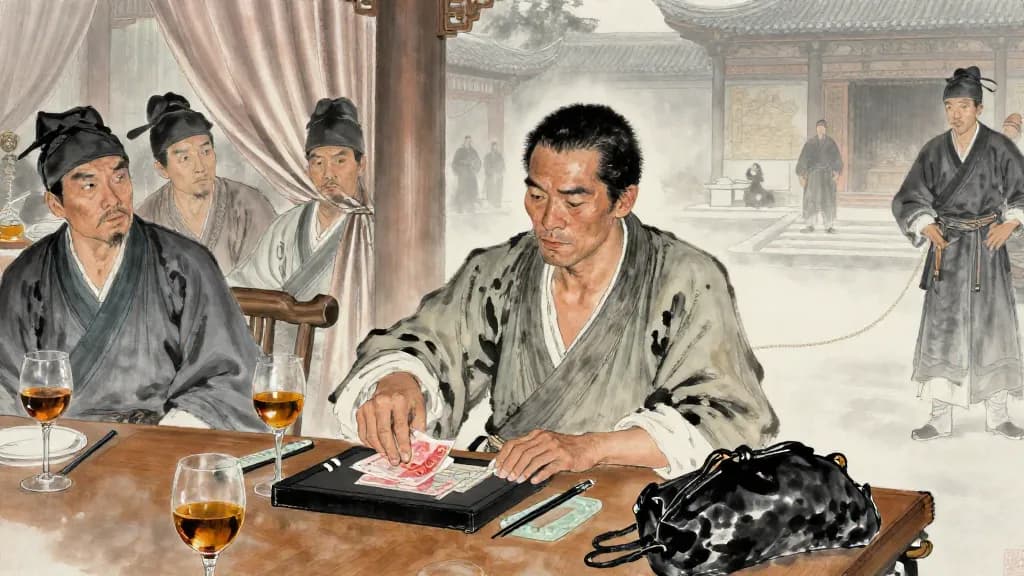
高祖本紀 (Annals of Emperor Gaozu) — Chinese ink painting

Chapter 8 of 130

高祖本紀

Annals of Emperor Gaozu

View:

高祖出身與異相

The Birth and Extraordinary Features of Gaozu

高祖,沛豐邑中陽里人,姓劉氏,字季。父曰太公,母曰劉媼。其先劉媼嘗息大澤之陂,夢與神遇。是時雷電晦冥,太公往視,則見蛟龍於其上。已而有身,遂產高祖。

高祖為人,隆準而龍顏,美須髯,左股有七十二黑子。仁而愛人,喜施,意豁如也。常有大度,不事家人生產作業。及壯,試為吏,為泗水亭長,廷中吏無所不狎侮。好酒及色。常從王媼、武負貰酒,醉臥,武負、王媼見其上常有龍,怪之。高祖每酤留飲,酒讎數倍。及見怪,歲竟,此兩家常折券棄責。

Gaozu is a man of Zhongyang Village in the town of Feng, in the district of Pei. His surname is Liu; his courtesy name is Ji. His father is called the Venerable Sire; his mother, Dame Liu. Previously, Dame Liu once rests by the bank of a great marsh and dreams of an encounter with a spirit. At that moment thunder and lightning darken the sky. The Venerable Sire goes to look and sees a scaly dragon above her. She thereupon conceives and gives birth to Gaozu.

Gaozu has a prominent nose and a dragon-like face, a fine beard and whiskers, and seventy-two dark moles on his left thigh. He is benevolent and fond of people, generous in giving, and open-minded. He always thinks on a grand scale and does not concern himself with the household livelihood. When he comes of age, he is tested as a functionary and becomes Head of the Relay Station at Sishui. He treats none of the officials at the local court with anything but casual disrespect. He is fond of wine and women. He often drinks on credit from Dame Wang and Dame Wu, and falls asleep drunk. Dame Wu and Dame Wang see that a dragon always hovers above him, and find this strange. Whenever Gaozu stays to drink, his wine tab multiplies several times over. Because of the strange omen, at year's end the two families always tear up his tallies and write off the debt.

Notes

personGāozǔ

placePèi Fēngyì Zhōngyáng lǐ

placeSìshuǐ tíng

觀秦皇帝與呂公嫁女

Seeing the First Emperor; Lü Gong Betroths His Daughter

高祖常縋鹹陽,縱觀,觀秦皇帝,喟然太息曰:"嗟乎,大丈夫當如此也!"

單父人呂公善沛令,避仇從之客,因家沛焉。沛中豪桀吏聞令有重客,皆往賀。蕭何為主吏,主進,令諸大夫曰:"進不滿千錢,坐之堂下。"高祖為亭長,素易諸吏,乃紿為謁曰"賀錢萬",實不持一錢。謁入,呂公大驚,起,迎之門。呂公者,好相人,見高祖狀貌,因重敬之,引入坐。蕭何曰:"劉季固多大言,少成事。"高祖因狎侮諸客,遂坐上坐,無所詘。酒闌,呂公因目固留高祖。高祖竟酒,後。呂公曰:"臣少好相人,相人多矣,無如季相,原季自愛。臣有息女,原為季箕帚妾。"酒罷,呂媼怒呂公曰:"公始常欲奇此女,與貴人。沛令善公,求之不與,何自妄許與劉季?"呂公曰:"此非兒女子所知也。"卒與劉季。呂公女乃呂后也,生孝惠帝、魯元公主。

Gaozu once goes to Xianyang on corvée duty and, free to gaze about, observes the First Emperor of Qin. He sighs deeply and says: "Ah! This is how a great man ought to be!"

A man of Shanfu named Lü Gong is on good terms with the magistrate of Pei. To avoid a feud he comes to stay with the magistrate as a guest, and so settles his household in Pei. The powerful men and officials of Pei, hearing that the magistrate has an important guest, all go to offer congratulations. Xiao He serves as chief clerk and manages the gifts, instructing the assembled gentlemen: "Anyone whose gift is less than a thousand cash, sit below the hall." Gaozu, as a mere station chief, has always made light of the officials. He brazenly writes on his calling card "Gift: ten thousand cash" — though he carries not a single coin. When the card is brought in, Lü Gong is greatly startled. He rises and meets Gaozu at the gate. Lü Gong is a man who delights in physiognomy. Seeing Gaozu's features, he treats him with deep respect and leads him inside to a seat. Xiao He says: "Liu Ji is always full of big talk but short on accomplishment." Gaozu proceeds to treat all the other guests with casual disrespect and takes the seat of honor without the slightest embarrassment. When the wine draws to a close, Lü Gong signals with his eyes for Gaozu to stay. After the drinking ends, Gaozu lingers. Lü Gong says: "Since my youth I have been fond of reading faces, and I have read a great many — but none compares with the face of Ji. I hope Ji will take care of himself. I have a daughter, and I wish to offer her as Ji's wife." After the banquet, Dame Lü angrily rebukes Lü Gong: "You always said you wanted to make something extraordinary of this girl — to marry her to a man of rank. The magistrate of Pei is your friend and sought her hand, yet you would not give her. How can you recklessly promise her to Liu Ji?" Lü Gong says: "This is not something a woman would understand." In the end he gives his daughter to Liu Ji. Lü Gong's daughter is none other than Empress Lü. She bears Emperor Hui and Princess Yuan of Lu.

Notes

placeXiányáng

personXiāo Hé

personLǚ Gōng

placeShànfù

personLǚ Hòu

personXiào Huì Dì

personLǔyuán Gōngzhǔ

老父相面與劉氏冠

The Old Man's Prophecy and the Liu Clan Cap

高祖為亭長時,常告歸之田。呂后與兩子居田中耨,有一老父過請飲,呂后因餔之。老父相呂后曰:"夫人天下貴人。"令相兩子,見孝惠,曰:"夫人所以貴者,乃此男也。"相魯元,亦皆貴。老父已去,高祖適從旁舍來,呂后具言客有過,相我子母皆大貴。高祖問,曰:"未遠。"乃追及,問老父。老父曰:"鄉者夫人嬰兒皆似君,君相貴不可言。"高祖乃謝曰:"誠如父言,不敢忘德。"及高祖貴,遂不知老父處。

高祖為亭長,乃以竹皮為冠,令求盜之薛治之,時時冠之,及貴常冠,所謂"劉氏冠"乃是也。

When Gaozu serves as station chief, he often takes leave to go to the fields. Empress Lü lives in the fields with their two children, weeding. An old man passes by and asks for a drink. Empress Lü gives him food. The old man reads Empress Lü's face and says: "Madam is the most exalted woman in All-Under-Heaven." She has him read the children. Seeing Hui, he says: "The reason Madam will be exalted is this boy." He reads the face of Princess Yuan of Lu — she too will be exalted. After the old man has gone, Gaozu happens to come from a neighboring house. Empress Lü tells him everything: that a traveler passed by and read the faces of her and the children, all destined for great eminence. Gaozu asks where the man went. She says: "He has not gone far." He gives chase, catches up, and questions the old man. The old man says: "Just now, the lady and the children all resemble you, my lord. Your face is so noble it is beyond words." Gaozu thanks him and says: "If it is truly as you say, sir, I shall never forget this kindness." By the time Gaozu rises to eminence, the old man's whereabouts are unknown.

While Gaozu serves as station chief, he has a cap made of bamboo bark and sends a thief-catcher to Xue to have it fashioned. He wears it from time to time, and after he becomes eminent he wears it constantly. This is the so-called "Liu Clan Cap."

Notes

placeXuē

斬白蛇起義

Slaying the White Serpent

高祖以亭長為縣送徒酈山,徒多道亡。自度比至皆亡之,到豐西澤中,止飲,夜乃解縱所送徒。曰:"公等皆去,吾亦從此逝矣!"徒中壯士原從者十餘人。高祖被酒,夜徑澤中,令一人行前。行前者還報曰:"前有大蛇當徑,原還。"高祖醉,曰:"壯士行,何畏!"乃前,拔劍擊斬蛇。蛇遂分為兩,徑開。行數里,醉,因臥。後人來至蛇所,有一老嫗夜哭。人問何哭,嫗曰:"人殺吾子,故哭之。"人曰:"嫗子何為見殺?"嫗曰:"吾,白帝子也,化為蛇,當道,今為赤帝子斬之,故哭。"人乃以嫗為不誠,欲告之,嫗因忽不見。後人至,高祖覺。後人告高祖,高祖乃心獨喜,自負。諸從者日益畏之。

As station chief, Gaozu is ordered by the county to escort a gang of convicts to Mount Li. Many abscond along the way. He reckons that by the time they arrive, all will have fled. Reaching the marshes west of Feng, he halts to drink, and that night he releases all the convicts. He says: "You may all go. I too shall disappear from here!" More than ten stout fellows among the convicts wish to follow him. Gaozu, flushed with wine, walks through the marshes by night and sends one man ahead to scout. The scout returns and reports: "There is a great serpent blocking the path. We should turn back." Gaozu, drunk, says: "A brave man walks forward — what is there to fear!" He goes ahead, draws his sword, and strikes the serpent, cleaving it in two. The path opens. After walking several li he lies down, overcome by drink. Those behind come upon the dead serpent. An old woman is weeping in the night. They ask her why. She says: "Someone has killed my son, and so I weep." They ask: "Why was your son killed?" She says: "My son is the son of the White Emperor. He took the form of a serpent and lay across the road. Now the son of the Red Emperor has slain him — that is why I weep." The men think the old woman dishonest and mean to rebuke her, but she suddenly vanishes. When the others catch up, Gaozu is awake. They tell him what happened. Gaozu is secretly delighted and grows self-assured. His followers become daily more in awe of him.

Notes

placeLìshān

glossaryBái Dì zǐ / Chì Dì zǐ

天子氣與陳勝起義

The Emanation of a Son of Heaven; Chen She's Uprising

秦始皇帝常曰"東南有天子氣",於是因東遊以厭之。高祖即自疑,亡匿,隱於芒、碭山澤岩石之間。呂后與人俱求,常得之。高祖怪問之。呂后曰:"季所居上常有雲氣,故從往常得季。"高祖心喜。沛中子弟或聞之,多欲附者矣。

秦二世元年秋,陳勝等起蘄,至陳而王,號為"張楚"。諸郡縣皆多殺其長吏以應陳涉。沛令恐,欲以沛應涉。掾、主吏蕭何、曹參乃曰:"君為秦吏,今欲背之,率沛子弟,恐不聽。原君召諸亡在外者,可得數百人,因劫眾,眾不敢不聽。"乃令樊噲召劉季。劉季之眾已數十百人矣。

The First Emperor of Qin often says: "In the southeast there is the emanation of a Son of Heaven." He therefore makes an eastern tour to suppress it. Gaozu suspects this refers to himself. He flees into hiding among the crags and marshes of Mount Mang and Mount Dang. Empress Lü goes with others to look for him and always finds him. Gaozu, puzzled, asks how. Empress Lü says: "Wherever Ji stays, there are always cloud formations above. By following them I always find Ji." Gaozu is pleased at heart. Some of the young men of Pei hear of this, and many wish to attach themselves to him.

In the autumn of the first year of the Second Emperor of Qin, Chen Sheng and others rise at Qi, advance to Chen, and declare themselves king, adopting the title "Expanded Chu." Throughout the commanderies and counties, many kill their chief officials to answer Chen She's call. The magistrate of Pei is alarmed and wishes to bring Pei over to Chen She's side. The clerks Xiao He and Cao Can say: "You are a Qin official. If you now turn against Qin and try to lead the young men of Pei, they may refuse to follow. We suggest you summon the fugitives who are in hiding outside — that could yield several hundred men. Use them to overawe the people, and the people will not dare refuse." They thereupon order Fan Kuai to summon Liu Ji. Liu Ji's band already numbers several hundred.

Notes

placeMáng, Dàng shān

personChén Shèng

personCáo Cān

personFán Kuài

place

placeChén

沛公起兵

The Lord of Pei Raises His Banner

於是樊噲從劉季來。沛令後悔,恐其有變,乃閉城城守,欲誅蕭、曹。蕭、曹恐,逾城保劉季。劉季乃書帛射城上,謂沛父老曰:"天下苦秦久矣。今父老雖為沛令守,諸侯並起,今屠沛。沛今共誅令,擇子弟可立者立之,以應諸侯,則家室完。不然,父子俱屠,無為也。"父老乃率子弟共殺沛令,開城門迎劉季,欲以為沛令。劉季曰:"天下方擾,諸侯並起,今置將不善,壹敗塗地。吾非敢自愛,恐能薄,不能完父兄子弟。此大事,原更相推擇可者。"蕭、曹等皆文吏,自愛,恐事不就,後秦種族其家,盡讓劉季。諸父老皆曰:"平生所聞劉季諸珍怪,當貴,且卜筮之,莫如劉季最吉。"於是劉季數讓。眾莫敢為,乃立季為沛公。祠黃帝,祭蚩尤於沛庭,而釁鼓旗,幟皆赤。由所殺蛇白帝子,殺者赤帝子,故上赤。於是少年豪吏如蕭、曹、樊噲等皆為收沛子弟二三千人,攻胡陵、方與,還守豐。

Fan Kuai comes with Liu Ji. The magistrate of Pei then regrets his decision, fears a turn of events, and shuts the city gates to defend the walls, intending to execute Xiao He and Cao Can. Xiao and Cao take fright and leap over the wall to join Liu Ji. Liu Ji writes a message on silk and shoots it over the wall, addressing the elders of Pei: "All-Under-Heaven has suffered under Qin for too long. Though you elders now defend the city for the magistrate, the lords are rising on every side and will soon slaughter Pei. If Pei joins together to execute the magistrate and sets up a worthy man from among its own sons to answer the call of the lords, then your homes and families will be preserved. Otherwise, fathers and sons alike will be slaughtered — to no purpose." The elders thereupon lead their sons to kill the magistrate, open the gates, and welcome Liu Ji, wishing to make him magistrate. Liu Ji says: "All-Under-Heaven is in turmoil. The lords are rising on every side. If you choose the wrong general now, a single defeat will ruin everything. It is not that I presume to put myself forward — I fear my abilities are too slight to protect the fathers, brothers, and sons of Pei. This is a great matter. I beg you to deliberate further and choose a worthy man." Xiao He, Cao Can, and the rest are all men of letters. Protective of themselves, they fear the enterprise may fail and that Qin will afterwards exterminate their clans, so all yield to Liu Ji. The elders all say: "We have always heard of the marvels and omens surrounding Liu Ji — he is destined for eminence. Moreover, divination by tortoise and milfoil shows no one so auspicious as Liu Ji." Liu Ji declines several times. None of the others dares to assume the position. They therefore establish Ji as the Lord of Pei. They sacrifice to the Yellow Emperor and to Chiyou in the courtyard of Pei, smear the drums with blood, and make all banners red — because the serpent that was slain was the son of the White Emperor, and the slayer the son of the Red Emperor; hence the color red is exalted. The bold young men and officials — Xiao He, Cao Can, Fan Kuai and the rest — then muster two or three thousand of the young men of Pei, attack Huling and Fangyu, and return to defend Feng.

Notes

glossaryPèi Gōng

placeHúlíng, Fāngyú

雍齒叛豐與項梁會師

Yong Chi's Betrayal at Feng; Joining Forces with Xiang Liang

秦二世二年,陳涉之將周章軍西至戲而還。燕、趙、齊、魏皆自立為王。項氏起吳。秦泗川監平將兵圍豐,二日,出與戰,破之。命雍齒守豐,引兵之薛。泗州守壯敗於薛,走至戚,沛公左司馬得泗川守壯,殺之。沛公還軍亢父,至方與,未戰。陳王使魏人周市略地。周市使人謂雍齒曰:"豐,故梁徙也。今魏地已定者數十城。齒今下魏,魏以齒為侯守豐。不下,且屠豐。"雍齒雅不欲屬沛公,及魏招之,即反為魏守豐。沛公引兵攻豐,不能取。沛公病,還之沛。沛公怨雍齒與豐子弟叛之,聞東陽甯君、秦嘉立景駒為假王,在留,乃往從之,欲請兵以攻豐。是時秦將章邯從陳,別將司馬枿將兵北定楚地,屠相,至碭。東陽甯君、沛公引兵西,與戰蕭西,不利。還收兵聚留,引兵攻碭,三日乃取碭。因收碭兵,得五六千人。攻下邑,拔之。還軍豐。聞項梁在薛,從騎百餘往見之。項梁益沛公卒五千人,五大夫將十人。沛公還,引兵攻豐。

In the second year of the Second Emperor, Zhou Zhang, a general of Chen She, marches his army west as far as Xi but then retreats. Yan, Zhao, Qi, and Wei each set up their own kings. The Xiang clan rises in Wu. The Qin Inspector of Sichuan, Ping, leads troops to besiege Feng. After two days the Lord of Pei sallies forth, engages him, and defeats him. He orders Yong Chi to hold Feng and leads his forces to Xue. The Governor of Si Province, Zhuang, is defeated at Xue, flees to Qi, and the Lord of Pei's Aide-de-Camp of the Left captures and kills him. The Lord of Pei withdraws to Kangfu, then advances to Fangyu without engaging. King Chen sends the Wei man Zhou Shi to take territory. Zhou Shi sends a messenger to Yong Chi, saying: "Feng was formerly resettled from Liang. Now Wei has already secured scores of cities. If you submit to Wei, Wei will make you marquis and let you hold Feng. If you do not submit, Feng will be slaughtered." Yong Chi has always been reluctant to serve the Lord of Pei. When Wei recruits him, he promptly revolts and holds Feng for Wei. The Lord of Pei leads his forces to attack Feng but cannot take it. He falls ill and returns to Pei. Resenting Yong Chi and the men of Feng for their betrayal, and hearing that Ning Jun of Dongyang and Qin Jia have set up Jing Ju as acting king at Liu, he goes to join them, hoping to borrow troops to attack Feng. At this time the Qin general Zhang Han advances from Chen, and his subordinate Sima Nie leads troops north to pacify Chu territory, massacres the people of Xiang, and reaches Dang. Ning Jun of Dongyang and the Lord of Pei lead their forces west and fight west of Xiao, but without success. They fall back, gather troops at Liu, and march to attack Dang. After three days they take Dang, absorb its garrison — gaining five or six thousand men — and attack and take Xiayi. They return to besiege Feng. Hearing that Xiang Liang is at Xue, the Lord of Pei rides out with over a hundred horsemen to meet him. Xiang Liang gives him five thousand additional troops and ten officers of the Fifth Rank. The Lord of Pei returns and leads his forces to attack Feng.

Notes

personYōng Chǐ

personXiàng Liáng

personZhāng Hán

placeXuē

placeDàng

楚懷王與項梁之死

King Huai of Chu and the Death of Xiang Liang

從項梁月餘,項羽已拔襄城還。項梁盡召別將居薛。聞陳王定死,因立楚後懷王孫心為楚王,治盱台。項梁號武信君。居數月,北攻亢父,救東阿,破秦軍。齊軍歸,楚獨追北,使沛公、項羽別攻城陽,屠之。軍濮陽之東,與秦軍戰,破之。

秦軍復振,守濮陽,環水。楚軍去而攻定陶,定陶未下。沛公與項羽西略地至雍丘之下,與秦軍戰,大破之,斬李由。還攻外黃,外黃未下。

項梁再破秦軍,有驕色。宋義諫,不聽。秦益章邯兵,夜銜枚擊項梁,大破之定陶,項梁死。沛公與項羽方攻陳留,聞項梁死,引兵與呂將軍俱東。呂臣軍彭城東,項羽軍彭城西,沛公軍碭。

章邯已破項梁軍,則以為楚地兵不足憂,乃渡河,北擊趙,大破之。當是之時,趙歇為王,秦將王離圍之鉅鹿城,此所謂河北之軍也。

After a month or so with Xiang Liang, Xiang Yu takes Xiangcheng by storm and returns. Xiang Liang summons all his subordinate generals to Xue. Having learned that King Chen is certainly dead, he enthrones Xiong Xin, a grandson of the old King Huai of Chu, as King of Chu, with his court at Xuyi. Xiang Liang takes the title Lord of Wuxin. After several months, they attack Kangfu to the north, rescue Dong'e, and defeat the Qin army. The Qi forces then withdraw. Chu alone pursues the routed enemy. The Lord of Pei and Xiang Yu separately attack Chengyang and put it to the sword. They encamp east of Puyang and engage the Qin army, defeating it.

The Qin army regroups and defends Puyang, moating it with water. The Chu forces move off to attack Dingtao, which does not fall. The Lord of Pei and Xiang Yu sweep westward to Yongqiu, engage the Qin army, and inflict a great defeat, killing Li You. They turn back to attack Waihuang, which does not fall.

Having twice defeated the Qin army, Xiang Liang grows arrogant. Song Yi remonstrates, but Xiang Liang does not listen. Qin reinforces Zhang Han. By night, with gags in their mouths, they strike Xiang Liang, inflict a devastating defeat at Dingtao, and Xiang Liang dies. The Lord of Pei and Xiang Yu are at that moment attacking Chenliu. On hearing of Xiang Liang's death, they withdraw eastward with General Lü. Lü Chen's army encamps east of Pengcheng, Xiang Yu's army west of Pengcheng, and the Lord of Pei's army at Dang.

Having destroyed Xiang Liang's army, Zhang Han concludes that the Chu forces are no longer a concern. He crosses the Yellow River and strikes north against Zhao, inflicting a great defeat. At this time Zhao Xie is king. The Qin general Wang Li besieges him at the city of Julu — this is the so-called "army north of the River."

Notes

personXiàng Yǔ

personHuáiwáng Xióng Xīn

personSòng Yì

placePéngchéng

placeJùlù

personLǐ Yóu

先入關中者王之

"He Who First Enters the Pass Shall Be King"

秦二世三年,楚懷王見項梁軍破,恐,徙盱台都彭城,並呂臣、項羽軍自將之。以沛公為碭郡長,封為武安侯,將碭郡兵。封項羽為長安侯,號為魯公。呂臣為司徒,其父呂青為令尹。

趙數請救,懷王乃以宋義為上將軍,項羽為次將,范增為末將,北救趙。令沛公西略地入關。與諸將約,先入定關中者王之。

當是時,秦兵彊,常乘勝逐北,諸將莫利先入關。獨項羽怨秦破項梁軍,奮,原與沛公西入關。懷王諸老將皆曰:"項羽為人僄悍猾賊。項羽嘗攻襄城,襄城無遺類,皆阬之,諸所過無不殘滅。且楚數進取,前陳王、項梁皆敗。不如更遣長者扶義而西,告諭秦父兄。秦父兄苦其主久矣,今誠得長者往,毋侵暴,宜可下。今項羽僄悍,今不可遣。獨沛公素寬大長者,可遣。"卒不許項羽,而遣沛公西略地,收陳王、項梁散卒。乃道碭至成陽,與槓里秦軍夾壁,破二軍。楚軍出兵擊王離,大破之。

In the third year of the Second Emperor, King Huai of Chu, seeing that Xiang Liang's army has been destroyed, is alarmed. He moves from Xuyi to make his capital at Pengcheng and personally takes command of the armies of Lü Chen and Xiang Yu. He appoints the Lord of Pei as Chief of Dang commandery, enfeoffs him as Marquis of Wu'an, and gives him command of the Dang garrison. He enfeoffs Xiang Yu as Marquis of Chang'an with the title Lord of Lu. Lü Chen is made Minister of Works, and his father Lü Qing is made Chief Minister.

Zhao repeatedly begs for rescue. King Huai thereupon appoints Song Yi as supreme general, Xiang Yu as second-in-command, and Fan Zeng as junior general, and sends them north to relieve Zhao. He orders the Lord of Pei to sweep westward and enter the Pass. He makes a covenant with all the generals: he who first enters and pacifies the land within the passes shall be made its king.

At this time the Qin army is strong, constantly pursuing and exploiting its victories. None of the generals see any advantage in being first to enter the Pass. Only Xiang Yu, burning with rage against Qin for destroying Xiang Liang's army, is eager and wishes to go west into the Pass with the Lord of Pei. The senior generals at King Huai's court all say: "Xiang Yu is headstrong, savage, cunning, and destructive. When Xiang Yu attacked Xiangcheng, not a living soul remained — he buried them all alive. Wherever he passes, nothing is left but ruin. Moreover, Chu has repeatedly advanced only to fail — first King Chen, then Xiang Liang, both met defeat. It would be better to send a man of magnanimity who upholds righteousness to go west and persuade the fathers and elders of Qin. The fathers and elders of Qin have long suffered under their ruler. If we can truly send a man of magnanimity who refrains from violence, the land should submit. Xiang Yu is headstrong and savage — he must not be sent. Only the Lord of Pei has always been a generous man of magnanimity — he should be sent." In the end they refuse Xiang Yu's request and dispatch the Lord of Pei to sweep westward, rallying the scattered troops of King Chen and Xiang Liang. He takes the road from Dang to Chengyang, confronts the Qin army at Gangli in a double encampment, and defeats both forces. The Chu army also sends troops to strike Wang Li, inflicting a great defeat.

Notes

personFàn Zēng

glossaryGuānzhōng

placeXūyí

沛公西進入關

The Lord of Pei's Westward March into the Pass

沛公引兵西,遇彭越昌邑,因與俱攻秦軍,戰不利。還至栗,遇剛武侯,奪其軍,可四千餘人,並之。與魏將皇欣、魏申徒武蒲之軍並攻昌邑,昌邑未拔。西過高陽。酈食其監門,曰:"諸將過此者多,吾視沛公大人長者。"乃求見說沛公。沛公方踞床,使兩女子洗足。酈生不拜,長揖,曰:"足下必欲誅無道秦,不宜踞見長者。"於是沛公起,攝衣謝之,延上坐。食其說沛公襲陳留,得秦積粟。乃以酈食其為廣野君,酈商為將,將陳留兵,與偕攻開封,開封未拔。西與秦將楊熊戰白馬,又戰曲遇東,大破之。楊熊走之滎陽,二世使使者斬以徇。南攻潁陽,屠之。因張良遂略韓地轘轅。

The Lord of Pei leads his forces west and encounters Peng Yue at Changyi. They join to attack the Qin army but without success. He falls back to Li and encounters the Marquis of Gangwu. He seizes his forces — some four thousand men — and absorbs them. Together with the Wei generals Huang Xin and the Wei Marshal Wu Pu, he attacks Changyi, which does not fall. He passes west through Gaoyang. Li Yiji, a gate-watcher there, says: "Many generals have passed through here, but I judge the Lord of Pei to be a man of magnanimity." He requests an audience and addresses the Lord of Pei. The Lord of Pei is at that moment sitting with legs spread on a couch, having two serving girls wash his feet. Master Li does not bow but gives a long salute and says: "If Your Lordship truly intends to destroy the lawless Qin, it is not fitting to sit with legs spread while receiving an elder." The Lord of Pei rises at once, straightens his robes, apologizes, and invites him to the seat of honor. Li Yiji advises the Lord of Pei to raid Chenliu to seize the Qin grain stores. He thereupon makes Li Yiji Lord of Guangye, and Li Yiji's brother Li Shang a general commanding the troops of Chenliu. Together they attack Kaifeng, which does not fall. Going west, they engage the Qin general Yang Xiong at Baima, then fight again east of Quyu and inflict a great defeat. Yang Xiong flees to Yingyang. The Second Emperor sends an envoy to behead Yang Xiong as an example. They attack Yingyang to the south and put it to the sword. Joining forces with Zhang Liang, they sweep through the Han territory at Huanyuan.

Notes

personPéng Yuè

personLì Yìjī

personZhāng Liáng

placeChāngyì

placeGāoyáng

placeXíngyáng

placeHuányuán

攻破武關入鹹陽

Breaking Through Wuguan and Entering Xianyang

當是時,趙別將司馬卬方欲渡河入關,沛公乃北攻平陰,絕河津。南,戰雒陽東,軍不利,還至陽城,收軍中馬騎,與南陽守齮戰犨東,破之。略南陽郡,南陽守齮走,保城守宛。沛公引兵過而西。張良諫曰:"沛公雖欲急入關,秦兵尚眾,距險。今不下宛,宛從後擊,彊秦在前,此危道也。"於是沛公乃夜引兵從他道還,更旗幟,黎明,圍宛城三匝。南陽守欲自剄。其舍人陳恢曰:"死未晚也。"乃逾城見沛公,曰:"臣聞足下約,先入鹹陽者王之。今足下留守宛。宛,大郡之都也,連城數十,人民眾,積蓄多,吏人自以為降必死,故皆堅守乘城。今足下盡日止攻,士死傷者必多;引兵去宛,宛必隨足下後:足下前則失鹹陽之約,後又有彊宛之患。為足下計,莫若約降,封其守,因使止守,引其甲卒與之西。諸城未下者,聞聲爭開門而待,足下通行無所累。"沛公曰:"善。"乃以宛守為殷侯,封陳恢千戶。引兵西,無不下者。至丹水,高武侯鰓、襄侯王陵降西陵。還攻胡陽,遇番君別將梅鋗,與皆,降析、酈。遣魏人甯昌使秦,使者未來。是時章邯已以軍降項羽於趙矣。

At this time the Zhao general Sima Ang is about to cross the Yellow River and enter the Pass. The Lord of Pei therefore attacks Pingyin to the north and cuts the river crossings. Moving south, he fights east of Luoyang but his army fares badly. He falls back to Yangcheng, gathers his cavalry, and engages the Governor of Nanyang, Yi, east of Chou, defeating him. He sweeps through Nanyang commandery. The Governor flees and holds up in the walled city of Wan. The Lord of Pei leads his forces past it and heads west. Zhang Liang remonstrates: "Though the Lord of Pei is anxious to enter the Pass quickly, Qin still has numerous troops holding the defiles. If you do not take Wan now, Wan will attack from behind while the might of Qin lies before you — this is a path to disaster." The Lord of Pei thereupon leads his troops back by another road under cover of night, changes his banners, and at dawn encircles the city of Wan three times over. The Governor of Nanyang is about to cut his own throat. His retainer Chen Hui says: "It is not too late to die." He climbs over the wall to see the Lord of Pei and says: "I have heard that Your Lordship has a covenant: he who first enters Xianyang shall be king. Now Your Lordship lingers at Wan. Wan is the seat of a great commandery, with scores of walled cities in a chain, its population large and its stores ample. The officials believe that to surrender means certain death, so they all hold fast to the walls. If Your Lordship spends the whole day in assault, many soldiers will be killed and wounded. If you withdraw and leave Wan, Wan's forces will follow on your heels — before you lies the loss of the covenant for Xianyang, behind you the menace of a strong Wan. In my estimation, the best course is to offer terms of surrender: enfeoff the Governor, have him remain as garrison commander, and take his armored troops with you westward. When the other cities that have not yet fallen hear of this, they will vie to open their gates and await you. Your Lordship will pass through unhindered." The Lord of Pei says: "Excellent." He thereupon enfeoffs the Governor of Wan as Marquis of Yin and grants Chen Hui a fief of a thousand households. He leads his forces west, and none fail to submit. At Danshui, the Marquis of Gaowu, Sai, and the Marquis of Xiang, Wang Ling, surrender Xiling. He turns back to attack Huyang, where he encounters Mei Xuan, a subordinate general of the Lord of Fan. Together they take Xi and Li by surrender. He sends the Wei man Ning Chang as envoy to Qin. The envoy has not yet returned. By this time Zhang Han has already surrendered his army to Xiang Yu in Zhao.

Notes

placeYuān

personChén Huī

personWáng Líng

placeLuòyáng

placeDānshuǐ

破武關滅秦

Breaking Wuguan and the Fall of Qin

初,項羽與宋義北救趙,及項羽殺宋義,代為上將軍,諸將黥布皆屬,破秦將王離軍,降章邯,諸侯皆附。及趙高已殺二世,使人來,欲約分王關中。沛公以為詐,乃用張良計,使酈生、陸賈往說秦將,啗以利,因襲攻武關,破之。又與秦軍戰於藍田南,益張疑兵旗幟,諸所過毋得掠鹵,秦人憙,秦軍解,因大破之。又戰其北,大破之。乘勝,遂破之。

Earlier, Xiang Yu and Song Yi go north to relieve Zhao. When Xiang Yu kills Song Yi and takes his place as supreme general, all the subordinate generals — including Qing Bu — submit to him. He destroys the army of the Qin general Wang Li, receives the surrender of Zhang Han, and all the lords attach themselves to him. When Zhao Gao has already killed the Second Emperor, he sends a messenger proposing to divide the land within the passes and share kingship. The Lord of Pei considers this a ruse. Adopting Zhang Liang's plan, he sends Master Li and Lu Jia to persuade the Qin generals, enticing them with profit, and then launches a surprise attack on Wuguan, breaking through it. He then engages the Qin army south of Lantian, deploying ever more decoy banners and flags, and forbidding all plunder wherever he passes. The people of Qin are pleased. The Qin army's cohesion slackens, and he inflicts a devastating defeat. He fights again north of Lantian and inflicts another great defeat. Pressing his advantage, he shatters the Qin forces completely.

Notes

personQíng Bù

personZhào Gāo

personLù Jiǎ

placeWǔguān

placeLántián

personWáng Lí

秦王子嬰投降與約法三章

The Surrender of King Ziying and the Three Articles of Law

漢元年十月,沛公兵遂先諸侯至霸上。秦王子嬰素車白馬,系頸以組,封皇帝璽符節,降軹道旁。諸將或言誅秦王。沛公曰:"始懷王遣我,固以能寬容;且人已服降,又殺之,不祥。"乃以秦王屬吏,遂西入鹹陽。欲止宮休舍,樊噲、張良諫,乃封秦重寶財物府庫,還軍霸上。召諸縣父老豪桀曰:"父老苦秦苛法久矣,誹謗者族,偶語者棄巿。吾與諸侯約,先入關者王之,吾當王關中。與父老約,法三章耳:殺人者死,傷人及盜抵罪。餘悉除去秦法。諸吏人皆案堵如故。凡吾所以來,為父老除害,非有所侵暴,無恐!且吾所以還軍霸上,待諸侯至而定約束耳。"乃使人與秦吏行縣鄉邑,告諭之。秦人大喜,爭持牛羊酒食獻饗軍士。沛公又讓不受,曰:"倉粟多,非乏,不欲費人。"人又益喜,唯恐沛公不為秦王。

In the tenth month of the first year of Han, the Lord of Pei's forces are the first among the lords to reach Bashang. The King of Qin, Ziying, arrives in a plain carriage drawn by white horses, a cord tied about his neck. He presents the imperial seals, tallies, and credentials, and surrenders by the side of the Zhi Road. Some of the generals urge that the King of Qin be executed. The Lord of Pei says: "King Huai sent me precisely because I am able to show leniency. Moreover, the man has already submitted and surrendered — to kill him now would be inauspicious." He hands the King of Qin over to the officials and proceeds west into Xianyang. He is about to quarter himself in the palace when Fan Kuai and Zhang Liang remonstrate. He thereupon seals up the Qin storehouses of treasure, valuables, and wealth, and withdraws his army to Bashang. He summons the elders and leading men of the counties and says: "Elders, you have long suffered under the harsh laws of Qin — those who criticized the government had their clans exterminated; those who so much as whispered together were executed in the marketplace. I have a covenant with the lords: he who first enters the Pass shall be its king. I am to be king of the land within the passes. I make a covenant with you elders: the law shall consist of three articles only — he who kills shall die; he who injures another or steals shall be punished accordingly. All the rest of the Qin laws are hereby abolished. All officials and people shall carry on as before. The sole reason I have come is to rid you elders of harm, not to commit any violence. Have no fear! Furthermore, the reason I have withdrawn my army to Bashang is merely to await the arrival of the other lords and settle the terms of our agreement." He then sends men along with the Qin officials to tour the counties, townships, and towns and proclaim this. The people of Qin are overjoyed, vying with one another to bring cattle, sheep, wine, and food to feast the soldiers. The Lord of Pei again declines, refusing to accept, saying: "The granaries have plenty of grain — there is no shortage. I do not wish to burden the people." The people are even more pleased, their only fear being that the Lord of Pei will not become King of Qin.

Notes

personZǐ Yīng

placeBàshàng

glossaryyuē fǎ sān zhāng

placeZhǐdào

鴻門宴

The Feast at Hong Gate

或說沛公曰:"秦富十倍天下,地形彊。今聞章邯降項羽,項羽乃號為雍王,王關中。今則來,沛公恐不得有此。可急使兵守函谷關,無內諸侯軍,稍徵關中兵以自益,距之。"沛公然其計,從之。十一月中,項羽果率諸侯兵西,欲入關,關門閉。聞沛公已定關中,大怒,使黥布等攻破函谷關。十二月中,遂至戲。沛公左司馬曹無傷聞項王怒,欲攻沛公,使人言項羽曰:"沛公欲王關中,令子嬰為相,珍寶盡有之。"欲以求封。亞父勸項羽擊沛公。方飨士,旦日合戰。是時項羽兵四十萬,號百萬。沛公兵十萬,號二十萬,力不敵。會項伯欲活張良,夜往見良,因以文諭項羽,項羽乃止。沛公從百餘騎,驅之鴻門,見謝項羽。項羽曰:"此沛公左司馬曹無傷言之。不然,籍何以生此!"沛公以樊噲、張良故,得解歸。歸,立誅曹無傷。

Someone advises the Lord of Pei: "Qin is ten times richer than All-Under-Heaven, and its terrain is strong. Now I hear that Zhang Han has surrendered to Xiang Yu, and Xiang Yu has named him King of Yong, to rule the land within the passes. When he arrives, the Lord of Pei may not be able to keep this territory. You should urgently station troops to guard Hangu Pass, refuse entry to the armies of the lords, and gradually conscript more soldiers within the passes to strengthen yourself and resist." The Lord of Pei approves this plan and follows it. In the eleventh month, Xiang Yu indeed leads the armies of the lords westward, intending to enter the Pass, but finds the gates shut. Hearing that the Lord of Pei has already pacified the land within the passes, he is enraged and sends Qing Bu and others to break through Hangu Pass. By the twelfth month he reaches Xi. The Lord of Pei's Aide-de-Camp of the Left, Cao Wushang, hearing that Lord Xiang is furious and means to attack, sends a man to tell Xiang Yu: "The Lord of Pei intends to make himself king of the land within the passes, with Ziying as his chancellor, and to keep all the treasures for himself." He does this hoping to gain an enfeoffment for himself. The Second Father urges Xiang Yu to strike the Lord of Pei. The feast for the troops is being prepared; battle is set for the following dawn. At this time Xiang Yu has four hundred thousand soldiers, nominally a million. The Lord of Pei has a hundred thousand, nominally two hundred thousand — he is no match. As it happens, Xiang Bo wishes to save Zhang Liang's life and goes to see him by night. Through this connection Zhang Liang persuades Xiang Yu with a written appeal, and Xiang Yu relents. The Lord of Pei rides to Hong Gate with just over a hundred horsemen, meets Xiang Yu, and apologizes. Xiang Yu says: "This was told to me by your Aide-de-Camp of the Left, Cao Wushang. Otherwise, how would I have conceived such a thing!" Thanks to Fan Kuai and Zhang Liang, the Lord of Pei manages to escape and return. Upon his return, he immediately executes Cao Wushang.

Notes

placeHángǔguān

placeHóngmén

personCáo Wúshāng

personXiàng Bó

glossaryYàfù

place

項羽屠鹹陽與分封諸侯

Xiang Yu Sacks Xianyang and Distributes the Kingdoms

項羽遂西,屠燒鹹陽秦宮室,所過無不殘破。秦人大失望,然恐,不敢不服耳。

項羽使人還報懷王。懷王曰:"如約。"項羽怨懷王不肯令與沛公俱西入關,而北救趙,後天下約。乃曰:"懷王者,吾家項梁所立耳,非有功伐,何以得主約!本定天下,諸將及籍也。"乃詳尊懷王為義帝,實不用其命。

正月,項羽自立為西楚霸王,王梁、楚地九郡,都彭城。負約,更立沛公為漢王,王巴、蜀、漢中,都南鄭。三分關中,立秦三將:章邯為雍王,都廢丘;司馬欣為塞王,都櫟陽;董翳為翟王,都高奴。楚將瑕丘申陽為河南王,都洛陽。趙將司馬卬為殷王,都朝歌。趙王歇徙王代。趙相張耳為常山王,都襄國。當陽君黥布為九江王,都六。懷王柱國共敖為臨江王,都江陵。番君吳芮為衡山王,都邾。燕將臧荼為燕王,都薊。故燕王韓廣徙王遼東。廣不聽,臧荼攻殺之無終。封成安君陳餘河間三縣,居南皮。封梅鋗十萬戶。

Xiang Yu then moves west, sacking and burning the palaces of Qin at Xianyang. Everything in his path is ravaged. The people of Qin are bitterly disappointed, yet so frightened that they dare not refuse submission.

Xiang Yu sends a messenger to report to King Huai. King Huai says: "Abide by the covenant." Xiang Yu resents King Huai for refusing to let him go west into the Pass with the Lord of Pei and instead sending him north to relieve Zhao, which caused him to miss the covenant with All-Under-Heaven. He says: "King Huai was set up by my uncle Xiang Liang — he has no merit of his own. By what right does he preside over the covenant? Those who truly pacified All-Under-Heaven are the generals — and I, Ji." He then ostensibly honors King Huai with the title Righteous Emperor, but in reality ignores his commands.

In the first month, Xiang Yu proclaims himself Hegemon-King of Western Chu, ruling nine commanderies of Liang and Chu, with his capital at Pengcheng. Breaking the covenant, he instead names the Lord of Pei King of Han, giving him Ba, Shu, and Hanzhong, with his capital at Nanzheng. He divides the land within the passes into three, establishing the three surrendered Qin generals as kings: Zhang Han as King of Yong, with his capital at Feiqiu; Sima Xin as King of Sai, with his capital at Liyang; Dong Yi as King of Di, with his capital at Gaonu. The Chu general Shen Yang of Xiaqiu is made King of Henan, with his capital at Luoyang. The Zhao general Sima Ang is made King of Yin, with his capital at Zhaoge. King Xie of Zhao is transferred to rule Dai. The Zhao chancellor Zhang Er is made King of Changshan, with his capital at Xiangguo. The Lord of Dangyang, Qing Bu, is made King of Jiujiang, with his capital at Liu. Gong Ao, King Huai's Pillar of State, is made King of Linjiang, with his capital at Jiangling. The Lord of Fan, Wu Rui, is made King of Hengshan, with his capital at Zhu. The Yan general Zang Tu is made King of Yan, with his capital at Ji. The former King of Yan, Han Guang, is transferred to rule Liaodong. Guang refuses to go; Zang Tu attacks and kills him at Wuzhong. The Lord of Cheng'an, Chen Yu, is enfeoffed with three counties in Hejian and resides at Nanpi. Mei Xuan is enfeoffed with a hundred thousand households.

Notes

glossaryXī Chǔ Bàwáng

glossaryHàn Wáng

placeNánzhèng

placeBā, Shǔ, Hànzhōng

personSīmǎ Xīn

personDǒng Yì

personZhāng Ěr

personWú Ruì

glossaryYì Dì

placeFèiqiū

漢王就國與韓信進言

The King of Han Goes to His Kingdom; Han Xin's Counsel

四月,兵罷戲下,諸侯各就國。漢王之國,項王使卒三萬人從,楚與諸侯之慕從者數萬人,從杜南入蝕中。去輒燒絕棧道,以備諸侯盜兵襲之,亦示項羽無東意。至南鄭,諸將及士卒多道亡歸,士卒皆歌思東歸。韓信說漢王曰:「項羽王諸將之有功者,而王獨居南鄭,是遷也。軍吏士卒皆山東之人也,日夜跂而望歸,及其鋒而用之,可以有大功。天下已定,人皆自寧,不可復用。不如決策東鄉,爭權天下。」

In the fourth month, the armies are disbanded at Xihe, and the feudal lords each depart for their kingdoms. As the King of Han proceeds to his domain, the King of Xiang sends thirty thousand soldiers to escort him; several tens of thousands more from Chu and the other lords follow of their own accord. They enter the Bao Valley from south of Du. As they advance, they burn the plank roads behind them — partly to guard against surprise attack by the other lords, and partly to signal to Xiang Yu that they have no intention of returning east. Upon reaching Nanzheng, many generals and soldiers desert along the way and flee home. The troops all sing songs longing to return east. Han Xin addresses the King of Han: "Xiang Yu has made kings of those generals who served him well, yet Your Majesty alone has been banished to Nanzheng — this is exile. Your officers and soldiers are all men from east of the mountains. Day and night they stand on tiptoe looking homeward. Use them now while their ardor is keen, and great deeds can be accomplished. Once All-Under-Heaven is settled and men grow comfortable, they can never be used again. Better to decide at once on an eastern campaign and contend for mastery of All-Under-Heaven."

Notes

personHán Xìn

placeNánzhèng

placezhàndào

還定三秦

Returning to Conquer the Three Qin Kingdoms

八月,漢王用韓信之計,從故道還,襲雍王章邯。邯迎擊漢陳倉,雍兵敗,還走;止戰好畤,又復敗,走廢丘。漢王遂定雍地。東至鹹陽,引兵圍雍王廢丘,而遣諸將略定隴西、北地、上郡。令將軍薛歐、王吸出武關,因王陵兵南陽,以迎太公、呂后於沛。楚聞之,發兵距之陽夏,不得前。令故吳令鄭昌為韓王,距漢兵。

二年,漢王東略地,塞王欣、翟王翳、河南王申陽皆降。韓王昌不聽,使韓信擊破之。於是置隴西、北地、上郡、渭南、河上、中地郡;關外置河南郡。更立韓太尉信為韓王。諸將以萬人若以一郡降者,封萬戶。繕治河上塞。諸故秦苑囿園池,皆令人得田之,正月,虜雍王弟章平。大赦罪人。

In the eighth month, the King of Han employs Han Xin's strategy: he returns by the old road through Chencang and launches a surprise attack on Zhang Han, King of Yong. Zhang Han meets the Han forces at Chencang but his troops are defeated and he falls back. He makes a stand at Haozhi but is defeated again and flees to Feiqiu. The King of Han thereupon pacifies the territory of Yong. He advances east to Xianyang, besieges Zhang Han at Feiqiu, and dispatches his generals to subdue the commanderies of Longxi, Beidi, and Shangjun. He orders Generals Xue Ou and Wang Xi to march out through Wuguan, combining forces with Wang Ling's troops in Nanyang, to escort the Venerable Sire and Lady Lü from Pei. But Chu hears of this and sends troops to block them at Yangxia; they cannot get through. Chu appoints the former magistrate of Wu, Zheng Chang, as King of Han to resist the Han armies.

In the second year, the King of Han pushes east to take territory. Sima Xin, King of Sai, Dong Yi, King of Di, and Shen Yang, King of Henan, all surrender. Zheng Chang, King of Han, refuses to submit; Han Xin is sent to crush him. The King of Han then establishes the commanderies of Longxi, Beidi, Shangjun, Weinan, Heshang, and Zhongdi; beyond the passes he establishes the commandery of Henan. He installs the Han Grand Commandant Xin as the new King of Han. Any general who has brought about the surrender of ten thousand men or an entire commandery is enfeoffed with ten thousand households. The frontier fortifications along the Yellow River are repaired. All the former Qin imperial parks, gardens, and pools are opened so that the common people may farm them. In the first month, the younger brother of the King of Yong, Zhang Ping, is captured. A general amnesty is proclaimed.

Notes

personZhāng Hán

placeChéncāng

personWáng Líng

義帝發喪與東伐楚

Mourning for the Righteous Emperor; The Eastern Campaign Against Chu

漢王之出關至陝,撫關外父老,還,張耳來見,漢王厚遇之。

二月,令除秦社稷,更立漢社稷。

三月,漢王從臨晉渡,魏王豹將兵從。下河內,虜殷王,置河內郡。南渡平陰津,至雒陽。新城三老董公遮說漢王以義帝死故。漢王聞之,袒而大哭。遂為義帝發喪,臨三日。發使者告諸侯曰:「天下共立義帝,北面事之。今項羽放殺義帝於江南,大逆無道。寡人親為發喪,諸侯皆縞素。悉發關內兵,收三河士,南浮江漢以下,原從諸侯王擊楚之殺義帝者。」

The King of Han marches out of the passes as far as Shan, where he comforts the elders beyond the passes, then returns. Zhang Er comes to see him, and the King of Han receives him generously.

In the second month, he orders the Qin altars of soil and grain demolished and the Han altars established in their place.

In the third month, the King of Han crosses the Yellow River at Linjin. Wei Bao, King of Wei, joins him with troops. They take Henei and capture Shen Yang, King of Yin, establishing the commandery of Henei. They cross southward at Pingyin Ford and reach Luoyang. Dong Gong, a village elder of Xincheng, intercepts the King of Han and tells him of the death of the Righteous Emperor. When the King of Han hears this, he bares his arms and weeps bitterly. He then proclaims a state mourning for the Righteous Emperor, observing it for three days. He dispatches envoys to announce to all the feudal lords: "All-Under-Heaven jointly enthroned the Righteous Emperor and served him as sovereign. Now Xiang Yu has banished and murdered the Righteous Emperor in the south of the Yangtze — an act of supreme treason and depravity. We personally conduct the mourning rites; let all the feudal lords don white garments of grief. We shall mobilize the full strength of the armies within the passes, muster the soldiers of the Three Rivers, and sail south down the Yangtze and Han. We call upon the kings of the feudal lords to join us in striking down those who murdered the Righteous Emperor."

Notes

personYì Dì

personZhāng Ěr

placeLuòyáng

彭城之敗

The Catastrophe at Pengcheng

是時項王北擊齊,田榮與戰城陽。田榮敗,走平原,平原民殺之。齊皆降楚。楚因焚燒其城郭,系虜其子女。齊人叛之。田榮弟橫立榮子廣為齊王,齊王反楚城陽。項羽雖聞漢東,既已連齊兵,欲遂破之而擊漢。漢王以故得劫五諸侯兵,遂入彭城。項羽聞之,乃引兵去齊,從魯出胡陵,至蕭,與漢大戰彭城靈壁東睢水上,大破漢軍,多殺士卒,睢水為之不流。乃取漢王父母妻子於沛,置之軍中以為質。當是時,諸侯見楚彊漢敗,還皆去漢復為楚。塞王欣亡入楚。

At this time the King of Xiang is campaigning northward against Qi. Tian Rong fights him at Chengyang but is defeated and flees to Pingyuan, where the people kill him. All of Qi surrenders to Chu. But Chu burns the cities and walls, and carries off Qi's women and children as captives. The people of Qi rebel. Tian Rong's brother Heng sets up Rong's son Guang as King of Qi, and the new King of Qi revolts against Chu at Chengyang. Although Xiang Yu hears that the King of Han is advancing east, he is already entangled with the Qi armies and resolves to finish them before turning to face Han. The King of Han therefore succeeds in coercing the armies of five feudal lords into his coalition and enters Pengcheng.

When Xiang Yu hears of this, he withdraws from Qi, marches out through Lu and Huling to Xiao, and engages the Han forces in a great battle east of Lingbi on the banks of the Sui River. He utterly destroys the Han army, slaughtering so many soldiers that the Sui River ceases to flow. He then seizes the King of Han's father, mother, wife, and children at Pei and holds them hostage in the Chu camp. At this, the feudal lords — seeing Chu's strength and Han's defeat — all abandon the King of Han and return to Chu's allegiance. Sima Xin, King of Sai, flees to Chu.

Notes

placePéngchéng

placeSuī shuǐ

滎陽之圍與陳平離間

The Siege of Xingyang; Chen Ping's Stratagems

漢王軍滎陽南,築甬道屬之河,以取敖倉。與項羽相距歲餘。項羽數侵奪漢甬道,漢軍乏食,遂圍漢王。漢王請和,割滎陽以西者為漢。項王不聽。漢王患之,乃用陳平之計,予陳平金四萬斤,以間疏楚君臣。於是項羽乃疑亞父。亞父是時勸項羽遂下滎陽,及其見疑,乃怒,辭老,原賜骸骨歸卒伍,未至彭城而死。

漢軍絕食,乃夜出女子東門二千餘人,被甲,楚因四面擊之。將軍紀信乃乘王駕,詐為漢王,誑楚,楚皆呼萬歲,之城東觀,以故漢王得與數十騎出西門遁。令御史大夫周苛、魏豹、樅公守滎陽。諸將卒不能從者,盡在城中。周苛、樅公相謂曰:「反國之王,難與守城。」因殺魏豹。

The King of Han stations his army south of Xingyang and builds a walled corridor connecting to the Yellow River to draw grain from the Ao Granary. He holds off Xiang Yu for over a year. But Xiang Yu repeatedly raids and seizes the corridor, and the Han army runs short of food. Xiang Yu then lays siege to the King of Han. The King of Han sues for peace, offering to cede everything west of Xingyang to Han. The King of Xiang refuses. The King of Han, deeply worried, adopts Chen Ping's stratagem: he gives Chen Ping forty thousand catties of gold to sow discord between Chu's sovereign and his ministers. As a result, Xiang Yu grows suspicious of the Second Father, Fan Zeng. Fan Zeng — who at this very moment is urging Xiang Yu to press the siege and take Xingyang — becomes furious at the mistrust, pleads old age, and begs leave to return home as a common soldier. He dies before reaching Pengcheng.

The Han army's food runs out entirely. At night, over two thousand women are sent out through the east gate wearing armor. Chu attacks them from all four sides. General Ji Xin then mounts the king's carriage, pretending to be the King of Han, and deceives Chu. The Chu soldiers all shout "Ten thousand years!" and rush to the east side of the city to look. Thus the King of Han escapes through the west gate with a few dozen horsemen. He leaves the Imperial Secretary Zhou Ke, Wei Bao, and the Duke of Zong to hold Xingyang. All the officers and men unable to follow remain in the city. Zhou Ke and the Duke of Zong say to one another: "A king who has turned traitor against his own state cannot be trusted to hold a city." They then kill Wei Bao.

Notes

placeXíngyáng

personChén Píng

personYàfù

personJì Xìn

成皋爭奪與韓信破齊

The Struggle for Chenggao; Han Xin Conquers Qi

漢王之出滎陽入關,收兵欲復東。袁生說漢王曰:「漢與楚相距滎陽數歲,漢常困。原君王出武關,項羽必引兵南走,王深壁,令滎陽成皋間且得休。使韓信等輯河北趙地,連燕齊,君王乃復走滎陽,未晚也。如此,則楚所備者多,力分,漢得休,復與之戰,破楚必矣。」漢王從其計,出軍宛葉間,與黥布行收兵。

項羽聞漢王在宛,果引兵南。漢王堅壁不與戰。是時彭越渡睢水,與項聲、薛公戰下邳,彭越大破楚軍。項羽乃引兵東擊彭越。漢王亦引兵北軍成皋。項羽已破走彭越,聞漢王復軍成皋,乃復引兵西,拔滎陽,誅周苛、樅公,而虜韓王信,遂圍成皋。

漢王跳,獨與滕公共車出成皋玉門,北渡河,馳宿脩武。自稱使者,晨馳入張耳、韓信壁,而奪之軍。乃使張耳北益收兵趙地,使韓信東擊齊。漢王得韓信軍,則復振。引兵臨河,南饗軍小脩武南,欲復戰。郎中鄭忠乃說止漢王,使高壘深塹,勿與戰。漢王聽其計,使盧綰、劉賈將卒二萬人,騎數百,渡白馬津,入楚地,與彭越復擊破楚軍燕郭西,遂復下樑地十餘城。

淮陰已受命東,未渡平原。漢王使酈生往說齊王田廣,廣叛楚,與漢和,共擊項羽。韓信用蒯通計,遂襲破齊。齊王烹酈生,東走高密。項羽聞韓信已舉河北兵破齊、趙,且欲擊楚,則使龍且、周蘭往擊之。韓信與戰,騎將灌嬰擊,大破楚軍,殺龍且。齊王廣餎彭越。當此時,彭越將兵居梁地,往來苦楚兵,絕其糧食。

After the King of Han escapes from Xingyang and returns to the passes to raise fresh troops, Yuan Sheng counsels him: "Han has been pinned at Xingyang for years and is always on the defensive. If Your Majesty marches out through Wuguan, Xiang Yu will surely lead his army south in pursuit. Build deep ramparts and hold fast, giving the forces between Xingyang and Chenggao time to rest. Meanwhile, send Han Xin to pacify Zhao north of the River, link up with Yan and Qi, and then return to Xingyang — it will not be too late. This way, Chu must guard against threats on every side, its strength will be divided, and Han will be rested. When you fight again, the destruction of Chu is certain." The King of Han follows this plan, marching his army into the area between Wan and Ye, where he joins Qing Bu to gather troops.

Xiang Yu hears that the King of Han is at Wan and, just as predicted, leads his army south. The King of Han fortifies his position and refuses battle. At this point Peng Yue crosses the Sui River, engages the Chu generals Xiang Sheng and the Duke of Xue at Xiapi, and inflicts a major defeat. Xiang Yu wheels east to strike Peng Yue. The King of Han then moves north and stations his army at Chenggao. After routing Peng Yue, Xiang Yu hears that the King of Han has reoccupied Chenggao. He turns west again, takes Xingyang, executes Zhou Ke and the Duke of Zong, captures Xin the King of Han, and then besieges Chenggao.

The King of Han slips away. With only the Marquis of Teng sharing his chariot, he escapes through the Jade Gate of Chenggao, crosses the Yellow River northward, and rides through the night to Xiuwu. At dawn, claiming to be a messenger, he gallops into the camp of Zhang Er and Han Xin — and seizes command of their army. He then sends Zhang Er north to recruit more soldiers in Zhao, and orders Han Xin east to attack Qi. With Han Xin's forces now under his direct control, the King of Han's strength is restored. He advances to the bank of the Yellow River and feasts the army south of Xiao Xiuwu, intending to resume offensive operations. But the palace gentleman Zheng Zhong persuades him to build high ramparts and deep trenches instead, and avoid a pitched battle. The King of Han follows this advice, and sends Lu Wan and Liu Jia with twenty thousand infantry and several hundred cavalry across Baima Ford into Chu territory to join Peng Yue in striking at the Chu army west of Yanguo, retaking more than ten cities in the Liang region.

The Marquis of Huaiyin, having received his orders to march east, has not yet crossed the Pingyuan region. The King of Han sends the scholar Li Yiji to persuade King Tian Guang of Qi to break with Chu and ally with Han against Xiang Yu. But Han Xin, following the advice of Kuai Tong, attacks and overruns Qi regardless. The King of Qi boils Li Yiji alive and flees east to Gaomi. When Xiang Yu hears that Han Xin has mobilized the armies north of the Yellow River and destroyed both Qi and Zhao, and is preparing to attack Chu itself, he dispatches Long Ju and Zhou Lan to intercept. Han Xin joins battle; the cavalry commander Guan Ying charges, and the Chu army is utterly destroyed. Long Ju is killed. King Guang of Qi flees to Peng Yue. At this point, Peng Yue with his forces controls the Liang region, constantly harassing the Chu army and cutting its supply lines.

Notes

placeChénggāo

personPéng Yuè

personGuàn Yīng

personLì Shēng

personLóng Jū

廣武對峙與鴻溝之約

The Standoff at Guangwu; The Treaty of Honggou

楚漢久相持未決,丁壯苦軍旅,老弱罷轉饟。漢王項羽相與臨廣武之間而語。項羽欲與漢王獨身挑戰。漢王數項羽曰:「始與項羽俱受命懷王,曰先入定關中者王之,項羽負約,王我於蜀漢,罪一。秦項羽矯殺卿子冠軍而自尊,罪二。項羽已救趙,當還報,而擅劫諸侯兵入關,罪三。懷王約入秦無暴掠,項羽燒秦宮室,掘始皇帝冢,私收其財物,罪四。又彊殺秦降王子嬰,罪五。詐阬秦子弟新安二十萬,王其將,罪六。項羽皆王諸將善地,而徙逐故主,令臣下爭叛逆,罪七。項羽出逐義帝彭城,自都之,奪韓王地,並王梁楚,多自予,罪八。項羽使人陰弒義帝江南,罪九。夫為人臣而弒其主,殺已降,為政不平,主約不信,天下所不容,大逆無道,罪十也。吾以義兵從諸侯誅殘賊,使刑餘罪人擊殺項羽,何苦乃與公挑戰!」項羽大怒,伏弩射中漢王。漢王傷匈,乃捫足曰:「虜中吾指!」漢王病創臥,張良彊請漢王起行勞軍,以安士卒,毋令楚乘勝於漢。漢王出行軍,病甚,因馳入成皋。

當此時,彭越將兵居梁地,往來苦楚兵,絕其糧食。田橫往從之。項羽數擊彭越等,齊王信又進擊楚。項羽恐,乃與漢王約,中分天下,割鴻溝而西者為漢,鴻溝而東者為楚。項王歸漢王父母妻子,軍中皆呼萬歲,乃歸而別去。

Chu and Han remain locked in a prolonged stalemate with no resolution. The able-bodied suffer under endless military campaigns; the old and weak are exhausted from hauling provisions. The King of Han and Xiang Yu face each other across the ramparts of Guangwu and exchange words. Xiang Yu challenges the King of Han to single combat. The King of Han enumerates Xiang Yu's crimes: "At the start, you and I alike received our commission from King Huai: whoever first entered and secured Guanzhong would be made its king. You broke this covenant and banished me to Shu and Hanzhong — that is your first crime. You forged orders to kill the Champion General Song Yi and elevated yourself — your second crime. After rescuing Zhao you should have reported back, but instead you commandeered the armies of the feudal lords and forced your way into the passes — your third crime. King Huai decreed that whoever entered Qin should not plunder, yet you burned the Qin palaces, dug up the First Emperor's tomb, and pocketed its treasures — your fourth crime. You forced the surrender of the Qin king Ziying and then killed him — your fifth crime. You treacherously buried alive two hundred thousand Qin youths at Xin'an and made kings of their Qin commanders — your sixth crime. You gave your own generals the best lands and expelled the rightful rulers, driving their subjects to rebel — your seventh crime. You expelled the Righteous Emperor from Pengcheng, seized his capital for yourself, stole the King of Han's territory, and took all of Liang and Chu for your own — your eighth crime. You secretly had the Righteous Emperor assassinated south of the Yangtze — your ninth crime. To serve as a subject and murder your sovereign, to slay those who have surrendered, to govern without fairness, to make treaties without honor — this All-Under-Heaven will not tolerate. This is supreme treason and depravity — your tenth crime. I lead a righteous army, joined by the feudal lords, to punish a cruel brigand. I need only send convicted criminals to strike you down — why should I trouble myself with single combat?" Xiang Yu, in a great fury, has a concealed crossbowman shoot the King of Han. The bolt strikes him in the chest. But the King of Han touches his foot and cries out: "The wretch has hit my toe!" Despite his wound, the King of Han lies abed. Zhang Liang insists that the King of Han rise and inspect the troops, to steady the soldiers' morale and prevent Chu from exploiting the situation. The King of Han goes out to review the army, but his condition worsens severely. He then races back into Chenggao.

At this time, Peng Yue controls the Liang region with his forces, continually harassing the Chu army and severing its supply lines. Tian Heng goes to join him. Xiang Yu repeatedly strikes at Peng Yue and the others, while the King of Qi, Han Xin, presses his attack against Chu. Xiang Yu grows fearful. He makes a treaty with the King of Han to divide All-Under-Heaven in two: everything west of the Honggou Canal shall belong to Han; everything east shall belong to Chu. Xiang Yu returns the King of Han's father, mother, wife, and children. The whole army shouts "Ten thousand years!" The two sides then part and go their separate ways.

Notes

placeGuǎngwǔ

placeHónggōu

personZhāng Liáng

垓下決戰

The Final Battle at Gaixia

項羽解而東歸。漢王欲引而西歸,用留侯、陳平計,乃進兵追項羽,至陽夏南止軍,與齊王信、建成侯彭越期會而擊楚軍。至固陵,不會。楚擊漢軍,大破之。漢王復入壁,深塹而守之。用張良計,於是韓信、彭越皆往。及劉賈入楚地,圍壽春,漢王敗固陵,乃使使者召大司馬周殷舉九江兵而迎武王,行屠城父,隨劉賈、齊梁諸侯皆大會垓下。立武王布為淮南王。

五年,高祖與諸侯兵共擊楚軍,與項羽決勝垓下。淮陰侯將三十萬自當之,孔將軍居左,費將軍居右,皇帝在後,絳侯、柴將軍在皇帝後。項羽之卒可十萬。淮陰先合,不利,卻。孔將軍、費將軍縱,楚兵不利,淮陰侯復乘之,大敗垓下。項羽卒聞漢軍之楚歌,以為漢盡得楚地,項羽乃敗而走,是以兵大敗。使騎將灌嬰追殺項羽東城,斬首八萬,遂略定楚地。魯為楚堅守不下。漢王引諸侯兵北,示魯父老項羽頭,魯乃降。遂以魯公號葬項羽穀城。還至定陶,馳入齊王壁,奪其軍。

Xiang Yu breaks camp and withdraws east. The King of Han intends to withdraw west as well, but Zhang Liang and Chen Ping persuade him to pursue. He advances and halts his army south of Yangxia, arranging to converge with Han Xin the King of Qi and Peng Yue the Marquis of Jiancheng for a combined assault on the Chu army. But when he reaches Guling, they fail to appear. Chu strikes the Han army and inflicts a major defeat. The King of Han retreats behind his ramparts and digs deep trenches to hold his position. Applying Zhang Liang's counsel — offering generous fiefs to secure their commitment — Han Xin and Peng Yue both march to join him. Liu Jia enters Chu territory and besieges Shouchun. After the reverse at Guling, the King of Han sends envoys to summon the Grand Marshal Zhou Yin to raise the troops of Jiujiang and bring them to join the King of Wu. Zhou Yin marches through Chengfu, and together with Liu Jia and the armies of Qi, Liang, and the other lords, all converge in a great assembly at Gaixia. The King of Wu, Qing Bu, is made King of Huainan.

In the fifth year, Gaozu and the armies of the feudal lords jointly attack the Chu forces and fight the decisive battle against Xiang Yu at Gaixia. The Marquis of Huaiyin commands three hundred thousand troops and takes the van. General Kong holds the left wing; General Fei holds the right. The Emperor takes position in the rear; the Marquis of Jiang and General Chai hold the reserve behind the Emperor. Xiang Yu's soldiers number perhaps one hundred thousand. Huaiyin engages first and is pushed back. Generals Kong and Fei then close from the flanks; when the Chu troops falter, the Marquis of Huaiyin surges forward again, and the Chu army is routed at Gaixia. Xiang Yu's soldiers hear the Han army singing songs of Chu, and believe that Han has already conquered all of Chu. Xiang Yu himself breaks and flees, and with that his army disintegrates entirely. The cavalry commander Guan Ying pursues and kills Xiang Yu at Dongcheng, taking eighty thousand heads. All of Chu is thereupon subdued. Only Lu holds out for Chu and will not surrender. The King of Han leads the armies of the feudal lords north and shows the elders of Lu the head of Xiang Yu. Lu then surrenders. Xiang Yu is buried at Gucheng with the honors due to the Duke of Lu. The King of Han returns to Dingtao, rides into the camp of the King of Qi, and seizes command of his army.

Notes

placeGāixià

personXiàng Yǔ

placeDōngchéng

即皇帝位

Accession as Emperor

正月,諸侯及將相相與共請尊漢王為皇帝。漢王曰:「吾聞帝賢者有也,空言虛語,非所守也,吾不敢當帝位。」群臣皆曰:「大王起微細,誅暴逆,平定四海,有功者輒裂地而封為王侯。大王不尊號,皆疑不信。臣等以死守之。」漢王三讓,不得已,曰:「諸君必以為便,便國家。」甲午,乃即皇帝位氾水之陽。

皇帝曰義帝無後。齊王韓信習楚風俗,徙為楚王,都下邳。立建成侯彭越為梁王,都定陶。故韓王信為韓王,都陽翟。徙衡山王吳芮為長沙王,都臨湘。番君之將梅鋗有功,從入武關,故德番君。淮南王布、燕王臧荼、趙王敖皆如故。

In the first month, the feudal lords and the generals and ministers jointly petition for the King of Han to be honored as Emperor. The King of Han says: "I have heard that the title of Emperor belongs only to the worthy. I will not presume to accept it based on empty words and hollow praise." The assembled ministers all say: "Your Majesty rose from the humblest origins, punished the brutal and the treasonous, and pacified All-Under-Heaven. Those with merit have been rewarded with lands and titles. If Your Majesty does not assume the imperial title, none of us can feel secure. We are prepared to defend this with our lives." The King of Han demurs three times. Unable to refuse, he says: "If you gentlemen truly believe this serves the realm, then let it serve the realm." On the jiawu day, he assumes the position of Emperor on the north bank of the Si River.

The Emperor declares that the Righteous Emperor left no heir. Since the King of Qi, Han Xin, is familiar with the customs of Chu, he is transferred to be King of Chu, with his capital at Xiapi. The Marquis of Jiancheng, Peng Yue, is made King of Liang, with his capital at Dingtao. The former King of Han, Xin, remains King of Han, with his capital at Yangzhai. Wu Rui, King of Hengshan, is transferred to be King of Changsha, with his capital at Linxiang. Because the Lord of Fan's general Mei Xuan rendered meritorious service and followed the army into Wuguan, the Lord of Fan is honored. The King of Huainan, Qing Bu, the King of Yan, Zang Tu, and the King of Zhao, Ao, all retain their existing titles.

Notes

placeFànshuǐ zhī yáng

雒陽論三傑

The Luoyang Banquet: Discussing the Three Heroes

天下大定。高祖都雒陽,諸侯皆臣屬。故臨江王驩為項羽叛漢,令盧綰、劉賈圍之,不下。數月而降,殺之雒陽。

五月,兵皆罷歸家。諸侯子在關中者復之十二歲,其歸者復之六歲,食之一歲。

高祖置酒雒陽南宮。高祖曰:「列侯諸將無敢隱朕,皆言其情。吾所以有天下者何?項氏之所以失天下者何?」高起、王陵對曰:「陛下慢而侮人,項羽仁而愛人。然陛下使人攻城略地,所降下者因以予之,與天下同利也。項羽妒賢嫉能,有功者害之,賢者疑之,戰勝而不予人功,得地而不予人利,此所以失天下也。」高祖曰:「公知其一,未知其二。夫運籌策帷帳之中,決勝於千里之外,吾不如子房。鎮國家,撫百姓,給餽饟,不絕糧道,吾不如蕭何。連百萬之軍,戰必勝,攻必取,吾不如韓信。此三者,皆人傑也,吾能用之,此吾所以取天下也。項羽有一范增而不能用,此其所以為我擒也。」

All-Under-Heaven is settled. Gaozu establishes his capital at Luoyang; all the feudal lords submit as subjects. The former King of Linjiang, Huan, had sided with Xiang Yu against Han. Lu Wan and Liu Jia are ordered to besiege him; he does not surrender for several months, and when he finally does, he is executed at Luoyang.

In the fifth month, all soldiers are demobilized and sent home. Sons of feudal lords residing within the passes are exempted from taxation for twelve years; those who return to their home regions, for six years; all are given one year of rations.

Gaozu holds a banquet in the Southern Palace at Luoyang. Gaozu says: "Let the marquises and generals hide nothing from me; speak the truth freely. Why is it that I won All-Under-Heaven? And why is it that the house of Xiang lost it?" Gao Qi and Wang Ling answer: "Your Majesty is rude and contemptuous toward others, while Xiang Yu was benevolent and kind to people. And yet, when Your Majesty sent men to attack cities and seize territory, those who surrendered were given a share of the conquest — Your Majesty shared the profits with All-Under-Heaven. Xiang Yu was jealous of the worthy and envious of the able; when men achieved merit he harmed them, when men showed talent he suspected them. When he won battles he gave no credit; when he gained lands he shared no rewards. This is why he lost All-Under-Heaven."

Gaozu says: "You know one reason but not the other. To devise strategies within the command tent and determine victory a thousand li away — in this I am no match for Zifang. To steady the state, care for the people, manage the flow of supplies, and keep the grain roads open — in this I am no match for Xiao He. To command an army of a million, win every battle, and take every stronghold — in this I am no match for Han Xin. These three are heroes among men. I was able to employ them — this is why I won All-Under-Heaven. Xiang Yu had one Fan Zeng and could not even use him — this is why he was captured by me."

Notes

personXiāo Hé

personZǐfáng

conceptsān zhě jiē rénjié yě

遷都關中

Moving the Capital to Guanzhong

高祖欲長都雒陽,齊人劉敬說,乃留侯勸上入都關中,高祖是日駕,入都關中。六月,大赦天下。

十月,燕王臧荼反,攻下代地。高祖自將擊之,得燕王臧荼。即立太尉盧綰為燕王。使丞相噲將兵攻代。

其秋,利幾反,高祖自將兵擊之,利幾走。利幾者,項氏之將。項氏敗,利幾為陳公,不隨項羽,亡降高祖,高祖侯之潁川。高祖至雒陽,舉通侯籍召之,而利幾恐,故反。

Gaozu wishes to make Luoyang his permanent capital. Liu Jing, a man of Qi, remonstrates, and then the Marquis of Liu persuades the Emperor to establish the capital within the passes. That same day Gaozu departs and enters Guanzhong to make it his capital. In the sixth month, a general amnesty is proclaimed throughout All-Under-Heaven.

In the tenth month, Zang Tu, King of Yan, rebels and attacks the territory of Dai. Gaozu personally leads the campaign against him and captures Zang Tu. He thereupon installs Grand Commandant Lu Wan as King of Yan, and orders Chancellor Kuai to lead troops to attack Dai.

That autumn, Li Ji rebels. Gaozu personally leads troops against him; Li Ji flees. Li Ji had been a general under the Xiang clan. When the Xiang clan fell, Li Ji became Duke of Chen. He did not follow Xiang Yu but fled and surrendered to Gaozu, who enfeoffed him as a marquis in Yingchuan. When Gaozu came to Luoyang and summoned all marquis-holders by their registers, Li Ji grew fearful and therefore rebelled.

Notes

personLiú Jìng

personLiú Hóu

personZāng Tú

personLú Wǎn

尊太公、擒韓信、封諸王

Honoring the Grand Sire; Capturing Han Xin; Enfeoffing the Kings

六年,高祖五日一朝太公,如家人父子禮。太公家令說太公曰:"天無二日,土無二王。今高祖雖子,人主也;太公雖父,人臣也。柰何令人主拜人臣!如此,則威重不行。"後高祖朝,太公擁篲,迎門卻行。高祖大驚,下扶太公。太公曰:"帝,人主也,柰何以我亂天下法!"於是高祖乃尊太公為太上皇。心善家令言,賜金五百斤。

十二月,人有上變事告楚王信謀反,上問左右,左右爭欲擊之。用陳平之計,乃偽遊雲夢,會諸侯於陳,楚王信迎,即因執之。是日,大赦天下。田肯賀,因說高祖曰:"陛下得韓信,又治秦中。秦,形勝之國,帶河山之險,縣隔千里,持戟百萬,秦得百二焉。地埶便利,其以下兵於諸侯,譬猶居高屋之上建瓴水也。夫齊,東有琅邪、即墨之饒,南有泰山之固,西有濁河之限,北有勃海之利。地方二千里,持戟百萬,縣隔千里之外,齊得十二焉。故此東西秦也。非親子弟,莫可使王齊矣。"高祖曰:"善。"賜黃金五百斤。

後十餘日,封韓信為淮陰侯,分其地為二國。高祖曰將軍劉賈數有功,以為荊王,王淮東。弟交為楚王,王淮西。子肥為齊王,王七十餘城,民能齊言者皆屬齊。乃論功,與諸列侯剖符行封。徙韓王信太原。

In the sixth year, Gaozu pays court to the Grand Sire once every five days, observing the rites of a commoner father and son. The Grand Sire's household steward advises the Grand Sire, saying: "There are not two suns in the sky, nor two kings over the land. Though Gaozu is your son, he is the sovereign; though the Grand Sire is his father, he is a subject. How can you allow the sovereign to bow to a subject? If this continues, his authority and dignity will be undermined." The next time Gaozu comes to pay his respects, the Grand Sire takes up a broom and, walking backward, meets him at the gate. Gaozu is greatly startled and dismounts to support his father. The Grand Sire says: "The Emperor is the sovereign — how could I allow you to violate the laws of All-Under-Heaven on my account?" Thereupon Gaozu confers upon the Grand Sire the title of Supreme Emperor. In his heart he approves of the steward's words and rewards him with five hundred catties of gold.

In the twelfth month, a man submits a report of seditious activity accusing Han Xin, King of Chu, of plotting rebellion. The Emperor consults his ministers; they all eagerly urge an attack. Adopting Chen Ping's stratagem, the Emperor feigns a pleasure tour to Yunmeng and summons the regional lords to a gathering at Chen. The King of Chu comes to welcome him, and is immediately arrested. That day, a general amnesty is proclaimed throughout All-Under-Heaven. Tian Ken offers congratulations and takes the opportunity to address Gaozu: "Your Majesty has secured Han Xin and holds the heartland of Qin. Qin is a land of strategic advantage, girded by rivers and mountains, separated from the feudal lords by a thousand li, able to marshal a million halberds — Qin's position is worth a hundred against two elsewhere. Given its terrain and strategic advantage, to send armies down upon the feudal lords is like pouring water from a jug atop a high roof. As for Qi: to the east it has the riches of Langya and Jimo, to the south the bastion of Mount Tai, to the west the barrier of the Turbid River, and to the north the profits of the Gulf of Bohai. Its territory spans two thousand li, it can marshal a million halberds, and separated by a thousand li from the rest, Qi's position is worth ten against two. It is thus a second Qin in the east. Unless one of your own sons is made its king, no one else should be entrusted with Qi." Gaozu says: "Excellent." He rewards Tian Ken with five hundred catties of gold.

More than ten days later, he demotes Han Xin to Marquis of Huaiyin and divides his territory into two kingdoms. Gaozu declares that General Liu Jia has rendered meritorious service many times, and appoints him King of Jing, ruling east of the Huai. His younger brother Jiao becomes King of Chu, ruling west of the Huai. His son Fei becomes King of Qi, ruling over more than seventy cities — all people who speak the Qi dialect are placed under Qi's jurisdiction. He then evaluates the merits of his followers and distributes tally-tokens to enfeoff the various marquises. He transfers Han Xin, King of Han, to Taiyuan.

Notes

personTàigōng

personHán Xìn

personChén Píng

personLiú Féi

personHán Wáng Xìn

匈奴之役與平城之圍

The Xiongnu Campaign and the Siege of Pingcheng

七年,匈奴攻韓王信馬邑,信因與謀反太原。白土曼丘臣、王黃立故趙將趙利為王以反,高祖自往擊之。會天寒,士卒墮指者什二三,遂至平城。匈奴圍我平城,七日而後罷去。令樊噲止定代地。立兄劉仲為代王。

二月,高祖自平城過趙、雒陽,至長安。長樂宮成,丞相已下徙治長安。

八年,高祖東擊韓王信餘反寇於東垣。

蕭丞相營作未央宮,立東闕、北闕、前殿、武庫、太倉。高祖還,見宮闕壯甚,怒,謂蕭何曰:"天下匈匈苦戰數歲,成敗未可知,是何治宮室過度也?"蕭何曰:"天下方未定,故可因遂就宮室。且夫天子四海為家,非壯麗無以重威,且無令後世有以加也。"高祖乃說。

In the seventh year, the Xiongnu attack Han Xin, King of Han, at Mayi. Han Xin thereupon conspires to rebel at Taiyuan. Man Qiuchen of Baitu and Wang Huang install the former Zhao general Zhao Li as king and rise in revolt. Gaozu goes in person to attack them. It happens that the weather is bitterly cold; two or three out of every ten soldiers lose fingers to frostbite. The army presses on to Pingcheng. The Xiongnu surround Gaozu at Pingcheng for seven days before finally withdrawing. Gaozu orders Fan Kuai to remain and pacify the territory of Dai, and installs his elder brother Liu Zhong as King of Dai.

In the second month, Gaozu returns from Pingcheng through Zhao and Luoyang, arriving at Chang'an. The Palace of Lasting Joy is completed, and the Chancellor and all officials below him relocate their administration to Chang'an.

In the eighth year, Gaozu campaigns east to strike the remnant rebels of Han Xin, King of Han, at Dongyuan.

Chancellor Xiao He has been constructing the Weiyang Palace, erecting the Eastern Watchtower, Northern Watchtower, Front Hall, Arsenal, and Grand Granary. When Gaozu returns and sees how imposing the palace towers are, he grows angry and says to Xiao He: "All-Under-Heaven has suffered bitterly through years of war, and the outcome is still uncertain — why have you built palaces to such excess?" Xiao He replies: "Precisely because All-Under-Heaven is not yet settled, this is the time to complete the palaces. The Son of Heaven takes the Four Seas as his home; without grandeur and magnificence there is nothing to invest his authority with gravity — and one must not leave later generations room to outdo it." Gaozu is pleased.

Notes

placePíngchéng

personXiāo Hé

personFán Kuài

placeChánglè Gōng

placeWèiyāng Gōng

諸王叛亂與夷族

Rebellions of the Kings and Their Extermination

十年十月,淮南王黥布、梁王彭越、燕王盧綰、荊王劉賈、楚王劉交、齊王劉肥、長沙王吳芮皆來朝長樂宮。春夏無事。

七月,太上皇崩櫟陽宮。楚王、梁王皆來送葬。赦櫟陽囚。更命酈邑曰新豐。

八月,趙相國陳豨反代地。上曰:"豨嘗為吾使,甚有信。代地吾所急也,故封豨為列侯,以相國守代,今乃與王黃等劫掠代地!代地吏民非有罪也。其赦代吏民。"九月,上自東往擊之。至邯鄲,上喜曰:"豨不南據邯鄲而阻漳水,吾知其無能為也。"聞豨將皆故賈人也,上曰:"吾知所以與之。"乃多以金啗豨將,豨將多降者。

十一年,高祖在邯鄲誅豨等未畢,豨將侯敞將萬餘人遊行,王黃軍曲逆,張春渡河擊聊城。漢使將軍郭蒙與齊將擊,大破之。太尉周勃道太原入,定代地。至馬邑,馬邑不下,即攻殘之。

豨將趙利守東垣,高祖攻之,不下。月餘,卒罵高祖,高祖怒。城降,令出罵者斬之,不罵者原之。於是乃分趙山北,立子恆以為代王,都晉陽。

春,淮陰侯韓信謀反關中,夷三族。

夏,梁王彭越謀反,廢遷蜀;復欲反,遂夷三族。立子恢為梁王,子友為淮陽王。

秋七月,淮南王黥布反,東並荊王劉賈地,北渡淮,楚王交走入薛。高祖自往擊之。立子長為淮南王。

In the tenth month of the tenth year, Ying Bu the King of Huainan, Peng Yue the King of Liang, Lu Wan the King of Yan, Liu Jia the King of Jing, Liu Jiao the King of Chu, Liu Fei the King of Qi, and Wu Rui the King of Changsha all come to pay court at the Palace of Lasting Joy. Spring and summer pass without incident.

In the seventh month, the Supreme Emperor dies at Yueyang Palace. The kings of Chu and Liang both come for the funeral. Prisoners at Yueyang are pardoned. The city of Liyi is renamed Xinfeng.

In the eighth month, Chen Xi, Chancellor of Zhao, rebels in the territory of Dai. The Emperor says: "Xi once served as my envoy and was most trustworthy. Because Dai was a territory I considered critical, I enfeoffed Xi as a full marquis and entrusted him with the chancellorship to defend Dai — and now he joins Wang Huang and others to plunder the land of Dai! The officials and people of Dai bear no guilt. Pardon them all." In the ninth month, the Emperor goes east in person to attack him. Upon reaching Handan, the Emperor says with satisfaction: "Xi has failed to take Handan in the south and block the Zhang River — I know he is incapable of anything great." When he hears that Chen Xi's generals are all former merchants, the Emperor says: "I know how to deal with them." He then lavishes gold to bribe Chen Xi's officers, and many of them surrender.

In the eleventh year, while Gaozu is at Handan and has not yet finished suppressing Chen Xi's forces, Chen Xi's general Hou Chang roams with over ten thousand men, Wang Huang camps at Quni, and Zhang Chun crosses the Yellow River to attack Liaocheng. The Han sends General Guo Meng together with the Qi generals to strike them, inflicting a great defeat. Grand Commandant Zhou Bo enters through Taiyuan to pacify the territory of Dai. He reaches Mayi, which refuses to surrender, and storms and destroys it.

Chen Xi's general Zhao Li holds Dongyuan. Gaozu attacks but cannot take the city. After more than a month, the garrison soldiers shout insults at Gaozu, and Gaozu is enraged. When the city finally surrenders, he orders those who shouted insults to be executed, and those who did not to be pardoned. He then divides the northern portion of Zhao and installs his son Heng as King of Dai, with his capital at Jinyang.

In the spring, the Marquis of Huaiyin, Han Xin, plots rebellion in Guanzhong. His three lineages are exterminated.

In the summer, Peng Yue, King of Liang, plots rebellion. He is deposed and exiled to Shu; when he again attempts rebellion, his three lineages are exterminated. Gaozu installs his son Hui as King of Liang and his son You as King of Huaiyang.

In the autumn, the seventh month, Ying Bu, King of Huainan, rebels. He annexes the territory of Liu Jia, King of Jing, to the east and crosses the Huai River northward. Liu Jiao, King of Chu, flees to Xue. Gaozu goes in person to attack him. He installs his son Chang as King of Huainan.
Notes

personPéng Yuè

personQíng Bù

personChén Xī

personZhōu Bó

還鄉沛縣與大風歌

Return to Pei and the Great Wind Song

十二年,十月,高祖已擊布軍會甀,布走,令別將追之。

高祖還歸,過沛,留。置酒沛宮,悉召故人父老子弟縱酒,發沛中兒得百二十人,教之歌。酒酣,高祖擊築,自為歌詩曰:"大風起兮雲飛揚,威加海內兮歸故鄉,安得猛士兮守四方!"令兒皆和習之。高祖乃起舞,慷慨傷懷,泣數行下。謂沛父兄曰:"遊子悲故鄉。吾雖都關中,萬歲後吾魂魄猶樂思沛。且朕自沛公以誅暴逆,遂有天下,其以沛為朕湯沐邑,復其民,世世無有所與。"沛父兄諸母故人日樂飲極驩,道舊故為笑樂。十餘日,高祖欲去,沛父兄固請留高祖。高祖曰:"吾人眾多,父兄不能給。"乃去。沛中空縣皆之邑西獻。高祖復留止,張飲三日。沛父兄皆頓首曰:"沛幸得復,豐未復,唯陛下哀憐之。"高祖曰:"豐吾所生長,極不忘耳,吾特為其以雍齒故反我為魏。"沛父兄固請,乃並復豐,比沛。於是拜沛侯劉濞為吳王。

In the twelfth year, in the tenth month, Gaozu engages Ying Bu's army at Huizhui. Ying Bu flees, and Gaozu orders a subordinate general to pursue him.

On his way back, Gaozu passes through Pei and stops there. He holds a banquet at the Palace of Pei, summoning all his old friends, village elders, and their sons and younger brothers for unrestrained drinking. He selects one hundred and twenty youths from among the children of Pei and teaches them a song. When the wine is at its height, Gaozu strikes the zhu lute and composes a song himself:

"A great wind rises — the clouds are driven and scattered! My power extends over All Within the Seas — I return to my homeland! Where shall I find brave warriors to guard the four quarters?"

He has the youths join in and practice the song. Gaozu then rises and dances; stirred to deep emotion, tears stream down his face in several lines. He addresses the fathers and elders of Pei: "The wanderer grieves for his homeland. Though I have made my capital within the passes, after ten thousand years my spirit will still delight in remembering Pei. Moreover, it was from here, as Lord of Pei, that I set out to punish tyranny and lawlessness, and thereby won All-Under-Heaven. I hereby designate Pei as my personal bath-town: its people shall be exempted from all taxes and labor service, generation after generation, forever." The fathers and elders of Pei, the mothers and old friends, spend their days in joyful drinking and deep delight, recounting old stories and laughing together. After more than ten days, Gaozu wishes to leave, but the fathers and elders of Pei press him to stay. Gaozu says: "My retinue is too large — you fathers and elders cannot afford to provide for us." He then departs. The entire population of Pei empties the district and goes to the west of the town to present gifts. Gaozu stops again and holds a drinking feast for three more days. The fathers and elders of Pei all prostrate themselves and say: "Pei has been fortunate enough to receive exemption, but Feng has not yet been exempted — we beg Your Majesty to show it the same compassion." Gaozu says: "Feng is where I was born and raised; I could never forget it. I single it out only because Yong Chi used it as a base to betray me and side with Wei." The fathers and elders persist in their plea, and so he exempts Feng as well, on equal terms with Pei. He then appoints Liu Bi, Marquis of Pei, as King of Wu.

Notes

termDà Fēng Gē

termzhù

termtāngmùyì

personLiú Bì

高祖之死與身後事

The Death of Gaozu and Its Aftermath

高祖擊布時,為流矢所中,行道病。病甚,呂后迎良醫,醫入見,高祖問醫,醫曰:"病可治。"於是高祖嚚罵之曰:"吾以布衣提三尺劍取天下,此非天命乎?命乃在天,雖扁鵲何益!"遂不使治病,賜金五十斤罷之。已而呂后問:"陛下百歲後,蕭相國即死,令誰代之?"上曰:"曹參可。"問其次,上曰:"王陵可。然陵少戇,陳平可以助之。陳平智有餘,然難以獨任。周勃重厚少文,然安劉氏者必勃也,可令為太尉。"呂后復問其次,上曰:"此後亦非而所知也。"

盧綰與數千騎居塞下候伺,幸上病癒自入謝。

四月甲辰,高祖崩長樂宮。四日不發喪。呂后與審食其謀曰:"諸將與帝為編戶民,今北面為臣,此常怏怏,今乃事少主,非盡族是,天下不安。"人或聞之,語酈將軍。酈將軍往見審食其,曰:"吾聞帝已崩,四日不發喪,欲誅諸將。誠如此,天下危矣。陳平、灌嬰將十萬守滎陽,樊噲、周勃將二十萬定燕、代,此聞帝崩,諸將皆誅,必連兵還鄉以攻關中。大臣內叛,諸侯外反,亡可翹足而待也。"審食其入言之,乃以丁未發喪,大赦天下。

盧綰聞高祖崩,遂亡入匈奴。

丙寅,葬。己巳,立太子,至太上皇廟。群臣皆曰:"高祖起微細,撥亂世反之正,平定天下,為漢太祖,功最高。"上尊號為高皇帝。太子襲號為皇帝,孝惠帝也。令郡國諸侯各立高祖廟,以歲時祠。

While campaigning against Ying Bu, Gaozu is struck by a stray arrow, and falls ill on the road. His condition worsens. Empress Lü summons a skilled physician. The physician enters and examines him. Gaozu asks for the prognosis. The physician says: "The illness can be treated." At this Gaozu curses him roughly, saying: "I, a commoner in hempen cloth, took up a three-foot sword and won All-Under-Heaven — is this not the Mandate of Heaven? My fate rests with Heaven; even Bian Que himself could do nothing!" He refuses treatment, rewards the physician with fifty catties of gold, and dismisses him. Shortly afterward, Empress Lü asks: "After Your Majesty has passed, if Chancellor Xiao He should also die, who should succeed him?" The Emperor says: "Cao Can will do." She asks who should follow him. The Emperor says: "Wang Ling will do. But Ling is somewhat blunt; Chen Ping can assist him. Chen Ping has wisdom to spare, but he cannot bear sole responsibility. Zhou Bo is solid and earnest, though lacking in letters — yet the one who will secure the House of Liu is surely Bo. He should be made Grand Commandant." Empress Lü asks again about those who come next. The Emperor says: "After that, it is no longer something you will need to know."

Lu Wan and several thousand horsemen wait at the frontier passes, hoping the Emperor will recover so that he may come in person to beg pardon.

On the jiachen day of the fourth month, Gaozu dies at the Palace of Lasting Joy. For four days the death is not announced. Empress Lü confers with Shen Shiqi, saying: "The generals were once commoners alongside the Emperor. Now they serve as his subjects, facing north — this has always galled them. If they must now serve a young sovereign, we shall have no peace in All-Under-Heaven unless we exterminate their entire clans." Someone overhears this and informs General Li. General Li goes to see Shen Shiqi and says: "I have heard that the Emperor has died and for four days the death has not been announced, because there is a plan to execute the generals. If this is truly so, All-Under-Heaven is in peril. Chen Ping and Guan Ying command a hundred thousand troops guarding Xingyang; Fan Kuai and Zhou Bo lead two hundred thousand to pacify Yan and Dai. If they hear that the Emperor has died and the generals are being executed, they will surely wheel their armies around and march on Guanzhong. With great ministers in revolt within and feudal lords rebelling without, the dynasty's destruction can be awaited on tiptoe." Shen Shiqi goes in and conveys this warning. On the dingwei day the death is finally announced, and a general amnesty is proclaimed throughout All-Under-Heaven.

When Lu Wan hears of Gaozu's death, he flees into Xiongnu territory.

On the bingyin day, the burial takes place. On the jisi day, the Heir is installed and proceeds to the Temple of the Supreme Emperor. All the ministers say: "Gaozu rose from humble obscurity, swept away the chaos of the age and restored it to order, pacified All-Under-Heaven, and became the Grand Ancestor of Han. His accomplishments are the highest of all." He is given the exalted posthumous title of Emperor Gao. The Heir succeeds to the imperial title — he is Emperor Xiaohui. An order is issued that each commandery, kingdom, and feudal domain shall establish a temple to Gaozu and offer sacrifices at the proper seasons.

Notes

personLǚ Hòu

personCáo Cān

personShěn Yìjī

termBiǎn Què

personXiào Huì Dì

高帝八子

The Eight Sons of Emperor Gao

及孝惠五年,思高祖之悲樂沛,以沛宮為高祖原廟。高祖所教歌兒百二十人,皆令為吹樂,後有缺,輒補之。

高帝八男:長庶齊悼惠王肥;次孝惠,呂后子;次戚夫人子趙隱王如意;次代王恆,已立為孝文帝,薄太后子;次梁王恢,呂太后時徙為趙共王;次淮陽王友,呂太后時徙為趙幽王;次淮南厲王長;次燕王建。

In the fifth year of Emperor Xiaohui's reign, remembering Gaozu's sorrowful joy at Pei, the Palace of Pei is designated as the Original Temple of Gaozu. The one hundred and twenty youths whom Gaozu had taught to sing are all retained as court musicians; whenever vacancies occur, replacements are recruited.

Emperor Gao has eight sons. The eldest, born of a concubine, is Liu Fei, posthumously King Daohui of Qi. Next is Xiaohui, son of Empress Lü. Next is Liu Ruyi, son of Lady Qi, posthumously King Yin of Zhao. Next is Liu Heng, King of Dai, who is later enthroned as Emperor Xiaowen — he is the son of Empress Dowager Bo. Next is Liu Hui, King of Liang, who under Empress Dowager Lü is transferred to become King Gong of Zhao. Next is Liu You, King of Huaiyang, who under Empress Dowager Lü is transferred to become King You of Zhao. Next is Liu Chang, King Li of Huainan. Last is Liu Jian, King of Yan.

Notes

personDài Wáng Héng

personQī Fūrén

太史公曰

The Grand Historian's Assessment

太史公曰:夏之政忠。忠之敝,小人以野,故殷人承之以敬。敬之敝,小人以鬼,故周人承之以文。文之敝,小人以僿,故救僿莫若以忠。三王之道若循環,終而復始。周秦之間,可謂文敝矣。秦政不改,反酷刑法,豈不繆乎?故漢興,承敝易變,使人不倦,得天統矣。朝以十月。車服黃屋左纛。葬長陵。

The Grand Historian remarks: The governance of the Xia was characterized by sincerity. When sincerity became corrupted, lesser men turned to uncouthness. Therefore the Yin succeeded it with reverence. When reverence became corrupted, lesser men turned to superstition. Therefore the Zhou succeeded it with refinement. When refinement became corrupted, lesser men turned to hollow pretense. To remedy pretense, nothing surpasses a return to sincerity. The Way of the Three Dynasties is like a cycle, ending only to begin again. In the interval from Zhou to Qin, one may say that refinement had become corrupted indeed. Yet Qin did not reform its governance but instead intensified harsh punishments and cruel laws — was this not a grave error? Therefore when Han arose, it inherited the corruption and introduced change, so that the people were not exhausted, and it obtained the legitimate succession of Heaven. Court was held in the tenth month. The imperial carriage bore a yellow canopy with a yak-tail standard to the left. Gaozu was buried at Changling.

Notes

personTàishǐ Gōng

termSān Wáng

placeChánglíng

Edition & Source

Text
《史記》 Shiji
Edition
中華古詩文古書籍網 transcription
Commentary
裴駰《史記集解》、司馬貞《史記索隱》、張守節《史記正義》(Three Commentaries)