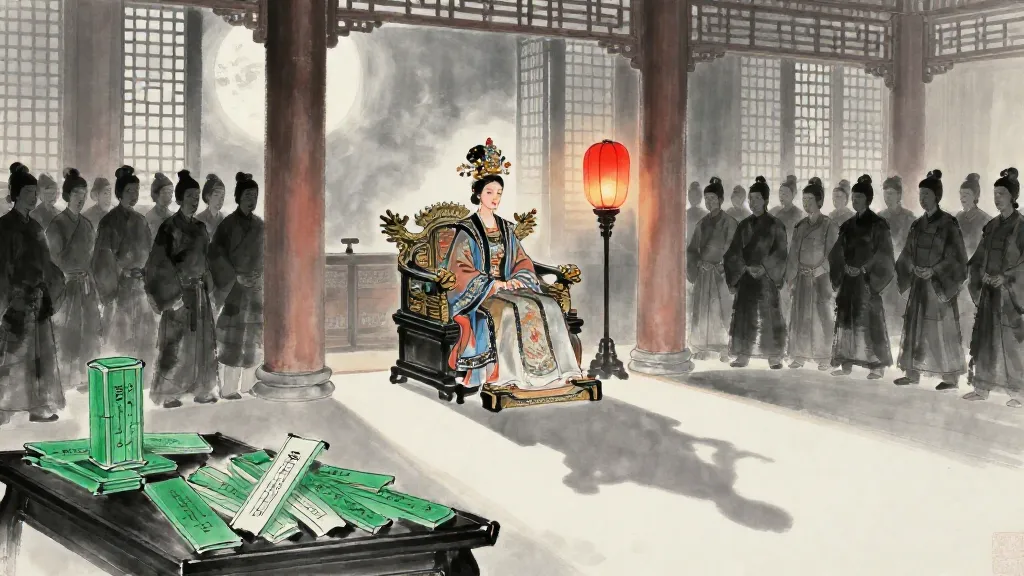
呂太后本紀 (Annals of Empress Dowager Lü) — Chinese ink painting

Chapter 9 of 130

呂太后本紀

Annals of Empress Dowager Lü

View:

呂后與戚夫人之爭

Empress Lü and the Struggle with Lady Qi

吕太后者,高祖微时妃也,生孝惠帝、女鲁元太后。及高祖为汉王,得定陶戚姬,爱幸,生赵隐王如意。孝惠为人仁弱,高祖以为不类我,常欲废太子,立戚姬子如意,如意类我。戚姬幸,常从上之关东,日夜啼泣,欲立其子代太子。吕后年长,常留守,希见上,益疏。如意立为赵王后,几代太子者数矣,赖大臣争之,及留侯策,太子得毋废。

吕后为人刚毅,佐高祖定天下,所诛大臣多吕后力。吕后兄二人,皆为将。长兄周吕侯死事,封其子吕台为郦侯,子产为交侯;次兄吕释之为建成侯。

Empress Dowager Lü was the wife of Gaozu from his days as a commoner. She bore Emperor Hui and the Princess of Lu Yuan. When Gaozu became King of Han, he took Lady Qi of Dingtao as a consort, doted on her, and she bore Ruyi, the Hidden King of Zhao. Emperor Hui was kind-natured but weak, and Gaozu considered him unlike himself. He often wished to depose the heir apparent and install Lady Qi's son Ruyi in his place, saying Ruyi took after him. Lady Qi, being favored, constantly accompanied the Emperor on his campaigns east of the passes, weeping day and night, pressing to have her son replace the heir. Empress Lü, growing older, was always left behind to hold the capital. She rarely saw the Emperor and grew ever more estranged. After Ruyi was made King of Zhao, the heir apparent came close to being deposed on several occasions, but was saved by the arguments of senior ministers and a stratagem devised by the Marquis of Liu. Thus the heir's position was preserved.

Empress Lü was a woman of iron will. She had helped Gaozu conquer the realm, and many of the great ministers who were executed owed their deaths to her influence. She had two elder brothers, both of whom served as generals. The eldest, the Marquis of Zhoulü, died in battle; his son Lü Tai was enfeoffed as Marquis of Li, and another son Lü Chan as Marquis of Jiao. The second brother, Lü Shizhi, was made Marquis of Jiancheng.

Notes

1person呂雉Lǚ Zhì

Empress Dowager Lü (呂太后, d. 180 BC), personal name Lü Zhi (呂雉), was the principal wife of Liu Bang (Emperor Gaozu) and the first woman to hold supreme power in the Han dynasty. She ruled as regent from 195 to 180 BC.

2person戚夫人Qī Fūrén

Lady Qi (戚夫人, d. c. 194 BC), also called Consort Qi, was Gaozu's favorite concubine from Dingtao. Her horrific fate at the hands of Empress Lü became one of the most infamous episodes in Chinese history.

3person劉如意Liú Rúyì

Ruyi (劉如意, d. 194 BC), posthumously the Hidden King of Zhao (趙隱王), was Lady Qi's son. Gaozu's wish to make him heir apparent was blocked by the ministers and Zhang Liang's famous stratagem of recruiting the Four Hoaryheads of Mount Shang.

4person張良Zhāng Liáng

The Marquis of Liu (留侯) is Zhang Liang (張良, d. 189 BC), one of the 'Three Heroes of Early Han.' His stratagem to save the heir apparent involved having the Four Hoaryheads (四皓) — four revered hermits whom Gaozu himself could not recruit — appear at the crown prince's side, thereby demonstrating the heir's support among the realm's most respected men.

高祖崩與諸王封國

Gaozu's Death and the Enfeoffed Kings

高祖十二年四月甲辰,崩长乐宫,太子袭号为帝。是时高祖八子:长男肥,孝惠兄也,异母,肥为齐王;馀皆孝惠弟,戚姬子如意为赵王,薄夫人子恒为代王,诸姬子子恢为梁王,子友为淮阳王,子长为淮南王,子建为燕王。高祖弟交为楚王,兄子濞为吴王。非刘氏功臣番君吴芮子臣为长沙王。

In the fourth month of Gaozu's twelfth year, on the jiachen day, the Emperor died in the Palace of Lasting Joy. The heir apparent succeeded to the imperial title. At this time Gaozu had eight sons: the eldest, Fei, was Emperor Hui's half-brother by a different mother, and had been made King of Qi. The rest were all younger than Emperor Hui. Lady Qi's son Ruyi was King of Zhao; Lady Bo's son Heng was King of Dai; sons by other consorts included Hui, King of Liang; You, King of Huaiyang; Chang, King of Huainan; and Jian, King of Yan. Gaozu's younger brother Jiao was King of Chu, and his nephew Bi was King of Wu. The only non-Liu king was the son of the meritorious minister Lord of Fan, Wu Rui — his son Chen was King of Changsha.

Notes

1person劉肥Liú Féi

Liu Fei (劉肥, d. 189 BC), King Daohui of Qi (齊悼惠王), was Gaozu's eldest son by a concubine surnamed Cao. As the senior prince with the richest kingdom (seventy-odd cities), he was a natural target for Empress Lü.

2person薄姬Bó Jī

Lady Bo (薄夫人), later Empress Dowager Bo, was a minor consort of Gaozu. Her son Liu Heng (劉恆) became King of Dai and was later enthroned as Emperor Wen — precisely because the Lü clan had overlooked him. Her low status ironically saved her family.

3person劉濞Liú Bì

Liu Bi (劉濞, 216–154 BC), King of Wu, was Gaozu's nephew. He later led the Rebellion of the Seven Kingdoms in 154 BC against Emperor Jing.

4context

The Kingdom of Changsha was the sole non-Liu fief to survive. Wu Rui (吳芮), the Lord of Fan (番君), had been one of the first to join the anti-Qin rebellion. The Changsha kingdom endured until its line died out in 157 BC.

殘害戚夫人與趙王如意

The Destruction of Lady Qi and the King of Zhao

吕后最怨戚夫人及其子赵王,乃令永巷囚戚夫人,而召赵王。使者三反,赵相建平侯周昌谓使者曰:"高帝属臣赵王,赵王年少。窃闻太后怨戚夫人,欲召赵王并诛之,臣不敢遣王。王且亦病,不能奉诏。"吕后大怒,乃使人召赵相。赵相徵至长安,乃使人复召赵王。王来,未到。孝惠帝慈仁,知太后怒,自迎赵王霸上,与入宫,自挟与赵王起居饮食。太后欲杀之,不得闲。孝惠元年十二月,帝晨出射。赵王少,不能蚤起。太后闻其独居,使人持酖饮之。犁明,孝惠还,赵王已死。于是乃徙淮阳王友为赵王。夏,诏赐郦侯父追谥为令武侯。太后遂断戚夫人手足,去眼,辉耳,饮喑药,使居厕中,命曰"人彘"。居数日,乃召孝惠帝观人彘。孝惠见,问,乃知其戚夫人,乃大哭,因病,岁馀不能起。使人请太后曰:"此非人所为。臣为太后子,终不能治天下。"孝惠以此日饮为淫乐,不听政,故有病也。

Empress Lü harbored the deepest hatred for Lady Qi and her son the King of Zhao. She had Lady Qi imprisoned in the Yongxiang — the palace workhouse — and summoned the King of Zhao. The envoys went back and forth three times, but the Zhao chancellor, Zhou Chang, Marquis of Jianping, told them: "Emperor Gaozu entrusted the King of Zhao to my care. The king is young. I have heard that the Empress Dowager bears a grudge against Lady Qi and wants to summon the king to have him killed alongside her. I dare not send the king. Moreover, the king is ill and cannot obey the summons." The Empress Dowager flew into a rage and sent for the Zhao chancellor instead. Once Zhou Chang was summoned to Chang'an, she sent again for the King of Zhao.

The king set out, but before he arrived, Emperor Hui — who was compassionate by nature and knew his mother's fury — rode out to meet the King of Zhao at Bashang, brought him into the palace, and kept him at his side at all times, eating and sleeping together. The Empress Dowager wanted to kill the boy but could find no opportunity.

In the twelfth month of Emperor Hui's first year, the Emperor went out at dawn to hunt. The King of Zhao was young and could not rise early. When the Empress Dowager learned he was alone, she sent someone with poisoned wine to force him to drink. By the time Emperor Hui returned at daybreak, the King of Zhao was dead. The King of Huaiyang, You, was then transferred to become King of Zhao.

That summer, a decree posthumously honored the father of the Marquis of Li with the title Marquis Lingwu. Then the Empress Dowager had Lady Qi's hands and feet cut off, her eyes gouged out, her ears burned, a muting drug poured down her throat, and had her thrown into the latrine pit. She called her the "human swine." After several days, she summoned Emperor Hui to view the human swine. When Emperor Hui saw the creature and was told it was Lady Qi, he broke down and wept uncontrollably. He fell ill and could not rise for more than a year. He sent a message to his mother: "This is not the work of a human being. I am your son, but I will never be able to govern the realm." From then on, Emperor Hui spent his days drinking and indulging in pleasure and refused to attend to state affairs. This is why he fell ill.

Notes

1place

The Yongxiang (永巷) was a women's prison within the palace complex, used to confine disgraced consorts and female attendants. It was later renamed the Ye Ting (掖庭) under Emperor Wu.

2person周昌Zhōu Chāng

Zhou Chang (周昌, d. c. 192 BC), Marquis of Jianping (建平侯), was a blunt-spoken old minister whom Gaozu had deliberately appointed as Zhao chancellor to protect Prince Ruyi. He was famous for once stuttering out a comparison of Gaozu to the tyrants Jie and Zhou.

3place

Bashang (霸上) was a plateau east of Chang'an, along the Ba River. It was a key staging area and the place where Liu Bang first entered the Qin capital region in 206 BC.

4context

The 'human swine' (人彘) episode is one of the most notorious atrocities in Chinese history. The term 彘 means 'pig' or 'swine.' Sima Qian's unflinching description serves both as historical record and as moral judgment on Empress Lü's character. The passage also explains Emperor Hui's psychological collapse — he was effectively broken by what his mother had done.

齊王朝見與孝惠年間

The King of Qi's Court Visit and the Reign of Emperor Hui

二年,楚元王、齐悼惠王皆来朝。十月,孝惠与齐王燕饮太后前,孝惠以为齐王兄,置上坐,如家人之礼。太后怒,乃令酌两卮酖,置前,令齐王起为寿。齐王起,孝惠亦起,取卮欲俱为寿。太后乃恐,自起泛孝惠卮。齐王怪之,因不敢饮,详醉去。问,知其酖,齐王恐,自以为不得脱长安,忧。齐内史士说王曰:"太后独有孝惠与鲁元公主。今王有七十馀城,而公主乃食数城。王诚以一郡上太后,为公主汤沐邑,太后必喜,王必无忧。"于是齐王乃上城阳之郡,尊公主为王太后。吕后喜,许之。乃置酒齐邸,乐饮,罢,归齐王。三年,方筑长安城,四年就半,五年六年城就。诸侯来会。十月朝贺。

In the second year, both the King Yuan of Chu and King Daohui of Qi came to court. In the tenth month, Emperor Hui held a banquet with the King of Qi in the Empress Dowager's presence. Emperor Hui, treating the King of Qi as an elder brother, seated him in the place of honor, following the etiquette of a family gathering. The Empress Dowager was furious. She ordered two goblets of poisoned wine placed before them and told the King of Qi to rise and offer a toast. The King of Qi rose, but Emperor Hui rose too and reached for a goblet, intending to drink together. The Empress Dowager, alarmed, leapt up and knocked over Emperor Hui's goblet. The King of Qi found this strange and dared not drink. He feigned drunkenness and left. Upon inquiry, he learned the wine was poisoned. Terrified that he would never leave Chang'an alive, he was consumed with worry.

The Qi Interior Secretary advised the king: "The Empress Dowager has only Emperor Hui and the Princess of Lu Yuan. Your Majesty rules over seventy cities, while the princess receives revenue from merely a few. If you were to present one commandery to the Empress Dowager as a bathing-fief for the princess, she will surely be pleased, and Your Majesty will have nothing to fear." The King of Qi thereupon offered the commandery of Chengyang and honored the princess with the title Queen Dowager. Empress Lü was delighted and agreed. She hosted a banquet at the Qi residence, and after the drinking was done, she let the King of Qi depart.

In the third year, the walls of Chang'an began to be built. By the fourth year they were half-finished, and by the fifth and sixth years the walls were complete. The feudal lords came for the assembly and offered their congratulations at the tenth-month audience.

Notes

1context

The poisoned-wine banquet reveals Empress Lü's willingness to murder even the eldest prince of the blood in public. Emperor Hui's instinctive move to drink alongside his half-brother — forcing his mother to knock over his cup — was the only thing that saved the King of Qi. The episode demonstrates both Hui's decency and his powerlessness.

2context

A 'bathing-fief' (湯沐邑) was an estate whose revenues were designated for a princess's personal expenses — literally, her bathing and grooming costs. Ceding Chengyang was a substantial political bribe: the King of Qi purchased his life with territory.

3place

Chengyang (城陽) commandery was in modern southern Shandong, around Ju County (莒縣). It was carved out of the large Qi kingdom.

孝惠崩與呂氏擅權

Death of Emperor Hui and the Lü Clan's Seizure of Power

七年秋八月戊寅,孝惠帝崩。发丧,太后哭,泣不下。留侯子张辟强为侍中,年十五,谓丞相曰:"太后独有孝惠,今崩,哭不悲,君知其解乎?"丞相曰:"何解?"辟强曰:"帝毋壮子,太后畏君等。君今请拜吕台、吕产、吕禄为将,将兵居南北军,及诸吕皆入宫,居中用事,如此则太后心安,君等幸得脱祸矣。"丞相乃如辟强计。太后说,其哭乃哀。吕氏权由此起。乃大赦天下。九月辛丑,葬。太子即位为帝,谒高庙。元年,号令一出太后。

太后称制,议欲立诸吕为王,问右丞相王陵。王陵曰:"高帝刑白马盟曰'非刘氏而王,天下共击之'。今王吕氏,非约也。"太后不说。问左丞相陈平、绛侯周勃。勃等对曰:"高帝定天下,王子弟,今太后称制,王昆弟诸吕,无所不可。"太后喜,罢朝。王陵让陈平、绛侯曰:"始与高帝啑血盟,诸君不在邪?今高帝崩,太后女主,欲王吕氏,诸君从欲阿意背约,何面目见高帝地下?"陈平、绛侯曰:"于今面折廷争,臣不如君;夫全社稷,定刘氏之后,君亦不如臣。"王陵无以应之。十一月,太后欲废王陵,乃拜为帝太傅,夺之相权。王陵遂病免归。乃以左丞相平为右丞相,以辟阳侯审食其为左丞相。左丞相不治事,令监宫中,如郎中令。食其故得幸太后,常用事,公卿皆因而决事。乃追尊郦侯父为悼武王,欲以王诸吕为渐。

In the autumn of the seventh year, on the wuyin day of the eighth month, Emperor Hui died. The funeral was announced. The Empress Dowager wailed, but no tears fell. Zhang Biqiang, the son of the Marquis of Liu, who served as Gentleman-in-Attendance and was only fifteen years old, said to the chancellor: "The Empress Dowager's only son was Emperor Hui. Now he is dead, yet she weeps without grief. Do you understand why?" The chancellor said: "Why?" Biqiang said: "The Emperor left no grown sons. The Empress Dowager fears you and the other ministers. If you now request that Lü Tai, Lü Chan, and Lü Lu be appointed generals commanding the Northern and Southern Armies, and that all members of the Lü clan be brought into the palace to hold power at the center — then the Empress Dowager's mind will be at ease, and you may yet escape disaster." The chancellor followed Biqiang's plan. The Empress Dowager was pleased, and at last her weeping became genuine grief. The power of the Lü clan dates from this moment. A general amnesty was declared. On the xinchou day of the ninth month, Emperor Hui was buried. The heir apparent was enthroned and presented himself at the Temple of Gaozu. In the first year of the new reign, all edicts issued from the Empress Dowager.

The Empress Dowager assumed the regency and proposed making the Lü clansmen kings. She consulted the Right Chancellor Wang Ling. Wang Ling said: "Emperor Gaozu slaughtered a white horse and swore an oath: 'If anyone who is not of the Liu surname is made king, let all under heaven attack him.' To make the Lü clan kings violates the covenant." The Empress Dowager was displeased. She then asked the Left Chancellor Chen Ping and the Marquis of Jiang, Zhou Bo. Zhou Bo and the others replied: "Emperor Gaozu pacified the realm and made his sons and brothers kings. Now the Empress Dowager rules as regent — if she makes her own brothers and kinsmen kings, there is nothing wrong with that." The Empress Dowager was delighted and dismissed the court.

Wang Ling rebuked Chen Ping and Zhou Bo: "When we first tasted blood and swore the oath with Emperor Gaozu, were you not present? Now Gaozu is dead, a woman rules, and she wishes to make the Lü clan kings. You flatter and acquiesce and betray the covenant — with what face will you meet Emperor Gaozu in the underworld?" Chen Ping and Zhou Bo replied: "When it comes to speaking bluntly and arguing at court, we are not your equals. But when it comes to preserving the altars of state and securing the future of the Liu house, you are not ours." Wang Ling had no answer.

In the eleventh month, the Empress Dowager moved to strip Wang Ling of power by promoting him to Grand Tutor of the Emperor — an honorific post with no authority. Wang Ling then pleaded illness and retired. Chen Ping was promoted from Left to Right Chancellor, and the Marquis of Biyang, Shen Yiji, was made Left Chancellor. But the Left Chancellor did not conduct government business; he was made to oversee matters inside the palace, functioning as a kind of Prefect of the Gentlemen. Shen Yiji had long been a favorite of the Empress Dowager, and he managed affairs continuously. All ministers and nobles conducted business through him. The Empress Dowager then posthumously honored the father of the Marquis of Li as King Daowu — a first step toward making the Lü clan kings.

Notes

1person張辟強Zhāng Bìqiáng

Zhang Biqiang (張辟強) was the son of Zhang Liang. Despite being only fifteen, his cold political calculation — that the ministers should appease Empress Lü by voluntarily ceding military power to the Lü clan — showed the same strategic instinct as his father's. His advice saved the ministers' lives in the short term while setting up the eventual confrontation.

2context

The White Horse Oath (白馬之盟) was Gaozu's deathbed covenant with his ministers: no one outside the Liu surname should be made a feudal king, and if anyone violated this, all under heaven should attack him. It became the legal and moral basis for the eventual overthrow of the Lü clan.

3person王陵Wáng Líng

Wang Ling (王陵, d. c. 180 BC), Right Chancellor, was one of Gaozu's oldest companions. His principled refusal to sanction the Lü kings cost him his position but preserved his moral reputation. Chen Ping and Zhou Bo's response — 'preserving the state is more important than arguing at court' — proved prophetic.

4person審食其Shěn Yìjī

Shen Yiji (審食其, d. 177 BC), Marquis of Biyang (辟陽侯), was widely rumored to have been Empress Lü's lover. He wielded enormous informal power during the regency. He was later killed by the King of Huainan in a private revenge.

5person陳平Chén Píng

Chen Ping (陳平, d. 178 BC) was one of Gaozu's most cunning strategists, famous for his 'six unorthodox stratagems.' His willingness to bend before Empress Lü while secretly planning the Lü clan's destruction exemplified his pragmatic political style.

6person周勃Zhōu Bó

Zhou Bo (周勃, d. 169 BC), Marquis of Jiang (絳侯), was a blunt, barely literate military man who had risen from humble origins alongside Gaozu. He would play the decisive role in the coup that destroyed the Lü clan.

諸呂封王與傀儡皇帝

The Lü Clan Made Kings and the Puppet Emperors

四月,太后欲侯诸吕,乃先封高祖之功臣郎中令无择为博城侯。鲁元公主薨,赐谥为鲁元太后。子偃为鲁王。鲁王父,宣平侯张敖也。封齐悼惠王子章为朱虚侯,以吕禄女妻之。齐丞相寿为平定侯。少府延为梧侯。乃封吕种为沛侯,吕平为扶柳侯,张买为南宫侯。

太后欲王吕氏,先立孝惠后宫子强为淮阳王,子不疑为常山王,子山为襄城侯,子朝为轵侯,子武为壶关侯。太后风大臣,大臣请立郦侯吕台为吕王,太后许之。建成康侯释之卒,嗣子有罪,废,立其弟吕禄为胡陵侯,续康侯后。二年,常山王薨,以其弟襄城侯山为常山王,更名义。十一月,吕王台薨,谥为肃王,太子嘉代立为王。三年,无事。四年,封吕媭为临光侯,吕他为俞侯,吕更始为赘其侯,吕忿为吕城侯,及诸侯丞相五人。

In the fourth month, the Empress Dowager wished to enfeoff members of the Lü clan. She first conferred a marquessate on one of Gaozu's old ministers, the Prefect of the Gentlemen Wuze, making him Marquis of Bocheng — establishing a precedent. The Princess of Lu Yuan died and was posthumously titled Empress Dowager of Lu Yuan. Her son Yan was made King of Lu; his father was Zhang Ao, the Marquis of Xuanping. The son of King Daohui of Qi, Zhang, was enfeoffed as Marquis of Zhuixu and given a daughter of Lü Lu as his wife. The Qi chancellor Shou was made Marquis of Pingding. The Privy Treasurer Yan was made Marquis of Wu. Then Lü Zhong was made Marquis of Pei, Lü Ping Marquis of Fuliu, and Zhang Mai Marquis of Nangong.

The Empress Dowager wished to make the Lü clan kings. She first installed sons from Emperor Hui's harem: Qiang as King of Huaiyang, Buyi as King of Changshan, Shan as Marquis of Xiangcheng, Chao as Marquis of Zhi, and Wu as Marquis of Huguan. She then hinted to the ministers, who requested that the Marquis of Li, Lü Tai, be made King of Lü. The Empress Dowager approved. The Marquis Kang of Jiancheng, Shizhi, had died; his heir was convicted of a crime and deposed. His younger brother Lü Lu was made Marquis of Huling to continue the Kang lineage.

In the second year, the King of Changshan died, and his brother, the Marquis of Xiangcheng Shan, replaced him, with his name changed to Yi. In the eleventh month, King Tai of Lü died with the posthumous title King Su. His heir apparent Jia succeeded as king. The third year passed without incident. In the fourth year, Lü Xu was enfeoffed as Marquis of Linguang, Lü Ta as Marquis of Yu, Lü Gengshi as Marquis of Zhuiqi, Lü Fen as Marquis of Lücheng, along with five feudal chancellors.

Notes

1person劉章Liú Zhāng

Liu Zhang (劉章, d. 176 BC), Marquis of Zhuixu (朱虛侯), was a grandson of Gaozu through the line of King Daohui of Qi. Bold and hot-tempered, he would play a crucial role in the coup against the Lü clan. Ironically, Empress Lü married him to Lü Lu's daughter, not suspecting he would turn against them.

2context

Empress Lü's strategy was layered: she first enfeoffed Gaozu's old ministers to establish the precedent, then created puppet Liu princes, and only then elevated Lü clansmen. The 'hint' (風) to the ministers is a telling detail — she wanted the fiction that the ministers themselves had requested Lü kings.

3person呂祿Lǚ Lù

Lü Lu (呂祿, d. 180 BC) was Empress Lü's nephew who was made Marquis of Huling and later King of Zhao, commanding the Northern Army. His indecisiveness during the crisis of 180 BC contributed directly to the Lü clan's destruction.

少帝廢立

The Deposition and Replacement of the Young Emperor

宣平侯女为孝惠皇后时,无子,详为有身,取美人子名之,杀其母,立所名子为太子。孝惠崩,太子立为帝。帝壮,或闻其母死,非真皇后子,乃出言曰:"后安能杀吾母而名我?我未壮,壮即为变。"太后闻而患之,恐其为乱,乃幽之永卷中,言帝病甚,左右莫得见。太后曰:"凡有天下治为万民命者,盖之如天,容之如地,上有欢心以安百姓,百姓欣然以事其上,欢欣交通而天下治。今皇帝病久不已,乃失惑惛乱,不能继嗣奉宗庙祭祀,不可属天下,其代之。"群臣皆顿首言:"皇太后为天下齐民计所以安宗庙社稷甚深,群臣顿首奉诏。"帝废位,太后幽杀之。五月丙辰,立常山王义为帝,更名曰弘。不称元年者,以太后制天下事也。以轵侯朝为常山王。置太尉官,绛侯勃为太尉。五年八月,淮阳王薨,以弟壶关侯武为淮阳王。六年十月,太后曰吕王嘉居处骄恣,废之,以肃王台弟吕产为吕王。夏,赦天下。封齐悼惠王子兴居为东牟侯。

The daughter of the Marquis of Xuanping had been made Empress Hui's consort, but she bore no children. She feigned pregnancy, took a son born to a palace beauty, claimed it as her own, and had the boy's real mother killed. This child was installed as heir apparent. When Emperor Hui died, the heir was enthroned.

As the young Emperor grew older, he somehow learned that his birth mother had been killed and that he was not the Empress's true son. He openly declared: "How could the Empress kill my mother and claim me as her own? I am not yet grown, but when I am, I will have my revenge." The Empress Dowager heard this and grew alarmed, fearing he would rebel. She confined him in the Yongxiang, announced that the Emperor was gravely ill, and allowed no one to see him.

The Empress Dowager declared: "Whoever holds dominion over the realm and governs the lives of the myriad people must shelter them like heaven and embrace them like the earth. Above, the ruler must have a joyful heart to bring peace to the people; below, the people must serve their lord with willing hearts. When this mutual joy flows freely, the realm is well governed. Now the Emperor has been ill for so long that he has lost his senses and fallen into confusion. He cannot continue the sacrifices at the ancestral temples. The realm cannot be entrusted to him. He must be replaced." The ministers all prostrated themselves and said: "The Empress Dowager's concern for the common people, the ancestral temples, and the altars of state is profound. We prostrate ourselves and accept the decree." The young Emperor was deposed, and the Empress Dowager had him secretly killed.

On the bingchen day of the fifth month, the King of Changshan, Yi, was installed as Emperor, and his name was changed to Hong. No new era was proclaimed, because the Empress Dowager controlled all affairs of the realm. The Marquis of Zhi, Chao, was made King of Changshan. The office of Grand Commandant was established, and Zhou Bo, Marquis of Jiang, was appointed to fill it.

In the eighth month of the fifth year, the King of Huaiyang died, and his brother, the Marquis of Huguan Wu, became King of Huaiyang. In the tenth month of the sixth year, the Empress Dowager declared that King Jia of Lü was arrogant and insubordinate. She deposed him and installed Lü Chan, the younger brother of the late King Su Tai, as King of Lü. That summer, a general amnesty was declared. Liu Xingju, son of King Daohui of Qi, was enfeoffed as Marquis of Dongmou.

Notes

1context

The puppet emperors of the Lü regency were children installed solely to legitimize Empress Lü's rule. The deposed emperor's defiant words — and his subsequent murder — illustrate the ruthlessness with which the Empress Dowager maintained control. Sima Qian notes that no new era was proclaimed because real power lay entirely with the Empress Dowager.

2person劉興居Liú Xīngjū

Liu Xingju (劉興居), Marquis of Dongmou (東牟侯), was another grandson of Gaozu through the Qi line and the younger brother of Liu Zhang. He helped clear the palace during the anti-Lü coup but later rebelled against Emperor Wen and was killed.

趙王友之死與日食

The Death of Zhao Wang You and the Solar Eclipse

七年正月,太后召赵王友。友以诸吕女为受后,弗爱,爱他姬,诸吕女妒,怒去,谗之于太后,诬以罪过,曰:"吕氏安得王!太后百岁后,吾必击之"。太后怒,以故召赵王。赵王至,置邸不见,令卫围守之,弗与食。其群臣或窃馈,辄捕论之,赵王饿,乃歌曰:"诸吕用事兮刘氏危,迫胁王侯兮强授我妃。我妃既妒兮诬我以恶,谗女乱国兮上曾不寤。我无忠臣兮何故弃国?自决中野兮苍天举直!于嗟不可悔兮宁蚤自财。为王而饿死兮谁者怜之!吕氏绝理兮托天报仇。"丁丑,赵王幽死,以民礼葬之长安民冢次。

己丑,日食,昼晦。太后恶之,心不乐,乃谓左右曰:"此为我也。"

In the first month of the seventh year, the Empress Dowager summoned the King of Zhao, You. You had been given a Lü woman as queen, but he did not love her. He loved another consort. The Lü queen grew jealous, left in anger, and slandered him to the Empress Dowager, fabricating accusations and claiming he had said: "How can the Lü clan presume to be kings? After the Empress Dowager dies, I will surely destroy them."

The Empress Dowager was furious and summoned the King of Zhao on this pretext. When the king arrived, he was placed under house arrest at his residence and denied an audience. Guards surrounded the building, and he was given no food. When any of his retainers tried to smuggle food to him, they were arrested and punished.

Starving, the King of Zhao composed a song:

"The Lü clan holds power — the Liu house is in peril. They coerce the princes — and force upon me a wife. My wife, consumed by jealousy — slanders me with lies. A scheming woman ruins the state — yet those above refuse to see. I have no loyal ministers — why have I lost my kingdom? I will end my life in the open fields — may heaven vindicate the just! Alas, what cannot be undone — better to have ended it sooner. To be a king and die of starvation — who will pity me? The Lü clan has severed all principle — I entrust my vengeance to heaven."

On the dingchou day, the King of Zhao died in confinement. He was buried with commoner's rites in the public cemetery of Chang'an.

On the jichou day, there was a solar eclipse and darkness at midday. The Empress Dowager was disturbed by it, uneasy in her heart. She said to her attendants: "This is on account of me."

Notes

1person劉友Liú Yǒu

Liu You (劉友, d. 181 BC), King You of Zhao (趙幽王), was a son of Emperor Gaozu. His forced marriage to a Lü woman was a tool of political control. His death by starvation and his bitter song make him one of the most sympathetic figures in this chapter.

2context

The solar eclipse is recorded not merely as an astronomical event but as a moral portent. Empress Lü's own admission — 'This is on account of me' — is a rare moment of self-awareness. In the Han cosmological framework, eclipses were warnings from heaven that the ruler had strayed from the Way.

3textual

The song attributed to the King of Zhao is in the Chu-ci (楚辭) style, using the particle 兮 (xi) as a caesura. Whether it was genuinely composed by the dying king or crafted by Sima Qian to heighten pathos is debated, but such laments by doomed figures are a hallmark of Shiji narrative.

趙王恢自殺與呂后晚年

The Suicide of Zhao Wang Hui and Empress Lü's Final Years

二月,徙梁王恢为赵王。吕王产徙为梁王,梁王不之国,为帝太傅。立皇子平昌侯太为吕王。更名梁曰吕,吕曰济川。太后女弟吕媭有女为营陵侯刘泽妻,泽为大将军。太后王诸吕,恐即崩后刘将军为害,乃以刘泽为琅邪王,以慰其心。

梁王恢之徙王赵,心怀不乐。太后以吕产女为赵王后。王后从官皆诸吕,擅权,微伺赵王,赵王不得自恣。王有所爱姬,王后使人酖杀之。王乃为歌诗四章,令乐人歌之。王悲,六月即自杀。太后闻之,以为王用妇人弃宗庙礼,废其嗣。

宣平侯张敖卒,以子偃为鲁王,敖赐谥为鲁元王。

秋,太后使使告代王,欲徙王赵。代王谢,愿守代边。

太傅产、丞相平等言,武信侯吕禄上侯,位次第一,请立为赵王。太后许之,追尊禄父康侯为赵昭王。九月,燕灵王建薨,有美人子,太后使人杀之,无后,国除。八年十月,立吕肃王子东平侯吕通为燕王,封通弟吕庄为东平侯。

In the second month, the King of Liang, Hui, was transferred to become King of Zhao. Lü Chan, King of Lü, was transferred to become King of Liang, though he did not go to his fief but served as Grand Tutor in the capital. The imperial son, the Marquis of Pingchang Tai, was installed as King of Lü. The name of Liang was changed to Lü, and Lü was renamed Jichuan. The Empress Dowager's younger sister Lü Xu had a daughter married to Liu Ze, the Marquis of Yingling, who served as Grand General. The Empress Dowager, having made the Lü clan kings, feared that after her death this Liu general might cause trouble. She therefore made Liu Ze King of Langya to pacify him.

When the King of Liang Hui was transferred to Zhao, he was deeply unhappy. The Empress Dowager gave him a daughter of Lü Chan as queen. The queen's attendants were all Lü clansmen who monopolized power, secretly monitored the king, and left him no freedom. The king had a beloved consort; the queen had her poisoned. The king then composed four songs and ordered his musicians to sing them. Overwhelmed with grief, he killed himself in the sixth month. When the Empress Dowager heard of this, she declared he had abandoned the rites of the ancestral temple over a woman and abolished his line of succession.

The Marquis of Xuanping, Zhang Ao, died. His son Yan was made King of Lu, and Ao was posthumously titled King of Lu Yuan.

In the autumn, the Empress Dowager sent envoys to the King of Dai, proposing to transfer him to Zhao. The King of Dai declined, saying he wished to remain and guard the border.

The Grand Tutor Lü Chan and Chancellor Chen Ping proposed that Lü Lu, the Marquis of Wuxin, who ranked first among the marquises, be made King of Zhao. The Empress Dowager approved, and Lü Lu's father, the late Marquis Kang, was posthumously honored as King Zhao of Zhao. In the ninth month, King Ling of Yan, Jian, died. He had a son by a palace beauty, but the Empress Dowager had the child killed. With no heir, the kingdom was abolished. In the tenth month of the eighth year, Lü Tong, the Marquis of Dongping and son of the late King Su of Lü, was made King of Yan. Tong's brother Lü Zhuang was made Marquis of Dongping.

Notes

1person劉恢Liú Huī

Liu Hui (劉恢, d. 181 BC), originally King of Liang, was forced into the position of King of Zhao with a Lü-clan queen as his minder. His suicide after his consort was poisoned was the third death of a Liu prince in the Zhao kingdom — an ominous pattern.

2person劉澤Liú Zé

Liu Ze (劉澤, d. 178 BC), a distant Liu relative, was made King of Langya to neutralize him. He later played a role in the anti-Lü coup and was rewarded with the richer kingdom of Yan.

3context

The King of Dai who declined the transfer to Zhao was Liu Heng — the future Emperor Wen. His polite refusal was a masterstroke of self-preservation: Zhao had become a death trap for Liu princes, and moving there would have placed him under Lü surveillance. Staying in remote Dai kept him alive.

4context

The Zhao kingdom had now consumed three Liu kings in succession: Ruyi (poisoned), You (starved), and Hui (suicide). The Empress Dowager's decision to eliminate King Ling of Yan's heir and abolish the kingdom, then install a Lü clansman, shows the systematic nature of her program to replace Liu kings with Lü ones.

呂后之病與遺詔

Empress Lü's Illness and Final Commands

三月中,吕后祓,还过轵道,见物如苍犬,据高后掖,忽弗复见。卜之,云赵王如意为祟。高后遂病掖伤。

高后为外孙鲁元王偃年少,蚤失父母,孤弱,乃封张敖前姬两子,侈为新都侯,寿为乐昌侯,以辅鲁元王偃。及封中大谒者张释为建陵侯,吕荣为祝兹侯。诸中宦者令丞皆为关内侯,食邑五百户。

七月中,高后病甚,乃令赵王吕禄为上将军,军北军;吕王产居南军。吕太后诫产、禄曰:"高帝已定天下,与大臣约,曰'非刘氏王者,天下共击之'。今吕氏王,大臣弗平。我即崩,帝年少,大臣恐为变。必据兵卫宫,慎毋送丧,毋为人所制。"辛巳,高后崩,遗诏赐诸侯王各千金,将相列侯郎吏皆以秩赐金。大赦天下。以吕王产为相国,以吕禄女为帝后。

高后已葬,以左丞相审食其为帝太傅。

In the middle of the third month, Empress Lü performed a purification ritual. On her way back, passing through the Zhidao, she saw an apparition like a grey dog that lunged at her armpit, then vanished. Diviners said it was the ghost of the King of Zhao, Ruyi, taking revenge. From that point on, the Empress Dowager suffered from pain in her armpit.

Because her grandson, the young King of Lu Yuan Yan, had lost both parents early and was orphaned and vulnerable, the Empress Dowager enfeoffed two sons of Zhang Ao by a former consort — Chi as Marquis of Xindu and Shou as Marquis of Lechang — to support King Yan. She also enfeoffed the Palace Grandee Zhang Shi as Marquis of Jianling and Lü Rong as Marquis of Zhuzi. All chiefs and deputies among the palace eunuchs were made Marquises Within the Passes with fiefs of five hundred households.

In the middle of the seventh month, the Empress Dowager fell gravely ill. She appointed Lü Lu, King of Zhao, as Supreme General commanding the Northern Army, and Lü Chan, King of Lü, to hold the Southern Army. She warned Lü Chan and Lü Lu: "After Emperor Gaozu pacified the realm, he made a covenant with the ministers: 'If anyone not of the Liu surname is made king, let all under heaven attack him.' Now the Lü clan holds kingships, and the ministers are resentful. When I die, the Emperor will be young, and the ministers may attempt a coup. You must hold the armies and guard the palace. Under no circumstances go out to escort my funeral cortege — do not let yourselves be outmaneuvered."

On the xinsi day, the Empress Dowager died. Her testament granted each feudal king a thousand catties of gold and distributed gold to generals, chancellors, marquises, and officials according to their rank. A general amnesty was declared. Lü Chan was made Chancellor of State, and a daughter of Lü Lu was made empress.

After the Empress Dowager was buried, the Left Chancellor Shen Yiji was made Grand Tutor of the Emperor.

Notes

1context

The apparition of the 'grey dog' (蒼犬) at Zhidao is presented as the vengeful ghost of Prince Ruyi, whom Empress Lü had poisoned. In Han belief, those who died unjustly could return as malevolent spirits (祟). The fact that the apparition struck her armpit (掖) and she subsequently developed an ailment there gives the episode a note of supernatural retribution.

2place

Zhidao (軹道) was a route south of Chang'an near the Zhiyang Pavilion, in the area of the Ba River crossing.

3context

Empress Lü's deathbed instructions are remarkably clear-eyed. She knew the ministers would move against her clan and explicitly told Lü Lu and Lü Chan to hold the armies and avoid the funeral — precisely because a funeral procession would draw them away from the troops. Their failure to follow her advice proved fatal.

齊王起兵與灌嬰駐軍

The King of Qi Raises Arms and Guan Ying Halts at Xingyang

朱虚侯刘章有气力,东牟侯兴居其弟也。皆齐哀王弟,居长安。当是时,诸吕用事擅权,欲为乱,畏高帝故大臣绛、灌等,未敢发。朱虚侯妇,吕禄女,阴知其谋。恐见诛,乃阴令人告其兄齐王,欲令发兵西,诛诸吕而立。朱虚侯欲从中与大臣为应。齐王欲发兵,其相弗听。八月丙午,齐王欲使人诛相,相召平乃反,举兵欲围王,王因杀其相,遂发兵东,诈夺琅邪王兵,并将之而西。语在齐王语中。

齐王乃遗诸侯王书曰:"高帝平定天下,王诸子弟,悼惠王王齐。悼惠王薨,孝惠帝使留侯良立臣为齐王。孝惠崩,高后用事,春秋高,听诸吕,擅废帝更立,又比杀三赵王,灭梁、赵、燕以王诸吕,分齐为四。忠臣进谏,上惑乱弗听。今高后崩,而帝春秋富,未能治天下,固恃大臣诸侯。而诸吕又擅自尊官,聚兵严威,劫列侯忠臣,矫制以令天下,宗庙所以危。寡人率兵入诛不当为王者。"汉闻之,相国吕产等乃遣颍阴侯灌婴将兵击之。灌婴至荥阳,乃谋曰:"诸吕权兵关中,欲危刘氏而自立。今我破齐还报,此益吕氏之资也。"乃留屯荥阳,使使谕齐王及诸侯,与连和,以待吕氏变,共诛之。齐王闻之,乃还兵西界待约。

The Marquis of Zhuixu, Liu Zhang, was a man of great physical strength. The Marquis of Dongmou, Xingju, was his younger brother. Both were brothers of the King Ai of Qi, and both resided in Chang'an. At this time, the Lü clan had seized all power and were plotting rebellion, but they feared Gaozu's old ministers — the Marquis of Jiang and Lord Guan among others — and had not yet dared to act. The wife of the Marquis of Zhuixu was a daughter of Lü Lu, and she had secretly learned of the Lü clan's plans. Fearing they would all be killed, she secretly sent word to her husband's brother, the King of Qi, urging him to raise troops, march west, destroy the Lü clan, and claim the throne. The Marquis of Zhuixu planned to coordinate from within the capital with the senior ministers.

The King of Qi wanted to mobilize, but his chancellor refused. On the bingwu day of the eighth month, the King of Qi tried to have the chancellor killed. The chancellor, Zhao Ping, counter-attacked and raised troops to surround the king. The king killed his chancellor, then mobilized his forces. Moving east, he seized the King of Langya's troops by trickery, combined them with his own, and marched west. The details are recorded in the account of the King of Qi.

The King of Qi then sent a letter to all the feudal kings: "Emperor Gaozu pacified the realm and made his sons and brothers kings. King Daohui was given Qi. When King Daohui died, Emperor Hui sent the Marquis of Liu, Zhang Liang, to install me as King of Qi. After Emperor Hui's death, Empress Dowager Lü took power. Advanced in years, she listened to the Lü clan, deposed and replaced emperors at will, killed three successive Kings of Zhao, abolished the kingdoms of Liang, Zhao, and Yan to install Lü clansmen, and carved Qi into four parts. Loyal ministers remonstrated, but the sovereign was confused and would not listen. Now the Empress Dowager is dead. The Emperor is young and cannot govern the realm; he depends on the ministers and feudal lords. Yet the Lü clan has appointed itself to high offices, concentrated armies, intimidated the marquises and loyal ministers, forged imperial decrees to command the realm, and endangered the ancestral temples. I am leading my troops to destroy those who have no right to be kings."

When the Han court learned of this, the Chancellor of State Lü Chan sent Guan Ying, the Marquis of Yingyin, to lead an army against Qi. Guan Ying reached Xingyang and deliberated: "The Lü clan holds military power within the passes and intends to overthrow the Liu house and seize power for itself. If I defeat Qi and return to report victory, I will only be strengthening the Lü clan's position." He therefore halted at Xingyang, sent envoys to the King of Qi and the other feudal lords, and formed a joint alliance to wait for the Lü clan to make its move, then destroy them together. When the King of Qi received this message, he pulled his forces back to his western border and waited.

Notes

1person灌嬰Guàn Yīng

Guan Ying (灌嬰, d. 176 BC), Marquis of Yingyin (潁陰侯), was one of Gaozu's greatest cavalry commanders. His decision to halt at Xingyang rather than fight Qi was a pivotal act of defiance — he recognized that the real enemy was the Lü clan, not a Liu prince asserting his birthright.

2place

Xingyang (滎陽) was the strategic key to the corridor between the eastern plains and the Guanzhong heartland. Whoever held Xingyang controlled passage through the passes. Guan Ying's choice to stop here was both strategic and symbolic — he blocked the Lü clan from the east while keeping open his line to the capital.

3person劉襄Liú Xiāng

The King Ai of Qi (齊哀王) was Liu Xiang (劉襄, d. 179 BC), the eldest grandson of Gaozu through the Qi line. He was the frontrunner for the throne after the Lü coup, but the ministers passed him over precisely because his mother's clan, the Si (駟) family, was considered dangerous — they feared replacing one domineering consort family with another.

絳侯奪軍與諸呂覆滅

Zhou Bo Seizes the Armies and the Destruction of the Lü Clan

吕禄、吕产欲发乱关中,内惮绛侯、朱虚等,外畏齐、楚兵,又恐灌婴畔之,欲待灌婴兵与齐合而发,犹豫未决。当是时,济川王太、淮阳王武、常山王朝名为少帝弟,及鲁元王吕后外孙,皆年少未之国,居长安。赵王禄、梁王产各将兵居南北军,皆吕氏之人。列侯群臣莫自坚其命。

太尉绛侯勃不得入军中主兵。曲周侯郦商老病,其子寄与吕禄善。绛侯乃与丞相陈平谋,使人劫郦商。令其子寄往绐说吕禄曰:"高帝与吕后共定天下,刘氏所立九王,吕氏所立三王,皆大臣之议,事已布告诸侯,诸侯皆以为宜。今太后崩,帝少,而足下佩赵王印,不急之国守藩,乃为上将,将兵留此,为大臣诸侯所疑。足下何不归印,以兵属太尉?请梁王归相国印,与大臣盟而之国,齐兵必罢,大臣得安,足下高枕而王千里,此万世之利也。"吕禄信然其计,欲归将印,以兵属太尉。使人报吕产及诸吕老人,或以为便,或曰不便,计犹豫未有所决。吕禄信郦寄,时与出游猎。过其姑吕媭,媭大怒,曰:"若为将而弃军,吕氏今无处矣。"乃悉出珠玉宝器散堂下,曰:"毋为他人守也"

左丞相食其免。

八月庚申旦,平阳侯窋行御史大夫事,见相国产计事。郎中令贾寿使从齐来,因数产曰:"王不蚤之国,今虽欲行,尚可得邪?"具以灌婴与齐楚合从,欲诛诸吕告产,乃趣产急入宫。平阳侯颇闻其语,乃驰告丞相、太尉。太尉欲入北军,不得入。襄平侯通尚符节。乃令持节矫内太尉北军。太尉复令郦寄与典客刘揭先说吕禄曰:"帝使太尉守北军,欲足下之国,急归将印辞去,不然,祸且起。"吕禄以为郦兄不欺己,遂解印属典客,而以兵授太尉。太尉将之入军门,行令军中曰:"为吕氏右袒,为刘氏左袒。"军中皆左袒为刘氏。太尉行至,将军吕禄亦已解上将印去,太尉遂将北军。

Lü Lu and Lü Chan intended to launch a rebellion in the capital region, but they feared the Marquis of Jiang and the Marquis of Zhuixu within, and the armies of Qi and Chu without. They also feared Guan Ying would turn against them. They wanted to wait until Guan Ying's forces had engaged Qi before making their move, but they hesitated and could not decide. At this time, the King of Jichuan Tai, the King of Huaiyang Wu, and the King of Changshan Chao — nominally younger brothers of the young Emperor — along with the King of Lu Yuan, Empress Lü's grandson, were all minors who had not gone to their fiefs and remained in Chang'an. Lü Lu as King of Zhao and Lü Chan as King of Liang each commanded troops in the Northern and Southern Armies. Every man in both forces was a Lü loyalist. The marquises and ministers feared for their lives.

The Grand Commandant Zhou Bo could not get into the Northern Army camp to take command. The Marquis of Quzhou, Li Shang, was old and sick, but his son Li Ji was on good terms with Lü Lu. Zhou Bo and Chancellor Chen Ping devised a plan: they coerced Li Shang and sent his son Li Ji to deceive Lü Lu. Li Ji told him: "Emperor Gaozu and Empress Lü together pacified the realm. The Liu house established nine kings, the Lü house three — all by agreement of the senior ministers, publicly announced to the feudal lords, who accepted it as proper. Now the Empress Dowager is dead and the Emperor is young. You wear the seal of the King of Zhao but instead of going to your fief to guard the frontier, you serve as Supreme General commanding troops here in the capital — arousing the suspicion of ministers and lords alike. Why not return the seal, hand your troops over to the Grand Commandant, and ask the King of Liang to return the Chancellor of State's seal? Swear a covenant with the ministers, then go to your kingdom. The Qi army will stand down, the ministers will rest easy, and you can sleep soundly as king of a thousand li. This is a plan for ten thousand generations." Lü Lu believed the argument and was inclined to hand over the general's seal and transfer command to the Grand Commandant. He sent word to Lü Chan and the Lü elders; some thought it a good idea, others did not. The debate went back and forth without resolution.

Lü Lu trusted Li Ji and went out hunting with him from time to time. He visited his aunt Lü Xu, who flew into a rage: "You are the general, and you abandon the army? The Lü clan is finished!" She took out all her pearls, jade, and precious objects and scattered them on the floor, saying: "I will not guard these for others."

The Left Chancellor Shen Yiji was dismissed.

At dawn on the gengshen day of the eighth month, the Marquis of Pingyang, Zhu, acting as Imperial Secretary, went to see the Chancellor of State Lü Chan to discuss plans. The Prefect of the Gentlemen Jia Shou, who had just returned from a mission to Qi, berated Lü Chan: "You did not go to your kingdom when you could have. Now even if you wanted to leave, is it still possible?" He informed Lü Chan in full that Guan Ying had allied with Qi and Chu and intended to destroy the Lü clan, and urged Lü Chan to rush into the palace immediately.

The Marquis of Pingyang overheard some of this conversation and raced to alert the Chancellor and the Grand Commandant. The Grand Commandant tried to enter the Northern Army but was refused entry. The Marquis of Xiangping, Tong, held the office of Keeper of Tallies and Credentials. Zhou Bo ordered him to use his tally to smuggle the Grand Commandant into the Northern Army on a forged authorization.

Zhou Bo then sent Li Ji and the Director of Guests Liu Jie to persuade Lü Lu: "The Emperor has ordered the Grand Commandant to take command of the Northern Army. He wants you to go to your kingdom. Return the general's seal at once and leave, or disaster will follow." Lü Lu, still trusting that Li Ji's brother would not deceive him, handed over the seal to the Director of Guests and surrendered his troops to the Grand Commandant.

The Grand Commandant entered the camp gates, took command, and issued an order throughout the army: "Those who stand with the Lü clan, bare your right shoulders. Those who stand with the Liu clan, bare your left." Every soldier in the camp bared his left shoulder for the Liu house. By the time the Grand Commandant reached the command post, General Lü Lu had already surrendered his Supreme General's seal and departed. The Grand Commandant now held the Northern Army.

Notes

1context

The 'bare the left shoulder' (左袒) command is one of the most famous moments in Chinese political history. It forced every soldier to publicly declare allegiance in a binary choice. The unanimous response for the Liu house showed that the Lü clan's military power had no ideological foundation — the soldiers served the dynasty, not the consort family.

2person呂媭Lǚ Xū

Lü Xu (呂媭, d. 180 BC) was Empress Lü's younger sister, a woman of fierce temperament. Her rage at Lü Lu's naivety and her dramatic gesture of scattering her treasures — 'I will not guard these for others' — showed she understood what the men of her clan did not: that they were being outmaneuvered.

3person酈寄Lì Jì

Li Ji (酈寄) was the son of Li Shang (酈商), Marquis of Quzhou. Zhou Bo and Chen Ping coerced his father to make him betray his friend Lü Lu. The deception was ruthlessly effective — Lü Lu trusted Li Ji precisely because they were hunting companions.

呂產之死與諸呂滅族

The Death of Lü Chan and the Extermination of the Lü Clan

然尚有南军。平阳侯闻之,以吕产谋告丞相平,丞相平乃召朱虚侯佐太尉。太尉令朱虚侯监军门。令平阳侯告卫尉:"毋入相国产殿门。"吕产不知吕禄已去北军,乃入未央宫,欲为乱,殿门弗得入,裴回往来。平阳侯恐弗胜,驰语太尉。太尉尚恐不胜诸吕,未敢讼言诛之,乃遣朱虚侯谓曰:"急入宫卫帝。"朱虚侯请卒,太尉予卒千馀人。入未央宫门,遂见产廷中。日餔时,遂击产。产走,天风大起,以故其从官乱,莫敢鬬。逐产,杀之郎中府吏厕中。

朱虚侯已杀产,帝命谒者持节劳朱虚侯。朱虚侯欲夺节信,谒者不肯,朱虚侯则从与载,因节信驰走,斩长乐卫尉吕更始。还,驰入北军,报太尉。太尉起,拜贺朱虚侯曰:"所患独吕产,今已诛,天下定矣。"遂遣人分部悉捕诸吕男女,无少长皆斩之。辛酉,捕斩吕禄,而笞杀吕媭。使人诛燕王吕通,而废鲁王偃。壬戌,以帝太傅食其复为左丞相。戊辰,徙济川王王梁,立赵幽王子遂为赵王。遣朱虚侯章以诛诸吕氏事告齐王,令罢兵。灌婴兵亦罢荥阳而归。

However, the Southern Army remained. When the Marquis of Pingyang learned of events, he informed Chancellor Chen Ping of Lü Chan's plot. Chen Ping summoned the Marquis of Zhuixu to assist the Grand Commandant. The Grand Commandant ordered the Marquis of Zhuixu to guard the palace gates and told the Marquis of Pingyang to instruct the Commander of the Palace Guard: "Do not allow the Chancellor of State Lü Chan through the palace gates."

Lü Chan, unaware that Lü Lu had already surrendered the Northern Army, entered the Weiyang Palace grounds intending to stage his coup. He found the palace gates barred to him and paced back and forth. The Marquis of Pingyang, fearing they might not prevail, rode to alert the Grand Commandant. The Grand Commandant, still unsure of victory and afraid of the remaining Lü forces, did not dare openly proclaim an order to execute them. Instead he sent word to the Marquis of Zhuixu: "Enter the palace immediately and protect the Emperor."

The Marquis of Zhuixu requested troops. The Grand Commandant gave him over a thousand soldiers. He entered the Weiyang Palace gates and encountered Lü Chan in the courtyard. It was the hour of the afternoon meal. He attacked. Lü Chan fled. At that moment a great wind rose, throwing Lü Chan's attendants into confusion — none dared fight. They pursued Lü Chan and killed him in a latrine of the Prefect of the Gentlemen's offices.

Having killed Lü Chan, the Marquis of Zhuixu received an imperial envoy bearing a tally to commend him. The Marquis of Zhuixu tried to seize the tally as his own credential, but the envoy refused. The Marquis of Zhuixu then jumped into the envoy's chariot and rode off with the tally. He drove to the Palace of Lasting Joy and beheaded Lü Gengshi, the Commander of its Guard. He then galloped back to the Northern Army and reported to the Grand Commandant.

The Grand Commandant rose, bowed, and congratulated the Marquis of Zhuixu: "The only one we feared was Lü Chan. Now he is dead — the realm is settled." He dispatched men in separate detachments to hunt down every member of the Lü clan, male and female, young and old, and had them all executed.

On the xinyou day, Lü Lu was captured and beheaded, and Lü Xu was beaten to death. Envoys were sent to execute Lü Tong, King of Yan, and to depose the King of Lu, Yan. On the renshu day, Shen Yiji, the former Grand Tutor, was restored as Left Chancellor. On the wuchen day, the King of Jichuan was transferred to become King of Liang, and Liu Sui, son of King You of Zhao, was made King of Zhao. The Marquis of Zhuixu, Zhang, was sent to inform the King of Qi that the Lü clan had been destroyed and to order him to stand down his troops. Guan Ying's army also withdrew from Xingyang and returned.

Notes

1context

The killing of Lü Chan in a latrine echoes the ignoble locale of Lady Qi's torment as a 'human swine' — Sima Qian may intend a note of poetic justice. The great wind (天風大起) that arose during the attack is presented as a heaven-sent intervention on behalf of the Liu house.

2context

The total extermination of the Lü clan — 'male and female, young and old, all beheaded' — was carried out with the thoroughness typical of clan-annihilation (族滅) in ancient China. This included the beating to death (笞殺) of Lü Xu and the execution of the Lü kings in Yan. The purge was absolute.

3person劉章Liú Zhāng

The Marquis of Zhuixu's seizure of the imperial tally from the envoy was an unauthorized act of bold improvisation. With the tally in hand, he could issue commands in the Emperor's name — which he immediately used to kill Lü Gengshi at the Palace of Lasting Joy, eliminating the last Lü military commander.

代王入京即位

The King of Dai Enters the Capital and Ascends the Throne

诸大臣相与阴谋曰:"少帝及梁、淮阳、常山王,皆非真孝惠子也。吕后以计诈名他人子,杀其母,养后宫,令孝惠子之,立以为后,及诸王,以强吕氏。今皆已夷灭诸吕,而置所立,即长用事,吾属无类矣。不如视诸王最贤者立之。"或言"齐悼惠王高帝长子,今其适子为齐王,推本言之,高帝适长孙,可立也"。大臣皆曰:"吕氏以外家恶而几危宗庙,乱功臣今齐王母家驷(钧),驷钧,恶人也。即立齐王,则复为吕氏。"欲立淮南王,以为少,母家又恶。乃曰:"代王方今高帝见子,最长,仁孝宽厚。太后家薄氏谨良。且立长故顺,以仁孝闻于天下,便。"乃相与共阴使人召代王。代王使人辞谢。再反,然后乘六乘传。后九月晦日己酉,至长安,舍代邸。大臣皆往谒,奉天子玺上代王,共尊立为天子。代王数让,群臣固请,然后听。

The senior ministers secretly deliberated among themselves: "The young Emperor and the Kings of Liang, Huaiyang, and Changshan are none of them true sons of Emperor Hui. Empress Lü schemed to take other women's children, killed the mothers, raised the boys in the harem, and had Emperor Hui claim them as his own, installing them as heirs and kings to strengthen the Lü clan. Now that the Lü clan has been exterminated, if we leave these pretenders in place, when they grow up and take power, our kind will be finished. Better to select the most worthy of the feudal kings and enthrone him."

Someone said: "King Daohui of Qi was Emperor Gaozu's eldest son. His legitimate son is now King of Qi. Tracing the lineage, this makes him Gaozu's eldest legitimate grandson. He could be enthroned." The ministers all objected: "The Lü clan, through the power of the empress's maternal family, nearly destroyed the ancestral temples and threw the meritorious ministers into chaos. The King of Qi's maternal family is the Si clan — and Si Jun is a dangerous man. If we enthrone the King of Qi, we will simply have another Lü clan." They considered the King of Huainan, but he was too young, and his mother's family was also troublesome.

Finally they said: "The King of Dai is currently Gaozu's eldest surviving son. He is the most senior in age, and he is known for his benevolence, filial piety, and generosity. The Empress Dowager's family, the Bo clan, is prudent and virtuous. Moreover, enthroning the eldest follows proper order, and his reputation for benevolence and filial devotion is known throughout the realm. It is the best choice."

They secretly sent envoys to summon the King of Dai. The King of Dai sent his apologies and declined. The envoys returned twice before he finally agreed and set out in a relay carriage with six horses. On the last day of the intercalary ninth month, the jiyou day, he arrived in Chang'an and took up residence at the Dai residence. All the senior ministers came to pay their respects, presented the imperial seals, and jointly proclaimed him Son of Heaven. The King of Dai declined several times; the ministers pressed their case; at last he consented.

Notes

1context

The ministers' reasoning in choosing Liu Heng reveals the cold political calculus behind the selection: they wanted a ruler whose maternal family was too weak to threaten them. The Bo clan's 'prudence and virtue' was code for political insignificance. Having just survived one domineering consort clan, they were determined not to create another.

2person駟鈞Sì Jūn

Si Jun (駟鈞) was a member of the powerful Si clan of Qi, the maternal family of the King of Qi. The ministers' comparison of the Si clan to the Lü clan was decisive in eliminating the King of Qi — the legitimate front-runner — from consideration.

3context

Liu Heng's ritual refusals (辭讓) before accepting the throne followed the established protocol of 'declining three times' (三讓). While conventional, his genuine hesitation — sending the envoys back twice — suggests real caution. He had survived the Lü regency by being inconspicuous, and the sudden invitation from the men who had just massacred an entire clan must have seemed dangerous.

清宮與代王即位

Clearing the Palace and the King of Dai Takes the Throne

东牟侯兴居曰:"诛吕氏吾无功,请得除宫。"乃与太仆汝阴侯滕公入宫,前谓少帝曰:"足下非刘氏,不当立。"乃顾麾左右执戟者掊兵罢去。有数人不肯去兵,宦者令张泽谕告,亦去兵。滕公乃召乘舆车载少帝出。少帝曰:"欲将我安之乎?"滕公曰"出就舍。"舍少府。乃奉天子法驾,迎代王于邸。报曰:"宫谨除。"代王即夕入未央宫。有谒者十人持戟卫端门,曰:"天子在也,足下何为者而入?"代王乃谓太尉。太尉往谕,谒者十人皆掊兵而去。代王遂入而听政。夜,有司分部诛灭梁、淮阳、常山王及少帝于邸。代王立为天子。二十三年崩,谥为孝文皇帝。

The Marquis of Dongmou, Xingju, said: "I had no role in destroying the Lü clan. Allow me to clear the palace." He entered the palace together with the Grand Coachman, Lord Teng, the Marquis of Ruyin. Approaching the young Emperor, he said: "You are not of the Liu bloodline. You have no right to the throne." He turned and waved away the halberd-bearing guards, who laid down their weapons and left. A few refused to disarm; the Eunuch Director Zhang Ze spoke to them, and they too laid down their weapons.

Lord Teng then summoned the imperial chariot and loaded the young Emperor into it. The boy asked: "Where are you taking me?" Lord Teng said: "Out to lodgings." He was placed in the residence of the Privy Treasurer.

The full imperial carriage procession was then prepared to welcome the King of Dai from his residence. Word was sent: "The palace has been thoroughly cleared." That evening, the King of Dai entered the Weiyang Palace. Ten ushers bearing halberds guarded the main gate and challenged him: "The Son of Heaven is within. Who are you, and why do you enter?" The King of Dai sent for the Grand Commandant. The Grand Commandant went to explain, and the ten ushers laid down their weapons and departed.

The King of Dai entered and took up the business of governance. That night, officials in separate detachments executed the Kings of Liang, Huaiyang, and Changshan, along with the deposed young Emperor, at their residences.

The King of Dai was enthroned as Son of Heaven. He reigned for twenty-three years, died, and was given the posthumous title Emperor Xiao Wen.

Notes

1context

The young Emperor's plaintive question — 'Where are you taking me?' — is one of the most affecting lines in this chapter. The boy, a puppet from birth, was removed from the throne and killed that same night. His death, along with the other supposed 'sons of Emperor Hui,' was a political necessity: the ministers had declared them illegitimate, and leaving them alive would have been an ongoing source of instability.

2person夏侯嬰Xiàhóu Yīng

Lord Teng (滕公), also known as Xiahou Ying (夏侯嬰, d. 172 BC), Marquis of Ruyin, was Gaozu's personal charioteer since their youth in Pei. He was one of the most loyal and long-serving of the founding ministers.

3context

The ten ushers guarding the gate who challenged the King of Dai were evidently still loyal to the deposed emperor — or at least unaware of the regime change. Their challenge ('The Son of Heaven is within') shows that the transition was not seamless; the new emperor had to be talked through the door by the Grand Commandant.

太史公論贊

The Grand Historian's Appraisal

太史公曰:孝惠皇帝、高后之时,黎民得离战国之苦,君臣俱欲休息乎无为,故惠帝垂拱,高后女主称制,政不出房户,天下晏然。刑罚罕用,罪人是希。民务稼穑,衣食滋殖。

The Grand Historian remarks: In the time of Emperor Hui and Empress Dowager Lü, the common people were able to leave behind the suffering of the civil wars. Both sovereign and ministers desired nothing more than to rest and practice non-interference. Therefore Emperor Hui sat with folded hands, and Empress Dowager Lü, a woman, ruled from behind the curtain. Government did not reach beyond the chamber door, and the realm was tranquil. Punishments were seldom applied, and criminals were few. The people devoted themselves to plowing and planting, and clothing and food grew abundant.

Notes

1context

Sima Qian's closing appraisal is notably balanced. Despite the gruesome narrative of Empress Lü's personal cruelties — the human swine, the starved king, the murdered children — he credits the Lü regency with giving the realm peace and prosperity. The phrase 'government did not reach beyond the chamber door' (政不出房戶) is both literal (Empress Lü governed from the inner palace) and a compliment (she did not burden the people with activist policies). This evaluation aligns with the Daoist-Legalist ideal of 'non-interference' (無為) that the early Han court embraced.

2context

Sima Qian's decision to place Empress Lü in the Basic Annals (本紀) — the section reserved for reigning emperors — was a deliberate historiographical statement. By giving her the same structural position as the emperors before and after her, he recognized that she was the de facto ruler of the empire, regardless of her title. Later historians debated this choice for centuries.

Edition & Source

Text
《史記》 Shiji
Edition
中華古詩文古書籍網 transcription
Commentary
裴駰《史記集解》、司馬貞《史記索隱》、張守節《史記正義》(Three Commentaries)