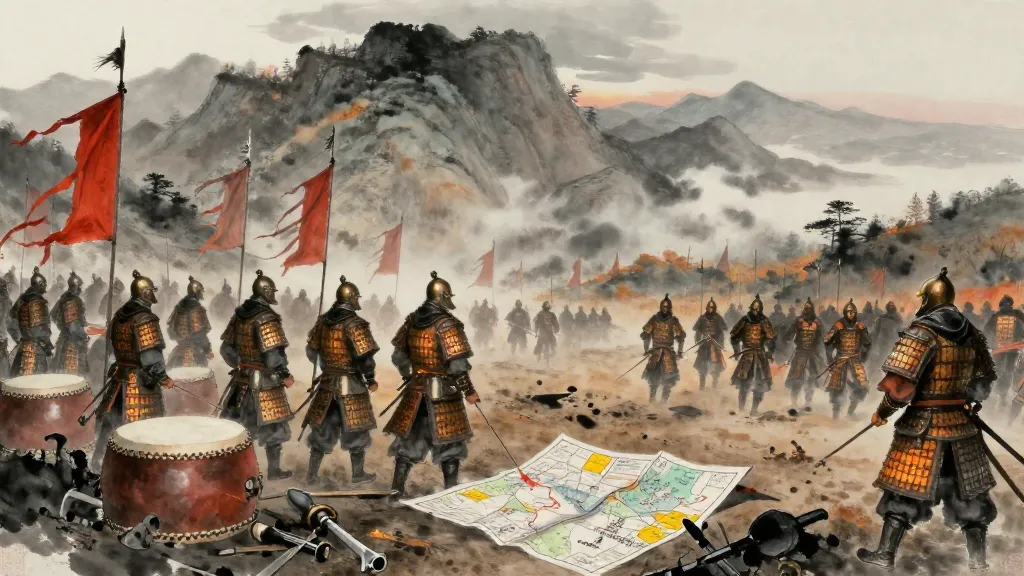
高祖本紀(下) (Annals of Emperor Gaozu (Part 3)) — Chinese ink painting

Chapter 8 of 130

高祖本紀(下)

Annals of Emperor Gaozu (Part 3)

View:

遷都關中

Moving the Capital to Guanzhong

高祖欲長都雒陽,齊人劉敬說,乃留侯勸上入都關中,高祖是日駕,入都關中。六月,大赦天下。

十月,燕王臧荼反,攻下代地。高祖自將擊之,得燕王臧荼。即立太尉盧綰為燕王。使丞相噲將兵攻代。

其秋,利幾反,高祖自將兵擊之,利幾走。利幾者,項氏之將。項氏敗,利幾為陳公,不隨項羽,亡降高祖,高祖侯之潁川。高祖至雒陽,舉通侯籍召之,而利幾恐,故反。

Gaozu wishes to make Luoyang his permanent capital. Liu Jing, a man of Qi, remonstrates, and then the Marquis of Liu persuades the Emperor to establish the capital within the passes. That same day Gaozu departs and enters Guanzhong to make it his capital. In the sixth month, a general amnesty is proclaimed throughout All-Under-Heaven.

In the tenth month, Zang Tu, King of Yan, rebels and attacks the territory of Dai. Gaozu personally leads the campaign against him and captures Zang Tu. He thereupon installs Grand Commandant Lu Wan as King of Yan, and orders Chancellor Kuai to lead troops to attack Dai.

That autumn, Li Ji rebels. Gaozu personally leads troops against him; Li Ji flees. Li Ji had been a general under the Xiang clan. When the Xiang clan fell, Li Ji became Duke of Chen. He did not follow Xiang Yu but fled and surrendered to Gaozu, who enfeoffed him as a marquis in Yingchuan. When Gaozu came to Luoyang and summoned all marquis-holders by their registers, Li Ji grew fearful and therefore rebelled.

Notes

1person劉敬Liú Jìng

Liu Jing (fl. 202–195 BC), originally surnamed Lou (婁), a man of Qi who persuaded Gaozu to establish the capital at Chang'an rather than Luoyang. Granted the imperial surname Liu for his counsel.

2person留侯Liú Hóu

Zhang Liang (張良, ?–186 BC), Marquis of Liu, one of Gaozu's three great ministers. A strategist who helped plan the Han victory over Chu.

3person臧荼Zāng Tú

Zang Tu (?–202 BC), a Yan general whom Xiang Yu appointed King of Yan. He was the first of the regional kings to rebel against the new Han dynasty.

4person盧綰Lú Wǎn

Lu Wan (?–194 BC), a childhood friend of Liu Bang from Feng. Appointed King of Yan in 202 BC. Later suspected of collusion with Chen Xi, he fled to the Xiongnu and died in exile.

尊太公、擒韓信、封諸王

Honoring the Grand Sire; Capturing Han Xin; Enfeoffing the Kings

六年,高祖五日一朝太公,如家人父子禮。太公家令說太公曰:"天無二日,土無二王。今高祖雖子,人主也;太公雖父,人臣也。柰何令人主拜人臣!如此,則威重不行。"後高祖朝,太公擁篲,迎門卻行。高祖大驚,下扶太公。太公曰:"帝,人主也,柰何以我亂天下法!"於是高祖乃尊太公為太上皇。心善家令言,賜金五百斤。

十二月,人有上變事告楚王信謀反,上問左右,左右爭欲擊之。用陳平之計,乃偽遊雲夢,會諸侯於陳,楚王信迎,即因執之。是日,大赦天下。田肯賀,因說高祖曰:"陛下得韓信,又治秦中。秦,形勝之國,帶河山之險,縣隔千里,持戟百萬,秦得百二焉。地埶便利,其以下兵於諸侯,譬猶居高屋之上建瓴水也。夫齊,東有琅邪、即墨之饒,南有泰山之固,西有濁河之限,北有勃海之利。地方二千里,持戟百萬,縣隔千里之外,齊得十二焉。故此東西秦也。非親子弟,莫可使王齊矣。"高祖曰:"善。"賜黃金五百斤。

後十餘日,封韓信為淮陰侯,分其地為二國。高祖曰將軍劉賈數有功,以為荊王,王淮東。弟交為楚王,王淮西。子肥為齊王,王七十餘城,民能齊言者皆屬齊。乃論功,與諸列侯剖符行封。徙韓王信太原。

In the sixth year, Gaozu pays court to the Grand Sire once every five days, observing the rites of a commoner father and son. The Grand Sire's household steward advises the Grand Sire, saying: "There are not two suns in the sky, nor two kings over the land. Though Gaozu is your son, he is the sovereign; though the Grand Sire is his father, he is a subject. How can you allow the sovereign to bow to a subject? If this continues, his authority and dignity will be undermined." The next time Gaozu comes to pay his respects, the Grand Sire takes up a broom and, walking backward, meets him at the gate. Gaozu is greatly startled and dismounts to support his father. The Grand Sire says: "The Emperor is the sovereign — how could I allow you to violate the laws of All-Under-Heaven on my account?" Thereupon Gaozu confers upon the Grand Sire the title of Supreme Emperor. In his heart he approves of the steward's words and rewards him with five hundred catties of gold.

In the twelfth month, a man submits a report of seditious activity accusing Han Xin, King of Chu, of plotting rebellion. The Emperor consults his ministers; they all eagerly urge an attack. Adopting Chen Ping's stratagem, the Emperor feigns a pleasure tour to Yunmeng and summons the regional lords to a gathering at Chen. The King of Chu comes to welcome him, and is immediately arrested. That day, a general amnesty is proclaimed throughout All-Under-Heaven. Tian Ken offers congratulations and takes the opportunity to address Gaozu: "Your Majesty has secured Han Xin and holds the heartland of Qin. Qin is a land of strategic advantage, girded by rivers and mountains, separated from the feudal lords by a thousand li, able to marshal a million halberds — Qin's position is worth a hundred against two elsewhere. Given its terrain and strategic advantage, to send armies down upon the feudal lords is like pouring water from a jug atop a high roof. As for Qi: to the east it has the riches of Langya and Jimo, to the south the bastion of Mount Tai, to the west the barrier of the Turbid River, and to the north the profits of the Gulf of Bohai. Its territory spans two thousand li, it can marshal a million halberds, and separated by a thousand li from the rest, Qi's position is worth ten against two. It is thus a second Qin in the east. Unless one of your own sons is made its king, no one else should be entrusted with Qi." Gaozu says: "Excellent." He rewards Tian Ken with five hundred catties of gold.

More than ten days later, he demotes Han Xin to Marquis of Huaiyin and divides his territory into two kingdoms. Gaozu declares that General Liu Jia has rendered meritorious service many times, and appoints him King of Jing, ruling east of the Huai. His younger brother Jiao becomes King of Chu, ruling west of the Huai. His son Fei becomes King of Qi, ruling over more than seventy cities — all people who speak the Qi dialect are placed under Qi's jurisdiction. He then evaluates the merits of his followers and distributes tally-tokens to enfeoff the various marquises. He transfers Han Xin, King of Han, to Taiyuan.

Notes

1person太公Tàigōng

The Grand Sire (太公), father of Liu Bang. His personal name is not recorded. Given the title Supreme Emperor (太上皇) in 201 BC — the first holder of that title in Chinese history.

2person韓信Hán Xìn

Han Xin (韓信, ?–196 BC), the supreme military strategist of the early Han. Originally a commoner from Huaiyin, he was made King of Qi and then King of Chu. Demoted to Marquis of Huaiyin in 201 BC. Executed for treason in 196 BC.

3person陳平Chén Píng

Chen Ping (陳平, ?–178 BC), a strategist who served Gaozu and later became Chancellor of Han. Known for his cunning stratagems.

4person劉肥Liú Féi

Liu Fei (劉肥, ?–189 BC), eldest son of Gaozu by a concubine. Appointed King of Qi in 201 BC. Posthumous title: King Daohui of Qi (齊悼惠王).

5person韓王信Hán Wáng Xìn

Han Xin, King of Han (韓王信, ?–196 BC) — a different person from the famous general Han Xin. A descendant of the old royal house of Han. Defected to the Xiongnu in 201 BC.

匈奴之役與平城之圍

The Xiongnu Campaign and the Siege of Pingcheng

七年,匈奴攻韓王信馬邑,信因與謀反太原。白土曼丘臣、王黃立故趙將趙利為王以反,高祖自往擊之。會天寒,士卒墮指者什二三,遂至平城。匈奴圍我平城,七日而後罷去。令樊噲止定代地。立兄劉仲為代王。

二月,高祖自平城過趙、雒陽,至長安。長樂宮成,丞相已下徙治長安。

八年,高祖東擊韓王信餘反寇於東垣。

蕭丞相營作未央宮,立東闕、北闕、前殿、武庫、太倉。高祖還,見宮闕壯甚,怒,謂蕭何曰:"天下匈匈苦戰數歲,成敗未可知,是何治宮室過度也?"蕭何曰:"天下方未定,故可因遂就宮室。且夫天子四海為家,非壯麗無以重威,且無令後世有以加也。"高祖乃說。

In the seventh year, the Xiongnu attack Han Xin, King of Han, at Mayi. Han Xin thereupon conspires to rebel at Taiyuan. Man Qiuchen of Baitu and Wang Huang install the former Zhao general Zhao Li as king and rise in revolt. Gaozu goes in person to attack them. It happens that the weather is bitterly cold; two or three out of every ten soldiers lose fingers to frostbite. The army presses on to Pingcheng. The Xiongnu surround Gaozu at Pingcheng for seven days before finally withdrawing. Gaozu orders Fan Kuai to remain and pacify the territory of Dai, and installs his elder brother Liu Zhong as King of Dai.

In the second month, Gaozu returns from Pingcheng through Zhao and Luoyang, arriving at Chang'an. The Palace of Lasting Joy is completed, and the Chancellor and all officials below him relocate their administration to Chang'an.

In the eighth year, Gaozu campaigns east to strike the remnant rebels of Han Xin, King of Han, at Dongyuan.

Chancellor Xiao He has been constructing the Weiyang Palace, erecting the Eastern Watchtower, Northern Watchtower, Front Hall, Arsenal, and Grand Granary. When Gaozu returns and sees how imposing the palace towers are, he grows angry and says to Xiao He: "All-Under-Heaven has suffered bitterly through years of war, and the outcome is still uncertain — why have you built palaces to such excess?" Xiao He replies: "Precisely because All-Under-Heaven is not yet settled, this is the time to complete the palaces. The Son of Heaven takes the Four Seas as his home; without grandeur and magnificence there is nothing to invest his authority with gravity — and one must not leave later generations room to outdo it." Gaozu is pleased.

Notes

1place

Modern Datong (大同), Shanxi province. Site of the famous siege in 200 BC where Modu Chanyu (冒頓單于) of the Xiongnu surrounded Gaozu's army on Mount Baideng (白登山) for seven days.

2person蕭何Xiāo Hé

Xiao He (蕭何, ?–193 BC), first Chancellor of the Han dynasty. He managed logistics during the civil war and oversaw the construction of Chang'an's palaces.

3person樊噲Fán Kuài

Fan Kuai (樊噲, ?–189 BC), a dog butcher from Pei who became one of Gaozu's most trusted generals. Famous for his bravery at the Feast at Hong Gate.

4place

Palace of Lasting Joy, the first major palace complex completed in Chang'an (200 BC). Originally the Qin Xingle Palace, it served as the primary imperial residence until the Weiyang Palace was completed.

5place

Weiyang Palace ("Palace of Endless [Joy]"), the principal palace of the Western Han dynasty in Chang'an, built by Xiao He in 200–199 BC.

諸王叛亂與夷族

Rebellions of the Kings and Their Extermination

十年十月,淮南王黥布、梁王彭越、燕王盧綰、荊王劉賈、楚王劉交、齊王劉肥、長沙王吳芮皆來朝長樂宮。春夏無事。

七月,太上皇崩櫟陽宮。楚王、梁王皆來送葬。赦櫟陽囚。更命酈邑曰新豐。

八月,趙相國陳豨反代地。上曰:"豨嘗為吾使,甚有信。代地吾所急也,故封豨為列侯,以相國守代,今乃與王黃等劫掠代地!代地吏民非有罪也。其赦代吏民。"九月,上自東往擊之。至邯鄲,上喜曰:"豨不南據邯鄲而阻漳水,吾知其無能為也。"聞豨將皆故賈人也,上曰:"吾知所以與之。"乃多以金啗豨將,豨將多降者。

十一年,高祖在邯鄲誅豨等未畢,豨將侯敞將萬餘人遊行,王黃軍曲逆,張春渡河擊聊城。漢使將軍郭蒙與齊將擊,大破之。太尉周勃道太原入,定代地。至馬邑,馬邑不下,即攻殘之。

豨將趙利守東垣,高祖攻之,不下。月餘,卒罵高祖,高祖怒。城降,令出罵者斬之,不罵者原之。於是乃分趙山北,立子恆以為代王,都晉陽。

春,淮陰侯韓信謀反關中,夷三族。

夏,梁王彭越謀反,廢遷蜀;復欲反,遂夷三族。立子恢為梁王,子友為淮陽王。

秋七月,淮南王黥布反,東並荊王劉賈地,北渡淮,楚王交走入薛。高祖自往擊之。立子長為淮南王。

In the tenth month of the tenth year, Ying Bu the King of Huainan, Peng Yue the King of Liang, Lu Wan the King of Yan, Liu Jia the King of Jing, Liu Jiao the King of Chu, Liu Fei the King of Qi, and Wu Rui the King of Changsha all come to pay court at the Palace of Lasting Joy. Spring and summer pass without incident.

In the seventh month, the Supreme Emperor dies at Yueyang Palace. The kings of Chu and Liang both come for the funeral. Prisoners at Yueyang are pardoned. The city of Liyi is renamed Xinfeng.

In the eighth month, Chen Xi, Chancellor of Zhao, rebels in the territory of Dai. The Emperor says: "Xi once served as my envoy and was most trustworthy. Because Dai was a territory I considered critical, I enfeoffed Xi as a full marquis and entrusted him with the chancellorship to defend Dai — and now he joins Wang Huang and others to plunder the land of Dai! The officials and people of Dai bear no guilt. Pardon them all." In the ninth month, the Emperor goes east in person to attack him. Upon reaching Handan, the Emperor says with satisfaction: "Xi has failed to take Handan in the south and block the Zhang River — I know he is incapable of anything great." When he hears that Chen Xi's generals are all former merchants, the Emperor says: "I know how to deal with them." He then lavishes gold to bribe Chen Xi's officers, and many of them surrender.

In the eleventh year, while Gaozu is at Handan and has not yet finished suppressing Chen Xi's forces, Chen Xi's general Hou Chang roams with over ten thousand men, Wang Huang camps at Quni, and Zhang Chun crosses the Yellow River to attack Liaocheng. The Han sends General Guo Meng together with the Qi generals to strike them, inflicting a great defeat. Grand Commandant Zhou Bo enters through Taiyuan to pacify the territory of Dai. He reaches Mayi, which refuses to surrender, and storms and destroys it.

Chen Xi's general Zhao Li holds Dongyuan. Gaozu attacks but cannot take the city. After more than a month, the garrison soldiers shout insults at Gaozu, and Gaozu is enraged. When the city finally surrenders, he orders those who shouted insults to be executed, and those who did not to be pardoned. He then divides the northern portion of Zhao and installs his son Heng as King of Dai, with his capital at Jinyang.

In the spring, the Marquis of Huaiyin, Han Xin, plots rebellion in Guanzhong. His three lineages are exterminated.

In the summer, Peng Yue, King of Liang, plots rebellion. He is deposed and exiled to Shu; when he again attempts rebellion, his three lineages are exterminated. Gaozu installs his son Hui as King of Liang and his son You as King of Huaiyang.

In the autumn, the seventh month, Ying Bu, King of Huainan, rebels. He annexes the territory of Liu Jia, King of Jing, to the east and crosses the Huai River northward. Liu Jiao, King of Chu, flees to Xue. Gaozu goes in person to attack him. He installs his son Chang as King of Huainan.

Notes

1person彭越Péng Yuè

Peng Yue (彭越, ?–196 BC), a bandit leader who became one of Gaozu's key allies against Xiang Yu. Appointed King of Liang in 202 BC. Accused of treason and executed; his flesh was minced and distributed to the other kings as a warning.

2person黥布Qíng Bù

Ying Bu (英布, ?–196 BC), also called Qing Bu (黥布) because he had been branded (黥) as a convict. Originally one of Xiang Yu's top generals, he defected to Han. Made King of Huainan, he rebelled in 196 BC and was killed.

3person陳豨Chén Xī

Chen Xi (陳豨, ?–195 BC), Chancellor of Zhao who was stationed in Dai. Rebelled in 197 BC. His revolt triggered the purge of Han Xin and Peng Yue, as both were accused of conspiring with him.

4person周勃Zhōu Bó

Zhou Bo (周勃, ?–169 BC), a general from Pei. Later played a decisive role in overthrowing the Lü clan after Empress Lü's death. Served as Chancellor under Emperor Wen.

還鄉沛縣與大風歌

Return to Pei and the Great Wind Song

十二年,十月,高祖已擊布軍會甀,布走,令別將追之。

高祖還歸,過沛,留。置酒沛宮,悉召故人父老子弟縱酒,發沛中兒得百二十人,教之歌。酒酣,高祖擊築,自為歌詩曰:"大風起兮雲飛揚,威加海內兮歸故鄉,安得猛士兮守四方!"令兒皆和習之。高祖乃起舞,慷慨傷懷,泣數行下。謂沛父兄曰:"遊子悲故鄉。吾雖都關中,萬歲後吾魂魄猶樂思沛。且朕自沛公以誅暴逆,遂有天下,其以沛為朕湯沐邑,復其民,世世無有所與。"沛父兄諸母故人日樂飲極驩,道舊故為笑樂。十餘日,高祖欲去,沛父兄固請留高祖。高祖曰:"吾人眾多,父兄不能給。"乃去。沛中空縣皆之邑西獻。高祖復留止,張飲三日。沛父兄皆頓首曰:"沛幸得復,豐未復,唯陛下哀憐之。"高祖曰:"豐吾所生長,極不忘耳,吾特為其以雍齒故反我為魏。"沛父兄固請,乃並復豐,比沛。於是拜沛侯劉濞為吳王。

In the twelfth year, in the tenth month, Gaozu engages Ying Bu's army at Huizhui. Ying Bu flees, and Gaozu orders a subordinate general to pursue him.

On his way back, Gaozu passes through Pei and stops there. He holds a banquet at the Palace of Pei, summoning all his old friends, village elders, and their sons and younger brothers for unrestrained drinking. He selects one hundred and twenty youths from among the children of Pei and teaches them a song. When the wine is at its height, Gaozu strikes the zhu lute and composes a song himself:

"A great wind rises — the clouds are driven and scattered! My power extends over All Within the Seas — I return to my homeland! Where shall I find brave warriors to guard the four quarters?"

He has the youths join in and practice the song. Gaozu then rises and dances; stirred to deep emotion, tears stream down his face in several lines. He addresses the fathers and elders of Pei: "The wanderer grieves for his homeland. Though I have made my capital within the passes, after ten thousand years my spirit will still delight in remembering Pei. Moreover, it was from here, as Lord of Pei, that I set out to punish tyranny and lawlessness, and thereby won All-Under-Heaven. I hereby designate Pei as my personal bath-town: its people shall be exempted from all taxes and labor service, generation after generation, forever." The fathers and elders of Pei, the mothers and old friends, spend their days in joyful drinking and deep delight, recounting old stories and laughing together. After more than ten days, Gaozu wishes to leave, but the fathers and elders of Pei press him to stay. Gaozu says: "My retinue is too large — you fathers and elders cannot afford to provide for us." He then departs. The entire population of Pei empties the district and goes to the west of the town to present gifts. Gaozu stops again and holds a drinking feast for three more days. The fathers and elders of Pei all prostrate themselves and say: "Pei has been fortunate enough to receive exemption, but Feng has not yet been exempted — we beg Your Majesty to show it the same compassion." Gaozu says: "Feng is where I was born and raised; I could never forget it. I single it out only because Yong Chi used it as a base to betray me and side with Wei." The fathers and elders persist in their plea, and so he exempts Feng as well, on equal terms with Pei. He then appoints Liu Bi, Marquis of Pei, as King of Wu.

Notes

1term

The Great Wind Song (大風歌), composed by Gaozu at the banquet in Pei in 195 BC. One of the most celebrated poems in Chinese literature, its three lines capture the emperor's triumph, nostalgia, and anxiety about defending the realm.

2term

The zhu (築), a thirteen-stringed percussion instrument struck with a bamboo stick. Popular in the state of Chu and the Pei region.

3term

A bath-town (湯沐邑): a district whose revenues are designated for the personal use of the emperor or an empress, and whose residents are exempted from ordinary taxation.

4person劉濞Liú Bì

Liu Bi (劉濞, 216–154 BC), nephew of Gaozu. Appointed King of Wu in 195 BC. Later led the Rebellion of the Seven Kingdoms in 154 BC against Emperor Jing and was killed.

高祖之死與身後事

The Death of Gaozu and Its Aftermath

高祖擊布時,為流矢所中,行道病。病甚,呂后迎良醫,醫入見,高祖問醫,醫曰:"病可治。"於是高祖嚚罵之曰:"吾以布衣提三尺劍取天下,此非天命乎?命乃在天,雖扁鵲何益!"遂不使治病,賜金五十斤罷之。已而呂后問:"陛下百歲後,蕭相國即死,令誰代之?"上曰:"曹參可。"問其次,上曰:"王陵可。然陵少戇,陳平可以助之。陳平智有餘,然難以獨任。周勃重厚少文,然安劉氏者必勃也,可令為太尉。"呂后復問其次,上曰:"此後亦非而所知也。"

盧綰與數千騎居塞下候伺,幸上病癒自入謝。

四月甲辰,高祖崩長樂宮。四日不發喪。呂后與審食其謀曰:"諸將與帝為編戶民,今北面為臣,此常怏怏,今乃事少主,非盡族是,天下不安。"人或聞之,語酈將軍。酈將軍往見審食其,曰:"吾聞帝已崩,四日不發喪,欲誅諸將。誠如此,天下危矣。陳平、灌嬰將十萬守滎陽,樊噲、周勃將二十萬定燕、代,此聞帝崩,諸將皆誅,必連兵還鄉以攻關中。大臣內叛,諸侯外反,亡可翹足而待也。"審食其入言之,乃以丁未發喪,大赦天下。

盧綰聞高祖崩,遂亡入匈奴。

丙寅,葬。己巳,立太子,至太上皇廟。群臣皆曰:"高祖起微細,撥亂世反之正,平定天下,為漢太祖,功最高。"上尊號為高皇帝。太子襲號為皇帝,孝惠帝也。令郡國諸侯各立高祖廟,以歲時祠。

While campaigning against Ying Bu, Gaozu is struck by a stray arrow, and falls ill on the road. His condition worsens. Empress Lü summons a skilled physician. The physician enters and examines him. Gaozu asks for the prognosis. The physician says: "The illness can be treated." At this Gaozu curses him roughly, saying: "I, a commoner in hempen cloth, took up a three-foot sword and won All-Under-Heaven — is this not the Mandate of Heaven? My fate rests with Heaven; even Bian Que himself could do nothing!" He refuses treatment, rewards the physician with fifty catties of gold, and dismisses him. Shortly afterward, Empress Lü asks: "After Your Majesty has passed, if Chancellor Xiao He should also die, who should succeed him?" The Emperor says: "Cao Can will do." She asks who should follow him. The Emperor says: "Wang Ling will do. But Ling is somewhat blunt; Chen Ping can assist him. Chen Ping has wisdom to spare, but he cannot bear sole responsibility. Zhou Bo is solid and earnest, though lacking in letters — yet the one who will secure the House of Liu is surely Bo. He should be made Grand Commandant." Empress Lü asks again about those who come next. The Emperor says: "After that, it is no longer something you will need to know."

Lu Wan and several thousand horsemen wait at the frontier passes, hoping the Emperor will recover so that he may come in person to beg pardon.

On the jiachen day of the fourth month, Gaozu dies at the Palace of Lasting Joy. For four days the death is not announced. Empress Lü confers with Shen Shiqi, saying: "The generals were once commoners alongside the Emperor. Now they serve as his subjects, facing north — this has always galled them. If they must now serve a young sovereign, we shall have no peace in All-Under-Heaven unless we exterminate their entire clans." Someone overhears this and informs General Li. General Li goes to see Shen Shiqi and says: "I have heard that the Emperor has died and for four days the death has not been announced, because there is a plan to execute the generals. If this is truly so, All-Under-Heaven is in peril. Chen Ping and Guan Ying command a hundred thousand troops guarding Xingyang; Fan Kuai and Zhou Bo lead two hundred thousand to pacify Yan and Dai. If they hear that the Emperor has died and the generals are being executed, they will surely wheel their armies around and march on Guanzhong. With great ministers in revolt within and feudal lords rebelling without, the dynasty's destruction can be awaited on tiptoe." Shen Shiqi goes in and conveys this warning. On the dingwei day the death is finally announced, and a general amnesty is proclaimed throughout All-Under-Heaven.

When Lu Wan hears of Gaozu's death, he flees into Xiongnu territory.

On the bingyin day, the burial takes place. On the jisi day, the Heir is installed and proceeds to the Temple of the Supreme Emperor. All the ministers say: "Gaozu rose from humble obscurity, swept away the chaos of the age and restored it to order, pacified All-Under-Heaven, and became the Grand Ancestor of Han. His accomplishments are the highest of all." He is given the exalted posthumous title of Emperor Gao. The Heir succeeds to the imperial title — he is Emperor Xiaohui. An order is issued that each commandery, kingdom, and feudal domain shall establish a temple to Gaozu and offer sacrifices at the proper seasons.

Notes

1person呂后Lǚ Hòu

Empress Lü (呂后, 241–180 BC), personal name Lü Zhi (呂雉). Wife of Gaozu and mother of Emperor Hui. After Gaozu's death she effectively ruled the empire as regent for fifteen years.

2person曹參Cáo Cān

Cao Can (曹參, ?–190 BC), a fellow townsman of Gaozu from Pei who served as a general during the civil war. Succeeded Xiao He as Chancellor in 193 BC, famously continuing Xiao He's policies unchanged.

3person審食其Shěn Yìjī

Shen Shiqi (審食其, ?–177 BC), a close associate of Empress Lü. Served as Marquis of Piyang. Rumored to have been Empress Lü's lover.

4term

Bian Que, legendary physician of antiquity, traditionally dated to the 5th century BC. His name became a byword for supreme medical skill.

5person孝惠帝Xiào Huì Dì

Emperor Xiaohui (孝惠帝, 210–188 BC), personal name Liu Ying (劉盈). Second emperor of the Han dynasty, reigned 195–188 BC. A gentle ruler largely overshadowed by his mother, Empress Lü.

高帝八子

The Eight Sons of Emperor Gao

及孝惠五年,思高祖之悲樂沛,以沛宮為高祖原廟。高祖所教歌兒百二十人,皆令為吹樂,後有缺,輒補之。

高帝八男:長庶齊悼惠王肥;次孝惠,呂后子;次戚夫人子趙隱王如意;次代王恆,已立為孝文帝,薄太后子;次梁王恢,呂太后時徙為趙共王;次淮陽王友,呂太后時徙為趙幽王;次淮南厲王長;次燕王建。

In the fifth year of Emperor Xiaohui's reign, remembering Gaozu's sorrowful joy at Pei, the Palace of Pei is designated as the Original Temple of Gaozu. The one hundred and twenty youths whom Gaozu had taught to sing are all retained as court musicians; whenever vacancies occur, replacements are recruited.

Emperor Gao has eight sons. The eldest, born of a concubine, is Liu Fei, posthumously King Daohui of Qi. Next is Xiaohui, son of Empress Lü. Next is Liu Ruyi, son of Lady Qi, posthumously King Yin of Zhao. Next is Liu Heng, King of Dai, who is later enthroned as Emperor Xiaowen — he is the son of Empress Dowager Bo. Next is Liu Hui, King of Liang, who under Empress Dowager Lü is transferred to become King Gong of Zhao. Next is Liu You, King of Huaiyang, who under Empress Dowager Lü is transferred to become King You of Zhao. Next is Liu Chang, King Li of Huainan. Last is Liu Jian, King of Yan.

Notes

1person代王恆Dài Wáng Héng

Liu Heng (劉恆, 203–157 BC), fourth son of Gaozu by Consort Bo. Installed as King of Dai in 196 BC. After the Lü clan was overthrown in 180 BC, he was invited to become emperor — Emperor Wen (文帝), regarded as one of the finest rulers in Chinese history.

2person戚夫人Qī Fūrén

Lady Qi (戚夫人, ?–194 BC), Gaozu's favorite consort. After Gaozu's death, Empress Lü had her mutilated and killed in an act of notorious cruelty — the so-called "human swine" (人彘) incident.

太史公曰

The Grand Historian's Assessment

太史公曰:夏之政忠。忠之敝,小人以野,故殷人承之以敬。敬之敝,小人以鬼,故周人承之以文。文之敝,小人以僿,故救僿莫若以忠。三王之道若循環,終而復始。周秦之間,可謂文敝矣。秦政不改,反酷刑法,豈不繆乎?故漢興,承敝易變,使人不倦,得天統矣。朝以十月。車服黃屋左纛。葬長陵。

The Grand Historian remarks: The governance of the Xia was characterized by sincerity. When sincerity became corrupted, lesser men turned to uncouthness. Therefore the Yin succeeded it with reverence. When reverence became corrupted, lesser men turned to superstition. Therefore the Zhou succeeded it with refinement. When refinement became corrupted, lesser men turned to hollow pretense. To remedy pretense, nothing surpasses a return to sincerity. The Way of the Three Dynasties is like a cycle, ending only to begin again. In the interval from Zhou to Qin, one may say that refinement had become corrupted indeed. Yet Qin did not reform its governance but instead intensified harsh punishments and cruel laws — was this not a grave error? Therefore when Han arose, it inherited the corruption and introduced change, so that the people were not exhausted, and it obtained the legitimate succession of Heaven. Court was held in the tenth month. The imperial carriage bore a yellow canopy with a yak-tail standard to the left. Gaozu was buried at Changling.

Notes

1person太史公Tàishǐ Gōng

The Grand Historian — Sima Qian (司馬遷, c. 145–c. 86 BC), author of the Shiji. This formulaic closing assessment (太史公曰) appears at the end of every chapter in the Shiji.

2term

The Three Dynasties (三王, lit. "Three Kings"): Xia, Shang (Yin), and Zhou. Each is associated with a governing virtue — sincerity (忠), reverence (敬), and refinement (文) — in a cyclical theory of political philosophy.

3place

Changling, the mausoleum of Emperor Gaozu, located on the Xianyang Plateau north of the Wei River. Modern Xianyang, Shaanxi province. Empress Lü was later buried nearby.

Edition & Source

Text
《史記》 Shiji
Edition
中華古詩文古書籍網 transcription
Commentary
裴駰《史記集解》、司馬貞《史記索隱》、張守節《史記正義》(Three Commentaries)