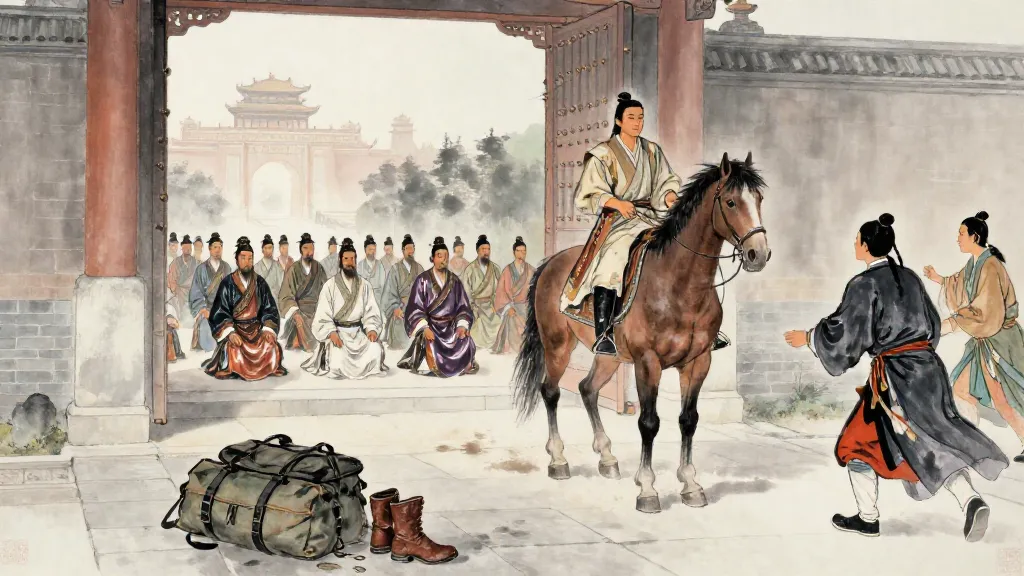
代王受召與宋昌進諫
The King of Dai Is Summoned and Song Chang's Counsel
孝文皇帝,高祖中子也。高祖十一年春,已破陳豨軍,定代地,立為代王,都中都。太后薄氏子。即位十七年,高后八年七月,高后崩。九月,諸呂呂產等欲為亂,以危劉氏,大臣共誅之,謀召立代王,事在呂后語中。
丞相陳平、太尉周勃等使人迎代王。代王問左右郎中令張武等。張武等議曰:"漢大臣皆故高帝時大將,習兵,多謀詐,此其屬意非止此也,特畏高帝、呂太后威耳。今已誅諸呂,新喋血京師,此以迎大王為名,實不可信。原大王稱疾毋往,以觀其變。"中尉宋昌進曰:"群臣之議皆非也。夫秦失其政,諸侯豪桀並起,人人自以為得之者以萬數,然卒踐天子之位者,劉氏也,天下絕望,一矣。高帝封王子弟,地犬牙相制,此所謂盤石之宗也,天下服其彊,二矣。漢興,除秦苛政,約法令,施德惠,人人自安,難動搖,三矣。夫以呂太后之嚴,立諸呂為三王,擅權專制,然而太尉以一節入北軍,一呼士皆左袒,為劉氏,叛諸呂,卒以滅之。此乃天授,非人力也。今大臣雖欲為變,百姓弗為使,其黨寧能專一邪?方今內有硃虛、東牟之親,外畏吳、楚、淮南、琅邪、齊、代之彊。方今高帝子獨淮南王與大王,大王又長,賢聖仁孝,聞於天下,故大臣因天下之心而欲迎立大王,大王勿疑也。"代王報太后計之,猶與未定。卜之龜,卦兆得大橫。占曰:"大橫庚庚,余為天王,夏啟以光。"代王曰:"寡人固已為王矣,又何王?"卜人曰:"所謂天王者乃天子。"於是代王乃遣太后弟薄昭往見絳侯,絳侯等具為昭言所以迎立王意。薄昭還報曰:"信矣,毋可疑者。"代王乃笑謂宋昌曰:"果如公言。"乃命宋昌參乘,張武等六人乘傳詣長安。至高陵休止,而使宋昌先馳之長安觀變。
Emperor Wen was a middle son of Gaozu. In the spring of Gaozu's eleventh year, after the army of Chen Xi had been defeated and the Dai territory secured, he was made King of Dai, with his capital at Zhongdu. His mother was Lady Bo. He had been on the throne seventeen years when, in the seventh month of Empress Dowager Lü's eighth year, the Empress Dowager died. In the ninth month, the Lü clan — Lü Chan and others — plotted rebellion to endanger the Liu house. The senior ministers jointly destroyed them and deliberated on summoning the King of Dai to take the throne. These events are recorded in the account of Empress Dowager Lü.
Chancellor Chen Ping and Grand Commandant Zhou Bo sent envoys to fetch the King of Dai. The king consulted his Prefect of the Gentlemen Zhang Wu and others. Zhang Wu and his colleagues argued: "The senior Han ministers are all former generals from Emperor Gaozu's time — experienced in warfare and full of cunning. Their ambitions do not stop here; they were merely cowed by the authority of Gaozu and Empress Lü. Now they have just slaughtered the Lü clan, and the blood is still fresh in the capital. Their invitation to Your Majesty is a pretext; it cannot be trusted. We urge Your Majesty to plead illness and not go, but wait and watch."
The Colonel of the Capital Guard, Song Chang, stepped forward and said: "These arguments are all wrong. When Qin lost control of its government, lords and heroes rose everywhere — tens of thousands believed the throne was theirs for the taking. Yet in the end, only the house of Liu ascended to the position of Son of Heaven. The realm abandoned all other hopes — that is the first point. Gaozu enfeoffed his sons and brothers as kings, their territories interlocking like dogs' teeth, mutually restraining one another. This is what is called a 'foundation of solid rock.' The realm submits to its strength — that is the second point. When the Han dynasty arose, it swept away the harsh laws of Qin, simplified the legal code, and bestowed benevolent policies. Every person felt secure; the order is difficult to shake — that is the third point.
"Consider: even with Empress Lü's iron authority, even after she made three Lü clansmen kings and seized all power — the Grand Commandant entered the Northern Army with a single tally, gave one shout, and every soldier bared his left shoulder for the Liu house, turning against the Lü clan and destroying them. This was heaven's mandate, not human effort. Even if the ministers now wished to rebel, the people would not follow them. Could their faction truly hold together?
"At present, within the capital there are the close kinsmen at Zhuixu and Dongmou; without, there is the strength of Wu, Chu, Huainan, Langya, Qi, and Dai to be feared. Of Emperor Gaozu's sons, only the King of Huainan and Your Majesty survive. Your Majesty is the eldest, renowned throughout the realm for sagacity, benevolence, and filial devotion. The ministers are following the will of the realm in wishing to welcome Your Majesty. Let Your Majesty have no doubt."
The King of Dai reported to Empress Dowager Bo and deliberated with her, still unable to decide. They divined with the tortoise shell and obtained the hexagram 'Great Traverse.' The diviner interpreted: "'Great Traverse, firm and unyielding' — you shall be king of heaven, glorious as Xia Qi." The King of Dai said: "I am already a king. What other king could I be?" The diviner said: "'King of heaven' means the Son of Heaven."
The King of Dai then sent Empress Dowager Bo's younger brother, Bo Zhao, to visit the Marquis of Jiang. Zhou Bo and the others explained in full their reasons for wishing to enthrone the king. Bo Zhao returned and reported: "It is genuine. There is nothing to doubt." The King of Dai smiled and said to Song Chang: "It is exactly as you said." He ordered Song Chang to ride as his carriage companion, and Zhang Wu with five others to proceed by relay to Chang'an. At Gaoling they halted, and Song Chang was sent ahead to Chang'an to observe the situation.
Notes
Emperor Wen (漢文帝, r. 180–157 BC), personal name Liu Heng (劉恆), was Gaozu's fourth son and is regarded as one of the greatest rulers of early China. His reign, together with that of his son Emperor Jing, is known as the 'Governance of Wen and Jing' (文景之治), a golden age of peace and prosperity.
Song Chang (宋昌) was the Colonel of the Capital Guard (中尉) in the Dai kingdom. His three-point argument for why Liu Heng should accept the throne — the finality of the Liu mandate, the interlocking feudal system, and popular contentment — is a masterpiece of political persuasion, and earned him immediate promotion upon the king's accession.
Empress Dowager Bo (薄太后, d. 155 BC) was originally a minor consort of Gaozu from the Wei kingdom. Her low status during Gaozu's lifetime paradoxically saved both her and her son — Empress Lü ignored them as inconsequential. She lived to see her son become emperor and her grandson Emperor Jing succeed him.
Bo Zhao (薄昭) was Empress Dowager Bo's younger brother. Emperor Wen later enfeoffed him as Marquis of Zhi (軹侯). He was eventually forced to commit suicide in 170 BC after killing an imperial envoy.
Zhongdu (中都) was the capital of the Dai kingdom, located in modern Pingyao County (平遙縣), Shanxi. Dai was a frontier kingdom bordering the Xiongnu.
The hexagram 'Great Traverse' (大橫) from the tortoise-shell divination is not from the Yijing but from a separate divination tradition using turtle plastrons. The phrase 'Xia Qi' (夏啟) refers to Qi, the son of Yu the Great, who succeeded his father as the first hereditary ruler of the Xia dynasty — an auspicious parallel for a son inheriting supreme power.