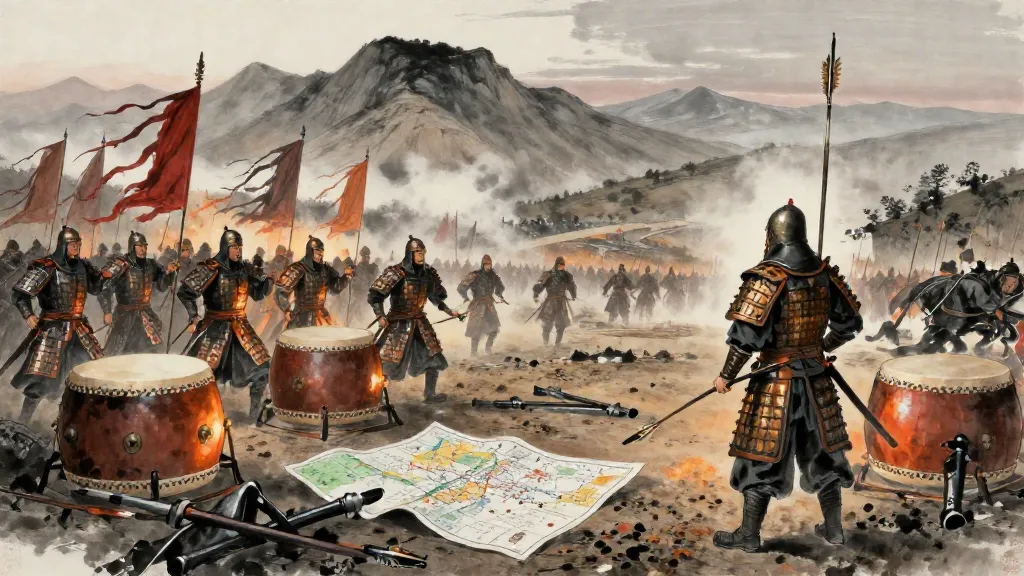
袁盎晁錯列傳 (Biographies of Yuan Ang and Chao Cuo) — Chinese ink painting

Chapter 101 of 130

袁盎晁錯列傳

Biographies of Yuan Ang and Chao Cuo

View:

袁盎直諫文帝

Yuan Ang's Forthright Counsel to Emperor Wen

袁盎者,楚人也,字絲。絳侯為丞相,朝罷趨出,意得甚。袁盎進曰:“絳侯所謂功臣,非社稷臣。丞相如有驕主色。陛下謙讓,臣主失禮,竊為陛下不取也。”後朝,上益莊,丞相益畏。

文帝從霸陵上,欲西馳下峻阪。袁盎騎,並車攬轡。盎曰:“聖主不乘危而徼幸。今陛下騁六騑,馳下峻山,如有馬驚車敗,陛下縱自輕,柰高廟、太后何?”上乃止。

Yuan Ang was a man of Chu, styled Si. When the Marquis of Jiang served as chancellor, he would stride out of morning court looking extremely pleased with himself. Yuan Ang said to the Emperor: "The Marquis of Jiang is merely a meritorious minister, not a pillar of the dynasty. The chancellor shows an air of arrogance toward his sovereign. Your Majesty is humble and deferential, but the proper relationship between ruler and minister is being lost — I find this unacceptable." At the next court session, the Emperor was more dignified and the chancellor more deferential.

When Emperor Wen visited the Baling heights and wanted to gallop his chariot down a steep slope, Yuan Ang rode alongside and grabbed the reins. He said: "A sage ruler does not court danger for a thrill. If Your Majesty races six horses down a precipitous mountain and a horse stumbles and the chariot overturns — even if Your Majesty does not value your own life, what about the Ancestral Temple and the Empress Dowager?" The Emperor stopped.

Notes

1person袁盎Yuán Àng

Yuan Ang (袁盎, d. 148 BC), styled Si, was one of the most outspoken advisers of Emperor Wen. His willingness to confront both the Emperor and powerful ministers earned him great fame but also many enemies — he was eventually assassinated by agents of the King of Liang.

2context

Yuan Ang's distinction between 'meritorious minister' (功臣) and 'pillar of the dynasty' (社稷臣) became a standard framework in Chinese political thought for evaluating officials.

晁錯削藩與被誅

Chao Cuo's Retrenchment Policy and Execution

晁錯者,潁川人也。學申商刑名。以其辯得幸太子,太子家號曰“智囊”。景帝即位,以錯為內史。遷為御史大夫,請諸侯之罪過,削其地。錯父聞之,謂錯曰:“劉氏安矣,而晁氏危矣,吾去公歸矣!”遂飲藥死。死十餘日,吳楚七國果反,以誅錯為名。上令晁錯衣朝衣斬東市。

鄧公曰:“夫晁錯患諸侯彊大不可制,故請削地以尊京師,萬世之利也。計畫始行,卒受大戮,內杜忠臣之口,外為諸侯報仇,臣竊為陛下不取也。”景帝默然良久,曰:“公言善,吾亦恨之。”

Chao Cuo was a man of Yingchuan who studied Legalist theory. His eloquence won him the favor of the Crown Prince, whose household called him 'the Brain Trust.' When Emperor Jing took the throne, Chao Cuo was made Interior Minister, then promoted to Censor-in-Chief. He memorialized to investigate the lords' offenses and reduce their territories. His father, hearing of this, traveled from Yingchuan and said: "The Liu dynasty will be secure, but the Chao family will be endangered. I am leaving you." He drank poison and died. Within ten days, the seven states of Wu and Chu revolted, using 'punish Chao Cuo' as their rallying cry. The Emperor ordered Chao Cuo executed in his court robes at the Eastern Market.

Deng Gong later said to the Emperor: "Chao Cuo feared the lords were too powerful to control, so he proposed reducing their territories to strengthen the capital — a benefit for ten thousand generations. His plan had barely begun when he was put to death. Internally you silenced loyal ministers; externally you avenged the lords. I find this unacceptable." Emperor Jing was silent for a long time, then said: "Your words are well-spoken. I too have regrets."

Notes

1person晁錯Cháo Cuò

Chao Cuo (晁錯, d. 154 BC), also written Chao Cuo, was the chief architect of the Han policy of reducing the feudal kingdoms. His execution during the Rebellion of the Seven States — sacrificed to appease the rebels — is one of the most debated episodes in Han history.

2context

Chao Cuo's father's suicide is one of the most tragic episodes in the Shiji. He saw clearly that his son's policy, though correct for the dynasty, would destroy their family — and chose to die before witnessing it.

3context

The Emperor's admission of regret ('I too have regrets') is devastating in its brevity. He had sacrificed his most capable minister to buy time, only to realize that the rebellion continued regardless — exactly as Deng Gong warned.

Edition & Source

Text
《史記》 Shiji
Edition
中華古詩文古書籍網 transcription
Commentary
裴駰《史記集解》、司馬貞《史記索隱》、張守節《史記正義》(Three Commentaries)