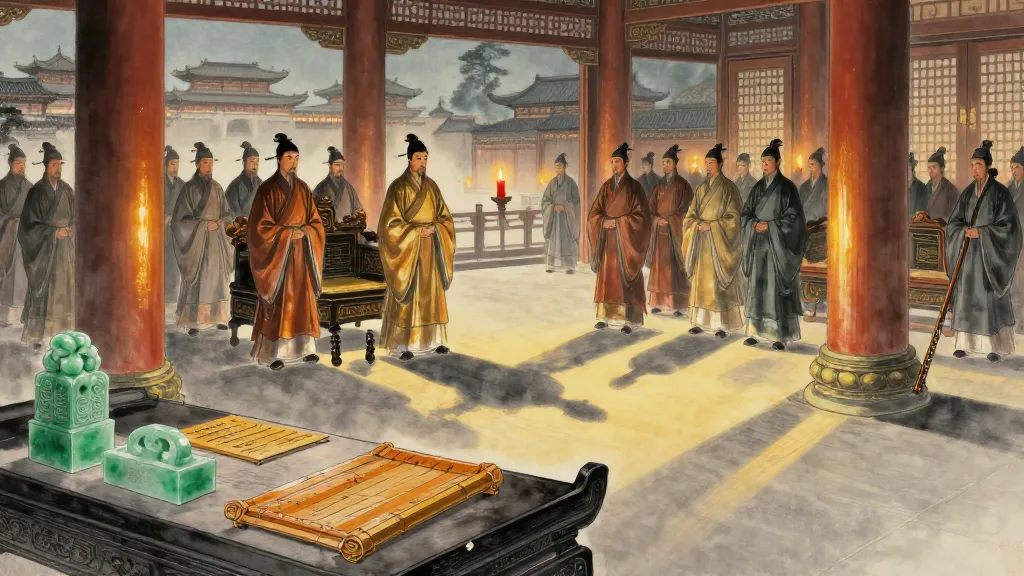
司馬相如列傳(上) (Biography of Sima Xiangru (Part 1)) — Chinese ink painting

Chapter 117 of 130

司馬相如列傳(上)

Biography of Sima Xiangru (Part 1)

View:

相如少時與琴挑文君

Xiangru's Youth and the Courtship of Zhuo Wenjun

司馬相如者,蜀郡成都人也,字長卿。少時好讀書,學擊劍,故其親名之曰犬子。相如既學,慕藺相如之為人,更名相如。以資為郎,事孝景帝,為武騎常侍,非其好也。會景帝不好辭賦,是時梁孝王來朝,從遊說之士齊人鄒陽、淮陰枚乘、吳莊忌夫子之徒,相如見而說之,因病免,客遊梁。梁孝王令與諸生同舍,相如得與諸生遊士居數歲,乃著子虛之賦。

會梁孝王卒,相如歸,而家貧,無以自業。素與臨郛令王吉相善,吉曰:“長卿久官遊不遂,而來過我。”於是相如往,舍都亭。…相如乃使人重賜文君侍者通殷勤。文君夜亡奔相如,相如乃與馳歸成都。家居徒四壁立。卓王孫大怒曰:“女至不材,我不忍殺,不分一錢也。”…文君乃與相如歸成都,買田宅,為富人。

Sima Xiangru was a man of Chengdu in the Commandery of Shu. His courtesy name was Changqing. As a youth he loved reading and the study of swordsmanship, so his parents named him Quanzi (‘Puppy’). After completing his studies, he admired Lin Xiangru of Zhao and changed his name to Xiangru. He purchased the rank of Gentleman and served Emperor Jing as a Mounted Attendant of the Guard, but this was not to his liking. As it happened, Emperor Jing did not appreciate literary compositions. At that time, King Xiao of Liang came to court, accompanied by such rhetoricians and persuaders as Zou Yang of Qi, Mei Sheng of Huaiyin, and Master Zhuang Ji of Wu. Xiangru was taken with them. He obtained a medical discharge and went to live as a guest in Liang. King Xiao of Liang lodged him with his scholars, and Xiangru lived among the literary men and traveling scholars for several years, during which he composed the Rhapsody of Master Nothingness.

When King Xiao of Liang died, Xiangru returned home to find the family impoverished and without a livelihood. He had long been on good terms with Wang Ji, the magistrate of Linqiong. Wang Ji said: “Changqing, you have served at court without success — come stay with me.” Xiangru went and took up lodging at the capital pavilion. ... Xiangru then sent rich gifts through Wenjun’s maid to convey his ardent feelings. Wenjun eloped with Xiangru that night, and together they rode back to Chengdu. Their home was bare — nothing but four walls. Her father Zhuo Wangsun was furious: “My daughter is utterly worthless. I cannot bring myself to kill her, but I will not give her a single coin.” ... Eventually Wenjun and Xiangru returned to Chengdu, purchased farmland and a house, and became wealthy.

Notes

1person司馬相如Sīmǎ Xiāngrú

Sima Xiangru (司馬相如, 179–117 BC) was the greatest literary stylist of the early Han dynasty, celebrated for his fu (賦, rhapsody) compositions. His elopement with Zhuo Wenjun is one of the most famous love stories in Chinese literature.

2person卓文君Zhuó Wénjūn

Zhuo Wenjun (卓文君) was the young widow of a wealthy Linqiong family who defied her father to elope with the impoverished poet. Their story became a symbol of romantic love triumphing over social convention.

3place

Linqiong (臨郛) is modern Qionglai, Sichuan. It was also where the Zhuo iron-smelting dynasty (mentioned in Juan 129) was based.

子虛賦與上林賦

The Rhapsody of Master Nothingness and the Rhapsody of the Shanglin Park

居久之,蜀人楊得意為狗監,侍上。上讀子虛賦而善之,曰:“朕獨不得與此人同時哉!”得意曰:“臣邑人司馬相如自言為此賦。”上驚,乃召問相如。相如曰:“有是。然此乃諸侯之事,未足觀也。請為天子遊獵賦,賦成奏之。”上許,令尚書給筆札。相如以“子虛”,虛言也,為楚稱;“烏有先生”者,烏有此事也,為齊難;“無是公”者,無是人也,明天子之義。故空藉此三人為辭,以推天子諸侯之苑囿。其卒章歸之於節儉,因以風諊。奏之天子,天子大說。

Some time later, Yang Deyi of Shu was serving as Keeper of the Imperial Hounds and attended the Emperor. The Emperor read the Rhapsody of Master Nothingness and admired it greatly, saying: “Alas that I could not have lived in the same age as this author!” Yang Deyi said: “My fellow townsman Sima Xiangru claims to have written this piece.” The Emperor was astonished and summoned Xiangru for questioning. Xiangru said: “Indeed I wrote it. But this concerns merely the affairs of the feudal lords, and is not worth looking at. Allow me to compose a rhapsody on the imperial hunt. When it is finished, I shall present it.” The Emperor agreed and had the Imperial Secretariat supply him with brush and writing tablets. Xiangru used ‘Master Nothingness’ as a fictitious speaker representing Chu; ‘Sir No-Such-Thing’ as the one who demonstrates that no such extravagance exists, representing Qi’s rebuttal; and ‘Lord No-One’ as a nonexistent person who illuminates the Emperor’s righteous position. He thus employed these three fictional personages as his vehicle for comparing the hunting parks of the Emperor and the feudal lords. The final chapter returns to the theme of frugality, using the text as a vehicle for remonstrance. He presented it to the Emperor, who was greatly pleased.

Notes

1context

The fu (賦) or ‘rhapsody’ was the dominant literary genre of the Han dynasty: a long, elaborate prose-poem combining description, narrative, and persuasion. Sima Xiangru’s Zixu fu (子虛賦) and its companion the Shanglin fu (上林賦) are considered the supreme examples of the form. The genre used extravagant description of imperial splendor as a vehicle for moral remonstrance.

2translation

The three fictional speakers — 子虛 (‘Master Nothingness’), 烏有先生 (‘Sir No-Such-Thing’), and 無是公 (‘Lord No-One’) — are elaborate puns. Their names signal that the extravagance described is itself fictitious, a rhetorical device rather than a factual account.

子虛賦與上林賦摘要

Summary of the Zixu and Shanglin Rhapsodies

楚使子虛使於齊,齊王悉發境內之士,備車騎之眾,與使者出田。田罷,子虛過誑烏有先生,而無是公在焉。…無是公聴然而笑曰:“楚則失矣,齊亦未為得也。…君未睹夫巨麗也,獨不聞天子之上林乎?”

“於是酒中樂酣,天子芒然而思,似若有亡。曰:‘嗟乎,此泰奢侈!朕以覽聽餘間,無事棄日,順天道以殺伐,時休息於此,恐後世靡麗,遂往而不反,非所以為繼嗣創業垂統也。’ 於是乃解酒罷獵,而命有司曰:‘地可以墾闢,悉為農郊,以贍萌隸。’”

Chu sent Master Nothingness as envoy to Qi. The King of Qi mustered all the warriors of his domain, assembled his chariots and cavalry, and went hunting with the envoy. Afterward, Master Nothingness visited Sir No-Such-Thing to boast, and Lord No-One was present. ... Lord No-One laughed and said: “Chu has missed the mark, and Qi has not found it either. ... Have you never beheld the magnificence of the Son of Heaven’s Shanglin Park?”

[Lord No-One then describes the Shanglin Park in sweeping detail — its rivers and mountains, forests and beasts, palaces and gardens. After the great imperial hunt:]

“When the wine was flowing and the music at its height, the Son of Heaven fell into a reverie, as though something were missing. He said: ‘Alas, this is extravagance carried too far! I have used my leisure from state affairs, wasting days, following Heaven’s way through hunting and culling, resting here for a time. But I fear that later generations will make this their model of luxury, going ever further without turning back — this is no way to establish a legacy for our successors.’ Thereupon he halted the hunt, dismissed the wine, and commanded his officials: ‘Let all land that can be plowed be opened for farming to feed the common people.’”

Notes

1context

The full text of the combined Zixu/Shanglin fu runs to thousands of characters of ornate description. Sima Qian reproduces it almost in its entirety, making this one of the longest quoted texts in the Shiji. The translation here summarizes the descriptive passages and quotes the morally significant conclusion.

2translation

The rhetorical structure of the fu is a deliberate paradox: hundreds of lines of dazzling description of imperial luxury, followed by the emperor’s rejection of it all in favor of frugality and benevolent governance. Yang Xiong later criticized this as ‘encouraging a hundred and warning against one’ (勸百諽一).

出使西南夷與蜀父老書

Mission to the Southwest Yi and the Address to the Elders of Shu

相如為郎數歲,會唐蒙使略通夜郎西僰中,發巴蜀吉卒千人,郡又多為發轉漕萬餘人,用興法誅其渠帥,巴蜀民大驚恐。上聞之,乃使相如責唐蒙,因喻告巴蜀民以非上意。…司馬長卿便略定西夷,郛、筰、厓、駹、斯榆之君皆請為內臣。除邊關,關益斥,西至沝、若水,南至牡柯為徼,通零關道,橋孫水以通郛都。還報天子,天子大説。

Xiangru had served as a Gentleman for several years when Tang Meng was sent to open a road through Yelang and the western Bo lands. He conscripted a thousand soldiers from Ba and Shu, and the commandery additionally mobilized over ten thousand more for transport service. He used military punishments against their chieftains, and the people of Ba and Shu were thrown into great alarm. When the Emperor learned of this, he sent Xiangru to reprimand Tang Meng and reassure the people of Ba and Shu that this was not the Emperor’s intention. ... Sima Xiangru then proceeded to pacify the southwestern Yi. The chieftains of Qiong, Zuo, Ran, Mang, and Siyu all requested to become internal subjects. He abolished the frontier passes, extending the borders westward to the Mei and Ruo rivers, and southward to Zangke. He opened the Lingguan road and bridged the Sun River to connect Qiong City. He returned and reported to the Emperor, who was greatly pleased.

Notes

1context

Sima Xiangru’s dual role as literary artist and imperial envoy reflects the Han court’s use of literary talent in diplomacy. His pacification of the southwestern peoples expanded Han territory into modern Sichuan, Yunnan, and Guizhou.

2place

The southwestern Yi (西南夷) peoples inhabited modern Sichuan, Yunnan, and Guizhou. Qiong (郛) and Zuo (筰) were tribal territories in the area of modern Xichang and Ya’an, Sichuan.

諊獵上疏與哀二世賦

The Remonstrance Against Hunting and the Lament for the Second Emperor

相如口吃而善著書。常有消渴疾。與卓氏婚,饒於財。其進仕官,未嘗肯與公卿國家之事,稱病間居,不慕官爵。常從上至長楊獵,是時天子方好自擊熊彘,馳逐野獸,相如上疏諊之。其辭曰:…蓋明者遠見於未萌而智者避危於無形,禍固多藏於隱微而發於人之所忽者也。故鄙諺曰“家累千金,坐不垂堂”。此言雖小,可以喻大。臣原陘下之留意幸察。

上善之。

Xiangru had a stutter but was a brilliant writer. He suffered constantly from the wasting-thirst disease. Having married into the Zhuo family, he was comfortable financially. In his official career, he never involved himself in matters of state with the other ministers, claiming illness and living in retirement, indifferent to rank. He once accompanied the Emperor to a hunt at Changyang. The Emperor was fond of personally attacking bears and boars and chasing wild beasts. Xiangru submitted a memorial of remonstrance. It read in part: ... “The far-sighted man perceives danger before it sprouts; the wise man avoids peril while it is still formless. Disasters are usually hidden in the subtle and emerge from what people neglect. Therefore the common proverb says: ‘A family worth a thousand in gold does not sit on the edge of the hall.’ These words may be humble, but they illustrate a great truth. I beg Your Majesty to reflect on this.”

The Emperor approved.

Notes

1context

The ‘wasting-thirst disease’ (消渴疾) is almost certainly diabetes mellitus, making this one of the earliest clinical references to the disease in world literature.

2translation

“家累千金,坐不垂堂” — ‘A family worth a thousand in gold does not sit on the edge of the hall’ (where roof tiles might fall). This proverb, advising the powerful to avoid unnecessary risk, became proverbial in Chinese.

Edition & Source

Text
《史記》 Shiji
Edition
中華古詩文古書籍網 transcription
Commentary
裴駰《史記集解》、司馬貞《史記索隱》、張守節《史記正義》(Three Commentaries)