孝武本紀 (Annals of Emperor Wu) — Chinese ink painting

Chapter 12 of 130

孝武本紀

Annals of Emperor Wu

View:

孝武皇帝即位

Accession of Emperor Wu

孝武皇帝者,孝景中子也。母曰王太后。孝景四年,以皇子為膠東王。孝景七年,栗太子廢為臨江王,以膠東王為太子。孝景十六年崩,太子即位,為孝武皇帝。孝武皇帝初即位,尤敬鬼神之祀。

Emperor Wu was the middle son of Emperor Jing. His mother was Empress Dowager Wang. In the fourth year of Emperor Jing's reign, he was made King of Jiaodong as an imperial prince. In the seventh year of Emperor Jing, Crown Prince Li was deposed and made King of Linjiang, and the King of Jiaodong was established as crown prince. In the sixteenth year of Emperor Jing's reign, the Emperor died, and the Crown Prince ascended the throne as Emperor Wu. When Emperor Wu first came to the throne, he was especially devoted to the worship of ghosts and spirits.

Notes

1person漢武帝劉徹Hàn Wǔ Dì Liú Chè

Emperor Wu of Han (漢武帝, r. 141–87 BC), personal name Liu Che (劉徹). One of the most consequential rulers in Chinese history, he reigned for fifty-four years, vastly expanded the empire, established Confucianism as state orthodoxy, and pursued immortality with obsessive zeal.

2person王太后Wáng Tài Hòu

Empress Dowager Wang (王太后, d. 126 BC), mother of Emperor Wu. She maneuvered successfully to have her son replace the original crown prince.

3person栗太子劉榮Lì Tàizǐ Liú Róng

Crown Prince Li (栗太子), also known as Liu Rong (劉榮). He was Emperor Jing's eldest son and original heir, but was deposed in 150 BC due to his mother Consort Li's loss of favor.

4place

Jiaodong (膠東) was a kingdom in the eastern Shandong peninsula, in the area of modern Pingdu.

元年:儒學興廢

First Year: The Rise and Fall of Confucian Reforms

元年,漢興已六十餘歲矣,天下乂安,薦紳之屬皆望天子封禪改正度也。而上鄉儒術,招賢良,趙綰、王臧等以文學為公卿,欲議古立明堂城南,以朝諸侯。草巡狩封禪改歷服色事未就。會竇太后治黃老言,不好儒術,使人微得趙綰等奸利事,召案綰、臧,綰、臧自殺,諸所興為者皆廢。

In the first year, the Han dynasty had been established for over sixty years. All-Under-Heaven was at peace, and the officials in their sashes and caps all hoped the Son of Heaven would perform the feng and shan sacrifices and reform the calendar and institutions. The Emperor inclined toward Confucian learning. He recruited men of talent, and scholars such as Zhao Wan and Wang Zang were appointed as high ministers. They proposed to follow ancient precedent by building a Bright Hall south of the capital in which to receive the feudal lords at court, and began drafting plans for imperial inspection tours, feng and shan sacrifices, and changes to the calendar and ritual colors — but none of this was completed. It happened that Empress Dowager Dou followed the doctrines of Huang-Lao and did not favor Confucian learning. She sent agents who uncovered corrupt dealings by Zhao Wan and the others. Zhao Wan and Wang Zang were summoned for investigation; both committed suicide, and all their initiatives were abolished.

Notes

1term

The feng and shan sacrifices (封禪) were the most solemn imperial rites. Feng involved mounding earth on a mountaintop to sacrifice to Heaven; shan involved clearing ground on a lesser hill to sacrifice to Earth. Only a truly virtuous ruler whose reign had received Heaven's endorsement was considered worthy to perform them.

2person趙綰、王臧Zhào Wǎn, Wáng Zāng

Zhao Wan (趙綰) and Wang Zang (王臧) were Confucian scholars who rose rapidly under the young Emperor Wu. Their downfall was engineered by Empress Dowager Dou, who saw their reforms as a threat to the Huang-Lao philosophy she championed.

3person竇太后Dòu Tài Hòu

Empress Dowager Dou (竇太后, d. 135 BC), Emperor Jing's mother and Emperor Wu's grandmother. Blind in her later years, she wielded enormous influence at court and was the principal patron of Huang-Lao (Yellow Emperor–Laozi) philosophy. Her death in 135 BC finally freed Emperor Wu to pursue Confucian reforms.

4term

The Bright Hall (明堂) was the ceremonial audience hall where, according to classical ritual texts, the Son of Heaven received the feudal lords and promulgated the calendar. Its reconstruction was a key Confucian reform aspiration.

竇太后崩與五畤郊祀

Death of Empress Dowager Dou and the Suburban Sacrifices at Yong

後六年,竇太后崩。其明年,上徵文學之士公孫弘等。

明年,上初至雍,郊見五畤。後常三歲一郊。是時上求神君,舍之上林中氾氏觀。神君者,長陵女子,以子死悲哀,故見神於先後宛若。宛若祠之其室,民多往祠。平原君往祠,其後子孫以尊顯。及武帝即位,則厚禮置祠之內中,聞其言,不見其人云。

Six years later, Empress Dowager Dou died. The following year, the Emperor summoned scholars of literature and learning, including Gongsun Hong.

The year after that, the Emperor first visited Yong, where he performed the suburban sacrifice at the Five Altars. Thereafter he regularly performed this sacrifice once every three years. At this time the Emperor sought the Spirit Lady, and housed her in the Fan Family Lodge within the Shanglin Park. The Spirit Lady had been a woman of Changling. Because she had grieved so bitterly at the death of her child, her spirit manifested itself through her sister-in-law Wan Ruo. Wan Ruo made offerings to her spirit in her own chambers, and many commoners came to worship there. The Lord of Pingyuan went to worship, and afterward his descendants rose to honor and prominence. When Emperor Wu came to the throne, he treated the spirit with lavish rites and installed her shrine within the inner palace. Her words could be heard, but no person was visible.

Notes

1person公孫弘Gōngsūn Hóng

Gongsun Hong (公孫弘, 200–121 BC) rose from swineherd to chancellor. He was the first to be ennobled as marquis while serving as chancellor, and was instrumental in establishing the Imperial Academy (太學) that institutionalized Confucian education.

2place

Yong (雍), in modern Fengxiang, Shaanxi, was the old Qin capital and site of the Five Altars (五畤), sacrificial platforms to the Five Emperors (五帝) established by the Qin. The Han continued these rites.

3place

Shanglin Park (上林苑) was the vast imperial hunting park southwest of Chang'an, encompassing hundreds of square li. Emperor Wu greatly expanded it.

李少君與方術

Li Shaojun and the Arts of the Fangshi

是時而李少君亦以祠灶、穀道、卻老方見上,上尊之。少君者,故深澤侯入以主方。匿其年及所生長,常自謂七十,能使物,卻老。其游以方遍諸侯。無妻子。人聞其能使物及不死,更饋遺之,常餘金錢帛衣食。人皆以為不治產業而饒給,又不知其何所人,愈信,爭事之。少君資好方,善為巧發奇中。嘗從武安侯飲,坐中有年九十餘老人,少君乃言與其大父游射處,老人為兒時從其大父行,識其處,一坐盡驚。少君見上,上有故銅器,問少君。少君曰:"此器齊桓公十年陳於柏寢。"已而案其刻,果齊桓公器。一宮盡駭,以少君為神,數百歲人也。

At this time, Li Shaojun also gained an audience with the Emperor by means of his techniques for sacrificing to the stove god, the grain-way diet, and methods of reversing old age. The Emperor honored him. Li Shaojun had formerly entered the service of the Marquis of Shenze as master of recipes. He concealed his age and birthplace, always claiming to be seventy years old, able to command objects and reverse aging. He traveled among the feudal lords, presenting his arts everywhere. He had no wife or children. When people heard he could command objects and cheat death, they vied to send him gifts, so that he always had surplus gold, cash, silk, clothing, and food. Since everyone saw that he amassed wealth without managing any estate, and since no one knew where he came from, they believed in him all the more and competed to serve him. Li Shaojun had a natural talent for esoteric arts and was skilled at ingenious demonstrations that hit their mark astonishingly. Once, while drinking at the home of the Marquis of Wu'an, there was an old man of over ninety among the guests. Li Shaojun described the places where the old man's grandfather used to hunt — and the old man, who as a child had accompanied his grandfather, recognized every place. The entire gathering was astounded. On another occasion, when Li Shaojun was received by the Emperor, the Emperor had an old bronze vessel and asked him about it. Li Shaojun said, 'This vessel was displayed in the Cypress Chamber by Duke Huan of Qi in his tenth year.' When they checked the inscription, it was indeed a vessel of Duke Huan of Qi. The entire palace was astonished, and everyone believed Li Shaojun was a divine being, hundreds of years old.

Notes

1person李少君Lǐ Shǎojūn

Li Shaojun (李少君, d. c. 133 BC) was the first prominent fangshi (方士) — ritual specialists and alchemists who claimed knowledge of immortality techniques — to gain Emperor Wu's patronage. He initiated the emperor's lifelong quest for immortality.

2term

Fangshi (方士): ritual specialists and alchemists who claimed knowledge of immortality techniques, spirit communication, and esoteric arts. They occupied an ambiguous space between court advisors and charlatans, and several rose to great influence under Emperor Wu.

3term

Sacrificing to the stove god (祠灶) was a technique by which the fangshi claimed to attract spirit beings. The stove god was believed to be an intermediary who could ascend to Heaven and relay requests.

4person武安侯田蚡Wǔ'ān Hóu Tián Fēn

The Marquis of Wu'an (武安侯) refers to Tian Fen (田蚡, d. 131 BC), half-brother of Empress Dowager Wang and a powerful political figure who served as chancellor.

李少君論仙道

Li Shaojun's Discourse on the Way of Immortality

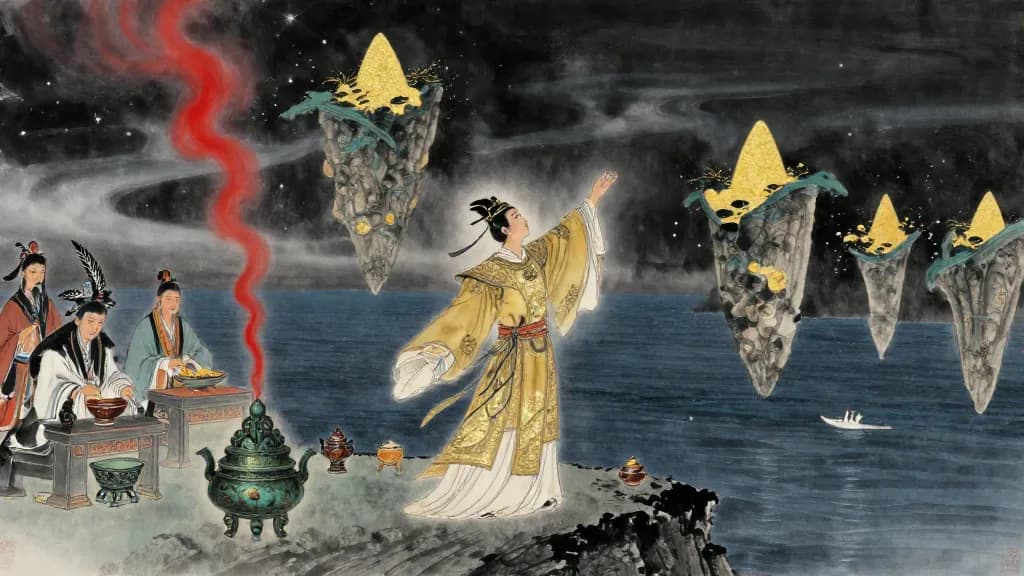
少君言於上曰:"祠灶則致物,致物而丹沙可化為黃金,黃金成以為飲食器則益壽,益壽而海中蓬萊仙者可見,見之以封禪則不死,黃帝是也。臣嘗游海上,見安期生,食臣棗,大如瓜。安期生仙者,通蓬萊中,合則見人,不合則隱。"於是天子始親祠灶,而遣方士入海求蓬萊安期生之屬,而事化丹沙諸藥齊為黃金矣。

Li Shaojun said to the Emperor: 'If you sacrifice to the stove god, you can attract spirit beings. Once spirit beings are attracted, cinnabar can be transmuted into gold. Once gold is made, fashion it into vessels for eating and drinking and your life will be prolonged. With prolonged life, the immortals of Penglai in the sea can be seen. Once you have seen them, perform the feng and shan sacrifices, and you will never die — this is what the Yellow Emperor did. Your servant once traveled over the seas and met Anqi Sheng. He fed me dates as large as melons. Anqi Sheng is an immortal who dwells in Penglai; when the time is right he appears to men, and when it is not, he hides himself.' Thereupon the Son of Heaven for the first time personally sacrificed to the stove god. He dispatched fangshi to sail into the sea seeking Penglai and Anqi Sheng and their kind, and he set about the work of transmuting cinnabar and various drugs into gold.

Notes

1term

Penglai (蓬萊) was one of three legendary islands in the eastern sea where immortals were said to dwell. The others were Fangzhang (方丈) and Yingzhou (瀛洲). Since the time of the First Emperor of Qin, expeditions had been sent to find them.

2person安期生Ānqī Shēng

Anqi Sheng (安期生) was a legendary immortal said to have lived on Penglai. According to tradition, the First Emperor of Qin also sent messengers to find him. He became a stock figure in fangshi lore.

3term

The transmutation of cinnabar (丹沙, mercuric sulfide) into gold was an early form of Chinese alchemy. The logic was sympathetic: cinnabar's red color symbolized vitality, and gold's incorruptibility symbolized immortality. Consuming elixirs made from transmuted gold was believed to confer longevity.

李少君之死與方士繼起

The Death of Li Shaojun and the Proliferation of Fangshi

居久之,李少君病死。天子以為化去不死也,而使黃錘史寬舒受其方。求蓬萊安期生莫能得,而海上燕齊怪迂之方士多相效,更言神事矣。

After a considerable time, Li Shaojun fell ill and died. The Son of Heaven believed he had merely transformed and departed rather than truly dying, and he ordered Huang Zhui and the Ritual Official Kuan Shu to carry on his methods. The search for Penglai and Anqi Sheng proved fruitless, yet the eccentric fangshi along the coasts of Yan and Qi increasingly imitated one another, each claiming to speak of divine matters.

Notes

1context

The phrase 'transformed and departed' (化去) reflects the belief that true adepts did not die but underwent a transformation — shedding the body like a cicada's shell. Emperor Wu's refusal to accept Li Shaojun's death as real is a recurring pattern: each time a fangshi failed, the Emperor found a way to preserve his belief.

2person寬舒Kuān Shū

Kuan Shu (寬舒) was a ritual official (祠官) who managed state sacrifices. He recurs throughout this chapter as the bureaucratic implementer of successive fangshi schemes.

3place

Yan (燕) and Qi (齊), the old kingdoms along the northeastern seaboard (modern Hebei and Shandong), were the traditional homeland of fangshi culture. Their proximity to the sea nurtured beliefs about island paradises of the immortals.

薄誘忌奏祠泰一

Miu Ji's Proposal to Sacrifice to Grand Unity

亳人薄誘忌奏祠泰一方,曰:"天神貴者泰一,泰一佐曰五帝。古者天子以春秋祭泰一東南郊,用太牢具,七日,為壇開八通之鬼道。"於是天子令太祝立其祠長安東南郊,常奉祠如忌方。其後人有上書,言"古者天子三年一用太牢具祠神三一:天一,地一,泰一"。天子許之,令太祝領祠之忌泰一壇上,如其方。後人復有上書,言"古者天子常以春秋解祠,祠黃帝用一梟破鏡;冥羊用羊;祠馬行用一青牡馬;泰一、皋山山君、地長用牛;武夷君用乾魚;陰陽使者以一牛"。令祠官領之如其方,而祠於忌泰一壇旁。

A man of Bo named Miu Ji memorialized the throne with a method for sacrificing to Grand Unity. He said: 'The most exalted of the celestial spirits is Grand Unity. Grand Unity's assistants are called the Five Emperors. In antiquity the Son of Heaven sacrificed to Grand Unity in the southeastern suburbs in spring and autumn, using a full set of the three great sacrificial animals, for seven days, building an altar with eight open spirit-roads.' Thereupon the Son of Heaven ordered the Grand Invocator to establish a shrine in the southeastern suburbs of Chang'an, and to maintain regular sacrifices according to Miu Ji's method. Later someone submitted a memorial stating: 'In antiquity the Son of Heaven once every three years used a full set of the three great animals to sacrifice to the Three Unities: Celestial Unity, Terrestrial Unity, and Grand Unity.' The Son of Heaven approved this and ordered the Grand Invocator to conduct the rites on Miu Ji's Grand Unity altar according to this method. Still later, another person submitted a memorial stating: 'In antiquity the Son of Heaven regularly performed expiatory sacrifices in spring and autumn. To sacrifice to the Yellow Emperor, use one owl and a broken mirror. For the Dark Sheep, use a sheep. To sacrifice to the Horse Traveler, use one blue-grey stallion. For Grand Unity, the Lord of Gao Mountain, and the Lord of the Earth, use an ox. For the Lord of Wuyi, use dried fish. For the Emissary of Yin and Yang, use one ox.' The Emperor ordered the ritual officials to conduct these rites according to their prescriptions, performing them beside Miu Ji's Grand Unity altar.

Notes

1person謬忌Miù Jì

Miu Ji (謬忌, also written 薄誘忌) was a man of Bo (亳, in modern Anhui). He proposed the cult of Taiyi (Grand Unity), which became the supreme deity in Emperor Wu's religious system, eventually displacing the Five Emperors of the Yong altars.

2term

Grand Unity (泰一, also written 太一, Taiyi) was conceived as the supreme cosmic deity, superior to the Five Emperors (五帝). The concept drew on cosmological speculation from the Warring States period. Under Emperor Wu, Taiyi became the focus of the most important state sacrifices.

3term

The three great sacrificial animals (太牢具) refers to the full complement of ox, sheep, and pig used in the highest-grade sacrifices. Lesser rites used only sheep and pig (少牢).

白鹿幣與麟瑞

The White Deer Skin Currency and the Auspicious Unicorn

其後,天子苑有白鹿,以其皮為幣,以發瑞應,造白金焉。

其明年,郊雍,獲一角獸,若麃然。有司曰:"陛下肅祗郊祀,上帝報享,錫一角獸,蓋麟雲。"於是以薦五畤,畤加一牛以燎。賜諸侯白金,以風符應合於天地。

After this, the Son of Heaven's park contained white deer. He had their hides made into a form of currency to announce the auspicious omen, and also minted white metal coins.

The following year, while performing the suburban sacrifice at Yong, a one-horned beast was captured that resembled a roe deer. The officials said: 'Your Majesty has reverently performed the suburban sacrifices, and the Lord on High has reciprocated your offerings by bestowing a one-horned beast. It is surely a unicorn.' Thereupon it was offered at the Five Altars, and an additional ox was burned at each altar. White metal coins were bestowed on the feudal lords, to broadcast that the omens of Heaven and Earth were in accord.

Notes

1context

The white deer skin currency (白鹿皮幣) was a piece of white deerskin one foot square, bordered with embroidery, valued at 400,000 cash. It was essentially a forced payment scheme: nobles had to purchase these skins at inflated prices when presenting jade at court. Together with the white metal coins (白金, an alloy of silver and tin), these were fiscal measures to fund Emperor Wu's wars and building projects, dressed up in the language of auspicious portents.

2term

The unicorn (麟, lin) was the most auspicious of beasts in Chinese tradition, said to appear only when a sage-king ruled. Its reported capture provided crucial ideological support for Emperor Wu's ambition to perform the feng and shan sacrifices.

濟北王獻泰山

The King of Jibei Offers Mount Tai

於是濟北王以為天子且封禪,乃上書獻泰山及其旁邑。天子受之,更以他縣償之。常山王有罪,遷,天子封其弟於真定,以續先王祀,而以常山為郡。然後五嶽皆在天子之郡。

At this point the King of Jibei, believing the Son of Heaven was about to perform the feng and shan sacrifices, submitted a memorial offering Mount Tai and the towns around it. The Son of Heaven accepted the gift, compensating him with other counties. The King of Changshan had committed an offense and was relocated. The Son of Heaven enfeoffed his brother at Zhending to continue the ancestral sacrifices of the former king, and converted Changshan into a commandery. After this, all Five Sacred Mountains fell within the Son of Heaven's own commanderies.

Notes

1context

The transfer of Mount Tai from the Kingdom of Jibei to direct imperial control was a political prerequisite for the feng and shan sacrifices. The fact that the King of Jibei 'volunteered' the territory reflects the political pressure: feudal kings understood they had no choice. The conversion of Changshan likewise brought Mount Heng (北嶽恆山) under direct imperial jurisdiction.

2term

The Five Sacred Mountains (五嶽) were: Mount Tai (泰山, east), Mount Hua (華山, west), Mount Heng (衡山, south), Mount Heng (恆山, north — different character), and Mount Song (嵩山, center). Imperial control over all five was symbolically essential for the feng and shan rites.

少翁與文成將軍

Shaoweng and the General of Accomplished Literature

其明年,齊人少翁以鬼神方見上。上有所幸王夫人,夫人卒,少翁以方術蓋夜致王夫人及灶鬼之貌雲,天子自帷中望見焉。於是乃拜少翁為文成將軍,賞賜甚多,以客禮禮之。文成言曰:"上即欲與神通,宮室被服不象神,神物不至。"乃作畫雲氣車,及各以勝日駕車辟惡鬼。又作甘泉宮,中為台室,畫天、地、泰一諸神,而置祭具以致天神。居歲餘,其方益衰,神不至。乃為帛書以飯牛,詳弗知也,言此牛腹中有奇。殺而視之,得書,書言其怪,天子疑之。有識其手書,問之人,果書。於是誅文成將軍而隱之。

The following year, a man of Qi named Shaoweng gained an audience with the Emperor through his techniques with ghosts and spirits. The Emperor had a favorite consort, Lady Wang, who had died. Shaoweng, using his arts, managed one night to conjure what appeared to be the likeness of Lady Wang and the stove spirit. The Son of Heaven watched from behind a curtain. Thereupon he appointed Shaoweng as General of Accomplished Literature, showered him with rewards, and treated him with the etiquette due a guest. The General of Accomplished Literature declared: 'If Your Majesty wishes to communicate with the spirits, your palaces and garments must be made to resemble those of the spirits — otherwise the spirit beings will not come.' So he had chariots painted with cloud patterns, and on days astrologically propitious for each element, particular chariots were driven to repel evil spirits. He also built the Ganquan Palace, with a terrace-chamber in its center painted with images of Heaven, Earth, Grand Unity, and the various gods, and furnished with sacrificial implements to attract the celestial spirits. After more than a year, his methods proved increasingly ineffective and no spirits came. He then wrote a text on silk and fed it to an ox, pretending to know nothing about it, and announced that there was something marvelous inside this ox. When the ox was slaughtered and opened, the silk text was found. Its contents were strange — and the Son of Heaven grew suspicious. Someone recognized the handwriting, and upon questioning, it was confirmed to be Shaoweng's own writing. Thereupon the General of Accomplished Literature was executed, but the matter was kept secret.

Notes

1person少翁Shǎo Wēng

Shaoweng (少翁) was the second major fangshi to gain Emperor Wu's favor. His conjuring of the dead Lady Wang — likely a shadow-puppet performance — so moved the Emperor that he was given the extraordinary military title 'General of Accomplished Literature' (文成將軍). His fraud and execution set the pattern for later fangshi who met the same fate.

2person王夫人Wáng Fūrén

Lady Wang (王夫人) was a favored consort of Emperor Wu who died young. She was the mother of Prince Liu Bo (劉髆), later made King of Changyi. Not to be confused with Empress Dowager Wang, the Emperor's mother.

3place

Ganquan Palace (甘泉宮) was a major imperial retreat in the mountains north of Chang'an (modern Chunhua County, Shaanxi). Emperor Wu expanded it extensively and used it as a center for spirit worship.

柏梁台與承露仙人

The Cypress Beam Terrace and the Dew-Receiving Immortal

其後則又作柏梁、銅柱、承露仙人掌之屬矣。

After this, the Emperor built the Cypress Beam Terrace, bronze pillars, and the statue of an immortal with upraised palm to catch dew, and similar structures.

Notes

1context

The dew-receiving immortal statue (承露仙人掌) was a tall bronze column topped with a figure holding a basin to catch the dew. Emperor Wu believed that drinking morning dew mixed with jade dust conferred longevity. This statue later became a famous poetic image of imperial ambition and transience.

天子病鼎湖與神君

The Emperor's Illness at Dinghu and the Spirit Lord

文成死明年,天子病鼎湖甚,巫醫無所不致,不愈。游水髮根乃言曰:"上郡有巫,病而鬼下之。"上召置祠之甘泉。及病,使人問神君。神君言曰:"天子毋憂病。病少愈,強與我會甘泉。"於是病癒,遂幸甘泉,病良已。大赦天下,置壽宮神君。神君最貴者,其佐曰大禁、司命之屬,皆從之。非可得見,聞其音,與人言等。時去時來,來則風肅然也。居室帷中。時晝言,然常以夜。天子祓,然後入。因巫為主人,關飲食。所欲者言行下。又置壽宮、北宮,張羽旗,設供具,以禮神君。神君所言,上使人受書其言,命之曰"畫法"。其所語,世俗之所知也,毋絕殊者,而天子獨喜。其事祕,世莫知也。

The year after Shaoweng's death, the Son of Heaven fell gravely ill at Dinghu. Every sort of shaman and physician was summoned, but none could cure him. A man named You Shui Fagen then said: 'In Shangjun there is a shaman to whom spirits descend when he is ill.' The Emperor summoned this shaman and installed him at Ganquan to perform sacrifices. When the Emperor fell ill, he sent someone to consult the Spirit Lord. The Spirit Lord said: 'Let the Son of Heaven not worry about his illness. When the illness has eased somewhat, let him make the effort to come meet me at Ganquan.' Thereupon the illness subsided, and the Emperor went to Ganquan, where the illness was completely cured. A great amnesty was proclaimed throughout All-Under-Heaven, and the Palace of Longevity was established for the Spirit Lord. The most exalted of the Spirit Lord's attendants were called Grand Prohibition, Director of Fate, and others of that kind — all followed the Spirit Lord. The spirits could not be seen, but their voices could be heard, speaking just like ordinary people. They came and went; when they arrived, a solemn wind would stir. They dwelt within curtained chambers. Sometimes they spoke by day, but usually by night. The Son of Heaven performed ritual purification before entering. The shaman served as host, attending to food and drink. Whatever the spirits requested was conveyed and carried out. The Emperor also established the Palace of Longevity and the Northern Palace, with feathered banners hung and offerings set out to honor the Spirit Lord. Whatever the Spirit Lord said, the Emperor had people take down in writing, calling these records the 'Painted Protocols.' What the spirits said was in fact commonplace knowledge, nothing extraordinary — yet the Son of Heaven alone delighted in it. The entire affair was kept secret, and the world knew nothing of it.

Notes

1place

Dinghu (鼎湖) was a palace near Huayin (modern Shaanxi), east of Chang'an. According to legend, it was named for the spot where the Yellow Emperor cast his tripod and ascended to Heaven on a dragon.

2term

The Director of Fate (司命) was a stellar deity believed to preside over human lifespans. In the Han spirit-medium cults described here, such deities manifested through shamans (巫) who served as their human vessels.

3context

Sima Qian's observation that the Spirit Lord's pronouncements were 'commonplace knowledge, nothing extraordinary' (世俗之所知也,毋絕殊者) is a pointed editorial aside. The Grand Historian's skepticism toward the fangshi pervades this chapter.

改元與后土祠

Renaming the Era and the Sacrifice to the Sovereign of Earth

其後三年,有司言元宜以天瑞命,不宜以一二數。一元曰建元,二元以長星曰元光,三元以郊得一角獸曰元狩雲。

其明年冬,天子郊雍,議曰:"今上帝朕親郊,而后土毋祀,則禮不答也。"有司與太史公、祠官寬舒等議:"天地牲角繭栗。今陛下親祀后土,后土宜於澤中圜丘為五壇,壇一黃犢太牢具,已祠盡瘞,而從祠衣上黃。"於是天子遂東,始立后土祠汾陰脽上,如寬舒等議。上親望拜,如上帝禮。禮畢,天子遂至滎陽而還。過雒陽,下詔曰:"三代邈絕,遠矣難存。其以三十里地封周後為周子南君,以奉先王祀焉。"是歲,天子始巡郡縣,侵尋於泰山矣。

Three years later, the officials proposed that era names should be designated by heavenly portents rather than numbered sequentially. The first era was named Jianyuan ('Establishing the Origin'), the second was named Yuanguang ('Original Brilliance') after the appearance of a long comet, and the third was named Yuanshou ('Original Hunting') after the one-horned beast captured during the suburban sacrifice.

The following year, in winter, the Son of Heaven performed the suburban sacrifice at Yong. He deliberated: 'Now I have personally performed the suburban sacrifice to the Lord on High, yet the Sovereign of Earth has received no offering — the ritual exchange is incomplete.' The officials conferred with the Grand Historian and the ritual official Kuan Shu, and they determined: 'The sacrificial animals for Heaven and Earth should have horns no larger than cocoons or chestnuts. Now that Your Majesty personally sacrifices to the Sovereign of Earth, the proper form is to build five altars on a circular mound in a marshy area. Each altar should receive one yellow calf and a full set of the three great animals. After the sacrifice, everything should be buried in the earth, and all attendants at the sacrifice should wear yellow garments over their robes.' Thereupon the Son of Heaven proceeded east and for the first time established a shrine to the Sovereign of Earth on the Fen River mound at Fenyin, following the recommendation of Kuan Shu and the others. The Emperor personally made obeisance from a distance, using the same rites as for the Lord on High. When the ceremonies were completed, the Son of Heaven proceeded to Xingyang and turned back. Passing through Luoyang, he issued an edict: 'The Three Dynasties are remote and distant, hard to preserve. Let thirty li of territory be enfeoffed upon the descendant of the Zhou as Lord Zinan of Zhou, to maintain the ancestral sacrifices of the former kings.' In this year, the Son of Heaven first began touring the commanderies and counties, gradually making his way toward Mount Tai.

Notes

1context

The retroactive naming of era periods (年號) by auspicious portents rather than simple sequence numbers was itself an innovation of Emperor Wu's reign. He was the first Chinese emperor to use named era periods systematically.

2person太史公司馬談Tàishǐ Gōng Sīmǎ Tán

The Grand Historian (太史公) here is Sima Tan (司馬談, d. 110 BC), father of Sima Qian and his predecessor as Grand Historian. Sima Tan's involvement in designing the Sovereign of Earth rites is significant — he died in 110 BC, despairing that he had not been allowed to participate in the feng and shan sacrifices.

3place

Fenyin (汾陰) was located on the north bank of the Yellow River in modern Wanrong County, Shanxi. The mound (脽) there was a raised area at the bend of the Fen River, considered a sacred site for earth worship.

欒大與五利將軍

Luan Da and the General of Five Advantages

其春,樂成侯上書言欒大。欒大,膠東宮人,故嘗與文成將軍同師,已而為膠東王尚方。而樂成侯姊為康王后,毋子。康王死,他姬子立為王。而康後有淫行,與王不相中,相危以法。康後聞文成已死,而欲自媚於上,乃遣欒大因樂成侯求見言方。天子既誅文成,後悔恨其早死,惜其方不盡,及見欒大,大悅。大為人長美,言多方略,而敢為大言,處之不疑。大言曰:"臣嘗往來海中,見安期、羨門之屬。顧以為臣賤,不信臣。又以為康王諸侯耳,不足予方。臣數言康王,康王又不用臣。臣之師曰:'黃金可成,而河決可塞,不死之藥可得,仙人可致也。'臣恐效文成,則方士皆掩口,惡敢言方哉!"上曰:"文成食馬肝死耳。子誠能脩其方,我何愛乎!"大曰:"臣師非有求人,人者求之。陛下必欲致之,則貴其使者,令有親屬,以客禮待之,勿卑,使各佩其信印,乃可使通言於神人。神人尚肯邪不邪。致尊其使,然後可致也。"於是上使先驗小方,斗旗,旗自相觸擊。

That spring, the Marquis of Lecheng submitted a memorial recommending Luan Da. Luan Da was an attendant in the Jiaodong palace who had once studied under the same master as the General of Accomplished Literature, and had subsequently served as director of workshops for the King of Jiaodong. Now, the Marquis of Lecheng's elder sister had been queen to the late King Kang, but she had borne no sons. When King Kang died, the son of another consort was established as king. The former queen had been guilty of licentious conduct and was on bad terms with the new king — each threatened the other with the law. When she heard that the General of Accomplished Literature had been killed, she hoped to ingratiate herself with the Emperor, and so she dispatched Luan Da through the Marquis of Lecheng to seek an audience and present his arts. The Son of Heaven had already executed the General of Accomplished Literature but later regretted having killed him too hastily and lamented that his methods had not been exhausted. When he met Luan Da, he was greatly pleased. Luan Da was tall and handsome, spoke with many stratagems, and made bold claims without the slightest hesitation. He declared: 'Your servant has traveled back and forth across the seas and met Anqi Sheng, Xianmen, and others of their kind. But they considered your servant too lowly and did not trust me. Moreover, they regarded King Kang as a mere feudal lord, unworthy of receiving their arts. Your servant spoke to King Kang repeatedly, but the King would not employ me. My master said: "Gold can be transmuted, the breach in the Yellow River can be sealed, the elixir of immortality can be obtained, and the immortals can be summoned." But I fear that if I meet the same end as the General of Accomplished Literature, every fangshi will clap his mouth shut — who would dare speak of these arts!' The Emperor said: 'The General of Accomplished Literature died from eating horse liver, that is all. If you can truly practice these arts, what would I begrudge?' Luan Da replied: 'My master does not seek out men — men must seek him. If Your Majesty truly wishes to summon him, then you must honor your envoy: give him kinship ties to the imperial house, treat him with the etiquette of a guest, do not demean him, and let him wear his own seal of authority. Only then can he serve as intermediary to speak with the spirit beings. Whether the spirit beings will consent or not depends on this — only by truly honoring the envoy can they be summoned.' Thereupon the Emperor had him first demonstrate a minor art: the contest of chess-piece banners, which moved and struck against each other of their own accord.

Notes

1person欒大Luán Dà

Luan Da (欒大, d. c. 112 BC) was the most spectacular of Emperor Wu's fangshi. He received five titles, four golden seals, a fief of two thousand households, and the hand of an imperial princess — all before producing a single result. His rise and fall epitomize the extraordinary credulity of Emperor Wu's court.

2person羨門Xiànmén

Xianmen (羨門), also known as Xianmen Gao (羨門高), was a legendary immortal from the same tradition as Anqi Sheng, frequently invoked by fangshi as a figure they claimed to have encountered.

3context

The claim that the General of Accomplished Literature 'died from eating horse liver' (食馬肝死) was the official cover story. Horse liver was popularly believed to be poisonous. The Emperor used this story to reassure Luan Da that fangshi would not be killed for practicing their arts — even though he had in fact executed Shaoweng.

欒大封侯拜將

Luan Da Enfeoffed and Ennobled

是時上方憂河決,而黃金不就,乃拜大為五利將軍。居月餘,得四金印,佩天士將軍、地土將軍、大通將軍、天道將軍印。制詔御史:"昔禹疏九江,決四瀆。間者河溢皋陸,隄繇不息。朕臨天下二十有八年,天若遺朕士而大通焉。乾稱'蜚龍','鴻漸於般',意庶幾與焉。其以二千戶封地士將軍大為樂通侯。"賜列侯甲第,僮千人。乘輿斥車馬帷帳器物以充其家。又以衛長公主妻之,齎金萬斤,更名其邑曰當利公主。天子親如五利之第。使者存問所給,連屬於道。自大主將相以下,皆置酒其家,獻遺之。於是天子又刻玉印曰"天道將軍",使使衣羽衣,夜立白茅上,五利將軍亦衣羽衣,立白茅上受印,以示弗臣也。而佩"天道"者,且為天子道天神也。於是五利常夜祠其家,欲以下神。神未至而百鬼集矣,然頗能使之。其後治裝行,東入海,求其師雲。大見數月,佩六印,貴振天下,而海上燕齊之間,莫不搤捥而自言有禁方,能神仙矣。

At this time the Emperor was anxious about the breach in the Yellow River and frustrated that the gold transmutation had not succeeded. He therefore appointed Luan Da as General of Five Advantages. Within a month, Luan Da had received four golden seals, wearing the titles General of the Celestial Warrior, General of the Terrestrial Warrior, General of Great Penetration, and General of the Celestial Way. The Emperor issued an edict to the Imperial Secretary: 'In antiquity Yu channeled the Nine Rivers and opened the Four Waterways. Recently the Yellow River has overflowed onto the highlands, and the levee corvée has been unceasing. We have presided over All-Under-Heaven for twenty-eight years, and Heaven seems to have sent Us a warrior who achieves great penetration. The Qian hexagram speaks of the "flying dragon," and the Jian hexagram of "the wild goose gradually advancing" — perhaps this is the fulfillment of those signs. Let the General of the Terrestrial Warrior, Luan Da, be enfeoffed as Marquis of Letong with a fief of two thousand households.' He was granted a first-rank marquis's mansion, a thousand servants, and carriages, horses, curtains, and utensils from the imperial stables to fill his residence. Furthermore, the Emperor gave him the Elder Princess Wei in marriage, with a dowry of ten thousand catties of gold, and renamed her fief the Princess of Dangli. The Son of Heaven personally visited the residence of the General of Five Advantages. Envoys bearing gifts of inquiry and provisions followed one another without break upon the road. From the Grand Princess and the Chancellor on down, all held banquets at his mansion and presented him with gifts. The Son of Heaven then had a jade seal carved reading 'General of the Celestial Way,' and sent an envoy in feathered robes to stand upon white rushes by night. The General of Five Advantages also donned feathered robes and stood upon white rushes to receive the seal — signifying that he was not treated as a subject. The one who wore the 'Celestial Way' seal was to serve as the Son of Heaven's guide to the celestial spirits. After this, the General of Five Advantages regularly performed nighttime sacrifices at his residence, attempting to bring down spirits. The spirits did not come, but a hundred lesser ghosts gathered, and he was able to direct them somewhat. He then prepared his traveling gear and went east into the sea, claiming to search for his master. Within a few months of his first audience, Luan Da wore six seals, and his eminence shook All-Under-Heaven. Along the seacoasts between Yan and Qi, there was no one who did not clench his fists with excitement and claim to possess secret arts and the power to become an immortal.

Notes

1person衛長公主Wèi Zhǎng Gōngzhǔ

The Elder Princess Wei (衛長公主) was Emperor Wu's eldest daughter, born to Empress Wei Zifu. Marrying an imperial princess to a fangshi was unprecedented and scandalous — it shows the extremity of Emperor Wu's credulity.

2context

The Yellow River breach (河決) was a catastrophic flood that occurred in 132 BC at Huzi (瓠子) in modern Puyang, Henan. It was not sealed for over twenty years, devastating vast areas of farmland. Emperor Wu's desperation to solve this crisis made him vulnerable to Luan Da's promises.

3term

The references to the Qian (乾) and Jian (漸) hexagrams of the Yijing (Book of Changes) lend cosmological authority to Luan Da's appointment. 'Flying dragon' (蜚龍/飛龍) from the Qian hexagram symbolizes the sage fully manifesting his power.

4context

Six seals (六印) was extraordinary — even the highest officials held only one. The list of titles suggests an attempt to construct a parallel spiritual bureaucracy: celestial, terrestrial, penetrating, and guiding — as if Luan Da were being credentialed as ambassador to the spirit world.

汾陰寶鼎出

The Precious Tripod Emerges at Fenyin

其夏六月中,汾陰巫錦為民祠魏脽后土營旁,見地如鉤狀,掊視得鼎。鼎大異於眾鼎,文鏤毋款識,怪之,言吏。吏告河東太守勝,勝以聞。天子使使驗問巫錦得鼎無奸詐,乃以禮祠,迎鼎至甘泉,從行,上薦之。至中山,晏溫,有黃雲蓋焉。有麃過,上自射之,因以祭雲。至長安,公卿大夫皆議請尊寶鼎。天子曰:"間者河溢,歲數不登,故巡祭后土,祈為百姓育穀。今年豐廡未有報,鼎曷為出哉?"有司皆曰:"聞昔大帝興神鼎一,一者一統,天地萬物所系終也。黃帝作寶鼎三,象天地人也。禹收九牧之金,鑄九鼎,皆嘗烹上帝鬼神。遭聖則興,遷於夏商。周德衰,宋之社亡,鼎乃淪伏而不見。頌雲'自堂徂基,自羊徂牛;鼐鼎及鼒,不虞不驁,胡考之休'。今鼎至甘泉,光潤龍變,承休無疆。合茲中山,有黃白雲降蓋,若獸為符,路弓乘矢,集獲壇下,報祠大饗。惟受命而帝者心知其意而合德焉。鼎宜見於祖禰,藏於帝廷,以合明應。"制曰:"可。"

That summer, in the middle of the sixth month, the shaman Jin of Fenyin was performing sacrifices on behalf of the people beside the Sovereign of Earth compound on the Wei mound, when he noticed the ground had a hook-like shape. Digging down, he discovered a tripod. The tripod was greatly different from ordinary tripods — it bore carved designs but no identifying inscription. Finding it strange, he reported it to the local officials. The officials informed the Grand Administrator of Hedong, Sheng, who reported it to the throne. The Son of Heaven sent envoys to verify that the shaman Jin had found the tripod without fraud, and then had it welcomed with proper sacrificial rites to Ganquan Palace. It traveled in the Emperor's procession, and the Emperor presented offerings to it. When they reached Zhongshan, the weather was warm and clear, and a canopy of yellow clouds appeared overhead. A roe deer passed by; the Emperor personally shot it and used it as a sacrifice. When they reached Chang'an, the ministers and grandees all deliberated and requested that the precious tripod be honored. The Son of Heaven said: 'Recently the Yellow River has overflowed and the harvests have failed for several years. That is why I toured and sacrificed to the Sovereign of Earth, praying that grain would be nurtured for the common people. This year the harvest is abundant but I have not yet given thanks — why should a tripod appear now?' The officials all replied: 'We have heard that in high antiquity the Great Emperor raised one divine tripod — one signifying unity, the culmination to which all things between Heaven and Earth are bound. The Yellow Emperor made three precious tripods, symbolizing Heaven, Earth, and Man. Yu collected the metal tribute of the Nine Provinces and cast the Nine Tripods, all of which were used to cook offerings to the Lord on High and the spirits. When they encountered a sage-ruler, they appeared; they passed from the Xia to the Shang. When the virtue of the Zhou declined and the altars of Song fell, the tripods sank from sight and were seen no more. The Odes say: "From hall to foundation stones, from sheep to oxen; the great cauldron and the small, without anxiety or pride — what blessings of old age!" Now the tripod has arrived at Ganquan, gleaming and lustrous, dragon-like in its transformations, bearing blessings without limit. At Zhongshan, yellow and white clouds descended like a canopy; a beast appeared as a talisman; bows and arrows were gathered beneath the altar — an offering-feast in reciprocation. Only one who has received the Mandate and rules as Emperor can understand its meaning in his heart and match its virtue. The tripod should be presented at the ancestral temples and stored in the imperial court, to correspond to this luminous sign.' The Emperor decreed: 'Approved.'

Notes

1context

The discovery of the precious tripod (寶鼎) was one of the most politically significant portents of Emperor Wu's reign. The Nine Tripods of Yu had been the supreme symbols of dynastic legitimacy since the Xia dynasty. Their loss when the Zhou fell was a metaphor for the end of legitimate rule. The discovery of a new tripod implied that Heaven had bestowed a fresh mandate on Emperor Wu, justifying the feng and shan sacrifices.

2context

Emperor Wu's initial show of modesty — 'why should a tripod appear now?' — was a ritual performance. The officials' elaborate response, linking the tripod to the Yellow Emperor, Yu, and the mandate of Heaven, provided the Emperor with the justification he wanted while allowing him to appear reluctant.

公孫卿與黃帝封禪之說

Gongsun Qing and the Theory of the Yellow Emperor's Feng and Shan Sacrifices

入海求蓬萊者,言蓬萊不遠,而不能至者,殆不見其氣。上乃遣望氣佐侯其氣雲。

其秋,上幸雍,且郊。或曰"五帝,泰一之佐也。宜立泰一而上親郊之"。上疑未定。齊人公孫卿曰:"今年得寶鼎,其冬辛巳朔旦冬至,與黃帝時等。"卿有札書曰:"黃帝得寶鼎宛,問於鬼臾區。區對曰:'帝得寶鼎神筴,是歲己酉朔旦冬至,得天之紀,終而復始。'於是黃帝迎日推筴,後率二十歲得朔旦冬至,凡二十推,三百八十年。黃帝仙登於天。"卿因所忠欲奏之。所忠視其書不經,疑其妄書,謝曰:"寶鼎事已決矣,尚何以為!"卿因嬖人奏之。上大說,召問卿。對曰:"受此書申功,申功已死。"上曰:"申功何人也?"卿曰:"申功,齊人也。與安期生通,受黃帝言,無書,獨有此鼎書。曰'漢興復當黃帝之時。漢之聖者在高祖之孫且曾孫也。寶鼎出而與神通,封禪。封禪七十二王,唯黃帝得上泰山封'。申功曰:'漢主亦當上封,上封則能仙登天矣。黃帝時萬諸侯,而神靈之封居七千。天下名山八,而三在蠻夷,五在中國。中國華山、首山、太室、泰山、東萊,此五山黃帝之所常游,與神會。黃帝且戰且學仙。患百姓非其道,乃斷斬非鬼神者。百餘歲然後得與神通。黃帝郊雍上帝,宿三月。鬼臾區號大鴻,死葬雍,故鴻冢是也。其後於黃帝接萬靈明廷。明廷者,甘泉也。所謂寒門者,谷口也。黃帝采首山銅,鑄鼎荊山下。鼎既成,有龍垂胡珣下迎黃帝。黃帝上騎,群臣後宮從上龍七十餘人,乃上去。餘小臣不得上,乃悉持龍珣,龍珣拔,墮黃帝之弓。百姓仰望黃帝既上天,乃抱其弓與龍胡珣號。故後世因名其處曰鼎湖,其弓曰烏號。'"於是天子曰:"嗟乎!吾誠得如黃帝,吾視去妻子如脫鵕耳。"乃拜卿為郎,東使候神於太室。

Those who had sailed into the sea seeking Penglai reported that it was not far away, but they had been unable to reach it — perhaps because they could not discern its vapors. The Emperor therefore dispatched vapor-watchers to observe for its emanations.

That autumn, the Emperor went to Yong and was about to perform the suburban sacrifice. Someone said: 'The Five Emperors are merely assistants to Grand Unity. It would be proper to establish Grand Unity and have the Emperor personally perform the suburban sacrifice to it.' The Emperor was uncertain and had not yet decided. A man of Qi named Gongsun Qing said: 'This year a precious tripod has been found, and this winter the xinsi day falls on the first day of the month at the winter solstice — the same alignment as in the time of the Yellow Emperor.' Gongsun Qing possessed a document written on wooden tablets that read: 'The Yellow Emperor obtained a precious tripod at Wan and inquired of Gui Yuqu. Gui Yuqu replied: "The Emperor has obtained the precious tripod and the divine counting-stalks. This year the jiyou day falls on the new moon at the winter solstice — you have obtained the cycle of Heaven, which ends and begins again." Thereupon the Yellow Emperor calculated forward from the solstice using the counting-stalks. Thereafter, approximately every twenty years the new moon coincided with the winter solstice. After twenty such cycles — three hundred and eighty years — the Yellow Emperor ascended to Heaven as an immortal.' Gongsun Qing tried to submit this through Suo Zhong. Suo Zhong examined the document and found it uncanonical, suspecting it was a fabrication. He declined, saying: 'The matter of the precious tripod is already settled — what more is needed!' So Gongsun Qing submitted it through one of the Emperor's favorites instead. The Emperor was overjoyed and summoned Gongsun Qing for questioning. Gongsun Qing replied: 'I received this document from Shen Gong, but Shen Gong is already dead.' The Emperor asked: 'Who was Shen Gong?' Gongsun Qing answered: 'Shen Gong was a man of Qi. He was in communication with Anqi Sheng and received the teachings of the Yellow Emperor. He left no writings except this one document about the tripod. It says: "The rise of the Han corresponds to the era of the Yellow Emperor. The sage of the Han will be found among the grandsons or great-grandsons of the High Ancestor. When the precious tripod appears, he will communicate with the spirits and perform the feng and shan sacrifices. Seventy-two kings performed the feng and shan, but only the Yellow Emperor was able to ascend Mount Tai for the feng sacrifice." Shen Gong said: "The ruler of the Han should also ascend to perform the feng sacrifice. Once he ascends for the feng, he will be able to rise to Heaven as an immortal. In the Yellow Emperor's time there were ten thousand feudal lords, and of those, seven thousand held their fiefs by virtue of their spiritual powers. There are eight famous mountains under Heaven: three are in barbarian lands, and five are in the Central Kingdoms. In the Central Kingdoms these are Mount Hua, Mount Shou, the Great Chamber, Mount Tai, and Donglai — these five mountains the Yellow Emperor regularly visited, and there he met with the spirits. The Yellow Emperor simultaneously waged war and studied the ways of immortality. He was troubled that the common people did not follow his Way, so he executed those who denied the existence of ghosts and spirits. After more than a hundred years he finally achieved communication with the spirits. The Yellow Emperor performed the suburban sacrifice at Yong to the Lord on High, staying for three months. Gui Yuqu, whose title was Grand Protector, died and was buried at Yong — hence the Tumulus of the Protector there. After this, the Yellow Emperor received the myriad spirits at the Bright Court. The Bright Court is Ganquan. What is called Cold Gate is the Valley Mouth. The Yellow Emperor mined copper at Mount Shou and cast a tripod at the foot of Mount Jing. When the tripod was complete, a dragon hung down its whiskers to welcome the Yellow Emperor. The Yellow Emperor mounted and rode it aloft. Over seventy of his ministers and palace women followed him onto the dragon, and they rose up and departed. The remaining minor officials who could not climb on all grasped the dragon's whiskers. The whiskers tore loose, and the Yellow Emperor's bow fell to earth. The common people gazed up as the Yellow Emperor ascended to Heaven, then embraced his bow and the dragon's whiskers and wailed. Hence later generations named that place Dinghu — Tripod Lake — and the bow Wuhao — the Raven's Cry."' At this the Son of Heaven exclaimed: 'Ah! If I could truly become like the Yellow Emperor, I would regard leaving my wife and children as no more than casting off a slipper.' He then appointed Gongsun Qing as a Gentleman and sent him east to watch for spirits at the Great Chamber.

Notes

1person公孫卿Gōngsūn Qīng

Gongsun Qing (公孫卿) was a fangshi from Qi who became one of Emperor Wu's most persistent spirit-watchers. Unlike Li Shaojun and Shaoweng, he survived by never making verifiable claims — only reporting ambiguous 'traces' and urging patience.

2context

The story of the Yellow Emperor ascending to Heaven on a dragon was the central myth driving Emperor Wu's obsession with immortality. Every element — the tripod, Ganquan Palace, the suburban sacrifice at Yong — mapped directly onto Emperor Wu's own situation, making the parallel irresistible. This was by design: Gongsun Qing's 'ancient document' was almost certainly fabricated to tell the Emperor exactly what he wanted to hear.

3context

The Emperor's remark about leaving his wife and children 'as no more than casting off a slipper' (如脫鵕耳) reveals the depth of his longing for immortality. Sima Qian's inclusion of this quote is characteristically devastating — it exposes the Emperor's private obsession in his own words.

4place

The Great Chamber (太室) is Mount Song (嵩山), the central sacred mountain, in modern Dengfeng, Henan.

泰一祠壇之建與冬至郊祀

The Grand Unity Altar and the Winter Solstice Sacrifice

上遂郊雍,至隴西,西登空桐,幸甘泉。令祠官寬舒等具泰一祠壇,壇放薄忌泰一壇,壇三垓。五帝壇環居其下,各如其方,黃帝西南,除八通鬼道。泰一所用,如雍一畤物,而加醴棗脯之屬,殺一犛牛以為俎豆牢具。而五帝獨有俎豆醴進。其下四方地,為餟食群神從者及北斗雲。已祠,胙餘皆燎之。其牛色白,鹿居其中,彘在鹿中,水而洎之。祭日以牛,祭月以羊彘特。泰一祝宰則衣紫及繡。五帝各如其色,日赤,月白。

十一月辛已朔旦冬至,昧爽,天子始郊拜泰一。朝朝日,夕夕月,則揖;而見泰一如雍禮。其贊饗曰:"天始以寶鼎神筴授皇帝,朔而又朔,終而復始,皇帝敬拜見焉。"而衣上黃。其祠列火滿壇,壇旁烹炊具。有司雲"祠上有光焉"。公卿言"皇帝始郊見泰一雲陽,有司奉瑄玉嘉牲薦饗。是夜有美光,及晝,黃氣上屬天。"太史公、祠官寬舒等曰:"神靈之休,祐福兆祥,宜因此地光域立泰畤壇以明應。令太祝領,及臘間祠。三歲天子一郊見。"

The Emperor then performed the suburban sacrifice at Yong, traveled to Longxi, climbed Mount Kongtong to the west, and proceeded to Ganquan. He ordered the ritual official Kuan Shu and others to prepare an altar for sacrificing to Grand Unity. The altar was modeled on Miu Ji's Grand Unity altar, with three concentric tiers. The altars of the Five Emperors were arranged in a ring below, each positioned according to its cardinal direction, with the Yellow Emperor to the southwest. Eight open spirit-roads were cleared. The offerings for Grand Unity followed those of a single altar at Yong, with the addition of sweet wine, dates, dried meat, and similar items. One yak was slaughtered for the sacrificial vessels and animal offerings. The Five Emperors received only sacrificial vessels and sweet wine. Below, on the four sides of the ground, libation-food was set out for the attending lesser gods and the Northern Dipper. After the sacrifice, the remaining consecrated meat was all burned. The ox was white; a deer was placed inside it, and a pig inside the deer, then the whole was immersed in water and boiled. For the sacrifice to the Sun, an ox was used; for the Moon, a sheep and a pig offered singly. The invokers and butchers at the Grand Unity sacrifice wore purple and embroidered garments. For the Five Emperors, each wore the color of his direction; for the Sun, red; for the Moon, white.

On the xinsi day, the first day of the eleventh month at the winter solstice, at first light, the Son of Heaven for the first time performed the suburban sacrifice to Grand Unity. In the morning he saluted the Sun; in the evening he saluted the Moon — each time with a bow. His audience with Grand Unity followed the rites of Yong. The blessing-invocation declared: 'Heaven for the first time bestowed the precious tripod and divine counting-stalks upon the Emperor. New moon follows new moon, ending and beginning again. The Emperor reverently makes obeisance.' He wore yellow over his robes. Rows of fires filled the altar, and beside the altar were cooking vessels. The officials reported: 'There was a radiance above the altar.' The ministers said: 'The Emperor for the first time performed the suburban sacrifice to Grand Unity at Yunyang. The officials presented fine jade and choice animals as offerings. That night there was a beautiful radiance, and by day a yellow vapor rose up and connected with Heaven.' The Grand Historian, the ritual official Kuan Shu, and others said: 'This is the blessing of the divine spirits, an auspicious sign of protective fortune. It would be fitting to establish a Grand Altar on this ground of radiance to correspond to the omen. Let the Grand Invocator administer it, with sacrifices during the winter offering period. Once every three years the Son of Heaven should perform the suburban sacrifice in person.'

Notes

1place

Mount Kongtong (空桐/崆峒) is in modern Pingliang, Gansu. According to legend, the Yellow Emperor traveled there to seek the Way from the sage Guangchengzi. Emperor Wu's visit was an explicit imitation of the Yellow Emperor's itinerary.

2place

Yunyang (雲陽) was the district in which Ganquan Palace was located, north of Chang'an in the Qinling mountain foothills.

3context

The concentric nesting of animals — deer inside ox, pig inside deer — and the elaborate color-coding of vestments reflect the correlative cosmology of the Han. Each element was assigned to a direction, a color, and a celestial body, creating a total ritual system.

4context

The reports of radiance (光) above the altar and yellow vapor connecting to Heaven were the kind of 'confirmations' that sustained Emperor Wu's belief. Whether the officials genuinely saw such phenomena, or were telling the Emperor what he wanted to hear, is left ambiguous by Sima Qian.

伐南越與五利將軍之誅

The Campaign Against Nanyue and the Execution of the General of Five Advantages

其秋,為伐南越,告禱泰一,以牡荊畫幡日月北斗登龍,以象天一三星,為泰一鋒,名曰"靈旗"。為兵禱,則太史奉以指所伐國。而五利將軍使不敢入海,之泰山祠。上使人微隨驗,實無所見。五利妄言見其師,其方盡,多不讎。上乃誅五利。

That autumn, in preparation for the campaign against Nanyue, prayers were offered to Grand Unity. Banners were painted on vitex wood with images of the Sun, Moon, Northern Dipper, and ascending dragon to represent the three stars of Celestial Unity. These formed the vanguard standard of Grand Unity, called the 'Numinous Banner.' When prayers were offered for military success, the Grand Historian held it aloft and pointed it toward the state to be attacked. Meanwhile, the General of Five Advantages did not dare enter the sea — he went instead to Mount Tai to perform sacrifices. The Emperor sent agents to follow him secretly and observe. In truth, he saw nothing at all. The General of Five Advantages had been lying about meeting his master. His methods were exhausted, and most of his claims had proved false. The Emperor thereupon executed the General of Five Advantages.

Notes

1context

The Nanyue (南越) campaign of 112–111 BC was one of Emperor Wu's great military enterprises, conquering the independent kingdom in modern Guangdong and northern Vietnam. The use of Grand Unity's 'Numinous Banner' to sanctify the campaign shows how the new supreme deity was integrated into state military ritual.

2context

Luan Da's execution followed the same pattern as Shaoweng's: initial dazzlement, lavish rewards, gradual failure, attempted fraud, exposure, and death. Yet the Emperor's reaction was also the same — he 'regretted' not having given each fangshi more time, and soon turned to the next one.

公孫卿候神與南越平定後的祭祀

Gongsun Qing Watches for Spirits and Post-Nanyue Ritual Developments

其冬,公孫卿候神河南,見仙人跡緱氏城上,有物若雉,往來城上。天子親幸緱氏城視跡。問卿:"得毋效文成、五利乎?"卿曰:"仙者非有求人主,人主求之。其道非少寬假,神不來。言神事,事如迂誕,積以歲乃可致。"於是郡國各除道,繕治宮觀名山神祠所,以望幸矣。

其年,既滅南越,上有嬖臣李延年以好音見。上善之,下公卿議,曰:"民間祠尚有鼓舞之樂,今郊祠而無樂,豈稱乎?"公卿曰:"古者祀天地皆有樂,而神祇可得而禮。"或曰:"泰帝使素女鼓五十弦瑟,悲,帝禁不止,故破其瑟為二十五弦。"於是塞南越,禱祠泰一、后土,始用樂舞,益召歌兒,作二十五弦及箜篌瑟自此起。

That winter, Gongsun Qing went to watch for spirits in Henan. He reported seeing the tracks of an immortal on the walls of Goushi city, and something resembling a pheasant moving back and forth atop the walls. The Son of Heaven personally visited Goushi to inspect the tracks. He asked Gongsun Qing: 'This had better not be another case like the General of Accomplished Literature or the General of Five Advantages.' Gongsun Qing replied: 'Immortals do not seek out rulers — rulers must seek them. Unless some latitude and time are granted to the Way, the spirits will not come. Speaking of spirit matters — the matter may seem roundabout and absurd, but give it years and they can be summoned.' Thereupon the commanderies and kingdoms each cleared their roads and repaired the palaces, lodges, and shrines on the famous mountains, hoping for an imperial visit.

That same year, after the destruction of Nanyue, the Emperor had a favorite courtier named Li Yannian who had gained notice for his musical talent. The Emperor approved of him and submitted the matter to the ministers for deliberation, saying: 'Even folk sacrifices have the music of drums and dancing. Now the suburban sacrifices have no music — how can that be fitting?' The ministers replied: 'In antiquity all sacrifices to Heaven and Earth had music, and thereby the spirits could be properly honored.' Someone added: 'The Great Emperor had the White Maiden play a fifty-stringed zither. The music was so sorrowful that the Emperor forbade it but could not make her stop, so he broke the zither in half to make twenty-five strings.' After this, with the pacification of Nanyue, the sacrifices to Grand Unity and the Sovereign of Earth for the first time employed music and dance. More singers were recruited, and the making of twenty-five-stringed instruments and the konghou harp began from this point.

Notes

1place

Goushi (緱氏) was a city in modern Yanshi, Henan, near Mount Song. According to legend, it was associated with the immortal Wang Ziqiao, who was said to have ascended to Heaven from there on a white crane.

2person李延年Lǐ Yánnián

Li Yannian (李延年, d. 87 BC) was a court musician of humble origins — originally a eunuch convicted of a crime. His sister was the famous Lady Li (李夫人), who became one of Emperor Wu's most beloved consorts. Li Yannian's musical innovations transformed Han court ritual.

3context

Gongsun Qing's defense — that immortals require patience and cannot be rushed — was brilliantly self-serving. It made his claims unfalsifiable: any failure to produce results could be attributed to insufficient time rather than fraud.

北巡朔方與封禪議起

Northern Tour to Shuofang and the Feng and Shan Debate Begins

其來年冬,上議曰:"古者先振兵澤旅,然後封禪。"乃遂北巡朔方,勒兵十餘萬,還祭黃帝冢橋山,澤兵須如。上曰:"吾聞黃帝不死,今有冢,何也?"或對曰:"黃帝已仙上天,群臣葬其衣冠。"即至甘泉,為且用事泰山,先類祠泰一。

自得寶鼎,上與公卿諸生議封禪。封禪用希曠絕,莫知其儀禮,而群儒采封禪尚書、周官、王制之望祀射牛事。齊人丁公年九十餘,曰:"封者,合不死之名也。秦皇帝不得上封。陛下必欲上,稍上即無風雨,遂上封矣。"上於是乃令諸儒習射牛,草封禪儀。數年,至且行。天子既聞公孫卿及方士之言,黃帝以上封禪,皆致怪物與神通,欲放黃帝以嘗接神仙人蓬萊士,高世比德於九皇,而頗采儒術以文之。群儒既以不能辯明封禪事,又牽拘於詩書古文而不敢騁。上為封祠器示群儒,群儒或曰"不與古同",徐偃又曰"太常諸生行禮不如魯善",周霸屬圖封事,於是上絀偃、霸,盡罷諸儒弗用。

The following year, in winter, the Emperor deliberated: 'In antiquity, one first reviewed the troops and purified the army, and only then performed the feng and shan sacrifices.' He therefore toured north to Shuofang, mustering over a hundred thousand troops, and on the return journey sacrificed at the Yellow Emperor's tomb on Bridge Mountain and purified his troops at Xuru. The Emperor said: 'I have heard that the Yellow Emperor did not die — yet there is a tomb here. Why is that?' Someone replied: 'The Yellow Emperor had already become an immortal and ascended to Heaven. His ministers buried only his cap and robes.' Upon reaching Ganquan, in preparation for the ceremonies at Mount Tai, he first performed a categorizing sacrifice to Grand Unity.

Ever since obtaining the precious tripod, the Emperor had discussed the feng and shan sacrifices with the ministers and the scholars. Since the feng and shan had not been performed for so long that the tradition had been completely broken, no one knew the proper rites. The assembled Confucian scholars culled passages about the distant-gazing sacrifice and the shooting of the sacrificial ox from the Book of Documents, the Rites of Zhou, and the Royal Regulations. An old man of Qi named Master Ding, over ninety years of age, said: 'The feng is a ceremony that merges with the name of immortality. The First Emperor of Qin was not able to ascend to perform the feng. If Your Majesty is determined to ascend, simply start climbing — if there is no wind or rain, proceed to the top and perform the feng.' The Emperor thereupon ordered the Confucian scholars to practice the shooting of the ox and to draft a feng and shan liturgy. After several years, the time came to carry it out. The Son of Heaven had already heard the claims of Gongsun Qing and the fangshi that the Yellow Emperor and earlier sovereigns who performed the feng and shan had all attracted wondrous beings and communicated with the spirits. He wished to emulate the Yellow Emperor, to encounter immortals and the adepts of Penglai, to transcend his age and match his virtue with that of the Nine Sovereigns — while adopting Confucian learning to ornament the proceedings. But the assembled Confucians were unable to clarify the feng and shan rites, and they were so constrained by the Odes, the Documents, and the ancient texts that they dared not improvise. When the Emperor showed the sacrificial vessels he had designed for the feng ceremony to the Confucians, some said 'These do not match antiquity.' Xu Yan further declared that the scholars of the Grand Master of Ceremonies performed the rites less well than those of Lu. Zhou Ba composed a diagram of the feng ceremony. At this the Emperor dismissed Xu Yan and Zhou Ba, and discharged all the Confucian scholars, refusing to employ them.

Notes

1place

Shuofang (朔方) was a commandery on the northern frontier, in the great bend of the Yellow River (modern Hangjin Banner, Inner Mongolia). Emperor Wu had established it in 127 BC after Meng Tian's campaigns pushed back the Xiongnu.

2place

Bridge Mountain (橋山) in modern Huangling County, Shaanxi, is the traditional site of the Yellow Emperor's tomb. It remains a major ceremonial site to this day.

3context

The dismissal of the Confucian scholars is a pivotal moment. Emperor Wu wanted the feng and shan to be both a state Confucian ritual and a gateway to immortality. When the Confucians' textual scruples proved incompatible with his visionary ambitions, he simply discarded them. The rites he ultimately performed were of his own devising — a fact that deeply troubled later commentators.

4context

The reference to the First Emperor of Qin (秦皇帝) being unable to ascend Mount Tai alludes to the story that a violent rainstorm prevented the First Emperor from reaching the summit — interpreted as Heaven's refusal to accept his feng sacrifice because he lacked the requisite virtue.

登太室、東巡與求仙

Ascending the Great Chamber, the Eastern Tour, and Seeking Immortals

三月,遂東幸緱氏,禮登中嶽太室。從官在山下聞若有言"萬歲"雲。問上,上不言;問下,下不言。於是以三百戶封太室奉祠,命曰崇高邑。東上泰山,山之草木葉未生,乃令人上石立之泰山顛。

上遂東巡海上,行禮祠八神。齊人之上疏言神怪奇方者以萬數,然無驗者。乃益發船,令言海中神山者數千人求蓬萊神人。公孫卿持節常先行候名山,至東萊,言夜見一人,長數丈,就之則不見,見其跡甚大,類禽獸雲。群臣有言見一老父牽狗,言"吾欲見巨公",已忽不見。上既見大跡,未信,及群臣有言老父,則大以為仙人也。宿留海上,與方士傳車及間使求仙人以千數。

In the third month, the Emperor proceeded east to Goushi and ceremonially ascended the central sacred mountain, the Great Chamber. The attendant officials at the foot of the mountain heard what seemed to be a voice crying 'Ten thousand years!' They asked those above — no one had spoken. They asked those below — no one had spoken. Thereupon three hundred households were assigned to serve the Great Chamber shrine, and the place was named the Township of Lofty Eminence. He then went east and ascended Mount Tai. The trees and grasses on the mountain had not yet put forth leaves. He ordered men to carry a stone to the summit of Mount Tai and erect it there.

The Emperor then continued east on a tour along the seacoast, performing sacrificial rites to the Eight Spirits. The people of Qi who submitted memorials claiming knowledge of divine marvels and extraordinary arts numbered in the tens of thousands, yet none produced verifiable results. Even so, the Emperor dispatched yet more ships, sending several thousand people who claimed knowledge of the spirit mountains in the sea to search for the immortals of Penglai. Gongsun Qing, bearing the imperial credentials, regularly went ahead to scout the famous mountains. Arriving at Donglai, he reported that one night he had seen a person several zhang tall — but when he approached, the figure vanished, leaving only enormous tracks resembling those of a bird or beast. Certain ministers reported seeing an old man leading a dog who said, 'I wish to see the Great Lord,' and then suddenly vanished. The Emperor had seen the large tracks but was not yet fully convinced. When the ministers reported the old man, however, he became thoroughly persuaded that these were immortals. He lingered by the sea, and the fangshi dispatched in relay carriages and as secret envoys to seek the immortals numbered in the thousands.

Notes

1term

The Eight Spirits (八神) were ancient deities of the Qi region associated with natural forces: the Lord of Heaven, the Lord of Earth, the Lord of War, the Lord of Yin, the Lord of Yang, the Lord of the Moon, the Lord of the Sun, and the Lord of the Four Seasons. Their shrines were scattered across the Shandong peninsula.

2place

Donglai (東萊) was a commandery on the tip of the Shandong peninsula (modern Yantai area), the point of land closest to the legendary islands. It was the natural launching point for expeditions to find Penglai.

3context

The mysterious voice crying 'ten thousand years' (萬歲) — with no one above or below admitting to it — is left by Sima Qian as a deliberate ambiguity. It could be a genuine mystery, a staged performance by courtiers, or an echo. The historian neither endorses nor debunks it.

封泰山、禪肅然山

The Feng Sacrifice on Mount Tai and the Shan Sacrifice on Mount Suran

四月,還至奉高。上念諸儒及方士言封禪人人殊,不經,難施行。天子至梁父,禮祠地主。乙卯,令侍中儒者皮弁薦紳,射牛行事。封泰山下東方,如郊祠泰一之禮。封廣丈二尺,高九尺,其下則有玉牒書,書祕。禮畢,天子獨與侍中奉車子侯上泰山,亦有封。其事皆禁。明日,下陰道。丙辰,禪泰山下阯東北肅然山,如祭后土禮。天子皆親拜見,衣上黃而盡用樂焉。江淮間一茅三脊為神藉。五色土益雜封。縱遠方奇獸蜚禽及白雉諸物,頗以加祠。兕旄牛犀象之屬弗用。皆至泰山然後去。封禪祠,其夜若有光,晝有白雲起封中。

In the fourth month, the Emperor returned to Fenggao. He reflected that the pronouncements of the Confucians and fangshi about the feng and shan all contradicted one another, were uncanonical, and were difficult to put into practice. The Son of Heaven proceeded to Mount Liangfu, where he performed the sacrificial rites to the Lord of the Earth. On the yimao day, he ordered the attending Confucian scholars to don leather caps and sashes and shoot the sacrificial ox to begin the ceremonies. The feng sacrifice was performed at the eastern base of Mount Tai, following the rites of the suburban sacrifice to Grand Unity. The mound of the feng was twelve feet across and nine feet high. Beneath it were placed jade tablets inscribed with a text whose contents were kept secret. When the rites were complete, the Son of Heaven, accompanied only by his attendant and the Chariot-Bearer Zihou, ascended Mount Tai. There too a feng ceremony was performed. All details of this rite were forbidden to be disclosed. The next day, they descended by the northern slope. On the bingchen day, the shan sacrifice was performed on Mount Suran, northeast of the base of Mount Tai, following the rites for sacrificing to the Sovereign of Earth. The Son of Heaven personally made obeisance at every stage, wearing yellow over his robes and employing music throughout. Three-ridged rushes from the region between the Yangtze and Huai Rivers were used as sacred matting. Earth of five colors was added to the mound. Rare beasts from distant lands, exotic birds, white pheasants, and similar creatures were released, and many were used to supplement the offerings. But rhinoceros, yaks, elephants, and their like were not used — all such animals had been brought to Mount Tai and then released. At the feng and shan sacrificial site, that night there seemed to be a radiance, and by day white clouds rose from within the mound.

Notes

1place

Fenggao (奉高) was the administrative seat at the base of Mount Tai (modern Tai'an, Shandong), serving as the staging area for the feng and shan ceremonies.

2place

Mount Liangfu (梁父) is a smaller mountain southeast of Mount Tai where, according to tradition, the shan sacrifice to Earth was performed. Emperor Wu performed a preliminary sacrifice to the Lord of the Earth there before the main feng ceremony.

3context

The secrecy surrounding the feng ceremony — the sealed jade tablets, the restricted ascent with only two companions, the prohibition on disclosing details — was deliberate. It allowed Emperor Wu to craft the rites to his own specifications without Confucian scrutiny, and preserved an aura of mystery. Sima Qian, who was present at Mount Tai, was not permitted to witness the summit ceremony.

4person奉車子侯Fèngchē Zǐhóu

The Chariot-Bearer Zihou (奉車子侯) was the son of Huo Qubing, the famous general. He served as Emperor Wu's personal chariot attendant and was one of only two people to witness the secret feng ceremony at the summit.

5place

Mount Suran (肅然山) was a small hill northeast of Mount Tai where the shan (禪) sacrifice to Earth was performed. The shan was the complement to the feng: where feng addressed Heaven from a height, shan addressed Earth from below.

封禪還,明堂受賀

Return from the Feng and Shan: The Emperor Receives Congratulations in the Bright Hall

天子從封禪還,坐明堂,群臣更上壽。於是制詔御史:"朕以眇眇之身承至尊,兢兢焉懼弗任。維德菲薄,不明於禮樂。脩祀泰一,若有象景光,籙如有望,依依震於怪物,欲止不敢,遂登封泰山,至於梁父,而後禪肅然。自新,嘉與士大夫更始,賜民百戶牛一酒十石,加年八十孤寡布帛二匹。復博、奉高、蛇丘、歷城,毋出今年租稅。其赦天下,如乙卯赦令。行所過毋有復作。事在二年前,皆勿聽治。"又下詔曰:"古者天子五載一巡狩,用事泰山,諸侯有朝宿地。其令諸侯各治邸泰山下。"

天子既已封禪泰山,無風雨菑,而方士更言蓬萊諸神山若將可得,於是上欣然庶幾遇之,乃復東至海上望,冀遇蓬萊焉。奉車子侯暴病,一日死。上乃遂去,並海上,北至碣石,巡自遼西,歷北邊至九原。五月,返至甘泉。有司言寶鼎出為元鼎,以今年為元封元年。

The Son of Heaven returned from the feng and shan ceremonies and took his seat in the Bright Hall, where the assembled ministers came forward in turn to offer congratulations. He thereupon issued an edict to the Imperial Secretary: 'We, in Our insignificant person, have received the supreme position, and tremble with apprehension lest We prove unequal to it. Our virtue is meager, and We have not been enlightened in matters of ritual and music. Yet when We cultivated the sacrifice to Grand Unity, there seemed to be signs and radiant light, and the omens appeared to accord with Our hopes. Reverently moved by these wonders, We wished to stop but did not dare, and so We ascended to perform the feng on Mount Tai, proceeded to Mount Liangfu, and afterward performed the shan on Mount Suran. Let Us begin anew, and joyfully make a fresh start together with all officials and grandees. We bestow upon the common people one ox for every hundred households and ten shi of wine. To those aged eighty and above, and to orphans and widows, We grant two bolts of cloth and silk. The districts of Bo, Fenggao, Sheqiu, and Licheng are exempted from this year's rent and taxes. Let a general amnesty be proclaimed throughout All-Under-Heaven, following the terms of the yimao amnesty decree. In all places through which the imperial procession passed, let there be no further corvée labor. All cases dating from more than two years ago shall not be heard.' He further decreed: 'In antiquity the Son of Heaven conducted an inspection tour once every five years, performing rites at Mount Tai, and the feudal lords had lodging places for their court attendance. Let the feudal lords each build a residence at the foot of Mount Tai.'

Having completed the feng and shan at Mount Tai without encountering wind, rain, or disaster, the Emperor heard the fangshi say that the spirit mountains of Penglai and the others seemed almost within reach. The Emperor, in joyful anticipation, hoped to encounter them. He proceeded east once more to the seacoast, gazing out and hoping to sight Penglai. The Chariot-Bearer Zihou suddenly fell ill and died within a single day. The Emperor then departed, traveling along the coast, north to Jieshi, then touring from Liaoxi along the northern frontier to Jiuyuan. In the fifth month he returned to Ganquan. The officials declared that since the precious tripod had appeared, the era should have been called Yuanding ('Original Tripod'), and the current year should be designated the first year of Yuanfeng ('Original Feng').
Notes

1context

The edict is a masterpiece of imperial rhetoric. Emperor Wu presents himself as reluctant and humble — 'wished to stop but did not dare' — while in fact he had spent years maneuvering toward this moment. The amnesties, tax exemptions, and gifts to the elderly are the standard beneficence expected after a successful feng and shan, demonstrating that imperial virtue now flows outward to all.

2context

The sudden death of Zihou (子侯), the only person besides the Emperor to witness the secret summit ceremony, was deeply ominous. Later commentators suspected foul play — if Zihou could reveal what happened at the summit, the mystery would be dissolved. Sima Qian records the death without comment, letting the reader draw conclusions.

3place

Jieshi (碣石) was a rocky promontory on the Bohai coast (traditionally located near modern Changli or Suizhong in Hebei/Liaoning). It was one of the easternmost points the Emperor visited, associated with earlier royal progresses.

4place

Jiuyuan (九原) was a commandery on the northern frontier in the bend of the Yellow River (modern Baotou area, Inner Mongolia). The Emperor's circuit from the eastern seaboard to the northern frontier and back to Ganquan covered thousands of li.

5context

The retroactive renaming of era periods — from numbered eras to names derived from portents (Yuanding for the tripod, Yuanfeng for the feng sacrifice) — shows how the regime constructed a narrative of cumulative divine endorsement. Each portent justified the next escalation.

北巡朔方,振兵祭黃帝

Northern Tour to Shuofang: Reviewing Troops and Sacrificing at the Yellow Emperor's Tomb

其來年冬,上議曰:“古者先振兵澤旅,然後封禪。”乃遂北巡朔方,勒兵十餘萬,還祭黃帝冢橋山,澤兵須如。上曰:“吾聞黃帝不死,今有冢,何也?”或對曰:“黃帝已仙上天,群臣葬其衣冠。”即至甘泉,為且用事泰山,先類祠泰一。

The following year in winter, the Emperor declared: “In antiquity, one first reviewed the troops and purified the army, and only then performed the feng and shan sacrifices.” He then toured north to Shuofang, reviewed over one hundred thousand soldiers, returned to sacrifice at the Yellow Emperor’s tomb on Bridge Mountain, and purified the troops at Xuru. The Emperor said: “I have heard that the Yellow Emperor did not die. Why then is there a tomb?” Someone replied: “The Yellow Emperor had already become an immortal and ascended to heaven. His ministers merely buried his cap and robes.” Upon reaching Ganquan, in preparation for the ceremony at Mount Tai, the Emperor first performed a lei sacrifice to Taiyi.

Notes

1context

The phrase 振兵澤旅 refers to the ancient ritual requirement that a ruler should first review and purify his army before performing the feng and shan sacrifices — demonstrating both martial readiness and ritual worthiness.

2place

Shuofang (朔方) was a commandery in the Ordos loop region along the northern frontier, established by Emperor Wu in 127 BC after Wei Qing drove the Xiongnu north of the Yellow River bend.

3place

Bridge Mountain (橋山) is the traditional site of the Yellow Emperor’s tomb. It remains a major ceremonial site to this day.

4place

Xuru (須如) was a location where troops were ritually purified (澤兵). The exact site is uncertain but was likely in the northern frontier region.

5place

Ganquan (甘泉) was a palace complex northwest of Chang’an, one of Emperor Wu’s most important ritual sites. It housed the Taiyi altar and other shrines.

6context

A lei (類) sacrifice was a special sacrificial rite performed to announce or report to a deity before undertaking a major action — here, to notify Taiyi before the feng and shan ceremonies at Mount Tai.

議封禪之儀,群儒被黜

Debating the Feng and Shan Ritual — The Confucian Scholars Are Dismissed

自得寶鼎,上與公卿諸生議封禪。封禪用希曠絕,莫知其儀禮,而群儒采封禪尚書、周官、王制之望祀射牛事。齊人丁公年九十餘,曰:“封者,合不死之名也。秦皇帝不得上封。陛下必欲上,稍上即無風雨,遂上封矣。”上於是乃令諸儒習射牛,草封禪儀。數年,至且行。天子既聞公孫卿及方士之言,黃帝以上封禪,皆致怪物與神通,欲放黃帝以嘗接神仙人蓬萊士,高世比德於九皇,而頗采儒術以文之。群儒既以不能辯明封禪事,又牽拘於詩書古文而不敢騁。上為封祠器示群儒,群儒或曰“不與古同”,徐偃又曰“太常諸生行禮不如魯善”,周霸屬圖封事,於是上絀偃、霸,盡罷諸儒弗用。

Ever since the precious tripod had been obtained, the Emperor discussed the feng and shan sacrifices with his ministers and scholars. Because the feng and shan had been so rarely performed, no one knew the proper ritual. The Confucian scholars gathered references to the suburban wang sacrifice and the shooting of the sacrificial ox from the Book of Documents, the Rites of Zhou, and the Royal Regulations. A man of Qi named Master Ding, over ninety years old, said: “The feng sacrifice is connected with the name of immortality. The First Emperor of Qin was unable to ascend to perform the feng. If Your Majesty truly wishes to ascend, go up gradually — if there is no wind or rain, then proceed with the feng ceremony.”

The Emperor thereupon ordered the Confucians to practice the ox-shooting rite and draft a feng and shan ritual. After several years, the time to act arrived. Having heard from Gongsun Qing and the fangshi that all rulers from the Yellow Emperor onward who performed the feng and shan had attracted marvels and communed with the spirits, the Emperor wished to emulate the Yellow Emperor in seeking immortals and the adepts of Penglai, to transcend the age and match his virtue with the Nine Sovereigns of old — and merely to use Confucian learning to ornament the occasion. The Confucian scholars, for their part, could not clearly explain the feng and shan ceremony, and were too constrained by the Odes, the Documents, and the ancient texts to venture freely. When the Emperor displayed the sacrificial vessels he had made, some of the Confucians said: “These do not match the ancient practice.” Xu Yan further said: “The students under the Grand Master of Ceremonies perform the rites less well than those of Lu.” Zhou Ba took it upon himself to draft plans for the feng ceremony. At this, the Emperor dismissed Xu Yan and Zhou Ba and cashiered all the Confucians, refusing to employ them.

Notes

1person丁公Dīng Gōng

Master Ding (丁公) of Qi, over ninety years old, was consulted as an elder authority on the feng and shan rites. His practical advice — go up gradually and only if the weather cooperates — contrasts with the scholars’ textual debates.

2person徐偃Xú Yǎn

Xu Yan (徐偃) was a Confucian scholar who criticized the ritual preparations, comparing them unfavorably with Lu’s traditions. His candor cost him his position.

3person周霸Zhōu Bà

Zhou Ba (周霸) was a Confucian scholar who took it upon himself to draw up plans for the feng ceremony without authorization. He was dismissed along with Xu Yan.

4context

The Nine Sovereigns (九皇) are legendary sage-rulers of deep antiquity, predating even the Yellow Emperor. Emperor Wu’s desire to ‘match his virtue’ with them reveals the scale of his ambition — he sought not merely to equal the historical kings but to rival primordial paragons.

5person公孫卿Gōngsūn Qìng

Gongsun Qing (公孫卿) was a fangshi from Qi who presented Emperor Wu with a book of prophecies linking the Han dynasty to the Yellow Emperor’s cosmic cycles. He became a trusted court ritualist and was appointed Gentleman (郎).

登中嶽太室,東上泰山

Ascending Mount Taishi of the Central Peak, Then East to Mount Tai

三月,遂東幸緱氏,禮登中嶽太室。從官在山下聞若有言“萬歲”雲。問上,上不言;問下,下不言。於是以三百戶封太室奉祠,命曰崇高邑。東上泰山,山之草木葉未生,乃令人上石立之泰山顛。

In the third month, the Emperor proceeded east to Goushi, where he performed rites and ascended Mount Taishi, the Central Peak. Attendants at the base of the mountain heard what sounded like a voice calling “Ten thousand years!” When asked, those above denied speaking; when asked, those below also denied it. Thereupon three hundred households were enfeoffed to maintain the sacrifices at Mount Taishi, and the place was named Chonggao — “Lofty Heights” — District. The Emperor then went east and ascended Mount Tai. Since the grasses and trees on the mountain had not yet put forth their leaves, he ordered men to haul a stone up and erect it at the summit of Mount Tai.

Notes

1place

Goushi (緼氏) was a county near Mount Taishi. It was also the location where Gongsun Qing claimed to have seen immortal footprints.

2place

Mount Taishi (太室) is the main peak of Mount Song (嵩山), the Central Peak of the Five Sacred Mountains. The name Chonggao (崇高) later evolved into the modern name Songshan.

3context

The mysterious cry of ‘Ten thousand years!’ (萬歲) — with no identifiable source — was interpreted as an auspicious supernatural confirmation of the Emperor’s ritual worthiness. This kind of ambiguous portent served the court’s need to validate Emperor Wu’s unprecedented feng and shan ceremonies.

4place

Mount Tai (泰山), the Eastern Peak and most sacred of the Five Sacred Mountains, was the traditional site for the feng and shan sacrifices. Its summit was believed to be the closest point to Heaven.

東巡海上,求蓬萊仙人

Eastern Tour Along the Coast — Seeking the Immortals of Penglai

上遂東巡海上,行禮祠八神。齊人之上疏言神怪奇方者以萬數,然無驗者。乃益發船,令言海中神山者數千人求蓬萊神人。公孫卿持節常先行候名山,至東萊,言夜見一人,長數丈,就之則不見,見其跡甚大,類禽獸雲。群臣有言見一老父牽狗,言“吾欲見巨公”,已忽不見。上既見大跡,未信,及群臣有言老父,則大以為仙人也。宿留海上,與方士傳車及間使求仙人以千數。

The Emperor then continued east, touring along the coast and performing sacrificial rites at the shrines of the Eight Spirits. Men of Qi who submitted memorials claiming knowledge of marvels and extraordinary techniques numbered in the tens of thousands, yet none produced any verified results. The Emperor nevertheless dispatched still more ships and ordered several thousand people who claimed knowledge of the divine mountains in the sea to search for the immortals of Penglai.

Gongsun Qing, carrying the imperial tally, constantly traveled ahead to scout the famous mountains. Arriving at Donglai, he reported that at night he had seen a figure several zhang tall, but when he approached it, it vanished — he could only see its tracks, which were very large and resembled those of a beast or bird. Some courtiers also reported seeing an old man leading a dog who said: “I wish to see the Great Lord,” and then suddenly vanished. The Emperor had seen the large tracks but was not yet convinced; when his courtiers reported the old man, however, he became firmly persuaded it was an immortal. He lingered by the sea, and the fangshi traveling by relay carriage, along with secret emissaries sent to find immortals, numbered in the thousands.

Notes

1context

The Eight Spirits (八神) were a set of deities traditionally worshipped in the Qi region of Shandong. They included the Lord of Heaven, Lord of Earth, Lord of War, Lord of Yin, Lord of Yang, Lord of the Moon, Lord of the Sun, and Lord of the Four Seasons.

2place

Donglai (東萊) was a commandery on the Shandong peninsula, the closest point on the mainland to the legendary immortal islands of Penglai.

3context

A zhang (丈) is approximately 2.31 meters (about 7.5 feet) in Han measurements. A figure ‘several zhang tall’ would be a giant of supernatural proportions.

4context

Penglai (蓬萊) was one of three legendary islands in the Eastern Sea believed to be inhabited by immortals who possessed the elixir of life. The others were Fangzhang (方丈) and Yingzhou (瀛洲). The search for Penglai was a persistent obsession of Emperor Wu.

封泰山,禪肅然山

The Feng Sacrifice on Mount Tai and the Shan Sacrifice at Mount Suran

四月,還至奉高。上念諸儒及方士言封禪人人殊,不經,難施行。天子至梁父,禮祠地主。乙卯,令侍中儒者皮弁薦紳,射牛行事。封泰山下東方,如郊祠泰一之禮。封廣丈二尺,高九尺,其下則有玉牒書,書祕。禮畢,天子獨與侍中奉車子侯上泰山,亦有封。其事皆禁。明日,下陰道。丙辰,禪泰山下阯東北肅然山,如祭后土禮。天子皆親拜見,衣上黃而盡用樂焉。江淮間一茅三脊為神藉。五色土益雜封。縱遠方奇獸蜚禽及白雉諸物,頗以加祠。兕旄牛犀象之屬弗用。皆至泰山然後去。封禪祠,其夜若有光,晝有白雲起封中。

In the fourth month, the Emperor returned to Fenggao. He reflected that what the Confucians and fangshi each said about the feng and shan was inconsistent with one another, lacked canonical basis, and was difficult to put into practice.

The Emperor arrived at Liangfu, where he performed rites and sacrificed to the Lord of the Earth. On the yimao day, he ordered the Palace Attendant Confucians to don leather caps and sashes and shoot the sacrificial ox to begin proceedings. The feng sacrifice was performed on the east side at the base of Mount Tai, following the rite used for the suburban sacrifice to Taiyi. The altar was twelve feet wide and nine feet high; beneath it were jade tablets inscribed with a text that was kept secret. When the rite was complete, the Emperor alone, accompanied only by his Palace Attendant and the Chariot Attendant Zihou, ascended Mount Tai, where another feng ceremony was performed. The details of this ceremony were all kept secret.

The next day, they descended by the northern path. On the bingchen day, the shan sacrifice was performed at Mount Suran, northeast of the base of Mount Tai, following the rites used for sacrifices to the Sovereign Earth. The Emperor personally performed the prostrations, wearing yellow upper garments, and music was used throughout. Three-ridged rushes from between the Yangtze and Huai rivers served as the sacred matting. Soils of five colors were added and mixed into the altar mound. Exotic beasts, flying birds, and white pheasants from distant regions were released as additional offerings to the ceremony. Rhinoceroses, yaks, and elephants were not used. All offerings were brought to Mount Tai and then released. During the night of the feng and shan sacrifices there appeared to be a luminous glow, and by day white clouds rose from within the altar mound.

Notes

1place

Fenggao (奉高) was the administrative seat nearest to Mount Tai, serving as the staging ground for the feng and shan ceremonies.

2place

Liangfu (梁父) is a smaller mountain south of Mount Tai, traditionally the site of the shan (禪) sacrifice to earth, though here it is used for a preliminary rite to the Lord of the Earth (地主).

3person奉車子侯Fèngchē Zǐhóu

The Chariot Attendant Zihou (奉車子侯) was a relative of Emperor Wu who accompanied him on the secret ascent of Mount Tai. He died suddenly shortly after the ceremony, which some interpreted as an ill omen.

4context

The jade tablets (玉牙) with their secret inscriptions were central to the feng ceremony. Their contents — likely prayers for immortality — were deliberately kept from the public and from court officials. This secrecy was unprecedented and controversial.

5place

Mount Suran (肅然山) was a small hill northeast of the base of Mount Tai where the shan (禪) sacrifice to earth was performed.

6context

The three-ridged rush (一茅三脊) from the Yangtze-Huai region was considered a sacred plant associated with the ancient feng and shan ceremonies. The five-colored soils symbolized the five directions and the unity of All-Under-Heaven under imperial rule.

封禪還,坐明堂,大赦

Return from the Feng and Shan — Audience in the Bright Hall and General Amnesty

天子從封禪還,坐明堂,群臣更上壽。於是制詔御史:“朕以眇眇之身承至尊,兢兢焉懼弗任。維德菲薄,不明於禮樂。脩祀泰一,若有象景光,籙如有望,依依震於怪物,欲止不敢,遂登封泰山,至於梁父,而後禪肅然。自新,嘉與士大夫更始,賜民百戶牛一酒十石,加年八十孤寡布帛二匹。復博、奉高、蛇丘、歷城,毋出今年租稅。其赦天下,如乙卯赦令。行所過毋有復作。事在二年前,皆勿聽治。”又下詔曰:“古者天子五載一巡狩,用事泰山,諸侯有朝宿地。其令諸侯各治邸泰山下。”

When the Emperor returned from the feng and shan sacrifices, he took his seat in the Bright Hall and the assembled ministers offered their congratulations in turn. Thereupon he issued an edict to the Imperial Secretary:

“We, in Our insignificant person, have inherited the supreme position, and tremblingly fear that We are not equal to it. Our virtue is thin and meager; We lack clarity in matters of ritual and music. In performing the sacrifices to Taiyi, there appeared auspicious images and radiant light, and the omens seemed to confirm Our hopes. Drawn by these marvels and unable to hold back, We ascended to perform the feng on Mount Tai, proceeded to Liangfu, and then performed the shan at Suran. Let this mark a renewal. We are pleased to share a new beginning with all officials and scholars. Grant to the common people one ox per hundred households and ten shi of wine. To those aged eighty and above, and to orphans and widows, give two bolts of cloth and silk. Exempt Bo, Fenggao, Sheqiu, and Licheng from this year’s taxes. Let a general amnesty be proclaimed throughout All-Under-Heaven, following the yimao amnesty decree. In places We have passed through, let there be no further corvée labor. Cases from more than two years ago shall no longer be heard.”

A further edict was issued: “In antiquity, the Son of Heaven made an inspection tour once every five years and performed ceremonies at Mount Tai, and the feudal lords had lodging places for their court audiences. Let each feudal lord now build a residence at the foot of Mount Tai.”

Notes

1context

The Bright Hall (明堂) was an idealized ritual structure from antiquity where the sovereign was to receive feudal lords and perform cosmic governance. Emperor Wu would later build one near Mount Tai based on an alleged ancient diagram.

2context

The edict’s language of humility — ‘insignificant person’ (眨眨之身), ‘thin virtue’ (德菲薄) — follows standard imperial convention. Yet the content reveals Emperor Wu’s conviction that heaven had validated his rule through supernatural signs.

3place

Bo (博), Fenggao (奉高), Sheqiu (蛇丘), and Licheng (歷城) were all counties in the vicinity of Mount Tai that received tax exemptions as an imperial favor after the feng and shan.

復東至海上,子侯暴死,元封元年

Return to the Coast — Zihou’s Sudden Death and the Proclamation of Yuanfeng 1

天子既已封禪泰山,無風雨菑,而方士更言蓬萊諸神山若將可得,於是上欣然庶幾遇之,乃復東至海上望,冀遇蓬萊焉。奉車子侯暴病,一日死。上乃遂去,並海上,北至碣石,巡自遼西,歷北邊至九原。五月,返至甘泉。有司言寶鼎出為元鼎,以今年為元封元年。

Now that the Emperor had completed the feng and shan at Mount Tai without incident of wind, rain, or calamity, the fangshi declared anew that the divine mountains of Penglai seemed within reach. The Emperor was elated at the prospect of encountering them and traveled east once more to gaze out over the sea, hoping to reach Penglai.

The Chariot Attendant Zihou fell suddenly ill and died within a single day. The Emperor then departed, traveling along the coast northward to Jieshi, touring from Liaoxi, passing along the northern frontier to Jiuyuan. In the fifth month, he returned to Ganquan. The responsible officials proposed that since the precious tripod had appeared, the era should be called Yuanding (“Origin of the Tripod”), and that the present year should become the first year of Yuanfeng (“Origin of the Feng Sacrifice”).

Notes

1context

Zihou’s sudden death — within one day of falling ill, and so soon after the secret summit ceremony — was widely seen as ominous. Sima Qian’s spare narration, without comment, allows the reader to draw implications about what the gods thought of the proceedings.

2place

Jieshi (碁石) was a prominent rocky headland on the Bohai Sea coast, a famous landmark since antiquity. It was where the First Emperor of Qin also made an inspection.

3place

Liaoxi (遼西) was a commandery in the far northeast of the Han empire, roughly corresponding to western Liaoning.

4place

Jiuyuan (九原) was a commandery on the northern frontier in the Yellow River bend region.

5context

Yuanfeng (元封) literally means ‘Origin of the Feng Sacrifice,’ marking the first year (110 BC) of a new reign-era commemorating the feng and shan. This reflects the Han practice of changing era names to mark auspicious events.

德星出,泰一贊饗

Auspicious Stars Appear — Hymn to Taiyi

其秋,有星茀於東井。後十餘日,有星茀於三能。望氣王朔言:“候獨見其星出如瓠,食頃復入焉。”有司言曰:“陛下建漢家封禪,天其報德星雲。”

其來年冬,郊雍五帝,還,拜祝祠泰一。贊饗曰:“德星昭衍,厥維休祥。壽星仍出,淵耀光明。信星昭見,皇帝敬拜泰祝之饗。”

That autumn, a bushy star appeared in the Eastern Well constellation. More than ten days later, another bushy star appeared in the Three Legs constellation. The qi-observer Wang Shuo said: “In my watch I alone saw a star emerge shaped like a gourd; after the space of a meal, it re-entered.” The responsible officials declared: “Your Majesty has established the feng and shan sacrifices for the house of Han. Heaven has responded with virtue-stars.”

The following year in winter, the Emperor performed the suburban sacrifice to the Five Emperors at Yong, and upon his return performed rites and prayers at the shrine of Taiyi. The hymn of offering said: “The virtue-stars shine and spread forth — these are auspicious signs. The longevity-star appears again, its deep brilliance shining bright. The faithfulness-star is clearly seen. The Emperor reverently bows in this grand offering of prayer.”

Notes

1context

The Eastern Well (東井) is a constellation in the traditional Chinese lunar-mansion system, roughly corresponding to parts of Gemini. The Three Legs (三能, also written 三台) correspond to parts of Ursa Major. Bushy stars (星茄) likely refer to comets, which could be interpreted as auspicious or ominous depending on context.

2person王朔Wáng Shuò

Wang Shuo (王朔) was a qi-observer (望氣者) — a specialist in interpreting clouds, vapors, and celestial phenomena as omens for the court.

3context

The ‘virtue-star’ (德星), ‘longevity-star’ (壽星), and ‘faithfulness-star’ (信星) are auspicious stellar phenomena interpreted as heaven’s endorsement of Emperor Wu’s sacrificial program. The hymn weaves these into a liturgical confirmation of imperial legitimacy.

公孫卿復言見神人,至東萊

Gongsun Qing Again Claims to See a Spirit — The Emperor Travels to Donglai

其春,公孫卿言見神人東萊山,若雲“見天子”。天子於是幸緱氏城,拜卿為中大夫。遂至東萊,宿留之數日,毋所見,見大人跡。復遣方士求神怪采芝藥以千數。是歲旱。於是天子既出毋名,乃禱萬里沙,過祠泰山。還至瓠子,自臨塞決河,留二日,沈祠而去。使二卿將卒塞決河,河徙二渠,復禹之故跡焉。

In spring, Gongsun Qing reported that he had seen a spirit on the mountains of Donglai, and that the spirit had seemingly said: “I wish to see the Emperor.” The Emperor thereupon visited Goushi and promoted Gongsun Qing to Grand Palace Gentleman. He then proceeded to Donglai and lingered for several days, but saw nothing — only the large footprints appeared again. He once more dispatched fangshi by the thousands to seek marvels and gather magical mushrooms and drugs.

That year there was a drought. The Emperor, having come out on no specific pretext, prayed at Wanli Sands, then passed by to sacrifice at Mount Tai. Returning to Huzi, he personally oversaw the blocking of the breach in the Yellow River. He stayed for two days, performed a sinking sacrifice, and departed. He ordered two ministers to lead soldiers in closing the breach. The river was diverted into two channels, restoring the old courses of Yu the Great.

Notes

1person公孫卿Gōngsūn Qìng

Gongsun Qing (公孫卿) continued to serve as Emperor Wu’s primary intermediary with the spirit world despite repeatedly failing to produce tangible results. His promotion to Grand Palace Gentleman (中大夫) rewarded him for the Donglai sighting claim.

2place

Huzi (瓠子) was the site of a catastrophic breach in the Yellow River that had flooded vast areas for over twenty years (from 132 BC). Emperor Wu’s personal visit to oversee its repair in 109 BC was a major event. Sima Qian himself was present.

3place

Wanli Sands (萬里沙) was a sacrificial site, likely a sandy area along the coast or riverbank where prayers for rain or safe passage were offered.

4context

The ‘sinking sacrifice’ (沈祠) involved submerging offerings — typically jade, silk, or animals — into the river to propitiate the water spirits. The repair of the Huzi breach was one of Emperor Wu’s genuine public works achievements, in contrast to his fruitless pursuit of immortals.

越巫雞卜

The Yue Shaman and Chicken-Bone Divination

是時既滅南越,越人勇之乃言“越人俗信鬼,而其祠皆見鬼,數有效。昔東甌王敬鬼,壽至百六十歲。後世謾怠,故衰秏”。乃令越巫立越祝祠,安台無壇,亦祠天神上帝百鬼,而以雞卜。上信之,越祠雞卜始用焉。

At this time, since the Nanyue kingdom had been destroyed, a Yue man named Yong Zhi declared: “The Yue people customarily believe in ghosts, and in their sacrifices they actually see ghosts — repeatedly with proven efficacy. In former times, the King of Dong’ou revered the ghosts and lived to one hundred and sixty years of age. Later generations grew lax and negligent, and thus declined.”

Thereupon the Emperor ordered Yue shamans to establish Yue-style prayer shrines. These had platforms but no earthen altars, and sacrificed to the heavenly spirits, the High God, and the hundred ghosts, using chicken-bone divination. The Emperor believed in it, and from this time the Yue sacrificial rites and chicken-bone divination came into use at court.

Notes

1person勇之Yǒng Zhī

Yong Zhi (勇之) was a man from the recently conquered Yue (越) territories in the far south who introduced southern shamanic practices to the Han court.

2context

Dong’ou (東甌) was a Yue kingdom in the area of modern Wenzhou, Zhejiang. It had been absorbed into the Han empire in 138 BC.

3context

Chicken-bone divination (雞卜) was a southern Yue practice of reading cracks in heated chicken bones to foretell the future — analogous to the northern Chinese oracle-bone tradition using turtle plastrons and ox scapulae. Its adoption at the Han court shows the eclectic, even indiscriminate, character of Emperor Wu’s religious experimentation.

公孫卿言仙人好樓居,造觀台

Gongsun Qing Says Immortals Prefer Towers — Construction of Observatories and Terraces

公孫卿曰:“仙人可見,而上往常遽,以故不見。今陛下可為觀,如緱氏城,置脯棗,神人宜可致。且仙人好樓居。”於是上令長安則作蜚廉桂觀,甘泉則作益延壽觀,使卿持節設具而候神人,乃作通天台,置祠具其下,將招來神仙之屬。於是甘泉更置前殿,始廣諸宮室。夏,有芝生殿防內中。天子為塞河,興通天台,若有光雲,乃下詔曰:“甘泉防生芝九莖,赦天下,毋有復作。”

Gongsun Qing said: “Immortals can be seen, but Your Majesty has always been in a hurry when traveling, and this is why they have not appeared. If Your Majesty were to build an observatory, like the one at Goushi, and set out dried meats and dates, the spirit-people could surely be attracted. Moreover, immortals prefer to dwell in tall towers.”

The Emperor thereupon ordered the Feilian and Gui observatories to be built at Chang’an, and the Yiyan Longevity Observatory to be built at Ganquan. He sent Gongsun Qing with an imperial tally to set up ritual equipment and watch for spirit-people. He also built the Heaven-Reaching Terrace and placed sacrificial equipment at its base, intending to attract immortals and their kind. At Ganquan, a new front hall was added, and all the palace buildings began to be expanded.

In summer, magical mushrooms grew on the balustrade within the inner palace. Because the Emperor had blocked the river breach and raised the Heaven-Reaching Terrace, and something like a luminous cloud had appeared, he issued an edict: “Nine stalks of magical mushrooms have grown on the Ganquan balustrade. Let a general amnesty be proclaimed throughout All-Under-Heaven, and let there be no further corvée labor.”

Notes

1context

The Feilian Observatory (蓑廉觀) was named after Feilian, a wind god. The Gui Observatory (桂觀) was named for the cassia tree (桂), associated with immortality. The Yiyan Longevity Observatory (益延壽觀) literally means ‘Further Extend Longevity’ — a name revealing its purpose.

2context

The Heaven-Reaching Terrace (通天台) at Ganquan was an enormously tall structure designed to provide a platform for communion with celestial beings — a physical instantiation of Emperor Wu’s desire to bridge heaven and earth.

3context

The magical mushroom or lingzhi (芝) was regarded as a potent omen of celestial favor. Its spontaneous growth within palace grounds was taken as a sign that heaven approved of the Emperor’s ritual and construction activities. The nine stalks specifically echo the auspicious number nine.

伐朝鮮,旱災,乾封

The Campaign Against Chaoxian — Drought and the ‘Dry Feng’

其明年,伐朝鮮。夏,旱。公孫卿曰:“黃帝時封則天旱,乾封三年。”上乃下詔曰:“天旱,意乾封乎?其令天下尊祠靈星焉。”

The following year, a campaign was launched against Chaoxian. In summer, there was a drought. Gongsun Qing said: “When the Yellow Emperor performed the feng sacrifice, there was likewise a drought — the ‘dry feng’ lasted three years.” The Emperor thereupon issued an edict: “The drought — could this be the ‘dry feng’? Let All-Under-Heaven reverently sacrifice to the Spirit Star.”

Notes

1context

Chaoxian (朝鮮) refers to the Wiman Joseon kingdom in the northern part of the Korean peninsula, which was conquered by Han forces in 108 BC and replaced by four commanderies.

2context

The ‘dry feng’ (乾封) was Gongsun Qing’s invention — he reframed a natural disaster (drought) as a mystical consequence of the sacred feng ceremony, just as it had supposedly occurred after the Yellow Emperor’s feng. This is a characteristic example of fangshi rhetoric: any outcome can be turned into confirmation of their theories.

3context

The Spirit Star (靈星) is generally identified with the star Tianshe (天社) or the Dragon constellation, associated with agriculture. Sacrificing to it was a prayer for rain and good harvests.

巡南郡,登天柱山,脩封泰山

Southern Tour — Ascending Mount Tianzhu, Then Renewing the Feng at Mount Tai

其明年,上郊雍,通回中道,巡之。春,至鳴澤,從西河歸。

其明年冬,上巡南郡,至江陵而東。登禮潛之天柱山,號曰南嶽。浮江,自尋陽出樅陽,過彭蠡,祀其名山川。北至琅邪,並海上。四月中,至奉高脩封焉。

The following year, the Emperor performed the suburban sacrifice at Yong, opened the Huizhong road, and toured along it. In spring, he reached Mingze and returned via Xihe.

The next year in winter, the Emperor toured the southern commanderies. He reached Jiangling and turned east. He ascended and performed rites at Mount Tianzhu of Qian, designating it the Southern Peak. He floated down the Yangtze, emerging from Xunyang to Zongyang, passing by Lake Pengli, and sacrificing at the famous mountains and rivers along the way. He went north to Langya and along the coast. In the middle of the fourth month, he arrived at Fenggao and renewed the feng sacrifice.

Notes

1place

Huizhong (回中) was a strategic route through the mountains connecting the Wei River valley with the northwestern frontier. Opening it facilitated both military communication and imperial tours.

2place

Jiangling (江陵) was the administrative center of the southern commandery of Nan, on the middle Yangtze.

3place

Mount Tianzhu (天柱山), the ‘Pillar of Heaven Mountain,’ was designated the Southern Peak (南嶽) by Emperor Wu, replacing the earlier designation of Mount Heng (衡山) in Hunan.

4place

Lake Pengli (彭蠡) is the ancient name for Poyang Lake, the largest freshwater lake in China.

5place

Langya (琅邪) was a commandery on the Shandong coast, famous as the site where the First Emperor of Qin also made an inspection and erected a stele.

明堂圖與泰山明堂祠

The Bright Hall Blueprint and the Ritual at the Bright Hall on Mount Tai

初,天子封泰山,泰山東北阯古時有明堂處,處險不敞。上欲治明堂奉高旁,未曉其制度。濟南人公玉帶上黃帝時明堂圖。明堂圖中有一殿,四面無壁,以茅蓋,通水,圜宮垣為衤復道,上有樓,從西南入,命曰崑崙,天子從之入,以拜祠上帝焉。於是上令奉高作明堂汶上,如帶圖。及五年脩封,則祠泰一、五帝於明堂上坐,令高皇帝祠坐對之。祠后土於下房,以二十太牢。天子從崑崙道入,始拜明堂如郊禮。禮畢,燎堂下。而上又上泰山,有祕祠其顛。而泰山下祠五帝,各如其方,黃帝並赤帝,而有司侍祠焉。泰山上舉火,下悉應之。

Originally, when the Emperor first performed the feng at Mount Tai, there was an ancient Bright Hall site at the northeast base of the mountain, but the terrain was rugged and not spacious. The Emperor wished to build a Bright Hall near Fenggao but did not know the proper design. A man from Jinan named Gongyu Dai submitted a diagram of the Bright Hall from the time of the Yellow Emperor.

The diagram showed a single hall with no walls on any of its four sides, roofed with thatch, with water channeled around it and a circular palace wall forming a covered corridor. Above was a tower. Entry was from the southwest, and the passage was called Kunlun. The Emperor would enter through it to bow and sacrifice to the High God.

The Emperor thereupon ordered the Bright Hall to be built above the Wen River at Fenggao, following Gongyu Dai’s diagram. When the five-year renewal of the feng ceremony came, sacrifices were performed to Taiyi and the Five Emperors in the upper seats of the Bright Hall, with a spirit-seat for Emperor Gaozu placed facing them. Sacrifices to the Sovereign Earth were performed in the lower chamber, using twenty sets of the Grand Sacrifice. The Emperor entered by the Kunlun passage and first performed prostrations in the Bright Hall following the suburban sacrifice rite. When the rites were complete, offerings were burned at the base of the hall.

The Emperor then ascended Mount Tai again, where he performed a secret sacrifice at the summit. At the base of Mount Tai, the Five Emperors were worshipped, each according to his proper direction, with the Yellow Emperor sharing a place with the Red Emperor. The responsible officials attended and assisted the rites. When fire was raised at the summit of Mount Tai, all below responded in kind.

Notes

1person公玉帶Gōngyù Dài

Gongyu Dai (公玉帶) was a man from Jinan who presented what he claimed was a diagram of the Yellow Emperor’s Bright Hall. The diagram’s authenticity was questionable, but the Emperor adopted it as the blueprint for his own Bright Hall.

2context

The Kunlun passage (崑崙道) within the Bright Hall was named after Mount Kunlun, the mythical axis mundi of Chinese cosmology. The circular design, thatched roof, flowing water, and directional entries all symbolize cosmic principles — the hall was intended as a microcosm.

3context

Placing Emperor Gaozu (Liu Bang, founder of the Han dynasty) in a spirit-seat facing the Five Cosmic Emperors was a potent statement: it positioned the Han founder as a peer of the cosmic deities, legitimizing the dynasty on the highest level.

4context

The Grand Sacrifice (太牢) consisted of an ox, a sheep, and a pig — the three principal sacrificial animals. Twenty sets was an extraordinary scale of offering.

5place

The Wen River (汶水) flows south of Mount Tai. The Bright Hall was built on its banks near Fenggao.

甲子冬至祠明堂,復東至海上

The Jiazi Winter Solstice Sacrifice at the Bright Hall — Again East to the Sea

其後二歲,十一月甲子朔旦冬至,推歷者以本統。天子親至泰山,以十一月甲子朔旦冬至日祠上帝明堂,每脩封禪。其贊饗曰:“天增授皇帝泰元神筴,周而復始。皇帝敬拜泰一。”東至海上,考入海及方士求神者,莫驗,然益遣,冀遇之。

Two years later, on the jiazi day, the first day of the eleventh month, which fell on the winter solstice, the calendar experts took this as the origin of the fundamental cycle. The Emperor came in person to Mount Tai and on this jiazi first-day winter solstice sacrificed to the High God in the Bright Hall, renewing the feng and shan ceremonies as before.

The hymn of offering said: “Heaven once more bestows upon the Emperor the grand primordial divine tallies. The cycle comes full and begins anew. The Emperor reverently bows to Taiyi.”

He traveled east to the coast and examined the results of those who had gone to sea and the fangshi who had sought spirits. None had produced any verification, yet he dispatched still more, hoping to encounter them.

Notes

1context

The coincidence of the jiazi day (first of the sixty-day cycle), the first day of the month (朔), and the winter solstice (冬至) was extremely rare and was regarded as a cosmic reset — the moment when all temporal cycles realigned. This was exactly what Gongsun Qing had predicted using the Yellow Emperor’s calendar.

2context

The ‘divine tallies’ (神策) were mystical counting-rods or calendrical instruments supposedly used by the Yellow Emperor. The hymn frames the Emperor’s calendar reform as a direct transmission from Heaven, linking Emperor Wu to the Yellow Emperor’s cosmic governance.

柏梁災,禪高里,臨渤海

The Bailiang Fire — Shan Sacrifice at Gaoli and Gazing Across the Bohai Sea

十一月乙酉,柏梁災。十二月甲午朔,上親禪高里,祠后土。臨渤海,將以望祠蓬萊之屬,冀至殊庭焉。

On the yiyou day of the eleventh month, the Bailiang Hall was destroyed by fire. On the jiawu day, the first of the twelfth month, the Emperor personally performed the shan sacrifice at Gaoli and sacrificed to the Sovereign Earth. He went to the shore of the Bohai Sea, intending to perform a distance sacrifice toward Penglai and its companion islands, hoping to reach the extraordinary courts of the immortals.

Notes

1context

The Bailiang Hall (柏梁台) was a grand copper-pillared hall in the Weiyang Palace at Chang’an. Its destruction by fire in 104 BC was a significant omen. Its loss prompted the construction of the even grander Jianzhang Palace.

2place

Gaoli (高里) was a hill near Mount Tai where the shan sacrifice to earth could be performed.

3context

The ‘extraordinary courts’ (殊庭) refers to the courts or palaces of the immortals on the island of Penglai and other legendary islands. The phrase conveys the otherworldly, unearthly nature of these destinations.

建章宮

The Jianzhang Palace

上還,以柏梁災故,朝受計甘泉。公孫卿曰:“黃帝就青靈台,十二日燒,黃帝乃治明庭。明庭,甘泉也。”方士多言古帝王有都甘泉者。其後天子又朝諸侯甘泉,甘泉作諸侯邸。勇之乃曰:“越俗有火災,復起屋必以大,用勝服之。”於是作建章宮,度為千門萬戶。前殿度高未央,其東則鳳闕,高二十餘丈。其西則唐中,數十里虎圈。其北治大池,漸台高二十餘丈,名曰泰液池,中有蓬萊、方丈、瀛洲、壺梁,象海中神山龜魚之屬。其南有玉堂、璧門、大鳥之屬。乃立神明台、井幹樓,度五十餘丈,輦道相屬焉。

The Emperor returned, and because of the Bailiang fire, held the annual accounting audience at Ganquan instead. Gongsun Qing said: “The Yellow Emperor built the Azure Spirit Terrace; after twelve days it burned down, and the Yellow Emperor then governed from the Bright Court. The Bright Court is Ganquan.” Many fangshi also claimed that ancient emperors had made their capital at Ganquan. Thereafter the Emperor received the feudal lords’ court audiences at Ganquan as well, and residences for the feudal lords were built there.

Yong Zhi then said: “Among the Yue people, when there is a fire, the custom is to rebuild on an even grander scale, using size to overpower and subdue the calamity.” Thereupon the Jianzhang Palace was built, designed with a thousand gates and ten thousand doors. Its front hall was built to exceed the Weiyang Palace in height. To its east rose the Phoenix Gate-towers, over twenty zhang tall. To its west lay the Tangzhong grounds, with beast parks extending for dozens of li. To its north a great pool was constructed, with the Gradual Terrace rising over twenty zhang — the pool was named the Grand Liquid Pool. In it were islands called Penglai, Fangzhang, Yingzhou, and Huliang, made in the image of the divine mountains in the sea with their turtles and fish. To its south were the Jade Hall, the Jade-Disc Gate, and great bird statues. The Spirit Brilliance Terrace and the Well-Crib Tower were also erected, rising over fifty zhang, with covered carriage-roads connecting them all.

Notes

1context

The Jianzhang Palace (建章宮) was Emperor Wu’s grandest architectural project, replacing the burned Bailiang Hall with an entire palace complex that rivaled and surpassed the original Weiyang Palace. Its construction expressed imperial power on a cosmic scale.

2context

The Grand Liquid Pool (泰液池, later written 太液池) with its artificial islands representing the three legendary immortal mountains — Penglai, Fangzhang, and Yingzhou — became the model for imperial garden design throughout later Chinese history. The concept of creating miniature sacred landscapes within palace grounds persisted for two millennia.

3context

A zhang (丈) was approximately 2.31 meters in Han measurements. The Phoenix Gate-towers at 20+ zhang (46+ meters) and the Well-Crib Tower at 50+ zhang (115+ meters) were extraordinary feats of Han engineering, though the figures may be exaggerated.

4context

The Weiyang Palace (未央宮) was the primary imperial palace of the Western Han, built by Emperor Gaozu. That the Jianzhang Palace’s front hall was designed to surpass its height was a deliberate statement of Emperor Wu’s ambition beyond all his predecessors.

改歷太初,以方祠詛

The Taichu Calendar Reform and Ritual Curses Against the Enemy

夏,漢改歷,以正月為歲首,而色上黃,官名更印章以五字。因為太初元年。是歲,西伐大宛。蝗大起。丁夫人、雒陽虞初等以方祠詛匈奴、大宛焉。

In summer, the Han reformed the calendar, making the first month the beginning of the year, and elevating yellow as the dynastic color. Official titles and seals were changed to use five-character formats. This became the first year of the Taichu era. That year, a western campaign was launched against Dayuan. A great locust plague arose. Lady Ding, Yu Chu of Luoyang, and others used ritual arts and sacrifices to cast curses against the Xiongnu and Dayuan.

Notes

1context

The Taichu (太初, ‘Grand Inception’) calendar reform of 104 BC was one of Emperor Wu’s most consequential acts. It replaced the Qin-era Zhuanxu calendar, restored the first month as the start of the year (the Qin had used the tenth month), adopted yellow as the imperial color according to Five Phases theory (earth phase), and recalculated astronomical constants. This calendar remained the basis of Chinese timekeeping for generations.

2context

Dayuan (大宛) was the Ferghana Valley kingdom in Central Asia, famous for its ‘blood-sweating’ horses. Emperor Wu launched two campaigns (104 and 102 BC) to obtain these horses, which he believed were the ‘heavenly horses’ needed for communication with the immortals.

3person虞初Yú Chū

Yu Chu (虞初) of Luoyang was a fangshi who specialized in ritual curses (詛祝) — magical warfare aimed at weakening enemies through supernatural means.

祠畤改制,木禺馬代駒

Reform of the Altar Sacrifices — Wooden Horses Replace Live Colts

其明年,有司言雍五畤無牢熟具,芬芳不備。乃命祠官進畤犢牢具,五色食所勝,而以木禺馬代駒焉。獨五帝用駒,行親郊用駒。及諸名山川用駒者,悉以木禺馬代。行過,乃用駒。他禮如故。

The following year, the responsible officials reported that at the five altars of Yong there were no proper cooked sacrificial offerings, and the aromatic preparations were incomplete. The Emperor thereupon ordered the sacrificial officials to supply the altars with calves and complete sacrifice sets, with foods of each of the five colors conquering the appropriate phase, and to replace live colts with wooden puppet-horses. Only the sacrifices to the Five Emperors used live colts, as did the Emperor’s personal suburban sacrifices. For all the various famous mountains and rivers that had previously used colts, wooden puppet-horses were substituted in every case. Only when the Emperor passed through in person were live colts used. All other rites continued as before.

Notes

1place

The Five Altars of Yong (雍五疄) were the traditional sacrificial altars established by the Qin dynasty near their old capital of Yong (modern Fengxiang, Shaanxi), dedicated to the Five Emperors of the cosmic directions. They remained in use under the Han.

2context

The substitution of wooden puppet-horses (木禺馬) for live colts represents a rationalization of the sacrificial system — reducing cost and logistical burden while maintaining the ritual form. The exception for imperial ceremonies and the Five Emperors preserved a hierarchy of sacredness.

復東巡海上,作迎年

Another Eastern Coastal Tour — Building the ‘Welcoming the Year’ Structure

其明年,東巡海上,考神仙之屬,未有驗者。方士有言“黃帝時為五城十二樓,以候神人於執期,命曰迎年”。上許作之如方,名曰明年。上親禮祠上帝,衣上黃焉。

The following year, the Emperor toured east along the coast and examined the results of those seeking immortals — none had produced any verification. A fangshi claimed: “In the time of the Yellow Emperor, five walled compounds with twelve towers were built to await spirit-people at the appointed time, and the structure was called ‘Welcoming the Year.’” The Emperor approved its construction according to the fangshi’s specifications, naming it Mingnian (“Next Year”). The Emperor personally performed rites and sacrificed to the High God, wearing yellow upper garments.

Notes

1context

The five-city, twelve-tower structure purportedly from the Yellow Emperor’s time was almost certainly an invention of the fangshi. The name ‘Welcoming the Year’ (迎年) and the Emperor’s renaming to ‘Mingnian’ (明年, literally ‘next year’ or ‘bright year’) suggest a ritual calendar function — perhaps a site to receive the new year’s cosmic energies.

東泰山不封,禪石閭

The Eastern Mount Tai Is Rejected — Shan Sacrifice at Stone Gate

公玉帶曰:“黃帝時雖封泰山,然風后、封鉅、岐伯令黃帝封東泰山,禪凡山合符,然後不死焉。”天子既令設祠具,至東泰山,東泰山卑小,不稱其聲,乃令祠官禮之,而不封禪焉。其後令帶奉祠候神物。夏,遂還泰山,脩五年之禮如前,而加禪祠石閭。石閭者,在泰山下阯南方,方士多言此仙人之閭也,故上親禪焉。

Gongyu Dai said: “Although the Yellow Emperor performed the feng at Mount Tai, his ministers Feng Hou, Feng Ju, and Qi Bo directed the Yellow Emperor to perform the feng at Eastern Mount Tai and the shan at Mount Fan to match the talismans — and only then did he achieve immortality.”

The Emperor ordered sacrificial equipment to be set up and went to Eastern Mount Tai. But Eastern Mount Tai was low and small, unworthy of its reputation, so the Emperor ordered the sacrificial officials to perform rites there without conducting the feng and shan. Afterward he ordered Gongyu Dai to remain and tend the sacrifices while watching for divine manifestations.

In summer, the Emperor returned to Mount Tai and renewed the five-year rites as before, adding a shan sacrifice at Stone Gate. Stone Gate was at the southern base of Mount Tai, and the fangshi widely claimed it was the gateway of the immortals. For this reason, the Emperor personally performed the shan there.

Notes

1place

Eastern Mount Tai (東泰山) was a separate, smaller mountain in the Shandong region, distinct from the main Mount Tai. Its identity is uncertain — it may refer to a peak in the Donglai area.

2person風後、封鉅、岐伯Fēng Hòu, Fēng Jù, Qí Bó

Feng Hou (風後), Feng Ju (封鉅), and Qi Bo (岐伯) are legendary ministers of the Yellow Emperor. Qi Bo is particularly famous as the interlocutor of the Yellow Emperor in the Huangdi Neijing (Yellow Emperor’s Inner Canon), the foundational text of Chinese medicine.

3place

Stone Gate (石閭) was a rock formation at the southern base of Mount Tai believed by fangshi to be a portal to the realm of the immortals.

後五年復至泰山

Five Years Later — Another Visit to Mount Tai

其後五年,復至泰山脩封,還過祭常山。

Five years later, the Emperor again came to Mount Tai to renew the feng sacrifice, and on his return passed by to sacrifice at Mount Chang.

Notes

1place

Mount Chang (常山), also known as Mount Heng (恆山), is the Northern Peak of the Five Sacred Mountains. In Han times it was called Changshan to avoid the taboo name of Emperor Wen (Liu Heng).

總論祠祀制度

Summary of the Sacrificial System

今天子所興祠,泰一、后土,三年親郊祠,建漢家封禪,五年一脩封。薄忌泰一及三一、冥羊、馬行、赤星,五,寬舒之祠官以歲時致禮。凡六祠,皆太祝領之。至如八神諸神,明年、凡山他名祠,行過則祀,去則已。方士所興祠,各自主,其人終則已,祠官弗主。他祠皆如其故。今上封禪,其後十二歲而還,遍於五嶽、四瀆矣。而方士之候祠神人,入海求蓬萊,終無有驗。而公孫卿之候神者,猶以大人跡為解,無其效。天子益怠厭方士之怪迂語矣,然終羈縻弗絕,冀遇其真。自此之後,方士言祠神者彌眾,然其效可睹矣。

The sacrifices currently maintained by the Emperor are as follows: Taiyi and the Sovereign Earth, at which the Emperor performs the suburban sacrifice in person every three years; the feng and shan sacrifices established for the house of Han, renewed once every five years. The Taiyi sacrifice of Bo Ji along with the Three Ones, the Dark Sheep, the Horse Procession, and the Red Star — five in number — have their seasonal rites performed by Kuan Shu’s sacrificial officials. In all, six sacrificial systems are overseen by the Grand Invocator.

As for the Eight Spirits and other deities — the Mingnian structure, Mount Fan, and the various other named shrines — when the Emperor passes through he sacrifices; when he departs, the rites cease. Sacrifices established by fangshi are each managed by the fangshi himself; when the man dies, the sacrifice ends, and the sacrificial officials do not maintain it. All other sacrifices continue as before.

Since the present Emperor performed the feng and shan, twelve years have passed, and he has made the circuit of all the Five Peaks and Four Great Rivers. Yet the fangshi who watched and prayed for spirit-people and went to sea seeking Penglai never produced any verified result. And Gongsun Qing, who was supposed to be watching for spirits, still offered the giant footprints as his excuse, with nothing to show for it.

The Emperor grew increasingly weary and disgusted with the fangshi’s bizarre and far-fetched claims. Yet in the end he could never bring himself to sever ties with them entirely, always hoping that he might encounter the genuine article. From this time on, fangshi who claimed to be able to invoke spirits through sacrifice grew ever more numerous — but their results speak for themselves.

Notes

1person薄忌、寬舒Bó Jì, Kuān Shū

Bo Ji (薄忌, also read Bó Jì) was the fangshi from Bo who originally proposed the Taiyi sacrifice. Kuan Shu (寬舒) was the sacrificial official who managed many of the rites established during Emperor Wu’s reign.

2context

The ‘Three Ones’ (三一) — Heaven One, Earth One, and Taiyi — were cosmic deities. The Dark Sheep (冥羊), Horse Procession (馬行), and Red Star (赤星) were associated sacrificial rites whose precise nature is debated by scholars.

3context

The Five Peaks (五嶽) are the Five Sacred Mountains: Mount Tai (east), Mount Hua (west), Mount Heng/衡 (south), Mount Heng/恆 (north), and Mount Song (center). The Four Great Rivers (四瀆) are the Yangtze, Yellow River, Huai, and Ji.

4context

This passage, summarizing the entire sacrificial system and delivering the devastating judgment that none of the fangshi ever produced results, is widely regarded as Sima Qian’s own editorial voice. The final line — ‘their results speak for themselves’ (其效可睹矣) — is one of the most quietly damning assessments in the entire Shiji, all the more effective for its understatement.

太史公曰

The Grand Historian’s Assessment

太史公曰:余從巡祭天地諸神名山川而封禪焉。入壽宮侍祠神語,究觀方士祠官之言,於是退而論次自古以來用事於鬼神者,具見其表里。後有君子,得以覽焉。至若俎豆珪幣之詳,獻酬之禮,則有司存焉。

The Grand Historian says: I personally accompanied the imperial tours to sacrifice to the gods of heaven and earth, the famous mountains and rivers, and the feng and shan ceremonies. I entered the Longevity Palace to attend upon the spirit-séances and hear the divine utterances. I thoroughly observed the claims of the fangshi and the sacrificial officials. Having done so, I withdrew and composed this ordered account of those who from antiquity to the present have dealt with ghosts and spirits, setting forth both the outward show and the inner reality of these matters. Should a discerning reader come after me, he will be able to see it all clearly here. As for the precise details of the sacrificial vessels, jade tablets, and silk offerings, and the rites of presentation and libation — these are preserved in the records of the responsible officials.

Notes

1person司馬遷Sīmǎ Qiān

The Grand Historian (太史公) is Sima Qian (司馬遷, c. 145–c. 86 BC), author of the Shiji. This closing assessment is notable for its eyewitness authority — Sima Qian was physically present at many of the events described in this chapter.

2context

The Longevity Palace (壽宮) housed the mysterious ‘Spirit Lady’ (神君) mentioned earlier in the chapter. Sima Qian’s claim to have personally attended these séances gives his skeptical account the force of eyewitness testimony.

3context

The phrase ‘outward show and inner reality’ (表裡) is the key to this closing: Sima Qian has presented both the elaborate ritual surface and the hollowness behind it. His restrained prose — declining to condemn directly — is characteristic of his historiographical method, leaving the judgment to the reader. The chapter as a whole stands as one of the Shiji’s most sustained critiques of imperial folly, documenting Emperor Wu’s decades-long pursuit of immortality through a long parade of charlatans, none of whom delivered.

Edition & Source

Text
《史記》 Shiji
Edition
中華古詩文古書籍網 transcription
Commentary
裴駰《史記集解》、司馬貞《史記索隱》、張守節《史記正義》(Three Commentaries)