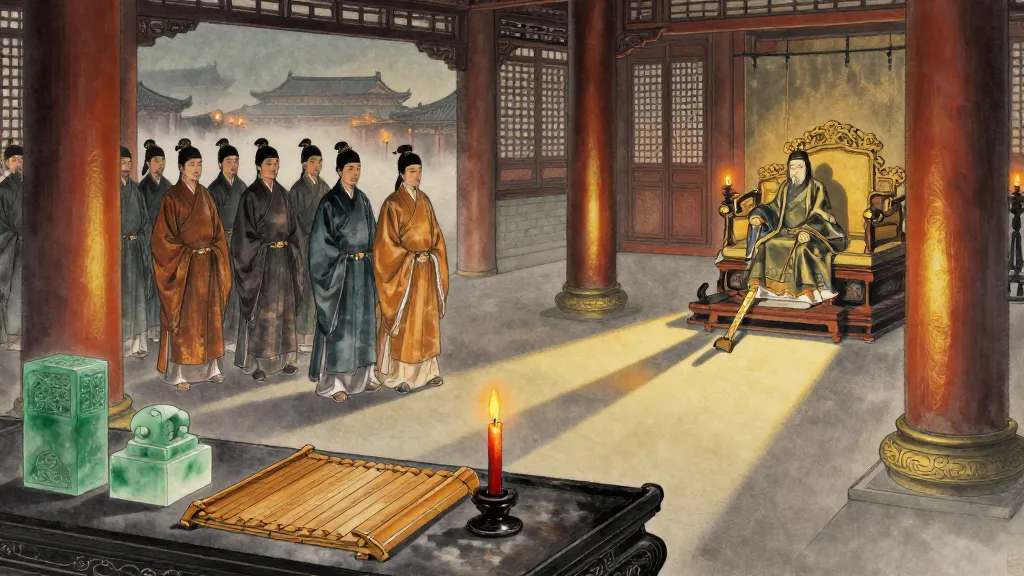
大宛列傳 (Account of Dayuan (Ferghana) and the Western Regions) — Chinese ink painting

Chapter 123 of 130

大宛列傳

Account of Dayuan (Ferghana) and the Western Regions

View:

張騫出使西域

Zhang Qian's Mission to the West

大宛之跡,見自張騫。張騫,漢中人。建元中為郎。是時天子問匈奴降者,皆言匈奴破月氏王,以其頭為飲器,月氏遁逃而常怨仇匈奴,無與共擊之。漢方欲事滅胡,聞此言,因欲通使。道必更匈奴中,乃募能使者。騫以郎應募,使月氏,與堂邑氏胡奴甘父俱出隴西。經匈奴,匈奴得之,傳詣單于。單于留之,曰:「月氏在吾北,漢何以得往使?吾欲使越,漢肯聽我乎?」留騫十餘歲,與妻,有子,然騫持漢節不失。

Knowledge of Dayuan (Ferghana) begins with Zhang Qian. Zhang Qian was a man of Hanzhong. During the Jianyuan era he served as a Gentleman. At that time, the emperor questioned Xiongnu defectors, who all said that the Xiongnu had destroyed the Yuezhi king and made a drinking vessel from his skull. The Yuezhi had fled and constantly harbored a grudge against the Xiongnu, but had no ally with whom to strike back. The Han was at that time eager to destroy the Xiongnu. Hearing this, the court wished to open diplomatic contact. Since the route necessarily passed through Xiongnu territory, volunteers were recruited for the mission. Zhang Qian, then a Gentleman, volunteered. He was dispatched to the Yuezhi, departing from Longxi together with Ganfu, a Xiongnu slave of the Tangyi household. They passed through Xiongnu lands; the Xiongnu captured them and brought them before the Chanyu. The Chanyu detained Zhang Qian, saying: 'The Yuezhi are to my north. How can the Han send envoys there? If I wished to send envoys to Yue, would Han permit it?' He held Zhang Qian for over ten years, gave him a wife, and he had children. Yet Zhang Qian never let go of the Han envoy's tally.

Notes

1person張騫Zhāng Qiān

Zhang Qian (張騫, d. 114 BC) is celebrated as the pioneer of the Silk Road. His two missions to the Western Regions (138–126 BC and 119 BC) opened China's first sustained contact with Central Asia, fundamentally transforming Han foreign policy, trade, and geographical knowledge.

2place

Dayuan (大宛) corresponds to the Ferghana Valley in modern Uzbekistan, Tajikistan, and Kyrgyzstan. It was famous for its 'blood-sweating' horses (汗血馬), which the Han coveted for military use against the Xiongnu.

西域諸國

The States of the Western Regions

騫身所至者大宛、大月氏、大夏、康居,而傳聞其旁大國五六,具為天子言之。曰:大宛在匈奴西南,在漢正西,去漢可萬里。其俗土著,耕田,田稻麥。有蒲陶酒。多善馬,馬汗血,其先天馬子也。有城郭屋室。其屬邑大小七十餘城,眾可數十萬。

The states Zhang Qian personally visited were Dayuan (Ferghana), the Greater Yuezhi, Daxia (Bactria), and Kangju (Sogdiana). He also gathered intelligence on five or six major states in the vicinity, all of which he reported to the Son of Heaven. He said: Dayuan lies southwest of the Xiongnu, due west of Han, approximately ten thousand li distant. Its people are sedentary, practice agriculture, and grow rice and wheat. They have grape wine. They possess many fine horses whose coats exude blood-like sweat — said to be descended from heavenly horses. They have walled cities and houses. The kingdom comprises over seventy dependent cities, large and small, with a population of several hundred thousand.

Notes

1place

Daxia (大夏, Bactria) occupied northern Afghanistan. The Greater Yuezhi (大月氏) had migrated there from the Gansu corridor after being driven west by the Xiongnu. Kangju (康居) corresponds roughly to Sogdiana, centered on modern Samarkand, Uzbekistan.

2context

The 'blood-sweating horses' (汗血馬) may have suffered from subcutaneous parasites (Parafilaria multipapillosa) that caused bleeding through the skin. Whatever the cause, these Ferghana horses were larger and faster than Chinese breeds, making them militarily invaluable against the Xiongnu's mounted archers.

安息與條枝

Parthia and Mesopotamia

安息在大月氏西可數千里。其俗土著,耕田,田稻麥,蒲陶酒。城邑如大宛。其屬小大數百城,地方數千里,最為大國。臨媯水,有市,民商賈用車及船,行旁國或數千里。以銀為錢,錢如其王面,王死輒更錢,效王面焉。畫革旁行以為書記。其西則條枝,北有奄蔡、黎軒。

條枝在安息西數千里,臨西海。暑濕。耕田,田稻。有大鳥,卵如甕。人眾甚多,往往有小君長,而安息役屬之,以為外國。國善眩。

Parthia (Anxi) lies several thousand li west of the Greater Yuezhi. Its people are sedentary, practice agriculture, and grow rice and wheat, and make grape wine. Their cities are similar to those of Dayuan. The kingdom encompasses several hundred cities, large and small, covering a territory of several thousand li — it is the largest state in the region. It borders the Gui River and has markets. The people use carts and boats for trade, traveling to neighboring states sometimes thousands of li distant. They use silver for coinage, stamping the coins with the likeness of their king; when the king dies, they immediately recast the coins with the new king's face. They write on leather, in horizontal lines, for their records. To the west lies Tiaozhi (Mesopotamia); to the north are Yancai and Lijian.

Tiaozhi lies several thousand li west of Parthia, on the shores of the Western Sea. It is hot and humid. The people practice agriculture and grow rice. There is a large bird whose eggs are the size of urns. The population is very large. There are scattered local chiefs, but Parthia rules over them as a vassal territory. The people are skilled at conjuring tricks.

Notes

1place

Anxi (安息) is Parthia, the Iranian empire of the Arsacid dynasty (247 BC – 224 AD). The silver coins with royal portraits are confirmed by surviving Parthian drachms. The 'leather written in horizontal lines' likely refers to Parthian scripts written on parchment.

2place

Tiaozhi (條枝) is generally identified with Mesopotamia or the Seleucid/Characene territories on the Persian Gulf. The 'Western Sea' (西海) is the Persian Gulf or possibly the Mediterranean. The 'large bird with eggs like urns' is the ostrich. Lijian (黎軒) may refer to the Greco-Roman world, possibly Alexandria or the Roman eastern provinces.

貳師將軍伐大宛

The Ershi General's Campaign Against Dayuan

而漢使者往既多,其少從率多進熟於天子,言曰:「宛有善馬在貳師城,匿不肯與漢使。」天子既好宛馬,聞之甘心,使壯士車令等持千金及金馬以請宛王貳師城善馬。宛國饒漢物,相與謀曰:「漢去我遠,而鹽水中數敗,出其北有胡寇,出其南乏水草。又且往往而絕邑,乏食者多。漢使數百人為輩來,而常乏食,死者過半,是安能致大軍乎?無柰我何。且貳師馬,宛寶馬也。」遂不肯予漢使。漢使怒,妄言,椎金馬而去。宛貴人怒曰:「漢使至輕我!」遣漢使去,令其東邊郁成遮攻殺漢使,取其財物。

As Han envoys had traveled west in ever-greater numbers, the junior members of these delegations competed to present exaggerated intelligence to the emperor. They said: 'Dayuan possesses fine horses in the city of Ershi, but hides them and will not give them to Han envoys.' The emperor, already enamored of Dayuan horses, was delighted to hear this and dispatched the warrior Che Ling and others with a thousand catties of gold and a golden horse statue to request the fine horses from the King of Dayuan at Ershi. The people of Dayuan, being well supplied with Han goods, conferred among themselves: 'Han is far from us. Many missions have perished in the salt marshes. To the north lie Xiongnu raiders; to the south there is no water or pasture. There are long stretches with no settlements at all, and many die of starvation. Han missions of several hundred men arrive, and regularly more than half die of hunger. How could they send a large army? They can do nothing to us. Besides, the Ershi horses are the national treasure of Dayuan.' They refused to hand over the horses. The Han envoy was furious, made reckless threats, smashed the golden horse statue, and departed. The Dayuan nobles were outraged: 'The Han envoy has treated us with utter contempt!' They sent the envoy away and ordered the border town of Yucheng to intercept and kill the Han envoys and seize their goods.

Notes

1context

The killing of Han envoys provided the pretext for Emperor Wu's two massive campaigns against Dayuan (104 and 102 BC), among the most logistically ambitious military operations in ancient history. The first campaign was a catastrophic failure; the second succeeded in capturing Dayuan's horses but at enormous cost.

太史公贊

The Grand Historian's Assessment

太史公曰:禹本紀言「河出崑崙。崑崙其高二千五百餘里,日月所相避隱為光明也。其上有醴泉、瑤池」。今自張騫使大夏之後也,窮河源,惡睹本紀所謂崑崙者乎?故言九州山川,尚書近之矣。至禹本紀、山海經所有怪物,余不敢言之也。

The Grand Historian says: The Basic Annals of Yu state: 'The Yellow River flows from Kunlun. Kunlun is over 2,500 li high, a place where the sun and moon alternately hide to give forth their light. Atop it are the Sweet Spring and the Jade Pool.' Now, since Zhang Qian's mission to Bactria, we have traced the source of the Yellow River — but where is the Kunlun described in the Basic Annals? Therefore, for descriptions of the mountains and rivers of the Nine Provinces, the Documents comes closest to the truth. As for the strange creatures found in the Basic Annals of Yu and the Classic of Mountains and Seas, I dare not speak of them.

Notes

1context

This remarkable conclusion shows Sima Qian applying empirical verification to mythological geography. Zhang Qian's actual exploration of Central Asia disproved the legendary account of Kunlun, leading Sima Qian to prefer the sober geographic descriptions of the Shangshu over the fantastic traditions of the Shanhai Jing. This is one of the earliest statements of evidence-based geographical criticism in Chinese historiography.

Edition & Source

Text
《史記》 Shiji
Edition
中華古詩文古書籍網 transcription
Commentary
裴駰《史記集解》、司馬貞《史記索隱》、張守節《史記正義》(Three Commentaries)