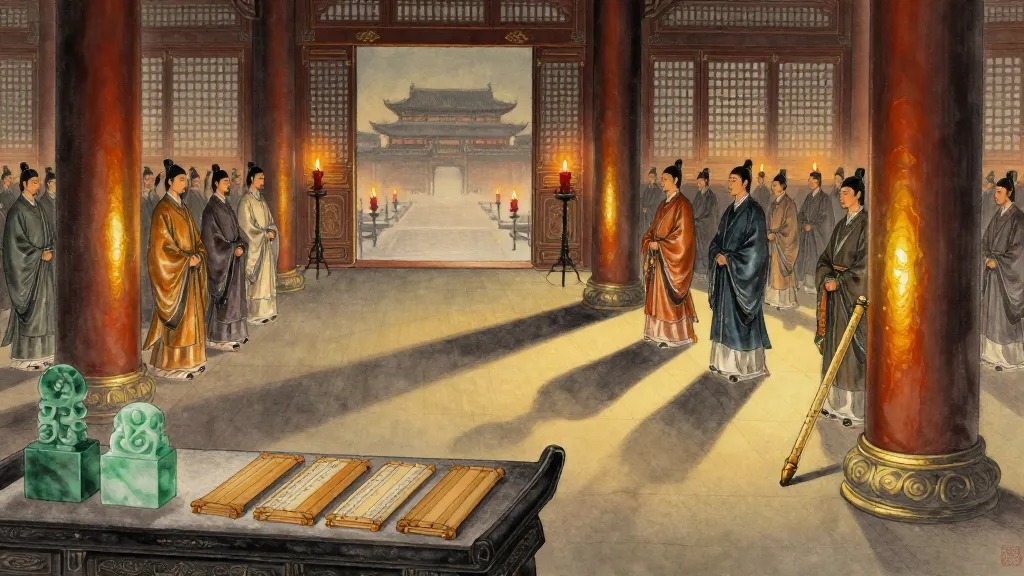
佞幸列傳 (Biographies of Imperial Favorites) — Chinese ink painting

Chapter 125 of 130

佞幸列傳

Biographies of Imperial Favorites

View:

佞幸總論

On Imperial Favorites

諺曰「力田不如逢年,善仕不如遇合」,固無虛言。非獨女以色媚,而士宦亦有之。

昔以色幸者多矣。至漢興,高祖至暴抗也,然籍孺以佞幸;孝惠時有閎孺。此兩人非有材能,徒以婉佞貴幸,與上臥起,公卿皆因關說。故孝惠時郎侍中皆冠鵕璘,貝帶,傅脂粉,化閎、籍之屬也。兩人徙家安陵。

A proverb says: 'Hard farming is not as good as meeting a good year; skilled service is not as good as finding favor.' These are no empty words. It is not only women who gain favor through physical beauty — men at court have done so too.

Since antiquity, many have risen through personal charm. When the Han dynasty was founded, Emperor Gaozu was as fierce and unyielding as any man, yet Ji Ru gained his favor through flattery and charm. Under Emperor Hui there was Hong Ru. Neither man possessed any real ability; they rose solely through obsequious charm, sharing the emperor's bed and daily life, while dukes and ministers all had to go through them to gain access. Thus during Emperor Hui's reign, the palace attendants and gentlemen of the interior all wore caps decorated with kingfisher feathers, belts studded with cowrie shells, and applied cosmetics and powder — all imitating Hong Ru and Ji Ru. Both families were relocated to Anling.

Notes

1context

Sima Qian introduces the phenomenon of male imperial favorites (佞幸) with remarkable directness. The chapter documents a pattern whereby emperors elevated personal companions — often sexual partners — to positions of extraordinary wealth and influence, bypassing the normal bureaucratic hierarchy.

2person籍孺Jí Rú

Ji Ru (籍孺) was a favorite of Emperor Gaozu of Han (漢高祖, r. 202–195 BC). Hong Ru (閎孺) served the same role under Emperor Hui (漢惠帝, r. 195–188 BC). Both names use the character 孺 (child/youth), suggesting these were young male companions.

鄧通受寵於孝文帝

Deng Tong and Emperor Wen's Favor

孝文時中寵臣,士人則鄧通,宦者則趙同、北宮伯子。北宮伯子以愛人長者;而趙同以星氣幸,常為文帝參乘;鄧通無伎能。鄧通,蜀郡南安人也,以濯船為黃頭郎。孝文帝夢欲上天,不能,有一黃頭郎從後推之上天,顧見其衣裻帶後穿。覺而之漸台,以夢中陰目求推者郎,即見鄧通,其衣後穿,夢中所見也。召問其名姓,姓鄧氏,名通,文帝說焉,尊幸之日異。通亦願謹,不好外交,雖賜洗沐,不欲出。於是文帝賞賜通巨萬以十數,官至上大夫。文帝時時如鄧通家遊戲。然鄧通無他能,不能有所薦士,獨自謹其身以媚上而已。上使善相者相通,曰「當貧餓死」。文帝曰:「能富通者在我也。何謂貧乎?」於是賜鄧通蜀嚴道銅山,得自鑄錢,「鄧氏錢」布天下。其富如此。

文帝嘗病癰,鄧通常為帝唶吮之。文帝不樂,從容問通曰:「天下誰最愛我者乎?」通曰:「宜莫如太子。」太子入問病,文帝使唶癰,唶癰而色難之。已而聞鄧通常為帝唶吮之,心慚,由此怨通矣。及文帝崩,景帝立,鄧通免,家居。居無何,人有告鄧通盜出徼外鑄錢。下吏驗問,頗有之,遂竟案,盡沒入鄧通家,尚負責數巨萬。長公主賜鄧通,吏輒隨沒入之,一簪不得著身。於是長公主乃令假衣食。竟不得名一錢,寄死人家。

During Emperor Wen's reign, the favored courtiers among commoners included Deng Tong, while among eunuchs there were Zhao Tong and Beigong Bozi. Beigong Bozi was favored for his kindly elder demeanor; Zhao Tong for his skill in astrology, and regularly served as Emperor Wen's charioteer. Deng Tong had no particular skill. He was a man from Nan'an in Shu Commandery who served as a Yellow-Cap Attendant, tending boats. Emperor Wen once dreamed he was trying to ascend to heaven but could not, when a Yellow-Cap Attendant pushed him up from behind. Looking back, he noticed the attendant's coat was torn at the back seam. Upon waking, the emperor went to the Gradual Terrace and covertly searched among the attendants for the one who had pushed him. He spotted Deng Tong, whose coat was indeed torn in the back — exactly as in the dream. He summoned him and asked his name. His surname was Deng, his given name Tong. Emperor Wen was delighted and elevated him in favor with each passing day. Tong was scrupulous and cautious, avoiding outside connections; even when granted rest days, he preferred not to leave the palace. Emperor Wen bestowed gifts on Tong amounting to hundreds of millions, and promoted him to Senior Grand Master. The emperor often visited Deng Tong's home to amuse himself. Yet Deng Tong had no other ability: he could not recommend worthy men; his sole skill was cautious self-conduct to please the sovereign. The emperor had a physiognomist examine Tong, who pronounced: 'He will die of poverty and starvation.' Emperor Wen said: 'I am the one who can make Tong rich. How could he be poor?' He thereupon granted Deng Tong the copper mines of Yan'dao in Shu, with the right to mint his own coins. 'Deng coins' circulated throughout the realm. Such was his wealth.

Emperor Wen once suffered from an abscess. Deng Tong would regularly suck and drain it. The emperor, in a melancholy mood, casually asked Tong: 'Who in the realm loves me most?' Tong replied: 'Surely none more than the Crown Prince.' When the Crown Prince came to inquire about the illness, Emperor Wen had him suck the abscess. The prince did so with visible reluctance. When he later heard that Deng Tong had been regularly sucking the abscess, he felt ashamed and from that point bore Tong a grudge. When Emperor Wen died and Emperor Jing ascended the throne, Deng Tong was dismissed and sent home. Shortly afterward, someone accused Deng Tong of illegally minting coins beyond the frontier. Officials investigated and found the accusation substantially true. The full case was pursued, and Deng Tong's entire estate was confiscated — yet he still owed debts of many millions. The Elder Princess gave gifts to Deng Tong, but officials immediately seized everything; he could not keep a single hairpin on his person. The Elder Princess then arranged to lend him clothing and food. In the end, he never owned so much as a single coin, and died as a dependent in another's household.

Notes

1person鄧通Dèng Tōng

Deng Tong (鄧通, d. c. 157 BC) became one of the wealthiest men in the Han empire through Emperor Wen's favor. His rise from boat-tender to millionaire, and subsequent fall to penniless death, became proverbial for the fickleness of fortune dependent on imperial favor.

2person漢景帝Hàn Jǐng Dì

The Crown Prince who reluctantly drained the abscess was the future Emperor Jing of Han (漢景帝, r. 157–141 BC). His resentment of Deng Tong was personal, and he moved against Tong immediately upon taking the throne.

韓嫣與李延年

Han Yan and Li Yannian

孝景帝時,中無寵臣,然獨郎中令周文仁,仁寵最過庸,乃不甚篤。

今天子中寵臣,士人則韓王孫嫣,宦者則李延年。嫣者,弓高侯孽孫也。今上為膠東王時,嫣與上學書相愛。及上為太子,愈益親嫣。嫣善騎射,善佞。上即位,欲事伐匈奴,而嫣先習胡兵,以故益尊貴,官至上大夫,賞賜擬於鄧通。時嫣常與上臥起。江都王入朝,有詔得從入獵上林中。天子車駕蹕道未行,而先使嫣乘副車,從數十百騎,騖馳視獸。江都王望見,以為天子,辟從者,伏謁道傍。嫣驅不見。既過,江都王怒,為皇太后泣曰:「請得歸國入宿衛,比韓嫣。」太后由此嗛嫣。嫣侍上,出入永巷不禁,以奸聞皇太后。皇太后怒,使使賜嫣死。上為謝,終不能得,嫣遂死。而案道侯韓說,其弟也,亦佞幸。

李延年,中山人也。父母及身兄弟及女,皆故倡也。延年坐法腐,給事狗中。而平陽公主言延年女弟善舞,上見,心說之,及入永巷,而召貴延年。延年善歌,為變新聲,而上方興天地祠,欲造樂詩歌弦之。延年善承意,弦次初詩。其女弟亦幸,有子男。延年佩二千石印,號協聲律。與上臥起,甚貴幸,埒如韓嫣也。久之,浸與中人亂,出入驕恣。及其女弟李夫人卒後,愛弛,則禽誅延年昆弟也。

自是之後,內寵嬖臣大底外戚之家,然不足數也。衛青、霍去病亦以外戚貴幸,然頗用材能自進。

During Emperor Jing's reign, there were no especially favored courtiers within the palace, save the Gentleman of the Interior Zhou Wenren, whose favor slightly exceeded the ordinary but was not particularly intense.

Under the present emperor, the favored courtier among commoners is Han Yan, a prince's grandson; among eunuchs, it is Li Yannian. Han Yan was an illegitimate grandson of the Marquis of Gonggao. When the present emperor was King of Jiaodong, Yan studied calligraphy with him and they became close. When the emperor was made Crown Prince, his intimacy with Yan deepened further. Yan was skilled at riding and archery, and adept at flattery. When the emperor took the throne and wished to campaign against the Xiongnu, Yan had already trained in nomadic military tactics, which further elevated his standing. He rose to Senior Grand Master, receiving gifts rivaling those of Deng Tong. At this time Yan regularly shared the emperor's bed and daily life. When the King of Jiangdu came to court and received permission to hunt in the Shanglin Park, the emperor's carriage escort had not yet set out when Yan was sent ahead in the deputy carriage, followed by scores of mounted attendants, galloping through the park to inspect the game. The King of Jiangdu saw them from a distance and took it for the imperial procession — he dismissed his own retinue and prostrated himself by the roadside. Yan galloped past without stopping. After he had passed, the King of Jiangdu was furious. He wept before the Empress Dowager and said: 'I request permission to return to my kingdom and serve in the Palace Guard, to be treated like Han Yan.' The Empress Dowager bore a grudge against Yan from then on. Yan attended the emperor and moved freely through the inner quarters without restriction. Reports of his misconduct reached the Empress Dowager. She was enraged and sent a messenger to bestow death upon Yan. The emperor apologized on Yan's behalf but could not save him, and Yan was put to death. His younger brother, the Marquis of Andao Han Yue, also enjoyed imperial favor through flattery.

Li Yannian was a man of Zhongshan. His parents, he himself, his brothers, and his sisters had all been performers. Yannian was convicted of a crime and castrated, then assigned to the dog kennels. Princess Pingyang mentioned that Yannian's younger sister was an excellent dancer. The emperor saw her, was pleased, and once she entered the inner quarters, he summoned and elevated Yannian. Yannian was a gifted singer who created new musical styles. At this time the emperor was establishing the Suburban Sacrifices to Heaven and Earth and wished to compose ritual hymns set to music. Yannian was skillful at anticipating the emperor's wishes and set the initial poems to music. His younger sister also found favor and bore a son. Yannian wore the seal of a two-thousand-bushel official and was titled Coordinator of Musical Standards. He shared the emperor's bed and daily life, enjoying favor equal to that of Han Yan. Over time, he grew dissolute, engaging in illicit relations with palace women and behaving arrogantly. After his younger sister, Lady Li, died, the emperor's affection waned, and Yannian and his brothers were arrested and executed.

From this point on, favored courtiers within the palace were mostly from families connected to the imperial consorts, but they were not worth recording. Wei Qing and Huo Qubing also rose through consort connections, but they advanced substantially on their own military abilities.
Notes

1person韓嫣Hán Yān

Han Yan (韓嫣, d. c. 130s BC) was a childhood companion of Emperor Wu of Han (漢武帝, r. 141–87 BC). His execution was ordered by the Empress Dowager Wang, Emperor Wu's mother, after Yan's conduct in the inner palace became scandalous.

2person李延年Lǐ Yánnián

Li Yannian (李延年, d. c. 87 BC) was a musician and castrate who rose to high office. His sister, Lady Li (李夫人), was one of Emperor Wu's most beloved consorts. Their brother Li Guangli (李廣利) was appointed General of the Ershi Campaign against Dayuan (Ferghana).

太史公贊

The Grand Historian's Assessment

太史公曰:甚哉愛憎之時!彌子瑕之行,足以觀後人佞幸矣。雖百世可知也。

The Grand Historian says: How extreme is the timing of love and hatred! The conduct of Mi Zixia is sufficient to observe the pattern of favorites in later ages. Even a hundred generations hence, this can be known.

Notes

1context

Mi Zixia (彌子瑕) was a favorite of Duke Ling of Wei. Han Feizi tells the famous story: when Mi Zixia was young and beautiful, he once shared a half-eaten peach with the duke, who praised him for his devotion. Years later, when his beauty had faded, the duke cited the same incident as evidence of disrespect. Sima Qian invokes this as a universal pattern: the same behavior is praised during the period of favor and condemned afterward.

Edition & Source

Text
《史記》 Shiji
Edition
中華古詩文古書籍網 transcription
Commentary
裴駰《史記集解》、司馬貞《史記索隱》、張守節《史記正義》(Three Commentaries)