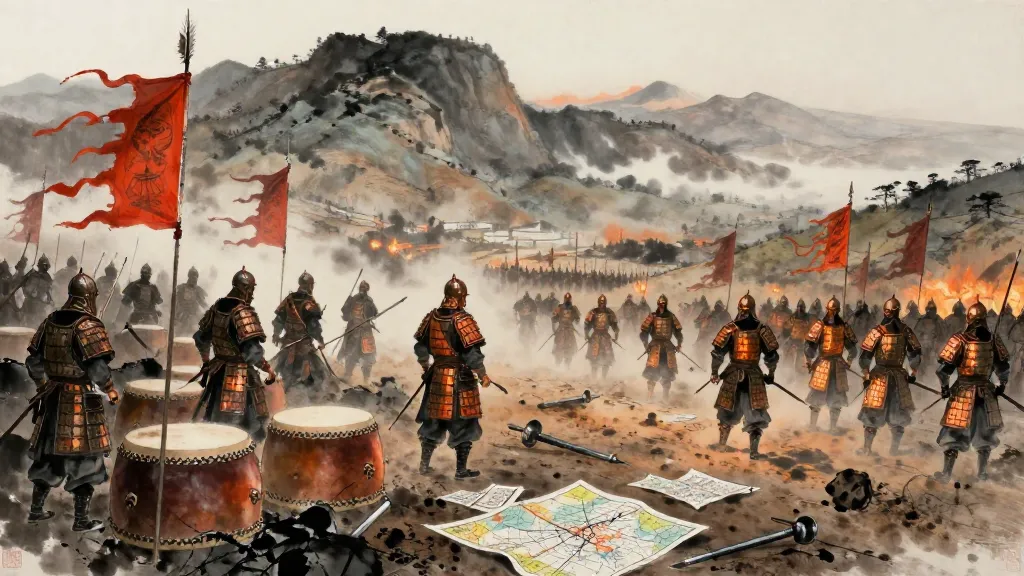
滑稽列傳 (Biographies of Jesters and Wits) — Chinese ink painting

Chapter 126 of 130

滑稽列傳

Biographies of Jesters and Wits

View:

淳于髡

Chunyu Kun

孔子曰:「六藝於治一也。禮以節人,樂以發和,書以道事,詩以達意,易以神化,春秋以義。」太史公曰:天道恢恢,豈不大哉!談言微中,亦可以解紛。

淳于髡者,齊之贅婿也。長不滿七尺,滑稽多辯,數使諸侯,未嘗屈辱。齊威王之時喜隱,好為淫樂長夜之飲,沈湎不治,委政卿大夫。百官荒亂,諸侯並侵,國且危亡,在於旦暮,左右莫敢諫。淳于髡說之以隱曰:「國中有大鳥,止王之庭,三年不蜚又不鳴,不知此鳥何也?」王曰:「此鳥不飛則已,一飛沖天;不鳴則已,一鳴驚人。」於是乃朝諸縣令長七十二人,賞一人,誅一人,奮兵而出。諸侯振驚,皆還齊侵地。威行三十六年。

Confucius said: 'The six arts serve governance in unity. Ritual regulates people, music promotes harmony, the Documents guide affairs, the Odes express intentions, the Changes work spiritual transformation, and the Spring and Autumn upholds righteousness.' The Grand Historian says: The Way of Heaven is vast — how great it is! Words that subtly hit the mark can also resolve disputes.

Chunyu Kun was an adopted son-in-law of Qi. Less than seven feet tall, he was witty and eloquent. He went on numerous diplomatic missions to the feudal lords and was never humiliated. King Wei of Qi was fond of riddles and given to debauchery and all-night drinking sessions, sunk in dissipation and neglecting governance, having delegated all authority to his ministers. Officials fell into disorder and the feudal lords encroached from all sides. The state was on the verge of destruction, and no one at court dared to remonstrate. Chunyu Kun addressed the king through a riddle: 'In the kingdom there is a great bird perched in Your Majesty's courtyard. For three years it has neither flown nor cried. What bird might this be?' The king replied: 'This bird — when it flies, it will soar to the sky; when it cries, it will astonish the world.' Thereupon the king summoned seventy-two county chiefs to court, rewarded one, executed one, and mobilized the army. The feudal lords were shaken with alarm and returned all the territory they had taken from Qi. His authority endured for thirty-six years.

Notes

1person淳于髡Chúnyú Kūn

Chunyu Kun (淳于髡, fl. 4th century BC) was a counselor of King Wei of Qi (齊威王, r. 356–320 BC). A commoner by origin who entered the Qi court through marriage, he exemplifies how wit and rhetorical skill could achieve what direct remonstrance could not.

優孟諫楚莊王

You Meng Admonishes King Zhuang of Chu

優孟,故楚之樂人也。長八尺,多辯,常以談笑諷諫。楚莊王之時,有所愛馬,衣以文繡,置之華屋之下,席以露床,啗以棗脯。馬病肥死,使群臣喪之,欲以棺槨大夫禮葬之。左右爭之,以為不可。王下令曰:「有敢以馬諫者,罪至死。」優孟聞之,入殿門。仰天大哭。王驚而問其故。優孟曰:「馬者王之所愛也,以楚國堂堂之大,何求不得,而以大夫禮葬之,薄,請以人君禮葬之。」

You Meng was a court performer of Chu. Eight feet tall, quick-witted, and eloquent, he habitually used humor and jest to deliver admonitions. During King Zhuang of Chu's time, the king had a favorite horse which he dressed in embroidered silks, stabled in a magnificent hall, bedded on an exposed couch, and fed with dates and dried meat. The horse grew sick from overfeeding and died. The king ordered his ministers to mourn it and wanted to bury it with the coffin and outer coffin of the rites for a grand officer. His attendants objected, arguing this was improper. The king issued a decree: 'Anyone who dares remonstrate about the horse shall be put to death.' When You Meng heard this, he entered the palace gate, looked up at the sky, and wailed loudly. The king was startled and asked the reason. You Meng said: 'The horse was Your Majesty's beloved. Given the greatness of the state of Chu, what could you not obtain? To bury it with the rites of a grand officer is too mean — I request it be buried with the rites for a sovereign.'

Notes

1person優孟Yōu Mèng

You Meng (優孟, fl. 6th century BC) was a court jester (優人) of Chu. His technique of agreeing with absurd propositions and pushing them to their logical extreme — a form of reductio ad absurdum — could change royal policy where direct remonstrance meant death.

優旃諫秦始皇

You Zhan Admonishes the First Emperor

優旃者,秦倡侏儒也。善為笑言,然合於大道,秦始皇時,置酒而天雨,陛楯者皆沾寒。優旃見而哀之,謂之曰:「汝欲休乎?」陛楯者皆曰:「幸甚。」優旃曰:「我即呼汝,汝疾應曰諾。」居有頃,殿上上壽呼萬歲。優旃臨檻大呼曰:「陛楯郎!」郎曰:「諾。」優旃曰:「汝雖長,何益,幸雨立。我雖短也,幸休居。」於是始皇使陛楯者得半相代。

始皇嘗議欲大苑囿,東至函谷關,西至雍、陳倉。優旃曰:「善。多縱禽獸於其中,寇從東方來,令麋鹿觸之足矣。」始皇以故輟止。

You Zhan was a dwarf court performer of Qin. He was skilled at witty remarks that nonetheless accorded with fundamental principles. During the First Emperor's reign, a banquet was held and it began to rain. The guards standing on the terrace steps were all soaked and freezing. You Zhan saw them and felt pity. He called out to them: 'Would you like a rest?' The guards all said: 'That would be wonderful!' You Zhan said: 'When I call you, answer "Aye!" at once.' After a while, a toast was raised in the palace hall and the cry of 'Ten thousand years!' went up. You Zhan leaned over the balustrade and shouted: 'Terrace guards!' They answered: 'Aye!' You Zhan said: 'You are tall, but what good does it do you? You get to stand in the rain. I am short, but I get to sit at ease indoors.' Thereupon the First Emperor allowed the guards to rotate, with half resting at a time.

The First Emperor once proposed to create an enormous imperial park stretching from Hangu Pass in the east to Yong and Chencang in the west. You Zhan said: 'Excellent! Fill it with wild game. When invaders come from the east, the deer can butt them away — that will be quite sufficient.' The First Emperor abandoned the project.

Notes

1person優旃Yōu Zhān

You Zhan (優旃) served the First Emperor and the Second Emperor of Qin. As a dwarf court jester, he occupied a social position that paradoxically granted him more freedom of speech than any minister. His ability to deflect tyrannical impulses through humor may have saved more lives than any formal remonstrance.

東方朔

Dongfang Shuo

武帝時,齊人有東方生名朔,以好古傳書,愛經術,多所博觀外家之語。朔初入長安,至公車上書,凡用三千奏牘。公車令兩人共持舉其書,僅然能勝之。人主從上方讀之,止,輒乙其處,讀之二月乃盡。

During Emperor Wu's reign, there was a man of Qi named Dongfang Shuo who was devoted to ancient texts and classical learning, widely read in writings outside the canonical traditions. When Shuo first arrived in Chang'an, he submitted a memorial at the Bureau of Carriages using a total of three thousand bamboo slips. It took two men from the bureau to lift and carry the document. The emperor read it from the top, marking his stopping place each time; it took him two months to finish.

Notes

1person東方朔Dōngfāng Shuò

Dongfang Shuo (東方朔, c. 154–c. 93 BC) was a court wit and scholar under Emperor Wu. Despite being dismissed as a 'madman' (狂人) by his peers, he combined genuine erudition with deliberate eccentricity, famously declaring that he was 'a hermit hiding within the court itself' (避世於朝廷間) rather than in the mountains.

太史公贊

The Grand Historian's Assessment

太史公曰:淳于髡仰天大笑,齊威王橫行。優孟搖頭而歌,負薪者以封。優旃臨檻疾呼,陛楯得以半更。豈不亦偉哉!

The Grand Historian says: Chunyu Kun threw back his head and laughed, and King Wei of Qi dominated the realm. You Meng shook his head and sang, and the firewood-gatherer received a fief. You Zhan leaned over the balustrade and shouted, and the terrace guards gained half-shifts of rest. Is this not also magnificent!

Notes

1context

Sima Qian's appreciation of jesters and wits reflects his belief that indirect speech — humor, allegory, riddles — could achieve what earnest remonstrance could not. In an era when speaking truth to power often meant death, the jester's art was a genuine survival strategy.

Edition & Source

Text
《史記》 Shiji
Edition
中華古詩文古書籍網 transcription
Commentary
裴駰《史記集解》、司馬貞《史記索隱》、張守節《史記正義》(Three Commentaries)