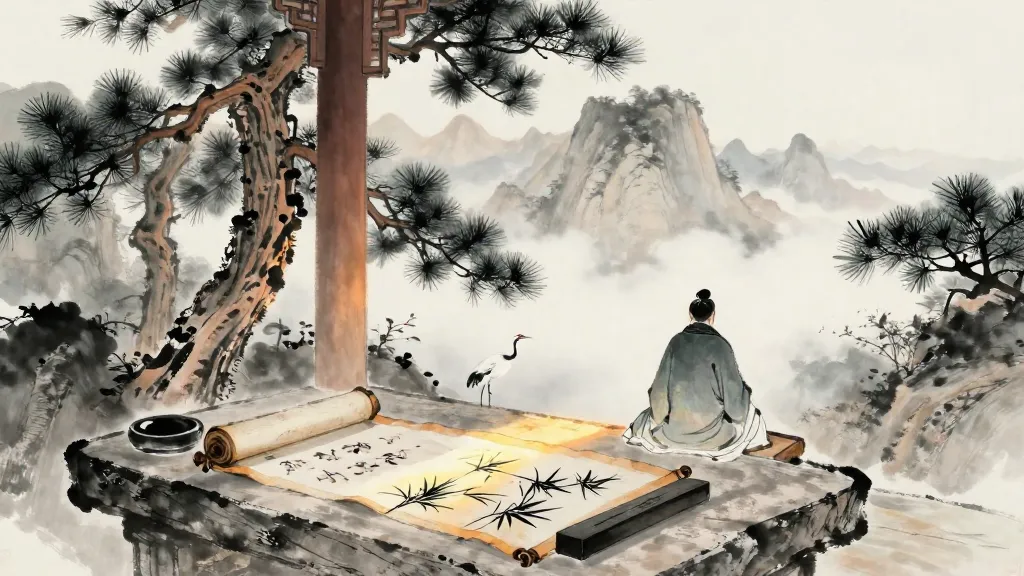
日者列傳 (Biography of the Diviner) — Chinese ink painting

Chapter 127 of 130

日者列傳

Biography of the Diviner

View:

卜筮之源流

Origins of Divination

自古受命而王,王者之興何嘗不以卜筮決於天命哉!其於周尤甚,及秦可見。代王之入,任於卜者。太卜之起,由漢興而有。

Since antiquity, whenever a king received the Mandate and ruled, has his rise ever failed to involve divination by tortoise shell and yarrow stalk to determine Heaven's will? This was especially pronounced under the Zhou, and also evident under the Qin. When the King of Dai entered to take the throne, the decision relied on diviners. The office of Grand Diviner was established with the founding of the Han.

Notes

1context

The 'King of Dai' refers to the future Emperor Wen of Han, whose accession in 180 BC was preceded by divination to confirm it was auspicious. This chapter and the next (Juan 128, Turtle and Yarrow) are Sima Qian's treatment of divination as a legitimate intellectual tradition, directly relevant to the Yi Jing (Book of Changes) and its practical applications.

司馬季主論卜筮之道

Sima Jizhu Discourses on the Way of Divination

司馬季主者,楚人也。卜於長安東市。

宋忠為中大夫,賈誼為博士,同日俱出洗沐,相從論議,誦易先王聖人之道術,究遍人情,相視而嘆。賈誼曰:「吾聞古之聖人,不居朝廷,必在卜醫之中。今吾已見三公九卿朝士大夫,皆可知矣。試之卜數中以觀採。」二人即同輿而之市,游於卜肆中。天新雨,道少人,司馬季主間坐,弟子三四人侍,方辯天地之道,日月之運,陰陽吉凶之本。二大夫再拜謁。

Sima Jizhu was a man of Chu. He practiced divination in the Eastern Market of Chang'an.

Song Zhong, a Central Grand Master, and Jia Yi, an Erudite, both went out on the same day for their rest-day ablutions. Traveling together, they discussed and recited the Way and methods of the sage-kings, exploring every aspect of human nature, gazing at each other and sighing. Jia Yi said: 'I have heard that the sages of antiquity, when they were not at court, were invariably to be found among the diviners and physicians. I have now observed the Three Excellencies, the Nine Ministers, and the officials and grand masters of the court — their measure can be taken. Let us try the world of diviners and see what we find.' The two men rode together to the market and strolled through the divination shops. It had just rained, the streets were nearly empty, and Sima Jizhu sat at his leisure with three or four disciples attending him. He was discoursing on the Way of Heaven and Earth, the movements of the sun and moon, and the fundamental principles of yin-yang and fortune. The two Grand Masters bowed twice and introduced themselves.

Notes

1person司馬季主Sīmǎ Jìzhǔ

Sima Jizhu (司馬季主) was a diviner of Chu who practiced in the Chang'an market during the early Han. Despite sharing the Sima surname, his connection (if any) to Sima Qian's family is uncertain. His philosophical defense of divination draws on Daoist, Confucian, and yinyang thought.

2person賈誼Jiǎ Yì

Jia Yi (賈誼, 200–168 BC) was one of the most brilliant political thinkers of the early Han, author of the famous 'Faults of Qin' (過秦論). His visit to the market diviner, as narrated here, serves as a frame for Sima Jizhu's philosophical discourse.

季主斥二大夫

Jizhu Rebukes the Two Grand Masters

宋忠、賈誼瞿然而悟,獵纓正襟危坐,曰:「吾望先生之狀,聽先生之辭,小子竊觀於世,未嘗見也。今何居之卑,何行之汙?」

司馬季主捧腹大笑曰:「觀大夫類有道術者,今何言之陋也,何辭之野也!今夫子所賢者何也?所高者誰也?今何以卑汙長者?」

Song Zhong and Jia Yi were struck with sudden realization. They straightened their cap-strings, adjusted their collars, and sat upright, saying: 'Looking at your bearing, sir, and hearing your words — in our humble observation of the world, we have never encountered the like. Why then do you dwell in such a lowly place? Why is your occupation so demeaning?'

Sima Jizhu threw back his head and laughed, holding his stomach: 'I had taken you Grand Masters to be men of learning and principle, yet how vulgar your words are, how uncouth your speech! Whom do you consider worthy? Whom do you regard as elevated? And by what right do you call an elder lowly and demeaning?'

Notes

1context

The dramatic reversal — where the market diviner intellectually overwhelms two of the court's finest minds — is Sima Qian's way of challenging the social hierarchy that placed government officials above all other occupations. Jizhu's extended speech (abridged here) argues that corrupt officials are the true criminals while diviners practice a legitimate and ancient art.

季主論卜筮之德

Jizhu on the Virtue of Divination

且夫卜筮者,埽除設坐,正其冠帶,然後乃言事,此有禮也。言而鬼神或以饗,忠臣以事其上,孝子以養其親,慈父以畜其子,此有德者也。而以義置數十百錢,病者或以愈,且死或以生,患或以免,事或以成,嫁子娶婦或以養生:此之為德,豈直數十百錢哉!此夫老子所謂「上德不德,是以有德」。今夫卜筮者利大而謝少,老子之雲豈異於是乎?

Moreover, the diviner sweeps and cleans, sets out the seats, straightens his cap and sash, and only then speaks of the matter at hand — this is ritual propriety. Through his words, the spirits may accept offerings; a loyal minister may serve his superior; a filial son may nurture his parents; a loving father may raise his children — this is virtue. For a righteous fee of merely tens or hundreds of coins, the sick may be healed, the dying may live, disasters may be averted, enterprises may succeed, and sons and daughters may be properly married — is this virtue merely worth tens or hundreds of coins? This is what Laozi meant when he said: 'The highest virtue does not claim virtue — therefore it possesses virtue.' The diviner's benefit is great while his fee is small — is this not precisely what Laozi described?

Notes

1context

Sima Jizhu's defense of divination as a form of 'highest virtue' (上德) draws directly on Daodejing Chapter 38. The argument is sophisticated: divination provides immense practical and spiritual benefit for minimal cost, embodying the Daoist ideal of effortless efficacy. This passage is directly relevant to the Six Lines app's approach to traditional divination.

結語與後事

Epilogue

宋忠、賈誼忽而自失,芒乎無色,悵然噤口不能言。於是攝衣而起,再拜而辭。行洋洋也,出門僅能自上車,伏軾低頭,卒不能出氣。

居三日,宋忠見賈誼於殿門外,乃相引屏語相謂自嘆曰:「道高益安,勢高益危。居赫赫之勢,失身且有日矣。夫卜而有不審,不見奪糈;為人主計而不審,身無所處。此相去遠矣,猶天冠地屨也。」

久之,宋忠使匈奴,不至而還,抵罪。而賈誼為梁懷王傅,王墮馬薨,誼不食,毒恨而死。此務華絕根者也。

太史公曰:古者卜人所以不載者,多不見於篇。及至司馬季主,余志而著之。

Song Zhong and Jia Yi were suddenly lost in themselves, their faces drained of color, mouths clamped shut, unable to speak. They gathered their robes, rose, bowed twice, and took their leave. They walked as if drifting; at the door they could barely climb into their carriage, slumping over the rail with bowed heads, unable to catch their breath.

Three days later, Song Zhong met Jia Yi outside the palace gate. They drew each other aside and whispered, sighing to one another: 'The higher the Way, the greater the security; the higher the position, the greater the peril. We occupy dazzling positions of power, and the day of our ruin draws near. When a diviner errs in his reading, he merely loses his fee; when one who plans for a ruler errs, he loses his life. The distance between these is as vast as a cap atop the head and a shoe upon the ground.'

In time, Song Zhong was sent on a mission to the Xiongnu, failed to reach his destination and returned, and was convicted. Jia Yi became tutor to King Huai of Liang; when the king fell from his horse and died, Jia Yi refused to eat and died of grief and remorse. These were men who pursued the flower while severing the root.

The Grand Historian says: The reason ancient diviners were not recorded is that most did not appear in the standard texts. When it came to Sima Jizhu, I determined to record him.

Notes

1context

The epilogue delivers the chapter's moral with brutal irony: the two great court intellectuals who condescended to visit a market diviner both met tragic ends in government service, while the diviner — secure in his lowly station — presumably lived out his days in peace. The phrase 'pursuing the flower while severing the root' (務華絕根) suggests that worldly ambition destroys the spiritual foundation of life.

Edition & Source

Text
《史記》 Shiji
Edition
中華古詩文古書籍網 transcription
Commentary
裴駰《史記集解》、司馬貞《史記索隱》、張守節《史記正義》(Three Commentaries)