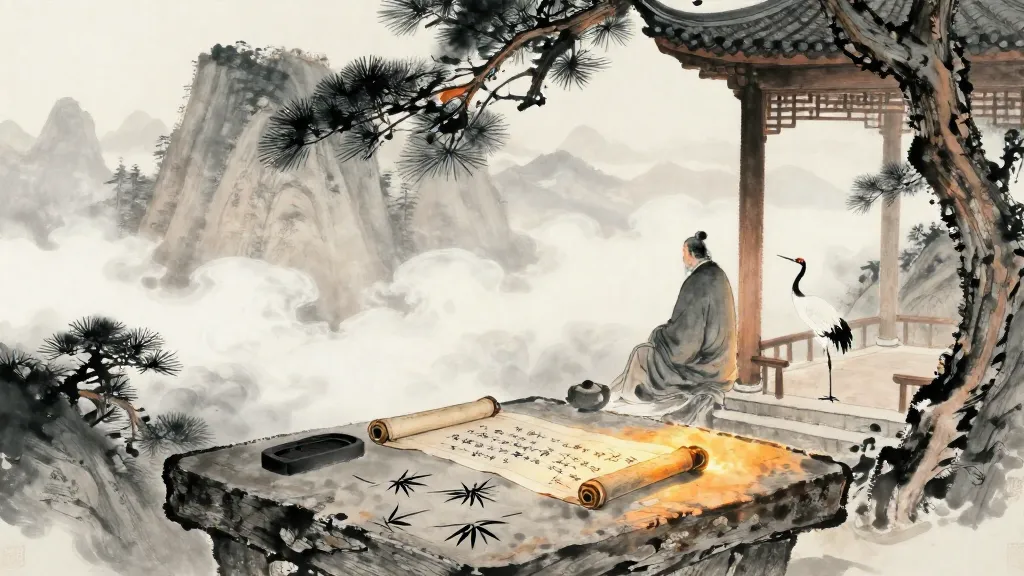
龜策列傳 (Account of Turtle Shell and Yarrow Stalk Divination) — Chinese ink painting

Chapter 128 of 130

龜策列傳

Account of Turtle Shell and Yarrow Stalk Divination

View:

卜筮之道

The Way of Divination

太史公曰:自古聖王將建國受命,興動事業,何嘗不寶卜筮以助善!唐虞以上,不可記已。自三代之興,各據禎祥。塗山之兆從而夏啟世,飛燕之卜順故殷興,百穀之筮吉故周王。王者決定諸疑,參以卜筮,斷以蓍龜,不易之道也。

蠻夷氐羌雖無君臣之序,亦有決疑之卜。或以金石,或以草木,國不同俗。然皆可以戰伐攻擊,推兵求勝,各信其神,以知來事。

The Grand Historian says: Since antiquity, whenever sage-kings founded states, received the Mandate, and launched great enterprises, have they ever failed to treasure divination by tortoise and yarrow to assist their good works? Before the ages of Yao and Shun, the record is lost. But with the rise of the Three Dynasties, each relied upon auspicious omens: the omen at Mount Tu was favorable and the Xia was established under Qi; the divination of the swallow was auspicious and so the Yin arose; the yarrow-stalk consultation about the hundred grains was favorable and so the Zhou kings reigned. For rulers to resolve all doubts by consulting divination and deciding by yarrow and tortoise is an unchanging principle.

Even the Man, Yi, Di, and Qiang barbarians, though they lack the hierarchies of ruler and minister, possess their own forms of divination to resolve uncertainty. Some use metal and stone, others plants and wood — customs differ from state to state. Yet all can be applied to warfare, military operations, and campaigns. Each people trusts its own spirits to learn of things to come.

Notes

1context

This chapter is one of the most important sources for understanding ancient Chinese divination practice. Much of the text was supplemented by Chu Shaosun (褚少孫), a later Han scholar who added practical instructions for turtle-shell divination that Sima Qian's original draft apparently lacked. The chapter is directly relevant to the Six Lines app as it documents the actual procedures and interpretive framework of Han-era divination.

宋元王與神龜

King Yuan of Song and the Divine Turtle

宋元王二年,江使神龜使於河,至於泉陽,漁者豫且舉網得而囚之。置之籠中。夜半,龜來見夢於宋元王曰:「我為江使於河,而幕網當吾路。泉陽豫且得我,我不能去。身在患中,莫可告語。王有德義,故來告訴。」元王惕然而悟。乃召博士衛平而問之曰:「今寡人夢見一丈夫,延頸而長頭,衣玄繡之衣而乘輜車,來見夢於寡人曰:『我為江使於河,而幕網當吾路。泉陽豫且得我,我不能去。身在患中,莫可告語。王有德義,故來告訴。』是何物也?」

In the second year of King Yuan of Song, a divine turtle was dispatched as an envoy from the Yangtze River to the Yellow River. When it reached Quanyang, a fisherman named Yuqie cast his net and captured it, placing it in a cage. At midnight, the turtle appeared in a dream to King Yuan of Song, saying: 'I am an envoy from the Yangtze to the Yellow River, but a net blocked my path. Yuqie of Quanyang captured me and I cannot escape. I am trapped in distress with no one to tell. Because Your Majesty possesses virtue and righteousness, I have come to appeal to you.' King Yuan awoke with a start. He summoned the court scholar Wei Ping and asked: 'I dreamed of a man with an elongated neck and long head, wearing robes of dark embroidery and riding in a covered carriage. He appeared in my dream saying: "I am an envoy from the Yangtze to the Yellow River, but a net blocked my path. Yuqie of Quanyang captured me and I cannot escape. I am trapped in distress with no one to tell. Because Your Majesty possesses virtue and righteousness, I have come to appeal to you." What manner of being is this?'

Notes

1context

The story of King Yuan and the divine turtle is an extended parable about the paradox of divination: the turtle possesses supernatural knowledge and can send dreams to kings, yet cannot free itself from a fisherman's net. This paradox — that spiritual power does not equate to physical invulnerability — is explored through a Socratic dialogue between the king and his advisor Wei Ping.

衛平論龜德

Wei Ping on the Virtue of the Turtle

衛平對曰:「龜者是天下之寶也,先得此龜者為天子,且十言十當,十戰十勝。生於深淵,長於黃土。知天之道,明於上古。游三千歲,不出其域。安平靜正,動不用力。壽蔽天地,莫知其極。與物變化,四時變色。居而自匿,伏而不食。春倉夏黃,秋白冬黑。明於陰陽,審於刑德。先知利害,察於禍福,以言而當,以戰而勝,王能寶之,諸侯盡服。王勿遣也,以安社稷。」

Wei Ping replied: 'The turtle is the treasure of the realm. Whoever first obtains such a turtle becomes Son of Heaven. Its pronouncements are always fulfilled in ten out of ten cases; its battles are won in ten out of ten engagements. Born in the deep abyss, raised in the yellow earth. It knows the Way of Heaven and understands high antiquity. It roams for three thousand years without leaving its domain. Peaceful, calm, still, and upright, it moves without exertion. Its lifespan rivals Heaven and Earth, and no one knows its limit. It transforms with all things, changing color with the four seasons. At rest it hides itself; when dormant it does not eat. In spring it is green-blue, in summer yellow, in autumn white, in winter black. It is illuminated in the principles of yin and yang, discerning in matters of punishment and virtue. It foreknows benefit and harm, perceives fortune and misfortune. Its words always prove true; its battles always result in victory. If Your Majesty treasures it, the feudal lords will all submit. Do not release it — use it to secure the altars of state.'

Notes

1context

Wei Ping's description of the divine turtle encodes fundamental principles of Chinese cosmology: the four seasonal colors correspond to the Five Phases cycle (green=wood/spring, yellow=earth/summer, white=metal/autumn, black=water/winter). The turtle's longevity, stillness, and comprehensive knowledge make it a microcosm of cosmic principles — hence its suitability as a divination instrument.

龜之悖論

The Paradox of the Turtle

故云神至能見夢於元王,而不能自出漁者之籠。身能十言盡當,不能通使於河,還報於江,賢能令人戰勝攻取,不能自解於刀鋒,免剝刺之患。聖能先知亟見,而不能令衛平無言。言事百全,至身而攣;當時不利,又焉事賢!

Thus it is said: the turtle's spirit was powerful enough to send a dream to King Yuan, yet it could not free itself from a fisherman's cage. It could make ten pronouncements and be right in all ten, yet could not complete its mission to the Yellow River or report back to the Yangtze. Its wisdom could lead men to victory in battle and conquest, yet it could not save itself from the blade or escape being split and scraped. Its sacred foresight was matchless, yet it could not silence Wei Ping's persuasion. Perfect in pronouncing on all affairs, yet helpless when it came to its own body — when the moment turns against you, of what use is wisdom!

Notes

1context

This passage articulates one of the deepest philosophical paradoxes in the Shiji: the limits of wisdom and power. No being — however spiritually gifted — can fully protect itself. The passage then extends this to a universal observation attributed to Confucius: 'The sun is virtuous and lord of all under heaven, yet is humiliated by the three-legged crow. The moon governs punishment, yet is devoured by the toad.' Even celestial bodies have their vulnerabilities. This insight applies equally to the human condition: no amount of knowledge guarantees personal safety.

龜卜實務

Practical Turtle Divination

卜禁曰:子亥戌不可以卜及殺龜。日中如食已卜。暮昏龜之徼也,不可以卜。庚辛可以殺,及以鑽之。常以月旦祓龜,先以清水澡之,以卵祓之,乃持龜而遂之,若常以為祖。

The divination prohibitions state: On the days zi, hai, and xu, one must not divine or kill a turtle. At noon, after eating, one may divine. At dusk and twilight — this is the turtle's boundary time — one must not divine. On geng and xin days, one may kill the turtle and drill it. The turtle should always be ritually purified at the beginning of each month: first wash it with clean water, purify it with an egg, then take up the turtle and consecrate it, treating it always with the reverence due an ancestor.

Notes

1context

This section preserves the practical handbook of Han-era turtle-shell divination, including the calendar restrictions (based on the Earthly Branches system), ritual purification procedures, and the proper method of preparing the shell. The references to specific days (子/亥/戌 for prohibitions, 庚/辛 for killing) embed divination practice within the sexagenary cycle calendar — the same system underlying the Yi Jing's temporal framework.

龜兆判讀

Reading the Turtle Crack Omens

大論曰:外者人也,內者自我也;外者女也,內者男也。首俯者憂。大者身也,小者枝也。大法,病者,足肣者生,足開者死。行者,足開至,足肣者不至。行者,足肣不行,足開行。有求,足開得,足肣者不得。系者,足肣不出,開出。

The general principles state: The outer side represents other people; the inner side represents oneself. The outer represents the female; the inner represents the male. When the head inclines downward, it portends worry. The main line represents the body; the minor lines represent the limbs. The fundamental rules: for illness — when the foot-crack closes (肣), the patient lives; when the foot-crack opens, the patient dies. For travel — when the foot-crack opens, the traveler arrives; when it closes, the traveler does not arrive. For departure — when the foot-crack closes, one does not depart; when it opens, one departs. For seeking something — when the foot-crack opens, one obtains it; when it closes, one does not. For prisoners — when the foot-crack closes, one does not go free; when it opens, one goes free.

Notes

1context

These interpretive rules constitute the earliest surviving systematic manual of Chinese turtle-shell plastromancy. The binary open/closed framework for reading crack patterns shows structural parallels to the yin/yang binary of the Yi Jing. The categories of inquiry — illness, travel, seeking, imprisonment — reflect the practical concerns that drove divination in Han society. This is primary source material for understanding the divinatory tradition that the Six Lines app builds upon.

Edition & Source

Text
《史記》 Shiji
Edition
中華古詩文古書籍網 transcription
Commentary
裴駰《史記集解》、司馬貞《史記索隱》、張守節《史記正義》(Three Commentaries)