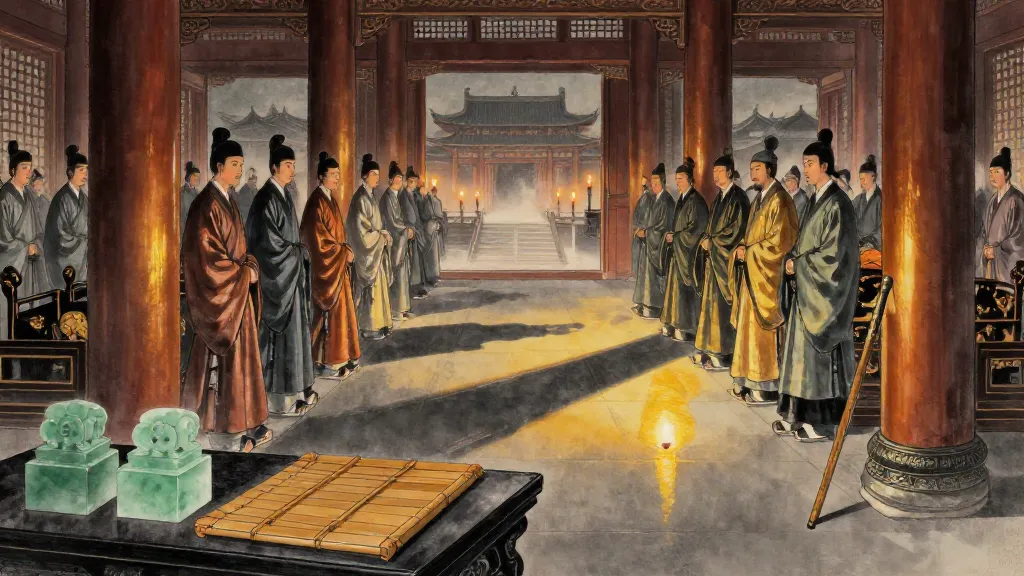
貨殖列傳 (Biographies of the Money-Makers) — Chinese ink painting

Chapter 129 of 130

貨殖列傳

Biographies of the Money-Makers

View:

論利之本

On the Roots of Profit

老子曰:“至治之極,鄰國相望,雞狗之聲相聞,民各甘其食,美其服,安其俗,樂其業,至老死不相往來。”必用此為務,輓近世塗民耳目,則幾無行矣。

太史公曰:夫神農以前,吾不知已。至若詩書所述虞夏以來,耳目欲極聲色之好,口欲窮芻豢之味,身安逸樂,而心夸矜埶能之榮使。俗之漸民久矣,雖戶說以眇論,終不能化。故善者因之,其次利道之,其次教誨之,其次整齊之,最下者與之爭。

Laozi said: “In the most perfect government, neighboring states are within sight of each other, the sounds of roosters and dogs are heard across the border, yet the people are content with their food, pleased with their clothing, comfortable in their customs, and happy in their work, and they grow old and die without ever visiting one another.” If one were to make this the guiding policy in the present age, it would mean stopping the people’s ears and covering their eyes — and it would be almost impossible to put into practice.

The Grand Historian remarks: Of the age before the Divine Farmer, I know nothing. But from the time of the Yu and Xia dynasties as described in the Odes and Documents, the ears and eyes have craved the finest sounds and sights, the mouth has sought the richest flavors of grain-fed meat, the body has pursued comfort and ease, and the heart has gloried in power and ability. These customs have soaked into the people for a long time. Even if one were to visit every household and preach the most subtle doctrines, one could never transform them. Therefore the best rulers go along with human nature; the next best guide it toward profit; the next best instruct it; the next best regulate it; and the worst rulers contend with it.

Notes

1context

Sima Qian opens with a Daoist quotation only to reject it, establishing the chapter’s central argument: that the desire for wealth is a natural human drive that wise governance should channel rather than suppress. This is one of the earliest defenses of market economics in world literature.

2person老子Lǎozǐ

Laozi (老子), traditionally identified as Li Er, is the legendary founder of Daoism and putative author of the Dao De Jing. The quoted passage is from Chapter 80 of that text.

天下物產與四民之業

The Products of the Realm and the Four Occupations

夫山西饒材、竹、穀、纑、旄、玉石;山東多魚、鹽、漆、絲、聲色;江南出棻、梓、姜、桂、金、錫、連、丹沙、犀、玳瑁、珠璣、齒革;龍門、碣石北多馬、牛、羊、旃裘、筋角;銅、鐵則千里往往山出釭置:此其大較也。皆中國人民所喜好,謠俗被服飲食奉生送死之具也。故待農而食之,虞而出之,工而成之,商而通之。此寧有政教發徵期會哉?人各任其能,竭其力,以得所欲。故物賤之徵貴,貴之徵賤,各勸其業,樂其事,若水之趨下,日夜無休時,不召而自來,不求而民出之。豈非道之所符,而自然之驗邪?

周書曰:“農不出則乏其食,工不出則乏其事,商不出則三寶絕,虞不出則財匱少。”財匱少而山澤不辟矣。此四者,民所衣食之原也。原大則饒,原小則鮮。上則富國,下則富家。貧富之道,莫之奪予,而巧者有餘,拙者不足。故太公望封於營丘,地潟鹵,人民寡,於是太公勸其女功,極技巧,通魚鹽,則人物歸之,繦至而輻湊。故齊冠帶衣履天下,海岱之間斂袂而往朝焉。其後齊中衰,管子修之,設輕重九府,則桓公以霸,九合諸侯,一匡天下;而管氏亦有三歸,位在陪臣,富於列國之君。是以齊富彊至於威、宣也。

West of the mountains the land is rich in timber, bamboo, grain, hemp, yak-tail hair, jade, and stone. East of the mountains there is abundant fish, salt, lacquer, silk, music, and beauty. South of the Yangtze come fragrant woods, catalpa, ginger, cinnamon, gold, tin, lead, cinnabar, rhinoceros horn, tortoiseshell, pearls, ivory, and hides. North of Longmen and Jieshi there are horses, cattle, sheep, felt and fur, sinew and horn in abundance. As for copper and iron, they are smelted from mountains scattered across a thousand li. This is the broad outline. These are all the things that the people of the Central States delight in — the goods of popular custom for clothing, food, living, and burying the dead. Therefore farmers are needed to produce food, foresters to bring out natural resources, artisans to craft finished goods, and merchants to circulate them. Is there any government policy, conscription order, or scheduled meeting that commands this? Each person exerts his own ability and exhausts his own strength to obtain what he desires. When goods are cheap, it is a sign they will become dear; when dear, a sign they will become cheap. Each person is encouraged in his trade and delights in his work, like water flowing downhill, ceaselessly day and night, coming without being summoned, produced by the people without being demanded. Is this not the verification of the Way and the proof of what is natural?

The Documents of Zhou says: “If the farmer does not produce, food will be scarce; if the artisan does not produce, goods will be lacking; if the merchant does not produce, the three treasures will cease to circulate; if the forester does not produce, wealth will run short.” When wealth runs short, the mountains and marshes go unexploited. These four are the root of the people’s clothing and food. When the root is large, there is abundance; when the root is small, there is scarcity. The enrichment of the state above and the family below — no one bestows or takes away the way to wealth and poverty; the clever have surplus and the clumsy have want. Thus when the Grand Duke was enfeoffed at Yingqiu, the soil was saline and barren and the population sparse. The Grand Duke then encouraged women’s handicrafts, perfected technical skills, and opened the fish and salt trade. People and goods flowed to him; infants were carried there and wagon spokes converged. Thus Qi dressed the entire realm in its caps, belts, robes, and shoes, and the people between the sea and Mount Tai tucked in their sleeves and came to pay court. Later, when Qi fell into decline, Guan Zhong reformed it, establishing the system of price equalization and the Nine Treasuries. Duke Huan thereby became hegemon, nine times assembling the lords and setting the realm in order. Guan Zhong himself held the Three Returns, and though a mere minister’s minister in rank, he was wealthier than the rulers of other states. Thus Qi remained rich and powerful down to the reigns of Kings Wei and Xuan.

Notes

1context

This passage contains one of the earliest formulations of the ‘invisible hand’ concept in economic thought: goods circulate naturally through supply and demand, ‘like water flowing downhill,’ without government command. Adam Smith would not articulate a comparable idea until 1776.

2person管仲Guǎn Zhòng

Guan Zhong (管仲, d. 645 BC) was the great reformer-minister of Qi under Duke Huan. His economic policies, especially the state management of salt and iron, are detailed in the text Guanzi (管子).

3translation

“Three Treasures” (三寶) here likely refers to grain, textiles, and metal — the essential commodities that merchants circulate.

倉廩實而知禮節

When Granaries Are Full, the People Know Propriety

故曰:“倉廩實而知禮節,衣食足而知榮辱。”禮生於有而廢於無。故君子富,好行其德;小人富,以適其力。淵深而魚生之,山深而獸往之,人富而仁義附焉。富者得埶益彰,失埶則客無所之,以而不樂。夷狄益甚。諺曰:“千金之子,不死於市。”此非空言也。故曰:“天下熙熙,皆為利來;天下壤壤,皆為利往。”夫千乘之王,萬家之侯,百室之君,尚猶患貧,而況匹夫編戶之民乎!

Therefore it is said: “When the granaries are full, the people know propriety and ritual; when there is enough clothing and food, the people know honor and shame.” Ritual is born from sufficiency and dies from want. When a gentleman is rich, he delights in practicing virtue; when a common man is rich, he applies his energies to practical ends. When the pool is deep, fish breed in it; when the mountain is deep, beasts go to it; when a man is rich, benevolence and righteousness attach themselves to him. The rich man who gains influence grows more illustrious; the one who loses it finds that even his guests have nowhere to go — and the result is unhappiness. For the foreign peoples this is even more the case. The proverb says: “The son of a man with a thousand pieces of gold does not die in the marketplace.” These are not empty words. Therefore it is said: “All-Under-Heaven bustles — all come for profit. All-Under-Heaven hustles — all go for profit.” If even the king of a thousand chariots, the lord of ten thousand households, and the head of a hundred families all worry about poverty, how much more the common man of registered households!

Notes

1translation

“倉廪實而知禮節,衣食足而知榮辱” — attributed to Guan Zhong in the Guanzi. This became one of the most influential aphorisms in Chinese political economy, arguing that material welfare is the prerequisite for moral behavior.

2translation

“天下熙熙,皆為利來;天下壤壤,皆為利往” — ‘All-Under-Heaven bustles, all come for profit; All-Under-Heaven hustles, all go for profit.’ This is Sima Qian’s most famous summation of human economic motivation.

計然與范蠡致富之道

The Wealth-Building Methods of Ji Ran and Fan Li

昔者越王句踐困於會稽之上,乃用范蠡、計然。計然曰:“知斗則修備,時用則知物,二者形則萬貨之情可得而觀已。故歲在金,穰;水,毀;木,飢;火,旱。旱則資舟,水則資車,物之理也。六歲穰,六歲旱,十二歲一大飢。夫糶,二十病農,九十病末。末病則財不出,農病則草不辟矣。上不過八十,下不減三十,則農末俱利,平糶齊物,關市不乏,治國之道也。積著之理,務完物,無息幣。以物相貿易,腐敗而食之貨勿留,無敢居貴。論其有餘不足,則知貴賤。貴上極則反賤,賤下極則反貴。貴出如糞土,賤取如珠玉。財幣欲其行如流水。”修之十年,國富,厚賂戰士,士赴矢石,如渴得飲,遂報彊吳,觀兵中國,稱號“五霸”。

范蠡既雪會稽之恥,乃喟然而嘆曰:“計然之策七,越用其五而得意。既已施於國,吾欲用之家。”乃乘扁舟浮於江湖,變名易姓,適齊為鴟夷子皮,之陶為硃公。硃公以為陶天下之中,諸侯四通,貨物所交易也。乃治產積居。與時逐而不責於人。故善治生者,能擇人而任時。十九年之中三致千金,再分散與貧交疏昆弟。此所謂富好行其德者也。後年衰老而聽子孫,子孫脩業而息之,遂至巨萬。故言富者皆稱陶硃公。

Long ago, King Goujian of Yue was trapped atop Mount Kuaiji. He then employed Fan Li and Ji Ran. Ji Ran said: “Knowing that a conflict is coming, prepare your supplies. Understanding the seasons’ demands, you will understand commodities. When these two factors are clear, the nature of all goods can be observed. When the year is governed by Metal, the harvest is abundant; by Water, there is ruin; by Wood, famine; by Fire, drought. In drought, invest in boats; in flood, invest in carts — this is the principle of things. Six years of abundance, six years of drought, one great famine in twelve years. When grain is sold at twenty cash, the farmer suffers; at ninety, the merchant suffers. When the merchant suffers, goods do not circulate; when the farmer suffers, the fields go uncleared. Keep the price no higher than eighty, no lower than thirty, and both farmer and merchant profit. Stabilize grain prices and equalize goods, and the markets will never run short — this is the way to govern a state. The principle of accumulating wealth: deal only in finished goods, do not let your money sit idle. In trading goods for goods, do not hold perishables; do not dare to hoard waiting for high prices. Observe what is in surplus and what is in deficit, and you will know what is dear and what is cheap. When prices reach their peak, they reverse and fall; when they reach their bottom, they reverse and rise. When prices are high, release goods as though they were dung and dirt; when prices are low, acquire goods as though they were pearls and jade. Let your money flow like water.” Goujian practiced these methods for ten years. The state grew rich. He lavished rewards on his warriors, and they charged into arrows and stones as though they were parched men reaching for water. He thus avenged himself on mighty Wu, paraded his troops before the Central States, and was honored among the Five Hegemons.

After Fan Li had wiped clean the shame of Kuaiji, he sighed deeply and said: “Of Ji Ran’s seven strategies, Yue used five and achieved its aim. I have already applied them to the state; now I wish to apply them to my household.” He took a small boat and drifted across the rivers and lakes, changed his name, and went to Qi as ‘Master Owl-Hide.’ He then moved to Tao and became known as Lord Zhu. Lord Zhu reasoned that Tao was at the center of All-Under-Heaven, where all the lords’ roads converged and goods were exchanged. He built up his estate and accumulated inventory, pursuing the market’s timing without pressuring anyone. The skillful manager of wealth knows how to choose good people and seize the right moment. In nineteen years he amassed a fortune of a thousand pieces of gold three times over, and twice distributed it among his poor friends and distant kin. This is what is called ‘a rich man who delights in practicing virtue.’ In his old age, he entrusted the business to his sons and grandsons, who continued the enterprise and multiplied it, eventually reaching immense wealth. Therefore whenever people speak of the rich, they all cite Lord Zhu of Tao.

Notes

1person計然Jì Rán

Ji Ran (計然), also known as Ji Ni, was an economic theorist who served King Goujian of Yue. His price-cycle theory, linking commodity prices to celestial cycles and arguing for counter-cyclical investment, is one of the earliest systematic economic doctrines in Chinese history.

2person范蠡Fàn Lǐ

Fan Li (范蠡), later known as Lord Zhu of Tao (陶朱公), was the strategist who saved Yue and then retired to become the most successful merchant of his era. He is revered in Chinese culture as both a political genius and the patron saint of business.

3place

Tao (陶) was located in modern Dingtao, Heze, Shandong — a major crossroads of ancient trade routes between the northern plains and the Yangtze region.

4context

Ji Ran’s theory of counter-cyclical investment (“in drought, invest in boats; in flood, invest in carts”) and his insight that prices oscillate between extremes are strikingly modern economic principles.

子貢與白圭

Zigong and Bai Gui

子贛既學於仲尼,退而仕於衛,廢著鬻財於曹、魯之間,七十子之徒,賜最為饒益。原憲不厭糟,匿於窮巷。子貢結駟連騎,束帛之幣以聘享諸侯,所至,國君無不分庭與之抗禮。夫使孔子名布揚於天下者,子貢先後之也。此所謂得埶而益彰者乎?

白圭,周人也。當魏文侯時,李克務盡地力,而白圭樂觀時變,故人棄我取,人取我與。夫歲孰取穀,予之絲漆;繭出取帛絮,予之食。太陰在卯,穰;明歲衰惡。至午,旱;明歲美。至酉,穰;明歲衰惡。至子,大旱;明歲美,有水。至卯,積著率歲倍。欲長錢,取下穀;長石斗,取上種。能薄飲食,忍嗜欲,節衣服,與用事僮僕同苦樂,趨時若猛獸摯鳥之發。故曰:“吾治生產,猶伊尹、呂尚之謀,孫吳用兵,商鞅行法是也。是故其智不足與權變,勇不足以決斷,仁不能以取予,彊不能有所守,雖欲學吾術,終不告之矣。”蓋天下言治生祖白圭。白圭其有所試矣,能試有所長,非苟而已也。

Zigong studied under Confucius, then withdrew and served in Wei, buying and selling goods for profit between Cao and Lu. Among the seventy disciples, Zigong was by far the wealthiest. Yuan Xian could not even afford chaff and hid in a back alley. But Zigong rode in four-horse chariots with a mounted escort and brought bundles of silk as gifts when he visited the lords. Wherever he went, no ruler failed to divide the courtyard with him and receive him as an equal. It was Zigong who, going before and after, spread the name of Confucius throughout All-Under-Heaven. Is this not what is called ‘gaining influence and thereby shining brighter’?

Bai Gui was a man of Zhou. During the time of Marquis Wen of Wei, when Li Ke strove to exhaust the potential of the land, Bai Gui delighted in observing the shifts of the seasons. His principle was: ‘What others discard, I take; what others take, I give.’ When the harvest was good, he bought grain and sold silk and lacquer; when silkworms had spun their cocoons, he bought silk floss and sold food. When Jupiter was in mao, the harvest would be abundant, but the following year poor. When it reached wu, there would be drought, but the following year good. When it reached you, abundance again, then decline. When it reached zi, a great drought, then a good year with flooding. By the time the cycle returned to mao, his accumulated inventory would have doubled each year. If he wanted to increase his cash, he bought cheap grain; if he wanted to increase his grain reserves, he bought the finest seed. He ate frugally, suppressed his appetites, wore plain clothes, and shared the toils and pleasures of his working servants. When the moment came to act, he struck like a beast of prey or a raptor swooping down. He therefore said: “My management of business is like the stratagems of Yi Yin and Lü Shang, the warfare of Sun and Wu, the legal reforms of Shang Yang. If a man’s intelligence is insufficient for adapting to change, if his courage is insufficient for decisive action, if his benevolence is insufficient for knowing when to give and take, if his firmness is insufficient for holding his ground — though he wishes to learn my methods, I will never teach him.” Thus all who speak of wealth management throughout the realm trace their origin to Bai Gui. Bai Gui had put his methods to the test and excelled at what he tested — this was no idle boast.

Notes

1person子貢Zǐgòng

Zigong (子貢, also written 子贡), personal name Duanmu Ci (端木赐), was one of Confucius’s most prominent disciples, famous for his eloquence and commercial success.

2person白圭Bái Guī

Bai Gui (白圭) was a merchant of the Warring States period whom Sima Qian presents as the founder of systematic commercial theory. His ‘counter-seasonal’ trading strategy and his comparison of business to statecraft and warfare are foundational ideas in Chinese economic thought.

3context

Bai Gui’s principle ‘what others discard, I take; what others take, I give’ (人棄我取,人取我與) is the classical Chinese formulation of contrarian investment strategy.

天下風俗與物產地理

Regional Customs, Products, and Economic Geography

關中自汧、雍以東至河、華,膏壤沃野千里,自虞夏之貢以為上田,而公劉適邠,大王、王季在岐,文王作豐,武王治鎬,故其民猶有先王之遺風,好稼穡,殖五穀,地重,重為邪。及秦文、、繆居雍,隙隴蜀之貨物而多賈。獻公徙櫟邑,櫟邑北卻戎翟,東通三晉,亦多大賈。昭治鹹陽,因以漢都,長安諸陵,四方輻湊並至而會,地小人眾,故其民益玩巧而事末也。南則巴蜀。巴蜀亦沃野,地饒卮、姜、丹沙、石、銅、鐵、竹、木之器。南御滇僰,僰僮。西近邛笮,笮馬、旄牛。然四塞,棧道千里,無所不通,唯襃斜綰轂其口,以所多易所鮮。天水、隴西、北地、上郡與關中同俗,然西有羌中之利,北有戎翟之畜,畜牧為天下饒。然地亦窮險,唯京師要其道。故關中之地,於天下三分之一,而人眾不過什三;然量其富,什居其六。

Within the passes, from Qian and Yong eastward to the Yellow River and Mount Hua, there stretches a thousand li of rich soil and fertile fields. Since the tribute system of Yu and Xia, these have been ranked as the finest farmland. Duke Liu settled at Bin; the Great King and King Ji were at Qi; King Wen built Feng; King Wu ruled from Hao. Therefore the people still preserve the ways of the former kings — they love farming and planting the five grains, the land is valued, and they are reluctant to do wrong. When Dukes Wen, De, and Mu of Qin held court at Yong, they exploited the gap in the trade of Long and Shu and produced many merchants. Duke Xian moved to Yueyi, which held back the Rong and Di to the north and connected with the three states of Jin to the east — it too produced great merchants. When Duke Zhao governed Xianyang, it became the Han capital in turn. Chang’an and the various imperial tombs drew people from all four directions converging at once. The land is small but the population dense, so the people have grown ever more clever in skill and devoted to commerce. To the south lies Ba and Shu. Ba and Shu too have fertile fields, rich in gardenia, ginger, cinnabar, stone, copper, iron, bamboo, and timber products. To the south they border Dian and the Bo; the Bo provide slave labor. To the west they adjoin Qiong and Zuo, which supply Zuo horses and yak-tail cattle. Though enclosed by barriers on four sides, plank roads extend a thousand li and connect everything — only the Bao and Xie passes serve as the bottleneck — and the region trades its surplus for what it lacks. Tianshui, Longxi, Beidi, and Shangjun share the same customs as Guanzhong, but to the west they have the profits of the Qiang territory and to the north the herds of the Rong and Di — their pasturelands are the richest in the realm. Yet the terrain is also perilous and remote; only the capital commands its trade routes. Thus the land within the passes accounts for one-third of All-Under-Heaven in area, and its population is no more than three-tenths of the total; yet measured by its wealth, it holds six-tenths.

Notes

1place

Guanzhong (關中), literally ‘within the passes,’ refers to the Wei River valley centered on modern Xi’an, Shaanxi — the heartland of the Western Zhou, Qin, and Han dynasties.

2context

Sima Qian’s claim that Guanzhong held 60% of the realm’s wealth with only 30% of the population reflects the massive concentration of resources in the capital region during the early Han dynasty.

齊魯燕趙之俗

The Customs of Qi, Lu, Yan, and Zhao

齊帶山海,膏壤千里,宜桑麻,人民多文采布帛魚鹽。臨菑亦海岱之間一都會也。其俗寬緩闊達,而足智,好議論,地重,難動搖,怯於眾斗,勇於持刺,故多劫人者,大國之風也。其中具五民。

而鄒、魯濱洙、泗,猶有周公遺風,俗好儒,備於禮,故其民齪齪。頗有桑麻之業,無林澤之饒。地小人眾,儉嗇,畏罪遠邪。及其衰,好賈趨利,甚於周人。

夫燕亦勃、碣之間一都會也。南通齊、趙,東北邊胡。上谷至遼東,地踔遠,人民希,數被寇,大與趙、代俗相類,而民雕捍少慮,有魚鹽棗栗之饒。北鄰烏桓、夫餘,東綰穢貉、朝鮮、真番之利。

Qi is girdled by mountains and sea, with a thousand li of rich soil suited to mulberry and hemp. Its people produce fine textiles, cloth, silk, fish, and salt. Linzi is a great metropolis of the region between the sea and Mount Tai. The customs are broad-minded and relaxed, the people intelligent, fond of debate, attached to their land, and hard to uproot. They are timid in mass battle but brave in individual assassination — hence the many highway robbers. This is the spirit of a great state. Its population comprises all five classes of people.

Zou and Lu, along the banks of the Zhu and Si rivers, still preserve the legacy of the Duke of Zhou. The customs favor Confucian learning and are meticulous about ritual, so the people are staid and reserved. There is some mulberry and hemp production but no wealth from forests and marshes. The land is small and the population dense; the people are frugal and parsimonious, fearful of crime, and avoid wrongdoing. But when times grow hard, they pursue trade and chase profit more avidly than the people of Zhou.

Yan is a metropolis of the region between the Bo and Jie seas. To the south it connects with Qi and Zhao; to the northeast it borders the barbarians. From Shanggu to Liaodong, the distances are vast, the population sparse, and the region has been raided many times. Its customs are broadly similar to those of Zhao and Dai — the people are tough and fierce, with little forethought — but it has the bounty of fish, salt, dates, and chestnuts. To the north it borders the Wuhuan and Fuyu; to the east it commands the trade of Huimo, Joseon, and Zhenfan.

Notes

1place

Linzi (臨菑/臨淄), in modern Zibo, Shandong, was the capital of Qi and one of the largest cities in the ancient world, with a population estimated at 70,000 households.

2context

Sima Qian’s regional economic-cultural profiles form a systematic commercial geography unprecedented in ancient historiography. His observations about the relationship between geography, customs, and economic activity foreshadow modern regional economics.

楚越南方之俗

The Customs of Chu, Yue, and the South

越、楚則有三俗。夫自淮北沛、陳、汝南、南郡,此西楚也。其俗剽輕,易發怒,地薄,寡於積聚。江陵故郢都,西通巫、巴,東有雲夢之饒。陳在楚夏之交,通魚鹽之貨,其民多賈。徐、僮、取慮,則清刻,矜己諾。

彭城以東,東海、吳、廣陵,此東楚也。其俗類徐、僮。朐、繒以北,俗則齊。浙江南則越。夫吳自闔廬、春申、王濞三人招致天下之喜遊子弟,東有海鹽之饒,章山之銅,三江、五湖之利,亦江東一都會也。

衡山、九江、江南、豫章、長沙,是南楚也,其俗大類西楚。郢之後徙壽春,亦一都會也。而合肥受南北潮,皮革、鮑、木輸會也。與閩中、乾越雜俗,故南楚好辭,巧說少信。江南卑濕,丈夫早夭。多竹木。豫章出黃金,長沙出連、錫,然堇堇物之所有,取之不足以更費。九疑、蒼梧以南至儋耳者,與江南大同俗,而楊越多焉。番禺亦其一都會也,珠璣、犀、玳瑁、果、布之湊。

Yue and Chu have three distinct regional customs. From Pei, Chen, Runan, and Nan Commandery north of the Huai River — this is Western Chu. Its customs are sharp and impetuous, quick to anger. The soil is thin and people accumulate little. Jiangling was the old Chu capital of Ying, connecting west to Wu Gorge and Ba, with the riches of the Yunmeng marshes to the east. Chen lies at the junction of Chu and the Xia lands, trading in fish and salt; its people are mostly merchants. Xu, Tong, and Qulü are austere and exacting, priding themselves on keeping their word.

From Pengcheng eastward — Donghai, Wu, and Guangling — this is Eastern Chu. Its customs resemble those of Xu and Tong. North of Qu and Zeng, the customs are like Qi’s. South of the Zhe River is Yue. Wu, from the time of King Helü, Lord Chunshen, and King Bi of Wu — these three men attracted adventurous young men from All-Under-Heaven. It has the bounty of sea salt to the east, the copper of Mount Zhang, and the profits of the Three Rivers and Five Lakes. It too is a great metropolis of the region east of the Yangtze.

Hengshan, Jiujiang, Jiangnan, Yuzhang, and Changsha — this is Southern Chu, and its customs broadly resemble Western Chu’s. After the fall of Ying, the capital moved to Shouchun, which also became a metropolis. Hefei receives the tides from north and south and is a collection point for hides, salted fish, and timber. Mixed with the customs of Min and Gan-Yue, Southern Chu is fond of rhetoric, clever in argument, and short on good faith. South of the Yangtze the land is low and damp, and men die young. There is much bamboo and timber. Yuzhang produces gold; Changsha produces lead and tin — but these are meager in quantity, and the cost of extraction exceeds the yield. From Jiuyi and Cangwu south to Dan’er, the customs are broadly similar to those south of the Yangtze, but with a stronger Yang-Yue element. Panyu is also a major metropolis — a convergence point for pearls, rhinoceros horn, tortoiseshell, fruit, and cloth.

Notes

1place

Panyu (番禺) is modern Guangzhou, Guangdong. Sima Qian identifies it as a major trading hub for tropical luxury goods, already functioning as the southern terminus of long-distance trade routes.

2place

Dan’er (儲耳) refers to Hainan Island. This marks the southern extent of Sima Qian’s economic geography.

素封與致富之理

The Untitled Nobility and the Principles of Wealth

由此觀之,賢人深謀於廊廟,論議朝廷,守信死節隱居岩穴之士設為名高者安歸乎?歸於富厚也。是以廉吏久,久更富,廉賈歸富。富者,人之情性,所不學而俱欲者也。故壯士在軍,攻城先登,陷陣卻敵,斬將搴旗,前蒙矢石,不避湯火之難者,為重賞使也。其在閭巷少年,攻剽椎埋,劫人作奸,掘冢鑄幣,任俠併兼,借交報仇,篡逐幽隱,不避法禁,走死地如騖者,其實皆為財用耳。今夫趙女鄭姬,設形容,揳鳴琴,揄長袂,躡利屣,目挑心招,出不遠千里,不擇老少者,奔富厚也。游閒公子,飾冠劍,連車騎,亦為富貴容也。弋射漁獵,犯晨夜,冒霜雪,馳阬谷,不避猛獸之害,為得味也。博戲馳逐,鬥雞走狗,作色相矜,必爭勝者,重失負也。醫方諸食技術之人,焦神極能,為重糈也。吏士舞文弄法,刻章偽書,不避刀鋸之誅者,沒於賂遺也。農工商賈畜長,固求富益貨也。此有知盡能索耳,終不餘力而讓財矣。

Seen from this perspective, where do the worthy ministers who plot deeply in the corridors of power, debate in the court, guard their integrity and die for principle, or live as hermits in mountain caves and fashion a lofty reputation — where do they all end up? They end up at wealth. Thus honest officials serve long, and the longer they serve, the richer they become. Honest merchants end up wealthy. Wealth is human nature — something all desire without being taught. The brave warrior in the army who scales the wall first, breaks through the enemy line, cuts down the opposing general, seizes his flag, and faces arrows and stones without flinching from boiling water or fire — he does it for the promise of heavy reward. The young toughs of the back alleys who rob and kill, ambush and plunder, break into tombs, forge coins, play the knight-errant, swallow up their neighbors, avenge their friends’ grudges, pursue fugitives in dark places, defy every law and prohibition, and rush toward death as eagerly as ducks to water — all of this is ultimately for money. The beauties of Zhao and the courtesans of Zheng, who perfect their appearance, play the sounding lute, trail long sleeves, step in sharp shoes, allure with glances and beckon with their hearts, traveling a thousand li without caring whether their patrons are old or young — they run toward wealth. The idle young lords who ornament their caps and swords and parade in linked carriages do so for the appearance of wealth and status. Hunters and fishermen who brave the dawn and dusk, endure frost and snow, race through ravines, and risk the harm of wild beasts do so for choice flavors. Gamblers, chariot-racers, cockfighters, and dog-runners who put on fierce expressions, boast, and fight to win — they dread losing their stake. Physicians, cooks, and every kind of specialist who exhaust their minds and push their skills to the limit do so for generous fees. Officials and clerks who manipulate the letter of the law, forge seals and documents, and do not shrink from the executioner’s blade do so because they are lost in bribery. Farmers, artisans, merchants, traders, and herdsmen all seek to grow richer and increase their goods. This is human intelligence exerting itself to the utmost — no one holds back effort and yields his wealth to another.

Notes

1translation

“素封” (sùfēng), ‘untitled nobility,’ is Sima Qian’s term for those who enjoy the wealth and lifestyle of the aristocracy without holding any formal title or fief. The concept challenges the assumption that only political rank confers status.

2context

This passage is Sima Qian’s most radical statement: that ALL human activity — from heroism to crime, from scholarship to prostitution — is ultimately driven by the desire for material gain. This ruthlessly materialist analysis was shocking to Confucian sensibilities.

致富之術與商品清單

Methods of Wealth-Building and a Commodity Index

諺曰:“百里不販樵,千里不販糴。”居之一歲,種之以穀;十歲,樹之以木;百歲,來之以德。德者,人物之謂也。今有無秩祿之奉,爵邑之入,而樂與之比者。命曰“素封”。封者食租稅,歲率戶二百。千戶之君則二十萬,朝覲聘享出其中。庶民農工商賈,率亦歲萬息二千,百萬之家則二十萬,而更徭租賦出其中。衣食之欲,恣所好美矣。故曰陸地牧馬二百蹄,牛蹄角千,千足羊,澤中千足彘,水居千石魚陂,山居千章之材。安邑千樹棗;燕、秦千樹栗;蜀、漢、江陵千樹橘;淮北、常山已南,河濟之間千樹萩;陳、夏千畝漆;齊、魯千畝桑麻;渭川千畝竹;及名國萬家之城,帶郭千畝畝鍾之田,若千畝卮茜,千畦姜韭:此其人皆與千戶侯等。然是富給之資也,不窺市井,不行異邑,坐而待收,身有處士之義而取給焉。

The proverb says: “Do not haul firewood a hundred li; do not haul grain a thousand li.” For one year’s investment, plant grain; for ten years, plant trees; for a hundred years, cultivate virtue — meaning, cultivate people and relationships. Now there are those who receive no official salary, hold no fiefdom, yet live as well as those who do. They are called the ‘untitled nobility.’ The enfeoffed lord consumes rent and tax at a rate of two hundred cash per household per year. The lord of a thousand households receives two hundred thousand, from which he pays for court audiences, diplomatic gifts, and ceremonial expenses. Among commoners — farmers, artisans, merchants, and traders — the going rate is also ten thousand in capital yielding two thousand in annual interest. A family with a million in capital thus earns two hundred thousand, from which come labor service, rent, and taxes. What remains amply covers all desires for food and clothing. Therefore: on open land, raise fifty horses; keep a thousand head of cattle; a thousand sheep; a thousand pigs in the marshes; maintain a thousand-bushel fish pond; on a mountainside, a thousand large timber trees. At Anyi, a thousand date trees; in Yan or Qin, a thousand chestnut trees; in Shu, Han, or Jiangling, a thousand orange trees; between the Huai and north, south of Changshan, between the Yellow River and the Ji, a thousand catalpa trees; in Chen or Xia, a thousand mu of lacquer trees; in Qi or Lu, a thousand mu of mulberry and hemp; along the Wei River, a thousand mu of bamboo. In a famous city of ten thousand households, a thousand mu of high-yield farmland outside the walls — or a thousand mu of gardenia and madder, a thousand plots of ginger and leeks. Each of these puts a man on par with a lord of a thousand households. This is the capital that makes one wealthy — without peeking into the marketplace or traveling to another city, sitting and waiting for the harvest, one has the dignity of a reclusive gentleman while drawing one’s livelihood.

Notes

1context

This detailed commodity index is one of the most valuable sources for understanding the Han dynasty economy. The specific quantities represent the minimum threshold for ‘untitled nobility’ status — roughly equivalent to the income of a lord with a thousand-household fief.

2place

Anyi (安邑) in modern Xia County, Shanxi, was famous for its date orchards. The geographic specificity of each crop reflects genuine regional specialization in the Han economy.

漢興大賈列傳

Biographies of Great Merchants Since the Rise of Han

蜀卓氏之先,趙人也,用鐵冶富。秦破趙,遷卓氏。卓氏見虜略,獨夫妻推輦,行詣遷處。諸遷虜少有餘財,爭與吏,求近處,處葭萌。唯卓氏曰:“此地狹薄。吾聞汶山之下,沃野,下有蹲鴟,至死不飢。民工於市,易賈。”乃求遠遷。致之臨邛,大喜,即鐵山鼓鑄,運籌策,傾滇蜀之民,富至僮千人。田池射獵之樂,擬於人君。

程鄭,山東遷虜也,亦冶鑄,賈椎髻之民,富埒卓氏,俱居臨邛。

宛孔氏之先,梁人也,用鐵冶為業。秦伐魏,遷孔氏南陽。大鼓鑄,規陂池,連車騎,游諸侯,因通商賈之利,有游閒公子之賜與名。然其贏得過當,愈於纖嗇,家致富數千金,故南陽行賈盡法孔氏之雍容。

魯人俗儉嗇,而曹邴氏尤甚,以鐵冶起,富至巨萬。然家自父兄子孫約,俯有拾,仰有取,貰貸行賈遍郡國。鄒、魯以其故多去文學而趨利者,以曹邴氏也。

齊俗賤奴虜,而刀間獨愛貴之。桀黠奴,人之所患也,唯刀間收取,使之逐漁鹽商賈之利,或連車騎,交守相,然愈益任之。終得其力,起富數千萬。故曰“寧爵毋刀”,言其能使豪奴自饒而盡其力。

The ancestor of the Zhuo family of Shu was a man of Zhao who made his fortune in iron smelting. When Qin conquered Zhao, the Zhuo family was forcibly relocated. When the deportees were being led away, the Zhuo couple alone pushed their own handcart and walked to the resettlement site. The other deportees who had any remaining wealth competed to bribe the officials for a nearby location and were settled at Jiameng. Only the Zhuo patriarch said: “This land is narrow and poor. I have heard that below Mount Wen there are fertile fields, and below the fields lies taro — one will never starve to death there. The people are skilled at market trade, and commerce is easy.” He requested to be sent farther away. When he reached Linqiong, he was overjoyed. He immediately began smelting iron from the mountains, managing his operations with calculation and strategy, drawing in the people of Dian and Shu. His wealth reached the point where he owned a thousand slaves. His pleasures of farms, ponds, and hunting rivaled those of a sovereign.

Cheng Zheng, also a deportee from east of the mountains, likewise smelted and traded with the topknot-wearing peoples. His wealth equaled the Zhuo family’s, and both resided in Linqiong.

The ancestor of the Kong family of Wan was a man of Liang who engaged in iron smelting. When Qin attacked Wei, the Kong family was relocated to Nanyang. They smelted on a grand scale, invested in reservoirs and ponds, maintained carriages and riding horses, traveled among the lords, and through their commercial connections acquired the reputation and gifts of leisured young nobles. Yet their profits exceeded what was normal — far beyond what mere penny-pinching could achieve. The family accumulated wealth of several thousand pieces of gold, and so all the traveling merchants of Nanyang emulated the Kong family’s elegant style.

The people of Lu are frugal by custom, but the Cao and Bing families were exceptionally so. They rose through iron smelting to immense wealth. Yet within the family, from fathers and brothers to sons and grandsons, they maintained the rule: pick up anything found on the ground, take anything offered from above. They lent at interest and traded throughout the commanderies and kingdoms. It was because of the Cao and Bing families that many in Zou and Lu abandoned scholarship to pursue profit.

In Qi, the custom was to despise slaves, but Dao Jian alone valued them highly. Rebellious and cunning slaves were everyone else’s problem, but Dao Jian collected them and put them to work pursuing the profits of fish, salt, and commerce. Some drove linked carriages and consorted with governors and chancellors — and he trusted them all the more. In the end he harnessed their power and rose to wealth of tens of millions. Hence the saying: “Better a noble title than Dao Jian’s knife” — meaning he could make even the most powerful slaves prosper and give their utmost.

Notes

1person卓氏Zhuó shì

The Zhuo (卓) family of Linqiong is the same family of Zhuo Wangsun (卓王孫), whose daughter Zhuo Wenjun (卓文君) famously eloped with Sima Xiangru — as narrated in Juan 117 of the Shiji.

2place

Linqiong (臨郛) is modern Qionglai, Sichuan. It became a major iron-smelting center after the Qin deportations.

3context

Sima Qian’s merchant biographies show how Qin’s policy of forcibly relocating conquered elites inadvertently created new commercial dynasties. Deportees with industrial skills exploited frontier resources to rebuild their fortunes.

致富無常業

There Is No Fixed Trade for Wealth

宣曲任氏之先,為督道倉吏。秦之敗也,豪傑皆爭取金玉,而任氏獨窖倉粟。楚漢相距滎陽也,民不得耕種,米石至萬,而豪傑金玉盡歸任氏,任氏以此起富。富人爭奢侈,而任氏折節為儉,力田畜。田畜人爭取賤賈,任氏獨取貴善。富者數世。然任公家約,非田畜所出弗衣食,公事不畢則身不得飲酒食肉。以此為閭里率,故富而主上重之。

塞之斥也,唯橋姚已致馬千匹,牛倍之,羊萬頭,粟以萬鍾計。吳楚七國兵起時,長安中列侯封君行從軍旅,齎貸子錢,子錢家以為侯邑國在關東,關東成敗未決,莫肯與。唯無鹽氏出捐千金貸,其息什之。三月,吳楚平,一歲之中,則無鹽氏之息什倍,用此富埒關中。

此其章章尤異者也。皆非有爵邑奉祿弄法犯奸而富,盡椎埋去就,與時俯仰,獲其贏利,以末致財,用本守之,以武一切,用文持之,變化有概,故足術也。若至力農畜,工虞商賈,為權利以成富,大者傾郡,中者傾縣,下者傾鄉里者,不可勝數。

夫纖嗇筋力,治生之正道也,而富者必用奇勝。田農,掘業,而秦揚以蓋一州。掘冢,奸事也,而田叔以起。博戲,惡業也,而桓發用富。行賈,丈夫賤行也,而雍樂成以饒。販脂,辱處也,而雍伯千金。賣漿,小業也,而張氏千萬。灑削,薄技也,而郅氏鼎食。胃脯,簡微耳,濁氏連騎。馬醫,淺方,張里擊鍾。此皆誠壹之所致。

由是觀之,富無經業,則貨無常主,能者輻湊,不肖者瓦解。千金之家比一都之君,巨萬者乃與王者同樂。豈所謂“素封”者邪?非也?

貨殖之利,工商是營。廢居善積,倚巿邪贏。白圭富國,計然強兵。倮參朝請,女築懷清。素封千戶,卓鄭齊名。

The ancestor of the Ren family of Xuanqu served as a granary official on the imperial courier road. When Qin collapsed, the heroes all scrambled to seize gold and jade, but the Ren family alone stored away their grain in underground pits. When Chu and Han confronted each other at Xingyang and the people could not farm, the price of rice reached ten thousand per bushel, and all the gold and jade the heroes had grabbed ended up flowing to the Ren family. The Ren family rose to wealth on this. While other rich families competed in extravagance, the Ren family restrained themselves and lived frugally, devoting their efforts to farming and herding. When others in farming and herding competed to buy cheap, the Ren family alone bought the finest and most expensive stock. They remained wealthy for several generations. The Ren family’s rule was: do not eat or wear anything not produced by your own farms and herds; do not drink wine or eat meat until all public obligations are fulfilled. This made them the model of their neighborhood, so they were wealthy and honored by the sovereign.

When the frontier was opened, only Qiao Yao amassed a thousand horses, twice that in cattle, ten thousand sheep, and grain measured in the tens of thousands of bushels. When the Seven Kingdoms Rebellion broke out, the marquises and lords in Chang’an who marched with the campaign army needed to borrow money at interest. The moneylenders calculated that the lords’ estates were in the east, and the outcome of the eastern campaign was uncertain, so none would lend. Only the Wuyan family put up a thousand pieces of gold at ten times interest. In three months, Wu and Chu were pacified. Within a single year, the Wuyan family’s interest had multiplied tenfold, and they became as wealthy as anyone within the passes.

These are the most conspicuous and extraordinary cases. None of them held titles, fiefs, or official salaries, nor did they bend the law or commit crimes to grow rich. All of them drove hard bargains, moved with the times, and seized their profits, building wealth through commerce and protecting it through land, using boldness for the initial acquisition and propriety for its maintenance. Their adaptations followed a pattern — there was a method to it. As for those who became rich through farming and herding, crafts and forestry, commerce and trade, leveraging opportunity to build their fortunes — the greatest dominated entire commanderies, the middling dominated counties, the least dominated villages — they are beyond counting.

Frugality and hard work are the orthodox path to making a living, but the truly rich always prevail through the extraordinary. Farming is a humble calling, yet Qin Yang used it to overshadow an entire province. Tomb-robbing is a criminal pursuit, yet Tian Shu rose through it. Gambling is a despised trade, yet Huan Fa used it to grow rich. Itinerant peddling is considered beneath a man’s dignity, yet Yong Lesuo prospered by it. Selling grease is a degrading occupation, yet Yong Bo made a thousand pieces of gold. Selling drinks is a trivial business, yet the Zhang family reached ten million. Knife-grinding is the thinnest of skills, yet the Zhi family ate from bronze tripods. Stomach tripe is the humblest of products, yet the Zhuo family rode with linked carriages. Horse-doctoring is a shallow art, yet Zhang Li struck bronze bells at his feasts. All these were achieved through single-minded dedication.

Seen from this perspective, there is no fixed trade for wealth, and goods have no permanent owner. The capable draw them in like spokes to a hub; the incapable let them crumble away like tiles. The family worth a thousand pieces of gold lives like the ruler of a city; the family worth ten million shares the pleasures of a king. Are these not what we call the ‘untitled nobility’?

The profits of money-making: industry and commerce manage them. Skillful hoarding and accumulation, leaning on the market for windfall gains. Bai Gui enriched the state; Ji Ran strengthened the army. The herder Luo attended court audiences; the woman built the Huaiqing Terrace. The untitled nobility of a thousand households — the Zhuo and Zheng families are equally renowned.
Notes

1context

The Wuyan (無鹽) family’s bet on the Seven Kingdoms Rebellion (154 BC) is one of history’s earliest documented examples of war profiteering through high-risk lending. Their willingness to lend when others would not, at ten times interest, yielded spectacular returns.

2context

Sima Qian’s concluding catalogue of humble tradesmen who became fabulously wealthy — from knife-grinders to tripe-sellers — drives home his central thesis: that wealth has no inherent connection to social status, birth, or respectability. This was a profoundly subversive message in a society organized around Confucian hierarchies.

3translation

“富無經業,則貨無常主” — ‘There is no fixed trade for wealth, and goods have no permanent owner.’ This is Sima Qian’s final and most memorable economic dictum.

Edition & Source

Text
《史記》 Shiji
Edition
中華古詩文古書籍網 transcription
Commentary
裴駰《史記集解》、司馬貞《史記索隱》、張守節《史記正義》(Three Commentaries)