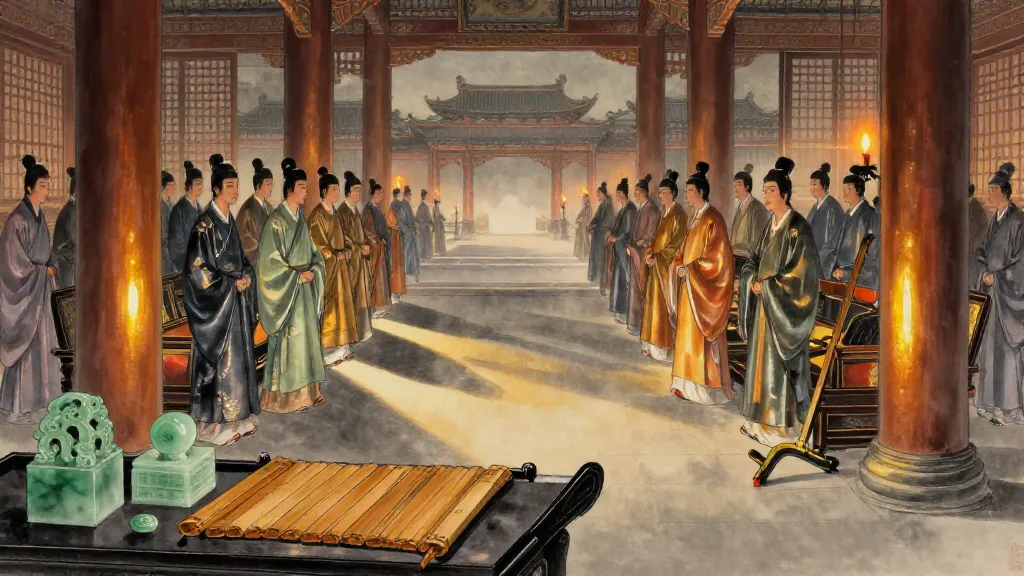
太史公序
The Grand Historian's Preface
太史公讀秦楚之際,曰:初作難,發於陳涉;虐戾滅秦,自項氏;撥亂誅暴,平定海內,卒踐帝祚,成於漢家。五年之間,號令三嬗。自生民以來,未始有受命若斯之亟也。
昔虞、夏之興,積善累功數十年,德洽百姓,攝行政事,考之於天,然後在位。湯、武之王,乃由契、后稷脩仁行義十餘世,不期而會孟津八百諸侯,猶以為未可,其後乃放弒。秦起襄公,章於文、繆,獻、孝之後,稍以蠶食六國,百有餘載,至始皇乃能並冠帶之倫。以德若彼,用力如此,蓋一統若斯之難也。
秦既稱帝,患兵革不休,以有諸侯也,於是無尺土之封,墮壞名城,銷鋒鏑,鉏豪桀,維萬世之安。然王跡之興,起於閭巷,合從討伐,軼於三代,鄉秦之禁,適足以資賢者為驅除難耳。故憤發其所為天下雄,安在無土不王。此乃傳之所謂大聖乎?豈非天哉,豈非天哉!非大聖孰能當此受命而帝者乎?
The Grand Historian, reading of the Qin-Chu transition, says: The first to raise the standard of revolt was Chen She. The brutal destruction of Qin came from the Xiang clan. The restoration of order, the punishment of tyranny, the pacification of the realm, and the final ascent to the imperial throne were accomplished by the House of Han. In the space of five years, supreme power changed hands three times. Since the birth of humanity, never has the Mandate been received with such speed.
In ancient times, when the houses of Yu and Xia rose, they accumulated good works over decades, their virtue pervading the people, serving in regency and testing their fitness before Heaven, and only then taking the throne. When Tang and Wu became kings, the process ran through more than ten generations from Xie and Hou Ji, cultivating humanity and practicing duty. Even when eight hundred lords rallied unsummoned at Mengjin, they still considered the moment premature, and the overthrow came only afterward. Qin began with Duke Xiang, became prominent under Dukes Wen and Mu, and after Dukes Xian and Xiao gradually consumed the Six States by silkworm-nibbling over more than a hundred years — only then could the First Emperor unite the civilized world. With virtue taking that long on one path and force taking that long on another, unification was clearly a matter of extreme difficulty.
Once Qin claimed the imperial title, it worried that warfare would never cease as long as feudal lords existed. So it granted not a foot of land in fief, demolished the famous walled cities, melted down weapons, and weeded out the powerful — all to secure ten thousand generations of peace. Yet the rise of the new dynasty's founder began in the back alleys. The coalition campaigns surpassed those of the Three Dynasties, and all the prohibitions that Qin had devised served only to clear the way for the worthy. Those who rose in righteous fury to become heroes of the world — where was the rule that a man without land could not become king? Is this not what the tradition calls a Great Sage? Was it not Heaven itself? Was it not Heaven itself! Who but a Great Sage could receive the Mandate and become Emperor?
Notes
Chen She (陳涉, also Chen Sheng 陳勝, d. 208 BC) was a laborer who led the first major uprising against the Qin dynasty in 209 BC at Daze Township. Though his rebellion was quickly crushed, it triggered the chain of revolts that destroyed Qin.
The Xiang clan (項氏) refers primarily to Xiang Yu (項羽, 232–202 BC), the warlord from Chu who destroyed the Qin armies, executed the last Qin ruler, and briefly dominated the post-Qin world as Hegemon-King of Western Chu before his defeat by Liu Bang.
The 'three transfers of power' (號令三嬗) in five years refers to: Qin's authority collapsing (209–207 BC), Xiang Yu's brief hegemony (206–202 BC), and Liu Bang's final victory establishing the Han dynasty (202 BC).