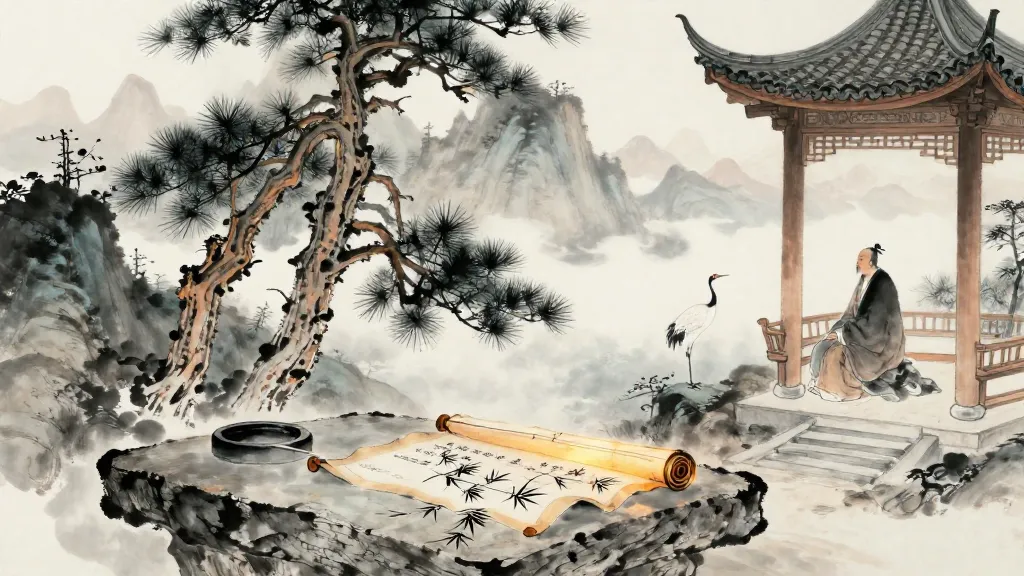
樂書 (Treatise on Music) — Chinese ink painting

Chapter 24 of 130

樂書

Treatise on Music

View:

太史公論樂之本源

The Grand Historian on the Origins of Music

太史公曰:余每讀虞書,至於君臣相敕,維是幾安,而股肱不良,萬事墮壞,未嘗不流涕也。成王作頌,推己懲艾,悲彼家難,可不謂戰戰恐懼,善守善終哉?君子不為約則修德,滿則棄禮,佚能思初,安能惟始,沐浴膏澤而歌詠勤苦,非大德誰能如斯!傳曰「治定功成,禮樂乃興」。海內人道益深,其德益至,所樂者益異。滿而不損則溢,盈而不持則傾。凡作樂者,所以節樂。君子以謙退為禮,以損減為樂,樂其如此也。以為州異國殊,情習不同,故博採風俗,協比聲律,以補短移化,助流政教。天子躬於明堂臨觀,而萬民鹹蕩滌邪穢,斟酌飽滿,以飾厥性。故云雅頌之音理而民正,嘄噭之聲興而士奮,鄭衛之曲動而心淫。及其調和諧合,鳥獸盡感,而況懷五常,含好惡,自然之勢也?

The Grand Historian says: Whenever I read the Documents of Yu and reach the passage where ruler and minister admonish each other — 'only by vigilance is there peace' — and where, if the limbs of state are not good, all affairs crumble and decay, I never fail to weep. When King Cheng composed the Hymns, examining himself and learning from past suffering, grieving over the troubles of his house — can this not be called fearful and trembling, guarding well and ending well? The gentleman who does not grow lax under constraint cultivates virtue; the one who does not discard rites when sated, who in leisure can recall the beginning, who in security can keep the origin in mind, who bathes in abundance yet sings of hardship — who but a person of great virtue could do this! The tradition says: 'When governance is settled and achievements are complete, rites and music arise.' As the Way of humankind deepens within the seas and virtue reaches its fullest expression, the forms of enjoyment become increasingly refined. If fullness is not diminished, it overflows; if surplus is not steadied, it collapses. All music-making exists to regulate pleasure. The gentleman takes modesty and deference as ritual propriety and takes reduction as the essence of music — this is what music is about. Since regions differ and states vary, with different temperaments and customs, the practice is to broadly collect folk ways, harmonize and compare their melodies with the standard pitch-pipes, to remedy shortcomings, shift customs, and help disseminate governance and instruction. The Son of Heaven presides in person at the Hall of Light, and the myriad people are cleansed of all defilement, steeped to fullness, and their natures are refined. Thus when the sounds of the Ya and Song odes are well ordered, the people become upright; when stirring martial cries arise, the warriors are roused; when the tunes of Zheng and Wei play, the heart turns to licentiousness. When music achieves harmony and concord, even birds and beasts are moved — how much more so human beings, who carry within them the five constant virtues and the capacity for like and dislike! This is simply the way of nature.

Notes

1context

This chapter draws extensively from the 'Record of Music' (樂記) section of the Book of Rites (禮記). Like the Treatise on Rites, it blends Sima Qian's historical observations with classical philosophical material.

2context

The 'sounds of Zheng and Wei' (鄭衛之曲) were popular folk songs from the states of Zheng and Wei, widely criticized by Confucians as sexually suggestive and morally corrupting, in contrast to the 'correct' court music of the Ya and Song sections of the Odes.

樂之興衰:先秦至漢

Rise and Fall of Music: Pre-Qin to Han

治道虧缺而鄭音興起,封君世辟,名顯鄰州,爭以相高。自仲尼不能與齊優遂容於魯,雖退正樂以誘世,作五章以剌時,猶莫之化。陵遲以至六國,流沔沈佚,遂往不返,卒於喪身滅宗,並國於秦。

秦二世尤以為娛。丞相李斯進諫曰:「放棄詩書,極意聲色,祖伊所以懼也;輕積細過,恣心長夜,紂所以亡也。」趙高曰:「五帝、三王樂各殊名,示不相襲。上自朝廷,下至人民,得以接歡喜,合殷勤,非此和說不通,解澤不流,亦各一世之化,度時之樂,何必華山之騄耳而後行遠乎?」二世然之。

高祖過沛詩三侯之章,令小兒歌之。高祖崩,令沛得以四時歌鳷宗廟。孝惠、孝文、孝景無所增更,於樂府習常肄舊而已。

至今上即位,作十九章,令侍中李延年次序其聲,拜為協律都尉。通一經之士不能獨知其辭,皆集會五經家,相與共講習讀之,乃能通知其意,多爾雅之文。

漢家常以正月上辛祠太一甘泉,以昏時夜祠,到明而終。常有流星經於祠壇上。使僮男僮女七十人俱歌。春歌青陽,夏歌硃明,秋歌西昚,冬歌玄冥。世多有,故不論。

又嘗得神馬渥窪水中,複次以為太一之歌。曲曰:「太一貢兮天馬下,霑赤汗兮沫流赭。騁容與兮跇萬里,今安匹兮龍為友。」後伐大宛得千里馬,馬名蒲梢,次作以為歌。歌詩曰:「天馬來兮從西極,經萬里兮歸有德。承靈威兮降外國,涉流沙兮四夷服。」中尉汲黯進曰:「凡王者作樂,上以承祖宗,下以化兆民。今陛下得馬,詩以為歌,協於宗廟,先帝百姓豈能知其音邪?」上默然不說。丞相公孫弘曰:「黯誹謗聖制,當族。」

As the Way of governance deteriorated, the music of Zheng rose in its place. Enfeoffed lords and hereditary rulers, famous across neighboring provinces, competed to outdo one another. Confucius himself could not prevent the Qi entertainers from corrupting the court of Lu. Though he withdrew to correct the music and guide the age, composing five chapters to satirize the times, no one was transformed. The decline continued through the Six States era, drifting and sinking into license, proceeding without return, until it ended in the destruction of their persons and the extinction of their ancestral lines, as their states were absorbed by Qin.

The Second Emperor of Qin was especially devoted to amusement. Chancellor Li Si remonstrated: 'To cast aside the Odes and Documents and indulge to the limit in sensual pleasures — this is what made Zu Yi tremble with fear. To make light of accumulating minor faults and give free rein to the heart through long nights — this is why King Zhou perished.' Zhao Gao countered: 'The music of the Five Emperors and Three Kings each had different names, showing that they did not copy from one another. From the court above to the people below, all should be able to share in joy and express devotion. Without this, harmony and goodwill do not circulate, and generosity does not flow. Each age has its own culture, each era its own music. Why insist on the fabled steeds of Mount Hua before traveling far?' The Second Emperor agreed with Zhao Gao.

When Emperor Gaozu passed through Pei, he composed the verse of the Three Marquises and had the local boys sing it. After Gaozu's death, the people of Pei were permitted to sing at the ancestral temple in all four seasons. Emperors Hui, Wen, and Jing made no additions or changes; the Music Bureau simply rehearsed and practiced the old repertoire.

When the current emperor took the throne, he composed the Nineteen Hymns and ordered the Palace Attendant Li Yannian to arrange their musical settings, appointing him Colonel for Harmonizing Pitches. No scholar versed in a single classic could comprehend the lyrics alone; they had to assemble experts in all Five Classics to study and read together before the meaning could be grasped, so rich was the text in archaic Erya-style language.

The Han court regularly performs a sacrifice to the Grand Unity at Ganquan on the first xin-day of the first month, beginning at dusk with a nighttime ceremony that continues until dawn. Shooting stars are regularly seen passing over the sacrificial altar. Seventy boys and girls sing together. In spring they sing 'Green Brightness'; in summer, 'Vermilion Radiance'; in autumn, 'Western Dusk'; in winter, 'Dark Mystery.' These songs are widely available and need not be discussed here.

Once a divine horse was obtained from the waters of Wowa, and a song to the Grand Unity was composed for the occasion. The lyrics say: 'The Grand Unity presents his tribute — a heavenly horse descends! Drenched in red sweat, its foam runs russet. Galloping at ease, it leaps ten thousand li. What now is its match? Only the dragon is its friend.' Later, after the campaign against Dayuan, a horse capable of a thousand li per day was obtained, named Pushao, and another song was composed. The lyrics say: 'The heavenly horse comes from the far west! Traveling ten thousand li, it returns to the virtuous. Bearing divine power, it descends upon foreign lands. Crossing the flowing sands, the four barbarian peoples submit.' The Palace Commandant Ji An protested: 'When a king composes music, it should serve the ancestors above and transform the myriad people below. Now Your Majesty obtains a horse and turns it into a song for the ancestral temple — could the former emperors or the common people possibly understand such music?' The emperor sat in silence, displeased. Chancellor Gongsun Hong said: 'Ji An slanders the sacred institutions. He should be executed along with his entire clan.'

Notes

1person李延年Lǐ Yánnián

Li Yannian (李延年, d. c. 87 BC) was a court musician of exceptional talent under Emperor Wu. His sister, Lady Li, became one of the emperor's favorite consorts. Li Yannian was later executed in the political purges of Emperor Wu's final years.

2person汲黯Jí Àn

Ji An (汲黯, d. 112 BC) was a famously blunt and outspoken official under Emperor Wu, one of the few who dared criticize the emperor to his face. Emperor Wu compared him to an unbending minister of ancient times.

3context

The 'heavenly horses' (天馬) of Dayuan (大宛, in the Fergana Valley of modern Uzbekistan) were the famous 'blood-sweating' horses that Emperor Wu coveted. He launched a massive and costly military expedition in 104–101 BC to obtain them.

樂記:聲音之道

Record of Music: The Way of Sound

凡音之起,由人心生也。人心之動,物使之然也。感於物而動,故形於聲;聲相應,故生變;變成方,謂之音;比音而樂之,及乾戚羽旄,謂之樂也。樂者,音之所由生也,其本在人心感於物也。是故其哀心感者,其聲噍以殺;其樂心感者,其聲嘽以緩;其喜心感者,其聲發以散;其怒心感者,其聲粗以厲;其敬心感者,其聲直以廉;其愛心感者,其聲和以柔。六者非性也,感於物而後動,是故先王慎所以感之。故禮以導其志,樂以和其聲,政以壹其行,刑以防其奸。禮樂刑政,其極一也,所以同民心而出治道也。

All sound arises from the human heart. The stirring of the human heart is caused by external things. Stirred by things, the heart moves, and this takes shape as sound. When sounds respond to each other, they produce variations. When variations form patterns, they are called music-tones. When tones are arranged for enjoyment and combined with shields, axes, plumes, and pennants, this is called music. Music is what arises from tones, and its root lies in the human heart being moved by things. Thus when the heart is stirred by grief, the sound is sharp and fading. When stirred by joy, the sound is broad and slow. When stirred by delight, the sound is bright and scattered. When stirred by anger, the sound is rough and fierce. When stirred by reverence, the sound is straight and clear. When stirred by love, the sound is gentle and soft. These six are not innate dispositions but responses to being moved by things. For this reason the former kings were careful about what moved the heart. Rites guide the will; music harmonizes the voice; government unifies conduct; punishments prevent wrongdoing. Rites, music, punishments, and government all reach toward the same goal: to unify the hearts of the people and to bring forth the Way of governance.

Notes

1context

This passage, and much of what follows in this chapter, is taken nearly verbatim from the 'Record of Music' (樂記) in the Book of Rites. It represents the classical Confucian theory of music as a tool of governance that shapes the emotional and moral character of the people.

樂記:治世亂世之音

Record of Music: Music of Order and Chaos

凡音者,生人心者也。情動於中,故形於聲,聲成文謂之音。是故治世之音安以樂,其正和;亂世之音怨以怒,其正乖;亡國之音哀以思,其民困。聲音之道,與正通矣。宮為君,商為臣,角為民,徵為事,羽為物。五者不亂,則無怗懘之音矣。宮亂則荒,其君驕;商亂則搥,其臣壞;角亂則憂,其民怨;徵亂則哀,其事勤;羽亂則危,其財匱。五者皆亂,迭相陵,謂之慢。如此則國之滅亡無日矣。鄭衛之音,亂世之音也,比於慢矣。桑間濮上之音,亡國之音也,其政散,其民流,誣上行私而不可止。

All sound is born from the human heart. When emotion stirs within, it takes shape as sound. When sound achieves pattern, it is called music-tone. The music of a well-governed age is peaceful and joyful — its governance is harmonious. The music of a disordered age is resentful and angry — its governance is perverse. The music of a doomed state is mournful and brooding — its people are in distress. The Way of sound and music connects directly to governance. The gong pitch represents the ruler; the shang pitch, the minister; the jue pitch, the people; the zhi pitch, affairs; the yu pitch, resources. When these five are not confused, there is no discordant sound. If gong is disordered, the sound is dissolute — the ruler is arrogant. If shang is disordered, the sound is deviant — the ministers are corrupt. If jue is disordered, the sound is anxious — the people are resentful. If zhi is disordered, the sound is mournful — public affairs are overburdened. If yu is disordered, the sound is precarious — resources are depleted. If all five are disordered, each encroaching on the others, this is called disintegration. When this happens, the destruction of the state is imminent. The music of Zheng and Wei is the music of a disordered age — it approaches disintegration. The music of Sangian and the banks of the Pu is the music of a doomed state: its governance is scattered, its people drift, they deceive their superiors and pursue private interests, and nothing can stop them.

Notes

1context

The five-pitch political correspondence (宮=君, 商=臣, 角=民, 徵=事, 羽=物) is a central doctrine of Chinese musical cosmology. Each pitch of the pentatonic scale maps to a domain of governance, so that disorder in music signals disorder in the state.

2place

Sangian and the banks of the Pu (桑間濮上) refers to the area between Sangian and the Pu River in the state of Wei (modern Puyang, Henan), notorious for its licentious folk songs. The 'music of Pu' became shorthand for morally corrupting music.

樂記:禮樂之大義

Record of Music: The Grand Principles of Rites and Music

樂者為同,禮者為異。同則相親,異則相敬。樂勝則流,禮勝則離。合情飾貌者,禮樂之事也。禮義立,則貴賤等矣;樂文同,則上下和矣;好惡著,則賢不肖別矣;刑禁暴,爵舉賢,則政均矣。仁以愛之,義以正之,如此則民治行矣。

樂由中出,禮自外作。樂由中出,故靜;禮自外作,故文。大樂必易,大禮必簡。樂至則無怨,禮至則不爭。揖讓而治天下者,禮樂之謂也。暴民不作,諸侯賓服,兵革不試,五刑不用,百姓無患,天子不怒,如此則樂達矣。合父子之親,明長幼之序,以敬四海之內。天子如此,則禮行矣。

大樂與天地同和,大禮與天地同節。和,故百物不失;節,故祀天祭地。明則有禮樂,幽則有鬼神,如此則四海之內合敬同愛矣。

Music creates unity; rites create distinction. Unity leads to mutual affection; distinction leads to mutual respect. If music predominates, there is dissolution; if rites predominate, there is alienation. To join feeling with an ordered appearance — this is the work of rites and music together. When rites and duty are established, noble and base find their proper grade. When the civilizing power of music creates unity, high and low are in harmony. When likes and dislikes are clearly expressed, the worthy and the unworthy are distinguished. When punishments restrain the violent and ranks elevate the worthy, governance is equitable. Humanity gives love; duty gives rectitude. When this is so, the people's conduct is well ordered.

Music emerges from within; rites are fashioned from without. Because music emerges from within, it is tranquil. Because rites are fashioned from without, they are patterned. The greatest music is necessarily simple; the greatest rites are necessarily plain. When music reaches its fullness, there is no resentment; when rites reach their fullness, there is no contention. To govern all under Heaven through bowing and yielding — this is what rites and music accomplish. When violent people do not arise, when feudal lords serve as loyal guests, when weapons are not tested, when the five punishments are not applied, when the common people are free from worry, and when the Son of Heaven has no cause for anger — then music has achieved its purpose. When the bonds of father and son are united, when the order of elder and younger is clear, and when respect pervades the four seas — then the Son of Heaven has made rites a reality.

The greatest music shares harmony with Heaven and Earth; the greatest rites share rhythm with Heaven and Earth. Through harmony, the hundred things are not lost; through rhythm, sacrifices to Heaven and Earth are made. In the visible realm there are rites and music; in the invisible realm there are spirits and gods. When this is so, the four seas are united in reverence and joined in love.

魏文侯問樂與師曠故事

Marquis Wen of Wei's Question About Music and the Story of Music Master Kuang

魏文侯問於子夏曰:「吾端冕而聽古樂則唯恐臥,聽鄭衛之音則不知倦。敢問古樂之如彼,何也?新樂之如此,何也?」

子夏答曰:「今夫古樂,進旅而退旅,和正以廣,弦匏笙簧合守拊鼓,始奏以文,止亂以武,治亂以相,訊疾以雅。君子於是語,於是道古,修身及家,平均天下:此古樂之發也。今夫新樂,進俯退俯,奸聲以淫,溺而不止,及優侏儒,雜子女,不知父子。樂終不可以語,不可以道古:此新樂之發也。今君之所問者樂也,所好者音也。夫樂之與音,相近而不同。」

Marquis Wen of Wei asked Zixia: "When I put on my formal cap and robes and listen to the ancient music, I can barely keep from falling asleep. But when I listen to the tunes of Zheng and Wei, I never grow tired. May I ask: why is the ancient music like that, and the new music like this?"

Zixia answered: "In the ancient music, the performers advance together and retire together. The sound is harmonious, correct, and expansive. Strings, gourds, mouth-organs, and reed-pipes all keep time with the hand-drum. The piece begins with the civil movement and ends with the martial finale. It is governed by the wooden clapper and paced by the ya measure. The gentleman uses the occasion to converse, to speak of the past, to cultivate his person, to order his household, and to bring equity to all under Heaven. This is what ancient music expresses. In the new music, the performers bob forward and bow backward. The sounds are seductive and licentious, drowning the listener without end. Jesters and dwarfs mix with men and women who no longer know the distinction between father and son. When the music ends, nothing can be discussed, nothing of the past can be spoken of. This is what the new music expresses. What you have asked about is true music; what you actually enjoy is mere sound. Music and sound are close to each other but not the same."

Notes

1person魏文侯Wèi Wén Hóu

Marquis Wen of Wei (魏文侯, r. 445–396 BC) was the founder of the state of Wei (魏) after the partition of Jin. He was renowned as one of the most capable rulers of the early Warring States period, patronizing scholars and reforming governance.

2person子夏Zǐxià

Zixia (子夏, also Bu Shang 卜商, 507–? BC) was one of Confucius's leading disciples, known for his literary scholarship. He later became a teacher in the state of Wei (魏) and reportedly instructed Marquis Wen.

師曠鼓琴

Music Master Kuang Plays the Zither

而衛靈公之時,將之晉,至於濮水之上舍。夜半時聞鼓琴聲,問左右,皆對曰「不聞」。乃召師涓曰:「吾聞鼓琴音,問左右,皆不聞。其狀似鬼神,為我聽而寫之。」師涓曰:「諾。」因端坐援琴,聽而寫之。明日,曰:「臣得之矣,然未習也,請宿習之。」靈公曰:「可。」因復宿。明日,報曰:「習矣。」即去之晉,見晉平公。平公置酒於施惠之台。酒酣,靈公曰:「今者來,聞新聲,請奏之。」平公曰:「可。」即令師涓坐師曠旁,援琴鼓之。未終,師曠撫而止之曰:「此亡國之聲也,不可遂。」平公曰:「何道出?」師曠曰:「師延所作也。與紂為靡靡之樂,武王伐紂,師延東走,自投濮水之中,故聞此聲必於濮水之上,先聞此聲者國削。」平公曰:「寡人所好者音也,原遂聞之。」師涓鼓而終之。

平公曰:「音無此最悲乎?」師曠曰:「有。」平公曰:「可得聞乎?」師曠曰:「君德義薄,不可以聽之。」平公曰:「寡人所好者音也,原聞之。」師曠不得已,援琴而鼓之。一奏之,有玄鶴二八集乎廊門;再奏之,延頸而鳴,舒翼而舞。

平公大喜,起而為師曠壽。反坐,問曰:「音無此最悲乎?」師曠曰:「有。昔者黃帝以大合鬼神,今君德義薄,不足以聽之,聽之將敗。」平公曰:「寡人老矣,所好者音也,原遂聞之。」師曠不得已,援琴而鼓之。一奏之,有白雲從西北起;再奏之,大風至而雨隨之,飛廊瓦,左右皆奔走。平公恐懼,伏於廊屋之間。晉國大旱,赤地三年。

聽者或吉或凶。夫樂不可妄興也。

In the time of Duke Ling of Wei, when he was traveling to Jin, he lodged by the Pu River. At midnight he heard the sound of a zither being played. He asked his attendants, and all said they heard nothing. He summoned his music master Shi Juan and said: "I hear zither music. I asked my attendants and none of them heard it. It seems to be the work of spirits. Listen and transcribe it for me." Shi Juan said: "Very well." He sat upright, took up his zither, and listened and transcribed. The next day he said: "I have it, but I have not yet practiced. Allow me one more night to rehearse." Duke Ling said: "You may." They stayed another night. The next day Shi Juan reported: "I have mastered it." They then proceeded to Jin and were received by Duke Ping of Jin, who gave a banquet at the Terrace of Bestowed Favor. When the wine was flowing freely, Duke Ling said: "On my journey here I heard a new piece. Please allow it to be performed." Duke Ping said: "By all means." Shi Juan was seated beside Music Master Kuang and began to play. Before he finished, Master Kuang pressed his hand down to stop him and said: "This is the sound of a doomed state. You must not continue." Duke Ping asked: "Where does it come from?" Master Kuang said: "It was composed by Music Master Yan. He created dissolute music for King Zhou of Shang. When King Wu conquered Zhou, Master Yan fled east and threw himself into the Pu River. Therefore this music can only be heard above the Pu River. The first to hear it will see his state diminished." Duke Ping said: "What I love is music. Let me hear it to the end." Shi Juan played to the finish.

Duke Ping asked: "Is there any music sadder than this?" Master Kuang said: "There is." Duke Ping asked: "May I hear it?" Master Kuang said: "Your virtue is too thin. You should not listen to it." Duke Ping said: "What I love is music. Let me hear it." Master Kuang had no choice. He took up his zither and played. At the first strain, sixteen black cranes gathered at the corridor gate. At the second strain, they stretched their necks and cried, spread their wings and danced.

Duke Ping was overjoyed. He rose and toasted Master Kuang. Returning to his seat, he asked: "Is there any music sadder than this?" Master Kuang said: "There is. In ancient times the Yellow Emperor used it in the great assembly of spirits and gods. But your virtue is too thin — you are not worthy to hear it. If you hear it, there will be calamity." Duke Ping said: "I am old now. What I love is music. Let me hear it." Master Kuang had no choice. He took up his zither and played. At the first strain, white clouds rose from the northwest. At the second strain, a great wind arrived and rain followed it, blowing tiles from the corridors as the attendants fled in all directions. Duke Ping cowered in terror between the corridor buildings. The state of Jin suffered a great drought, and the earth was scorched bare for three years.

What one hears may bring fortune or disaster. Music must not be recklessly performed.

Notes

1person師曠Shī Kuàng

Music Master Kuang (師曠) was the blind court musician of Duke Ping of Jin (晉平公, r. 557–532 BC), legendary for his extraordinary musical sensitivity. He could discern the moral quality of music and its political implications through sound alone.

太史公總論與贊

The Grand Historian's Summary and Eulogy

太史公曰:夫上古明王舉樂者,非以娛心自樂,快意恣欲,將欲為治也。正教者皆始於音,音正而行正。故音樂者,所以動盪血脈,通流精神而和正心也。故宮動脾而和正聖,商動肺而和正義,角動肝而和正仁,徵動心而和正禮,羽動腎而和正智。故樂所以內輔正心而外異貴賤也;上以事宗廟,下以變化黎庶也。琴長八尺一寸,正度也。弦大者為宮,而居中央,君也。商張右傍,其餘大小相次,不失其次序,則君臣之位正矣。故聞宮音,使人溫舒而廣大;聞商音,使人方正而好義;聞角音,使人惻隱而愛人;聞徵音,使人樂善而好施;聞羽音,使人整齊而好禮。夫禮由外入,樂自內出。故君子不可須臾離禮,須臾離禮則暴慢之行窮外;不可須臾離樂,須臾離樂則奸邪之行窮內。故樂音者,君子之所養義也。夫古者,天子諸侯聽鐘磬未嘗離於庭,卿大夫聽琴瑟之音未嘗離於前,所以養行義而防淫佚也。夫淫佚生於無禮,故聖王使人耳聞雅頌之音,目視威儀之禮,足行恭敬之容,口言仁義之道。故君子終日言而邪辟無由入也。

樂之所興,在乎防欲。陶心暢志,舞手蹈足。舜曰簫韶,融稱屬續。審音知政,觀風變俗。端如貫珠,清同叩玉。洋洋盈耳,鹹英餘曲。

The Grand Historian says: When the enlightened kings of high antiquity employed music, it was not for amusement and self-indulgence, not to gratify desire. Their purpose was governance. All correct instruction begins with sound: when sound is correct, conduct becomes correct. Music stirs the blood, circulates the vital spirit, and harmonizes the heart. The gong pitch activates the spleen and harmonizes sagacity; the shang pitch activates the lungs and harmonizes duty; the jue pitch activates the liver and harmonizes humanity; the zhi pitch activates the heart and harmonizes propriety; the yu pitch activates the kidneys and harmonizes wisdom. Thus music internally supports the rectification of the heart and externally distinguishes noble from base. Above it serves the ancestral temple; below it transforms the common people. The zither is eight feet and one inch long — this is the standard measure. The thickest string is gong, placed in the center — representing the ruler. Shang is strung to its right, and the rest follow in order of thickness. When they do not lose their proper sequence, the positions of ruler and minister are correct. Hearing the gong tone makes a person warm, open, and magnanimous. Hearing shang makes a person upright and devoted to duty. Hearing jue makes a person compassionate and caring. Hearing zhi makes a person delighted in goodness and inclined to give. Hearing yu makes a person orderly and devoted to propriety. Rites enter from without; music emerges from within. The gentleman must never be separated from rites even for an instant — to be separated from rites for an instant is to expose oneself to brutal and disrespectful conduct. He must never be separated from music even for an instant — to be separated from music for an instant is to expose oneself to treacherous and deviant behavior. Music is what the gentleman uses to nourish duty. In ancient times, the Son of Heaven and the feudal lords never left the sound of bells and chime-stones absent from their courtyards; ministers and grand masters never left the sound of zither and lute absent from before them. This nourished righteous conduct and guarded against license. License is born of the absence of rites. Therefore the sage kings ensured that people's ears heard the sounds of the Ya and Song odes, their eyes saw the ceremonies of dignified propriety, their feet walked in the postures of respect, and their mouths spoke the words of humanity and duty. Thus the gentleman could speak all day long, and depravity had no way in.

The rise of music lies in restraining desire. It molds the heart and frees the will; the hands dance and the feet stamp. Shun spoke of the Xiao and Shao; Zhu Rong spoke of Shu and Xu. Examine the music and know the governance; observe the customs and transform the folkways. Measured like threaded pearls, clear as the striking of jade. Abundant and full to the ear — the strains of the Xian and Ying still echo.

Notes

1context

The correspondence between the five pitches and the five organs (宮-脾, 商-肺, 角-肝, 徵-心, 羽-腎) reflects Han-dynasty medical and cosmological theory that music could directly affect bodily health through resonance with specific organs.

Edition & Source

Text
《史記》 Shiji
Edition
中華古詩文古書籍網 transcription
Commentary
裴駰《史記集解》、司馬貞《史記索隱》、張守節《史記正義》(Three Commentaries)