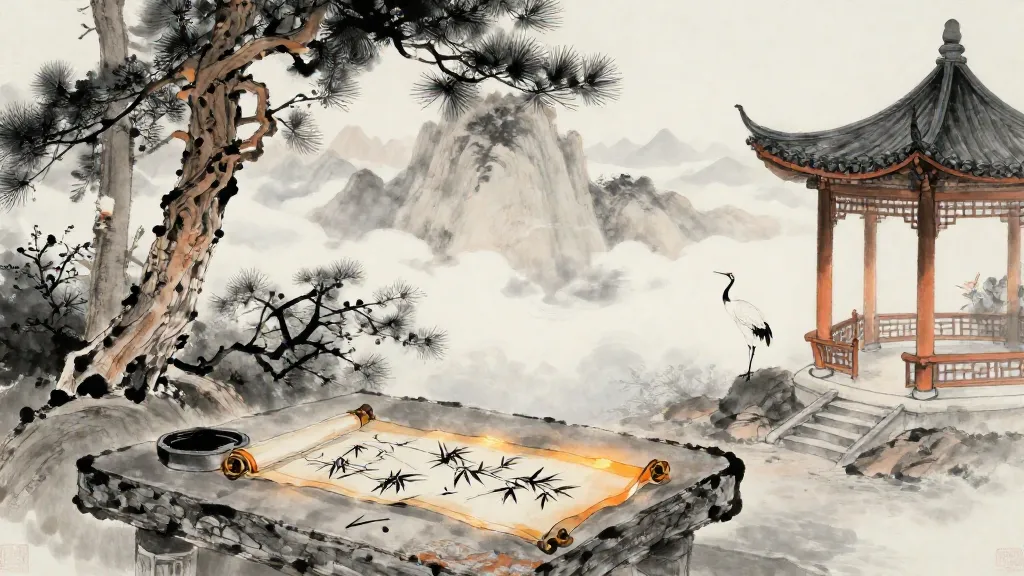
封禪書(下) (Treatise on the Feng and Shan Sacrifices — Part 2: Emperor Wu's Quest for Immortality) — Chinese ink painting

Chapter 28 of 130

封禪書(下)

Treatise on the Feng and Shan Sacrifices — Part 2: Emperor Wu's Quest for Immortality

View:

方士李少君與求仙之始

The Magician Li Shaojun and the Beginning of the Quest for Immortality

今天子初即位,尤敬鬼神之祀。

是時李少君亦以祠灶、穀道、卻老方見上,上尊之。少君者,故深澤侯舍人,主方。少君言上曰:「祠灶則致物,致物而丹沙可化為黃金,黃金成以為飲食器則益壽,益壽而海中蓬萊仙者乃可見,見之以封禪則不死,黃帝是也。「

居久之,李少君病死。天子以為化去不死,而使黃錘史寬舒受其方。求蓬萊安期生莫能得,而海上燕齊怪迂之方士多更來言神事矣。

When the present Emperor first ascended the throne, he was especially devoted to the worship of spirits and deities.

At that time Li Shaojun presented himself to the Emperor with methods for sacrificing to the stove-god, the grain-path diet, and techniques for reversing aging. The Emperor honored him. Li Shaojun had formerly been a retainer of the Marquis of Shenze, specializing in occult methods. He told the Emperor: 'Sacrifice to the stove-god, and rare substances will be attracted. Once attracted, cinnabar can be transmuted into gold. Make this gold into eating and drinking vessels and your lifespan will increase. With increased lifespan, the immortals of Penglai in the sea can be met. After meeting them, perform the Feng and Shan sacrifices and you will never die — as the Yellow Emperor did.'

After a long time, Li Shaojun fell ill and died. The Emperor believed he had transformed and departed rather than truly dying, and sent Huang Chui and the historian Kuan Shu to study his methods. The search for Penglai and Anqi Sheng yielded nothing, but the fantastic and eccentric magicians from the coasts of Yan and Qi came in ever greater numbers to speak of divine matters.

Notes

1context

This section documents Emperor Wu's decades-long obsession with achieving immortality through alchemical and shamanistic practices. The 'magicians' (方士, fangshi) were itinerant practitioners who promised transmutation of metals, elixirs of immortality, and communication with spirits. Emperor Wu spent enormous resources on their schemes.

2place

Penglai (蓬萊) was one of three mythical islands (with Fangzhang and Yingzhou) believed to exist in the Eastern Sea, inhabited by immortals. Multiple expeditions were sent but none succeeded.

武帝封禪泰山

Emperor Wu Performs the Feng and Shan on Mount Tai

自得寶鼎,上與公卿諸生議封禪。封禪用希曠絕,莫知其儀禮,而群儒采封禪尚書、周官、王制之望祀射牛事。上為封禪祠器示群儒,群儒或曰「不與古同「。上為封禪祠器示群儒,群儒或曰「不與古同「,徐偃又曰「太常諸生行禮不如魯善「,周霸屬圖封禪事,於是上絀偃、霸,而盡罷諸儒不用。

三月,遂東幸緱氏,禮登中嶽太室。從官在山下聞若有言「萬歲「雲。問上,上不言;問下,下不言。於是以三百戶封太室奉祠,命曰崇高邑。東上泰山,泰山之草木葉未生,乃令人上石立之泰山巔。

四月,還至奉高。上念諸儒及方士言封禪人人殊,不經,難施行。天子至梁父,禮祠地主。乙卯,令侍中儒者皮弁薦紳,射牛行事。封泰山下東方,如郊祠太一之禮。封廣丈二尺,高九尺,其下則有玉牒書,書祕。禮畢,天子獨與侍中奉車子侯上泰山,亦有封。其事皆禁。明日,下陰道。丙辰,禪泰山下阯東北肅然山,如祭后土禮。天子皆親拜見,衣上黃而盡用樂焉。

After obtaining the precious tripod, the Emperor and his ministers and scholars deliberated on the Feng and Shan. The rites had been so rarely performed as to have been virtually discontinued, and no one knew the proper ceremonies. The assembled Confucians drew on the Shangshu, Rites of Zhou, and Royal Regulations regarding the rites of gazing sacrifice and the ox-shooting ceremony. The Emperor showed the assembled scholars the ritual vessels he had prepared for the Feng and Shan, but some said they did not match ancient precedent. Xu Yan said the Imperial Academy scholars performed the rites less well than the men of Lu; Zhou Ba compiled illustrated plans for the Feng and Shan. The Emperor dismissed Yan and Ba and entirely discharged the Confucians, making no further use of them.

In the third month, he traveled east to Goushi and ritually ascended the Central Peak, Mount Taishi. Officials at the base of the mountain heard what sounded like a voice saying 'Ten thousand years!' They asked the Emperor — he said nothing. They asked the attendants below — none spoke. The Emperor enfeoffed 300 households to maintain the temple of Mount Taishi and named the settlement Chonggao. He then ascended Mount Tai to the east. The grass and trees of Mount Tai had not yet leafed out, so he had workers carry stones up and erect them on the summit.

In the fourth month, he returned to Fenggao. Reflecting that the Confucians and magicians each described the Feng and Shan differently, with their proposals unorthodox and impractical, the Emperor went to Liangfu and ritually sacrificed to the Earth Lord. On the yimao day, he ordered his Confucian attendants in leather caps and sash-robes to shoot the ox and conduct the ceremony. The Feng was performed at the eastern base of Mount Tai, following the rites of the suburban sacrifice to the Great Unity. The altar was twelve feet wide and nine feet high, with jade tablets inscribed below — their contents were kept secret. After the ceremony, the Emperor ascended Mount Tai accompanied only by his personal attendant and the Chariot-Attender Zihou. There was a further sealed offering at the summit. All these matters were kept strictly secret. The next day, he descended by the north path. On the bingchen day, the Shan was performed at Mount Suran, northeast of Mount Tai's base, following the rites for the Earth Empress. The Emperor personally made obeisance at all, wearing yellow garments and employing full musical accompaniment throughout.

Notes

1context

Emperor Wu's Feng and Shan sacrifice at Mount Tai in 110 BC was the first such ceremony in nearly a millennium. The secrecy surrounding the sealed jade tablets (玉牒書) fueled speculation for centuries about what promises the Emperor made to Heaven — presumably a petition for immortality.

太史公論封禪

The Grand Historian's Assessment

今天子所興祠,太一、后土,三年親郊祠,建漢家封禪,五年一脩封。而方士之候祠神人,入海求蓬萊,終無有驗。而公孫卿之候神者,猶以大人之跡為解,無有效。天子益怠厭方士之怪迂語矣,然羈縻不絕,冀遇其真。自此之後,方士言神祠者彌眾,然其效可睹矣。

太史公曰:余從巡祭天地諸神名山川而封禪焉。入壽宮侍祠神語,究觀方士祠官之意,於是退而論次自古以來用事於鬼神者,具見其表里。後有君子,得以覽焉。若至俎豆珪幣之詳,獻酬之禮,則有司存。

The present Emperor has established the worship of the Great Unity and the Earth Empress, personally performing the suburban sacrifice every three years. He established the Han house's Feng and Shan tradition, renewing the sealed altar every five years. Yet the magicians who kept watch and sacrificed to divine beings, and who entered the sea searching for Penglai, never produced any verification. Gongsun Qing, who watched for divine beings, could only explain away the lack of results by pointing to giant footprints. The Emperor grew increasingly weary and disgusted with the magicians' fantastical nonsense — yet he kept them in tow, hoping to encounter the genuine article. From this point on, magicians speaking of divine shrines multiplied, but their results were plain to see.

The Grand Historian remarks: I accompanied the Emperor on his tours sacrificing to the gods of Heaven and Earth, to the famous mountains and rivers, and to the Feng and Shan. I entered the Shougong Palace and attended the spirit-speech ceremonies. I thoroughly observed the intentions of the magicians and sacrificial officials. Upon returning, I arranged and assessed all those who from ancient times to the present have engaged in the worship of ghosts and spirits, setting forth both their external claims and inner realities. Those gentlemen who come after may review this record. As for the details of the ritual vessels, jade offerings, and the protocols of presentation and reception, the officials in charge possess those records.

Notes

1context

Sima Qian's conclusion is a masterpiece of understated criticism. As a participant-observer, he catalogues Emperor Wu's obsession with immortality without directly condemning it, letting the accumulated evidence of fraud and failure speak for itself. The phrase 'their results were plain to see' (其效可睹矣) is devastatingly ironic.

Edition & Source

Text
《史記》 Shiji
Edition
中華古詩文古書籍網 transcription
Commentary
裴駰《史記集解》、司馬貞《史記索隱》、張守節《史記正義》(Three Commentaries)