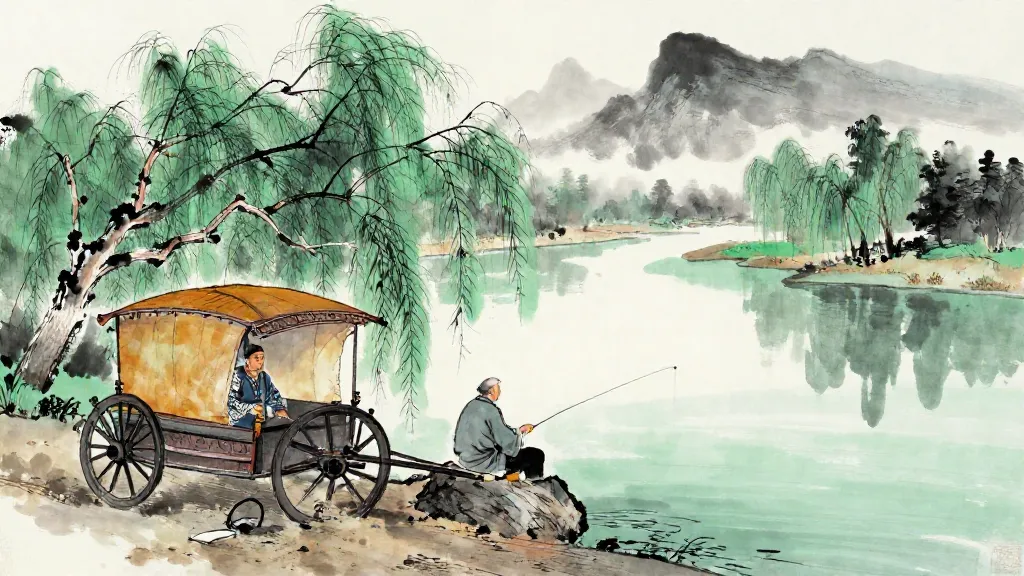
齊太公世家 (Hereditary House of Qi — The Grand Duke) — Chinese ink painting

Chapter 32 of 130

齊太公世家

Hereditary House of Qi — The Grand Duke

View:

太公望佐周

The Grand Duke Assists Zhou

太公望呂尚者,東海上人。其先祖嘗為四岳,佐禹平水土甚有功。虞夏之際封於呂,或封於申,姓姜氏。夏商之時,申、呂或封枝庶子孫,或為庶人,尚其後苗裔也。本姓姜氏,從其封姓,故曰呂尚。

呂尚蓋嘗窮困,年老矣,以漁釣奸周西伯。西伯將出獵,卜之,曰「所獲非龍非 ,非虎非羆;所獲霸王之輔」。於是周西伯獵,果遇太公於渭之陽,與語大說,曰:「自吾先君太公曰『當有聖人適周,周以興』。子真是邪?吾太公望子久矣。」故號之曰「太公望」,載與俱歸,立為師。

或曰,太公博聞,嘗事紂。紂無道,去之。遊說諸侯,無所遇,而卒西歸周西伯。或曰,呂尚處士,隱海濱。周西伯拘羑里,散宜生、閎夭素知而招呂尚。呂尚亦曰「吾聞西伯賢,又善養老,盍往焉」。三人者為西伯求美女奇物,獻之於紂,以贖西伯。西伯得以出,反國。言呂尚所以事周雖異,然要之為文武師。

The Grand Duke, Lü Shang, was a man from the shores of the Eastern Sea. His remote ancestors had once served as the Four Peaks and assisted Yu the Great in taming the floods and ordering the land, winning great merit. During the Shun-to-Xia transition, his line was enfeoffed at Lü — or, some say, at Shen — and bore the surname Jiang. Through the Xia and Shang dynasties, the houses of Shen and Lü sometimes enfeoffed junior branches of descendants, and sometimes their members fell to commoner status. Shang was a later descendant of this line. His original surname was Jiang, but he took the surname of his fief, hence "Lü Shang."

Lü Shang had long been poor and obscure. Now old, he went fishing on the Wei River to seek an encounter with the Lord of the West of Zhou. The Lord of the West was about to go hunting and had the divination performed. The oracle said: "What you will catch is neither dragon nor serpent, neither tiger nor bear — what you will catch is an aide fit for a hegemon-king." The Lord of the West went hunting and indeed met the Grand Duke on the north bank of the Wei. He conversed with him and was greatly pleased, saying: "My late ancestor, the Grand Duke, once said, 'A sage will come to Zhou, and Zhou will rise through him.' Are you truly that man? My Grand Duke has awaited you for a long time." He therefore called him "Grand Duke's Hope" (Taigong Wang), took him in his carriage, and returned with him, installing him as his Teacher.

Another account says that the Grand Duke was a man of wide learning who once served King Zhou of Shang. Finding Zhou lawless, he left him and traveled among the lords offering counsel, but met with no success, and at last went west to the Lord of the West of Zhou. Yet another account says that Lü Shang was a reclusive scholar living by the sea. When the Lord of the West was imprisoned at Youli, San Yisheng and Hong Yao, who had long known of Lü Shang, summoned him. Lü Shang himself said, "I hear the Lord of the West is a worthy man who treats the elderly well — why not go to him?" The three men sought out beautiful women and rare treasures for the Lord of the West and presented them to King Zhou to ransom him. The Lord of the West was released and returned to his state. Though the accounts of how Lü Shang came to serve Zhou differ, all agree that he became the Teacher of Kings Wen and Wu.

Notes

1person呂尚Lǚ Shàng

Lü Shang (呂尚), also known as Jiang Ziya (姜子牙) or Taigong Wang (太公望), is one of the most celebrated figures in Chinese history. He served as chief strategist to Kings Wen and Wu of Zhou and was instrumental in the overthrow of the Shang dynasty, c. 1046 BC. Later tradition credited him with authoring the Six Secret Teachings (六韜), a foundational military text.

2context

The Four Peaks (四岳) were legendary officials under Emperor Yao and Emperor Shun who helped Yu the Great control the great floods. The Jiang surname clan traced its ancestry to this line.

3person周文王Zhōu Wén Wáng

The Lord of the West (西伯) is King Wen of Zhou (周文王, Ji Chang 姬昌, r. c. 1099–1050 BC), father of King Wu. He was posthumously titled 'King Wen' (文王, the Cultured King) after the Zhou conquest.

4place

The Wei River (渭水) flows through modern Shaanxi province past Xi'an. The traditional site of the Grand Duke's fishing is at Panxi (磻溪), near modern Baoji, Shaanxi.

5translation

太公望 literally means 'the Grand Duke's hope/expectation.' The 'Grand Duke' (太公) here refers to King Wen's ancestor, the Ancient Duke Danfu (古公亶父). The name became Lü Shang's epithet.

6place

Youli (羑里) was a Shang prison in modern Tangyin County, Henan, where King Wen was imprisoned by King Zhou of Shang. Tradition holds that King Wen composed the Changes (易) commentaries during his imprisonment.

文王謀商與武王伐紂

King Wen's Plotting Against Shang and King Wu's Conquest

周西伯昌之脫羑里歸,與呂尚陰謀修德以傾商政,其事多兵權與奇計,故後世之言兵及周之陰權皆宗太公為本謀。周西伯政平,及斷虞芮之訟,而詩人稱西伯受命曰文王。伐崇、密須、犬夷,大作豐邑。天下三分,其二歸周者,太公之謀計居多。

文王崩,武王即位。九年,欲修文王業,東伐以觀諸侯集否。師行,師尚父左杖黃鉞,右把白旄以誓,曰:「蒼兕蒼兕,總爾眾庶,與爾舟楫,後至者斬!」遂至盟津。諸侯不期而會者八百諸侯。諸侯皆曰:「紂可伐也。」武王曰:「未可。」還師,與太公作此太誓。

居二年,紂殺王子比干,囚箕子。武王將伐紂,卜,龜兆不吉,風雨暴至。群公盡懼,唯太公彊之勸武王,武王於是遂行。十一年正月甲子,誓於牧野,伐商紂。紂師敗績。紂反走,登鹿台,遂追斬紂。明日,武王立於社,群公奉明水,衛康叔封布采席,師尚父牽牲,史佚策祝,以告神討紂之罪。散鹿台之錢,發鉅橋之粟,以振貧民。封比干墓,釋箕子囚。遷九鼎,脩周政,與天下更始。師尚父謀居多。

When the Lord of the West, Chang, escaped Youli and returned home, he and Lü Shang secretly plotted to cultivate virtue and undermine Shang rule. Their work involved much military strategy and unorthodox planning, and so later generations who discussed warfare and the covert statecraft of Zhou all traced these arts back to the Grand Duke as their originator. The Lord of the West governed with even-handedness — he even adjudicated the dispute between Yu and Rui — and the poets declared that the Lord of the West had received Heaven's Mandate, calling him King Wen. He attacked Chong, Mixu, and the Quanyi, and built the great capital at Feng. Two-thirds of the realm came over to Zhou, and the Grand Duke's stratagems were largely responsible.

King Wen died and King Wu succeeded him. In his ninth year, wishing to continue King Wen's work, King Wu marched east to test whether the lords would rally to him. When the army set out, the Master and Revered Father held the yellow battle-axe in his left hand and the white pennant in his right, and proclaimed the oath: "Grey rhinoceros! Grey rhinoceros! Assemble your multitudes, bring your boats and oars — any who arrive late shall be beheaded!" They reached Mengjin, and eight hundred lords assembled without prior summons. They all said: "Zhou can be attacked now." King Wu said: "Not yet." He withdrew the army and, with the Grand Duke, composed the Great Oath.

Two years later, King Zhou killed Prince Bigan and imprisoned Jizi. King Wu prepared to attack Zhou. He consulted the tortoise oracle, but the signs were inauspicious and a violent storm struck. All the lords were terrified. Only the Grand Duke urged King Wu forward, and King Wu marched. On the jiazi day of the first month of the eleventh year, he swore the oath at Muye and attacked King Zhou of Shang. Zhou's army was routed. Zhou fled back and ascended the Deer Terrace. They pursued him and cut him down. The next day, King Wu stood at the altar of soil. The lords presented pure water, the Earl of Kang of Wei spread the ceremonial mat, the Master and Revered Father led the sacrificial animal forward, and the Scribe Yi read the prayer, announcing to the spirits the crimes for which Zhou had been punished. They scattered the wealth of the Deer Terrace and opened the granaries of Juqiao to relieve the poor. They sealed Bigan's tomb and freed Jizi from prison. They moved the Nine Cauldrons, reformed the government of Zhou, and began the realm anew. The Master and Revered Father's counsel was central to all of this.

Notes

1person周武王Zhōu Wǔ Wáng

King Wu of Zhou (周武王, Ji Fa 姬發, r. c. 1049–1043 BC) led the Zhou conquest of Shang at the Battle of Muye, c. 1046 BC.

2translation

師尚父 (Master and Revered Father) was the Grand Duke's title of honor under King Wu, indicating his status as both military commander and father-figure mentor.

3place

Mengjin (盟津, also written 孟津) was the Yellow River crossing point in modern Mengjin District, Luoyang, Henan. It was where King Wu tested the lords' loyalty before the final campaign.

4place

Muye (牧野, 'Shepherd's Wild') was the site of the decisive battle that ended the Shang dynasty, located near modern Qi County (淇縣), Henan.

5person比干Bǐ Gān

Prince Bigan (比干) was a virtuous Shang prince who remonstrated with King Zhou and was killed — according to tradition, his heart was cut out. Jizi (箕子) was another Shang royal uncle who was imprisoned for criticizing the king's excesses.

6context

The Deer Terrace (鹿台) was a pleasure palace built by King Zhou of Shang, said to have taken seven years to construct. It stored immense treasure. King Zhou immolated himself there after his defeat.

太公封齊建國

The Grand Duke Is Enfeoffed at Qi and Founds the State

於是武王已平商而王天下,封師尚父於齊營丘。東就國,道宿行遲。逆旅之人曰:「吾聞時難得而易失。客寢甚安,殆非就國者也。」太公聞之,夜衣而行,犁明至國。萊侯來伐,與之爭營丘。營丘邊萊。萊人,夷也,會紂之亂而周初定,未能集遠方,是以與太公爭國。

太公至國,脩政,因其俗,簡其禮,通商工之業,便魚鹽之利,而人民多歸齊,齊為大國。及周成王少時,管蔡作亂,淮夷畔周,乃使召康公命太公曰:「東至海,西至河,南至穆陵,北至無棣,五侯九伯,實得征之。」齊由此得征伐,為大國。都營丘。

When King Wu had pacified Shang and become king of all under Heaven, he enfeoffed the Master and Revered Father at Yingqiu in Qi. The Grand Duke traveled east to take up his domain, but lodged along the road and moved slowly. An innkeeper said: "I have heard that opportunity is hard to seize and easy to lose. This guest sleeps far too soundly — he is surely not a man hurrying to claim his state." The Grand Duke heard this, dressed in the night, and marched on, reaching his domain at dawn. The Marquis of Lai came to attack, contesting Yingqiu. Yingqiu bordered Lai. The Lai people were Yi barbarians, and with the turmoil of King Zhou's fall and the Zhou dynasty newly established, the new regime had not yet consolidated the distant regions — that is why they contested the state with the Grand Duke.

Upon reaching his domain, the Grand Duke reformed the government. He adapted to local customs, simplified ritual practice, promoted commerce and industry, and facilitated the profits of the fish and salt trade. People flocked to Qi in great numbers, and Qi became a major state. Later, when King Cheng of Zhou was still young and the rebellions of Guan and Cai broke out and the Huai Yi revolted against Zhou, the Duke of Shao, the Earl of Kang, was sent to deliver the royal command to the Grand Duke: "From the sea in the east to the Yellow River in the west, from Muling in the south to Wudi in the north — the five ranks of lords and nine classes of chiefs, you have full authority to campaign against them." From this point Qi held the right of punitive expedition and became a great power. Its capital was at Yingqiu.

Notes

1place

Yingqiu (營丘) was the original capital of Qi, located near modern Linzi District (臨淄區), Zibo, Shandong. It remained the capital until Duke Xian moved it to Linzi — though the two sites are very close together.

2context

The Lai (萊) were a non-Zhou people of the Shandong peninsula, classified as Eastern Yi. They had their own state east of Qi and remained a rival until Qi finally destroyed them in 567 BC.

3context

The Grand Duke's economic reforms — adapting to local customs rather than imposing Western Zhou ritual, and exploiting Qi's coastal resources of fish and salt — established a pattern that would define Qi throughout its history. Guan Zhong would later build on this same foundation.

4context

The rebellion of Guan and Cai (管蔡之亂) occurred c. 1042 BC when King Wu's brothers, Guan Shu and Cai Shu, allied with Shang remnants and Eastern Yi peoples to revolt against the Zhou regency under the Duke of Zhou. The broad mandate given to the Grand Duke reflects the crisis.

5place

Muling (穆陵) is a mountain pass in modern Yishui County, Shandong. Wudi (無棣) is in modern Wudi County, Shandong, near the Bohai coast. These four boundaries defined Qi's sphere of authority.

早期繼承與胡公遷都

Early Succession and Duke Hu's Relocation

蓋太公之卒百有餘年,子丁公呂伋立。丁公卒,子乙公得立。乙公卒,子癸公慈母立。癸公卒,子哀公不辰立。

哀公時,紀侯譖之周,周烹哀公而立其弟靜,是為胡公。胡公徙都薄姑,而當周夷王之時。

哀公之同母少弟山怨胡公,乃與其黨率營丘人襲攻殺胡公而自立,是為獻公。獻公元年,盡逐胡公子,因徙薄姑都,治臨菑。

九年,獻公卒,子武公壽立。武公九年,周厲王出奔,居彘。十年,王室亂,大臣行政,號曰「共和」。二十四年,周宣王初立。

二十六年,武公卒,子厲公無忌立。厲公暴虐,故胡公子復入齊,齊人慾立之,乃與攻殺厲公。胡公子亦戰死。齊人乃立厲公子赤為君,是為文公,而誅殺厲公者七十人。

The Grand Duke lived to be over a hundred. His son, Duke Ding, Lü Ji, succeeded him. When Duke Ding died, his son Duke Yi, De, succeeded. When Duke Yi died, his son Duke Gui, Cimu, succeeded. When Duke Gui died, his son Duke Ai, Buchen, succeeded.

In the time of Duke Ai, the Marquis of Ji slandered him to the Zhou court. The Zhou king had Duke Ai boiled alive and installed his younger brother Jing in his place — this was Duke Hu. Duke Hu moved the capital to Bogu. This was during the reign of King Yi of Zhou.

Shan, Duke Ai's younger full brother, resented Duke Hu. He conspired with his partisans and led the people of Yingqiu in a surprise attack, killing Duke Hu and installing himself — this was Duke Xian. In the first year of Duke Xian's reign, he expelled all of Duke Hu's sons, then moved the capital from Bogu to Linzi.

In his ninth year, Duke Xian died, and his son Duke Wu, Shou, succeeded. In the ninth year of Duke Wu, King Li of Zhou fled and lived in exile at Zhi. In his tenth year, the royal court was in turmoil and the great ministers administered the government, a period called the "Gonghe Regency." In his twenty-fourth year, King Xuan of Zhou first took the throne.

In his twenty-sixth year, Duke Wu died, and his son Duke Li, Wuji, succeeded. Duke Li was violent and cruel, so the sons of Duke Hu re-entered Qi. The people of Qi wanted to install them and joined them in attacking and killing Duke Li. But Duke Hu's sons also died in the fighting. The people of Qi then installed Duke Li's son Chi as ruler — this was Duke Wen — and executed seventy of those who had killed Duke Li.

Notes

1context

Sima Qian passes over a century and a half of early Qi dukes in a few lines, reflecting the sparse records available for this period (c. 1000–860 BC).

2context

The boiling (烹) of Duke Ai is one of the rare cases of a Zhou king executing a feudal lord. The Marquis of Ji (紀侯) was ruler of the neighboring state of Ji (in modern Shouguang, Shandong), and his accusation presumably served Ji's strategic interests against Qi.

3place

Bogu (薄姑) was an ancient settlement near modern Boxing County (博興縣), Shandong. Linzi (臨淄), meaning 'overlooking the Zi River,' became Qi's permanent capital from Duke Xian onward (c. 859 BC) and remained so for over 600 years.

4context

The Gonghe Regency (共和, 841–828 BC) is a watershed in Chinese historiography: it marks the beginning of continuous, year-by-year dating in the historical record. Before 841 BC, exact dates are uncertain.

襄公亂政與無知之變

Duke Xiang's Misrule and the Rebellion of Wuzhi

文公十二年卒,子成公脫立。成公九年卒,子莊公購立。

莊公二十四年,犬戎殺幽王,周東徙雒。秦始列為諸侯。五十六年,晉弒其君昭侯。

六十四年,莊公卒,子釐公祿甫立。

釐公九年,魯隱公初立。十九年,魯桓公弒其兄隱公而自立為君。

二十五年,北戎伐齊。鄭使太子忽來救齊,齊欲妻之。忽曰:「鄭小齊大,非我敵。」遂辭之。

三十二年,釐公同母弟夷仲年死。其子曰公孫無知,釐公愛之,令其秩服奉養比太子。

三十三年,釐公卒,太子諸兒立,是為襄公。

襄公元年,始為太子時,嘗與無知斗,及立,絀無知秩服,無知怨。

四年,魯桓公與夫人如齊。齊襄公故嘗私通魯夫人。魯夫人者,襄公女弟也,自釐公時嫁為魯桓公婦,及桓公來而襄公復通焉。魯桓公知之,怒夫人,夫人以告齊襄公。齊襄公與魯君飲,醉之,使力士彭生抱上魯君車,因拉殺魯桓公,桓公下車則死矣。魯人以為讓,而齊襄公殺彭生以謝魯。

八年,伐紀,紀遷去其邑。

十二年,初,襄公使連稱、管至父戍葵丘,瓜時而往,及瓜而代。往戍一歲,卒瓜時而公弗為發代。或為請代,公弗許。故此二人怒,因公孫無知謀作亂。連稱有從妹在公宮,無寵,使之間襄公,曰「事成以女為無知夫人」。冬十二月,襄公游姑棼,遂獵沛丘。見彘,從者曰「彭生」。公怒,射之,彘人立而啼。公懼,墜車傷足,失屨。反而鞭主屨者茀三百。茀出宮。而無知、連稱、管至父等聞公傷,乃遂率其眾襲宮。逢主屨茀,茀曰:「且無入驚宮,驚宮未易入也。」無知弗信,茀示之創,乃信之。待宮外,令茀先入。茀先入,即匿襄公戶間。良久,無知等恐,遂入宮。茀反與宮中及公之幸臣攻無知等,不勝,皆死。無知入宮,求公不得。或見人足於戶間,發視,乃襄公,遂弒之,而無知自立為齊君。

Duke Wen reigned twelve years and died. His son Duke Cheng, Tuo, succeeded. Duke Cheng reigned nine years and died. His son Duke Zhuang, Gou, succeeded.

In the twenty-fourth year of Duke Zhuang, the Quanrong killed King You, and Zhou moved its capital east to Luo. Qin was for the first time ranked among the feudal lords. In his fifty-sixth year, Jin assassinated its ruler, Duke Zhao of Jin.

In his sixty-fourth year, Duke Zhuang died, and his son Duke Xi, Lufu, succeeded.

In the ninth year of Duke Xi, Duke Yin of Lu first took the throne. In the nineteenth year, Duke Huan of Lu murdered his elder brother Duke Yin and installed himself as ruler.

In the twenty-fifth year, the Northern Rong attacked Qi. Zheng sent Crown Prince Hu to rescue Qi. Qi offered him a bride, but Hu declined, saying: "Zheng is small and Qi is great — it is no match for us." He refused.

In the thirty-second year, Duke Xi's full brother Yizhongnian died. His son was named Gongsun Wuzhi. Duke Xi favored him and ordered that his rank, dress, and provisions be equal to the heir apparent's.

In the thirty-third year, Duke Xi died. The heir apparent, Zhu'er, succeeded — this was Duke Xiang.

In the first year of Duke Xiang: when he had first been heir apparent, he had once quarreled with Wuzhi. Upon taking the throne, he stripped Wuzhi of his rank and privileges. Wuzhi harbored a grudge.

In the fourth year, Duke Huan of Lu visited Qi with his consort. Duke Xiang of Qi had previously conducted an illicit affair with the consort of Lu. This lady was Duke Xiang's own younger sister, married to Duke Huan of Lu during Duke Xi's time. When Duke Huan came to visit, Duke Xiang resumed the affair. Duke Huan discovered it and berated his wife. She told Duke Xiang. Duke Xiang invited the Lord of Lu to drink, got him drunk, and ordered the strongman Peng Sheng to carry the Lord of Lu onto his carriage — and crush him to death in the process. When Duke Huan was taken down from the carriage, he was already dead. Lu lodged a protest, and Duke Xiang killed Peng Sheng to appease them.

In the eighth year, Qi attacked Ji. Ji abandoned its settlement and relocated.

In the twelfth year: earlier, Duke Xiang had sent Lian Cheng and Guan Zhifu to garrison Qiuqiu. They went at melon-ripening time and were to be relieved the following melon season. They served a full year; melon season came around again, but the duke sent no relief. Someone petitioned for their replacement, but the duke refused. The two men were furious and conspired with Gongsun Wuzhi to stage a revolt. Lian Cheng had a cousin serving in the duke's palace, a woman without favor. He sent her to spy on Duke Xiang, promising: "If the plot succeeds, you will be made Wuzhi's consort."

In the twelfth month of winter, Duke Xiang went hunting at Gufen and then at Peiqiu. He saw a boar. His attendants said: "It is Peng Sheng!" The duke was enraged and shot at it. The boar reared up on its hind legs and screamed like a man. The duke was terrified, fell from his charriage, injured his foot, and lost his shoe. On returning, he had the shoe-keeper Fu flogged three hundred strokes. Fu left the palace. When Wuzhi, Lian Cheng, Guan Zhifu and their followers heard the duke was injured, they led their men to storm the palace. They encountered the shoe-keeper Fu. Fu said: "Do not charge in yet — the palace guards are alert and it will not be easy." Wuzhi did not believe him. Fu showed them his welts, and they believed. They waited outside while Fu entered first. Fu went in and hid Duke Xiang behind a door. After a long wait, Wuzhi's men grew anxious and rushed into the palace. Fu turned and, together with the palace guards and the duke's favorites, counterattacked Wuzhi's men — but they were defeated and all killed. Wuzhi entered the palace and searched for the duke but could not find him. Then someone noticed a man's feet behind the door. They pulled back the door and found Duke Xiang. They killed him, and Wuzhi installed himself as ruler of Qi.

Notes

1context

Duke Zhuang's extraordinarily long reign of 64 years (794–731 BC) bridged the transition from the Western to Eastern Zhou periods. The fall of the Western Zhou to the Quanrong in 771 BC occurred during his reign.

2person齊襄公Qí Xiāng Gōng

Duke Xiang of Qi (齊襄公, r. 697–686 BC) is presented as a tyrant whose sexual immorality and arbitrary cruelty led to his downfall. His incestuous affair with his sister (the consort of Lu) and his murder of Duke Huan of Lu in 694 BC scandalized the feudal world.

3context

The destruction of Ji (紀) in 690 BC was Qi's long-delayed revenge for Ji's role in getting Duke Ai boiled alive by the Zhou king centuries earlier — an extraordinarily long-held grudge.

4context

The boar episode is one of the most famous supernatural anecdotes in the Shiji. Peng Sheng — the strongman Duke Xiang had ordered to murder the Lord of Lu, then killed as a scapegoat — appears to return as a vengeful spirit in the form of a boar. The scene foreshadows the duke's imminent death.

5translation

瓜時而往,及瓜而代: 'They went at melon time and were to be replaced at melon time' — meaning they would serve exactly one year, from one melon harvest to the next. The duke's failure to honor this rotation became the proximate cause of the rebellion.

桓公即位與管仲拜相

Duke Huan Takes the Throne and Appoints Guan Zhong

桓公元年春,齊君無知游於雍林。雍林人嘗有怨無知,及其往游,雍林人襲殺無知,告齊大夫曰:「無知弒襄公自立,臣謹行誅。唯大夫更立公子之當立者,唯命是聽。」

初,襄公之醉殺魯桓公,通其夫人,殺誅數不當,淫於婦人,數欺大臣,群弟恐禍及,故次弟糾奔魯。其母魯女也。管仲、召忽傅之。次弟小白奔莒,鮑叔傅之。小白母,衛女也,有寵於釐公。小白自少好善大夫高傒。及雍林人殺無知,議立君,高、國先陰召小白於莒。魯聞無知死,亦發兵送公子糾,而使管仲別將兵遮莒道,射中小白帶鉤。小白詳死,管仲使人馳報魯。魯送糾者行益遲,六日至齊,則小白已入,高傒立之,是為桓公。

桓公之中鉤,詳死以誤管仲,已而載溫車中馳行,亦有高、國內應,故得先入立,發兵距魯。秋,與魯戰於乾時,魯兵敗走,齊兵掩絕魯歸道。齊遺魯書曰:「子糾兄弟,弗忍誅,請魯自殺之。召忽、管仲讎也,請得而甘心醢之。不然,將圍魯。」魯人患之,遂殺子糾於笙瀆。召忽自殺,管仲請囚。桓公之立,發兵攻魯,心欲殺管仲。鮑叔牙曰:「臣幸得從君,君竟以立。君之尊,臣無以增君。君將治齊,即高傒與叔牙足也。君且欲霸王,非管夷吾不可。夷吾所居國國重,不可失也。」於是桓公從之。乃詳為召管仲欲甘心,實欲用之。管仲知之,故請往。鮑叔牙迎受管仲,及堂阜而脫桎梏,齋祓而見桓公。桓公厚禮以為大夫,任政。

In the spring of Duke Huan's first year, Wuzhi, the self-proclaimed ruler of Qi, went on an excursion to Yonglin. The people of Yonglin had long held a grudge against Wuzhi. When he visited, they ambushed and killed him, then reported to Qi's senior ministers: "Wuzhi murdered Duke Xiang and usurped the throne. We have carried out the punishment. We ask only that the ministers install whichever prince is rightful — we will obey."

Earlier, when Duke Xiang had drunkenly murdered the lord of Lu, conducted an affair with his sister, killed without justification, debauched himself with women, and repeatedly deceived his ministers, his younger brothers feared the calamity would reach them. The next brother, Jiu, fled to Lu — his mother was a woman of Lu. Guan Zhong and Shao Hu served as his tutors. The next brother, Xiaobai, fled to Ju. Bao Shu served as his tutor. Xiaobai's mother was a woman of Wei and had been favored by Duke Xi. From youth, Xiaobai had been close to the senior minister Gao Xi. When the people of Yonglin killed Wuzhi and the question of succession arose, Gao and Guo secretly sent for Xiaobai from Ju. Lu, hearing that Wuzhi was dead, also dispatched troops to escort Prince Jiu home, and sent Guan Zhong with a separate force to block the road from Ju. Guan Zhong shot Xiaobai and hit his belt-hook. Xiaobai feigned death. Guan Zhong sent a rider galloping to report to Lu. The Lu escort, now unhurried, slowed their pace. Six days later they reached Qi — but Xiaobai had already entered the capital, and Gao Xi had installed him. This was Duke Huan.

When the arrow struck Duke Huan's belt-hook, he feigned death to deceive Guan Zhong. He then hid in a covered carriage and raced to the capital. With Gao and Guo as allies inside, he secured his position first, then raised troops to resist Lu. In autumn, he fought Lu at Ganshi. Lu's army was routed, and Qi's forces cut off their retreat. Qi sent Lu a letter: "Prince Jiu is our brother — we cannot bear to execute him ourselves. We request that Lu put him to death. As for Shao Hu and Guan Zhong, they are our enemies; we demand they be handed over so we may have the satisfaction of pickling them alive. Otherwise, we will besiege Lu."

The people of Lu were alarmed. They killed Prince Jiu at Shengdu. Shao Hu killed himself. Guan Zhong asked to be taken prisoner. When Duke Huan first took the throne and attacked Lu, his heart's desire was to kill Guan Zhong. But Bao Shuya said: "I was fortunate to follow you, my lord, and you have attained the throne. Your present eminence — I can add nothing to it. If you wish merely to govern Qi, then Gao Xi and I are sufficient. But if you wish to become hegemon-king, no one but Guan Yiwu can achieve it. Whichever state possesses Yiwu grows powerful — you must not let him slip away."

Duke Huan heeded him. He pretended to summon Guan Zhong in order to execute him, but actually intended to employ him. Guan Zhong understood this and agreed to go. Bao Shuya met and received Guan Zhong. At Tangfu they removed his shackles. He fasted, was ritually purified, and was presented to Duke Huan. Duke Huan received him with lavish ceremony, appointed him senior minister, and entrusted him with the government.

Notes

1person齊桓公Qí Huán Gōng

Duke Huan of Qi (齊桓公, personal name Xiaobai 小白, r. 685–643 BC) became the first of the Five Hegemons (五霸) of the Spring and Autumn period. His forty-three-year reign, guided by Guan Zhong, represented Qi's golden age.

2person管仲Guǎn Zhòng

Guan Zhong (管仲, also called Guan Yiwu 管夷吾, d. 645 BC) is one of the most celebrated statesmen in Chinese history. He reformed Qi's administration, military, and economy, enabling Duke Huan's hegemony. Confucius praised his achievements despite criticizing his ritual propriety.

3person鮑叔牙Bào Shūyá

Bao Shuya (鮑叔牙) was Guan Zhong's lifelong friend. Their friendship became proverbial in Chinese culture (管鮑之交) for its selflessness — Bao Shu recommended Guan Zhong for the position he himself could have claimed.

4context

The arrow striking Xiaobai's belt-hook (帶鉤) is one of the most dramatic moments in Spring and Autumn history. Belt-hooks were bronze clasps; the arrow striking it instead of piercing his body was pure luck. Xiaobai's quick thinking in feigning death saved his life and won him the throne.

5translation

甘心醢之: literally 'to satisfy our hearts by pickling them into meat paste.' 醢 (hǎi) was an extreme punishment — mincing the victim's flesh. The phrase is rhetorical; Duke Huan actually wanted Guan Zhong alive.

桓公稱霸

Duke Huan's Hegemony

桓公既得管仲,與鮑叔、隰朋、高傒修齊國政,連五家之兵,伸輕重魚鹽之利,以贍貧窮,祿賢能,齊人皆說。

二年,伐滅郯,郯子奔莒。初,桓公亡時,過郯,郯無禮,故伐之。

五年,伐魯,魯將師敗。魯莊公請獻遂邑以平,桓公許,與魯會柯而盟。魯將盟,曹沬以匕首劫桓公於壇上,曰:「反魯之侵地!」桓公許之。已而曹沬去匕首,北面就臣位。桓公後悔,欲無與魯地而殺曹沬。管仲曰:「夫劫許之而倍信殺之,愈一小快耳,而棄信於諸侯,失天下之援,不可。」於是遂與曹沬三敗所亡地於魯。諸侯聞之,皆信齊而欲附焉。七年,諸侯會桓公於甄,而桓公於是始霸焉。

十四年,陳厲公子完,號敬仲,來奔齊。齊桓公欲以為卿,讓;於是以為工正。田成子常之祖也。

二十三年,山戎伐燕,燕告急於齊。齊桓公救燕,遂伐山戎,至於孤竹而還。燕莊公遂送桓公入齊境。桓公曰:「非天子,諸侯相送不出境,吾不可以無禮於燕。」於是分溝割燕君所至與燕,命燕君復修召公之政,納貢於周,如成康之時。諸侯聞之,皆從齊。

二十七年,魯湣公母曰哀姜,桓公女弟也。哀姜淫於魯公子慶父,慶父弒湣公,哀姜欲立慶父,魯人更立釐公。桓公召哀姜,殺之。

二十八年,衛文公有狄亂,告急於齊。齊率諸侯城楚丘而立衛君。

二十九年,桓公與夫人蔡姬戲船中。蔡姬習水,盪公,公懼,止之,不止,出船,怒,歸蔡姬,弗絕。蔡亦怒,嫁其女。桓公聞而怒,興師往伐。

Having secured Guan Zhong, Duke Huan worked with Bao Shu, Xi Peng, and Gao Xi to reform Qi's government. They organized the population into groups of five households for military service, regulated the fish and salt trade to balance prices, provided for the poor, and rewarded the capable. The people of Qi were all pleased.

In the second year, he attacked and destroyed Tan. The Viscount of Tan fled to Ju. Earlier, when Duke Huan was a fugitive, he had passed through Tan and been treated discourteously — hence the attack.

In the fifth year, he attacked Lu. Lu's army was defeated. Duke Zhuang of Lu offered to cede the town of Sui to make peace. Duke Huan agreed and met Lu at Ke to swear a covenant. Just as they were about to swear, Cao Mo drew a dagger and held Duke Huan hostage on the altar, demanding: "Return Lu's occupied territory!" Duke Huan agreed. Cao Mo then put away his dagger and took his place facing north in the position of a subject. Afterward, Duke Huan regretted his promise and wanted to refuse the territory and have Cao Mo killed. Guan Zhong said: "To agree under duress and then break your word by killing him would bring one moment of petty satisfaction, but would destroy your credibility with the lords and lose you the support of the realm. You must not." Duke Huan therefore returned to Lu all the territory lost in three defeats. When the lords heard of this, they all trusted Qi and wished to align with it.

In the seventh year, the lords met Duke Huan at Zhen, and from this point Duke Huan was recognized as hegemon.

In the fourteenth year, Wan, a son of Duke Li of Chen, styled Jing Zhong, came as a refugee to Qi. Duke Huan wished to make him a minister, but he declined. He was appointed Superintendent of Works instead. He was the ancestor of Tian Chengzi Chang.

In the twenty-third year, the Mountain Rong attacked Yan. Yan sent an urgent appeal to Qi. Duke Huan rescued Yan and pursued the Mountain Rong all the way to Guzhu before returning. Duke Zhuang of Yan escorted Duke Huan into Qi territory. Duke Huan said: "Protocol forbids lords from escorting each other beyond their own borders unless it is for the Son of Heaven. I must not be discourteous to Yan." He therefore drew a line at the ditch where the Lord of Yan stood and ceded that strip of land to Yan, commanding the Lord of Yan to restore the good government of the Duke of Shao and resume tribute to Zhou as in the time of Kings Cheng and Kang. When the lords heard of this, they all followed Qi.

In the twenty-seventh year, the mother of Duke Min of Lu was Lady Ai Jiang, Duke Huan's younger sister. Ai Jiang had an affair with the Lu prince Qingfu. Qingfu assassinated Duke Min. Ai Jiang wanted to install Qingfu, but the people of Lu installed Duke Xi instead. Duke Huan summoned Ai Jiang and had her executed.

In the twenty-eighth year, Duke Wen of Wei was beset by Di barbarian incursions and sent an urgent appeal to Qi. Qi led the lords in building a walled city at Chuqiu and re-establishing the ruler of Wei.

In the twenty-ninth year, Duke Huan was playing in a boat with his consort, Lady Cai. Lady Cai, who was a strong swimmer, rocked the boat. The duke was frightened and told her to stop, but she would not. He got out of the boat in anger and sent her back to Cai — without formally divorcing her. Cai, equally angry, remarried her to another. When Duke Huan heard this, he was furious and raised an army to attack.

Notes

1person曹沬Cáo Mèi

Cao Mo (曹沬, also written 曹劌) is famous for this dagger incident at Ke (柯, near modern Dong'e, Shandong) in 681 BC. His bold act recovered Lu's lost territory and became a celebrated example of courage in the Zhanguoce and Shiji's 'Assassins' chapter.

2context

Guan Zhong's advice to honor the coerced agreement is a landmark moment in Chinese political thought. It established the principle that a hegemon's power rests on credibility (信) — keeping promises even when costly — rather than brute force.

3person陳完Chén Wán

Chen Wan (陳完), styled Jing Zhong (敬仲), fled to Qi in 672 BC after a succession crisis in Chen. He changed his surname from Chen (陳) to Tian (田). His descendants — the Tian clan — would gradually amass power in Qi and eventually replace the Jiang ruling house entirely in 386 BC. Sima Qian plants this detail early as foreshadowing.

4place

Guzhu (孤竹) was a Shang-lineage state in the far northeast, near modern Lulong County, Hebei. The campaign of 664 BC was the furthest Duke Huan projected Qi's power.

5context

The Lady Cai boat-rocking incident (657 BC) shows how personal pique could trigger interstate warfare. The resulting campaign against Cai served as a pretext for Duke Huan's famous confrontation with Chu the following year.

伐楚問罪與葵丘之會

The Campaign Against Chu and the Assembly at Kuiqiu

三十年春,齊桓公率諸侯伐蔡,蔡潰。遂伐楚。楚成王興師問曰:「何故涉吾地?」管仲對曰:「昔召康公命我先君太公曰:『五侯九伯,若實征之,以夾輔周室。』賜我先君履,東至海,西至河,南至穆陵,北至無棣。楚貢包茅不入,王祭不具,是以來責。昭王南征不復,是以來問。」楚王曰:「貢之不入,有之,寡人罪也,敢不共乎!昭王之出不復,君其問之水濱。」齊師進次於陘。夏,楚王使屈完將兵扞齊,齊師退次召陵。桓公矜屈完以其眾。屈完曰:「君以道則可;若不,則楚方城以為城,江、漢以為溝,君安能進乎?」乃與屈完盟而去。過陳,陳袁濤塗詐齊,令出東方,覺。秋,齊伐陳。是歲,晉殺太子申生。

三十五年夏,會諸侯於葵丘。周襄王使宰孔賜桓公文武胙、彤弓矢、大路,命無拜。桓公欲許之,管仲曰「不可」,乃下拜受賜。秋,復會諸侯於葵丘,益有驕色。周使宰孔會。諸侯頗有叛者。晉侯病,後,遇宰孔。宰孔曰:「齊侯驕矣,弟無行。」從之。是歲,晉獻公卒,里克殺奚齊、卓子,秦穆公以夫人入公子夷吾為晉君。桓公於是討晉亂,至高梁,使隰朋立晉君,還。

In the spring of the thirtieth year, Duke Huan led the lords in an attack on Cai. Cai collapsed. He then marched against Chu. King Cheng of Chu raised an army and demanded: "Why have you entered my territory?"

Guan Zhong replied: "In ancient times, the Duke of Shao, the Earl of Kang, commanded our ancestor the Grand Duke: 'The five ranks of lords and nine classes of chiefs — you have full authority to campaign against them, in support of the royal house of Zhou.' He granted our ancestor a domain stretching east to the sea, west to the Yellow River, south to Muling, and north to Wudi. Chu has failed to send its tribute of bundled rushes, and the royal sacrifices lack the proper offerings — that is why we have come to hold you accountable. King Zhao marched south and never returned — that is why we have come to inquire."

The King of Chu said: "The failure to send tribute — yes, that is my fault. How would I dare refuse? As for King Zhao's failure to return, you should ask the riverbanks about that."

The Qi army advanced and encamped at Xing. In summer, the King of Chu sent Qu Wan with troops to block Qi. The Qi army withdrew to Zhaoling. Duke Huan boasted to Qu Wan of the size of his forces. Qu Wan replied: "If you act according to the Way, so be it. If not, then Chu has the Fangcheng Mountains for its walls and the Yangzi and Han Rivers for its moats — how could you advance?" They swore a covenant with Qu Wan and departed. Passing through Chen, the Chen minister Yuan Taotu deceived Qi, directing them to exit through the east — but the deception was discovered. In autumn, Qi attacked Chen. That year, Jin killed Crown Prince Shensheng.

In the summer of the thirty-fifth year, the lords assembled at Kuiqiu. King Xiang of Zhou sent the steward Kong to bestow on Duke Huan the sacrificial meat of Kings Wen and Wu, a vermilion bow with arrows, and a grand chariot, with the command that he need not prostrate himself. Duke Huan was about to accept this privilege, but Guan Zhong said: "You must not." So he descended and prostrated himself to receive the gifts.

In autumn, the lords assembled again at Kuiqiu, but Duke Huan's manner had grown increasingly arrogant. Zhou sent the steward Kong to attend. Several lords were showing signs of defection. The lord of Jin fell ill and arrived late. He encountered the steward Kong, who said: "The lord of Qi has grown arrogant. You would do well not to attend." Jin followed this advice. That year, Duke Xian of Jin died. Li Ke killed Xiqi and Zhuozi. Duke Mu of Qin used his influence to install Prince Yiwu as ruler of Jin. Duke Huan thereupon intervened in Jin's disorder, advancing as far as Gaoliang. He sent Xi Peng to install the Jin ruler, then withdrew.

Notes

1context

The confrontation with Chu at Zhaoling (召陵) in 656 BC was the defining moment of Duke Huan's hegemony. He forced Chu to acknowledge Zhou suzerainty without fighting a battle — pure diplomatic coercion backed by military force. This is one of the most quoted diplomatic exchanges in Chinese history.

2translation

包茅 (bundled rushes) were a specific tribute item Chu owed to the Zhou court, used to filter sacrificial wine. Guan Zhong's charge was technically valid but was a pretext — the real issue was Chu's growing power and refusal to submit to the Zhou-centered order.

3context

King Zhao of Zhou (周昭王, r. c. 977–957 BC) drowned during a southern campaign against Chu, reportedly when his boat — deliberately constructed with defective glue by Chu partisans — fell apart mid-river. This was over three centuries before Guan Zhong raised the issue, showing the long memory of interstate grievances.

4place

Kuiqiu (葵丘) was in modern Lankao County, Henan. The 651 BC assembly was the apex of Duke Huan's power, where he received quasi-royal honors from the Zhou king. It also marked the beginning of his decline into arrogance.

5context

Guan Zhong's insistence that Duke Huan prostrate himself despite the royal exemption shows his understanding that a hegemon's legitimacy depends on respecting the forms of Zhou hierarchy. Accepting the exemption would have implied equality with the king.

桓公晚年與管仲之死

Duke Huan's Decline and the Death of Guan Zhong

是時周室微,唯齊、楚、秦、晉為彊。晉初與會,獻公死,國內亂。秦穆公辟遠,不與中國會盟。楚成王初收荊蠻有之,夷狄自置。唯獨齊為中國會盟,而桓公能宣其德,故諸侯賓會。於是桓公稱曰:「寡人南伐至召陵,望熊山;北伐山戎、離枝、孤竹;西伐大夏,涉流沙;束馬懸車登太行,至卑耳山而還。諸侯莫違寡人。寡人兵車之會三,乘車之會六,九合諸侯,一匡天下。昔三代受命,有何以異於此乎?吾欲封泰山,禪梁父。」管仲固諫,不聽;乃說桓公以遠方珍怪物至乃得封,桓公乃止。

三十八年,周襄王弟帶與戎、翟合謀伐周,齊使管仲平戎於周。周欲以上卿禮管仲,管仲頓首曰:「臣陪臣,安敢!」三讓,乃受下卿禮以見。三十九年,周襄王弟帶來奔齊。齊使仲孫請王,為帶謝。襄王怒,弗聽。

四十一年,秦穆公虜晉惠公,復歸之。是歲,管仲、隰朋皆卒。管仲病,桓公問曰:「群臣誰可相者?」管仲曰:「知臣莫如君。」公曰:「易牙如何?」對曰:「殺子以適君,非人情,不可。」公曰:「開方如何?」對曰:「倍親以適君,非人情,難近。」公曰:「豎刀如何?」對曰:「自宮以適君,非人情,難親。」管仲死,而桓公不用管仲言,卒近用三子,三子專權。

At this time the Zhou royal house was weak, and only Qi, Chu, Qin, and Jin were powerful. Jin had only recently begun to participate in interstate assemblies, but Duke Xian had died and the state was in turmoil. Duke Mu of Qin was far away and did not join the assemblies of the central states. King Cheng of Chu had newly absorbed the Jing barbarians, setting himself up as a power among the non-Chinese peoples. Qi alone led the assemblies of the central states, and Duke Huan was able to project his virtue, so the lords came as guests to his meetings.

Duke Huan thereupon declared: "I marched south as far as Zhaoling and gazed upon Mount Xiong. I campaigned north against the Mountain Rong, the Lizhi, and Guzhu. I marched west against Daxia and crossed the Flowing Sands. I bound the horses and suspended the chariots to climb the Taihang Mountains, reaching Mount Bi'er before turning back. Not a single lord defied me. I held three assemblies with war chariots and six with civilian carriages — nine assemblies of the lords, bringing unity to all under Heaven. How do the three dynasties that received Heaven's Mandate differ from this? I wish to perform the Feng sacrifice on Mount Tai and the Shan sacrifice on Mount Liangfu."

Guan Zhong firmly remonstrated, but Duke Huan would not listen. So Guan Zhong told Duke Huan that rare and wondrous creatures from distant lands must appear before the Feng sacrifice could be performed. Duke Huan gave up the idea.

In the thirty-eighth year, Prince Dai, brother of King Xiang of Zhou, conspired with the Rong and Di to attack Zhou. Qi sent Guan Zhong to pacify the Rong on Zhou's behalf. Zhou wished to receive Guan Zhong with the rites due an upper minister. Guan Zhong bowed his head to the ground and said: "I am but a subject's subject — how would I dare!" He declined three times, then accepted the rites of a lower minister for his audience. In the thirty-ninth year, Prince Dai of Zhou fled to Qi. Qi sent Zhongsun to petition the king and apologize on Dai's behalf. King Xiang was angry and would not listen.

In the forty-first year, Duke Mu of Qin captured Duke Hui of Jin, then released him. That year, Guan Zhong and Xi Peng both died. When Guan Zhong was ill, Duke Huan asked: "Among my ministers, who is fit to be chancellor?"

Guan Zhong said: "No one knows a minister like his lord."

The duke said: "What about Yi Ya?"

Guan Zhong replied: "He killed his own son to please you. This is contrary to human nature. He must not be used."

The duke said: "What about Kai Fang?"

"He abandoned his own parents to please you. This is contrary to human nature. He should not be trusted."

The duke said: "What about Shu Diao?"

"He castrated himself to please you. This is contrary to human nature. He should not be relied upon."

Guan Zhong died, and Duke Huan disregarded his counsel. In the end he drew close to these three men, and the three monopolized power.

Notes

1context

Duke Huan's desire to perform the Feng and Shan sacrifices (封禪) on Mount Tai was extraordinarily presumptuous. These were the most solemn sacrifices in Chinese religion, reserved exclusively for the Son of Heaven to report to Heaven and Earth. Only a founder of a dynasty that had received the Mandate of Heaven could legitimately perform them.

2context

Guan Zhong's brilliant diversion — telling Duke Huan that rare creatures must appear first — showed his mastery of managing his ruler. Unable to win the argument on principle, he redirected the duke's ambition toward an impossible precondition.

3person易牙Yì Yá

Yi Ya (易牙) was Duke Huan's cook who allegedly killed and cooked his own son when the duke remarked he had never tasted human flesh. Kai Fang (開方) was a prince of Wei who abandoned his parents to serve Duke Huan for fifteen years without visiting home. Shu Diao (豎刁/豎刀) was a eunuch who castrated himself to gain access to the inner palace. Guan Zhong's judgment was that anyone willing to violate the most basic human bonds to please a ruler could not be trusted.

4context

Guan Zhong's deathbed advice — and Duke Huan's failure to follow it — is one of the great cautionary tales of Chinese political literature. The pattern of a ruler ignoring his dying minister's counsel recurs throughout the Shiji.

桓公之死與五子爭立

The Death of Duke Huan and the Succession Crisis

四十二年,戎伐周,周告急於齊,齊令諸侯各發卒戍周。是歲,晉公子重耳來,桓公妻之。

四十三年。初,齊桓公之夫人三:曰王姬、徐姬、蔡姬,皆無子。桓公好內,多內寵,如夫人者六人,長衛姬,生無詭;少衛姬,生惠公元;鄭姬,生孝公昭;葛嬴,生昭公潘;密姬,生懿公商人;宋華子,生公子雍。桓公與管仲屬孝公於宋襄公,以為太子。雍巫有寵於衛共姬,因宦者豎刀以厚獻於桓公,亦有寵,桓公許之立無詭。管仲卒,五公子皆求立。冬十月乙亥,齊桓公卒。易牙入,與豎刀因內寵殺群吏,而立公子無詭為君。太子昭奔宋。

桓公病,五公子各樹黨爭立。及桓公卒,遂相攻,以故宮中空,莫敢棺。桓公屍在床上六十七日,屍蟲出於戶。十二月乙亥,無詭立,乃棺赴。辛巳夜,斂殯。

桓公十有餘子,要其後立者五人:無詭立三月死,無謚;次孝公;次昭公;次懿公;次惠公。孝公元年三月,宋襄公率諸侯兵送齊太子昭而伐齊。齊人恐,殺其君無詭。齊人將立太子昭,四公子之徒攻太子,太子走宋,宋遂與齊人四公子戰。五月,宋敗齊四公子師而立太子昭,是為齊孝公。宋以桓公與管仲屬之太子,故來征之。以亂故,八月乃葬齊桓公。

In the forty-second year, the Rong attacked Zhou. Zhou sent an urgent appeal to Qi, and Qi ordered the lords to each dispatch troops to garrison the royal domain. That year, Prince Chonger of Jin came to Qi, and Duke Huan gave him a wife.

In the forty-third year: Duke Huan had three formal consorts — Lady Wang Ji, Lady Xu Ji, and Lady Cai Ji — all childless. The duke was fond of women and kept many favorites. He had six concubines with the status of secondary consorts: the elder Lady Wei Ji bore Wugui; the younger Lady Wei Ji bore Hui Gong Yuan; Lady Zheng Ji bore Xiao Gong Zhao; Lady Ge Ying bore Zhao Gong Pan; Lady Mi Ji bore Yi Gong Shangren; and Lady Song Huazi bore Prince Yong. Duke Huan and Guan Zhong had entrusted the heir Prince Zhao to Duke Xiang of Song and designated him crown prince. But the sorcerer Yong Wu, who enjoyed the favor of Lady Wei Gongji, used the eunuch Shu Diao to lavish gifts on Duke Huan and also won his favor. Duke Huan then promised to install Wugui instead.

After Guan Zhong died, all five princes sought to succeed. In the winter, on the yihai day of the tenth month, Duke Huan died. Yi Ya entered the palace and, together with Shu Diao and the palace favorites, killed the court officials and installed Prince Wugui as ruler. Crown Prince Zhao fled to Song.

While Duke Huan lay ill, each of the five princes had built factions competing for the succession. When the duke died, they attacked each other. The palace was empty and no one dared prepare the coffin. Duke Huan's corpse lay on his bed for sixty-seven days until maggots crawled out past the threshold. On the yihai day of the twelfth month, Wugui was formally installed, and only then was the body coffined. On the xinsi night, the remains were finally dressed and placed in the outer coffin.

Duke Huan had over ten sons. Five of them eventually took the throne in succession: Wugui ruled three months and died without a posthumous title; then came Duke Xiao, Duke Zhao, Duke Yi, and Duke Hui.

In the third month of Duke Xiao's first year, Duke Xiang of Song led an allied army to escort Crown Prince Zhao back to Qi. The people of Qi were alarmed and killed their ruler Wugui. They were about to install Crown Prince Zhao, but the partisans of the four other princes attacked. The crown prince fled back to Song, and Song fought the forces of the four princes. In the fifth month, Song defeated the four princes' armies and installed Crown Prince Zhao. This was Duke Xiao of Qi. Song had intervened because Duke Huan and Guan Zhong had entrusted the crown prince to Song's care. Because of the turmoil, Duke Huan was not buried until the eighth month.

Notes

1person重耳Chóng'ěr

Prince Chonger (重耳) was the future Duke Wen of Jin (晉文公, r. 636–628 BC), who would become the second of the Five Hegemons. He spent nineteen years in exile before returning to power. Duke Huan's hospitality was one of many stops on his long wandering.

2context

The image of Duke Huan's maggot-infested corpse lying unattended for sixty-seven days is one of the most harrowing passages in the Shiji. The man who had been the most powerful lord in the realm, who had assembled the feudal lords nine times, died alone while his sons fought over his throne. Sima Qian uses this scene as a moral commentary on the consequences of ignoring Guan Zhong's final counsel.

3person宋襄公Sòng Xiāng Gōng

Duke Xiang of Song (宋襄公, r. 650–637 BC) is sometimes counted among the Five Hegemons, though his actual power was limited. His intervention in Qi's succession was his most significant act on the interstate stage.

昭公懿公與齊之衰落

Dukes Zhao and Yi — Qi's Decline

六年春,齊伐宋,以其不同盟於齊也。夏,宋襄公卒。七年,晉文公立。

十年,孝公卒,孝公弟潘因衛公子開方殺孝公子而立潘,是為昭公。昭公,桓公子也,其母曰葛嬴。

昭公元年,晉文公敗楚於城濮,而會諸侯踐土,朝周,天子使晉稱伯。六年,翟侵齊。晉文公卒。秦兵敗於殽。十二年,秦穆公卒。

十九年五月,昭公卒,子舍立為齊君。舍之母無寵於昭公,國人莫畏。昭公之弟商人以桓公死爭立而不得,陰交賢士,附愛百姓,百姓說。及昭公卒,子舍立,孤弱,即與眾十月即墓上弒齊君舍,而商人自立,是為懿公。懿公,桓公子也,其母曰密姬。

懿公四年春,初,懿公為公子時,與丙戎之父獵,爭獲不勝,及即位,斷丙戎父足,而使丙戎仆。庸職之妻好,公內之宮,使庸職驂乘。五月,懿公游於申池,二人浴,戲。職曰:「斷足子!」戎曰:「奪妻者!」二人俱病此言,乃怨。謀與公游竹中,二人弒懿公車上,棄竹中而亡去。

懿公之立,驕,民不附。齊人廢其子而迎公子元於衛,立之,是為惠公。惠公,桓公子也。其母衛女,曰少衛姬,避齊亂,故在衛。

In the spring of the sixth year, Qi attacked Song for refusing to join Qi's alliance. In summer, Duke Xiang of Song died. In the seventh year, Duke Wen of Jin took the throne.

In the tenth year, Duke Xiao died. His brother Pan, with the help of the Wei prince Kai Fang, killed Duke Xiao's son and installed Pan — this was Duke Zhao. Duke Zhao was a son of Duke Huan; his mother was Lady Ge Ying.

In the first year of Duke Zhao, Duke Wen of Jin defeated Chu at the Battle of Chengpu, assembled the lords at Jiantu, presented himself at the Zhou court, and was designated hegemon by the Son of Heaven. In the sixth year, the Di invaded Qi. Duke Wen of Jin died. Qin's army was defeated at Xiao. In the twelfth year, Duke Mu of Qin died.

In the fifth month of the nineteenth year, Duke Zhao died. His son She succeeded as ruler of Qi. She's mother had not been favored by Duke Zhao, and the people felt no awe of him. Duke Zhao's brother Shangren had competed unsuccessfully for the throne when Duke Huan died, and since then had secretly cultivated worthy men and won the affection of the common people, who were pleased with him. When Duke Zhao died and the young She took the throne, isolated and weak, Shangren and his followers killed the ruler She at the graveside in the tenth month. Shangren installed himself — this was Duke Yi. Duke Yi was a son of Duke Huan; his mother was Lady Mi Ji.

In the spring of Duke Yi's fourth year: earlier, when Duke Yi had been a prince, he went hunting with the father of Bing Rong and quarreled over the catch but lost the argument. After taking the throne, he had Bing Rong's father's foot cut off, then made Bing Rong serve as his driver. He desired the wife of Yong Zhi, took her into his palace, and made Yong Zhi ride as his carriage companion. In the fifth month, Duke Yi went swimming at Shenchi. The two men were bathing and joking. Yong Zhi said: "You footless man's son!" Bing Rong said: "You wife-stealer!" Both were stung by these words, and their resentment boiled over. They conspired, and when the duke went into a bamboo grove, the two killed him in his carriage, dumped his body in the bamboo, and fled.

Duke Yi had been arrogant since taking the throne, and the people did not support him. The people of Qi passed over his son and welcomed Prince Yuan from Wei, installing him as ruler — this was Duke Hui. Duke Hui was a son of Duke Huan. His mother was a woman of Wei called the younger Lady Wei Ji, who had gone to Wei to escape the turmoil in Qi.

Notes

1context

The Battle of Chengpu (城濮之戰, 632 BC) was the decisive engagement that established Jin's hegemony under Duke Wen, permanently eclipsing Qi's primacy among the central states. Qi is mentioned only in passing — a measure of how far it had fallen since Duke Huan's death.

2context

The murder of Duke Yi (齊懿公, r. 613–609 BC) at Shenchi is a dark comedy of petty cruelties coming home. The duke maimed one man's father and stole another's wife, then forced both victims into his personal service. The scene where the two retainers taunt each other with their humiliations — and realize they share a common enemy — is vividly rendered.

3context

The rapid turnover of rulers after Duke Huan's death — five rulers in less than forty years, three of them murdered — illustrates the complete collapse of political order in Qi. Sima Qian traces this directly to Duke Huan's failure to heed Guan Zhong's advice.

頃公與鞍之戰

Duke Qing and the Battle of An

惠公二年,長翟來,王子城父攻殺之,埋之於北門。晉趙穿弒其君靈公。

十年,惠公卒,子頃公無野立。初,崔杼有寵於惠公,惠公卒,高、國畏其偪也,逐之,崔杼奔衛。

頃公元年,楚莊王彊,伐陳;二年,圍鄭,鄭伯降,已復國鄭伯。

六年春,晉使郤克於齊,齊使夫人帷中而觀之。郤克上,夫人笑之。郤克曰:「不是報,不復涉河!」歸,請伐齊,晉侯弗許。齊使至晉,郤克執齊使者四人河內,殺之。八年。晉伐齊,齊以公子彊質晉,晉兵去。十年春,齊伐魯、衛。魯、衛大夫如晉請師,皆因郤克。晉使郤克以車八百乘為中軍將,士燮將上軍,欒書將下軍,以救魯、衛,伐齊。六月壬申,與齊侯兵合靡笄下。癸酉,陳於鞍。逄醜父為齊頃公右。頃公曰:「馳之,破晉軍會食。」射傷郤克,流血至履。克欲還入壁,其御曰:「我始入,再傷,不敢言疾,恐懼士卒,原子忍之。」遂復戰。戰,齊急,醜父恐齊侯得,乃易處,頃公為右,車絓於木而止。晉小將韓厥伏齊侯車前,曰「寡君使臣救魯、衛」,戲之。醜父使頃公下取飲,因得亡,脫去,入其軍。晉郤克欲殺醜父。醜父曰:「代君死而見僇,後人臣無忠其君者矣。」克舍之,醜父遂得亡歸齊。於是晉軍追齊至馬陵。齊侯請以寶器謝,不聽;必得笑克者蕭桐叔子,令齊東畝。對曰:「叔子,齊君母。齊君母亦猶晉君母,子安置之?且子以義伐而以暴為後,其可乎?」於是乃許,令反魯、衛之侵地。

十一年,晉初置六卿,賞鞍之功。齊頃公朝晉,欲尊王晉景公,晉景公不敢受,乃歸。歸而頃公弛苑囿,薄賦斂,振孤問疾,虛積聚以救民,民亦大說。厚禮諸侯。竟頃公卒,百姓附,諸侯不犯。

十七年,頃公卒,子靈公環立。

In the second year of Duke Hui, a tall Di warrior appeared. Prince Chengfu attacked and killed him and buried him at the north gate. In Jin, Zhao Chuan assassinated his lord, Duke Ling.

In the tenth year, Duke Hui died. His son Duke Qing, Wuye, succeeded. Earlier, Cui Zhu had been a favorite of Duke Hui. When Duke Hui died, the Gao and Guo families feared his growing influence and expelled him. Cui Zhu fled to Wei.

In the first year of Duke Qing, King Zhuang of Chu was at the height of his power and attacked Chen. In the second year, he besieged Zheng. The Earl of Zheng surrendered, but the king restored him to his domain.

In the spring of the sixth year, Jin sent Xi Ke on a mission to Qi. The duchess of Qi had him observed from behind a curtain. When Xi Ke ascended the steps, the duchess laughed at him. Xi Ke said: "Until I am avenged for this, I will never cross the Yellow River again!" He returned and requested permission to attack Qi. The lord of Jin refused. When Qi's envoys came to Jin, Xi Ke seized four of them within the Yellow River bend and killed them.

In the eighth year, Jin attacked Qi. Qi sent a prince as hostage, and Jin withdrew. In the spring of the tenth year, Qi attacked Lu and Wei. Ministers of Lu and Wei went to Jin to request aid, all going through Xi Ke. Jin sent Xi Ke with eight hundred chariots as commander of the central army, Shi Xie commanding the upper army, and Luan Shu the lower army, to rescue Lu and Wei and attack Qi.

On the renshen day of the sixth month, the armies met at the foot of Miji. On the guiyou day, they drew up for battle at An. Pang Choufu served as Duke Qing's chariot companion on the right. Duke Qing said: "Charge them! We will smash Jin's army and eat breakfast." An arrow struck and wounded Xi Ke; the blood flowed down to his shoes. Xi Ke wanted to withdraw behind the ramparts, but his charioteer said: "When I first entered the fight, I was wounded twice. I dared not mention my pain for fear of demoralizing the troops. I beg you to endure." They resumed fighting.

The battle turned against Qi. Pang Choufu, fearing the duke would be captured, switched positions with him — the duke took the right seat while Choufu drove. Their chariot snagged on a tree and stopped. The Jin junior officer Han Jue came to the front of the duke's chariot and said: "Our lord sent me to rescue Lu and Wei" — mocking him. Choufu had Duke Qing get down to fetch water, and the duke escaped and made it back to his own army. Xi Ke wanted to kill Choufu, but Choufu said: "If a man who substitutes himself for his lord in death is killed for it, no subject will ever be loyal to his ruler again." Xi Ke released him, and Choufu escaped back to Qi.

Jin pursued Qi all the way to Maling. The lord of Qi offered precious vessels in apology, but Jin refused, demanding the woman who had laughed at Xi Ke — Xiao Tong Shuzi — and that Qi realign its field furrows to run east-west. The reply came: "Shuzi is the lord of Qi's mother. The lord of Qi's mother is equivalent to the lord of Jin's mother — where would you place her? Moreover, you launched this campaign in the name of righteousness — would you end it with brutality?" Jin relented and demanded only the return of Lu and Wei's occupied territory.

In the eleventh year, Jin established its six ministers for the first time, rewarding the merit of the Battle of An. Duke Qing of Qi visited the Jin court, intending to honor Duke Jing of Jin as king. Duke Jing of Jin dared not accept, and Duke Qing returned home. Upon his return, he opened up the royal parks, reduced taxes, aided orphans and visited the sick, and emptied the storehouses to relieve the people. The people were greatly pleased. He treated the lords generously. For the remainder of Duke Qing's reign, the people were devoted to him and no lord dared invade.

In the seventeenth year, Duke Qing died. His son Duke Ling, Huan, succeeded.

Notes

1context

The Battle of An (鞍之戰, 589 BC) was a major defeat for Qi at the hands of Jin. The incident that triggered it — the duchess laughing at the lame Xi Ke (郤克) from behind a curtain — shows how personal humiliation could escalate into full-scale interstate war.

2person逄醜父Páng Chǒufù

Pang Choufu (逄醜父) became a byword for loyal self-sacrifice. He switched places with his lord in the chariot to let him escape capture. His argument to Xi Ke — that killing a man for loyalty would destroy the institution of loyalty itself — was persuasive even to his enemy.

3translation

東畝 ('east-west furrows'): Jin's demand that Qi realign its agricultural fields east-west was a symbolic assertion of dominance. Fields oriented north-south suited Qi's geography; east-west orientation would facilitate Jin's military access from the west. It was both a practical and ritualistic humiliation.

4context

Duke Qing's transformation after the defeat at An is one of the Shiji's clearest examples of a ruler learning from disaster. His humane reforms echo the Grand Duke's original founding principles — adapting to the people rather than imposing on them.

莊公之弒與崔杼之亂

The Murder of Duke Zhuang and the Cui Zhu Affair

靈公九年,晉欒書弒其君厲公。十年,晉悼公伐齊,齊令公子光質晉。十九年,立子光為太子,高厚傅之,令會諸侯盟於鍾離。二十七年,晉使中行獻子伐齊。齊師敗,靈公走入臨菑。晏嬰止靈公,靈公弗從。曰:「君亦無勇矣!」晉兵遂圍臨菑,臨菑城守不敢出,晉焚郭中而去。

二十八年,初,靈公取魯女,生子光,以為太子。仲姬,戎姬。戎姬嬖,仲姬生子牙,屬之戎姬。戎姬請以為太子,公許之。仲姬曰:「不可。光之立,列於諸侯矣,今無故廢之,君必悔之。」公曰:「在我耳。」遂東太子光,使高厚傅牙為太子。靈公疾,崔杼迎故太子光而立之,是為莊公。莊公殺戎姬。五月壬辰,靈公卒,莊公即位,執太子牙於句竇之丘,殺之。八月,崔杼殺高厚。晉聞齊亂,伐齊,至高唐。

莊公三年,晉大夫欒盈奔齊,莊公厚客待之。晏嬰、田文子諫,公弗聽。四年,齊莊公使欒盈間入晉曲沃為內應,以兵隨之,上太行,入孟門。欒盈敗,齊兵還,取朝歌。

六年,初,棠公妻好,棠公死,崔杼取之。莊公通之,數如崔氏,以崔杼之冠賜人。待者曰:「不可。」崔杼怒,因其伐晉,欲與晉合謀襲齊而不得間。莊公嘗笞宦者賈舉,賈舉復侍,為崔杼間公以報怨。五月,莒子朝齊,齊以甲戌饗之。崔杼稱病不視事。乙亥,公問崔杼病,遂從崔杼妻。崔杼妻入室,與崔杼自閉戶不出,公擁柱而歌。宦者賈舉遮公從官而入,閉門,崔杼之徒持兵從中起。公登台而請解,不許;請盟,不許;請自殺於廟,不許。皆曰:「君之臣杼疾病,不能聽命。近於公宮。陪臣爭趣有淫者,不知二命。」公逾牆,射中公股,公反墜,遂弒之。晏嬰立崔杼門外,曰:「君為社稷死則死之,為社稷亡則亡之。若為己死己亡,非其私暱,誰敢任之!」門開而入,枕公屍而哭,三踴而出。人謂崔杼:「必殺之。」崔杼曰:「民之望也,舍之得民。」

丁丑,崔杼立莊公異母弟杵臼,是為景公。景公母,魯叔孫宣伯女也。景公立,以崔杼為右相,慶封為左相。二相恐亂起,乃與國人盟曰:「不與崔慶者死!」晏子仰天曰:「嬰所不唯忠於君利社稷者是從!」不肯盟。慶封欲殺晏子,崔杼曰:「忠臣也,舍之。」齊太史書曰「崔杼弒莊公」,崔杼殺之。其弟復書,崔杼復殺之。少弟復書,崔杼乃舍之。

In the ninth year of Duke Ling, Luan Shu of Jin assassinated his lord, Duke Li. In the tenth year, Duke Dao of Jin attacked Qi, and Qi sent Prince Guang as a hostage to Jin. In the nineteenth year, Prince Guang was made heir apparent, with Gao Hou as his tutor, and was sent to attend the lords' covenant at Zhongli. In the twenty-seventh year, Jin sent Zhonghang Xianzi to attack Qi. Qi's army was defeated, and Duke Ling fled into Linzi. Yan Ying tried to stop him, but Duke Ling would not listen. Yan Ying said: "Our lord lacks even courage!" Jin's forces besieged Linzi. The garrison held the walls and dared not sally out. Jin burned the outer city and withdrew.

In the twenty-eighth year: Duke Ling had taken a woman of Lu and sired Prince Guang, whom he made heir apparent. There were two consorts, Zhongji and Rongji. Rongji was his favorite. Zhongji bore a son named Ya and entrusted him to Rongji. Rongji asked that Ya be made heir apparent, and the duke agreed. Zhongji protested: "This cannot be done. Guang has already been presented to the lords as heir. To depose him now without cause — you will surely regret it." The duke said: "This is my decision." He banished Crown Prince Guang to the east and appointed Gao Hou to tutor Ya as the new heir.

When Duke Ling fell ill, Cui Zhu welcomed the former Crown Prince Guang back and installed him. This was Duke Zhuang. Duke Zhuang killed Rongji. On the renchen day of the fifth month, Duke Ling died and Duke Zhuang took the throne. He seized Prince Ya at Goudou Hill and killed him. In the eighth month, Cui Zhu killed Gao Hou. Jin heard of the disorder in Qi and attacked, reaching Gaotang.

In the third year of Duke Zhuang, the Jin minister Luan Ying fled to Qi. Duke Zhuang received him generously. Yan Ying and Tian Wenzi remonstrated, but the duke would not listen. In the fourth year, Duke Zhuang sent Luan Ying to infiltrate Jin at Quwo as an internal agent, then followed with troops. They ascended the Taihang Mountains and entered Mengmen. Luan Ying was defeated. Qi's forces returned and seized Chaoge.

In the sixth year: earlier, the wife of the lord of Tang was a beautiful woman. When the lord of Tang died, Cui Zhu took her as his wife. Duke Zhuang began an affair with her, visiting the Cui household frequently, and even gave Cui Zhu's cap to others as a gift. His attendants warned him: "You must not do this." Cui Zhu was furious. He tried to conspire with Jin to attack Qi during a campaign, but found no opening.

Duke Zhuang had once flogged the eunuch Jia Ju. Jia Ju continued to serve the duke, but secretly spied on him for Cui Zhu in revenge. In the fifth month, the Viscount of Ju came to the Qi court. On the jiaxu day, Qi held a feast for him. Cui Zhu claimed illness and did not attend. On the yihai day, the duke went to inquire about Cui Zhu's illness, and then went to see Cui Zhu's wife. She retreated into an inner room and locked the door with Cui Zhu; neither came out. The duke embraced a pillar and sang.

The eunuch Jia Ju blocked the duke's attendants from entering, shut the gate, and Cui Zhu's armed men rose from within. The duke climbed to a terrace and begged for his life — refused. He begged to swear a covenant — refused. He begged to be allowed to kill himself in the ancestral temple — refused. They all said: "Your subject Zhu is ill and unable to receive orders. We are near the ducal palace. Your subordinate's servants have come to seize one who committed adultery — we know no other command." The duke leaped over a wall. An arrow struck his thigh. He fell back, and they killed him.

Yan Ying stood outside Cui Zhu's gate and said: "If the lord died for the altars of soil and grain, then I would die with him. If he fled for the altars, I would flee with him. But if he died for his own private pleasures and fled for his own sake — unless one were his personal favorite, who would take responsibility?" The gate was opened. He entered, pillowed his head on the duke's corpse and wept, leaped three times in mourning, and left. Someone told Cui Zhu: "You must kill him." Cui Zhu said: "He is the hope of the people. Spare him and win the people's hearts."

On the dingchou day, Cui Zhu installed Duke Zhuang's half-brother Chujiu as ruler. This was Duke Jing. Duke Jing's mother was a daughter of Shusun Xuanbo of Lu. Upon Duke Jing's installation, Cui Zhu was made right chancellor and Qing Feng left chancellor. The two chancellors, fearing unrest, swore an oath with the people: "Any who do not support Cui and Qing shall die!" Yan Ying looked up at Heaven and said: "What I, Ying, will not do is follow any who are not loyal to the ruler and beneficial to the altars of soil and grain!" He refused to swear.

Qing Feng wanted to kill Yan Ying. Cui Zhu said: "He is a loyal minister. Let him go." The Grand Historian of Qi wrote in the record: "Cui Zhu murdered Duke Zhuang." Cui Zhu killed him. The historian's brother took up the brush and wrote the same. Cui Zhu killed him too. The youngest brother wrote it again. Cui Zhu finally let it stand.

Notes

1person晏嬰Yàn Yīng

Yan Ying (晏嬰, also known as Yanzi 晏子, d. 500 BC) was one of the most celebrated ministers and moral exemplars of the Spring and Autumn period. His refusal to die for a lord who died for private lust — while still mourning him with proper ritual — exemplifies his pragmatic moral reasoning.

2person崔杼Cuī Zhù

Cui Zhu (崔杼, d. 546 BC) was a powerful minister of Qi whose wife had been seduced by Duke Zhuang. His assassination of the duke in 548 BC plunged Qi into a period of ministerial dominance from which the Jiang ducal house never recovered.

3context

The episode of the Grand Historians (太史) is one of the most famous passages in Chinese historiography. Three brothers died rather than falsify the record. Their defiance established the principle that the historian's duty to truth transcends even the threat of death. The youngest brother's persistence — and Cui Zhu's decision to relent — enshrined 'Cui Zhu murdered Duke Zhuang' in the record for eternity.

4context

Duke Zhuang's murder (548 BC) closely parallels Duke Xiang's earlier murder: both were killed after personal misconduct (Duke Xiang's incest, Duke Zhuang's adultery), both by men they had personally wronged, and both attempted to hide at the end. Sima Qian draws these parallels to show repeating patterns in Qi's dynastic history.

景公時代與晏嬰諫政

The Era of Duke Jing and the Counsel of Yan Ying

景公元年,初,崔杼生子成及彊,其母死,取東郭女,生明。東郭女使其前夫子無咎與其弟偃相崔氏。成有罪,二相急治之,立明為太子。成請老於崔,崔杼許之,二相弗聽,曰:「崔,宗邑,不可。」成、彊怒,告慶封。慶封與崔杼有郤,欲其敗也。成、彊殺無咎、偃於崔杼家,家皆奔亡。崔杼怒,無人,使一宦者御,見慶封。慶封曰:「請為子誅之。」使崔杼仇盧蒲嫳攻崔氏,殺成、彊,盡滅崔氏,崔杼婦自殺。崔杼毋歸,亦自殺。慶封為相國,專權。

三年十月,慶封出獵。初,慶封已殺崔杼,益驕,嗜酒好獵,不聽政令。慶舍用政,已有內郤。田文子謂桓子曰:「亂將作。」田、鮑、高、欒氏相與謀慶氏。慶舍發甲圍慶封宮,四家徒共擊破之。慶封還,不得入,奔魯。齊人讓魯,封奔吳。吳與之硃方,聚其族而居之,富於在齊。其秋,齊人徙葬莊公,僇崔杼屍於市以說眾。

九年,景公使晏嬰之晉,與叔向私語曰:「齊政卒歸田氏。田氏雖無大德,以公權私,有德於民,民愛之。」十二年,景公如晉,見平公,欲與伐燕。十八年,公復如晉,見昭公。二十六年,獵魯郊,因入魯,與晏嬰俱問魯禮。三十一年,魯昭公辟季氏難,奔齊。齊欲以千社封之,子家止昭公,昭公乃請齊伐魯,取鄆以居昭公。

三十二年,彗星見。景公坐柏寢,嘆曰:「堂堂!誰有此乎?」群臣皆泣,晏子笑,公怒。晏子曰:「臣笑群臣諛甚。」景公曰:「彗星出東北,當齊分野,寡人以為憂。」晏子曰:「君高台深池,賦斂如弗得,刑罰恐弗勝,茀星將出,彗星何懼乎?」公曰:「可禳否?」晏子曰:「使神可祝而來,亦可禳而去也。百姓苦怨以萬數,而君令一人禳之,安能勝眾口乎?」是時景公好治宮室,聚狗馬,奢侈,厚賦重刑,故晏子以此諫之。

In the first year of Duke Jing: Cui Zhu had fathered sons Cheng and Qiang by his first wife, who had died. He then took a woman of the Dongguo family and fathered Ming. The Dongguo woman placed her son Wujiu by her previous husband and his brother Yan in charge of the Cui household. Cheng committed an offense, and the two stewards pressed the case harshly, establishing Ming as the heir. Cheng asked to retire at the Cui ancestral estate. Cui Zhu agreed, but the two stewards refused, saying: "The Cui estate is the clan seat — it cannot be allowed." Cheng and Qiang, furious, appealed to Qing Feng. Qing Feng bore a grudge against Cui Zhu and wanted to see him ruined. Cheng and Qiang killed Wujiu and Yan inside the Cui household. Everyone in the household fled. Cui Zhu, enraged and with no one left, had a single eunuch drive him to see Qing Feng. Qing Feng said: "Allow me to punish them for you." He sent Cui Zhu's enemy Lu Pupie to attack the Cui household, killing Cheng and Qiang and wiping out the Cui clan entirely. Cui Zhu's wife killed herself. Cui Zhu had nowhere to go and also killed himself. Qing Feng became chancellor of state and monopolized power.

In the tenth month of the third year, Qing Feng went hunting. After destroying Cui Zhu, he had grown ever more arrogant, indulging in drink and hunting, and neglecting government. His son Qing She administered policy, and internal friction had already developed. Tian Wenzi said to Huanzi: "Chaos is coming." The Tian, Bao, Gao, and Luan families conspired against the Qing clan. Qing She mobilized armored troops and surrounded Qing Feng's residence, and the four families' followers attacked and broke through. Qing Feng returned but could not enter. He fled to Lu. Qi rebuked Lu, and Qing Feng fled on to Wu. Wu gave him the city of Zhufang, where he gathered his clan and settled. He became wealthier than he had been in Qi. That autumn, Qi reburied Duke Zhuang with proper rites and exposed Cui Zhu's corpse in the marketplace to please the people.

In the ninth year, Duke Jing sent Yan Ying on a mission to Jin. In private conversation with Shu Xiang, Yan Ying said: "Qi's government will ultimately pass to the Tian family. The Tian family has no great virtue, but they use public resources to cultivate private generosity. They have won the people's gratitude, and the people love them."

In the twelfth year, Duke Jing visited Jin and met Duke Ping, hoping to organize a campaign against Yan. In the eighteenth year, he visited Jin again and met Duke Zhao. In the twenty-sixth year, he hunted in Lu's suburbs, then entered Lu and, together with Yan Ying, inquired into Lu's ritual practices. In the thirty-first year, Duke Zhao of Lu fled to Qi to escape the Ji clan. Qi wished to enfeoff him with a thousand communities, but Zijia restrained Duke Zhao. Duke Zhao then asked Qi to attack Lu. Qi took Yun and settled Duke Zhao there.

In the thirty-second year, a comet appeared. Duke Jing sat in the Cypress Hall and sighed: "How magnificent this hall is! Who will possess it after me?" All his ministers wept. Yan Ying alone laughed. The duke was angry. Yan Ying said: "I laugh at the extreme flattery of the ministers."

Duke Jing said: "The comet has appeared in the northeast, directly in Qi's celestial domain. I consider this cause for alarm."

Yan Ying replied: "You build high terraces and deep pools. You tax as if you can never get enough. You punish as if you fear the penalties are not harsh enough. A baleful star is about to rise — what is there to fear from a mere comet?"

The duke said: "Can it be exorcised?"

Yan Ying said: "If spirits could be summoned by prayer, they could also be sent away by exorcism. But the people's bitter grievances number in the tens of thousands. You would have one man perform an exorcism — how can he prevail against so many voices?"

At this time Duke Jing was fond of building palaces, collecting dogs and horses, living in extravagance, imposing heavy taxes and harsh punishments. Yan Ying used this occasion to remonstrate.

Notes

1context

The destruction of the Cui and Qing families (546–545 BC) removed the two most powerful ministerial houses, but this only opened the way for the Tian (Chen) family to fill the vacuum. Yan Ying's prescient remark to Shu Xiang in 539 BC — that power would inevitably pass to the Tian clan — proved exactly correct.

2person叔向Shū Xiàng

Shu Xiang (叔向, also known as Yang Shehe 羊舌肸) was a Jin statesman renowned for his wisdom. His private conversation with Yan Ying is one of the most famous exchanges between two wise ministers in the Zuozhuan tradition.

3context

Yan Ying's comet dialogue with Duke Jing is a masterpiece of indirect remonstrance. Rather than directly criticizing the duke's governance, he reframes the celestial omen as a symptom of human misgovernment — the real 'baleful star' (茀星) is the people's resentment, not anything in the sky.

景公晚年與田氏崛起

Duke Jing's Final Years and the Rise of the Tian Clan

四十二年,吳王闔閭伐楚,入郢。

四十七年,魯陽虎攻其君,不勝,奔齊,請齊伐魯。鮑子諫景公,乃囚陽虎。陽虎得亡,奔晉。

四十八年,與魯定公好會夾谷。犁鉏曰:「孔丘知禮而怯,請令萊人為樂,因執魯君,可得志。」景公害孔丘相魯,懼其霸,故從犁鉏之計。方會,進萊樂,孔子歷階上,使有司執萊人斬之,以禮讓景公。景公慚,乃歸魯侵地以謝,而罷去。是歲,晏嬰卒。

五十五年,范、中行反其君於晉,晉攻之急,來請粟。田乞欲為亂,樹黨於逆臣,說景公曰:「范、中行數有德於齊,不可不救。」及使乞救而輸之粟。

五十八年夏,景公夫人燕姬適子死。景公寵妾芮姬生子荼,荼少,其母賤,無行,諸大夫恐其為嗣,乃言原擇諸子長賢者為太子。景公老,惡言嗣事,又愛荼母,欲立之,憚發之口,乃謂諸大夫曰:「為樂耳,國何患無君乎?」秋,景公病,命國惠子、高昭子立少子荼為太子,逐群公子,遷之萊。景公卒,太子荼立,是為晏孺子。冬,未葬,而群公子畏誅,皆出亡。荼諸異母兄公子壽、駒、黔奔衛,公子駔、陽生奔魯。萊人歌之曰:「景公死乎弗與埋,三軍事乎弗與謀,師乎師乎,胡黨之乎?」

In the forty-second year, King Helu of Wu attacked Chu and entered its capital Ying.

In the forty-seventh year, Yang Hu of Lu attacked his lord but was defeated. He fled to Qi and asked Qi to attack Lu. Bao Zi remonstrated with Duke Jing, and Yang Hu was imprisoned. Yang Hu managed to escape and fled to Jin.

In the forty-eighth year, Qi held a friendly meeting with Duke Ding of Lu at Jiagu. Li Chu said: "Confucius knows ritual but is timid. Have Lai tribesmen perform music, and seize the Lord of Lu during the performance — you can achieve your aim." Duke Jing feared that Confucius, as Lu's chief minister, would make Lu a hegemon, and therefore followed Li Chu's plan. During the meeting, the Lai musicians advanced. Confucius ascended the steps, ordered the officials to seize the Lai men and behead them, then rebuked Duke Jing on grounds of ritual propriety. Duke Jing was ashamed. He returned Lu's occupied territory in apology and withdrew. That year, Yan Ying died.

In the fifty-fifth year, the Fan and Zhonghang clans rebelled against their lord in Jin. Jin attacked them vigorously, and they came to Qi requesting grain. Tian Qi wished to foment disorder and build his faction among disloyal ministers. He persuaded Duke Jing: "The Fan and Zhonghang clans have often shown kindness to Qi — we cannot fail to rescue them." He was sent to deliver aid and transport grain to them.

In the summer of the fifty-eighth year, Duke Jing's consort Lady Yan Ji's legitimate son died. The duke's favored concubine Lady Rui Ji had borne a son, Tu. Tu was young, his mother was of low birth and poor character, and the ministers feared he would be named heir. They proposed selecting the eldest and most worthy among the duke's sons as crown prince. Duke Jing was old, hated talk of succession, and loved Tu's mother. He wanted to install Tu but dreaded public opposition, so he told the ministers: "Let us enjoy ourselves — why worry about who will rule the state?"

In autumn, Duke Jing fell ill. He commanded Guo Huizi and Gao Zhaozi to install the young Tu as crown prince and to expel the other princes, banishing them to Lai. Duke Jing died, and Crown Prince Tu succeeded. This was the Young Lord Yan. In winter, before the burial, the other princes feared execution and all fled. Tu's half-brothers — Princes Shou, Ju, and Qian — fled to Wei; Princes Zao and Yangsheng fled to Lu. The people of Lai sang: "Duke Jing is dead, but we had no part in burying him. The army acts, but we had no part in its councils. O master, o master — whose faction do you serve?"

Notes

1person孔丘Kǒng Qiū

Confucius (孔丘, 551–479 BC) served briefly as acting chief minister of Lu around 500 BC. The Jiagu conference (500 BC) was his most significant diplomatic achievement — he foiled Qi's attempt to ambush the Lord of Lu and forced Duke Jing to return occupied territory. Sima Qian treats the episode at greater length in the Confucius World Family chapter (Shiji 47).

2person田乞Tián Qǐ

Tian Qi (田乞, d. 485 BC), also known as Tian Xizi (田僖子), was the key figure in the Tian clan's seizure of power. His strategy of 'using public resources to cultivate private generosity' — exactly as Yan Ying had predicted — built the popular support that enabled the eventual Tian takeover.

3context

Duke Jing's fifty-eight-year reign (547–490 BC) was the longest in Qi's history. But his late-life succession crisis — installing a young son by a low-born favorite while expelling his older sons — repeated the same pattern that had destroyed Qi after Duke Huan's death. The Lai people's song captures the common people's alienation from factional court politics.

田氏專政與簡公之弒

The Tian Clan's Dominance and the Murder of Duke Jian

晏孺子元年春,田乞偽事高、國者,每朝,乞驂乘,言曰:「子得君,大夫皆自危,欲謀作亂。」又謂諸大夫曰:「高昭子可畏,及未發,先之。」大夫從之。六月,田乞、鮑牧乃與大夫以兵入公宮,攻高昭子。昭子聞之,與國惠子救公。公師敗,田乞之徒追之,國惠子奔莒,遂反殺高昭子。晏圉奔魯。八月,齊秉意茲。田乞敗二相,乃使人之魯召公子陽生。陽生至齊,私匿田乞家。十月戊子,田乞請諸大夫曰:「常之母有魚菽之祭,幸來會飲。」會飲,田乞盛陽生橐中,置坐中央,發橐出陽生,曰:「此乃齊君矣!」大夫皆伏謁。將與大夫盟而立之,鮑牧醉,乞誣大夫曰:「吾與鮑牧謀共立陽生。」鮑牧怒曰:「子忘景公之命乎?」諸大夫相視欲悔,陽生前,頓首曰:「可則立之,否則已。」鮑牧恐禍起,乃復曰:「皆景公子也,何為不可!」乃與盟,立陽生,是為悼公。悼公入宮,使人遷晏孺子於駘,殺之幕下,而逐孺子母芮子。芮子故賤而孺子少,故無權,國人輕之。

悼公元年,齊伐魯,取讙、闡。初,陽生亡在魯,季康子以其妹妻之。及歸即位,使迎之。季姬與季魴侯通,言其情,魯弗敢與,故齊伐魯,竟迎季姬。季姬嬖,齊復歸魯侵地。

鮑子與悼公有郤,不善。四年,吳、魯伐齊南方。鮑子弒悼公,赴於吳。吳王夫差哭於軍門外三日,將從海入討齊。齊人敗之,吳師乃去。晉趙鞅伐齊,至賴而去。齊人共立悼公子壬,是為簡公。

簡公四年春,初,簡公與父陽生俱在魯也,監止有寵焉。及即位,使為政。田成子憚之,驟顧於朝。御鞅言簡公曰:「田、監不可並也,君其擇焉。」弗聽。子我夕,田逆殺人,逢之,遂捕以入。田氏方睦,使囚病而遺守囚者酒,醉而殺守者,得亡。子我盟諸田於陳宗。初,田豹欲為子我臣,使公孫言豹,豹有喪而止。後卒以為臣,幸於子我。子我謂曰:「吾盡逐田氏而立女,可乎?」對曰:「我遠田氏矣。且其違者不過數人,何盡逐焉!」遂告田氏。子行曰:「彼得君,弗先,必禍子。」子行舍於公宮。

夏五月壬申,成子兄弟四乘如公。子我在幄,出迎之,遂入,閉門。宦者御之,子行殺宦者。公與婦人飲酒於檀台,成子遷諸寢。公執戈將擊之,太史子餘曰:「非不利也,將除害也。」成子出舍於庫,聞公猶怒,將出,曰:「何所無君!」子行拔劍曰:「需,事之賊也。誰非田宗?所不殺子者有如田宗。」乃止。子我歸,屬徒攻闈與大門,皆弗勝,乃出。田氏追之。豐丘人執子我以告,殺之郭關。成子將殺大陸子方,田逆請而免之。以公命取車於道,出雍門。田豹與之車,弗受,曰:「逆為余請,豹與余車,余有私焉。事子我而有私於其讎,何以見魯、衛之士?」

庚辰,田常執簡公於袪州。公曰:「余蚤從御鞅言,不及此。」甲午,田常弒簡公於袪州。田常乃立簡公弟驁,是為平公。平公即位,田常相之,專齊之政,割齊安平以東為田氏封邑。

In the spring of the Young Lord Yan's first year, Tian Qi pretended to serve the Gao and Guo families loyally. At every court session, he rode alongside them and said: "You have the ear of the lord, and the ministers all feel threatened — they are plotting rebellion." He also told the ministers: "Gao Zhaozi is dangerous. Strike before he moves." The ministers followed his advice.

In the sixth month, Tian Qi, Bao Mu, and the ministers entered the ducal palace with troops and attacked Gao Zhaozi. When Gao heard, he and Guo Huizi tried to rescue the young lord. The ducal forces were defeated. Tian Qi's followers pursued them. Guo Huizi fled to Ju. They turned and killed Gao Zhaozi. Yan Yu fled to Lu.

In the eighth month, Qi was convulsed. Having destroyed the two chancellors, Tian Qi sent a man to Lu to summon Prince Yangsheng. Yangsheng came to Qi and was secretly hidden in Tian Qi's house. On the wuzi day of the tenth month, Tian Qi invited the ministers: "My mother has a fish-and-bean sacrifice — please come and drink." At the gathering, Tian Qi had Yangsheng concealed in a large sack, which was placed in the center of the room. He opened the sack, brought out Yangsheng, and said: "This is the ruler of Qi!" All the ministers prostrated themselves in homage.

As they were about to swear an oath and install him, Bao Mu, drunk, protested. Tian Qi lied to the ministers: "Bao Mu and I planned this together." Bao Mu was furious: "Have you forgotten Duke Jing's command?" The ministers looked at each other, on the verge of backing out. Yangsheng came forward and bowed his head to the ground: "If it is acceptable, install me. If not, let it be." Bao Mu feared bloodshed and reversed himself: "They are all sons of Duke Jing. Why should it not be acceptable?" They swore the oath and installed Yangsheng. This was Duke Dao.

Duke Dao entered the palace, had the Young Lord Yan moved to Tai, and killed him beneath a curtain. He expelled the young lord's mother, Lady Rui. Lady Rui had been of low birth and the young lord was a child, so they had no power, and the people of the state held them in contempt.

In the first year of Duke Dao, Qi attacked Lu and took Huan and Chan. Earlier, when Yangsheng was a fugitive in Lu, Ji Kangzi had given him his sister in marriage. When Yangsheng returned to take the throne, he sent for her. But Lady Ji had been having an affair with Ji Fanghou. She confessed the situation, and Lu did not dare hand her over. Qi therefore attacked Lu — and eventually brought Lady Ji back. She became his favorite, and Qi returned Lu's occupied territory.

Bao Zi had a falling-out with Duke Dao. In the fourth year, Wu and Lu attacked Qi's southern territories. Bao Zi assassinated Duke Dao, reporting the death to Wu. King Fuchai of Wu wept outside the army gate for three days and prepared to attack Qi by sea. Qi defeated them, and Wu's forces withdrew. Zhao Yang of Jin also attacked Qi, reaching Lai before withdrawing. The people of Qi jointly installed Duke Dao's son Ren. This was Duke Jian.

In the spring of Duke Jian's fourth year: Duke Jian had been in Lu together with his father Yangsheng, and his favorite Jian Zhi had been close to him there. Upon taking the throne, the duke put Jian Zhi in charge of government. Tian Chengzi feared him and repeatedly glared at him in court. Yu Yang told Duke Jian: "Tian and Jian cannot coexist. You must choose between them." The duke did not listen.

One evening, Tian Ni killed a man. Jian Zhi encountered him, seized him, and brought him in. The Tian clan closed ranks. They had the prisoner feign illness, sent wine to the guards, got them drunk, killed the guards, and freed him. Jian Zhi swore an oath with all the Tian kinsmen at the Chen ancestral temple.

Earlier, Tian Bao had wanted to serve Jian Zhi and had sent Gongsun to recommend him, but Bao was in mourning and the matter was delayed. Later he finally became Jian Zhi's retainer and won his favor. Jian Zhi said to him: "I will expel the entire Tian clan and install you in their place — what do you say?" Bao replied: "I have distanced myself from the Tian clan. Besides, those who oppose you are only a few men — why expel them all?" He then informed the Tian clan. Zi Xing said: "He has the lord's backing. If we do not strike first, disaster will fall on us." Zi Xing took up residence in the ducal palace.

On the renshen day of the fifth month, Tian Chengzi and his brothers came to the palace in four chariots. Jian Zhi was in a tent. He came out to greet them. They entered and shut the gate. Eunuchs tried to block them; Zi Xing killed the eunuchs. The duke was drinking with women on the Sandalwood Terrace. Tian Chengzi moved them to the inner chamber. The duke seized a halberd to strike him. The Grand Historian Ziyu said: "This is not disloyalty — he means to remove a threat." Tian Chengzi withdrew to the storehouse. Hearing the duke was still angry, he prepared to leave, saying: "Where is there no lord to serve?" Zi Xing drew his sword and said: "Hesitation is the enemy of action. Who among us is not of the Tian lineage? I swear by the Tian ancestors — if I do not kill you for deserting, may I be struck down." Chengzi stayed.

Jian Zhi went home, gathered his followers, and attacked the palace's inner and outer gates but could not break through. He fled. The Tian clan pursued him. The people of Fengqiu captured Jian Zhi and reported it. He was killed at the Guo Gate.

Tian Chengzi was about to kill Dalu Zifang. Tian Ni interceded and spared him. Taking a chariot by ducal command, he left through the Yong Gate. Tian Bao offered him a chariot, but he refused, saying: "Ni interceded for me, and Bao offers me a chariot — I would be accepting private favors. To serve Jian Zhi while accepting favors from his enemies — how could I face the gentlemen of Lu and Wei?"

On the gengchen day, Tian Chang seized Duke Jian at Quzhou. The duke said: "If only I had followed Yu Yang's advice sooner — it would not have come to this." On the jiawu day, Tian Chang killed Duke Jian at Quzhou.

Tian Chang then installed Duke Jian's younger brother Ao. This was Duke Ping. Upon Duke Ping's installation, Tian Chang served as chancellor, monopolizing Qi's government. He carved off all of Qi east of Anping as the Tian clan's personal domain.

Notes

1person田常Tián Cháng

Tian Chang (田常, also called Tian Chengzi 田成子, d. 481 BC) was the grandson of Tian Qi and the Tian clan leader who effectively seized power in Qi by assassinating Duke Jian in 481 BC. After the murder, the Tian clan controlled the state while the Jiang dukes remained as figureheads. Confucius reportedly urged the Duke of Lu to intervene, calling this 'regicide' — but Lu did not act.

2context

The sack ruse — Tian Qi hiding a prince in a bag and producing him at a banquet — is one of the most audacious coups in Chinese history. It forced the assembled ministers into an immediate decision with no time for deliberation, a masterful manipulation of the fait accompli.

3context

The murder of Duke Jian in 481 BC is traditionally taken as the effective end of the Spring and Autumn period and the beginning of the Warring States. Confucius reportedly ended his Spring and Autumn Annerta at this year. The Tian clan had now achieved exactly what Yan Ying had predicted decades earlier.

4person御鞅Yù Yāng

Yu Yang (御鞅) was a minister who warned Duke Jian that the Tian and Jian factions could not coexist — advice the duke fatally ignored. His counsel echoes the pattern of ignored advice that runs through the entire chapter, from Guan Zhong's deathbed warnings to this moment.

田氏代齊與太史公論贊

The Tian Clan Replaces Qi — The Grand Historian's Judgment

平公八年,越滅吳。二十五年卒,子宣公積立。

宣公五十一年卒,子康公貸立。田會反廩丘。

康公二年,韓、魏、趙始列為諸侯。十九年,田常曾孫田和始為諸侯,遷康公海濱。

二十六年,康公卒,呂氏遂絕其祀。田氏卒有齊國,為齊威王,彊於天下。

太史公曰:吾適齊,自泰山屬之琅邪,北被于海,膏壤二千里,其民闊達多匿知,其天性也。以太公之聖,建國本,桓公之盛,修善政,以為諸侯會盟,稱伯,不亦宜乎?洋洋哉,固大國之風也!

In the eighth year of Duke Ping, Yue destroyed Wu. In his twenty-fifth year, Duke Ping died. His son Duke Xuan, Ji, succeeded.

In the fifty-first year of Duke Xuan, he died. His son Duke Kang, Dai, succeeded. Tian Hui rebelled at Linqiu.

In the second year of Duke Kang, Han, Wei, and Zhao were first recognized as feudal lords. In the nineteenth year, Tian He — the great-grandson of Tian Chang — was for the first time recognized as a feudal lord. He banished Duke Kang to the seashore.

In the twenty-sixth year, Duke Kang died, and the house of Lu thereby lost all claim to sacrifice. The Tian clan had fully taken possession of the state of Qi. They became King Wei of Qi and grew powerful over all under Heaven.

The Grand Historian comments: I traveled to Qi, from Mount Tai through to Langya, north to the sea — two thousand li of rich soil. Its people are broad-minded and shrewd, and this is their natural character. Given the sagacity of the Grand Duke in founding the state, and the vigor of Duke Huan in cultivating good government and convening the lords in assembly to achieve hegemony — was this not fitting? How splendid it was, truly the manner of a great state!

Notes

1context

The Tian clan's replacement of the Jiang ruling house (田氏代齊) was formally completed in 386 BC when the Zhou king recognized Tian He as Marquis of Qi. Duke Kang, the last Jiang ruler, was banished to a few plots of land on the coast and died there in 379 BC. The transition took roughly three centuries, from Chen Wan's arrival in 672 BC to the final recognition.

2context

The text says 呂氏遂絕其祀 — 'the Lü clan thereby lost their sacrifices.' In Chinese ancestor worship, having descendants maintain sacrificial offerings was essential. The extinction of sacrifices was equivalent to the complete annihilation of a lineage. Sima Qian here uses the founding clan's original name (Lü 呂, from the Grand Duke's fief) rather than the state name, emphasizing the family dimension of the tragedy.

3translation

太史公曰 ('The Grand Historian comments') marks Sima Qian's personal conclusion. His praise of Qi as a 'great state' with a 'broad and shrewd' people is genuine admiration, but the chapter's structure — from the Grand Duke's brilliance through Duke Huan's glory to the ignominious Tian takeover — makes the praise bittersweet. The 'manner of a great state' endured even as the ruling house perished.

4person齊威王Qí Wēi Wáng

King Wei of Qi (齊威王, Tian Yinqi 田因齊, r. 356–320 BC) was the first truly powerful ruler of the Tian-lineage Qi. Under his reign, Qi defeated Wei at the battles of Guiling (354 BC) and Maling (341 BC), and the Jixia Academy became the intellectual center of the Warring States world.

太史公贊詩

The Grand Historian's Verse Eulogy

太公佐周,實秉陰謀。既表東海,乃居營丘。小白致霸,九合諸侯。及溺內寵,釁鍾蟲流。莊公失德,崔杼作仇。陳氏專政,厚貨輕收。悼、簡遘禍,田、闞非儔。渢渢餘烈,一變何由?

The Grand Duke aided Zhou, wielding secret strategy. Having been marked out by the Eastern Sea, he settled at Yingqiu. Xiaobai achieved hegemony, assembling the lords nine times. But when he drowned in palace favorites, ritual vessels cracked and maggots crawled. Duke Zhuang lost his virtue; Cui Zhu became his nemesis. The Chen clan monopolized government, dispensing largesse while collecting lightly. Dukes Dao and Jian met disaster; the Tian and Kan were no true partners. The lingering afterglow — how could a single turn of fortune reverse it?

Notes

1translation

This rhyming eulogy (贊) is Sima Qian's poetic summary of the entire chapter. Each couplet encapsulates a phase of Qi's history: founding, hegemony, decline through personal vice, ministerial usurpation, Tian clan dominance, and the final question — could anything have saved the Jiang house?

2translation

釁鍾蟲流: literally 'the sacrificial bell was cracked and maggots flowed.' This compresses two images — the ritual disorder of Duke Huan's death and the maggots that crawled from his unburied corpse — into a single devastating phrase.

3translation

田、闞非儔: 'the Tian and Kan were no true partners.' 闞 (Kan) refers to Jian Zhi (監止), Duke Jian's favorite minister. The line means that the Tian clan and the Jian/Kan faction were fundamentally incompatible — their rivalry was destined to end in bloodshed.

4context

The final line — 渢渢餘烈,一變何由? ('the lingering afterglow — how could a single turn of fortune reverse it?') — is deliberately ambiguous. It can be read as lamenting that Qi's former glory could never be recovered, or as asking what single event might have changed the outcome. This open question is characteristic of Sima Qian's historiographical style.

Edition & Source

Text
《史記》 Shiji
Edition
中華古詩文古書籍網 transcription
Commentary
裴駰《史記集解》、司馬貞《史記索隱》、張守節《史記正義》(Three Commentaries)