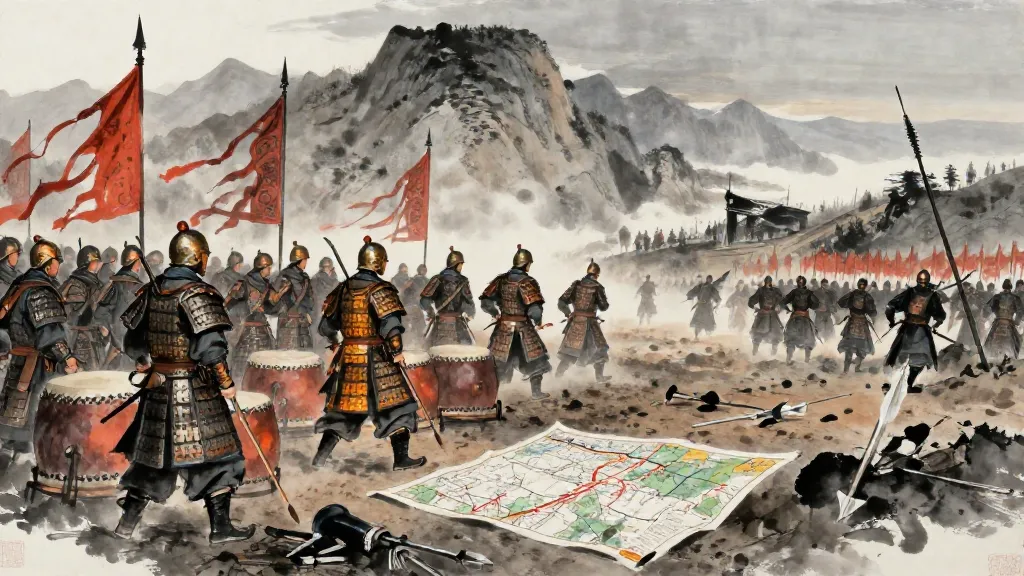
魯周公世家 (Hereditary House of Lu — The Duke of Zhou) — Chinese ink painting

Chapter 33 of 130

魯周公世家

Hereditary House of Lu — The Duke of Zhou

View:

周公輔武王克殷

The Duke of Zhou Assists King Wu in Conquering Yin

周公旦者,周武王弟也。自文王在時,旦為子孝,篤仁,異於群子。及武王即位,旦常輔翼武王,用事居多。武王九年,東伐至盟津,周公輔行。十一年,伐紂,至牧野,周公佐武王,作牧誓。破殷,入商宮。已殺紂,周公把大鉞,召公把小鉞,以夾武王,釁社,告紂之罪於天,及殷民。釋箕子之囚。封紂子武庚祿父,使管叔、蔡叔傅之,以續殷祀。遍封功臣同姓戚者。封周公旦於少昊之虛曲阜,是為魯公。周公不就封,留佐武王。

The Duke of Zhou, Dan, was a younger brother of King Wu of Zhou. From King Wen's time, Dan served as a filial son, deeply benevolent, distinguished from all the other sons. When King Wu took the throne, Dan constantly supported him and was involved in most affairs of state. In King Wu's ninth year, the eastern campaign reached Mengjin, with the Duke of Zhou assisting. In the eleventh year, they attacked King Zhou of Shang and reached Muye, where the Duke of Zhou aided King Wu and composed the Oath at Mu. They shattered Yin and entered the Shang palace. After King Zhou was killed, the Duke of Zhou held the great battle-axe and the Duke of Shao held the lesser battle-axe, flanking King Wu as they consecrated the altar of soil with blood and proclaimed King Zhou's crimes to Heaven and to the Yin people. They freed Jizi from prison, enfeoffed King Zhou's son Wu Geng Lufu and appointed Guan Shu and Cai Shu to oversee him, continuing the Yin sacrifices. They enfeoffed meritorious ministers and kinsmen throughout the realm. The Duke of Zhou was enfeoffed at Qufu in the old domain of Shaohao — this was the Lordship of Lu. But the Duke of Zhou did not go to take up his fief. He remained to assist King Wu.

Notes

1person周公旦Zhōu Gōng Dàn

The Duke of Zhou (周公旦, Ji Dan 姬旦) was King Wen's fourth son and one of the most revered figures in Chinese civilization. Confucius regarded him as the model statesman. He served as regent for the young King Cheng and is credited with establishing the ritual and institutional foundations of the Zhou dynasty.

2place

Qufu (曲阜) was the capital of Lu, located in modern Qufu, Shandong province. It was traditionally identified as the old domain of the legendary emperor Shaohao. It later became the birthplace of Confucius.

3context

The Oath at Mu (牧誓) is preserved in the Book of Documents (尚書). It was King Wu's address to his troops before the decisive Battle of Muye, listing the crimes of King Zhou of Shang.

周公禱以代武王死

The Duke of Zhou Offers Himself in Place of King Wu

武王克殷二年,天下未集,武王有疾,不豫,群臣懼,太公、召公乃繆卜。周公曰:"未可以戚我先王。"周公於是乃自以為質,設三壇,周公北面立,戴璧秉圭,告於太王、王季、文王。史策祝曰:"惟爾元孫王發,勤勞阻疾。若爾三王是有負子之責於天,以旦代王發之身。旦巧能,多材多藝,能事鬼神。乃王發不如旦多材多藝,不能事鬼神。乃命於帝庭,敷佑四方,用能定汝子孫於下地,四方之民罔不敬畏。無墜天之降葆命,我先王亦永有所依歸。今我其即命於元龜,爾之許我,我以其璧與圭歸,以俟爾命。爾不許我,我乃屏璧與圭。"周公已令史策告太王、王季、文王,欲代武王發,於是乃即三王而卜。卜人皆曰吉,發書視之,信吉。周公喜,開籥,乃見書遇吉。周公入賀武王曰:"王其無害。旦新受命三王,維長終是圖。茲道能念予一人。"周公藏其策金縢匱中,誡守者勿敢言。明日,武王有瘳。

Two years after King Wu conquered Yin, All-Under-Heaven was not yet settled. King Wu fell ill and would not recover. The ministers were terrified. The Grand Duke and the Duke of Shao performed divinations. The Duke of Zhou said: "We must not yet distress our former kings." He then offered himself as a pledge. He set up three altars and stood facing north, holding a jade disk and a jade scepter, and addressed the Great King, King Ji, and King Wen. The scribe read the prayer from bamboo tablets: "Your eldest grandson, King Fa, labors under grave illness. If you three kings bear a debt to Heaven for a son's life, let Dan take King Fa's place. Dan is clever and capable, possessing many talents and arts, able to serve the spirits. King Fa does not match Dan in talents and arts and cannot serve the spirits as well. He received his mandate in the court of the Supreme Lord and spread his protection to the four quarters, thereby securing your descendants upon the earth. The people of the four quarters all revere and fear him. Do not let Heaven's precious mandate fall. Our former kings will also have an eternal home to rest in. I now seek the answer from the great tortoise. If you grant my request, I will take the jade disk and scepter home to await your command. If you do not grant it, I will put away the disk and scepter."

When the Duke of Zhou had the scribe announce to the three kings his wish to take King Wu's place, he then performed the divination before all three. The diviners all said it was auspicious. He opened the documents to examine them — they were truly auspicious. The Duke of Zhou was overjoyed. He opened the lock-box and saw the written oracles were favorable. He entered and congratulated King Wu: "Your Majesty will suffer no harm. Dan has just received a mandate from the three kings — they plan for your long survival. This way can preserve me alone." The Duke of Zhou stored the prayer tablets in a bronze-bound chest and forbade the keepers to speak of it. The next day, King Wu began to recover.

Notes

1context

The Duke of Zhou's prayer offering himself in place of King Wu is one of the most famous passages in the Book of Documents (尚書·金縢 'Metal-Bound Chest'). It established the Duke as the archetype of selfless loyalty in the Confucian tradition.

2translation

金縢匱 (jīn téng guì) means 'metal-bound chest' — a chest sealed with metal bands for security. The prayer tablets stored inside became crucial evidence later when King Cheng discovered them and realized the Duke of Zhou's loyalty.

周公攝政平叛

The Duke of Zhou's Regency and Suppression of the Rebellion

其後武王既崩,成王少,在強葆之中。周公恐天下聞武王崩而畔,周公乃踐阼代成王攝行政當國。管叔及其群弟流言於國曰:"周公將不利於成王。"周公乃告太公望、召公奭曰:"我之所以弗辟而攝行政者,恐天下畔周,無以告我先王太王、王季、文王。三王之憂勞天下久矣,於今而後成。武王蚤終,成王少,將以成周,我所以為之若此。"於是卒相成王,而使其子伯禽代就封於魯。周公戒伯禽曰:"我文王之子,武王之弟,成王之叔父,我於天下亦不賤矣。然我一沐三捉髮,一飯三吐哺,起以待士,猶恐失天下之賢人。子之魯,慎無以國驕人。"

管、蔡、武庚等果率淮夷而反。周公乃奉成王命,興師東伐,作大誥。遂誅管叔,殺武庚,放蔡叔。收殷餘民,以封康叔於衛,封微子於宋,以奉殷祀。寧淮夷東土,二年而畢定。諸侯鹹服宗周。

Afterward, King Wu died. King Cheng was young, still in swaddling clothes. The Duke of Zhou feared that when All-Under-Heaven learned of King Wu's death, they would rebel. He therefore ascended the dais and served as regent for King Cheng, administering the government and directing the state. Guan Shu and the other brothers spread rumors throughout the land, saying: "The Duke of Zhou intends harm against King Cheng." The Duke of Zhou told the Grand Duke and the Duke of Shao, Shi: "The reason I do not step aside but act as regent is that I fear the realm will turn against Zhou, and I would have no way to face our former kings — the Great King, King Ji, and King Wen. The three kings labored anxiously over All-Under-Heaven for a long time, and only now has their work come to fruition. King Wu died young. King Cheng is a child. I do this to bring Zhou to completion." He then served as minister to King Cheng and sent his own son, Bo Qin, to take up the enfeoffment at Lu in his place. The Duke of Zhou admonished Bo Qin: "I am the son of King Wen, the brother of King Wu, and the uncle of King Cheng. My position in All-Under-Heaven is by no means low. Yet during a single washing of my hair I stop three times to grasp it and receive visitors; during a single meal I spit out my food three times to rise and attend to callers — still I fear losing the worthy men of All-Under-Heaven. When you go to Lu, be careful never to be arrogant with men because you possess a state."

Guan Shu, Cai Shu, Wu Geng, and the others did indeed rally the Huai Yi and revolt. The Duke of Zhou, bearing King Cheng's mandate, raised an army and campaigned eastward, composing the Great Announcement. He executed Guan Shu, killed Wu Geng, and banished Cai Shu. He settled the remnant Yin people, enfeoffing Kang Shu at Wei and Weizi at Song to continue the Yin sacrifices. He pacified the Huai Yi and the eastern lands, completing the task within two years. All the lords submitted to the Zhou royal house.

Notes

1person伯禽Bó Qín

Bo Qin (伯禽) was the Duke of Zhou's eldest son. Since the Duke remained at the Zhou court as regent, Bo Qin went to Lu as its first actual resident ruler. His governance style — slow, thorough, ritual-based — set the tone for Lu's famous conservatism.

2translation

一沐三捉髮,一飯三吐哺 (yī mù sān zhuō fà, yī fàn sān tǔ bǔ) — 'during one hair-washing, grasping it three times; during one meal, spitting out food three times.' This became one of the most quoted phrases in Chinese political culture, symbolizing a ruler's eagerness to receive and not slight men of talent.

3context

The Great Announcement (大誥) is preserved in the Book of Documents. It was the Duke of Zhou's address justifying the eastern campaign against the rebels, framed as King Cheng's words but written by the Duke.

周公營洛邑與還政成王

The Duke of Zhou Builds Luoyi and Returns Power to King Cheng

天降祉福,唐叔得禾,異母同穎,獻之成王,成王命唐叔以餽周公於東土,作餽禾。周公既受命禾,嘉天子命,作嘉禾。東土以集,周公歸報成王,乃為詩貽王,命之曰鴟鴞。王亦未敢訓周公。

成王七年二月乙未,王朝步自周,至豐,使太保召公先之雒相土。其三月,周公往營成周雒邑,卜居焉,曰吉,遂國之。

成王長,能聽政。於是周公乃還政於成王,成王臨朝。周公之代成王治,南面倍依以朝諸侯。及七年後,還政成王,北面就臣位,歔歔如畏然。

Heaven sent down blessings. Uncle Tang obtained a grain stalk with two different stalks sharing a single ear, and presented it to King Cheng. King Cheng ordered Uncle Tang to give it as a gift to the Duke of Zhou in the eastern lands, and composed the "Presenting Grain." When the Duke of Zhou received the Heaven-blessed grain, he praised the Son of Heaven's command and composed the "Excellent Grain." Once the eastern lands were settled, the Duke of Zhou returned to report to King Cheng and composed a poem for the king, called "The Owl." The king did not yet dare to admonish the Duke of Zhou.

In the second month of King Cheng's seventh year, on the yiwei day, the king departed from Zhou on foot, arrived at Feng, and sent the Grand Guardian, the Duke of Shao, ahead to Luo to survey the terrain. In the third month, the Duke of Zhou went to build the completed Zhou capital at Luoyi. He performed divination about the site, and the result was auspicious. He then established the city.

King Cheng grew up and became able to govern. The Duke of Zhou then returned political authority to King Cheng, and King Cheng presided over court. During the time the Duke of Zhou had governed on King Cheng's behalf, he had faced south, leaning against the ceremonial screen, to receive the lords. After seven years, when he returned governance to King Cheng, he faced north and took the position of a subject, sighing as if in awe.

Notes

1place

Luoyi (雒邑), also called Chengzhou (成周), was the eastern capital built by the Duke of Zhou, located at modern Luoyang, Henan. It served as the Zhou dynasty's eastern administrative center and later became the capital after the Western Zhou fell.

2context

The poem 'The Owl' (鴟鴞) is preserved in the Book of Odes. Traditionally interpreted as the Duke of Zhou's allegorical defense against the slanders of Guan and Cai, it compares himself to a bird whose nest is threatened.

3translation

The Duke of Zhou facing south (南面) when ruling as regent and then facing north (北面) as a subject after returning power is one of the most symbolically laden passages in Chinese political writing. South-facing is the ruler's position; north-facing is the subject's.

周公之死與金縢之開

The Death of the Duke of Zhou and the Opening of the Metal-Bound Chest

初,成王少時,病,周公乃自揃其蚤沈之河,以祝於神曰:"王少未有識,奸神命者乃旦也。"亦藏其策於府。成王病有瘳。及成王用事,人或譖周公,周公奔楚。成王發府,見周公禱書,乃泣,反周公。周公歸,恐成王壯,治有所淫佚,乃作多士,作毋逸。毋逸稱:"為人父母,為業至長久,子孫驕奢忘之,以亡其家,為人子可不慎乎!故昔在殷王中宗,嚴恭敬畏天命,自度治民,震懼不敢荒寧,故中宗饗國七十五年。其在高宗,久勞於外,為與小人,作其即位,乃有亮闇,三年不言,言乃讙,不敢荒寧,密靖殷國,至於小大無怨,故高宗饗國五十五年。其在祖甲,不義惟王,久為小人於外,知小人之依,能保施小民,不侮鰥寡,故祖甲饗國三十三年。"多士稱曰:"自湯至於帝乙,無不率祀明德,帝無不配天者。在今後嗣王紂,誕淫厥佚,不顧天及民之從也。其民皆可誅。""文王日中昃不暇食,饗國五十年。"作此以誡成王。

成王在豐,天下已安,周之官政未次序,於是周公作周官,官別其宜,作立政,以便百姓。百姓說。

周公在豐,病,將沒,曰:"必葬我成周,以明吾不敢離成王。"周公既卒,成王亦讓,葬周公於畢,從文王,以明予小子不敢臣周公也。

周公卒後,秋未穫,暴風雷,禾盡偃,大木盡拔。周國大恐。成王與大夫朝服以開金縢書,王乃得周公所自以為功代武王之說。二公及王乃問史百執事,史百執事曰:"信有,昔周公命我勿敢言。"成王執書以泣,曰:"自今後其無繆卜乎!昔周公勤勞王家,惟予幼人弗及知。今天動威以彰周公之德,惟朕小子其迎,我國家禮亦宜之。"王出郊,天乃雨,反風,禾盡起。二公命國人,凡大木所偃,盡起而築之。歲則大孰。於是成王乃命魯得郊祭文王。魯有天子禮樂者,以襃周公之德也。

Earlier, when King Cheng was young and fell ill, the Duke of Zhou cut his own fingernails, sank them in the Yellow River, and prayed to the spirits: "The king is young and has no understanding. If anyone has offended the spirits' commands, it is Dan." He also stored this prayer in the archives. King Cheng recovered from his illness. Later, when King Cheng came to power, people slandered the Duke of Zhou, and the Duke fled to Chu. King Cheng opened the archives and discovered the Duke of Zhou's prayer. He wept and summoned the Duke of Zhou back. After returning, the Duke feared that as King Cheng matured, his governance might grow dissolute. He composed the "Many Officers" and the "Against Indulgence." The "Against Indulgence" states: "When a father builds an enterprise that lasts long, and his sons and grandsons grow arrogant and extravagant and forget it, their house perishes. Should not a son be cautious? Consider the Yin king Zhongzong — stern, reverent, and respectful of Heaven's mandate, he governed the people with self-discipline, trembling with fear and never daring to be lax, so Zhongzong held the state for seventy-five years. Then there was Gaozong — he long labored among the people, working alongside commoners. Upon taking the throne, he observed a period of silent mourning for three years. When he spoke, it brought joy. He dared not be lax and silently brought peace to the Yin state, so that none, great or small, bore resentment. Gaozong held the state for fifty-five years. Then there was Zu Jia — he did not presume to be king, but long lived among the common people, understanding their needs. He could care for and provide for the lowly and did not abuse the widowed and orphaned. Zu Jia held the state for thirty-three years." The "Many Officers" states: "From Tang to Di Yi, every one maintained the sacrifices and manifested virtue, and every ruler was worthy to partner with Heaven. But the current successor, King Zhou, is wildly dissolute and indulgent, heedless of Heaven and the people who follow him. His people are all deserving of punishment." And: "King Wen from midday until the sun slanted had no time to eat, and he held the state for fifty years." He composed these to admonish King Cheng.

King Cheng was at Feng. All-Under-Heaven was at peace, but the Zhou government's offices were not yet properly ordered. The Duke of Zhou then composed the "Offices of Zhou," distinguishing the proper functions of each office, and composed the "Establishing Governance" to benefit the common people. The people were pleased.

The Duke of Zhou fell ill at Feng and was about to die. He said: "You must bury me at Chengzhou, to make clear that I dare not leave King Cheng's side." When the Duke of Zhou died, King Cheng yielded to his wish — yet buried him at Bi, alongside King Wen, saying: "This is to make clear that I, your young servant, do not dare treat the Duke of Zhou as a mere subject."

After the Duke of Zhou's death, before the autumn harvest was gathered, a violent windstorm struck with thunder. The grain was all flattened, and great trees were uprooted. The Zhou domain was terrified. King Cheng and his ministers put on court robes and opened the metal-bound chest. The king then discovered the Duke of Zhou's prayer offering himself in place of King Wu. The two dukes and the king questioned the scribes and all the officials. They said: "It is true. The Duke of Zhou commanded us not to dare speak of it." King Cheng held the document and wept, saying: "From now on, we need perform no further anxious divination! In the past, the Duke of Zhou labored for the royal house, but I was a mere child and did not know. Now Heaven has shown its power to make manifest the Duke of Zhou's virtue. I, your young servant, shall go out to welcome it — the rites of our state demand it." The king went out to the suburbs. Heaven then sent rain, the wind reversed, and the grain all rose again. The two dukes ordered the people of the domain to raise up and replant every great tree that had been blown down. That year saw a great harvest. King Cheng then decreed that Lu might perform the suburban sacrifice to King Wen. The reason Lu possessed the ritual music of the Son of Heaven was to honor the virtue of the Duke of Zhou.

Notes

1context

The Duke of Zhou's two literary works mentioned here — 'Against Indulgence' (毋逸/無逸) and 'Many Officers' (多士) — are both preserved in the Book of Documents. They became foundational texts for Confucian political philosophy, arguing that rulers must work tirelessly and avoid luxury.

2place

Bi (畢) was the Zhou royal burial ground, near modern Xi'an, Shaanxi. Burying the Duke of Zhou alongside King Wen rather than at Chengzhou was King Cheng's way of honoring him as virtually equal to the founding kings.

3context

Lu's unique privilege of performing the Son of Heaven's ritual music (天子禮樂) was a singular honor granted in recognition of the Duke of Zhou's services. It made Lu the ritual center of the eastern lands and gave it a special status among the feudal states.

伯禽治魯與早期諸公

Bo Qin's Rule in Lu and the Early Dukes

周公卒,子伯禽固已前受封,是為魯公。魯公伯禽之初受封之魯,三年而後報政周公。周公曰:"何遲也?"伯禽曰:"變其俗,革其禮,喪三年然後除之,故遲。"太公亦封於齊,五月而報政周公。周公曰:"何疾也?"曰:"吾簡其君臣禮,從其俗為也。"及後聞伯禽報政遲,乃嘆曰:"嗚呼,魯後世其北面事齊矣!夫政不簡不易,民不有近;平易近民,民必歸之。"

伯禽即位之後,有管、蔡等反也,淮夷、徐戎亦並興反。於是伯禽率師伐之於肸,作肸誓,曰:"陳爾甲冑,無敢不善。無敢傷牿。馬牛其風,臣妾逋逃,勿敢越逐,敬復之。無敢寇攘,逾牆垣。魯人三郊三隧,歭爾芻茭、糗糧、楨榦,無敢不逮。我甲戌築而征徐戎,無敢不及,有大刑。"作此肸誓,遂平徐戎,定魯。

魯公伯禽卒,子考公酋立。考公四年卒,立弟熙,是謂煬公。煬公築茅闕門。六年卒,子幽公宰立。幽公十四年。幽公弟晞殺幽公而自立,是為魏公。魏公五十年卒,子厲公擢立。厲公三十七年卒,魯人立其弟具,是為獻公。獻公三十二年卒,子真公濞立。

真公十四年,周厲王無道,出奔彘,共和行政。二十九年,周宣王即位。

三十年,真公卒,弟敖立,是為武公。

After the Duke of Zhou died, his son Bo Qin had already taken up his enfeoffment — he was the Lord of Lu. When Bo Qin first received his fief in Lu, three years passed before he reported on governance to the Duke of Zhou. The Duke asked: "Why so slow?" Bo Qin said: "I had to transform the customs, reform the rites, and enforce three years of mourning before lifting them — that is why it was slow." The Grand Duke had also been enfeoffed at Qi and reported on governance within five months. The Duke of Zhou asked: "Why so fast?" He replied: "I simplified the protocols between lord and minister and adapted to local customs." Later, when the Duke of Zhou heard that Bo Qin's report came slowly, he sighed: "Alas, in future generations Lu will face north and serve Qi! If governance is not simple and easy, the people will not feel close to it. Plain and easy governance that stays close to the people — the people will flock to it."

After Bo Qin took power, the rebellion of Guan, Cai, and others broke out, and the Huai Yi and Xu Rong also rose in revolt. Bo Qin led his army against them at Bi and composed the Bi Oath: "Array your armor and helmets — let none dare be careless. Do not dare harm the tethered animals. If horses or cattle stray, or servants flee, do not dare pursue them beyond bounds — respectfully bring them back. Do not dare plunder or steal or climb over walls. People of Lu's three suburbs and three tunnel-roads — prepare your fodder, provisions, and building timbers, and let none dare fall short. On the jiaxu day I will fortify our position and campaign against the Xu Rong. Any who dare not keep up will face severe punishment." With this oath, he pacified the Xu Rong and secured Lu.

When Bo Qin died, his son Duke Kao Qiu succeeded. Duke Kao died in his fourth year, and his brother Xi was established — this was Duke Yang. Duke Yang built the Thatched Gate Tower. He died in his sixth year. His son Duke You Zai succeeded and ruled fourteen years. Duke You's brother Xi killed him and took the throne — this was Duke Wei. Duke Wei died after fifty years. His son Duke Li Zhuo succeeded and died after thirty-seven years. The people of Lu established his brother Ju — this was Duke Xian. Duke Xian died after thirty-two years. His son Duke Zhen Bi succeeded.

In the fourteenth year of Duke Zhen, King Li of Zhou ruled unjustly, fled to Zhi, and the Gonghe Regency administered the government. In the twenty-ninth year, King Xuan of Zhou took the throne.

In Duke Zhen's thirtieth year he died. His brother Ao succeeded — this was Duke Wu.

Notes

1context

The contrast between Bo Qin's slow, thorough approach and the Grand Duke's quick adaptation became a famous parable in Chinese political thought about the trade-off between idealism and pragmatism. The Duke of Zhou's prediction that Lu would eventually serve Qi proved accurate.

2context

The Bi Oath (肸誓) shows Lu conducting a military campaign with strict discipline. The emphasis on not plundering and returning strays reflects early Zhou military ethics.

武公廢長立幼與懿公之亂

Duke Wu's Improper Succession and the Disorder of Duke Yi

武公九年春,武公與長子括,少子戲,西朝周宣王。宣王愛戲,欲立戲為魯太子。周之樊仲山父諫宣王曰:"廢長立少,不順;不順,必犯王命;犯王命,必誅之:故出令不可不順也。令之不行,政之不立;行而不順,民將棄上。夫下事上,少事長,所以為順。今天子建諸侯,立其少,是教民逆也。若魯從之,諸侯效之,王命將有所壅;若弗從而誅之,是自誅王命也。誅之亦失,不誅亦失,王其圖之。"宣王弗聽,卒立戲為魯太子。夏,武公歸而卒,戲立,是為懿公。

懿公九年,懿公兄括之子伯御與魯人攻弒懿公,而立伯御為君。伯御即位十一年,周宣王伐魯,殺其君伯御,而問魯公子能道順諸侯者,以為魯後。樊穆仲曰:"魯懿公弟稱,肅恭明神,敬事耆老;賦事行刑,必問於遺訓而咨於固實;不乾所問,不犯所咨。"宣王曰:"然,能訓治其民矣。"乃立稱於夷宮,是為孝公。自是後,諸侯多畔王命。

In the spring of Duke Wu's ninth year, Duke Wu brought his elder son Kuo and his younger son Xi to pay court to King Xuan of Zhou in the west. King Xuan took a liking to Xi and wished to make him crown prince of Lu. Fan Zhongshan Fu, a Zhou minister, remonstrated: "To set aside the elder and establish the younger is contrary to order. What is contrary to order will invite defiance of the royal command. Defiance will require punishment. Therefore commands must be in proper order. If commands are not carried out, governance cannot be established. If carried out but in improper order, the people will abandon their superiors. The younger serving the elder, the lower serving the higher — this is order. Now for the Son of Heaven to establish a lord and select the younger son is to teach the people disobedience. If Lu follows this, other lords will imitate it, and royal commands will be obstructed. If Lu does not follow and is punished, it is the royal command itself that is being punished. To punish is a mistake, and not to punish is also a mistake. May the king reconsider." King Xuan did not listen and ultimately made Xi the crown prince of Lu. In summer, Duke Wu returned home and died. Xi took the throne — this was Duke Yi.

In Duke Yi's ninth year, Boyu, the son of Yi's elder brother Kuo, together with the people of Lu attacked and killed Duke Yi, and established Boyu as ruler. After Boyu had been on the throne for eleven years, King Xuan of Zhou attacked Lu, killed Boyu, and asked which prince of Lu could lead the lords in obedience to be made ruler of Lu. Fan Muzhong said: "Cheng, younger brother of Duke Yi of Lu, is solemn, reverent, and attentive to the spirits. He respectfully serves the elders. In levying duties and administering punishment, he always consults the inherited teachings and seeks counsel from the wise and reliable. He does not overstep what he is told, nor violate what is counseled." King Xuan said: "Very well, he can instruct and govern his people." He then established Cheng at the Yi Palace — this was Duke Xiao. From this time on, many lords defied royal commands.

Notes

1context

Fan Zhongshan Fu's remonstrance against establishing the younger son as heir is one of the most frequently cited arguments for primogeniture in Chinese political philosophy. King Xuan's insistence on his personal preference over proper succession order undermined royal authority and contributed to the decline of Zhou's ability to command the lords.

2person周宣王Zhōu Xuān Wáng

King Xuan of Zhou (周宣王, r. c. 827–782 BC) is generally considered the last capable Western Zhou king. However, his interference in Lu's succession demonstrated the limits of royal power and the contradictions of the feudal system.

隱公與桓公

Duke Yin and Duke Huan

孝公二十五年,諸侯畔周,犬戎殺幽王。秦始列為諸侯。

二十七年,孝公卒,子弗湟立,是為惠公。

惠公三十年,晉人弒其君昭侯。四十五年,晉人又弒其君孝侯。

四十六年,惠公卒,長庶子息攝當國,行君事,是為隱公。初,惠公適夫人無子,公賤妾聲子生子息。息長,為娶於宋。宋女至而好,惠公奪而自妻之。生子允。登宋女為夫人,以允為太子。及惠公卒,為允少故,魯人共令息攝政,不言即位。

隱公五年,觀漁於棠。八年,與鄭易天子之太山之邑祊及許田,君子譏之。

十一年冬,公子揮諂謂隱公曰:"百姓便君,君其遂立。吾請為君殺子允,君以我為相。"隱公曰:"有先君命。吾為允少,故攝代。今允長矣,吾方營菟裘之地而老焉,以授子允政。"揮懼子允聞而反誅之,乃反譖隱公於子允曰:"隱公欲遂立,去子,子其圖之。請為子殺隱公。"子允許諾。十一月,隱公祭鍾巫,齊於社圃,館於蔿氏。揮使人殺隱公於蔿氏,而立子允為君,是為桓公。

桓公元年,鄭以璧易天子之許田。二年,以宋之賂鼎入於太廟,君子譏之。

三年,使揮迎婦於齊為夫人。六年,夫人生子,與桓公同日,故名曰同。同長,為太子。

十六年,會於曹,伐鄭,入厲公。

十八年春,公將有行,遂與夫人如齊。申繻諫止,公不聽,遂如齊。齊襄公通桓公夫人。公怒夫人,夫人以告齊侯。夏四月丙子,齊襄公饗公,公醉,使公子彭生抱魯桓公,因命彭生摺其脅,公死於車。魯人告於齊曰:"寡君畏君之威,不敢寧居,來脩好禮。禮成而不反,無所歸咎,請得彭生除醜於諸侯。"齊人殺彭生以說魯。立太子同,是為莊公。莊公母夫人因留齊,不敢歸魯。

In the twenty-fifth year of Duke Xiao, the lords rebelled against Zhou, and the Quanrong killed King You. Qin first came to be listed among the lords.

In his twenty-seventh year, Duke Xiao died. His son Fuhuang succeeded — this was Duke Hui.

In the thirtieth year of Duke Hui, the men of Jin assassinated their lord Duke Zhao. In the forty-fifth year, they again assassinated their lord Duke Xiao.

In the forty-sixth year, Duke Hui died. His eldest illegitimate son Xi served as regent, carrying out the ruler's duties — this was Duke Yin. Originally, Duke Hui's principal consort had no sons. A lesser concubine called Shengzi bore a son, Xi. When Xi grew up, a bride was obtained for him from Song. The Song woman arrived and was beautiful. Duke Hui took her from Xi and married her himself. She bore a son, Yun. The Song woman was raised to the rank of principal consort, and Yun was made crown prince. When Duke Hui died, since Yun was young, the people of Lu collectively appointed Xi as regent. He was not said to have taken the throne.

In the fifth year of Duke Yin, he went to observe fishing at Tang. In the eighth year, he exchanged the Son of Heaven's Mount Tai town of Beng with Zheng for Xutian. Men of discernment criticized this.

In the winter of the eleventh year, Prince Hui flatteringly told Duke Yin: "The people are comfortable with you as ruler. You should remain on the throne permanently. Let me kill Prince Yun for you, and you can make me chief minister." Duke Yin said: "There is our late lord's command. I served as regent because Yun was young. Now Yun is grown. I am just preparing a retirement estate at Tuqiu to grow old there, and then hand governance to Yun." Hui feared that Yun would hear of his proposal and have him killed, so he reversed himself and slandered Duke Yin to Yun, saying: "Duke Yin intends to stay permanently on the throne and remove you. You must act. Let me kill Duke Yin for you." Yun agreed. In the eleventh month, Duke Yin performed sacrifices at Zhongwu, purified himself at Shepu, and lodged at the Wei house. Hui had men kill Duke Yin at the Wei house, and established Yun as ruler — this was Duke Huan.

In the first year of Duke Huan, Zheng exchanged jade disks for the Son of Heaven's Xutian. In the second year, he placed a tripod cauldron received as a bribe from Song into the Grand Ancestral Temple. Men of discernment criticized this.

In the third year, Hui was sent to fetch a bride from Qi as consort. In the sixth year, the consort bore a son on the same day as Duke Huan's birthday, so the child was named Tong. When Tong grew up, he was made crown prince.

In the sixteenth year, he met with Cao and attacked Zheng, installing Duke Li.

In the spring of the eighteenth year, the duke was about to travel. He went with his consort to Qi. Shen Xu remonstrated, but the duke did not listen and proceeded to Qi. Duke Xiang of Qi was having an affair with Duke Huan's consort. The duke reproached his wife. She told the Duke of Qi. On the bingzi day of the fourth month in summer, Duke Xiang of Qi hosted a banquet for the duke. When the duke was drunk, Xiang ordered Prince Pengsheng to carry Duke Huan of Lu, and then commanded Pengsheng to break his ribs. The duke died in his carriage. The people of Lu sent word to Qi: "Our lord, in awe of your might, dared not rest easy. He came to perform the rites of friendship. The rites were completed, yet he did not return. We have no one else to blame — we request that Pengsheng be punished to remove the disgrace before the lords." The people of Qi killed Pengsheng to appease Lu. They established Crown Prince Tong — this was Duke Zhuang. Duke Zhuang's mother, the consort, remained in Qi and dared not return to Lu.

Notes

1person魯隱公Lǔ Yǐn Gōng

Duke Yin of Lu (魯隱公, r. 722–712 BC) is the first ruler whose reign is covered in the Spring and Autumn Annerta (春秋), Confucius's chronicle. The year 722 BC thus marks the traditional beginning of the Spring and Autumn period.

2person魯桓公Lǔ Huán Gōng

Duke Huan of Lu (魯桓公, r. 711–694 BC) was installed by the murder of his half-brother. His own death was orchestrated by Duke Xiang of Qi, who was having an affair with Huan's wife — the famous Wen Jiang (文姜).

3context

Duke Yin's statement about preparing a retirement estate at Tuqiu and handing power to the rightful heir Yun was celebrated in the Confucian tradition as a model of selfless regency, in direct contrast to Prince Hui's treachery.

莊公至釐公:三桓之興

From Duke Zhuang to Duke Xi: The Rise of the Three Huan

莊公五年冬,伐衛,內衛惠公。

八年,齊公子糾來奔。九年,魯欲內子糾於齊,後桓公,桓公發兵擊魯,魯急,殺子糾。召忽死。齊告魯生致管仲。魯人施伯曰:"齊欲得管仲,非殺之也,將用之,用之則為魯患。不如殺,以其屍與之。"莊公不聽,遂囚管仲與齊。齊人相管仲。

十三年,魯莊公與曹沬會齊桓公於柯,曹沬劫齊桓公,求魯侵地,已盟而釋桓公。桓公欲背約,管仲諫,卒歸魯侵地。十五年,齊桓公始霸。二十三年,莊公如齊觀社。

三十二年,初,莊公築台臨黨氏,見孟女,說而愛之,許立為夫人,割臂以盟。孟女生子斑。斑長,說梁氏女,往觀。圉人犖自牆外與梁氏女戲。斑怒,鞭犖。莊公聞之,曰:"犖有力焉,遂殺之,是未可鞭而置也。"斑未得殺。會莊公有疾。莊公有三弟,長曰慶父,次曰叔牙,次曰季友。莊公取齊女為夫人曰哀姜。哀姜無子。哀姜娣曰叔姜,生子開。莊公無適嗣,愛孟女,欲立其子斑。莊公病,而問嗣於弟叔牙。叔牙曰:"一繼一及,魯之常也。慶父在,可為嗣,君何憂?"莊公患叔牙欲立慶父,退而問季友。季友曰:"請以死立斑也。"莊公曰:"曩者叔牙欲立慶父,柰何?"季友以莊公命命牙待於針巫氏,使針季劫飲叔牙以鴆,曰:"飲此則有後奉祀;不然,死且無後。"牙遂飲鴆而死,魯立其子為叔孫氏。八月癸亥,莊公卒,季友竟立子斑為君,如莊公命。侍喪,舍於黨氏。

先時慶父與哀姜私通,欲立哀姜娣子開。及莊公卒而季友立斑,十月己未,慶父使圉人犖殺魯公子斑於黨氏。季友餎陳。慶父竟立莊公子開,是為湣公。

湣公二年,慶父與哀姜通益甚。哀姜與慶父謀殺湣公而立慶父。慶父使卜齮襲殺湣公於武闈。季友聞之,自陳與湣公弟申如邾,請魯求內之。魯人慾誅慶父。慶父恐,奔莒。於是季友奉子申入,立之,是為釐公。釐公亦莊公少子。哀姜恐,奔邾。季友以賂如莒求慶父,慶父歸,使人殺慶父,慶父請奔,弗聽,乃使大夫奚斯行哭而往。慶父聞奚斯音,乃自殺。齊桓公聞哀姜與慶父亂以危魯,及召之邾而殺之,以其屍歸,戮之魯。魯釐公請而葬之。

季友母陳女,故亡在陳,陳故佐送季友及子申。季友之將生也,父魯桓公使人卜之,曰:"男也,其名曰'友',間於兩社,為公室輔。季友亡,則魯不昌。"及生,有文在掌曰"友",遂以名之,號為成季。其後為季氏,慶父後為孟氏也。

釐公元年,以汶陽鄪封季友。季友為相。

九年,晉里克殺其君奚齊、卓子。齊桓公率釐公討晉亂,至高梁而還,立晉惠公。十七年,齊桓公卒。二十四年,晉文公即位。

三十三年,釐公卒,子興立,是為文公。

In the winter of Duke Zhuang's fifth year, Lu attacked Wei and installed Duke Hui of Wei.

In the eighth year, Prince Jiu of Qi came seeking refuge. In the ninth year, Lu wished to install Prince Jiu in Qi, but Duke Huan of Qi gained the upper hand. Duke Huan sent troops to attack Lu. In desperation, Lu killed Prince Jiu. Zhao Hu died with him. Qi demanded that Lu deliver Guan Zhong alive. The Lu minister Shi Bo said: "Qi wants Guan Zhong not to kill him but to employ him. If they use him, he will become a threat to Lu. Better to kill him and send the corpse." Duke Zhuang did not listen and sent Guan Zhong as a prisoner to Qi. Qi made Guan Zhong chief minister.

In the thirteenth year, Duke Zhuang of Lu and Cao Mo met Duke Huan of Qi at Ke. Cao Mo seized Duke Huan at knifepoint and demanded the return of Lu's lost territory. Once the covenant was sworn, he released Duke Huan. Duke Huan wanted to renege on the agreement, but Guan Zhong remonstrated, and he ultimately returned Lu's territory. In the fifteenth year, Duke Huan of Qi first became hegemon. In the twenty-third year, Duke Zhuang went to Qi to observe the she sacrifices.

In the thirty-second year: earlier, Duke Zhuang had built a terrace overlooking the Dang clan. He spotted the Meng woman, took a liking to her, promised to make her his consort, and they sealed an oath by cutting their arms. The Meng woman bore a son, Ban. When Ban grew up, he admired a woman of the Liang clan and went to see her. A groom named Luo flirted with the Liang woman from outside the wall. Ban was furious and whipped Luo. Duke Zhuang heard of it and said: "Luo is a man of great strength. You should have killed him outright — you cannot whip such a man and let it go at that." Ban had not yet killed Luo when Duke Zhuang fell ill.

Duke Zhuang had three younger brothers: the eldest was Qingfu, the next was Shuya, and the youngest was Jiyou. Duke Zhuang had taken a Qi woman as his consort, called Lady Ai Jiang, who had no children. Ai Jiang's younger sister, Shu Jiang, bore a son named Kai. Duke Zhuang had no legitimate heir. Loving the Meng woman, he wished to establish her son Ban. When the duke grew ill, he asked his brother Shuya about the succession. Shuya said: "Alternating between sons and brothers is Lu's custom. With Qingfu here, you have a successor — what is there to worry about?" Duke Zhuang, alarmed that Shuya wanted to establish Qingfu, withdrew and consulted Jiyou. Jiyou said: "I will establish Ban even at the cost of my life." The duke said: "But Shuya just proposed Qingfu. What shall we do?" Jiyou, on the duke's authority, summoned Shuya to the house of Zhen Wu and had Zhen Ji force Shuya to drink poisoned wine, saying: "Drink this and your line will have descendants to maintain the sacrifices. Otherwise, you die without posterity." Shuya drank the poison and died. Lu established his sons as the Shusun clan. On the guihai day of the eighth month, Duke Zhuang died. Jiyou established Ban as ruler, in accordance with the duke's command. They were attending the funeral and lodging at the Dang estate.

Earlier, Qingfu had been secretly involved with Lady Ai Jiang and wished to establish Ai Jiang's sister's son Kai. When Duke Zhuang died and Jiyou established Ban, on the jiwei day of the tenth month, Qingfu sent the groom Luo to kill Prince Ban at the Dang estate. Jiyou fled to Chen. Qingfu established Duke Zhuang's son Kai — this was Duke Min.

In the second year of Duke Min, Qingfu's affair with Ai Jiang grew even more flagrant. Ai Jiang and Qingfu plotted to kill Duke Min and establish Qingfu as ruler. Qingfu sent Bu Yi to assassinate Duke Min at the Wu Gate. Jiyou heard of this, and from Chen he brought Duke Min's younger brother Shen to Zhu, petitioning Lu to accept them. The people of Lu wanted to execute Qingfu. Qingfu panicked and fled to Ju. Jiyou then escorted Prince Shen into Lu and established him — this was Duke Xi. Duke Xi was also a younger son of Duke Zhuang. Ai Jiang, terrified, fled to Zhu. Jiyou used bribes to request Qingfu's return from Ju. Qingfu returned, and Jiyou sent men to kill him. Qingfu begged to be allowed to flee, but his request was denied. The minister Xi Si was sent, wailing, to bring the message. When Qingfu heard Xi Si's voice, he killed himself. Duke Huan of Qi, hearing how Ai Jiang and Qingfu's affair had endangered Lu, summoned Ai Jiang from Zhu and killed her, sending her corpse back to be displayed publicly in Lu. Duke Xi of Lu requested and received permission to bury her.

Jiyou's mother was a woman of Chen, so he had fled to Chen in exile, and Chen therefore helped escort Jiyou and Prince Shen. When Jiyou was about to be born, his father Duke Huan of Lu had a divination performed, which said: "A boy. His name shall be 'You' ('Friend'). He will stand between the two altars of soil as a pillar of the ducal house. If Jiyou perishes, Lu will not flourish." When he was born, there were markings on his palm reading 'You,' and he was accordingly given that name. His style-name was Chengji. His descendants became the Ji clan. Qingfu's descendants became the Meng clan.

In the first year of Duke Xi, he enfeoffed Jiyou with Wenyang and Bi. Jiyou served as chief minister.

In the ninth year, Li Ke of Jin killed the rulers Xiqi and Zhuozi. Duke Huan of Qi led Duke Xi to punish the disorder in Jin. They reached Gaoliang and returned, establishing Duke Hui of Jin. In the seventeenth year, Duke Huan of Qi died. In the twenty-fourth year, Duke Wen of Jin took the throne.

In the thirty-third year, Duke Xi died. His son Xing succeeded — this was Duke Wen of Lu.

Notes

1person管仲Guǎn Zhòng

Guan Zhong (管仲, c. 723–645 BC) was one of the greatest statesmen of Chinese antiquity. Originally supporting Duke Huan's rival Prince Jiu, he was taken prisoner by Lu but released to Qi, where he became the architect of Qi's hegemony. Confucius praised his achievements while criticizing his lack of ritual propriety.

2person曹沬Cáo Mèi

Cao Mo (曹沬, also written 曹劌) was a Lu warrior who seized Duke Huan of Qi at the Ke conference in 681 BC to recover Lu's lost territory. This became one of the most celebrated acts of coerced diplomacy in Chinese history.

3person慶父Qìngfù

Qingfu (慶父, d. 660 BC) was a younger brother of Duke Zhuang who murdered two successive Lu rulers in pursuit of the throne. His name became proverbial for political chaos — the Chinese idiom '慶父不死,魯難未已' (Until Qingfu is dead, Lu's troubles will not cease) originated from these events.

4context

The Three Huan (三桓) — the Ji (季), Meng (孟/Meng from Qingfu), and Shusun (叔孫 from Shuya) clans — all descended from Duke Huan of Lu's sons. They would progressively dominate Lu's government for the next three centuries, reducing the ducal house to a figurehead.

宣公至昭公:三桓專權

From Duke Xuan to Duke Zhao: The Three Huan Seize Power

文公元年,楚太子商臣弒其父成王,代立。三年,文公朝晉襄父。

十一年十月甲午,魯敗翟於鹹,獲長翟喬如,富父終甥舂其喉,以戈殺之,埋其首於子駒之門,以命宣伯。

十五年,季文子使於晉。

十八年二月,文公卒。文公有二妃:長妃齊女為哀姜,生子惡及視;次妃敬嬴,嬖愛,生子俀。俀私事襄仲,襄仲欲立之,叔仲曰不可。襄仲請齊惠公,惠公新立,欲親魯,許之。冬十月,襄仲殺子惡及視而立俀,是為宣公。哀姜歸齊,哭而過巿,曰:"天乎!襄仲為不道,殺適立庶!"巿人皆哭,魯人謂之"哀姜"。魯由此公室卑,三桓彊。

宣公俀十二年,楚莊王彊,圍鄭。鄭伯降,復國之。

十八年,宣公卒,子成公黑肱立,是為成公。季文子曰:"使我殺適立庶失大援者,襄仲。"襄仲立宣公,公孫歸父有寵。宣公欲去三桓,與晉謀伐三桓。會宣公卒,季文子怨之,歸父奔齊。

成公二年春,齊伐取我隆。夏,公與晉郤克敗齊頃公於鞍,齊復歸我侵地。四年,成公如晉,晉景公不敬魯。魯欲背晉合於楚,或諫,乃不。十年,成公如晉。晉景公卒,因留成公送葬,魯恥之。十五年,始與吳王壽夢會鍾離。

十六年,宣伯告晉,欲誅季文子。文子有義,晉人弗許。

十八年,成公卒,子午立,是為襄公。是時襄公三歲也。

襄公元年,晉立悼公。往年冬,晉欒書弒其君厲公。四年,襄公朝晉。

五年,季文子卒。家無衣帛之妾,廄無食粟之馬,府無金玉,以相三君。君子曰:"季文子廉忠矣。"

九年,與晉伐鄭。晉悼公冠襄公於衛,季武子從,相行禮。

十一年,三桓氏分為三軍。

十二年,朝晉。十六年,晉平公即位。二十一年,朝晉平公。

二十二年,孔丘生。

二十五年,齊崔杼弒其君莊公,立其弟景公。

二十九年,吳延陵季子使魯,問周樂,盡知其意,魯人敬焉。

三十一年六月,襄公卒。其九月,太子卒。魯人立齊歸之子裯為君,是為昭公。

In the first year of Duke Wen, the Chu crown prince Shangchen murdered his father King Cheng and took his place. In the third year, Duke Wen went to pay court to Duke Xiang of Jin.

On the jiawu day of the tenth month of the eleventh year, Lu defeated the Di at Xian, capturing the tall Di warrior Qiaoru. Fufu Zhongsheng struck his throat and killed him with a halberd, burying his head at the Gate of Ziju, and thereby conferring the name on Duke Xuan Bo.

In the fifteenth year, Ji Wenzi was sent on a mission to Jin.

In the second month of the eighteenth year, Duke Wen died. Duke Wen had two consorts: the senior was a Qi woman called Ai Jiang, who bore sons E and Shi; the junior was Jing Ying, a favorite, who bore a son named Tui. Tui privately served Xiang Zhong, who wished to establish him. Shuzhong objected. Xiang Zhong petitioned Duke Hui of Qi, who was newly enthroned and wished to befriend Lu, so he agreed. In the winter, in the tenth month, Xiang Zhong killed Princes E and Shi and established Tui — this was Duke Xuan. Ai Jiang returned to Qi, weeping as she passed through the marketplace, crying: "Heaven! Xiang Zhong has committed an outrage — killing the legitimate heirs to establish a concubine's son!" The marketplace people all wept, and the people of Lu called her 'Ai Jiang' (the Sorrowful Lady). From this point the ducal house of Lu declined and the Three Huan grew powerful.

In the twelfth year of Duke Xuan Tui, King Zhuang of Chu grew powerful and besieged Zheng. The Lord of Zheng surrendered, and Chu restored him.

In the eighteenth year, Duke Xuan died. His son Duke Cheng Heigong succeeded. Ji Wenzi said: "The one who made us kill the legitimate heirs and establish an illegitimate son, losing us our great support, was Xiang Zhong." Xiang Zhong had established Duke Xuan, and Gongsun Guifu had been in favor. Duke Xuan had wished to eliminate the Three Huan and conspired with Jin to attack them. But then Duke Xuan died. Ji Wenzi resented Guifu, and Guifu fled to Qi.

In the spring of Duke Cheng's second year, Qi attacked and took our town of Long. In summer, the Duke and Xi Ke of Jin defeated Duke Qing of Qi at An. Qi returned our lost territory. In the fourth year, Duke Cheng went to Jin. Duke Jing of Jin was disrespectful to Lu. Lu considered breaking with Jin and allying with Chu, but someone remonstrated and the plan was dropped. In the tenth year, Duke Cheng went to Jin. Duke Jing of Jin died, and Lu was forced to remain and attend the funeral — Lu felt humiliated. In the fifteenth year, Lu first met with King Shoumeng of Wu at Zhongli.

In the sixteenth year, Duke Xuan Bo denounced Ji Wenzi to Jin, seeking his execution. But Wenzi was a man of righteousness, and the Jin court refused.

In the eighteenth year, Duke Cheng died. His son Wu succeeded — this was Duke Xiang. He was three years old at the time.

In the first year of Duke Xiang, Jin established Duke Dao. The previous winter, Luan Shu of Jin had murdered his lord Duke Li. In the fourth year, Duke Xiang went to pay court to Jin.

In the fifth year, Ji Wenzi died. His household had no concubines dressed in silk, his stables had no horses fed on grain, and his treasury had no gold or jade — yet he had served as chief minister to three successive dukes. Men of discernment said: "Ji Wenzi was incorruptible and loyal."

In the ninth year, Lu joined Jin to attack Zheng. Duke Dao of Jin performed the capping ceremony for Duke Xiang at Wei, with Ji Wuzi in attendance to assist with the ritual.

In the eleventh year, the Three Huan clans divided the military into three armies.

In the twelfth year, he went to Jin. In the sixteenth year, Duke Ping of Jin took the throne. In the twenty-first year, he paid court to Duke Ping of Jin.

In the twenty-second year, Confucius was born.

In the twenty-fifth year, Cui Zhu of Qi murdered his lord Duke Zhuang and established his brother Duke Jing.

In the twenty-ninth year, Jizha of Yanling, from Wu, came on a mission to Lu. He asked to hear the Zhou music and understood its full meaning. The people of Lu were deeply impressed.

In the sixth month of the thirty-first year, Duke Xiang died. In the ninth month, the crown prince also died. The people of Lu established Qichao, the son of Qi Gui, as ruler — this was Duke Zhao.
Notes

1person季文子Jì Wénzǐ

Ji Wenzi (季文子, d. 568 BC), personal name Ji Hangfu, served as Lu's chief minister under three dukes. His legendary frugality — no silk-clad concubines, no grain-fed horses, no treasure in the treasury — made him one of the most celebrated examples of ministerial integrity in Chinese history.

2context

The Three Huan's division of Lu's military into three armies (三軍), each controlled by one of the three clans, marks the definitive transfer of military power from the ducal house to the ministerial families. From this point, the dukes were effectively figureheads.

3person孔子Kǒngzǐ

Confucius (孔子, 551–479 BC) was born in Lu in 551 BC (Duke Xiang's 22nd year). His birth in this state — with its rich but declining ritual tradition — profoundly shaped his philosophical outlook.

昭公與季氏之爭

Duke Zhao's Struggle Against the Ji Clan

昭公年十九,猶有童心。穆叔不欲立,曰:"太子死,有母弟可立,不即立長。年鈞擇賢,義鈞則卜之。今裯非適嗣,且又居喪意不在戚而有喜色,若果立,必為季氏憂。"季武子弗聽,卒立之。比及葬,三易衰。君子曰:"是不終也。"

昭公三年,朝晉至河,晉平公謝還之,魯恥焉。四年,楚靈王會諸侯於申,昭公稱病不往。七年,季武子卒。八年,楚靈王就章華台,召昭公。昭公往賀,賜昭公寶器;已而悔,復詐取之。十二年,朝晉至河,晉平公謝還之。十三年,楚公子棄疾弒其君靈王,代立。十五年,朝晉,晉留之葬晉昭公,魯恥之。二十年,齊景公與晏子狩竟,因入魯問禮。二十一年,朝晉至河,晉謝還之。

二十五年春,鴝鵒來巢。師己曰:"文成之世童謠曰'鴝鵒來巢,公在乾侯。鴝鵒入處,公在外野'。"

季氏與郈氏鬥雞,季氏芥雞羽,郈氏金距。季平子怒而侵郈氏,郈昭伯亦怒平子。臧昭伯之弟會偽讒臧氏,匿季氏,臧昭伯囚季氏人。季平子怒,囚臧氏老。臧、郈氏以難告昭公。昭公九月戊戌伐季氏,遂入。平子登台請曰:"君以讒不察臣罪,誅之,請遷沂上。"弗許。請囚於鄪,弗許。請以五乘亡,弗許。子家駒曰:"君其許之。政自季氏久矣,為徒者眾,眾將合謀。"弗聽。郈氏曰:"必殺之。"叔孫氏之臣戾謂其眾曰:"無季氏與有,孰利?"皆曰:"無季氏是無叔孫氏。"戾曰:"然,救季氏!"遂敗公師。孟懿子聞叔孫氏勝,亦殺郈昭伯。郈昭伯為公使,故孟氏得之。三家共伐公,公遂奔。己亥,公至於齊。齊景公曰:"請致千社待君。"子家曰:"棄周公之業而臣於齊,可乎?"乃止。子家曰:"齊景公無信,不如早之晉。"弗從。叔孫見公還,見平子,平子頓首。初欲迎昭公,孟孫、季孫後悔,乃止。

Duke Zhao was nineteen but still had a childish temperament. Mushu did not wish to establish him, saying: "The crown prince has died. There are his mother's younger sons who could be established — one need not choose the eldest. Among equals in age, choose the worthiest; among equals in merit, consult the oracle. Qichao is not the legitimate heir. Moreover, during the mourning period, his mind was not on grief but showed signs of happiness. If he is established, he will surely bring trouble to the Ji clan." Ji Wuzi did not listen and established him. Before the funeral was even complete, the new duke changed his mourning clothes three times. Men of discernment said: "He will not last."

In Duke Zhao's third year, he went to pay court to Jin but was turned back at the Yellow River by Duke Ping of Jin. Lu felt humiliated. In the fourth year, King Ling of Chu convened the lords at Shen, but Duke Zhao pleaded illness and did not attend. In the seventh year, Ji Wuzi died. In the eighth year, King Ling of Chu was at the Zhanghua Terrace and summoned Duke Zhao. Duke Zhao went to congratulate him and was given precious vessels, but later Chu regretted it and fraudulently took them back. In the twelfth year, he went to Jin but was again turned back at the river. In the thirteenth year, the Chu prince Qiji murdered King Ling and took his place. In the fifteenth year, he went to Jin, and Jin detained him to attend the funeral of Duke Zhao of Jin — Lu was humiliated. In the twentieth year, Duke Jing of Qi and Yanzi went hunting near the border and entered Lu to inquire about ritual. In the twenty-first year, he went to Jin and was again turned back at the river.

In the spring of the twenty-fifth year, mynah birds came to nest. The official Shi Ji said: "A children's song from the time of Dukes Wen and Cheng went: 'When the mynah birds come to nest, the duke is at Ganhou. When the mynah birds take up residence, the duke is in the wilderness.'"

The Ji and Hou clans held a cockfight. The Ji side coated their rooster's feathers with mustard; the Hou side fitted metal spurs. Ji Pingzi was furious and encroached on the Hou estate. Hou Zhaobo was likewise furious at Pingzi. Zang Zhaobo's brother Hui spread false slanders against the Zang clan and hid among the Ji. Zang Zhaobo imprisoned Ji clan retainers. Ji Pingzi was furious and imprisoned a Zang elder. The Zang and Hou clans reported their grievances to Duke Zhao. On the wuxu day of the ninth month, Duke Zhao attacked the Ji clan and forced his way in. Pingzi climbed a tower and pleaded: "If my lord finds me guilty on the basis of slanders without examining the charges, and condemns me, let me be exiled to the banks of the Yi." The duke refused. Pingzi asked to be imprisoned at Bi. Refused. He asked to flee with just five chariots. Refused. Zijia Ju said: "My lord, you should grant his request. The Ji have controlled governance for a long time. Their followers are many, and the many will join together against you." The duke did not listen. The Hou clan said: "He must be killed." Li, a retainer of the Shusun clan, told his men: "Which serves us better — no Ji clan, or the Ji clan?" All said: "No Ji clan means no Shusun clan either." Li said: "Then rescue the Ji!" They routed the duke's forces. When Meng Yizi heard that the Shusun had won, he too killed Hou Zhaobo. Hou Zhaobo had been the duke's envoy, and so the Meng clan seized him. The three families together attacked the duke, and the duke fled. On the jihai day, the duke reached Qi. Duke Jing of Qi said: "I will provide a thousand she of land and await your lordship." Zijia said: "To abandon the legacy of the Duke of Zhou and become a vassal of Qi — is that acceptable?" They declined. Zijia said: "Duke Jing of Qi is untrustworthy. Better to go to Jin early." The duke did not follow this advice. Shusun went to see the duke, then returned and met Pingzi. Pingzi prostrated himself. At first he wished to welcome Duke Zhao back, but Mengsun and Jisun later regretted it, and the plan was dropped.

Notes

1person季平子Jì Píngzǐ

Ji Pingzi (季平子, d. 505 BC), personal name Ji Yiru, was the head of the Ji clan and the most powerful minister in Lu. His cockfight quarrel with the Hou clan triggered Duke Zhao's ill-fated attempt to break the Three Huan's power.

2context

The cockfight that escalated into a coup attempt is one of the most famous examples in Chinese historiography of how trivial incidents could expose deep structural tensions. Duke Zhao's attack on the Ji clan failed because all three ministerial families recognized that their collective interest lay in preserving the system.

昭公之亡與定公之世

Duke Zhao's Exile and the Reign of Duke Ding

二十六年春,齊伐魯,取鄆而居昭公焉。夏,齊景公將內公,令無受魯賂。申豐、汝賈許齊臣高齕、子將粟五千庾。子將言於齊侯曰:"群臣不能事魯君,有異焉。宋元公為魯如晉,求內之,道卒。叔孫昭子求內其君,無病而死。不知天棄魯乎?抑魯君有罪於鬼神也?原君且待。"齊景公從之。

二十八年,昭公如晉,求入。季平子私於晉六卿,六卿受季氏賂,諫晉君,晉君乃止,居昭公乾侯。二十九年,昭公如鄆。齊景公使人賜昭公書,自謂"主君"。昭公恥之,怒而去乾侯。三十一年,晉欲內昭公,召季平子。平子布衣跣行,因六卿謝罪。六卿為言曰:"晉欲內昭公,眾不從。"晉人止。三十二年,昭公卒於乾侯。魯人共立昭公弟宋為君,是為定公。

定公立,趙簡子問史墨曰:"季氏亡乎?"史墨對曰:"不亡。季友有大功於魯,受鄪為上卿,至於文子、武子,世增其業。魯文公卒,東門遂殺適立庶,魯君於是失國政。政在季氏,於今四君矣。民不知君,何以得國!是以為君慎器與名,不可以假人。"

定公五年,季平子卒。陽虎私怒,囚季桓子,與盟,乃舍之。七年,齊伐我,取鄆,以為魯陽虎邑以從政。八年,陽虎欲盡殺三桓適,而更立其所善庶子以代之;載季桓子將殺之,桓子詐而得脫。三桓共攻陽虎,陽虎居陽關。九年,魯伐陽虎,陽虎奔齊,已而奔晉趙氏。

十年,定公與齊景公會於夾谷,孔子行相事。齊欲襲魯君,孔子以禮歷階,誅齊淫樂,齊侯懼,乃止,歸魯侵地而謝過。十二年,使仲由毀三桓城,收其甲兵。孟氏不肯墮城,伐之,不克而止。季桓子受齊女樂,孔子去。

十五年,定公卒,子將立,是為哀公。

In the spring of the twenty-sixth year, Qi attacked Lu, took Yun, and settled Duke Zhao there. In summer, Duke Jing of Qi was about to restore the duke, ordering that no bribes from Lu be accepted. But Shen Feng and Ru Jia promised the Qi ministers Gao He and Zijiang five thousand yu of grain. Zijiang told the Duke of Qi: "The ministers cannot serve the Lu ruler — something is wrong. Duke Yuan of Song went to Jin on Lu's behalf to seek the duke's restoration but died on the road. Shusun Zhaozi sought to restore his lord and died though he was not ill. Is it that Heaven has abandoned Lu? Or has the Lu ruler offended the spirits? I recommend that Your Lordship wait." Duke Jing of Qi followed this advice.

In the twenty-eighth year, Duke Zhao went to Jin seeking restoration. Ji Pingzi bribed the six Jin ministers privately. The six accepted the Ji clan's bribes and advised the Jin ruler against acting. The Jin ruler stopped, and Duke Zhao was settled at Ganhou. In the twenty-ninth year, Duke Zhao went to Yun. Duke Jing of Qi sent a letter to Duke Zhao addressing himself as 'your host-lord.' Duke Zhao was humiliated and angrily left for Ganhou. In the thirty-first year, Jin wished to restore Duke Zhao and summoned Ji Pingzi. Pingzi went in plain clothes and barefoot, using the six ministers as intermediaries to apologize. The six said: "Jin wishes to restore Duke Zhao, but the people will not follow." Jin desisted. In the thirty-second year, Duke Zhao died at Ganhou. The people of Lu jointly established Duke Zhao's brother Song — this was Duke Ding.

When Duke Ding was established, Zhao Jianzi of Jin asked the historian Shi Mo: "Will the Ji clan perish?" Shi Mo replied: "No. Jiyou rendered great services to Lu and received Bi as a senior minister. Through Wenzi and Wuzi, they increased their inheritance generation by generation. When Duke Wen of Lu died, Dongmen Sui killed the legitimate heirs and established an illegitimate son, and from that point the Lu ruler lost control of governance. Power has been with the Ji for four lords now. The people do not know the ruler — how can he hold the state? This is why a ruler must guard his instruments and titles carefully, and never lend them to others."

In the fifth year of Duke Ding, Ji Pingzi died. Yang Hu, in a private rage, imprisoned Ji Huanzi, forced him to swear a covenant, and then released him. In the seventh year, Qi attacked Lu and took Yun, making it Yang Hu's base for conducting governance. In the eighth year, Yang Hu plotted to kill all the legitimate heirs of the Three Huan and replace them with illegitimate sons of his choosing. He seized Ji Huanzi to kill him, but Huanzi escaped through a ruse. The Three Huan jointly attacked Yang Hu. Yang Hu held Yangguan. In the ninth year, Lu attacked Yang Hu. He fled to Qi and then to the Zhao clan in Jin.

In the tenth year, Duke Ding and Duke Jing of Qi met at Jiagu. Confucius served as master of ceremonies. Qi planned to ambush the ruler of Lu, but Confucius invoked ritual protocol as he ascended the steps and condemned Qi's improper entertainment. The Duke of Qi was alarmed and desisted, returning Lu's lost territory and apologizing. In the twelfth year, Confucius had Zhong You demolish the Three Huan's fortifications and confiscate their weapons. The Meng clan refused to raze their walls. An attack was launched but failed, and the effort was abandoned. Ji Huanzi accepted female musicians from Qi, and Confucius departed.

In the fifteenth year, Duke Ding died. His son Jiang succeeded — this was Duke Ai.

Notes

1person陽虎Yáng Hǔ

Yang Hu (陽虎, also known as Yang Huo 陽貨) was a retainer of the Ji clan who briefly seized power in Lu c. 505–501 BC. He represented a new threat: not the ministerial families usurping the duke, but a subordinate usurping the ministers. His attempted coup against the Three Huan shows how far the power structure had deteriorated.

2context

The Jiagu conference (夾谷會, 500 BC) was one of the most famous episodes in Confucius's political career. His use of ritual propriety to thwart Qi's military ambush and recover Lu's territory demonstrated his belief that moral authority could prevail over force.

3context

Shi Mo's analysis of the Ji clan's durability is one of the Shiji's most penetrating observations about structural power: once the people recognize the minister rather than the ruler as their actual government, the formal sovereign loses all real authority.

哀公至魯之終亡

Duke Ai to the End of Lu

哀公五年,齊景公卒。六年,齊田乞弒其君孺子。

七年,吳王夫差彊,伐齊,至繒,徵百牢於魯。季康子使子貢說吳王及太宰嚭,以禮詘之。吳王曰:"我文身,不足責禮。"乃止。

八年,吳為鄒伐魯,至城下,盟而去。齊伐我,取三邑。十年,伐齊南邊。十一年,齊伐魯。季氏用厓有有功,思孔子,孔子自衛歸魯。

十四年,齊田常弒其君簡公於袪州。孔子請伐之,哀公不聽。十五年,使子服景伯、子貢為介,適齊,齊歸我侵地。田常初相,欲親諸侯。

十六年,孔子卒。

二十二年,越王句踐滅吳王夫差。

二十七年春,季康子卒。夏,哀公患三桓,將欲因諸侯以劫之,三桓亦患公作難,故君臣多間。公游於陵阪,遇孟武伯於街,曰:"請問余及死乎?"對曰:"不知也。"公欲以越伐三桓。八月,哀公如陘氏。三桓攻公,公奔於衛,去如鄒,遂如越。國人迎哀公復歸,卒於有山氏。子寧立,是為悼公。

悼公之時,三桓勝,魯如小侯,卑於三桓之家。

十三年,三晉滅智伯,分其地有之。

三十七年,悼公卒,子嘉立,是為元公。元公二十一年卒,子顯立,是為穆公。穆公三十三年卒,子奮立,是為共公。共公二十二年卒,子屯立,是為康公。康公九年卒,子匽立,是為景公。景公二十九年卒,子叔立,是為平公。是時六國皆稱王。

平公十二年,秦惠王卒。二十年,平公卒,子賈立,是為文公。文公元年,楚懷王死於秦。二十三年,文公卒,子讎立,是為頃公。

頃公二年,秦拔楚之郢,楚頃王東徙於陳。十九年,楚伐我,取徐州。二十四年,楚考烈王伐滅魯。頃公亡,遷於下邑,為家人,魯絕祀。頃公卒於柯。

魯起周公至頃公,凡三十四世。

In the fifth year of Duke Ai, Duke Jing of Qi died. In the sixth year, Tian Qi of Qi murdered his lord, the child ruler.

In the seventh year, King Fuchai of Wu grew powerful, attacked Qi, reached Zeng, and demanded a hundred sets of sacrificial animals from Lu. Ji Kangzi sent Zigong to persuade the king of Wu and the Grand Steward Bo Pi, using ritual protocol to deflect the demand. The king of Wu said: "My people tattoo their bodies — we cannot be held to ritual standards." The demand was dropped.

In the eighth year, Wu attacked Lu on behalf of Zou, reaching the city walls, making a covenant before withdrawing. Qi attacked Lu and took three towns. In the tenth year, Lu attacked Qi's southern border. In the eleventh year, Qi attacked Lu. The Ji clan, noting Ran You's meritorious service, thought of Confucius. Confucius returned to Lu from Wei.

In the fourteenth year, Tian Chang of Qi murdered his lord Duke Jian at Quzhou. Confucius requested permission to mount a punitive expedition. Duke Ai would not listen. In the fifteenth year, Zifu Jingbo was sent with Zigong as deputy to Qi. Qi returned the occupied territory. Tian Chang, newly serving as chief minister, wished to befriend the lords.

In the sixteenth year, Confucius died.

In the twenty-second year, King Goujian of Yue destroyed King Fuchai of Wu.

In the spring of the twenty-seventh year, Ji Kangzi died. In summer, Duke Ai, resentful of the Three Huan, planned to use foreign lords to coerce them. The Three Huan also feared the duke would cause trouble, so suspicion grew between ruler and ministers. The duke was strolling at Lingban and encountered Meng Wubo on the road. He said: "May I ask — will I live to die a natural death?" The reply was: "I do not know." The duke wished to use Yue to attack the Three Huan. In the eighth month, Duke Ai went to the Xing estate. The Three Huan attacked the duke. He fled to Wei, then to Zou, then to Yue. The people of the state went to welcome Duke Ai and brought him back. He died at the Youshan estate. His son Ning succeeded — this was Duke Dao.

In Duke Dao's time, the Three Huan had won completely. Lu was like a minor lordship, humbled below the houses of the Three Huan.

In the thirteenth year, the three houses of Jin destroyed Zhi Bo and divided his territory among themselves.

In Duke Dao's thirty-seventh year he died. His son Jia succeeded — this was Duke Yuan. Duke Yuan died in his twenty-first year. His son Xian succeeded — this was Duke Mu. Duke Mu died in his thirty-third year. His son Fen succeeded — this was Duke Gong. Duke Gong died in his twenty-second year. His son Tun succeeded — this was Duke Kang. Duke Kang died in his ninth year. His son Yan succeeded — this was Duke Jing. Duke Jing died in his twenty-ninth year. His son Shu succeeded — this was Duke Ping. At this time all six major states had claimed the title of king.

In the twelfth year of Duke Ping, King Hui of Qin died. In his twentieth year, Duke Ping died. His son Jia succeeded — this was Duke Wen. In the first year of Duke Wen, King Huai of Chu died in Qin. In his twenty-third year, Duke Wen died. His son Chou succeeded — this was Duke Qing.

In the second year of Duke Qing, Qin took the Chu capital Ying. King Qing of Chu moved east to Chen. In the nineteenth year, Chu attacked Lu and took Xuzhou. In the twenty-fourth year, King Kaolie of Chu attacked and destroyed Lu. Duke Qing fled and was relocated to Xiayi, reduced to commoner status. Lu's sacrifices were extinguished. Duke Qing died at Ke.

From the Duke of Zhou to Duke Qing, Lu lasted thirty-four generations.

Notes

1context

Confucius's death in 479 BC (Duke Ai's 16th year) is noted with a brevity that belies its significance. Sima Qian devotes a separate chapter (Kongzi Shijia, juan 47) to Confucius's biography.

2context

Lu was destroyed by Chu in 256 BC, making it one of the last of the old Zhou-era states to fall. Its destruction came during Chu's final expansions before Qin's own conquest of all the states. From the Duke of Zhou's founding to the fall of Lu spanned over 800 years.

3person冉有Rǎn Yǒu

Ran You (冉有, also known as Ran Qiu 冉求, 522–489 BC) was a disciple of Confucius who served the Ji clan as a military and administrative officer. His success in battle led the Ji clan to recall Confucius from exile.

太史公論贊

The Grand Historian's Appraisal

太史公曰:余聞孔子稱曰"甚矣魯道之衰也!洙泗之間齗齗如也"。觀慶父及叔牙閔公之際,何其亂也?隱桓之事;襄仲殺適立庶;三家北面為臣,親攻昭公,昭公以奔。至其揖讓之禮則從矣,而行事何其戾也?

武王既沒,成王幼孤。周公攝政,負扆據圖。及還臣列,北面歔如。元子封魯,少昊之墟。夾輔王室,系職不渝。降及孝王,穆仲致譽。隱能讓國,春秋之初。丘明執簡,襃貶備書。

The Grand Historian says: I have heard Confucius declare, "How grievous is the decline of Lu's Way! The region between the Zhu and Si rivers is full of contention." When one considers the chaos of Qingfu, Shuya, and Duke Min's time — how disordered it was! The affair of Dukes Yin and Huan; Xiang Zhong killing the legitimate heirs to establish an illegitimate son; the three families facing north as nominal subjects yet personally attacking Duke Zhao, driving him into exile. As for their performance of the rites of deference and yielding — they observed the forms perfectly. Yet their actual conduct — how violent it was!

King Wu died, and King Cheng was a young orphan. The Duke of Zhou served as regent, leaning on the screen and consulting the maps. When he returned to the ranks of subjects, he faced north and sighed. His eldest son was enfeoffed at Lu, the domain of Shaohao. They flanked and supported the royal house, their duty unwavering. Down to King Xiao's time, Muzhong praised Lu's virtue. Duke Yin could yield the state — this was the beginning of the Spring and Autumn. Qiu Ming took up the bamboo tablets and wrote down praise and blame in full.

Notes

1context

Sima Qian's judgment on Lu is characteristically ironic: the state most associated with ritual propriety and Confucian civilization was also among the most politically dysfunctional. The contrast between ritual form (揖讓之禮) and political reality (行事何其戾) is the chapter's central theme.

2person左丘明Zuǒ Qiūmíng

Qiu Ming (丘明) refers to Zuo Qiuming (左丘明), the traditional author of the Zuo Zhuan (左傳), the most detailed historical commentary on the Spring and Autumn period. He was said to have been a contemporary of Confucius.

Edition & Source

Text
《史記》 Shiji
Edition
中華古詩文古書籍網 transcription
Commentary
裴駰《史記集解》、司馬貞《史記索隱》、張守節《史記正義》(Three Commentaries)