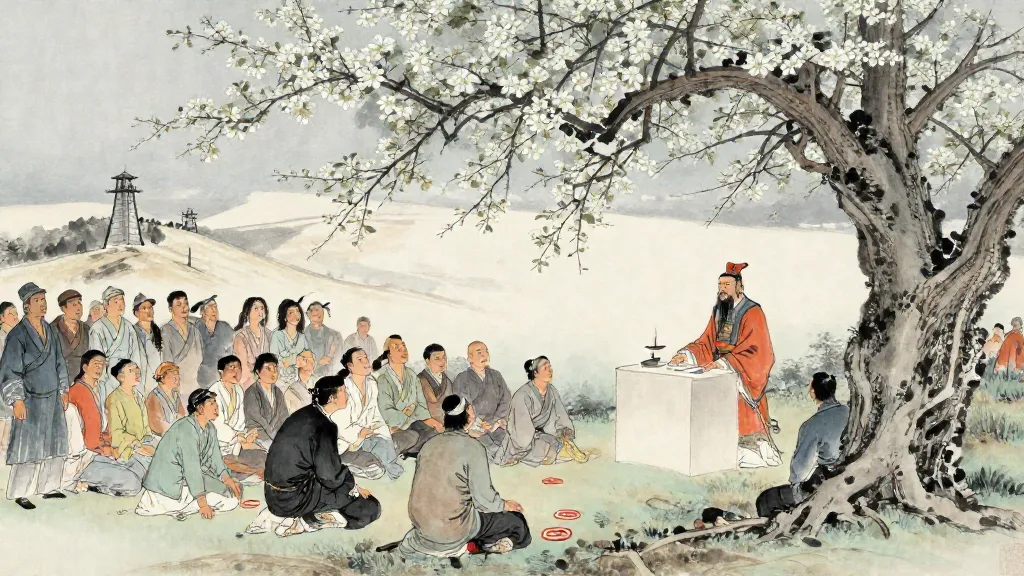
燕召公世家 (Hereditary House of Yan) — Chinese ink painting

Chapter 34 of 130

燕召公世家

Hereditary House of Yan

View:

召公受封與甘棠遺愛

The Duke of Shao Receives His Fief and the Legacy of the Sweet Pear Tree

召公奭與周同姓,姓姬氏。周武王之滅紂,封召公於北燕。

其在成王時,召王為三公:自陝以西,召公主之;自陝以東,周公主之。成王既幼,周公攝政,當國踐祚,召公疑之,作君奭。君奭不說周公。周公乃稱「湯時有伊尹,假於皇天;在太戊時,則有若伊陟、臣扈,假於上帝,巫鹹治王家;在祖乙時,則有若巫賢;在武丁時,則有若甘般:率維茲有陳,保乂有殷」。於是召公乃說。

召公之治西方,甚得兆民和。召公巡行鄉邑,有棠樹,決獄政事其下,自侯伯至庶人各得其所,無失職者。召公卒,而民人思召公之政,懷棠樹不敢伐,哥詠之,作甘棠之詩。

The Duke of Shao, whose personal name was Shi, shared the Ji surname of the Zhou royal house. When King Wu of Zhou destroyed the Shang tyrant Zhou, he enfeoffed the Duke of Shao in northern Yan.

During King Cheng's reign, the Duke of Shao served as one of the Three Dukes. The realm was divided at Shan: the Duke of Shao governed everything west of it, and the Duke of Zhou governed everything east. Since King Cheng was still a child, the Duke of Zhou served as regent, exercising royal authority. The Duke of Shao had misgivings about this and composed the 'Lord Shi' address. Lord Shi was displeased with the Duke of Zhou. The Duke of Zhou then invoked precedents: "In Tang's time there was Yi Yin, commissioned by August Heaven. In the time of Tai Wu there were Yi Zhi and Chen Hu, commissioned by the Lord on High, while Wu Xian managed the royal household. In Zu Yi's time there was Wu Xian. In Wu Ding's time there was Gan Pan. All of these followed this tradition and preserved the Yin dynasty." At this, the Duke of Shao was satisfied.

The Duke of Shao governed the western region and won the deep affection of the people. When he toured the villages and towns, he would sit beneath a sweet pear tree to hear legal cases and conduct government business. From the nobles down to the common people, everyone was properly served and no one was neglected. After the Duke of Shao died, the people cherished the memory of his governance. They revered the pear tree and dared not cut it down. They sang songs about it and composed the poem 'Sweet Pear Tree.'

Notes

1person召公奭Shào Gōng Shì

The Duke of Shao (召公奭, Shao Gong Shi) was a kinsman of the Zhou royal house who served Kings Wu, Cheng, and Kang. He and the Duke of Zhou were the two most powerful ministers of early Western Zhou. 'Shao' is sometimes romanized 'Zhao' but should not be confused with the Warring States kingdom of Zhao (趙).

2place

The division at Shan (陝, modern Shanzhou District, Sanmenxia, Henan) placed the Duke of Shao in charge of the western territories (including the Wei River valley and the Zhou homeland) and the Duke of Zhou in charge of the eastern territories (including the newly conquered Shang heartland).

3context

The 'Sweet Pear Tree' (甘棠) poem is preserved in the Book of Odes (Shijing, Ode 16 of the 'Airs of Shao and the South'). It reads: 'Do not cut the sweet pear, / Do not fell it; / The Duke of Shao rested beneath it.' The poem became a lasting symbol of benevolent local governance in Chinese political culture.

西周至春秋:諸侯紀年

Western Zhou Through the Spring and Autumn: A Chronological Record

自召公已下九世至惠侯。燕惠侯當周厲王奔彘,共和之時。

惠侯卒,子釐侯立。是歲,周宣王初即位。釐侯二十一年,鄭桓公初封於鄭。三十六年,釐侯卒,子頃侯立。

頃侯二十年,周幽王淫亂,為犬戎所弒。秦始列為諸侯。

二十四年,頃侯卒,子哀侯立。哀侯二年卒,子鄭侯立。鄭侯三十六年卒,子繆侯立。

繆侯七年,而魯隱公元年也。十八年卒,子宣侯立。宣侯十三年卒,子桓侯立。桓侯七年卒,子莊公立。

莊公十二年,齊桓公始霸。十六年,與宋、衛共伐周惠王,惠王出奔溫,立惠王弟穨為周王。十七年,鄭執燕仲父而內惠王於周。二十七年,山戎來侵我,齊桓公救燕,遂北伐山戎而還。燕君送齊桓公出境,桓公因割燕所至地予燕,使燕共貢天子,如成周時職;使燕復修召公之法。三十三年卒,子襄公立。

襄公二十六年,晉文公為踐土之會,稱伯。三十一年,秦師敗於殽。三十七年,秦穆公卒。四十年,襄公卒,桓公立。

桓公十六年卒,宣公立。宣公十五年卒,昭公立。昭公十三年卒,武公立。是歲晉滅三郤大夫。

武公十九年卒,文公立。文公六年卒,懿公立。懿公元年,齊崔杼弒其君莊公。四年卒,子惠公立。

惠公元年,齊高止來奔。六年,惠公多寵姬,公欲去諸大夫而立寵姬宋,大夫共誅姬宋,惠公懼,奔齊。四年,齊高偃如晉,請共伐燕,入其君。晉平公許,與齊伐燕,入惠公。惠公至燕而死。燕立悼公。

悼公七年卒,共公立。共公五年卒,平公立。晉公室卑,六卿始彊大。平公十八年,吳王闔閭破楚入郢。十九年卒,簡公立。簡公十二年卒,獻公立。晉趙鞅圍范、中行於朝歌。獻公十二年,齊田常弒其君簡公。十四年,孔子卒。二十八年,獻公卒,孝公立。

孝公十二年,韓、魏、趙滅知伯,分其地,三晉彊。

十五年,孝公卒,成公立。成公十六年卒,湣公立。湣公三十一年卒,釐公立。是歲,三晉列為諸侯。

Nine generations after the Duke of Shao came Marquis Hui. Marquis Hui's time corresponded to the period when King Li of Zhou fled to Zhi and the Gonghe Regency governed.

When Marquis Hui died, his son Marquis Xi succeeded. That year, King Xuan of Zhou first took the throne. In Marquis Xi's twenty-first year, Duke Huan of Zheng received his first enfeoffment. In the thirty-sixth year, Marquis Xi died and his son Marquis Qing succeeded.

In Marquis Qing's twentieth year, King You of Zhou debauched and was killed by the Quanrong. Qin was first listed among the feudal lords.

In the twenty-fourth year, Marquis Qing died and his son Marquis Ai succeeded. Marquis Ai died in his second year, and his son Marquis Zheng succeeded. Marquis Zheng died in his thirty-sixth year, and his son Marquis Mu succeeded.

In Marquis Mu's seventh year, it was the first year of Duke Yin of Lu. He died in his eighteenth year, and his son Marquis Xuan succeeded. Marquis Xuan died in his thirteenth year, and his son Marquis Huan succeeded. Marquis Huan died in his seventh year, and his son Duke Zhuang succeeded.

In Duke Zhuang's twelfth year, Duke Huan of Qi first achieved hegemony. In the sixteenth year, Yan joined Song and Wey in attacking King Hui of Zhou. King Hui fled to Wen, and they installed his brother Tui as king. In the seventeenth year, Zheng arrested Yan Zhongfu and restored King Hui to the throne. In the twenty-seventh year, the Shanrong invaded Yan. Duke Huan of Qi came to Yan's rescue and campaigned north against the Shanrong before returning. The lord of Yan escorted Duke Huan beyond Yan's border. Duke Huan thereupon ceded to Yan the territory up to the point where the Yan lord had accompanied him, instructed Yan to resume tributes to the Son of Heaven as in the days of the Cheng Zhou court, and directed Yan to restore the governance of the Duke of Shao. Duke Zhuang died in his thirty-third year, and his son Duke Xiang succeeded.

In Duke Xiang's twenty-sixth year, Duke Wen of Jin convened the Jiantu assembly and claimed the hegemony. In the thirty-first year, Qin's army was defeated at Xiao. In the thirty-seventh year, Duke Mu of Qin died. In the fortieth year, Duke Xiang died and Duke Huan succeeded.

Duke Huan died in his sixteenth year, and Duke Xuan succeeded. Duke Xuan died in his fifteenth year, and Duke Zhao succeeded. Duke Zhao died in his thirteenth year, and Duke Wu succeeded. That year, Jin eliminated three Grandees of the Xi clan.

Duke Wu died in his nineteenth year, and Duke Wen succeeded. Duke Wen died in his sixth year, and Duke Yi succeeded. In Duke Yi's first year, Cui Zhu of Qi assassinated his lord Duke Zhuang. Duke Yi died in his fourth year, and his son Duke Hui succeeded.

In Duke Hui's first year, Gao Zhi of Qi fled to Yan. In the sixth year, Duke Hui had many favored consorts. He wished to dismiss the grandees and install his favorite, the Lady Song. The grandees jointly killed the Lady Song, and Duke Hui, fearful, fled to Qi. Four years later, Qi's Gao Yan went to Jin to request a joint campaign against Yan to restore its lord. Duke Ping of Jin agreed, and together with Qi they attacked Yan and restored Duke Hui. Duke Hui reached Yan and died. Yan installed Duke Dao.

Duke Dao died in his seventh year, and Duke Gong succeeded. Duke Gong died in his fifth year, and Duke Ping succeeded. The Jin ducal house had declined, and the six ministerial clans grew powerful. In Duke Ping's eighteenth year, King Helu of Wu destroyed Chu and entered Ying. Duke Ping died in his nineteenth year, and Duke Jian succeeded. Duke Jian died in his twelfth year, and Duke Xian succeeded. In Jin, Zhao Yang besieged Fan and Zhonghang at Zhaoge. In Duke Xian's twelfth year, Tian Chang of Qi assassinated his lord Duke Jian. In the fourteenth year, Confucius died. In the twenty-eighth year, Duke Xian died and Duke Xiao succeeded.

In Duke Xiao's twelfth year, Han, Wei, and Zhao destroyed Zhi Bo and divided his territory. The Three Jin grew powerful.

In the fifteenth year, Duke Xiao died and Duke Cheng succeeded. Duke Cheng died in his sixteenth year, and Duke Min succeeded. Duke Min died in his thirty-first year, and Duke Xi succeeded. That year, the Three Jin were formally listed as feudal lords.

Notes

1context

The Gonghe Regency (共和, 841-828 BC) is the earliest precisely dated period in Chinese history. It began when the nobles of the Zhou court expelled the tyrannical King Li and governed collectively until King Xuan's accession.

2context

The Shanrong (山戎) were a northern frontier people who repeatedly threatened Yan. Duke Huan of Qi's rescue campaign (c. 664 BC) was a famous demonstration of hegemonic responsibility: the hegemon protected weaker states from barbarian incursions. The territory Huan ceded to Yan as a gesture of courtesy became a celebrated example of magnanimity.

3context

Sima Qian compresses roughly five hundred years of Yan history (from the Western Zhou through the Spring and Autumn period) into a sparse chronological outline. Yan was geographically remote from the centers of power in the central plain, and its early history is poorly documented. The text essentially serves as a timeline, anchored to better-known events in other states.

蘇秦與文侯、易王

Su Qin and the Reigns of Duke Wen and King Yi

釐公三十年,伐敗齊於林營。釐公卒,桓公立。桓公十一年卒,文公立。是歲,秦獻公卒。秦益彊。

文公十九年,齊威王卒。二十八年,蘇秦始來見,說文公。文公予車馬金帛以至趙,趙肅侯用之。因約六國,為從長。秦惠王以其女為燕太子婦。

二十九年,文公卒,太子立,是為易王。

易王初立,齊宣王因燕喪伐我,取十城;蘇秦說齊,使復歸燕十城。十年,燕君為王。蘇秦與燕文公夫人私通,懼誅,乃說王使齊為反間,欲以亂齊。易王立十二年卒,子燕噲立。

In Duke Xi's thirtieth year, Yan defeated Qi at Linying. Duke Xi died and Duke Huan succeeded. Duke Huan died in his eleventh year, and Duke Wen succeeded. That year, Duke Xian of Qin died. Qin grew ever stronger.

In Duke Wen's nineteenth year, King Wei of Qi died. In the twenty-eighth year, Su Qin first came to present his proposals to Duke Wen. Duke Wen provided him with carriages, horses, gold, and silk to proceed to Zhao. Marquis Su of Zhao employed him. Su Qin thereupon brokered an alliance of the six states and became the leader of the vertical coalition. King Hui of Qin gave his daughter in marriage to the Yan crown prince.

In the twenty-ninth year, Duke Wen died and the crown prince succeeded as King Yi.

When King Yi first took the throne, King Xuan of Qi exploited Yan's mourning period to attack, seizing ten cities. Su Qin persuaded Qi to return all ten cities to Yan. In the tenth year, the Yan ruler assumed the title of king. Su Qin had been conducting an affair with the widow of Duke Wen. Fearing execution, he persuaded the king to send him to Qi as a double agent, intending to destabilize Qi from within. King Yi died in his twelfth year, and his son Yan Kuai succeeded.

Notes

1person蘇秦Sū Qín

Su Qin (蘇秦, d. c. 284 BC) was the famous architect of the 'vertical alliance' (合縱) strategy, which sought to unite the six eastern states against Qin. Yan was his original patron. Recent discoveries of bamboo-slip texts from Mawangdui have complicated the traditional chronology of Su Qin's career, suggesting he may have been primarily active later than the Shiji implies.

2context

Su Qin's affair with the Dowager Duchess of Yan and his subsequent mission to Qi as a double agent is one of the most remarkable episodes in Warring States espionage. Sima Qian portrays him as simultaneously serving Yan's strategic interests (weakening Qi) while fleeing personal danger, a morally ambiguous figure typical of the era's itinerant persuaders.

燕王噲禪讓之禍

King Kuai's Abdication Disaster

燕噲既立,齊人殺蘇秦。蘇秦之在燕,與其相子之為婚,而蘇代與子之交。及蘇秦死,而齊宣王復用蘇代。燕噲三年,與楚、三晉攻秦,不勝而還。子之相燕,貴重,主斷。蘇代為齊使於燕,燕王問曰:「齊王奚如?」對曰:「必不霸。」燕王曰:「何也?」對曰:「不信其臣。」蘇代欲以激燕王以尊子之也。於是燕王大信子之。子之因遺蘇代百金,而聽其所使。

鹿毛壽謂燕王:「不如以國讓相子之。人之謂堯賢者,以其讓天下於許由,許由不受,有讓天下之名而實不失天下。今王以國讓於子之,子之必不敢受,是王與堯同行也。」燕王因屬國於子之,子之大重。或曰:「禹薦益,已而以啟人為吏。及老,而以啟人為不足任乎天下,傳之於益。已而啟與交黨攻益,奪之。天下謂禹名傳天下於益,已而實令啟自取之。今王言屬國於子之,而吏無非太子人者,是名屬子之而實太子用事也。」王因收印自三百石賣已訟而效之子之。子之南面行王事,而噲老不聽政,顧為臣,國事皆決於子之。

After Yan Kuai took the throne, the people of Qi killed Su Qin. While Su Qin had been in Yan, he had arranged a marriage alliance with Yan's chancellor Zi Zhi, and Su Dai had formed a close relationship with Zi Zhi. After Su Qin's death, King Xuan of Qi again employed Su Dai. In Yan Kuai's third year, Yan joined Chu and the Three Jin in attacking Qin, but they failed and withdrew. Zi Zhi served as Yan's chancellor, wielding great authority and making key decisions. When Su Dai came to Yan as Qi's envoy, the king asked: "What is the King of Qi like?" Su Dai replied: "He will never achieve hegemony." The king asked why. Su Dai said: "Because he does not trust his ministers." Su Dai intended to provoke the king into elevating Zi Zhi. The king thereupon placed immense trust in Zi Zhi. Zi Zhi rewarded Su Dai with a hundred pieces of gold and followed his directives.

Lu Maoshou told the King of Yan: "Why not cede the state to Chancellor Zi Zhi? The reason people call Yao a sage is that he offered the realm to Xu You, and Xu You refused. Yao gained the reputation of yielding the realm without actually losing it. If Your Majesty offers the state to Zi Zhi, Zi Zhi will surely not dare accept, and Your Majesty will share Yao's reputation." The king accordingly entrusted the state to Zi Zhi, and Zi Zhi's authority became paramount. Someone then said: "Yu recommended Yi as his successor but staffed the government with his son Qi's men. When Yu grew old and declared Qi unfit, he passed the throne to Yi. But then Qi and his faction attacked Yi and seized power. The world says Yu nominally passed the realm to Yi but actually arranged for Qi to take it. Now Your Majesty says he has entrusted the state to Zi Zhi, but every official is the crown prince's man. This is nominally entrusting the state to Zi Zhi while the crown prince actually holds power." The king then collected the seals of office from every official ranked at three hundred shi and above and handed them all to Zi Zhi. Zi Zhi faced south and exercised royal authority. Kuai, now old, no longer participated in governance but became a subject instead. All affairs of state were decided by Zi Zhi.

Notes

1person子之Zǐ Zhī

Zi Zhi (子之, d. 314 BC) was Yan's chancellor who effectively usurped royal power through King Kuai's misguided abdication. His brief reign plunged Yan into civil war and foreign invasion.

2context

King Kuai's abdication (禪讓) was inspired by the ancient legend of sage-king Yao yielding the throne to the worthy Shun, bypassing his own son. This Confucian and Mohist ideal of meritocratic succession was deeply impractical in the Warring States context. Lu Maoshou's cunning argument exploited Kuai's vanity, and the result was catastrophic.

3context

The parallel to the Yu-Yi-Qi succession myth is telling. The advisor argues that merely 'offering' the state means nothing if the bureaucracy still serves the crown prince, since real power follows the officials, not the title. King Kuai responded by actually transferring the seals of office, making the abdication genuine rather than ceremonial. This naive literalism destroyed Yan's political order.

齊破燕與昭王復國

Qi Destroys Yan; King Zhao Restores the State

三年,國大亂,百姓恫恐。將軍市被與太子平謀,將攻子之。諸將謂齊湣王曰:「因而赴之,破燕必矣。」齊王因令人謂燕太子平曰:「寡人聞太子之義,將廢私而立公,飭君臣之義,明父子之位。寡人之國小,不足以為先後。雖然,則唯太子所以令之。」太子因要黨聚眾,將軍市被圍公宮,攻子之,不克。將軍市被及百姓反攻太子平,將軍市被死,以徇。因搆難數月,死者數萬,眾人恫恐,百姓離志。孟軻謂齊王曰:「今伐燕,此文、武之時,不可失也。」王因令章子將五都之兵,以因北地之眾以伐燕。士卒不戰,城門不閉,燕君噲死,齊大勝。燕子之亡二年,而燕人共立太子平,是為燕昭王。

燕昭王於破燕之後即位,卑身厚幣以招賢者。謂郭隗曰:「齊因孤之國亂而襲破燕,孤極知燕小力少,不足以報。然誠得賢士以共國,以雪先王之恥,孤之原也。先生視可者,得身事之。」郭隗曰:「王必欲致士,先從隗始。況賢於隗者,豈遠千里哉!」於是昭王為隗改築宮而師事之。樂毅自魏往,鄒衍自齊往,劇辛自趙往,士爭趨燕。燕王吊死問孤,與百姓同甘苦。

In the third year, the state fell into great turmoil and the people were terrified. General Shi Bei conspired with Crown Prince Ping to attack Zi Zhi. Generals advised King Min of Qi: "Strike now while they are in chaos. Yan will surely be destroyed." The King of Qi sent word to Crown Prince Ping: "I have heard of the prince's righteousness. You intend to abolish private interest and establish the public good, to correct the proper relationship between ruler and minister, and to clarify the positions of father and son. My state is small and cannot take the lead. Nevertheless, I will follow whatever the prince commands." The crown prince rallied his faction and raised a force. General Shi Bei besieged the palace and attacked Zi Zhi but failed to overcome him. General Shi Bei and his soldiers then turned against Crown Prince Ping instead. General Shi Bei was killed and his body publicly displayed. The fighting continued for several months. Tens of thousands died, the people were terrorized, and the populace lost all allegiance. Mencius told the King of Qi: "Now is the time to attack Yan. This is an opportunity like those of Kings Wen and Wu. It must not be lost." The king therefore ordered General Zhang Zi to lead the troops of the five capitals, supplemented by the northern garrison forces, to invade Yan. The soldiers did not fight and the city gates were not closed. King Kuai died, and Qi won a great victory. Two years after Zi Zhi's death, the people of Yan together installed Crown Prince Ping as king. This was King Zhao of Yan.

King Zhao took the throne amid the ruins of the state. He humbled himself and offered generous rewards to attract men of talent. He said to Guo Wei: "Qi exploited our disorder to invade and destroy Yan. I know well that Yan is small and weak, not strong enough for revenge. But if I can truly find worthy men to share in governing the state and wash away the shame of my predecessor, that is my deepest wish. Tell me, sir, whom should I serve?" Guo Wei said: "If Your Majesty truly wishes to attract talent, begin with me. If even someone of my modest ability is honored, how much more will those far worthier than I refuse to travel a thousand li?" King Zhao thereupon built Guo Wei a new residence and treated him as his teacher. Yue Yi came from Wei, Zou Yan came from Qi, and Ju Xin came from Zhao. Scholars competed to come to Yan. The king mourned the dead, cared for orphans, and shared the hardships and pleasures of his people.

Notes

1person燕昭王Yān Zhāo Wáng

King Zhao of Yan (燕昭王, r. c. 311-279 BC) is celebrated as one of the great state-builders of the Warring States. His patient, decades-long project of national recovery and talent recruitment transformed Yan from a devastated state into one capable of nearly destroying Qi.

2person郭隗Guō Wěi

Guo Wei (郭隗) was a scholar who advised King Zhao to attract talent by honoring even mediocre men, on the principle that greater men would follow. His saying 'begin with me' (先從隗始) became a proverbial expression for starting with modest steps to achieve a larger goal.

3person樂毅Yuè Yì

Yue Yi (樂毅) was a brilliant general from a Wei noble family who became the instrument of King Zhao's revenge against Qi. Zou Yan (鄒衍) was the leading Yin-Yang cosmologist of the age. Ju Xin (劇辛) was a Zhao military figure. Together they represented the range of talent King Zhao attracted.

4context

Mencius's advice to the King of Qi to invade Yan is a controversial episode. While Mencius framed it as a righteous intervention to end Zi Zhi's usurpation, the invasion turned into an occupation that brutalized the Yan people and ultimately backfired, creating the bitter resentment that fueled King Zhao's revenge campaign decades later.

樂毅伐齊

Yue Yi's Campaign Against Qi

二十八年,燕國殷富,士卒樂軼輕戰,於是遂以樂毅為上將軍,與秦、楚、三晉合謀以伐齊。齊兵敗,湣王出亡於外。燕兵獨追北,入至臨淄,盡取齊寶,燒其宮室宗廟。齊城之不下者,獨唯聊、莒、即墨,其餘皆屬燕,六歲。

昭王三十三年卒,子惠王立。

惠王為太子時,與樂毅有隙;及即位,疑毅,使騎劫代將。樂毅亡走趙。齊田單以即墨擊敗燕軍,騎劫死,燕兵引歸,齊悉復得其故城。湣王死於莒,乃立其子為襄王。

In the twenty-eighth year, Yan was prosperous and powerful. Its soldiers were eager and ready for battle. King Zhao thereupon appointed Yue Yi as supreme general and coordinated with Qin, Chu, and the Three Jin to attack Qi. The Qi army was defeated, and King Min fled into exile. Yan's forces alone pursued the retreating Qi army, entering the capital Linzi, seizing all of Qi's treasures, and burning its palaces and ancestral temples. The only Qi cities that held out were Liao, Ju, and Jimo. All the rest submitted to Yan, and this situation lasted six years.

King Zhao died in his thirty-third year, and his son King Hui succeeded.

When Hui had been crown prince, he had quarreled with Yue Yi. Upon taking the throne, he distrusted Yue Yi and sent Qi Jie to replace him as commander. Yue Yi fled to Zhao. Qi's Tian Dan, based at Jimo, defeated the Yan army. Qi Jie was killed, and the Yan forces withdrew. Qi recovered all of its former cities. King Min had died at Ju, and the Qi people installed his son as King Xiang.

Notes

1context

The joint invasion of Qi in 284 BC was the greatest military achievement in Yan's history. Yue Yi conquered over seventy Qi cities in a lightning campaign. However, his inability to take the last three cities (particularly Jimo) over six years allowed Qi to survive and eventually recover.

2person田單Tián Dān

Tian Dan (田單, fl. 279 BC) was a minor Qi official who organized the defense of Jimo and then launched a brilliant counterattack using a 'fire ox' stratagem: he tied torches to the tails of a thousand oxen and drove them into the Yan camp at night, causing chaos. His recovery of all Qi territory from Yan is one of the most celebrated comebacks in Chinese military history.

3context

King Hui's decision to replace Yue Yi with the incompetent Qi Jie is a classic example of how personal grudges between ruler and general could reverse the fortunes of an entire state. Sima Qian implies that Yan's loss of its Qi conquests was entirely due to the change in command, not to any failure of Yue Yi's strategy.

衰落:從武成王到燕王喜

Decline: From King Wucheng to King Xi

惠王七年卒。韓、魏、楚共伐燕。燕武成王立。

武成王七年,齊田單伐我,拔中陽。十三年,秦敗趙於長平四十餘萬。十四年,武成王卒,子孝王立。

孝王元年,秦圍邯鄲者解去。三年卒,子今王喜立。

今王喜四年,秦昭王卒。燕王命相栗腹約歡趙,以五百金為趙王酒。還報燕王曰:「趙王壯者皆死長平,其孤未壯,可伐也。」王召昌國君樂間問之。對曰:「趙四戰之國,其民習兵,不可伐。」王曰:「吾以五而伐一。」對曰:「不可。」燕王怒,群臣皆以為可。卒起二軍,車二千乘,栗腹將而攻鄗,卿秦攻代。唯獨大夫將渠謂燕王曰:「與人通關約交,以五百金飲人之王,使者報而反攻之,不祥,兵無成功。」燕王不聽,自將偏軍隨之。將渠引燕王綬止之曰:「王必無自往,往無成功。」王槅之以足。將渠泣曰:「臣非以自為,為王也!」燕軍至宋子,趙使廉頗將,擊破栗腹於鄗。破卿秦於代。樂間奔趙。廉頗逐之五百餘里,圍其國。燕人請和,趙人不許,必令將渠處和。燕相將渠以處和。趙聽將渠,解燕圍。

King Hui died in his seventh year. Han, Wei, and Chu jointly attacked Yan. King Wucheng was installed.

In King Wucheng's seventh year, Qi's Tian Dan attacked Yan and captured Zhongyang. In the thirteenth year, Qin defeated Zhao at Changping, killing over four hundred thousand. In the fourteenth year, King Wucheng died and his son King Xiao succeeded.

In King Xiao's first year, Qin lifted its siege of Handan and withdrew. King Xiao died in his third year, and his son, the current King Xi, succeeded.

In King Xi's fourth year, King Zhao of Qin died. King Xi ordered Chancellor Li Fu to make a friendship pact with Zhao, presenting five hundred pieces of gold as a gift for the King of Zhao's banquet. Upon returning, Li Fu reported: "Zhao's able-bodied men all died at Changping. Their orphans have not yet grown up. Zhao can be attacked." The king summoned Lord Changguo, Yue Jian, and asked his opinion. Yue Jian replied: "Zhao is a state that has fought on all four borders. Its people are experienced in war. Zhao cannot be attacked." The king said: "I will attack with five to one." Yue Jian replied: "It cannot be done." The king was furious. All other ministers said it could be done. He raised two armies with two thousand chariots. Li Fu commanded the attack on Hao, and Minister Qin attacked Dai. Only the grandee Jiang Qu told the king: "To make a pact of friendship with someone, present five hundred gold as a banquet gift to their king, and then upon the envoy's return attack them, is deeply inauspicious. The campaign will not succeed." The king refused to listen and personally led a supporting army. Jiang Qu seized the king's sash to stop him, saying: "Your Majesty must not go in person. If you go, there will be no success." The king kicked him away. Jiang Qu wept: "I do not say this for myself. I say it for the king."

The Yan army reached Songzi. Zhao sent Lian Po to command its forces, who routed Li Fu at Hao and defeated Minister Qin at Dai. Yue Jian fled to Zhao. Lian Po pursued for over five hundred li and besieged the Yan capital. Yan sued for peace, but Zhao refused, insisting that Jiang Qu handle the negotiations. Chancellor Jiang Qu conducted the peace talks. Zhao accepted Jiang Qu's terms and lifted the siege.

Notes

1person廉頗Lián Pō

Lian Po (廉頗, fl. 280s-240s BC) was one of Zhao's greatest generals, famous for both offensive and defensive warfare. His decisive defeat of Yan's invasion demonstrated that Zhao, even after the Changping disaster, retained formidable military capability.

2context

King Xi's attack on Zhao (251 BC) was a profound strategic blunder. Despite Zhao's massive losses at Changping (260 BC), the surviving Zhao population was battle-hardened and highly motivated. Li Fu's opportunism and the king's refusal to heed Yue Jian and Jiang Qu's warnings echoed the tragic pattern of rulers ignoring sound advice that recurs throughout the Shiji.

3person將渠Jiāng Qú

Jiang Qu (將渠) was a Yan grandee whose principled opposition to the war and subsequent role as peace negotiator saved Yan from destruction. That Zhao insisted on him specifically as the negotiator reflects the Warring States convention that an honest opponent was a more reliable treaty partner than a duplicitous one.

燕之滅亡

The Fall of Yan

六年,秦滅東周,置三川郡。七年,秦拔趙榆次三十七城,秦置大原郡。九年,秦王政初即位。十年,趙使廉頗將攻繁陽,拔之。趙孝成王卒,悼襄王立。使樂乘代廉頗,廉頗不聽,攻樂乘,樂乘走,廉頗奔大梁。十二年,趙使李牧攻燕,拔武遂、方城。劇辛故居趙,與龐暖善,已而亡走燕。燕見趙數困於秦,而廉頗去,令龐暖將也,欲因趙弊攻之。問劇辛,辛曰:「龐暖易與耳。」燕使劇辛將擊趙,趙使龐暖擊之,取燕軍二萬,殺劇辛。秦拔魏二十城,置東郡。十九年,秦拔趙之鄴九城。趙悼襄王卒。二十三年,太子丹質於秦,亡歸燕。二十五年,秦虜滅韓王安,置潁川郡。二十七年,秦虜趙王遷,滅趙。趙公子嘉自立為代王。

燕見秦且滅六國,秦兵臨易水,禍且至燕。太子丹陰養壯士二十人,使荊軻獻督亢地圖於秦,因襲刺秦王。秦王覺,殺軻,使將軍王翦擊燕。二十九年,秦攻拔我薊,燕王亡,徙居遼東,斬丹以獻秦。三十年,秦滅魏。

三十三年,秦拔遼東,虜燕王喜,卒滅燕。是歲,秦將王賁亦虜代王嘉。

太史公曰:召公奭可謂仁矣!甘棠且思之,況其人乎?燕迫蠻貉,內措齊、晉,崎嶇彊國之間,最為弱小,幾滅者數矣。然社稷血食者八九百歲,於姬姓獨後亡,豈非召公之烈邪!

In the sixth year, Qin destroyed the Eastern Zhou court and established the Sanchuan commandery. In the seventh year, Qin captured thirty-seven Zhao cities including Yuci, and established the Taiyuan commandery. In the ninth year, King Zheng of Qin first took the throne. In the tenth year, Zhao sent Lian Po to attack Fanyang and capture it. King Xiaocheng of Zhao died and King Daoxiang succeeded. He sent Yue Cheng to replace Lian Po, but Lian Po refused and attacked Yue Cheng, who fled. Lian Po then fled to Daliang. In the twelfth year, Zhao sent Li Mu to attack Yan, capturing Wusui and Fangcheng. Ju Xin had formerly lived in Zhao and was close to Pang Nuan, but later fled to Yan. Yan observed that Zhao had been weakened by repeated Qin attacks, that Lian Po had departed, and that Pang Nuan now commanded. Yan wished to exploit Zhao's weakness. They consulted Ju Xin, who said: "Pang Nuan is easy to handle." Yan sent Ju Xin to lead an attack on Zhao. Zhao sent Pang Nuan to counter him. Pang Nuan captured twenty thousand Yan troops and killed Ju Xin. Qin took twenty Wei cities and established the Eastern Commandery. In the nineteenth year, Qin took nine of Zhao's Ye-region cities. King Daoxiang of Zhao died. In the twenty-third year, Crown Prince Dan, who had been a hostage in Qin, escaped and returned to Yan. In the twenty-fifth year, Qin captured King An of Han and destroyed Han, establishing the Yingchuan commandery. In the twenty-seventh year, Qin captured King Qian of Zhao and destroyed Zhao. Zhao prince Jia proclaimed himself King of Dai.

Yan saw that Qin was on the verge of destroying all six states. Qin's army had reached the Yi River, and catastrophe was about to descend on Yan. Crown Prince Dan had secretly nurtured twenty strong men. He sent Jing Ke to present a map of the Dukang region to Qin, with a hidden dagger to assassinate the King of Qin. The king detected the plot and killed Jing Ke, then sent General Wang Jian to attack Yan. In the twenty-ninth year, Qin captured Ji, Yan's capital. The King of Yan fled and relocated to Liaodong. He beheaded Prince Dan and presented the head to Qin. In the thirtieth year, Qin destroyed Wei.

In the thirty-third year, Qin captured Liaodong, took King Xi prisoner, and finally destroyed Yan. That same year, the Qin general Wang Ben also captured King Jia of Dai.

The Grand Historian remarks: The Duke of Shao may truly be called benevolent! Even a pear tree is cherished in his memory; how much more the man himself? Yan was pressed by the Man and Mo peoples on its borders, hemmed in by Qi and Jin on the inside, caught between powerful states, and was always the weakest and smallest. It nearly perished several times. Yet its altars received sacrificial offerings for eight or nine hundred years, and among all the Ji-surnamed states it was the last to fall. Was this not the enduring influence of the Duke of Shao?

Notes

1person太子丹Tàizǐ Dān

Crown Prince Dan (太子丹, d. 226 BC) had been a hostage at the Qin court and bore a personal grudge against King Zheng. His assassination plot, using Jing Ke, is told in dramatic detail in Shiji chapter 86. Its failure accelerated Yan's destruction.

2place

Ji (薊) was Yan's capital, located at modern Beijing. After Ji fell in 226 BC, King Xi fled to Liaodong (modern southern Manchuria), where he survived three more years before final capture.

3place

Dukang (督亢) was a fertile region in southern Yan (modern Zhuozhou-Gu'an area, Hebei). Prince Dan offered its map to Qin as a pretext for Jing Ke's audience, concealing a poisoned dagger inside the rolled scroll.

4context

Sima Qian's concluding assessment draws a long arc from the Duke of Shao's benevolent founding to Yan's final destruction eight centuries later. His attribution of Yan's remarkable longevity to the Duke of Shao's legacy reflects the traditional Chinese belief that virtuous founding had lasting effects across generations. Yan was the last Ji-surnamed (Zhou royal lineage) state to fall: it outlasted even the Zhou royal domain itself.

Edition & Source

Text
《史記》 Shiji
Edition
中華古詩文古書籍網 transcription
Commentary
裴駰《史記集解》、司馬貞《史記索隱》、張守節《史記正義》(Three Commentaries)