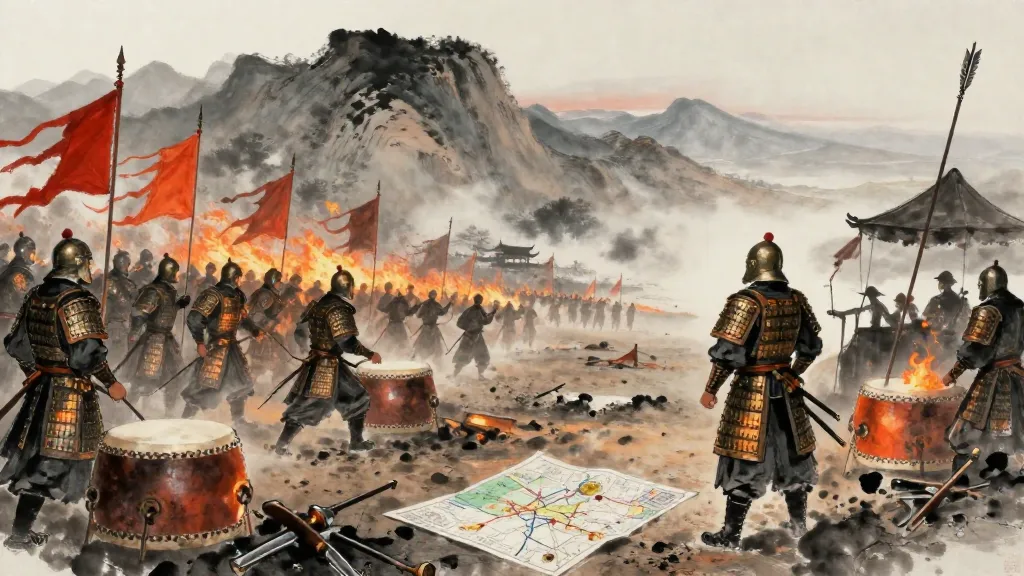
宋微子世家 (Hereditary House of Song — Weizi) — Chinese ink painting

Chapter 38 of 130

宋微子世家

Hereditary House of Song — Weizi

View:

殷之三仁

The Three Humane Men of Yin

微子開者,殷帝乙之首子而帝紂之庶兄也。紂既立,不明,淫亂於政,微子數諫,紂不聽。及祖伊以周西伯昌之修德,滅璿國,懼禍至,以告紂。紂曰:「我生不有命在天乎?是何能為!」於是微子度紂終不可諫,欲死之,及去,未能自決,乃問於太師、少師。

箕子者,紂親戚也。紂始為象箸,箕子嘆曰:「彼為象箸,必為玉桮;為桮,則必思遠方珍怪之物而御之矣。輿馬宮室之漸自此始,不可振也。」紂為淫泆,箕子諫,不聽。人或曰:「可以去矣。」箕子曰:「為人臣諫不聽而去,是彰君之惡而自說於民,吾不忍為也。」乃被發詳狂而為奴。

王子比干者,亦紂之親戚也。見箕子諫不聽而為奴,則曰:「君有過而不以死爭,則百姓何辜!」乃直言諫紂。紂怒曰:「吾聞聖人之心有七竅,信有諸乎?」乃遂殺王子比干,刳視其心。

Weizi Kai was the eldest son of the Yin ruler Di Yi and an elder half-brother of King Zhou. After Zhou took the throne, he was unenlightened, ruling with wanton excess. Weizi remonstrated repeatedly, but Zhou would not listen. When Zu Yi, alarmed by King Wen of Zhou's cultivation of virtue and destruction of the state of Xuan, warned Zhou that disaster was approaching, Zhou said: "Was I not born with Heaven's mandate? What can anyone do?" Weizi then judged that Zhou could never be swayed by remonstrance. He wished either to die for his principles or to leave, but could not decide, so he consulted the Grand Preceptor and Junior Preceptor.

Jizi was a kinsman of King Zhou. When Zhou first had ivory chopsticks made, Jizi sighed: "If he makes ivory chopsticks, he will want jade cups; with jade cups, he will crave exotic delicacies from distant lands. The escalation of carriages, horses, and palaces begins here — it cannot be reversed." As Zhou grew increasingly dissolute, Jizi remonstrated but was ignored. Someone said: "You may leave now." Jizi said: "When a minister remonstrates and is not heeded, to leave is to expose the ruler's faults and ingratiate oneself with the people. I cannot bear to do that." He then disheveled his hair, feigned madness, and became a slave.

Prince Bigan was also a kinsman of Zhou. Seeing that Jizi's remonstrance was ignored and that he had been enslaved, Bigan said: "If a ruler has faults and his ministers do not contend to the death, what wrong have the common people committed?" He spoke out plainly to remonstrate with Zhou. Zhou was furious: "I have heard that a sage's heart has seven apertures — is that true?" He killed Prince Bigan and cut open his chest to examine his heart.

Notes

1person微子Wēi Zǐ

Weizi (微子, personal name Kai 開) was the elder half-brother of the last Shang king, Zhou. After the Zhou conquest, he was enfeoffed at Song to continue the Shang sacrifices. Confucius praised him as one of the 'Three Humane Men of Yin' (殷有三仁).

2person箕子Jī Zǐ

Jizi (箕子) was a Shang royal uncle who feigned madness to survive. After the Zhou conquest, King Wu consulted him on governance; he expounded the Great Plan (洪範). He was traditionally said to have been enfeoffed in Joseon (Korea).

3person比干Bǐ Gān

Prince Bigan (比干) died for his remonstrance and became the archetype of the loyal minister who sacrifices his life for his principles. His story of the 'seven-aperture heart' is one of the most famous in Chinese tradition.

宋國之建立與箕子洪範

The Founding of Song and Jizi's Great Plan

微子曰:「父子有骨肉,而臣主以義屬。故父有過,子三諫不聽,則隨而號之;人臣三諫不聽,則其義可以去矣。」於是太師、少師乃勸微子去,遂行。

周武王伐紂克殷,微子乃持其祭器造於軍門,肉袒面縛,左牽羊,右把茅,膝行而前以告。於是武王乃釋微子,復其位如故。

武王封紂子武庚祿父以續殷祀,使管叔、蔡叔傅相之。

武王既克殷,訪問箕子。

武王曰:「於乎!維天陰定下民,相和其居,我不知其常倫所序。」

箕子對曰:「在昔鯀堙鴻水,汨陳其五行,帝乃震怒,不從鴻範九等,常倫所斁。鯀則殛死,禹乃嗣興。天乃錫禹鴻範九等,常倫所序。」

於是武王乃封箕子於朝鮮而不臣也。

武王崩,成王少,周公旦代行政當國。管、蔡疑之,乃與武庚作亂,欲襲成王、周公。周公既承成王命誅武庚,殺管叔,放蔡叔,乃命微子開代殷後,奉其先祀,作微子之命以申之,國於宋。微子故能仁賢,乃代武庚,故殷之餘民甚戴愛之。

Weizi said: "Between father and son there are bonds of flesh and blood, but between minister and ruler the bond is one of righteousness. Thus if a father errs and the son remonstrates three times without being heeded, the son follows and weeps. If a minister remonstrates three times without being heeded, it is right for him to leave." The Grand and Junior Preceptors then urged Weizi to depart, and he left.

When King Wu of Zhou attacked King Zhou and conquered Yin, Weizi brought his ancestral ritual vessels to the army's gate, bared his upper body with hands tied behind his back, holding a sheep in his left hand and a bundle of reeds in his right, and crawled forward on his knees to submit. King Wu released Weizi and restored him to his former status.

King Wu enfeoffed Zhou's son Wu Geng Lufu to continue the Yin sacrifices, and appointed the Dukes of Guan and Cai as his tutors and aides.

After conquering Yin, King Wu consulted Jizi. The king said: "Alas! Heaven silently establishes the people below, harmonizing their dwellings, but I do not know the proper ordering of the constant principles." Jizi replied: "In ancient times, Gun tried to dam the great flood and disrupted the Five Phases. The Lord on High was enraged and did not grant the Great Plan's Nine Categories, so the constant principles fell into disorder. Gun was executed, and Yu succeeded him. Heaven then bestowed upon Yu the Nine Categories of the Great Plan, and the constant principles were ordered."

King Wu enfeoffed Jizi in Joseon and did not treat him as a subject.

King Wu died. King Cheng was young, and the Duke of Zhou governed as regent. The Dukes of Guan and Cai suspected his intentions and revolted with Wu Geng, plotting to attack King Cheng and the Duke of Zhou. The Duke of Zhou, acting on King Cheng's authority, executed Wu Geng, killed the Duke of Guan, and exiled the Duke of Cai. He then commanded Weizi Kai to succeed as representative of the Yin line, maintain the ancestral sacrifices, and composed the Charge to Weizi to formalize it. He was given the state of Song. Because Weizi was humane and capable, and because he replaced Wu Geng, the surviving people of Yin deeply admired and loved him.

Notes

1context

The Great Plan (洪範) expounded by Jizi is preserved in the Shangshu (Book of Documents). It outlines nine categories of governance including the Five Phases, Five Affairs, Eight Policies, Five Markers of Time, Royal Perfection, Three Virtues, Resolution of Doubts, Various Portents, and Five Blessings and Six Extremities.

2place

The state of Song (宋) was centered at Shangqiu (商丘) in modern Henan. As the continuation of the Shang royal line, Song held special ritual status among the Zhou feudal states and was permitted to use Shang dynasty rites.

宋國紛亂與襄公之仁

Song's Internal Strife and Duke Xiang's Chivalry

微子開卒,立其弟衍,是為微仲。微仲卒,子宋公稽立。宋公稽卒,子丁公申立。丁公申卒,子湣公共立。湣公共卒,弟煬公熙立。煬公即位,湣公子鮒祀弒煬公而自立,曰「我當立」,是為厲公。厲公卒,子釐公舉立。

宣公有太子與夷。十九年,宣公病,讓其弟和,曰:「父死子繼,兄死弟及,天下通義也。我其立和。」和亦三讓而受之。宣公卒,弟和立,是為穆公。

穆公九年,病,召大司馬孔父謂曰:「先君宣公舍太子與夷而立我,我不敢忘。我死,必立與夷也。」

襄公七年,宋地霣星如雨,與雨偕下;六鶂退蜚,風疾也。

八年,齊桓公卒,宋欲為盟會。十二年春,宋襄公為鹿上之盟,以求諸侯於楚,楚人許之。秋,諸侯會宋公盟於盂。目夷曰:「禍其在此乎?君欲已甚,何以堪之!」於是楚執宋襄公以伐宋。冬,會於亳,以釋宋公。十三年夏,宋伐鄭。秋,楚伐宋以救鄭。襄公將戰,子魚諫曰:「天之棄商久矣,不可。」冬,十一月,襄公與楚成王戰於泓。楚人未濟,目夷曰:「彼眾我寡,及其未濟擊之。」公不聽。已濟未陳,又曰:「可擊。」公曰:「待其已陳。」陳成,宋人擊之。宋師大敗,襄公傷股。國人皆怨公。公曰:「君子不困人於戹,不鼓不成列。」子魚曰:「兵以勝為功,何常言與!必如公言,即奴事之耳,又何戰為?」

Weizi Kai died and his younger brother Yan was installed, known as Wei Zhong. [The text traces the succession through multiple generations.] Duke Xuan had Crown Prince Yuyi. In his nineteenth year, Duke Xuan fell ill and yielded to his younger brother He, saying: "When a father dies, the son succeeds; when an elder brother dies, the younger brother follows — this is a universal principle. I shall install He." He accepted after declining three times. Duke Xuan died and his brother He was installed as Duke Mu.

In Duke Mu's ninth year, he fell ill and summoned the Grand Marshal Kong Fu, saying: "The former duke, Duke Xuan, passed over Crown Prince Yuyi to install me. I dare not forget this. When I die, you must install Yuyi."

In Duke Xiang's seventh year, stars fell on Song like rain, tumbling down with the raindrops; six herons flew backward — driven by the force of the wind.

In his eighth year, Duke Huan of Qi died and Song wished to lead the interstate covenants. In the spring of his twelfth year, Duke Xiang of Song convened the covenant at Lushang, seeking the feudal lords' allegiance through Chu. Chu agreed. In autumn, the lords met with Duke of Song at Yu for the covenant. Muyi said: "Will disaster come from this? The duke's ambitions are excessive — how can he bear the weight?" Chu then seized Duke Xiang and attacked Song. In winter, they met at Bo and released the duke. In the summer of his thirteenth year, Song attacked Zheng. In autumn, Chu attacked Song to rescue Zheng. Duke Xiang prepared for battle. Ziyu remonstrated: "Heaven abandoned Shang long ago — this cannot succeed." In the winter, the eleventh month, Duke Xiang fought King Cheng of Chu at the Hong River. The Chu forces had not yet crossed. Muyi said: "They are many and we are few — strike them before they cross." The duke would not listen. They crossed but had not yet formed ranks. Muyi said again: "Strike now." The duke said: "Wait until they have formed up." When the formation was complete, the Song forces attacked. Song's army was routed and Duke Xiang was wounded in the thigh. The people all blamed the duke. The duke said: "A gentleman does not press men in distress, and does not drum the charge against forces not yet in formation." Ziyu said: "In war, what matters is victory. What is this talk of rules? If we must follow your principles, we might as well serve them as slaves — why fight at all?"

Notes

1person宋襄公Sòng Xiāng Gōng

Duke Xiang of Song (宋襄公, r. 650–637 BC) is one of the most debated figures in Chinese history. His insistence on fighting by chivalric rules at the Battle of Hong (638 BC) led to disaster. Traditionally counted among the Five Hegemons, though some historians consider his inclusion questionable.

2context

The Battle of Hong (泓之戰, 638 BC) became a classic cautionary tale about the futility of applying aristocratic honor codes to warfare. By Duke Xiang's time, the old chivalric conventions of chariot warfare were already becoming obsolete.

宋之衰亡

The Decline and Fall of Song

景公三十七年,楚惠王滅陳。熒惑守心。心,宋之分野也。景公憂之。司星子韋曰:「可移於相。」景公曰:「相,吾之股肱。」曰:「可移於民。」景公曰:「君者待民。」曰:「可移於歲。」景公曰:「歲饑民困,吾誰為君!」子韋曰:「天高聽卑。君有君人之言三,熒惑宜有動。」於是候之,果徙三度。

君偃十一年,自立為王。東敗齊,取五城;南敗楚,取地三百里;西敗魏軍,乃與齊、魏為敵國。盛血以韋囊,縣而射之,命曰「射天」。淫於酒婦人。群臣諫者輒射之。於是諸侯皆曰「桀宋」。「宋其復為紂所為,不可不誅」。告齊伐宋。王偃立四十七年,齊湣王與魏、楚伐宋,殺王偃,遂滅宋而三分其地。

太史公曰:孔子稱「微子去之,箕子為之奴,比干諫而死,殷有三仁焉」。春秋譏宋之亂自宣公廢太子而立弟,國以不寧者十世。襄公之時,修行仁義,欲為盟主。其大夫正考父美之,故追道契、湯、高宗,殷所以興,作商頌。襄公既敗於泓,而君子或以為多,傷中國闕禮義,襃之也,宋襄之有禮讓也。

In Duke Jing's thirty-seventh year, King Hui of Chu destroyed Chen. Mars was guarding the Heart constellation. Heart is Song's allotted celestial region. Duke Jing was worried. The court astronomer Ziwei said: "The calamity can be transferred to the chancellor." Duke Jing said: "The chancellor is my right arm." "It can be transferred to the people." Duke Jing said: "A ruler exists for the people." "It can be transferred to the harvest." Duke Jing said: "If the harvest fails and the people suffer, whom would I be ruling?" Ziwei said: "Heaven is high but heeds the lowly. You have spoken three words worthy of a ruler — Mars should surely move." They watched, and indeed it shifted three degrees.

In Lord Yan's eleventh year, he proclaimed himself king. He defeated Qi to the east, taking five cities; defeated Chu to the south, taking 300 li of territory; and defeated Wei's army to the west, making Song a rival of Qi and Wei. He filled a leather bag with blood, hung it up, and shot arrows at it, calling this 'shooting at Heaven.' He was addicted to wine and women. Ministers who remonstrated were shot at with arrows. The feudal lords all called him 'Tyrant Song,' saying: "Song has become like Tyrant Zhou all over again — it must be punished." They called on Qi to attack Song. Lord Yan reigned forty-seven years. King Min of Qi, together with Wei and Chu, attacked Song, killed Lord Yan, and destroyed Song, dividing its territory in three.

The Grand Historian remarks: Confucius said: "Weizi left him, Jizi became his slave, Bigan remonstrated and died — Yin had three humane men." The Spring and Autumn Annals criticize Song's disorder as beginning when Duke Xuan bypassed the crown prince and installed his brother, after which the state knew no peace for ten generations. In Duke Xiang's time, he cultivated benevolence and righteousness, seeking to become the leader of covenants. His senior official Zheng Kaofu praised him, tracing back to Xie, Tang, and Gaozong — the reasons Yin had flourished — and composed the Hymns of Shang. Though Duke Xiang was defeated at Hong, some considered him worthy of praise, lamenting that the Central States had abandoned ritual propriety, and commending Duke Xiang's adherence to courtesy and deference.

Notes

1context

The story of Duke Jing and Mars is one of the most famous in Chinese astral lore. 'Mars guarding the Heart' (熒惑守心) was considered the most ominous celestial phenomenon, portending the death of a ruler. Duke Jing's selfless responses were said to have averted the omen.

2context

Song was destroyed in 286 BC, one of the last major states to fall before Qin's final unification. Its last ruler's behavior — 'shooting at Heaven' — became proverbial for insane hubris.

Edition & Source

Text
《史記》 Shiji
Edition
中華古詩文古書籍網 transcription
Commentary
裴駰《史記集解》、司馬貞《史記索隱》、張守節《史記正義》(Three Commentaries)