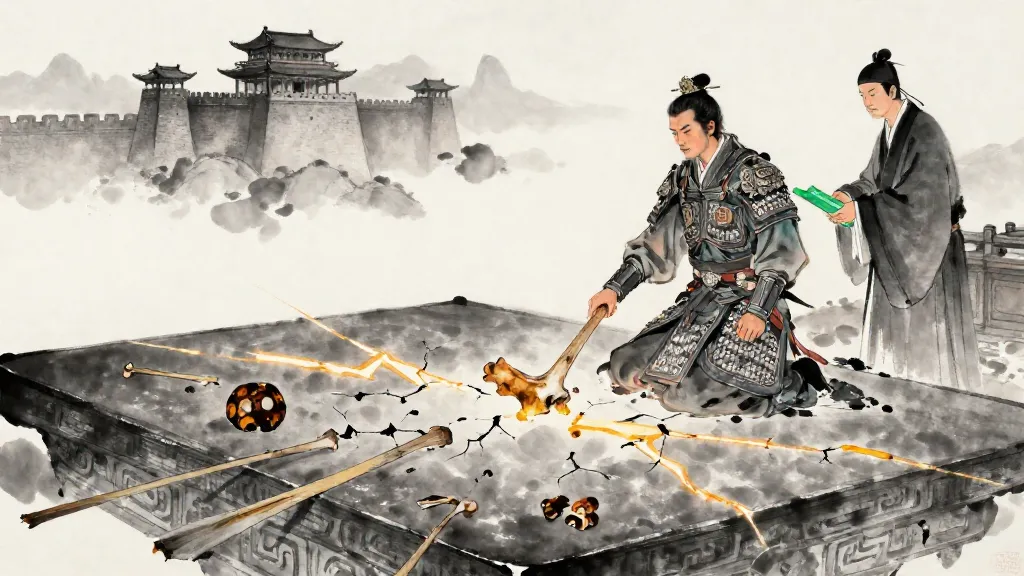
魏世家 (Hereditary House of Wei) — Chinese ink painting

Chapter 44 of 130

魏世家

Hereditary House of Wei

View:

畢萬受封與魏氏興起

Bi Wan Receives His Fief and the Rise of the Wei Clan

魏之先,畢公高之後也。畢公高與周同姓。武王之伐紂,而高封於畢,於是為畢姓。其後絕封,為庶人,或在中國,或在夷狄。其苗裔曰畢萬,事晉獻公。

獻公之十六年,趙夙為御,畢萬為右,以伐霍、耿、魏,滅之。以耿封趙夙,以魏封畢萬,為大夫。卜偃曰:「畢萬之後必大矣,萬,滿數也;魏,大名也。以是始賞,天開之矣,天子曰兆民,諸侯曰萬民。今命之大,以從滿數,其必有眾。」初,畢萬卜事晉,遇屯之比。辛廖占之,曰:「吉。屯固比入,吉孰大焉,其必蕃昌。」

畢萬封十一年,晉獻公卒,四子爭更立,晉亂。而畢萬之世彌大,從其國名為魏氏。生武子。魏武子以魏諸子事晉公子重耳。晉獻公之二十一年,武子從重耳出亡。十九年反,重耳立為晉文公,而令魏武子襲魏氏之後封,列為大夫,治於魏。生悼子。

魏悼子徙治霍。生魏絳。

The ancestors of Wei descended from Bi Gao, Duke of Bi, who shared the same surname as the Zhou royal house. When King Wu conquered the Shang tyrant Zhou, Bi Gao was enfeoffed at Bi, and his line took that as their surname. Later the fief was extinguished and the family fell to commoner status, scattered between the central states and the frontier peoples. A descendant named Bi Wan entered the service of Duke Xian of Jin.

In the sixteenth year of Duke Xian, Zhao Su served as charioteer and Bi Wan as spearman on the right. They campaigned against Huo, Geng, and Wei and destroyed all three. Duke Xian enfeoffed Zhao Su at Geng and Bi Wan at Wei, making them grandees. The diviner Bu Yan said: "Bi Wan's descendants will surely become great. Wan means 'ten thousand,' a full number; Wei means 'great.' To receive one's first reward under such auspices shows that Heaven has opened the way. The Son of Heaven speaks of his 'myriad people' and the feudal lords of their 'ten thousand subjects.' Now he has been given a great name and a full number: he will surely command multitudes." Earlier, when Bi Wan had divined about entering Jin's service, he drew the hexagram Tun changing to Bi. The diviner Xin Liao interpreted it: "Auspicious. Tun signifies solidity, Bi signifies unity; what greater fortune could there be? His line will surely flourish."

Eleven years after Bi Wan's enfeoffment, Duke Xian of Jin died and four of his sons fought for the succession, plunging Jin into chaos. But Bi Wan's house grew ever larger, and they adopted their fief's name as their clan name: Wei. Bi Wan's son was Wu Zi. Wei Wu Zi led the Wei retainers in service to the Jin prince Chong Er. In the twenty-first year of Duke Xian, Wu Zi followed Chong Er into exile. Nineteen years later they returned, and Chong Er was enthroned as Duke Wen of Jin. He ordered Wei Wu Zi to inherit the Wei clan's fief, listed him as a grandee, and gave him governance over Wei. Wu Zi's son was Dao Zi.

Wei Dao Zi moved the clan seat to Huo. His son was Wei Jiang.

Notes

1person畢公高Bì Gōng Gāo

Bi Gao (畢公高) was a younger brother of King Wu of Zhou (r. c. 1046-1043 BC). His fief at Bi was near modern Xianyang, Shaanxi.

2person晉獻公Jìn Xiàn Gōng

Duke Xian of Jin (晉獻公, r. 676-651 BC) expanded Jin aggressively, conquering many small polities including Huo, Geng, and Wei.

3context

The divination references the Yijing hexagrams Tun (屯, 'Sprouting,' hex. 3) and Bi (比, 'Holding Together,' hex. 8). Bu Yan interprets the combination as signifying growth from difficulty into solidarity, an extremely favorable omen.

4person晉文公重耳Jìn Wén Gōng Chóng Ěr

Chong Er (重耳), later Duke Wen of Jin (晉文公, r. 636-628 BC), spent nineteen years in exile before returning to become one of the Five Hegemons of the Spring and Autumn period. Wei Wu Zi's loyalty during this exile cemented the Wei clan's position.

魏絳和戎與獻子為政

Wei Jiang Pacifies the Rong; Wei Xian Zi Governs Jin

魏絳事晉悼公。悼公三年,會諸侯。悼公弟楊乾亂行,魏絳僇辱楊乾。悼公怒曰:「合諸侯以為榮,今辱吾弟!」將誅魏絳。或說悼公,悼公止。卒任魏絳政,使和戎、翟,戎、翟親附。悼公之十一年,曰:「自吾用魏絳,八年之中,九合諸侯,戎、翟和,子之力也。」賜之樂,三讓,然後受之。徙治安邑。魏絳卒,謚為昭子。生魏嬴。嬴生魏獻子。

獻子事晉昭公。昭公卒而六卿彊,公室卑。

晉頃公之十二年,韓宣子老,魏獻子為國政。晉宗室祁氏、羊舌氏相惡,六卿誅之,盡取其邑為十縣,六卿各令其子為之大夫。獻子與趙簡子、中行文子、范獻子並為晉卿。

其後十四歲而孔子相魯。後四歲,趙簡子以晉陽之亂也,而與韓、魏共攻范、中行氏。魏獻子生魏侈。魏侈與趙鞅共攻范、中行氏。

魏侈之孫曰魏桓子,與韓康子、趙襄子共伐滅知伯,分其地。

Wei Jiang served Duke Dao of Jin. In the duke's third year, a meeting of the feudal lords was convened. The duke's younger brother Yang Gan disrupted the formation, and Wei Jiang publicly humiliated Yang Gan for it. Duke Dao was furious: "I assembled the lords as an honor, and now you disgrace my brother!" He prepared to execute Wei Jiang. Someone persuaded the duke to relent, and in the end he entrusted Wei Jiang with governance. Wei Jiang was sent to make peace with the Rong and Di peoples, who thereafter became loyal allies. In the duke's eleventh year, he declared: "Since I employed Wei Jiang, in eight years I have convened the lords nine times and the Rong and Di have been pacified. This is all your doing." He bestowed musical instruments upon Wei Jiang, who declined three times before accepting. The clan seat was moved to Anyi. When Wei Jiang died, he was given the posthumous name Zhao Zi. His son was Wei Ying, whose son was Wei Xian Zi.

Wei Xian Zi served Duke Zhao of Jin. After Zhao's death, the six ministerial clans grew powerful and the ducal house declined.

In the twelfth year of Duke Qing of Jin, Han Xuan Zi retired and Wei Xian Zi took charge of state affairs. The Jin princely houses of Qi and Yangshe quarreled with each other; the six clans destroyed them both, seized all their lands as ten counties, and each clan appointed its own sons as the counties' administrators. Wei Xian Zi served alongside Zhao Jian Zi, Zhonghang Wen Zi, and Fan Xian Zi as ministers of Jin.

Fourteen years later, Confucius became chancellor of Lu. Four years after that, Zhao Jian Zi used the Jinyang affair as a pretext to attack the Fan and Zhonghang clans in concert with Han and Wei. Wei Xian Zi's son was Wei Chi. Wei Chi joined Zhao Yang in the campaign against Fan and Zhonghang.

Wei Chi's grandson was Wei Huan Zi, who together with Han Kang Zi and Zhao Xiang Zi destroyed Zhi Bo and divided his territory.

Notes

1person晉悼公Jìn Dào Gōng

Duke Dao of Jin (晉悼公, r. 573-558 BC) is considered the last effective Jin hegemon. Wei Jiang's diplomatic success with the northern Rong and Di peoples was a major achievement of his reign.

2place

Anyi (安邑) was located near modern Xia County, Shanxi. It served as the Wei clan seat and later the first capital of the state of Wei, until the move to Daliang in 361 BC.

3context

The six ministerial clans (六卿) of Jin were Zhao, Han, Wei, Zhi (智), Fan (范), and Zhonghang (中行). Their rivalries consumed Jin from the late sixth century BC onward, culminating in the elimination of Fan and Zhonghang (c. 490 BC), then Zhi (453 BC), and finally the formal partition of Jin among the surviving three in 403 BC.

4context

The destruction of Zhi Bo (智伯) in 453 BC is the de facto founding moment of the three successor states of Wei, Han, and Zhao, though formal recognition by the Zhou court did not come until 403 BC. Zhi Bo had been the most powerful of the six clans, but his arrogance drove the other three to conspire against him.

魏文侯:變法圖強

Marquis Wen of Wei: Reforms and the Rise to Power

桓子之孫曰文侯都。魏文侯元年,秦靈公之元年也。與韓武子、趙桓子、周威王同時。

六年,城少梁。十三年,使子擊圍繁、龐,出其民。十六年,伐秦,築臨晉元里。

十七年,伐中山,使子擊守之,趙倉唐傅之。子擊逢文侯之師田子方於朝歌,引車避,下謁。田子方不為禮。子擊因問曰:「富貴者驕人乎?且貧賤者驕人乎?」子方曰:「亦貧賤者驕人耳。夫諸侯而驕人則失其國,大夫而驕人則失其家。貧賤者,行不合,言不用,則去之楚、越,若脫鵕然,柰何其同之哉!」子擊不懌而去。西攻秦,至鄭而還,築雒陰、合陽。

二十二年,魏、趙、韓列為諸侯。

二十四年,秦伐我,至陽狐。

二十五年,子擊生子。

文侯受子夏經藝,客段乾木,過其閭,未嘗不軾也。秦嘗欲伐魏,或曰:「魏君賢人是禮,國人稱仁,上下和合,未可圖也。」文侯由此得譽於諸侯。

任西門豹守鄴,而河內稱治。

魏文侯謂李克曰:「先生嘗教寡人曰『家貧則思良妻,國亂則思良相』。今所置非成則璜,二子何如?」李克對曰:「臣聞之,卑不謀尊,疏不謀戚。臣在闕門之外,不敢當命。」文侯曰:「先生臨事勿讓。」李克曰:「君不察故也。居視其所親,富視其所與,達視其所舉,窮視其所不為,貧視其所不取,五者足以定之矣,何待克哉!」文侯曰:「先生就舍,寡人之相定矣。」李克趨而出,過翟璜之家。翟璜曰:「今者聞君召先生而卜相,果誰為之?」李克曰:「魏成子為相矣。」翟璜忿然作色曰:「以耳目之所睹記,臣何負於魏成子?西河之守,臣之所進也。君內以鄴為憂,臣進西門豹。君謀欲伐中山,臣進樂羊。中山以拔,無使守之,臣進先生。君之子無傅,臣進屈侯鮒。臣何以負於魏成子!」李克曰:「且子之言克於子之君者,豈將比周以求大官哉?君問而置相『非成則璜,二子何如』?克對曰:『君不察故也。居視其所親,富視其所與,達視其所舉,窮視其所不為,貧視其所不取,五者足以定之矣,何待克哉!』是以知魏成子之為相也。且子安得與魏成子比乎?魏成子以食祿千鍾,什九在外,什一在內,是以東得卜子夏、田子方、段乾木。此三人者,君皆師之。子之所進五人者,君皆臣之。子惡得與魏成子比也?」翟璜逡巡再拜曰:「璜,鄙人也,失對,原卒為弟子。」

Huan Zi's grandson was Marquis Wen, who established his capital. The first year of Marquis Wen of Wei coincided with the first year of Duke Ling of Qin. He was contemporary with Wu Zi of Han, Huan Zi of Zhao, and King Wei of Zhou.

In his sixth year, he fortified Shaoliang. In his thirteenth year, he sent his heir Zi Ji to besiege Fan and Pang, and evacuated their populations. In his sixteenth year, he attacked Qin and built the fortifications at Linjin and Yuanli.

In his seventeenth year, he conquered Zhongshan and assigned Zi Ji to garrison it, with Zhao Cangtang as tutor. On the road at Zhaoge, Zi Ji encountered Marquis Wen's teacher Tian Zifang. He pulled his chariot aside and dismounted to pay his respects. Tian Zifang did not return the courtesy. Zi Ji then asked: "Is it the rich and noble who are entitled to be haughty, or the poor and lowly?" Tian Zifang replied: "Only the poor and lowly. If a feudal lord is haughty, he loses his state. If a grandee is haughty, he loses his house. But a poor man whose conduct is rejected and whose words go unheeded can simply leave for Chu or Yue, shedding his ties like a bird molting its feathers. How can the two be compared?" Zi Ji departed unhappily. He then campaigned west against Qin, reached Zheng, and returned, building fortifications at Luoyin and Heyang.

In his twenty-second year, Wei, Zhao, and Han were formally listed as feudal lords.

In his twenty-fourth year, Qin attacked Wei, reaching Yanghu.

In his twenty-fifth year, Zi Ji had a son.

Marquis Wen studied the classics under Zixia and hosted Duan Ganmu as a guest. Whenever his carriage passed Duan Ganmu's gate, he would lean forward on the crossbar as a mark of respect. Once, when Qin planned to attack Wei, someone said: "The lord of Wei honors worthy men, his people praise his benevolence, and the court is harmonious from top to bottom. This is not a state that can be taken." Through this, Marquis Wen earned a reputation among all the lords.

He appointed Ximen Bao to govern Ye, and the entire Henei region was considered well-administered.

Marquis Wen said to Li Ke: "You once taught me: 'When a family is poor, one thinks of a good wife; when a state is in disorder, one thinks of a good chancellor.' Now I must choose between Cheng and Huang. What is your opinion of the two?" Li Ke replied: "I have heard that those of low rank should not counsel on matters above their station, and outsiders should not meddle in a family's affairs. I stand outside the palace gates and dare not accept such a charge." The marquis said: "When the matter is urgent, do not demur." Li Ke said: "Your lordship has not observed closely enough. In leisure, observe whom a man keeps close. In wealth, observe to whom he gives. In high office, observe whom he promotes. In adversity, observe what he refuses to do. In poverty, observe what he refuses to take. These five tests are sufficient to decide. Why wait for me?" The marquis said: "Return to your lodging, sir. My chancellor is decided."

Li Ke hurried out and passed by the house of Di Huang. Di Huang said: "I hear the marquis summoned you to advise on the chancellorship. Who was chosen?" Li Ke said: "Wei Chengzi will be chancellor." Di Huang flushed with anger: "By everything I have seen and heard, how have I fallen short of Wei Chengzi? The governorship of Xihe was my recommendation. When the marquis was troubled about Ye, I recommended Ximen Bao. When he planned to conquer Zhongshan, I recommended Yue Yang. After Zhongshan was taken and needed a governor, I recommended you. When the heir lacked a tutor, I recommended Qu Houfu. How have I fallen short of Wei Chengzi?" Li Ke said: "When you spoke to the marquis on my behalf, was it to form a faction and seek high office? The marquis asked me about the chancellorship and I replied: observe a man's associations, his generosity, his appointments, his limits, and his integrity. That is how I know Wei Chengzi will be chancellor. And how can you compare yourself to him? Wei Chengzi receives a salary of a thousand zhong, but nine-tenths goes to others and only one-tenth to himself. With this, he attracted Bu Zixia, Tian Zifang, and Duan Ganmu from the east. The marquis treats all three as his own teachers. The five men you recommended? The marquis treats them all as his servants. How can you compare yourself to Wei Chengzi?" Di Huang stepped back, bowed twice, and said: "Huang is a shallow man. I spoke amiss. I beg to become your disciple henceforth."

Notes

1person魏文侯Wèi Wén Hóu

Marquis Wen of Wei (魏文侯, r. 445-396 BC) was the first great ruler of the Wei state after the partition of Jin. His court attracted the finest scholars and administrators of the age, making Wei the dominant power among the three Jin successor states.

2person子夏Zǐ Xià

Zixia (子夏, Bu Shang 卜商) was one of Confucius's foremost disciples, known for his learning in the Odes and the Spring and Autumn Annals. After Confucius's death, he established an academy at Xihe that trained many of the Warring States' leading statesmen.

3person李克Lǐ Kè

Li Ke (李克, also written 李悝 Li Kui) was a legalist reformer who served Marquis Wen. He is credited with compiling the Canon of Laws (法經), the first systematic Chinese legal code, and with agricultural reforms that greatly increased Wei's grain output.

4person西門豹Xīmén Bào

Ximen Bao (西門豹) was an administrator famous for breaking the power of superstitious local shamans at Ye (modern Linzhang, Hebei). He also oversaw major irrigation works along the Zhang River.

5person段乾木Duàn Gānmù

Duan Ganmu (段乾木) was a reclusive scholar whom Marquis Wen deeply respected. Tian Zifang (田子方) was another prominent intellectual at the Wei court. Together with Zixia, these three were known as Marquis Wen's 'three teachers.'

6context

The dialogue between Li Ke and Di Huang is one of the most celebrated passages on meritocratic governance in early Chinese literature. Li Ke's 'five tests' for evaluating character became a standard reference in later political thought. The key distinction is between Wei Chengzi, who uses his wealth to attract men the ruler treats as teachers, and Di Huang, who recommends men the ruler treats as servants.

7place

Zhongshan (中山) was a non-Zhou state of the White Di people, located in modern central Hebei. Wei conquered it around 407 BC, but it later regained independence before being finally destroyed by Zhao in 296 BC.

魏武侯與惠王初年

Marquis Wu and the Early Reign of King Hui

二十六年,虢山崩,壅河。

三十二年,伐鄭。城酸棗。敗秦於注。三十五年,齊伐取我襄陵。三十六年,秦侵我陰晉。

三十八年,伐秦,敗我武下,得其將識。是歲,文侯卒,子擊立,是為武侯。

魏武侯元年,趙敬侯初立,公子朔為亂,不勝,奔魏,與魏襲邯鄲,魏敗而去。

二年,城安邑、王垣。

七年,伐齊,至桑丘。九年,翟敗我於澮。使吳起伐齊,至靈丘。齊威王初立。

十一年,與韓、趙三分晉地,滅其後。

十三年,秦獻公縣櫟陽。十五年,敗趙北藺。

十六年,伐楚,取魯陽。武侯卒,子立,是為惠王。

惠王元年,初,武侯卒也,子與公中緩爭為太子。公孫頎自宋入趙,自趙入韓,謂韓懿侯曰:「魏與公中緩爭為太子,君亦聞之乎?今魏得王錯,挾上黨,固半國也。因而除之,破魏必矣,不可失也。」懿侯說,乃與趙成侯合軍並兵以伐魏,戰於濁澤,魏氏大敗,魏君圍。趙謂韓曰:「除魏君,立公中緩,割地而退,我且利。」韓曰:「不可。殺魏君,人必曰暴;割地而退,人必曰貪。不如兩分之。魏分為兩,不彊於宋、衛,則我終無魏之患矣。」趙不聽。韓不說,以其少卒夜去。惠王之所以身不死,國不分者,二家謀不和也。若從一家之謀,則魏必分矣。故曰「君終無適子,其國可破也」。

In the twenty-sixth year, Mount Guo collapsed and dammed the Yellow River.

In the thirty-second year, Marquis Wen attacked Zheng, fortified Suanzao, and defeated Qin at Zhu. In the thirty-fifth year, Qi attacked and took Xiangling. In the thirty-sixth year, Qin raided Yinjin.

In the thirty-eighth year, Wei attacked Qin but was defeated at Wuxia; Qin captured a Wei general named Shi. That year, Marquis Wen died and Zi Ji succeeded him as Marquis Wu.

In the first year of Marquis Wu, Duke Jing of Zhao had just acceded. Prince Shuo rebelled but failed and fled to Wei. He and Wei forces raided Handan, but the attack failed and they withdrew.

In the second year, the walls of Anyi and Wangyuan were strengthened.

In the seventh year, Wei attacked Qi, reaching Sangqiu. In the ninth year, the Di defeated Wei at Hui. Wu Qi was sent to attack Qi, reaching Lingqiu. King Wei of Qi had just acceded.

In the eleventh year, Wei, Han, and Zhao formally partitioned the remaining Jin lands and abolished the Jin ruling line.

In the thirteenth year, Duke Xian of Qin made Yueyang a county seat. In the fifteenth year, Wei defeated Zhao at Beilin.

In the sixteenth year, Wei attacked Chu and took Luyang. Marquis Wu died, and his son succeeded as King Hui.

In the first year of King Hui, when Marquis Wu had died, the heir and Gongzhong Huan contested the succession. Gongsun Qi traveled from Song to Zhao and then to Han, where he told Marquis Yi of Han: "The Wei heir and Gongzhong Huan are fighting for the throne. Have you heard? If we strike now while Wei holds Wang Cuo and controls Shangdang, that is half the state. Eliminate them and Wei will surely be destroyed. This opportunity must not be lost." Marquis Yi was pleased and joined Marquis Cheng of Zhao in a combined assault on Wei. They fought at Zhuoze, where Wei suffered a catastrophic defeat and the Wei ruler was surrounded. Zhao said to Han: "Let us kill the Wei ruler, install Gongzhong Huan, take territory, and withdraw. We will profit." Han replied: "No. Kill the Wei ruler, and people will call us cruel. Take territory and withdraw, and people will call us greedy. Better to split Wei in two. If Wei becomes two states, neither stronger than Song or Wey, we need never fear Wei again." Zhao refused to listen. Han, displeased, withdrew its forces in the night. The reason King Hui survived and Wei was not partitioned was that the two allies could not agree on their scheme. Had they followed either plan, Wei would certainly have been split. Hence the saying: "When a ruler has no legitimate heir, his state can be destroyed."

Notes

1person魏武侯Wèi Wǔ Hóu

Marquis Wu of Wei (魏武侯, r. 395-370 BC) continued his father's military expansion but lacked Marquis Wen's ability to attract talent. His general Wu Qi (吳起) eventually defected to Chu.

2person吳起Wú Qǐ

Wu Qi (吳起, d. 381 BC) was one of the greatest generals of the Warring States, renowned for his treatise on military strategy (Wuzi). He served Wei under both Marquis Wen and Marquis Wu before being driven out by court intrigues and defecting to Chu.

3context

The succession crisis at King Hui's accession (370 BC) nearly destroyed Wei entirely. The Battle of Zhuoze was the closest Wei came to annihilation before its final conquest by Qin in 225 BC. Sima Qian emphasizes that Wei was saved not by its own strength but by its enemies' inability to cooperate, a recurring theme in Warring States diplomacy.

4place

Shangdang (上黨) was a strategically vital highland region in southeastern Shanxi, controlling the passes between the central plain and the Zhao-Han territories. It was contested throughout the Warring States period.

惠王中期:桂陵與馬陵之敗

King Hui's Middle Years: The Disasters at Guiling and Maling

二年,魏敗韓於馬陵,敗趙於懷。三年,齊敗我觀。五年,與韓會宅陽。城武堵。為秦所敗。六年,伐取宋儀台。九年,伐敗韓於澮。與秦戰少梁,虜我將公孫痤,取龐。秦獻公卒,子孝公立。

十年,伐取趙皮牢。彗星見。十二年,星晝墜,有聲。

十四年,與趙會鄗。十五年,魯、衛、宋、鄭君來朝。十六年,與秦孝公會杜平。侵宋黃池,宋復取之。

十七年,與秦戰元里,秦取我少梁。圍趙邯鄲。十八年,拔邯鄲。趙請救於齊,齊使田忌、孫臏救趙,敗魏桂陵。

十九年,諸侯圍我襄陵。築長城,塞固陽。

二十年,歸趙邯鄲,與盟漳水上。二十一年,與秦會彤。趙成侯卒。二十八年,齊威王卒。中山君相魏。

三十年,魏伐趙,趙告急齊。齊宣王用孫子計,救趙擊魏。魏遂大興師,使龐涓將,而令太子申為上將軍。過外黃,外黃徐子謂太子曰:「臣有百戰百勝之術。」太子曰:「可得聞乎?」客曰:「固原效之。」曰:「太子自將攻齊,大勝並莒,則富不過有魏,貴不益為王。若戰不勝齊,則萬世無魏矣。此臣之百戰百勝之術也。」太子曰:「諾,請必從公之言而還矣。」客曰:「太子雖欲還,不得矣。彼勸太子戰攻,欲啜汁者眾。太子雖欲還,恐不得矣。」太子因欲還,其御曰:「將出而還,與北同。」太子果與齊人戰,敗於馬陵。齊虜魏太子申,殺將軍涓,軍遂大破。

In the second year, Wei defeated Han at Maling and defeated Zhao at Huai. In the third year, Qi defeated Wei at Guan. In the fifth year, Wei met Han at Zhaiyang, fortified Wudu, and was defeated by Qin. In the sixth year, Wei conquered the Yitai district of Song. In the ninth year, Wei defeated Han at Hui, but fighting Qin at Shaoliang, Qin captured Wei's general Gongsun Cuo and took Pang. Duke Xian of Qin died and his son Duke Xiao succeeded.

In the tenth year, Wei took Pilao from Zhao. A comet appeared. In the twelfth year, a star fell in daylight with a great noise.

In the fourteenth year, Wei met Zhao at Hao. In the fifteenth year, the rulers of Lu, Wey, Song, and Zheng came to pay court. In the sixteenth year, Wei met Duke Xiao of Qin at Duping. Wei raided Huangchi from Song, but Song retook it.

In the seventeenth year, Wei fought Qin at Yuanli, and Qin took Shaoliang. Wei besieged Handan. In the eighteenth year, Handan fell. Zhao appealed to Qi for aid, and Qi sent Tian Ji and Sun Bin to rescue Zhao. They defeated Wei at Guiling.

In the nineteenth year, a coalition besieged Wei's Xiangling. Wei built a long wall and blocked Guyang.

In the twentieth year, Wei returned Handan to Zhao and the two swore a covenant on the Zhang River. In the twenty-first year, Wei met Qin at Tong. Marquis Cheng of Zhao died. In the twenty-eighth year, King Wei of Qi died. The lord of Zhongshan served as Wei's chancellor.

In the thirtieth year, Wei attacked Zhao, and Zhao urgently appealed to Qi. King Xuan of Qi employed Sun Bin's stratagem to rescue Zhao by striking Wei. Wei raised a great army, appointing Pang Juan as commander and Crown Prince Shen as supreme general. Passing through Waihuang, the scholar Xu Zi of Waihuang said to the crown prince: "I have a strategy that wins every battle." The prince asked: "May I hear it?" The man replied: "I shall demonstrate it. If Your Highness personally leads the attack on Qi and wins a great victory, conquering as far as Ju, your wealth will still not exceed possessing Wei, and your rank will still not exceed being king. But if you fail to defeat Qi, then for ten thousand generations there will be no Wei. This is my strategy of a hundred battles and a hundred victories." The crown prince said: "Very well. I shall certainly follow your advice and turn back." The man said: "Even if Your Highness wishes to turn back, you will not be able to. Those who urged you to go to war, hoping to drink the broth of victory, are too many. Even if you wish to turn back, I fear you cannot." The prince tried to turn back, but his charioteer said: "To march out and then retreat is the same as defeat." In the end, the prince fought the Qi army and was routed at Maling. Qi captured Crown Prince Shen and killed General Pang Juan, and the Wei army was utterly destroyed.

Notes

1person孫臏Sūn Bìn

Sun Bin (孫臏, fl. 340s BC) was a military strategist and descendant of Sun Wu (author of the Art of War). He had been mutilated by Pang Juan, a former fellow student, who had his kneecaps removed out of jealousy. Sun Bin later took his revenge at Maling.

2person龐涓Páng Juān

Pang Juan (龐涓, d. 341 BC) was Wei's foremost general. His defeat and death at Maling marked the end of Wei's military dominance over the central states.

3context

The Battle of Guiling (桂陵之戰, 354 BC) and Battle of Maling (馬陵之戰, 341 BC) are two of the most famous engagements of the Warring States. In both cases, Qi used Sun Bin's strategy of 'besieging Wei to rescue Zhao' (圍魏救趙), attacking Wei's homeland to force its army to withdraw from a siege. At Maling, Sun Bin lured Pang Juan into a narrow defile using a feigned retreat, where the Wei army was ambushed and annihilated.

4context

The Xu Zi episode illustrates the tragic logic of Warring States politics: the crown prince knows the campaign is futile, but the pressure from his entourage makes retreat politically impossible. Sima Qian uses this to show how Wei's leaders were prisoners of their own court factions.

惠王晚年:商鞅之敗與遷都大梁

King Hui's Later Years: Defeat by Shang Yang and the Move to Daliang

三十一年,秦、趙、齊共伐我,秦將商君詐我將軍公子卬而襲奪其軍,破之。秦用商君,東地至河,而齊、趙數破我,安邑近秦,於是徙治大梁。以公子赫為太子。

三十三年,秦孝公卒,商君亡秦歸魏,魏怒,不入。三十五年,與齊宣王會平阿南。

惠王數被於軍旅,卑禮厚幣以招賢者。鄒衍、淳于髡、孟軻皆至梁。梁惠王曰:「寡人不佞,兵三折於外,太子虜,上將死,國以空虛,以羞先君宗廟社稷,寡人甚醜之,叟不遠千里,辱幸至弊邑之廷,將何利吾國?」孟軻曰:「君不可以言利若是。夫君欲利則大夫欲利,大夫欲利則庶人慾利,上下爭利,國則危矣。為人君,仁義而已矣,何以利為!」

三十六年,復與齊王會甄。是歲,惠王卒,子襄王立。

In the thirty-first year, Qin, Zhao, and Qi jointly attacked Wei. The Qin commander Shang Yang tricked Wei's general Prince Ang into a meeting and ambushed his army, destroying it. Qin, empowered by Shang Yang's reforms, extended its eastern border to the Yellow River. Meanwhile Qi and Zhao repeatedly defeated Wei. Since the old capital Anyi was dangerously close to Qin, Wei moved its seat of government to Daliang. Prince He was designated crown prince.

In the thirty-third year, Duke Xiao of Qin died and Shang Yang fled Qin, seeking refuge in Wei. Wei, furious at his past treachery, refused to admit him. In the thirty-fifth year, King Hui met King Xuan of Qi south of Ping'e.

Having suffered repeated military disasters, King Hui humbled himself and offered generous gifts to attract men of talent. Zou Yan, Chunyu Kun, and Mencius all came to Liang. King Hui of Liang said: "I am an unworthy ruler. My armies have been broken three times abroad, my crown prince was captured, my supreme general killed, and my state left empty and exhausted. I have shamed my ancestors, their altars, and their temples. I am deeply ashamed of this. Elder, you have not considered a thousand li too far and have honored my poor court with your presence. How will you profit my state?" Mencius replied: "Your Majesty should not speak of profit in such terms. If the ruler desires profit, then the grandees will desire profit. If the grandees desire profit, then the common people will desire profit. When those above and those below compete for profit, the state is in danger. For a ruler, benevolence and righteousness are all that matter. What need is there for profit?"

In the thirty-sixth year, he again met the King of Qi at Zhen. That year, King Hui died and his son King Xiang succeeded.

Notes

1person商鞅Shāng Yāng

Shang Yang (商鞅, also Lord Shang 商君, d. 338 BC) was the great Legalist reformer who transformed Qin into the dominant military power. His treacherous capture of Prince Ang of Wei in 340 BC epitomized his ruthless pragmatism.

2place

Daliang (大梁) is modern Kaifeng, Henan. It became Wei's capital in 361 BC and gave the state its alternative name 'Liang.' The city was eventually destroyed by Qin in 225 BC when Qin diverted river water to flood it.

3person孟軻Mèng Kē

Mencius (孟軻, Meng Ke, c. 372-289 BC) was the most influential Confucian thinker after Confucius himself. His opening exchange with King Hui of Liang, recorded here, is also the opening passage of the Mengzi (Book of Mencius) and became one of the most quoted statements in Chinese political philosophy.

4context

King Hui's lament is remarkable for its candor. Sima Qian shows Wei's decline as a direct consequence of Maling: the crown prince captured, Pang Juan killed, and Shang Yang's Qin pushing Wei's border to the Yellow River. The move from Anyi to Daliang was a strategic retreat eastward, away from Qin's growing power.

襄王與哀王:張儀縱橫

King Xiang and King Ai: The Age of Zhang Yi

襄王元年,與諸侯會徐州,相王也。追尊父惠王為王。

五年,秦敗我龍賈軍四萬五千於雕陰,圍我焦、曲沃。予秦河西之地。

六年,與秦會應。秦取我汾陰、皮氏、焦。魏伐楚,敗之陘山。七年,魏盡入上郡於秦。秦降我蒲陽。八年,秦歸我焦、曲沃。

十二年,楚敗我襄陵。諸侯執政與秦相張儀會齧桑。十三年,張儀相魏。魏有女子化為丈夫。秦取我曲沃、平周。

十六年,襄王卒,子哀王立。張儀復歸秦。

哀王元年,五國共攻秦,不勝而去。

二年,齊敗我觀津。五年,秦使樗里子伐取我曲沃,走犀首岸門。六年,秦來立公子政為太子。與秦會臨晉。七年,攻齊。與秦伐燕。

八年,伐衛,拔列城二。見衛君曰:「請罷魏兵,免成陵君可乎?」衛君曰:「先生果能,孤請世世以衛事先生。」如耳見成陵君曰:「昔者魏伐趙,斷羊腸,拔閼與,約斬趙,趙分而為二,所以不亡者,魏為從主也。今衛已迫亡,將西請事於秦。與其以秦醳衛,不如以魏醳衛,衛之德魏必終無窮。」成陵君曰:「諾。」如耳見魏王曰:「臣有謁於衛。衛故周室之別也,其稱小國,多寶器。今國迫於難而寶器不出者,其心以為攻衛醳衛不以王為主,故寶器雖出必不入於王也。臣竊料之,先言醳衛者必受衛者也。」如耳出,成陵君入,以其言見魏王。魏王聽其說,罷其兵,免成陵君,終身不見。

九年,與秦王會臨晉。張儀、魏章皆歸於魏。魏相田需死,楚害張儀、犀首、薛公。楚相昭魚謂蘇代曰:「田需死,吾恐張儀、犀首、薛公有一人相魏者也。」代曰:「然相者欲誰而君便之?」昭魚曰:「吾欲太子之自相也。」代曰:「請為君北,必相之。」昭魚曰:「柰何?」對曰:「君其為梁王,代請說君。」昭魚曰:「柰何?」對曰:「代也從楚來,昭魚甚憂,曰:『田需死,吾恐張儀、犀首、薛公有一人相魏者也。』代曰:『梁王,長主也,必不相張儀。張儀相,必右秦而左魏。犀首相,必右韓而左魏。薛公相,必右齊而左魏。梁王,長主也,必不便也。』王曰:『然則寡人孰相?』代曰:『莫若太子之自相。太子之自相,是三人者皆以太子為非常相也,皆將務以其國事魏,欲得丞相璽也。以魏之彊,而三萬乘之國輔之,魏必安矣。故曰莫若太子之自相也。』」遂北見梁王,以此告之。太子果相魏。

十年,張儀死。十一年,與秦武王會應。十二年,太子朝於秦。秦來伐我皮氏,未拔而解。十四年,秦來歸武王后。十六年,秦拔我蒲反、陽晉、封陵。十七年,與秦會臨晉。秦予我蒲反。十八年,與秦伐楚。二十一年,與齊、韓共敗秦軍函谷。

二十三年,秦復予我河外及封陵為和。哀王卒,子昭王立。

In King Xiang's first year, the lords met at Xuzhou and conferred royal titles upon each other. Xiang posthumously honored his father King Hui as a king.

In the fifth year, Qin destroyed Wei's army of forty-five thousand under Long Jia at Diaoyin, and besieged Jiao and Quwo. Wei ceded the lands west of the Yellow River to Qin.

In the sixth year, Wei met Qin at Ying. Qin took Fenyin, Pishi, and Jiao from Wei. Wei attacked Chu and defeated it at Xingshan. In the seventh year, Wei surrendered the entire Shangjun commandery to Qin. Qin reduced Puyang. In the eighth year, Qin returned Jiao and Quwo.

In the twelfth year, Chu defeated Wei at Xiangling. The chief ministers of the states met with Qin's chancellor Zhang Yi at Niesang. In the thirteenth year, Zhang Yi became chancellor of Wei. A woman in Wei was reported to have transformed into a man. Qin took Quwo and Pingzhou.

In the sixteenth year, King Xiang died and his son King Ai succeeded. Zhang Yi returned to Qin.

In the first year of King Ai, five states jointly attacked Qin but failed and withdrew.

In the second year, Qi defeated Wei at Guanjin. In the fifth year, Qin sent Chuli Zi to capture Quwo and routed Xishou at Anmen. In the sixth year, Qin installed Prince Zheng as Wei's crown prince and met Wei at Linjin. In the seventh year, Wei attacked Qi and joined Qin in attacking Yan.

In the eighth year, Wei attacked Wey and took two walled cities. The diplomat Ru Er told the lord of Wey: "If Wei withdraws its troops, will you dismiss Lord Chengling?" The lord of Wey said: "If you can truly accomplish this, Wey will serve you for generations." Ru Er then told Lord Chengling: "In the past, when Wei attacked Zhao, it cut through Yangchang Pass and took Yuyu, intending to destroy Zhao. The reason Zhao survived was that Wei led the vertical alliance. Now Wey faces destruction and will turn west to serve Qin. Rather than letting Qin save Wey, better that Wei save Wey; Wey's gratitude toward Wei would be endless." Lord Chengling agreed. Ru Er then told the King of Wei: "I have made contact with Wey. Wey is a branch of the Zhou royal house; though it calls itself a small state, it possesses many treasures. The reason it has not surrendered its treasures despite its peril is that it believes whoever attacks and then rescues Wey controls the outcome, so the treasures will not go to Your Majesty. By my calculation, whoever first offers to rescue Wey will gain Wey's allegiance." Ru Er left, and Lord Chengling entered the court and presented the same argument to the king. The king accepted the reasoning, withdrew the troops, and dismissed Lord Chengling, never granting him an audience again.

In the ninth year, Wei met the King of Qin at Linjin. Zhang Yi and Wei Zhang both returned to Wei. Wei's chancellor Tian Xu died, and Chu feared that Zhang Yi, Xishou, or Lord Xue would become Wei's next chancellor. Chu's chancellor Zhao Yu told Su Dai: "Tian Xu is dead. I fear one of those three will become Wei's chancellor." Su Dai asked: "Who would you prefer, and how can I help?" Zhao Yu said: "I want the crown prince to serve as his own chancellor." Su Dai said: "Allow me to go north. I will see it done." He then explained his plan: he would tell the King of Wei that Zhao Yu was worried about the three candidates, and argue that since Zhang Yi would favor Qin, Xishou would favor Han, and Lord Xue would favor Qi, the king, being an experienced ruler, would see that none of them served Wei's interests. The best course was for the crown prince to serve as chancellor himself, since all three would then compete to win the chancellorship by having their home states serve Wei's interests. Su Dai traveled north and presented this argument to the King of Liang. The crown prince was indeed made chancellor.

In the tenth year, Zhang Yi died. In the eleventh year, Wei met King Wu of Qin at Ying. In the twelfth year, the crown prince visited Qin. Qin attacked Pishi but withdrew before taking it. In the fourteenth year, Qin returned King Wu's widow. In the sixteenth year, Qin captured Pufan, Yangjin, and Fengling. In the seventeenth year, Wei met Qin at Linjin, and Qin returned Pufan. In the eighteenth year, Wei joined Qin in attacking Chu. In the twenty-first year, Wei, Qi, and Han together defeated the Qin army at Hangu Pass.

In the twenty-third year, Qin returned the lands beyond the river and Fengling to Wei as a peace settlement. King Ai died and his son King Zhao succeeded.

Notes

1person張儀Zhāng Yí

Zhang Yi (張儀, d. 309 BC) was the foremost practitioner of 'horizontal alliance' (連橫) diplomacy, working to align states individually with Qin against the 'vertical alliance' (合縱) that sought to unite the eastern states against Qin. His stint as Wei's chancellor was a tool of Qin's strategy to control Wei.

2context

The mutual conferral of royal titles at Xuzhou in 334 BC was a watershed: Wei and Qi acknowledged each other as kings, breaking Zhou's monopoly on the title. Previously only Chu had dared claim kingship. This event is sometimes called the 'Mutual Kingship' (相王).

3context

The Hexi (河西, 'west of the River') lands between the Yellow River and the Luo River had been contested between Qin and Wei for generations. Wei's final surrender of these territories in King Xiang's reign sealed the shift in the balance of power westward.

4person蘇代Sū Dài

Su Dai (蘇代) was the younger brother of the famous persuader Su Qin. He was a skilled diplomat in his own right, serving various states as an itinerant advisor. The episode here shows how Chu manipulated Wei's chancellorship appointment through Su Dai as a proxy.

昭王:秦之蠶食

King Zhao: Qin's Relentless Encroachment

昭王元年,秦拔我襄城。二年,與秦戰,我不利。三年,佐韓攻秦,秦將白起敗我軍伊闕二十四萬。六年,予秦河東地方四百里。芒卯以詐重。七年,秦拔我城大小六十一。八年,秦昭王為西帝,齊湣王為東帝,月餘,皆復稱王歸帝。九年,秦拔我新垣、曲陽之城。

十年,齊滅宋,宋王死我溫。十二年,與秦、趙、韓、燕共伐齊,敗之濟西,湣王出亡。燕獨入臨菑。與秦王會西周。

十三年,秦拔我安城。兵到大梁,去。十八年,秦拔郢,楚王徙陳。

十九年,昭王卒,子安釐王立。

In King Zhao's first year, Qin captured Xiangcheng. In the second year, Wei fought Qin and lost. In the third year, Wei assisted Han in attacking Qin, but Qin's general Bai Qi destroyed a combined Wei army of two hundred forty thousand at Yique. In the sixth year, Wei ceded four hundred li of territory east of the Yellow River to Qin. Mang Mao gained influence through deception. In the seventh year, Qin captured sixty-one Wei cities, large and small. In the eighth year, King Zhao of Qin proclaimed himself Western Emperor and King Min of Qi proclaimed himself Eastern Emperor, but after little more than a month both renounced the title and reverted to calling themselves kings. In the ninth year, Qin captured Xinyuan and Quyang.

In the tenth year, Qi destroyed Song. The King of Song died at Wei's city of Wen. In the twelfth year, Wei joined Qin, Zhao, Han, and Yan in attacking Qi, defeating it at Jixi. King Min fled. Yan alone entered Linzi. Wei met the King of Qin at the Western Zhou court.

In the thirteenth year, Qin captured Ancheng. Its army reached the walls of Daliang, then withdrew. In the eighteenth year, Qin captured Ying, the Chu capital, and the King of Chu relocated to Chen.

In the nineteenth year, King Zhao died and his son King Anxi succeeded.

Notes

1person白起Bái Qǐ

Bai Qi (白起, d. 257 BC) was Qin's most feared general, sometimes called the 'Human Butcher.' The Battle of Yique (伊闕之戰, 293 BC) was one of his earliest great victories, destroying a combined Wei-Han force of 240,000. He would later command the massacre at Changping (260 BC).

2context

The 'Emperor' (帝) episode of 288 BC was a brief experiment in which Qin and Qi claimed a title above 'king.' It collapsed within weeks, as neither state wished to provoke a coalition, but it foreshadowed the eventual unification under a single emperor.

3context

The destruction of Qi by the five-state coalition in 284 BC, led by Yan's general Yue Yi, temporarily removed Qin's main rival. But Yan's inability to finish the conquest, and Qi's eventual recovery under Tian Dan, meant that the chief beneficiary was Qin, which continued its conquests in the west unchecked.

安釐王與信陵君

King Anxi and the Lord of Xinling

安釐王元年,秦拔我兩城。二年,又拔我二城,軍大梁下,韓來救,予秦溫以和。三年,秦拔我四城,斬首四萬。四年,秦破我及韓、趙,殺十五萬人,走我將芒卯。魏將段乾子請予秦南陽以和。蘇代謂魏王曰:「欲璽者段乾子也,欲地者秦也。今王使欲地者制璽,使欲璽者制地,魏氏地不盡則不知已。且夫以地事秦,譬猶抱薪救火,薪不盡,火不滅。」王曰:「是則然也。雖然,事始已行,不可更矣。」對曰:「王獨不見夫博之所以貴梟者,便則食,不便則止矣。今王曰『事始已行,不可更』,是何王之用智不如用梟也?」

九年,秦拔我懷。十年,秦太子外質於魏死。十一年,秦拔我郪丘。

秦昭王謂左右曰:「今時韓、魏與始孰彊?」對曰:「不如始彊。」王曰:「今時如耳、魏齊與孟嘗、芒卯孰賢?」對曰:「不如。」王曰:「以孟嘗、芒卯之賢,率彊韓、魏以攻秦,猶無柰寡人何也。今以無能之如耳、魏齊而率弱韓、魏以伐秦,其無柰寡人何亦明矣。」左右皆曰:「甚然。」中旗馮琴而對曰:「王之料天下過矣。當晉六卿之時,知氏最彊,滅范、中行,又率韓、魏之兵以圍趙襄子於晉陽,決晉水以灌晉陽之城,不湛者三版。知伯行水,魏桓子御,韓康子為參乘。知伯曰:『吾始不知水之可以亡人之國也,乃今知之。』汾水可以灌安邑,絳水可以灌平陽。魏桓子肘韓康子,韓康子履魏桓子,肘足接於車上,而知氏地分,身死國亡,為天下笑。今秦兵雖彊,不能過知氏;韓、魏雖弱,尚賢其在晉陽之下也。此方其用肘足之時也,原王之勿易也!」於是秦王恐。

齊、楚相約而攻魏,魏使人求救於秦,冠蓋相望也,而秦救不至。魏人有唐雎者,年九十餘矣,謂魏王曰:「老臣請西說秦王,令兵先臣出。」魏王再拜,遂約車而遣之。唐雎到,入見秦王。秦王曰:「丈人芒然乃遠至此,甚苦矣!夫魏之來求救數矣,寡人知魏之急已。」唐雎對曰:「大王已知魏之急而救不發者,臣竊以為用策之臣無任矣。夫魏,一萬乘之國也,然所以西面而事秦,稱東籓,受冠帶,祠春秋者,以秦之彊足以為與也。今齊、楚之兵已合於魏郊矣,而秦救不發,亦將賴其未急也。使之大急,彼且割地而約從,王尚何救焉?必待其急而救之,是失一東籓之魏而彊二敵之齊、楚,則王何利焉?」於是秦昭王遽為發兵救魏。魏氏復定。

In the first year of King Anxi, Qin captured two Wei cities. In the second year, Qin took two more and camped beneath the walls of Daliang. Han came to Wei's aid, and Wei ceded Wen to Qin as the price of peace. In the third year, Qin took four more cities and killed forty thousand. In the fourth year, Qin defeated Wei, Han, and Zhao, killing one hundred fifty thousand and routing Wei's general Mang Mao. Wei's general Duan Ganzi proposed ceding Nanyang to Qin for peace. Su Dai told the King of Wei: "The one who wants the chancellor's seal is Duan Ganzi; the one who wants territory is Qin. Now Your Majesty lets the one who wants territory control the seal, and the one who wants the seal control the territory. Wei's lands will not be exhausted until they stop. To serve Qin with territory is like carrying firewood to put out a fire: so long as the fuel lasts, the fire will not go out." The king said: "That may be so. But the matter is already in motion and cannot be changed." Su Dai replied: "Has Your Majesty not seen how a gambler values the owl throw? When the move is favorable, he plays it; when unfavorable, he stops. Now Your Majesty says 'the matter is in motion and cannot be changed.' How is it that Your Majesty's wisdom is less than that of a gambler's dice?"

In the ninth year, Qin captured Huai. In the tenth year, Qin's crown prince, who had been held hostage in Wei, died. In the eleventh year, Qin captured Qiqiu.

King Zhao of Qin asked his courtiers: "Are Han and Wei now as strong as they once were?" They replied: "They are not as strong as before." He asked: "Are Ru Er and Wei Qi as capable as Lord Mengchang and Mang Mao?" They replied: "They are not." He said: "Even with Lord Mengchang and Mang Mao leading a strong Han and Wei against me, they could do nothing. Now that the incompetent Ru Er and Wei Qi lead a weakened Han and Wei, obviously they can do nothing either." The courtiers all agreed: "Indeed." But Zhongqi, leaning on his zither, replied: "Your Majesty's assessment of the realm is mistaken. In the time of Jin's six ministerial clans, the Zhi clan was the strongest. After destroying Fan and Zhonghang, Zhi Bo led Han and Wei's armies to besiege Zhao Xiangzi at Jinyang, diverting the Jin River to flood the city until only three courses of bricks remained above water. Zhi Bo inspected the floodwaters from his chariot, with Wei Huanzi driving and Han Kangzi riding beside him. Zhi Bo said: 'I never knew that water could destroy a state. Now I know.' He noted that the Fen River could flood Anyi and the Jiang River could flood Pingyang. At that, Wei Huanzi nudged Han Kangzi with his elbow and Han Kangzi trod on Wei Huanzi's foot. Elbows and feet touched in the chariot, and soon Zhi Bo's lands were divided, his body killed, his state destroyed, and he became the laughingstock of the realm. Now Qin's armies, though strong, are not stronger than Zhi Bo's, and Han and Wei, though weak, are better off than when they sat beneath Jinyang. This is precisely the moment for elbows and feet. I beg Your Majesty not to take them lightly!" The King of Qin was alarmed.

Qi and Chu made a pact and attacked Wei. Wei sent envoys to beg Qin for rescue, one carriage after another filling the road, but Qin's armies did not come. A Wei man named Tang Ju, over ninety years old, said to the King of Wei: "Allow this old minister to go west and persuade the King of Qin. His troops will march before I return." The king bowed twice and dispatched him. Tang Ju arrived and was admitted to see the King of Qin. The king said: "Elder, you have traveled far in your confusion. It must have been exhausting. Wei has begged for rescue many times; I am well aware of Wei's predicament." Tang Ju replied: "If Your Majesty is well aware of Wei's predicament yet has not dispatched rescue, I venture to say your advisors have failed you. Wei is a state of ten thousand chariots. The reason it faces west to serve Qin, calling itself your eastern vassal, accepting your court dress, and sending seasonal tributes, is that Qin's strength made it a worthy ally. Now Qi and Chu's armies have already converged on Wei's borders, yet Qin has not sent relief, presumably because the situation is not yet desperate. But if it becomes truly desperate, Wei will cede territory and join the vertical alliance, and then what will Your Majesty rescue? If you wait until it is desperate, you will lose an eastern vassal in Wei and strengthen two enemies in Qi and Chu. What does Your Majesty gain from that?" King Zhao of Qin immediately dispatched troops to rescue Wei. Wei was stabilized.

Notes

1context

Su Dai's metaphor of 'carrying firewood to extinguish a fire' (抱薪救火) became one of the most famous idioms in the Chinese language, used to describe any policy that feeds the very problem it claims to solve. It encapsulates the fundamental dilemma of appeasement that haunted the eastern states throughout the late Warring States period.

2context

Zhongqi's story about Zhi Bo at Jinyang (453 BC) is a warning drawn from the founding event of the Warring States era itself. Zhi Bo was the most powerful man in Jin, yet his arrogant remark about flooding cities prompted his subordinates Han and Wei to conspire against him. The parallel is pointed: Qin, like Zhi Bo, may be stronger than its opponents individually, but by threatening them existentially it may drive them to a desperate alliance.

3person唐雎Táng Jū

Tang Ju (唐雎) was an elderly Wei diplomat famous for his fearlessness. His argument to the King of Qin is a classic example of the logic that kept the Warring States system in balance: even Qin needed buffer states, and a Wei that joined the anti-Qin alliance was worse for Qin than a Wei that served as a submissive vassal.

信陵君救趙與合縱抗秦

The Lord of Xinling Rescues Zhao and Leads the Coalition Against Qin

趙使人謂魏王曰:「為我殺范痤,吾請獻七十里之地。」魏王曰:「諾。」使吏捕之,圍而未殺。痤因上屋騎危,謂使者曰:「與其以死痤市,不如以生痤市。有如痤死,趙不予王地,則王將柰何?故不若與先定割地,然後殺痤。」魏王曰:「善。」痤因上書信陵君曰:「痤,故魏之免相也,趙以地殺痤而魏王聽之,有如彊秦亦將襲趙之欲,則君且柰何?」信陵君言於王而出之。

魏王以秦救之故,欲親秦而伐韓,以求故地。無忌謂魏王曰:

秦與戎翟同俗,有虎狼之心,貪戾好利無信,不識禮義德行。苟有利焉,不顧親戚兄弟,若禽獸耳,此天下之所識也,非有所施厚積德也。故太后母也,而以憂死;穰侯舅也,功莫大焉,而竟逐之;兩弟無罪,而再奪之國。此於親戚若此,而況於仇讎之國乎?今王與秦共伐韓而益近秦患,臣甚惑之。而王不識則不明,群臣莫以聞則不忠。

今韓氏以一女子奉一弱主,內有大亂,外交彊秦魏之兵,王以為不亡乎?韓亡,秦有鄭地,與大梁鄴,王以為安乎?王欲得故地,今負彊秦之親,王以為利乎?

秦非無事之國也,韓亡之後必將更事,更事必就易與利,就易與利必不伐楚與趙矣。是何也?夫越山逾河,絕韓上黨而攻彊趙,是復閼與之事,秦必不為也。若道河內,倍鄴、朝歌,絕漳滏水,與趙兵決於邯鄲之郊,是知伯之禍也,秦又不敢。伐楚,道涉谷,行三千里。而攻冥戹之塞,所行甚遠,所攻甚難,秦又不為也。若道河外,倍大梁,右上蔡、召陵,與楚兵決於陳郊,秦又不敢。故曰秦必不伐楚與趙矣,又不攻衛與齊矣。

夫韓亡之後,兵出之日,非魏無攻已。秦固有懷、茅、邢丘,城垝津以臨河內,河內共、汲。必危;有鄭地,得垣雍,決熒澤水灌大梁,大梁必亡。王之使者出過而惡安陵氏於秦,秦之欲誅之久矣。秦葉陽、昆陽與舞陽鄰,聽使者之惡之,隨安陵氏而亡之,繞舞陽之北,以東臨許,南國必危,國無害乎?

夫憎韓不愛安陵氏可也,夫不患秦之不愛南國非也。異日者,秦在河西晉,國去梁千里,有河山以闌之,有周韓以間之。從林鄉軍以至於今,秦七攻魏,五入囿中,邊城盡拔,文台墮,垂都焚,林木伐,麋鹿盡,而國繼以圍。又長驅梁北,東至陶衛之郊,北至平監。所亡於秦者,山南山北,河外河內,大縣數十,名都數百。秦乃在河西晉,去梁千里,而禍若是矣,又況於使秦無韓,有鄭地,無河山而闌之,無周韓而間之,去大梁百里,禍必由此矣。

異日者,從之不成也,楚、魏疑而韓不可得也。今韓受兵三年,秦橈之以講,識亡不聽,投質於趙,請為天下雁行頓刃,楚、趙必集兵,皆識秦之欲無窮也,非盡亡天下之國而臣海內,必不休矣。是故臣原以從事王,王速受楚趙之約,而挾韓之質以存韓,而求故地,韓必效之。

夫存韓安魏而利天下,此亦王之天時已。通韓上黨於共、甯,使道安成,出入賦之,是魏重質韓以其上黨也。今有其賦,足以富國。韓必德魏愛魏重魏畏魏,韓必不敢反魏,是韓則魏之縣也。魏得韓以為縣,衛、大梁、河外必安矣。今不存韓,二周、安陵必危,楚、趙大破,衛、齊甚畏,天下西鄉而馳秦入朝而為臣不久矣。

二十年,秦圍邯鄲,信陵君無忌矯奪將軍晉鄙兵以救趙,趙得全。無忌因留趙。二十六年,秦昭王卒。

三十年,無忌歸魏,率五國兵攻秦,敗之河外,走蒙驁。魏太子增質於秦,秦怒,欲囚魏太子增。或為增謂秦王曰:「公孫喜固謂魏相曰『請以魏疾擊秦,秦王怒,必囚增。魏王又怒,擊秦,秦必傷』。今王囚增,是喜之計中也。故不若貴增而合魏,以疑之於齊、韓。」秦乃止增。

三十一年,秦王政初立。

三十四年,安釐王卒,太子增立,是為景湣王。信陵君無忌卒。

Zhao sent word to the King of Wei: "Kill Fan Cuo for us, and we will cede seventy li of territory." The king agreed and sent officials to arrest Fan Cuo. They surrounded him but had not yet killed him. Fan Cuo climbed to the roof ridge and called down to the officials: "Rather than bargain with a dead Fan Cuo, better to bargain with a living one. If I die and Zhao does not cede the land, what will the king do? Better to settle the land transfer first, then kill me." The king said: "Fair enough." Fan Cuo then sent a letter to the Lord of Xinling: "I am a former dismissed chancellor of Wei. Zhao offers territory for my death and the king agrees. If mighty Qin should adopt Zhao's approach, what would become of you, my lord?" The Lord of Xinling spoke to the king and secured Fan Cuo's release.

Because Qin had rescued Wei, the king wanted to ally with Qin and attack Han to recover lost territory. Lord Xinling addressed the king:

"Qin shares the customs of the Rong and Di. It has the heart of a tiger or wolf: greedy, cruel, profit-seeking, faithless, ignorant of ritual, righteousness, and virtue. Where there is gain, it disregards kinsmen and brothers alike, like a beast. All the world knows this; Qin has never accumulated goodwill. Its own Queen Dowager was a mother, yet she died of grief. The Marquis of Rang was an uncle whose accomplishments were unmatched, yet he was banished. Two royal brothers had committed no crime, yet their domains were taken twice. If Qin treats its own kin this way, how much worse for enemy states? Now Your Majesty wishes to join Qin in attacking Han and thereby bring Qin's threat closer. I am deeply perplexed. If the king does not see this, he lacks discernment; if his ministers do not speak of it, they lack loyalty.

"Han is ruled by a woman regent serving a weak young lord. It faces internal turmoil and external assault by Qin and Wei. Does Your Majesty suppose it can survive? If Han falls, Qin will hold the Zheng lands, adjacent to Daliang and Ye. Will Your Majesty feel safe then?

"Qin is not a state that rests idle. After Han falls, it will seek its next target, and it will choose what is easy and profitable. It will certainly not attack Chu or Zhao. Why? To cross mountains and rivers, bypass Shangdang, and strike powerful Zhao would repeat the Yuyu debacle; Qin will not do it. To march through Henei past Ye and Zhaoge, cross the Zhang and Fu rivers, and fight Zhao at Handan would repeat Zhi Bo's catastrophe; Qin dares not. To attack Chu means a march of three thousand li through Shegu to assault the fortress of Minge; too far and too difficult. To march past Daliang with Shangcai and Zhaoling on the right and fight Chu at Chen; Qin dares not. Therefore after Han falls, Qin will not attack Chu or Zhao, nor will it attack Wey or Qi.

"After Han falls, on the day Qin marches, there will be no one to attack but Wei. Qin already holds Huai, Mao, and Xingqiu, and has fortified Guijin overlooking Henei. The cities of Gong and Ji will be in peril. With the Zheng lands, Qin can seize Yuanyong, breach the Xingze reservoir, and flood Daliang. Daliang will certainly be destroyed.

"In former days, Qin was at Hexi in Jin territory, a thousand li from Liang, with the river and mountains as barriers and Zhou and Han as buffers. Yet from the Battle of Linxiang to the present, Qin has attacked Wei seven times, entered the royal park five times, captured every border city, toppled the Wen Terrace, burned the Chui capital, felled the forests, and exterminated the game, and then besieged the state. It drove north of Liang, east to the borders of Tao and Wey, north to Pingjian. What Wei has lost to Qin: south of the mountains and north of the mountains, beyond the river and within the river, dozens of large counties, hundreds of famous towns. Qin was then a thousand li from Liang, yet the damage was this severe. How much worse when Qin has no Han to block it, holds the Zheng lands, has no river or mountains as barriers, no Zhou or Han as buffers, and stands just a hundred li from Daliang? Disaster will surely follow.

"In the past, the vertical alliance failed because Chu and Wei were suspicious and Han could not be won over. Now Han has endured three years of Qin's attacks. Qin has tried to lure it into peace, but Han, knowing it faces annihilation, has refused. It has sent hostages to Zhao and volunteered to lead the charge. Chu and Zhao will surely gather their forces, for all now recognize that Qin's ambitions are limitless; it will not rest until every state is destroyed and all within the seas are its subjects. Therefore I urge Your Majesty to accept Chu and Zhao's alliance, hold Han's hostages to preserve Han, and demand the return of our lost territory. Han will surely comply.

"To preserve Han, secure Wei, and benefit all under Heaven: this is Your Majesty's moment ordained by Heaven."

In the twentieth year, Qin besieged Handan. The Lord of Xinling, Wei Wuji, forged the king's seal to commandeer General Jin Bi's army and rescue Zhao. Zhao was saved. Wuji remained in Zhao. In the twenty-sixth year, King Zhao of Qin died.

In the thirtieth year, Wuji returned to Wei and led the armies of five states against Qin, defeating it beyond the river and routing the general Meng Ao. Wei's crown prince Zeng was a hostage in Qin. Qin, furious, wanted to imprison him. Someone said to the King of Qin on Zeng's behalf: "Gongsun Xi told the Wei chancellor: 'Let Wei attack Qin aggressively. The King of Qin will be enraged and imprison Zeng. The King of Wei will be enraged in turn and attack Qin, and Qin will suffer.' If Your Majesty imprisons Zeng, you play right into Gongsun Xi's hands. Better to honor Zeng and reconcile with Wei, thereby driving a wedge between Wei and Qi and Han." Qin relented.

In the thirty-first year, King Zheng of Qin first took the throne.

In the thirty-fourth year, King Anxi died. Crown Prince Zeng succeeded as King Jingmin. The Lord of Xinling, Wei Wuji, also died.
Notes

1person信陵君魏無忌Xìnlíng Jūn Wèi Wújì

The Lord of Xinling (信陵君魏無忌, Wei Wuji, d. 243 BC) was one of the Four Lords of the Warring States (戰國四公子), famous for maintaining three thousand retainers. His rescue of Zhao at Handan in 257 BC by stealing the general's tally is one of the best-known episodes in Chinese history, told at length in Shiji chapter 77.

2context

Lord Xinling's memorial to the king is one of the most important strategic analyses in the Shiji. His central argument, that destroying Han would remove the last buffer between Qin and Wei's capital Daliang, proved prophetically correct: after Qin conquered Han in 230 BC, Wei fell just five years later, destroyed exactly as Wuji had predicted, by flooding Daliang.

3context

Lord Xinling's coalition victory over Qin in 247 BC was the last successful joint military action against Qin. After Xinling's death, no eastern leader emerged with sufficient prestige to organize another effective coalition, and Qin's unification proceeded without serious opposition.

4person秦王政Qín Wáng Zhèng

King Zheng of Qin (秦王政), who first took the throne in 246 BC at age thirteen, would eventually become Qin Shi Huang (秦始皇), the First Emperor of unified China.

景湣王至魏亡

King Jingmin to the Fall of Wei

景湣王元年,秦拔我二十城,以為秦東郡。二年,秦拔我朝歌。

徙野王。三年,秦拔我汲。五年,秦拔我垣、蒲陽、衍。十五年,景湣王卒,子王假立。

王假元年,燕太子丹使荊軻刺秦王,秦王覺之。

三年,秦灌大梁,虜王假,遂滅魏以為郡縣。

太史公曰:吾適故大梁之墟,墟中人曰:「秦之破梁,引河溝而灌大梁,三月城壞,王請降,遂滅魏。」說者皆曰魏以不用信陵君故,國削弱至於亡,余以為不然。天方令秦平海內,其業未成,魏雖得阿衡之佐,曷益乎?

In the first year of King Jingmin, Qin captured twenty Wei cities and formed them into Qin's Eastern Commandery. In the second year, Qin took Zhaoge.

The court moved to Yewang. In the third year, Qin took Ji. In the fifth year, Qin took Yuan, Puyang, and Yan. In the fifteenth year, King Jingmin died and his son King Jia succeeded.

In the first year of King Jia, Crown Prince Dan of Yan sent Jing Ke to assassinate the King of Qin, but the king detected the plot.

In the third year, Qin flooded Daliang, captured King Jia, and thus destroyed Wei, converting it into commanderies and counties.

The Grand Historian remarks: I visited the ruins of old Daliang. The people of the ruins told me: "When Qin destroyed Liang, it diverted the river channels to flood Daliang. After three months the walls collapsed, the king asked to surrender, and Wei was extinguished." Commentators all say that Wei declined to the point of destruction because it failed to employ the Lord of Xinling. I disagree. Heaven had ordained that Qin should pacify all within the seas, and that task was not yet complete. Even if Wei had obtained a minister of the caliber of Yi Yin, what difference would it have made?

Notes

1context

Wei fell in 225 BC, the third of the six states to be conquered by Qin (after Han in 230 and Zhao in 228). The flooding of Daliang was carried out by the Qin general Wang Ben (王賁), who diverted the Yellow River and Bian Canal to inundate the city. This was exactly the scenario Lord Xinling had warned about decades earlier.

2context

Sima Qian's concluding judgment is notably fatalistic. Rather than blaming Wei's decline on specific policy failures, he attributes it to Heaven's mandate (天命). This reflects a recurring tension in the Shiji between the historian's belief in human agency and his recognition of historical inevitability. The comparison to Yi Yin (阿衡), the legendary minister who helped found the Shang dynasty, suggests that no amount of human talent could have reversed the tide.

3person荊軻Jīng Kē

Jing Ke (荊軻, d. 227 BC) was an assassin sent by Crown Prince Dan of Yan to kill the King of Qin. The failed attempt hastened Yan's destruction. See Shiji chapter 86 for the full account.

Edition & Source

Text
《史記》 Shiji
Edition
中華古詩文古書籍網 transcription
Commentary
裴駰《史記集解》、司馬貞《史記索隱》、張守節《史記正義》(Three Commentaries)